Australia Cold Chain Logistics Market Snapshot
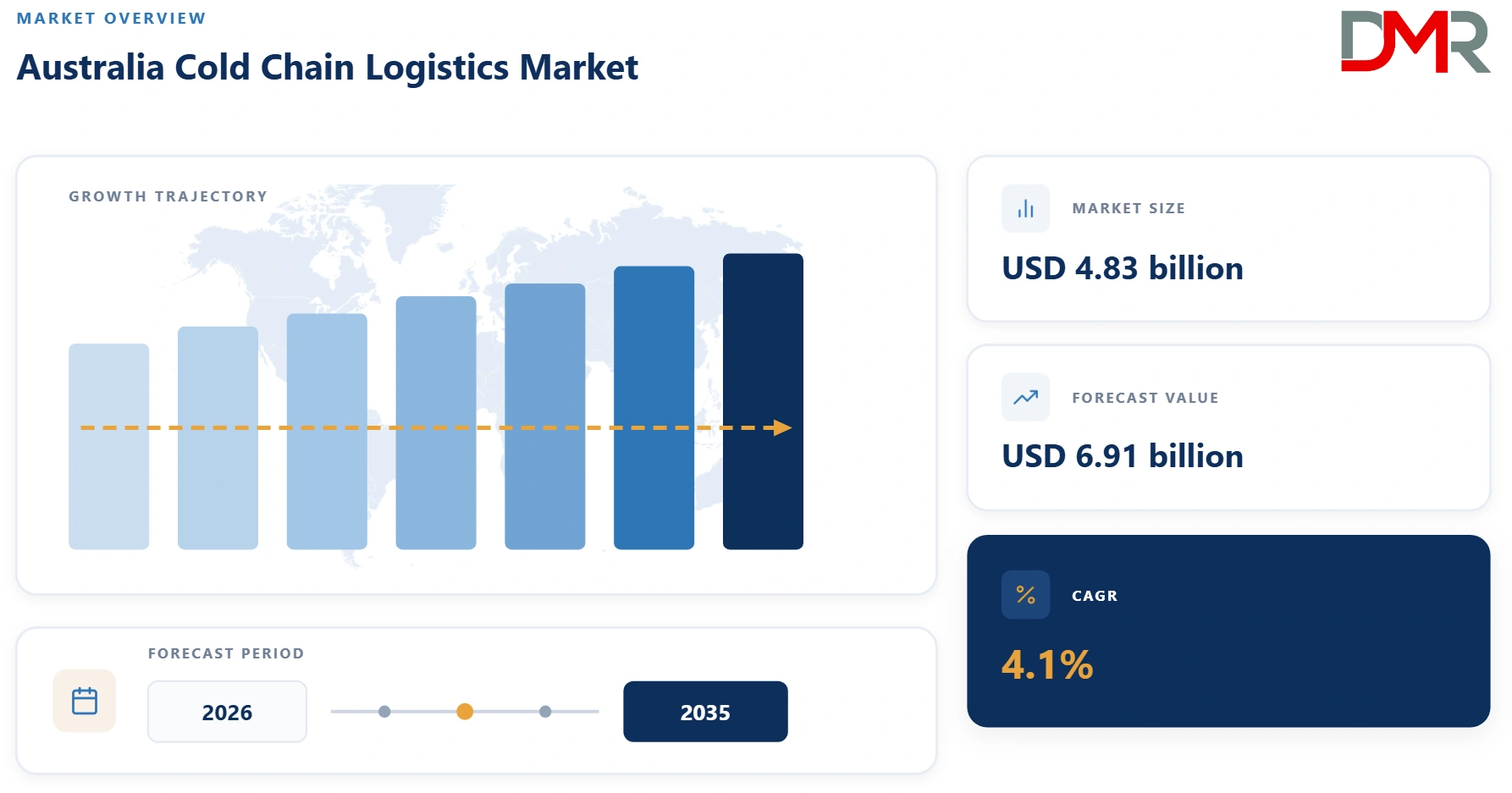
- Australia Cold Chain Logistics Market Size in 2026: USD 4.83 billion
- Australia Cold Chain Logistics Market Size in 2035: USD 6.91 billion
- Australia CAGR from 2026 to 2035: 4.1%
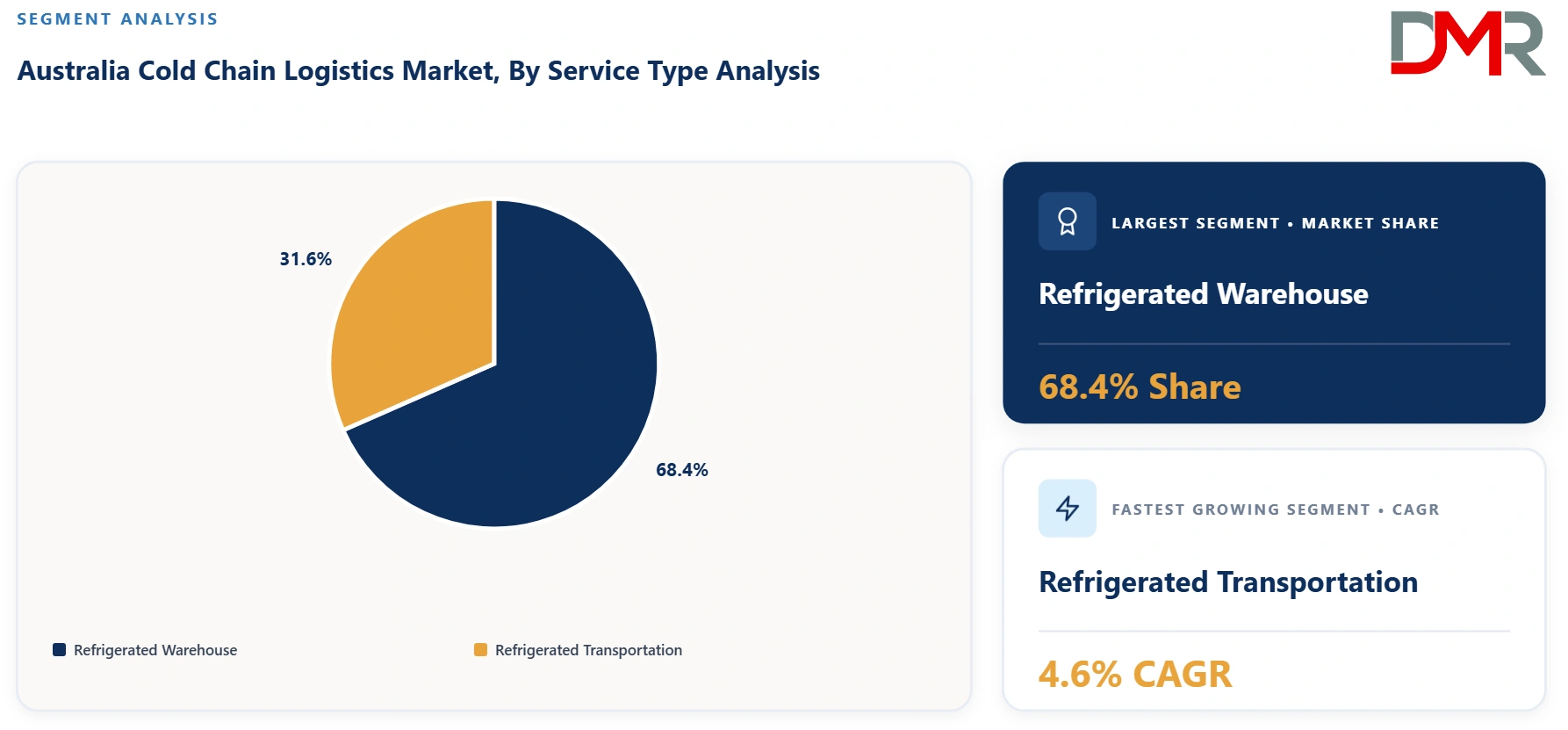
- Refrigerated Warehouse is the leading service type segment in 2026: 68.4%
- Meat is the leading application segment in 2026: 27.6%
- Chilled is the leading temperature type segment in 2026: 57.8%
- Dry Ice is the leading technology segment in 2026: 34.2%
What is the Australia Cold Chain Logistics Market and Its Market Size?
The Australia Cold Chain Logistics Market is projected to reach USD 4.83 billion in 2026 and grow at a compound annual growth rate of 4.1% until 2035 to reach a value of USD 6.91 billion.
ℹ
To learn more about this report –
Download Your Free Sample Report Here
Cold chain logistics encompasses temperature-controlled warehousing, transportation, packaging, handling, monitoring, and distribution services that preserve perishable and temperature-sensitive products. Australia’s expansive geography, strong meat and seafood exports, organized grocery sector, pharmaceutical distribution requirements, and demand for frozen foods support market development. Investments in automated warehouses, refrigerated vehicles, real-time temperature monitoring, renewable-powered refrigeration, and efficient last-mile delivery are improving reliability while reducing spoilage, energy consumption, and operating costs.
Use Cases
- Meat Storage and Distribution: Cold chain logistics preserves beef, lamb, pork, and poultry from processing facilities through warehouses, retailers, export terminals, and foodservice establishments. Temperature-controlled storage, blast freezing, refrigerated transportation, and continuous monitoring help prevent microbial growth, maintain product quality, extend shelf life, and satisfy Australia’s domestic food safety requirements and demanding international meat export protocols.
- Seafood Export Logistics: Australian seafood producers depend on chilled and frozen logistics to distribute salmon, tuna, prawns, lobster, abalone, and other premium products. Rapid chilling, insulated packaging, dry ice, reefer containers, airport handling, and real-time temperature visibility protect freshness during long-distance transit, minimize deterioration, and support reliable delivery to high-value markets across Asia, Europe, and North America.
- Fresh Produce and Dairy Distribution: Fruit, vegetables, milk, cheese, yogurt, butter, and other perishable products require carefully managed temperature and humidity throughout storage and transportation. Pre-cooling, refrigerated warehouses, multi-temperature vehicles, gel packs, and route optimization help producers and retailers maintain freshness, reduce waste, extend selling periods, and provide consistent product availability across metropolitan, regional, and remote Australian communities.
- Alternative Protein Fulfilment: Manufacturers of plant-based meat, dairy alternatives, cultured products, and other emerging proteins use cold chains to protect product integrity and support retail expansion. Chilled storage, frozen distribution, insulated packaging, data loggers, and specialized last-mile services help brands maintain safety, texture, flavor, and shelf life while responding to growing demand from supermarkets, restaurants, and online customers.
Key Takeaways
- Market Size: The Australia Cold Chain Logistics Market is anticipated to be valued at USD 4.83 billion in 2026 and is forecast to reach USD 6.91 billion by 2035, expanding at a CAGR of 4.1%.
- Growth Outlook: Market expansion is supported by increasing demand for fresh and frozen foods, rising meat and seafood exports, online grocery purchasing, organized food retail, pharmaceutical distribution, urban population growth, stringent food safety requirements, and investments in automated storage, refrigerated fleets, route optimization, temperature sensors, and energy-efficient refrigeration systems.
- Primary Growth Drivers: Australia’s geographically dispersed population, long domestic transport distances, growing consumption of convenience foods, expanding export-oriented agriculture, and increasing requirements for traceability are stimulating cold chain investment. Australia wastes approximately 7.6 million tonnes of food annually, emphasizing the need for better storage, handling, transportation, and temperature visibility across perishable supply chains.
- By Service Type Analysis: Refrigerated Warehouse is projected to lead with a 68.4% share in 2026, supported by demand for large-scale frozen and chilled inventory management. Refrigerated Transportation is expected to grow faster as grocery delivery, regional distribution, export movements, and demand for integrated farm-to-retail temperature control increase.
- By Application Analysis: Meat is anticipated to dominate with a 27.6% share in 2026 because of Australia’s large livestock-processing sector, domestic consumption, and export activity. Alternative Protein is expected to register the fastest growth as plant-based products, specialized nutrition, and new protein categories gain retail and foodservice distribution.
- By Temperature Type Analysis: Chilled is projected to hold a 57.8% share in 2026, driven by fresh meat, seafood, dairy, fruit, vegetables, and short-shelf-life foods. Frozen logistics is expected to record faster growth as consumers purchase more frozen meals, processed meat, desserts, and products intended for long-distance distribution.
- By Technology Analysis: Dry Ice is expected to lead with a 34.2% share in 2026 due to its strong cooling capability and suitability for seafood, frozen products, and time-sensitive shipments. Liquid Nitrogen is projected to register the fastest growth, supported by ultra-low-temperature requirements, rapid freezing applications, premium food preservation, and specialized life-science logistics.
How AI and Generative AI Are Transforming the Australia Cold Chain Logistics Market
AI and generative AI are improving cold chain planning, temperature control, asset utilization, and risk management. Predictive algorithms analyze sensor, weather, traffic, equipment, and inventory data to identify refrigeration failures, optimize routes, and prevent spoilage. AI-enabled warehouse systems improve slotting, picking, energy usage, and workforce scheduling. Generative AI assists operators in preparing compliance documentation, analyzing temperature excursions, generating maintenance instructions, and simulating disruption scenarios. Computer vision also supports pallet inspection and inventory verification, creating more traceable, responsive, and cost-efficient refrigerated supply chains.
Key Drivers in the Australia Cold Chain Logistics Market
Growing Demand for Perishable Foods and Export Logistics
Australia’s substantial meat, seafood, dairy, fruit, and vegetable industries create sustained demand for temperature-controlled storage and transportation. Export products often travel long distances before reaching customers, making precise refrigeration, traceability, and reliable handling essential. Domestic demand is also increasing as supermarkets, foodservice operators, and households purchase more fresh, frozen, and convenience products. Online grocery platforms further require flexible fulfilment and refrigerated last-mile delivery. These conditions encourage logistics providers to expand warehouse capacity, reefer fleets, port connectivity, and digital monitoring systems capable of protecting product quality across complex national and international distribution networks.
Need to Reduce Food Waste and Strengthen Safety
Australia generates approximately 7.6 million tonnes of food waste annually, costing the economy more than AUD 36.6 billion, according to the Australian Department of Climate Change, Energy, the Environment and Water. Temperature excursions, inefficient handling, delayed delivery, and limited visibility contribute to avoidable losses. Food safety regulations also require potentially hazardous food to remain at 5°C or colder or 60°C or hotter, unless a validated alternative system is used. These safety and waste-reduction priorities are increasing investment in monitoring devices, warehouse automation, insulated packaging, efficient refrigeration, and integrated cold chain management.
Restraints in the Australia Cold Chain Logistics Market
High Energy, Infrastructure, and Operating Costs
Cold warehouses and refrigerated vehicles require considerable electricity, fuel, specialized equipment, insulation, backup power, and ongoing maintenance. Rising energy costs can significantly reduce operator margins, particularly for businesses managing frozen facilities that operate continuously. Automated warehouses and low-emission refrigeration technologies offer long-term savings but demand substantial upfront capital. Smaller providers may struggle to finance modern facilities, fleet replacement, or advanced monitoring platforms. Costs are further increased by Australia’s long delivery distances, low-density regional routes, driver shortages, and the need to maintain backup capacity during equipment failures, heatwaves, floods, bushfires, and power disruptions.
Operational Fragmentation and Temperature Excursion Risks
Cold chain performance depends on coordinated handling across producers, processors, warehouses, transport operators, ports, retailers, and last-mile providers. Differences in technology, temperature records, operating procedures, and data systems can create visibility gaps during product transfers. Door openings, loading delays, vehicle breakdowns, incorrect packaging, and improper handling can cause damaging temperature excursions. Fragmented regional coverage also makes delivery to remote Australian communities expensive and operationally difficult. Companies must invest in standardized processes, staff training, interoperable monitoring systems, and contingency planning, increasing costs while making consistent service quality challenging across large and complex distribution networks.
Growth Opportunities in the Australia Cold Chain Logistics Market
Automated and Energy-Efficient Cold Storage Development
High-bay automated warehouses offer opportunities to increase pallet density, reduce land requirements, improve inventory accuracy, and limit human exposure to low-temperature environments. Automated storage and retrieval systems, robotics, intelligent warehouse management software, and demand forecasting can improve throughput while lowering picking errors and energy loss. Providers can also integrate rooftop solar, battery storage, natural refrigerants, heat recovery, advanced insulation, and intelligent cooling controls. New facilities near ports, processing regions, and major population centers can address capacity gaps while helping food manufacturers and retailers satisfy efficiency, resilience, traceability, and emissions-reduction objectives.
Regional Networks and Specialized Last-Mile Services
Australia’s regional communities, agricultural production centers, and geographically dispersed population provide opportunities for decentralized cold storage, cross-docking, and shared-user distribution hubs. Modular facilities and smaller refrigerated vehicles can improve access without requiring large conventional warehouses in every location. Growth in meal kits, direct-to-consumer food brands, specialty seafood, premium meat, and online grocery services is also creating demand for temperature-controlled last-mile fulfilment. Providers that combine reusable insulated packaging, route optimization, real-time tracking, pickup points, and reverse logistics can establish differentiated service models for metropolitan, regional, and remote markets.
Trends in the Australia Cold Chain Logistics Market
Real-Time Monitoring and End-to-End Traceability
Operators are increasingly using IoT sensors, telematics, cloud platforms, RFID, GPS, and electronic data loggers to monitor product temperature, humidity, location, door activity, and equipment performance. Automated alerts allow managers to respond quickly to deviations before products become unsafe or unusable. Integrated records also simplify audits, insurance claims, export documentation, and customer reporting. As retailers and food manufacturers seek greater supply chain transparency, logistics providers are connecting warehouse, vehicle, packaging, and order data within centralized control towers, improving accountability and enabling more accurate performance measurement across temperature-controlled distribution networks.
Sustainable Refrigeration and Low-Emission Logistics
Cold chain businesses are adopting natural refrigerants, electric material-handling equipment, solar generation, improved building insulation, energy management platforms, and high-efficiency compressors to reduce operating costs and environmental impacts. Transport operators are evaluating electric vehicles, renewable diesel, alternative fuels, aerodynamic trailers, and optimized delivery routes. Reusable gel packs, recyclable insulated packaging, and phase-change materials are also gaining attention as companies seek alternatives to disposable packaging. Sustainability performance is becoming increasingly important in customer tenders, financing decisions, regulatory planning, corporate emissions reporting, and the design of new refrigerated warehouses and distribution networks.
Research Scope and Analysis
Australia Cold Chain Logistics Market includes refrigerated warehouse and refrigerated transportation services, applications cover seafood, meat, fruit and vegetable, dairy products, alternative protein and others, temperature types include frozen and chilled, technologies include dry ice, gel packs, eutectic plates, liquid nitrogen and quilts, the study evaluates demand, competition, innovation, regulation, investment, opportunities and forecasts through 2035.
ℹ
To learn more about this report –
Download Your Free Sample Report Here
By Service Type Analysis
Refrigerated Warehouse is expected to dominate the service type segment with a 68.4% market share in 2026, supported by demand for bulk inventory storage, freezing, cross-docking, and export consolidation. Refrigerated Transportation is projected to register the highest CAGR of approximately 4.6% through 2035 as online grocery delivery, regional distribution, and integrated temperature-controlled transport requirements expand across Australia.
By Application Analysis
Meat is anticipated to lead the application segment with a 27.6% share in 2026, reflecting Australia’s large beef, lamb, pork, and poultry supply chains. Alternative Protein is projected to record the highest CAGR of approximately 5.3% through 2035, supported by expanding plant-based product portfolios, growing retail availability, dietary diversification, and specialized chilled and frozen distribution requirements.
By Temperature Type Analysis
Chilled is projected to dominate the temperature type segment with a 57.8% share in 2026, supported by extensive movement of fresh meat, seafood, dairy products, fruit, and vegetables. Frozen is expected to register the highest CAGR of approximately 4.4% through 2035 due to increasing consumption of frozen meals, longer storage requirements, export activity, and demand for inventory resilience.
By Technology Analysis
Dry Ice is expected to lead the technology segment with a 34.2% share in 2026, driven by reliable cooling performance in frozen seafood, meat, and time-sensitive deliveries. Liquid Nitrogen is anticipated to achieve the highest CAGR of approximately 5.0% through 2035, supported by rapid freezing, ultra-low-temperature logistics, specialty food preservation, and increasing requirements for precise thermal control.
The Australia Cold Chain Logistics Market Report Is Segmented Based on the Following
By Service Type
- Refrigerated Warehouse
- Refrigerated Transportation
By Application
- Seafood
- Meat
- Fruit and Vegetable
- Dairy Products
- Alternative Protein
- Others
By Temperature Type
By Technology
- Dry Ice
- Gel Packs
- Eutectic Plates
- Liquid Nitrogen
- Quilts
Regulatory Landscape
Australia’s cold chain regulatory environment emphasizes food safety, product traceability, hygienic handling, and verifiable temperature control. Food Standards Australia New Zealand requires potentially hazardous food to be maintained at 5°C or colder or 60°C or hotter unless businesses can demonstrate an alternative safe process. State and territory authorities enforce food transport, storage, premises, and recordkeeping requirements, while export supply chains must satisfy commodity-specific controls and destination-country protocols. Compliance creates opportunities for monitoring systems, validated packaging, automated reporting, and audit-ready platforms. However, inconsistent processes, incomplete records, equipment failure, and temperature excursions can lead to rejected shipments, recalls, financial losses, penalties, and reputational damage.
Technology Analysis
Technology adoption is shifting Australia’s cold chain from reactive temperature management toward predictive, connected operations. IoT sensors, telematics, cloud-based warehouse systems, AI forecasting, automated storage and retrieval, robotics, and digital twins improve inventory control, route planning, energy efficiency, and equipment maintenance. Phase-change materials, dry ice systems, eutectic plates, liquid nitrogen, and thermal quilts support different duration and temperature requirements. Opportunities are strongest for interoperable platforms that connect warehouses, vehicles, packaging, and customer systems. Cybersecurity exposure, legacy integration, data ownership, sensor calibration, connectivity gaps, and implementation costs remain important risks, particularly for smaller operators and remote distribution networks.
Competitive Landscape
The Australia Cold Chain Logistics Market is moderately concentrated, with multinational warehouse operators competing alongside national transport companies and specialized regional providers. Lineage, Americold, NewCold, Linfox, Lindsay Australia, and Toll Group strengthen their positions through capacity expansion, automation, customer contracts, acquisitions, and integrated warehousing and transport services. Competition is increasingly based on geographic coverage, energy efficiency, temperature visibility, food safety compliance, warehouse automation, and last-mile capabilities. Regional specialists remain important because local relationships, flexible fleets, and route knowledge help serve agricultural production areas and remote communities.
Some of the Prominent Players in the Australia Cold Chain Logistics Market Are
- Lineage Logistics
- Americold Realty Trust
- NewCold Advanced Cold Logistics
- Linfox
- Lindsay Australia
- Toll Group
- Rand Refrigerated Logistics
- AHG Refrigerated Logistics
- SCG Logistics
- DHL Supply Chain
- Karras Cold Logistics
- Oxford Cold Storage
- PFD Food Services
- QMC Logistics
- Laverton Cold Storage
- Pakwal Business Logistics
- Cold Xpress
- SRT Logistics
- Booth Transport
- Ron Finemore Transport
- GKR Transport
- Centurion
- Followmont Transport
- Border Express
- Mainfreight Australia
- Kuehne and Nagel
- CEVA Logistics
- DB Schenker
- DSV
- Maersk
- DP World Australia
- SCT Logistics
- Team Global Express
- ANC Delivers
- AirRoad
- BCR Australia
- ICEE Containers
- CoolPac
- Thermo King Australia
- Carrier Transicold Australia
- Other Key Players
Recent Developments
- December 2025: Americold announced a partnership with Australian convenience retailer On The Run to provide temperature-controlled storage and distribution services supporting the retailer’s national expansion and broader cold chain requirements.
- June 2025: NewCold announced an expansion of its Australian operations through a new Sydney automated facility designed to add approximately 100,000 frozen pallet positions, strengthening large-scale cold storage and distribution capacity.
- February 2025: Americold reported a customer-supported expansion program, including investment in temperature-controlled infrastructure across its wider Asia-Pacific network, reinforcing its focus on capacity, automation, customer integration, and warehouse productivity.
Report Details
| Report Characteristics |
| Market Size (2026) |
USD 4.83 Bn/Mn |
| Forecast Value (2035) |
USD 6.91 Bn/Mn |
| CAGR (2026–2035) |
4.1% |
| Historical Data |
2021 – 2025 |
| Forecast Data |
2026 – 2035 |
| Base Year |
2025 |
| Segments Covered |
By Service Type, By Application, By Temperature Type, By Technology |
Frequently Asked Questions
How big is the Australia Cold Chain Logistics Market?
▾ The Australia Cold Chain Logistics Market is projected to reach USD 4.83 billion in 2026 and USD 6.91 billion by 2035.
What is the CAGR of the Australia Cold Chain Logistics Market from 2026 to 2035?
▾ The market is expected to expand at a compound annual growth rate of 4.1% from 2026 to 2035.
What factors are driving the growth of the Australia Cold Chain Logistics Market?
▾ Growth is driven by rising consumption of perishable and frozen foods, meat and seafood exports, online grocery delivery, long domestic distribution distances, stringent food safety requirements, warehouse automation, and increasing investment in refrigerated transport and temperature-monitoring technologies.
What are the major trends in the Australia Cold Chain Logistics Market?
▾ Major trends include automated high-bay warehouses, real-time temperature monitoring, AI-based route optimization, predictive equipment maintenance, natural refrigerants, renewable energy integration, low-emission refrigerated vehicles, reusable thermal packaging, and end-to-end product traceability.
Who are the key players in the Australia Cold Chain Logistics Market?
▾ Key players include Lineage Logistics, Americold Realty Trust, NewCold, Linfox, Lindsay Australia, Toll Group, Rand Refrigerated Logistics, DHL Supply Chain, Karras Cold Logistics, Oxford Cold Storage, and PFD Food Services.
How is the Australia Cold Chain Logistics Market segmented?
▾ The market is segmented by service type into refrigerated warehouse and refrigerated transportation, by application into seafood, meat, fruit and vegetable, dairy products, alternative protein, and others, by temperature type into frozen and chilled, and by technology into dry ice, gel packs, eutectic plates, liquid nitrogen, and quilts.