Australia Dairy Ingredients Market Snapshot
- Australia Dairy Ingredients Market Size in 2026: USD 1.7 Billion
- Australia Dairy Ingredients Market Size in 2035: USD 2.5 Billion
- Australia CAGR from 2026 to 2035: 4.4%
- Milk Powder is the leading Product segment in 2026: 38.6%
- Milk is the leading Source segment in 2026: 71.8%
- Dry is the leading Form segment in 2026: 82.6%
- Dairy Products is the leading Application segment in 2026: 32.4%
- Victoria is the leading Australian region in 2026: 63.3%
What is the Australia Dairy Ingredients Market and its Market Size?
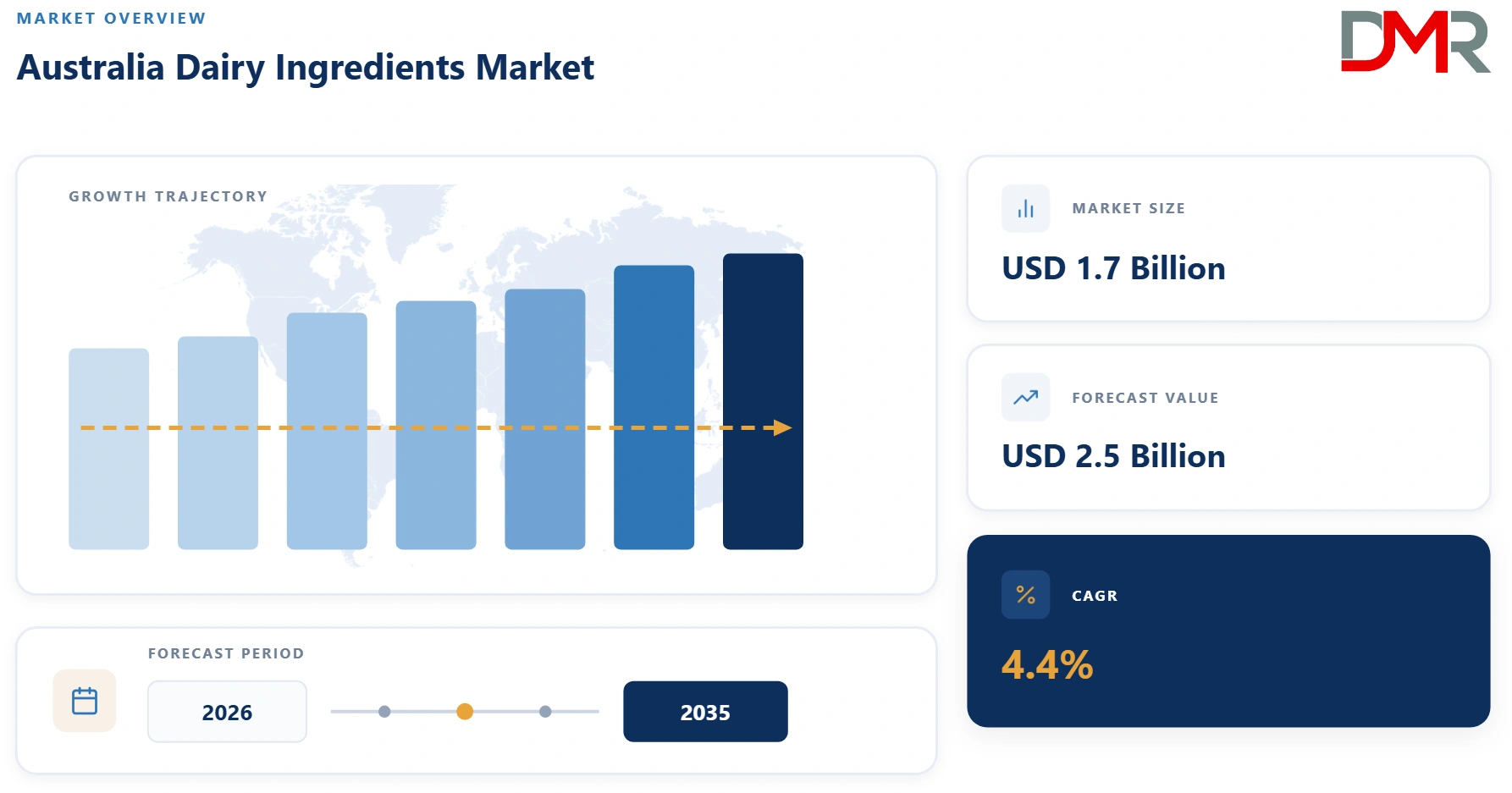
The Australia Dairy Ingredients Market is projected to reach USD 1.7 billion in 2026 and grow at a compound annual growth rate of 4.4% from there until 2035 to reach a value of USD 2.5 billion.
ℹ
To learn more about this report –
Download Your Free Sample Report Here
Australia’s dairy ingredients market encompasses milk powders, concentrated proteins, whey fractions, lactose derivatives, caseinates, and related functional materials supplied to food and nutrition manufacturers. The industry benefits from established milk processing capabilities, strong quality systems, pasture-based dairy production, and proximity to Asian customers. Growth is increasingly value-driven, with suppliers moving beyond commodity powders toward specialised proteins, clean-label functionality, infant nutrition inputs, and sports or clinical formulations while managing constrained milk supply, climate volatility, energy costs, and international price competition pressures.
Use Cases
- Food manufacturers use milk powders, lactose, caseinates, whey proteins, and milk protein concentrates to improve texture, browning, emulsification, moisture retention, flavour, and nutritional density in bakery, confectionery, beverages, sauces, and prepared foods. These ingredients provide consistent functionality, longer shelf life, and scalable formulation performance while helping processors standardise output despite seasonal variation in fresh milk composition and availability across Australia.
- Infant formula and medical nutrition producers apply demineralised whey, lactose, milk protein isolates, casein, and specialised fractions to deliver controlled protein quality, digestibility, mineral balance, and energy density. Australian ingredient suppliers can differentiate through traceable milk origin, stringent food safety, tailored solubility, and export-ready documentation, supporting formulations for early life nutrition, healthy ageing, hospital feeding, and recovery-focused clinical products worldwide.
- Sports nutrition brands incorporate whey protein concentrates, isolates, milk protein concentrates, micellar casein, and milk minerals into powders, bars, gels, and ready-to-drink products. The ingredients support muscle recovery, satiety, sustained amino acid delivery, and convenient high-protein positioning. Demand also encourages cleaner labels, improved taste masking, heat stability, and formulations designed for active consumers, older adults, and weight-management users across Australia.
Key Takeaways
Market Size: The Australia Dairy Ingredients Market is anticipated to be valued at USD 1.7 billion in 2026 and is forecast to reach USD 2.5 billion by 2035, expanding at a stated CAGR of 4.4%.
Growth Rate and Outlook: Market expansion is supported by growing high-protein food consumption, sports nutrition demand, infant formula manufacturing, rising use of functional dairy proteins, export opportunities across Asia, clean-label formulation requirements, and investments in value-added milk processing.
Primary Growth Drivers: Increasing demand for convenient nutrition, muscle health products, protein-enriched foods, clinical formulations, specialised infant nutrition, clean-label ingredients, improved food texture, and traceable Australian dairy inputs is encouraging manufacturers to increase the use of milk and whey-derived ingredients.
By Product Analysis: Milk Powder is projected to lead the product segment with approximately 38.6% of revenue in 2026 due to its shelf stability, transportation efficiency, export demand, and broad use in dairy products, bakery formulations, confectionery, and infant nutrition.
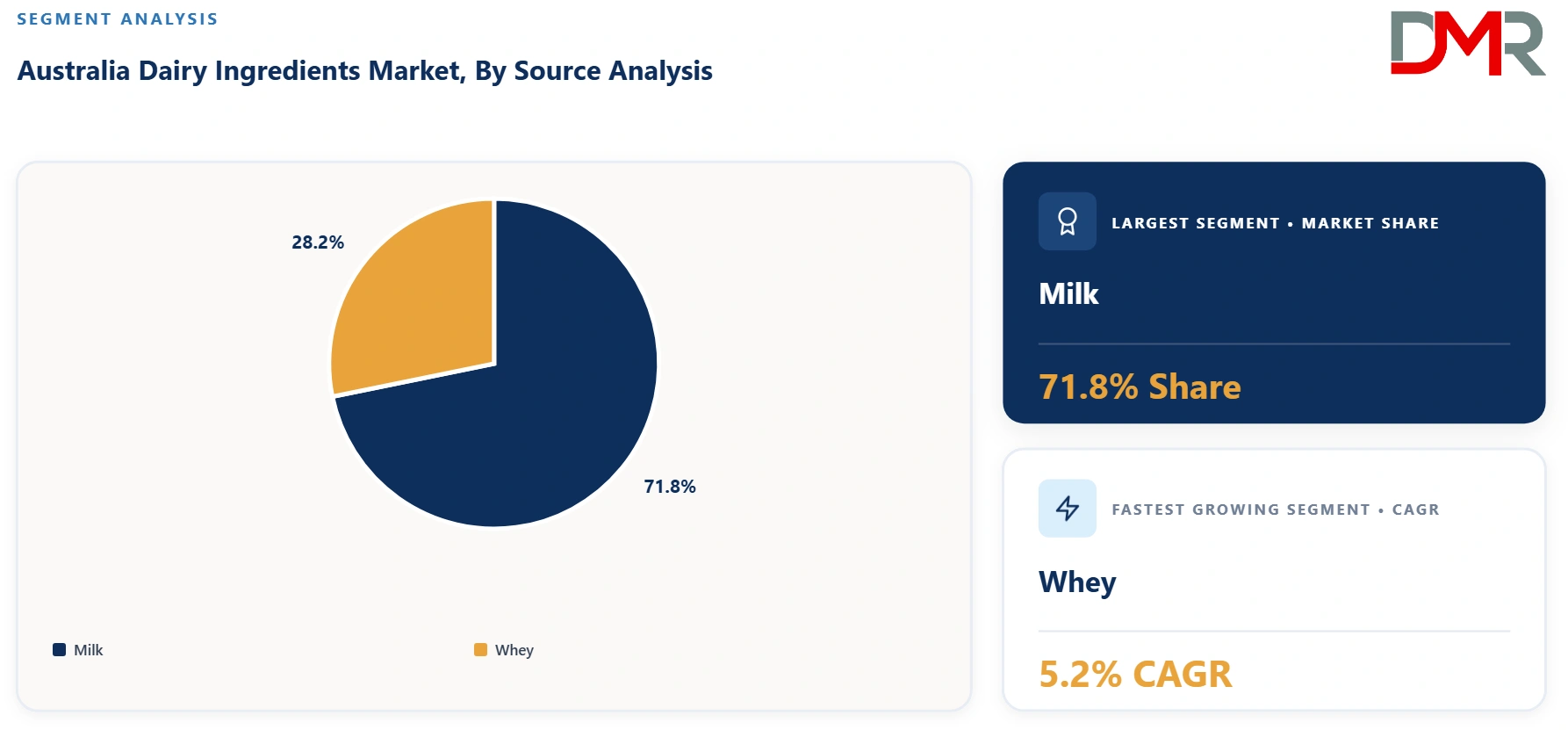
By Source Analysis: Milk is expected to dominate the source segment with approximately 71.8% of the market in 2026. Its leadership is supported by the extensive use of skim milk powder, whole milk powder, milk protein concentrates, caseinates, and milk-derived nutritional fractions.
By Form Analysis: Dry ingredients are anticipated to account for approximately 82.6% of market revenue in 2026. Their long shelf life, concentrated functionality, lower transportation costs, storage efficiency, and compatibility with industrial blending systems support adoption.
By Application Analysis: Dairy Products are projected to lead applications with approximately 32.4% of revenue in 2026, supported by the use of milk solids, whey proteins, lactose, and caseinates in yoghurt, cheese, ice cream, beverages, recombined milk, and cultured products.
How AI and Gen AI are Transforming the Australian Dairy Ingredients Market?
AI and generative AI are improving demand forecasting, milk procurement, formulation design, process control, quality assurance, and predictive maintenance across Australian dairy ingredient operations. Machine learning can connect weather, herd, milk-solids, energy, and customer-order data to optimise plant scheduling and product yields. Vision systems strengthen contamination and packaging inspection, while digital twins support spray-drying and membrane-filtration efficiency. Generative AI also accelerates technical documentation, customer formulation support, and regulatory review. Adoption depends on validated data, cybersecurity, model governance, and human oversight, particularly for infant nutrition and regulated clinical product manufacturing.
Key Drivers in the Australia Dairy Ingredients Market
Rising Demand for Protein-Enriched and Functional Nutrition
Australian consumers are increasingly purchasing high-protein yoghurt, beverages, bars, powders, and convenient nutritional products. Dairy Australia reported that supermarket milk sales increased 1.1%, cheese sales rose 3.8%, and yoghurt sales expanded 8.4% during the latest measured annual period, with Greek yoghurt growing 15.0%. This consumption pattern supports greater use of whey protein, milk protein concentrates, casein, and specialised mineral fractions. Demand is also broadening beyond athletes toward older consumers, weight-management users, and households seeking satiating foods. Manufacturers are responding with higher protein claims, improved flavour, lower sugar, convenient formats, and products positioned around muscle, digestive, and general wellness benefits.
Established Export Infrastructure and Asian Market Access
Australia’s proximity to Asian markets, recognised food-safety systems, and established dairy trade relationships support ingredient exports. During the year ended June 2026, Australia exported 151,512 tonnes of skim milk powder, 53,458 tonnes of whole milk powder, and 24,124 tonnes of whey products. Export values included approximately A$739.8 million for skim milk powder, A$665.1 million for whole milk powder, and A$275.7 million for whey products. These flows demonstrate the importance of export demand for ingredient plants. Suppliers can build stronger positions through traceability, customised protein specifications, application support, halal certification, dependable documentation, and formulations tailored to infant, sports, bakery, and dairy customers.
Restraints in the Australia Dairy Ingredients Market
Contracting Milk Supply and Climate-Related Production Volatility
Limited milk availability can restrict ingredient plant utilisation and increase competition among processors. Dairy Australia forecast national milk production to decline approximately 2% to around 8.149 billion litres during 2025-2026. Production was already down 2.3% from July through October 2025 compared with the corresponding period, reflecting dry conditions, expensive feed, water constraints, herd reductions, and farm exits. Ingredient facilities require dependable volumes to operate dryers, evaporators, and membrane systems efficiently. Seasonal shortages can raise procurement costs, reduce production runs, and prioritise higher-margin consumer products over commodity ingredients. Climate uncertainty therefore remains a material risk for capacity planning, export commitments, and long-term investment decisions.
High Processing Costs and International Price Competition
Dairy ingredient manufacturing requires substantial energy, water, specialised equipment, quality testing, and skilled labour. Spray drying, evaporation, filtration, cold storage, and wastewater treatment can create significant operating expenses, particularly when electricity and gas prices are volatile. Australian suppliers also compete against larger production platforms in New Zealand, the European Union, and the United States. These regions can influence international powder and protein prices through changes in milk supply, inventory, exchange rates, and trade policy. When Australian products carry a price premium, customers may shift toward imported powders or alternative proteins. Processors must therefore balance product differentiation with production efficiency, reliable customer service, and disciplined milk procurement.
Growth Opportunities in the Australia Dairy Ingredients Market
Expansion of High-Value Protein and Bioactive Ingredients
Strong opportunities exist in milk protein isolates, whey protein isolates, micellar casein, lactoferrin, milk fat globule membrane, hydrolysed proteins, and customised mineral concentrates. These products command greater value than conventional powders and address sports nutrition, healthy ageing, medical foods, infant formula, and weight-management applications. Australia is identified as the world’s third-largest sports nutrition market, creating a supportive environment for advanced performance ingredients. Local processors can use membrane filtration, chromatography, fractionation, and application laboratories to move further into specialised nutrition. Partnerships with international technology owners and ingredient developers can accelerate product availability while allowing Australian suppliers to differentiate through traceability, pasture-based sourcing, food safety, and regional customer support.
Customised Ingredients for Asian Food and Nutrition Markets
Approximately 85% of Australian dairy exports went to Asia in 2024-2025, while Greater China accounted for about 22% of dairy export volume. These established trade routes create opportunities for customised milk powders, protein systems, infant nutrition inputs, bakery ingredients, and beverage-ready formulations. Australian manufacturers can target customers requiring specific protein levels, heat stability, dispersibility, mineral composition, halal certification, or clean-label positioning. Opportunities also exist in Indonesia, Japan, Malaysia, Singapore, Thailand, and other regional markets where urbanisation and convenience-food consumption are supporting nutritional product development. Diversifying destinations and offering customer-specific specifications can reduce dependence on commodity pricing and strengthen long-term business relationships.
Trends in the Australia Dairy Ingredients Market
Shift from Commodity Powders to Specialised Nutrition Systems
Manufacturers are gradually increasing their focus on concentrated proteins, bioactive components, high-solubility powders, and application-specific blends. Conventional skim and whole milk powders remain important, but margin opportunities are increasingly connected to whey protein concentrates, milk protein isolates, lactoferrin, casein fractions, and mineral-rich ingredients. Suppliers are developing products that address texture, fortification, satiety, healthy ageing, muscle recovery, and early-life nutrition. This transition requires application laboratories, technical sales teams, validated nutritional evidence, and closer collaboration with food manufacturers. Companies capable of offering both ingredients and formulation support can differentiate themselves from commodity suppliers and build stronger relationships with premium nutrition, beverage, dairy, bakery, and clinical customers.
Circular Processing and Greater Byproduct Utilisation
Processors are increasing the recovery of valuable components from whey, permeate, buttermilk, and other dairy streams that were historically treated as low-value byproducts. Membrane filtration and separation technologies allow manufacturers to recover proteins, lactose, minerals, and functional fractions while reducing waste. Whey generated during cheese production can be converted into concentrates, isolates, permeates, and nutritional ingredients for sports foods, infant formula, bakery applications, and animal nutrition. Water recovery, renewable energy, heat integration, and waste reduction are also becoming important plant investment priorities. These initiatives can improve ingredient yield, diversify processor revenue, reduce environmental impact, and support sustainability expectations from multinational food and nutrition customers.
Research Scope and Analysis
The Australian dairy ingredients market covers milk powder, milk protein concentrates and isolates, whey ingredients, lactose derivatives, casein and caseinates, other products, milk and whey sources, dry and liquid forms, bakery and confectionery, dairy products, infant milk formula, sports and clinical nutrition, other food, beverage and nutritional applications throughout Australia over the 2026 to 2035 forecast period.
ℹ
To learn more about this report –
Download Your Free Sample Report Here
By Product Analysis
Milk Powder is projected to lead the product segment with approximately 38.6% of revenue in 2026, supported by its extensive use, long shelf life, export suitability, and processing flexibility. Milk Protein Concentrates and Milk Protein Isolates are expected to record the fastest growth at a CAGR of approximately 4.8% from 2026 to 2035. Growth is supported by high-protein beverages, sports nutrition, healthy ageing products, clinical formulations, and functional foods.
By Source Analysis
Milk is expected to dominate the source segment with approximately 71.8% of market revenue in 2026 due to its use in powders, protein concentrates, isolates, lactose, casein, and caseinates. Whey is projected to record the fastest CAGR of approximately 5.5% between 2026 and 2035. Expansion is supported by improved whey valorisation, sports nutrition demand, protein fortification, and the growing commercial use of cheese-processing byproducts.
By Form Analysis
Dry ingredients are anticipated to lead the form segment with approximately 82.6% of revenue in 2026, supported by extended shelf life, storage efficiency, concentrated functionality, and export suitability. Liquid ingredients are forecast to grow at the fastest CAGR of approximately 5.2% from 2026 to 2035. Growth will be supported by ready-to-drink nutrition, fresh dairy processing, liquid protein systems, and reduced reconstitution requirements.
By Application Analysis
Dairy Products are projected to dominate applications with approximately 32.4% of market revenue in 2026 due to extensive use in yoghurt, cheese, beverages, ice cream, and recombined dairy products. Sports and Clinical Nutrition is expected to record the fastest CAGR of approximately 7.9% through 2035. Demand is supported by protein supplementation, healthy ageing, muscle recovery, weight management, and specialised medical nutrition formulations.
The Australia Dairy Ingredients Market Report is Segmented Based on the Following
By Product
- Milk Powder
- Milk Protein Concentrates and Milk Protein Isolates
- Whey Ingredients
- Lactose and Derivatives
- Casein and Caseinates
- Others
By Source
By Form
By Application
- Bakery and Confectionery
- Dairy Products
- Infant Milk Formula
- Sports and Clinical Nutrition
- Others
Export Import Analysis
Australia’s dairy ingredient trade is shaped by a relatively small milk pool, established Asian relationships, and exposure to global commodity pricing. In the year ended June 2026, Australia exported 151,512 tonnes of skim milk powder, 53,458 tonnes of whole milk powder, and 24,124 tonnes of whey products. Whey export value rose 10.6% despite a 3.9% volume decline, indicating firmer value realisation. Opportunities lie in higher-value proteins, customised powders, infant nutrition inputs, and traceable formulations for Asian buyers. Risks include exchange-rate volatility, freight disruption, imported competition, seasonal production weakness, and changing destination-country registration rules. Export diversification and differentiated specifications can protect margins and plant utilisation while supporting resilient long-term customer relationships.
Technology Analysis
Australian processors are using membrane filtration, fractionation, evaporation, spray drying, agglomeration, advanced heat treatment, and automated quality control to increase protein concentration, solubility, yield, and consistency. Digital sensors and inline analytics help control moisture, microbiology, fouling, energy consumption, and powder functionality. Technology opportunities are strongest in milk protein isolates, whey protein concentrates, lactoferrin, bioactive fractions, instantised powders, and application-specific blends. However, upgrades require substantial capital, dependable milk volumes, skilled operators, and validated food-safety systems. Plants also face energy and water constraints. Modular processing, renewable heat, water recovery, predictive maintenance, and digital twins can reduce operating risk while supporting flexible, traceable, higher-value production and faster customer-driven product development across sites.
Competitive Landscape
The Australia dairy ingredients market combines domestic processors, specialist regional manufacturers, multinational ingredient companies, and import-distribution networks. Saputo Dairy Australia, Lactalis-Mainland Dairy, Bega Group, and Burra Foods compete through milk access, processing scale, export channels, and product breadth. Global specialists such as Arla Foods Ingredients, FrieslandCampina Ingredients, Kerry, Glanbia, and Ingredia strengthen competition in premium proteins and nutrition systems. Differentiation increasingly depends on traceability, application support, solubility, protein purity, food-safety credentials, sustainability, and customer-specific formulation. Consolidation and distribution partnerships are expanding access to high-value ingredient portfolios.
Some of the Prominent Players in the Australia Dairy Ingredients Market Are
- Saputo Dairy Australia Pty Ltd
- Lactalis Australia Pty Ltd
- Lactalis-Mainland Dairy
- Bega Cheese Limited
- Tatura Milk Industries Limited
- Burra Foods Australia Pty Ltd
- Australian Consolidated Milk Pty Ltd
- Noumi Limited
- Bulla Dairy Foods
- Real Dairy Australia Pty Ltd
- Maxum Foods Pty Ltd
- Alchemy Agencies Pty Ltd
- Fonterra Co-operative Group Limited
- NZMP
- Arla Foods Ingredients Group P/S
- FrieslandCampina Ingredients
- Kerry Group plc
- Glanbia plc
- Ingredia SA
- Lactalis Ingredients
- Agropur Cooperative
- Hilmar Cheese Company Inc.
- Leprino Foods Company
- Milk Specialties Global
- Proliant Dairy Ingredients
- Tatua Co-operative Dairy Company Limited
- Open Country Dairy Limited
- Westland Milk Products
- Synlait Milk Limited
- Danone S.A.
- The a2 Milk Company Limited
- DMK Deutsches Milchkontor GmbH
- MEGGLE Group GmbH
- MILEI GmbH
- Armor Protéines
- Euroserum
- Dairygold Food Ingredients
- Carbery Group
- Hoogwegt Group
- Barentz Australia Pty Ltd
- Other Key Players
Recent Developments
- June 2026: Danone entered into agreements to acquire Australia-based MADE Group and the remaining 49% interest in its fresh dairy joint venture with Saputo Dairy Australia. The transactions strengthen Danone’s Australian exposure to high-protein beverages, functional yoghurt, gut-health products, and healthy nutrition.
- March 2026: Fonterra completed the sale of Mainland Group, including its Oceania operations, to Lactalis. The transaction transferred an established dairy manufacturing, foodservice, consumer, and associated ingredients platform to Lactalis, expanding its operational position across Australia and other regional markets.
- May 2025: Arla Foods Ingredients entered a distribution partnership with Alchemy Agencies for Australia, New Zealand, and the Pacific Islands. The agreement covers whey protein isolate, micellar casein isolate, milk mineral concentrate, milk fat globule membrane, and functional whey and milk protein ingredients for performance nutrition applications.
Report Details
| Report Characteristics |
| Market Size (2026) |
USD 1.7 Bn |
| Forecast Value (2035) |
USD 2.5 Bn |
| CAGR (2026–2035) |
4.4% |
| Historical Data |
2021 – 2025 |
| Forecast Data |
2026 – 2035 |
| Base Year |
2025 |
| Segments Covered |
By Product, By Source, By Form, By Application |
Frequently Asked Questions
How big is the Australia Dairy Ingredients Market?
▾ The Australia Dairy Ingredients Market is projected to be valued at USD 1.7 billion in 2026 and reach USD 2.5 billion by 2035.
What is the CAGR of the Australia Dairy Ingredients Market from 2026 to 2035?
▾ The Australia Dairy Ingredients Market is stated to expand at a CAGR of 4.4% during the forecast period from 2026 to 2035.
What factors are driving the growth of the Australia Dairy Ingredients Market?
▾ Growth is driven by high-protein nutrition, functional foods, sports and clinical nutrition, infant formula production, Asian export demand, improved whey utilisation, clean-label formulations, and investment in specialised dairy proteins.
What are the major trends in the Australia Dairy Ingredients Market?
▾ Major trends include movement toward specialised proteins, whey valorisation, high-protein beverages, clean-label ingredients, customised formulations, membrane filtration, digital manufacturing, traceability, circular processing, and sustainable energy and water management.
Who are the key players in the Australia Dairy Ingredients Market?
▾ Key players include Saputo Dairy Australia, Lactalis Australia, Bega Group, Burra Foods, Australian Consolidated Milk, Fonterra, Arla Foods Ingredients, FrieslandCampina Ingredients, Kerry Group, Glanbia, Ingredia, and Maxum Foods.
How is the Australia Dairy Ingredients Market segmented?
▾ The market is segmented by Product into milk powder, milk proteins, whey ingredients, lactose derivatives, caseinates, and others, by Source into milk and whey, by Form into dry and liquid, and by Application into bakery, dairy products, infant formula, sports and clinical nutrition, and others.