Australia Data Center Cooling Market Snapshot
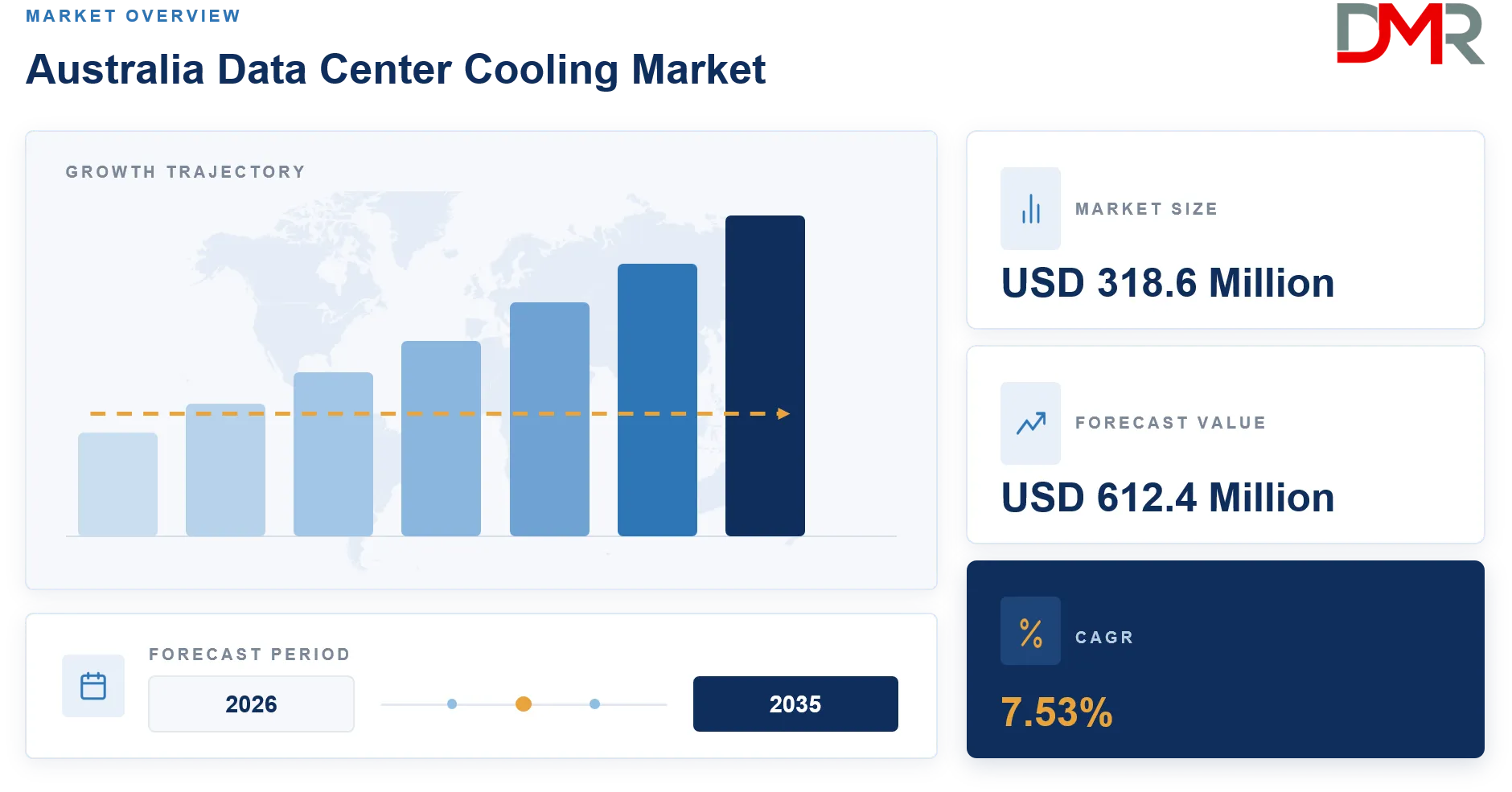
- Market Value: Australia data center cooling market is valued at USD 318.6 million in 2026 and is projected to reach USD 612.4 million by 2035.
- CAGR: Australia data center cooling market is expected to grow at a CAGR of 7.53% from 2026 to 2035.
- By Component Segment Analysis: Solution segment dominated with 93.1% share in 2026, supported by demand for air-conditioning systems, chilling units, cooling towers, control systems, economizers, and liquid cooling infrastructure.
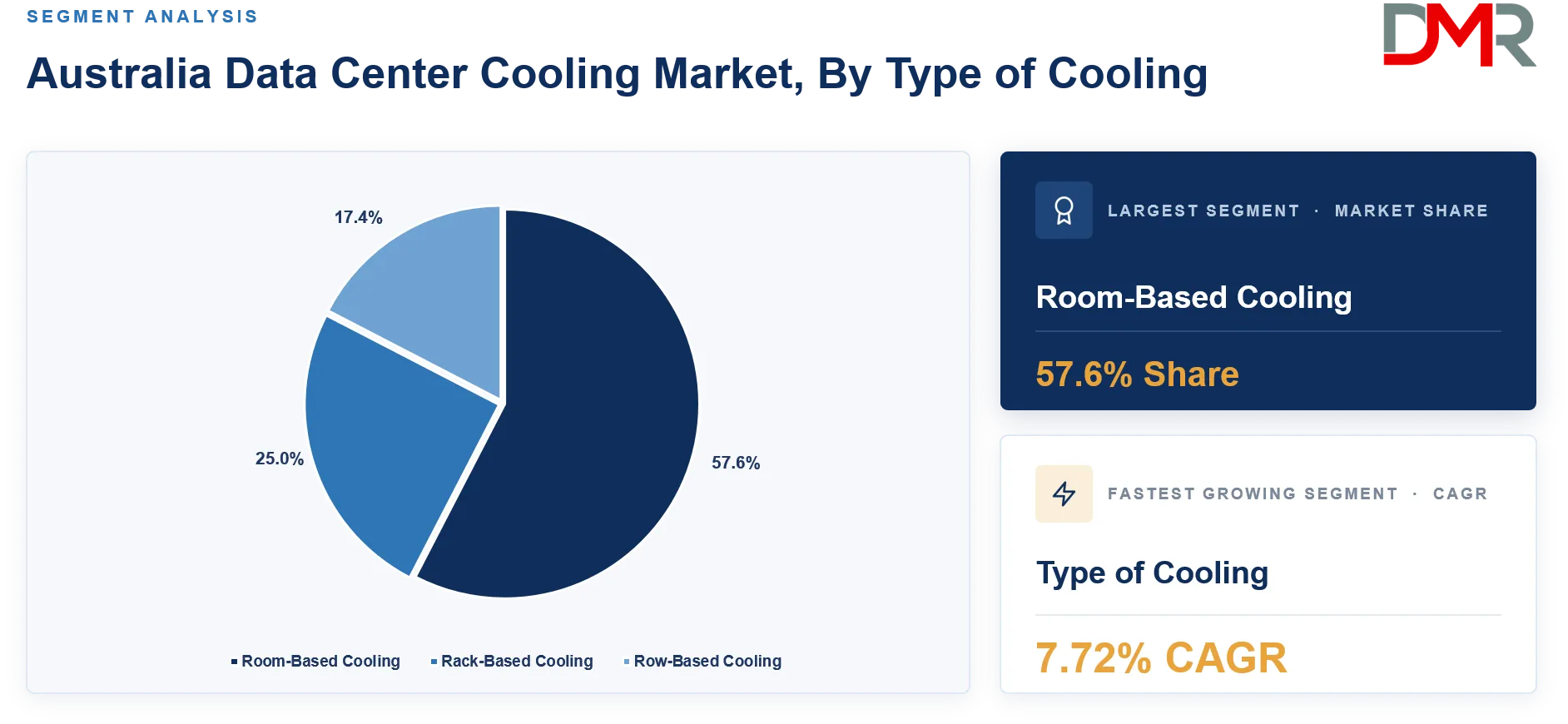
- By Type of Cooling Segment Analysis: Room-based cooling led the market with 57.6% share in 2026, while rack-based cooling is gaining importance for AI and high-density computing environments.
- By Cooling Technology Segment Analysis: Air-based cooling held 82.4% share in 2026, while liquid-based cooling is expected to gain market share through 2035 as rack power density increases.
- Major Players: Schneider Electric SE, Vertiv Group Co., STULZ GmbH, Asetek, and Submer Technologies.
What is the Australia Data Center Cooling Market and its Market Size?
The Australia Data Center Cooling Market size is projected to be valued at USD 318.6 million in 2026 and is projected to reach USD 612.4 million by 2035, expanding at a steady CAGR of 7.53% during the forecast period.
ℹ
To learn more about this report –
Download Your Free Sample Report Here
Data center cooling includes the equipment, controls, thermal management systems, and related services used to remove heat from servers, storage devices, networking hardware, and high-performance computing infrastructure. In Australia, the market includes conventional room cooling, row-based systems, rack-level cooling, precision air conditioning, chillers, cooling towers, economizers, direct liquid cooling, and immersion cooling. Demand is becoming more closely linked with hyperscale cloud capacity, artificial intelligence infrastructure, colocation expansion, power availability, sustainability targets, and the need to operate higher-density computing equipment without affecting uptime.
Use Cases
- Hyperscale Cloud Facilities: Large cloud campuses require scalable cooling systems that can support thousands of servers while maintaining stable temperatures across rapidly changing IT loads. Australian hyperscale projects increasingly combine central chilled-water systems, precision air management, advanced controls, and liquid-ready infrastructure to improve capacity planning and prepare facilities for higher-density cloud and AI workloads.
- AI and High-Performance Computing: GPU clusters used for generative AI, model training, analytics, and scientific computing produce far more concentrated heat than standard enterprise servers. Operators are therefore evaluating direct-to-chip liquid cooling, coolant distribution units, rear-door heat exchangers, and immersion cooling to manage dense racks while reducing dependence on high-volume airflow and traditional room cooling.
- Colocation Data Centers: Australian colocation providers must serve customers with different rack densities, uptime requirements, and cooling needs within the same facility. Flexible combinations of room, row, and rack cooling allow operators to support conventional enterprise workloads alongside high-density deployments while improving space use, energy performance, service reliability, and customer scalability.
- Financial and Government Infrastructure: Banks, public agencies, defence users, and regulated organizations depend on cooling systems to support continuous processing, secure digital services, and resilient IT operations. Precision cooling, redundant chilling capacity, environmental monitoring, and intelligent control systems help maintain stable operating conditions and reduce the risk of thermal events affecting mission-critical infrastructure.
- Edge and Remote Computing: Mining, energy, telecommunications, and industrial operators increasingly deploy computing infrastructure closer to regional operations. Compact cooling systems, modular thermal management, and remotely monitored equipment are important for edge facilities operating in locations with harsh temperatures, limited technical staffing, or restricted access to supporting infrastructure.
How AI/Gen AI is Transforming the Australia Data Center Cooling Market?
AI infrastructure is changing the thermal profile of Australian data centers. GPU-based servers place far more computing capacity into individual racks, increasing heat concentration and creating cooling requirements that conventional room-based air systems may struggle to manage efficiently at very high densities. This change is encouraging operators to redesign mechanical infrastructure around hybrid cooling architectures. Air cooling remains important for standard servers, networking equipment, and lower-density halls, while direct-to-chip liquid cooling, coolant distribution units, liquid loops, and rear-door heat exchangers are being introduced for AI clusters and high-performance computing zones.
Generative AI is also influencing investment decisions beyond cooling hardware. Operators increasingly need automated thermal monitoring, workload-aware controls, predictive maintenance, sensor networks, and real-time optimization of pumps, fans, chillers, and water temperatures. The shift supports demand for integrated cooling platforms rather than isolated mechanical products. AI-ready facilities must also balance thermal performance with power and water efficiency. This is especially relevant in Australia, where government expectations increasingly connect data center expansion with renewable energy, responsible water use, infrastructure resilience, skills development, and broader national economic value.
Key Drivers in the Australia Data Center Cooling Market
Rapid Expansion of Hyperscale, Cloud, and Colocation Capacity
Australia is experiencing strong investment in digital infrastructure as cloud providers, colocation operators, and large technology users expand computing capacity. Sydney and Melbourne remain major deployment locations, while new projects are also emerging in other states. Every additional megawatt of IT capacity requires dependable heat rejection, air management, chilled-water infrastructure, or liquid cooling. This creates direct demand for cooling equipment, installation, controls, commissioning, and long-term maintenance services.
Rising Rack Density from AI and Accelerated Computing
AI, machine learning, simulation, analytics, and high-performance computing are increasing heat loads at rack level. Dense GPU infrastructure can create thermal conditions that are difficult to address through conventional airflow alone. This is raising demand for direct liquid cooling, coolant distribution units, rear-door heat exchangers, and hybrid cooling architectures. Vertiv notes that liquid cooling can improve efficiency in high-density environments, while direct-to-chip systems can remove a large portion of heat close to the processor.
Restraints in the Australia Data Center Cooling Market
High Capital Cost and Retrofit Complexity
Advanced cooling systems require significant engineering, piping, heat rejection equipment, controls, commissioning, and facility modifications. Retrofitting an operating air-cooled data center for direct liquid cooling can also require coolant distribution units, secondary loops, leak detection, rack changes, and compatibility checks with server hardware. These requirements can delay adoption among smaller enterprise facilities and encourage operators to upgrade cooling infrastructure gradually rather than replace existing systems in a single investment cycle.
Power, Water, and Infrastructure Constraints
Cooling strategy is increasingly linked to electricity supply, grid capacity, water availability, and planning approvals. Large data centers can require substantial supporting energy infrastructure, while some cooling designs depend on water for heat rejection. Australia’s policy direction places growing attention on renewable generation, responsible water use, community impact, and infrastructure investment. These requirements can increase project complexity and encourage operators to select cooling architectures that minimize energy and water intensity over the facility lifecycle.
Growth Opportunities in the Australia Data Center Cooling Market
Expansion of Direct Liquid and Immersion Cooling
Liquid cooling represents one of the clearest opportunities as AI infrastructure increases server heat density. Direct-to-chip systems transfer heat from processors into a liquid loop, while immersion cooling places computing equipment in dielectric fluid. These technologies can reduce reliance on large volumes of conditioned air and enable higher-density deployments. Submer has previously deployed immersion cooling technology in Sydney, showing that the technology already has a practical base in the Australian market.
Modernization of Existing Data Center Cooling Infrastructure
Many operators will need to modernize existing facilities rather than build entirely new AI campuses. This creates opportunities for modular chillers, high-efficiency air-conditioning systems, intelligent controls, containment, rear-door cooling, coolant distribution units, and hybrid air-liquid systems. Retrofit solutions allow operators to preserve useful mechanical infrastructure while introducing liquid cooling in selected high-density zones. Vendors that combine design, installation, controls, commissioning, and maintenance can capture recurring demand throughout these upgrade cycles.
Trends in the Australia Data Center Cooling Market
Shift from Room Cooling Toward Hybrid and Rack-Level Architectures
Room-based cooling remains the largest type in 2026 with 57.6% share, reflecting the installed base of conventional data center halls. However, new high-density deployments are moving thermal management closer to the source of heat. Row cooling, rear-door heat exchangers, rack-level liquid loops, and direct-to-chip technologies provide targeted heat removal. The result is a hybrid market where operators retain air cooling for standard equipment and introduce liquid cooling for GPU clusters, AI servers, and other high-density workloads.
Greater Focus on Measurable Energy and Environmental Performance
Cooling selection is becoming more closely connected with PUE, operating cost, water consumption, and environmental performance. NABERS rates Australian data center infrastructure using operational energy performance and PUE, giving owners and customers a recognized efficiency benchmark. Australia has already demonstrated that efficient cooling design can materially improve facility performance; government guidance highlights a Melbourne facility that achieved a PUE of 1.3 using efficient design and free air-side cooling.
Research Scope and Analysis
The Australia Data Center Cooling Market is segmented based on Component, Type of Cooling, Cooling Technology, Data Center Size, Vertical, and regional markets. The study examines key segments and sub-segments based on their applications, adoption patterns, cooling density requirements, infrastructure investment, technology transition, and contribution to overall market growth.
By Component;
The solution segment dominated the Australia data center cooling market with 93.1% share in 2026. Its position reflects the capital-intensive nature of thermal infrastructure, including air-conditioning systems, chilling units, cooling towers, economizers, control systems, and liquid cooling equipment. Data center developers generally specify these systems during design and capacity expansion because cooling performance directly affects equipment reliability and usable IT density. Growth in AI infrastructure is broadening the solution mix further as facilities add coolant distribution, liquid loops, advanced heat exchangers, and controls alongside established air-based equipment.
ℹ
To learn more about this report –
Download Your Free Sample Report Here
By Type of Cooling;
Room-based cooling accounted for 57.6% of the market in 2026 and remains central to conventional enterprise, cloud, and colocation halls. Its installed base, broad equipment compatibility, and ability to support standard rack densities sustain demand. Rack-based cooling, however, is expected to expand faster as operators deploy GPU servers and dense computing clusters. Moving cooling closer to individual racks reduces the distance required to remove concentrated heat and allows high-density zones to operate alongside conventional equipment, creating opportunities for rear-door exchangers and direct liquid cooling.
By Cooling Technology;
Air-based cooling led with 82.4% share in 2026 because precision air-conditioning, chilled-air distribution, containment, and other mature technologies remain suitable for a large portion of installed IT infrastructure. Liquid-based cooling is positioned for stronger growth through 2035. Higher processor thermal design power and AI rack density are making direct liquid cooling increasingly relevant. The transition is expected to be gradual, with hybrid facilities using air systems for general IT loads while liquid systems serve high-performance computing and accelerated workloads.
By Vertical;
IT and telecom accounted for 29.6% share in 2026. Cloud platforms, managed hosting, telecommunications networks, internet services, colocation facilities, and digital applications generate continuous computing loads and require high levels of availability. The segment is also closely exposed to AI adoption and cloud capacity expansion, increasing demand for flexible thermal infrastructure. BFSI, government, healthcare, energy, education, and retail add further demand because digital service delivery and data-intensive applications require resilient computing environments.
The Australia Data Center Cooling Market Report is segmented on the basis of the following:
By Component
- Solution
- Control Systems
- Liquid Cooling Systems
- Economizer Systems
- Cooling Towers
- Chilling Units
- Air Conditioning
- Others
- Services
- Maintenance and Support
- Installation and Deployment
- Consulting
By Type of Cooling
- Rack-Based Cooling
- Row-Based Cooling
- Room-Based Cooling
By Cooling Technology
- Air-Based Cooling
- Liquid-Based Cooling
By Data Center Size
- Large Data Centers
- Enterprise Data Centers
- Mid-Sized Data Centers
By Vertical
- Healthcare
- Energy
- Retail
- Government and Defense
- Research and Educational Institutes
- IT and Telecom
- BFSI
- Others
Competitive Landscape
The Australia data center cooling market is competitive across precision air cooling, chilled-water systems, heat rejection, thermal controls, direct liquid cooling, immersion cooling, installation, and lifecycle services. Schneider Electric, Vertiv, STULZ, Asetek, Submer, Airedale, Coolcentric, Emerson Electric, and other suppliers compete through technology breadth, energy performance, local service capability, reliability, and integration with data center power infrastructure. Competition is shifting toward complete thermal architectures as customers seek systems capable of supporting both conventional racks and AI clusters. Schneider Electric markets liquid cooling solutions for GPU and high-density environments, while Vertiv offers CDUs, chillers, rear-door heat exchangers, and retrofit options. STULZ has expanded its Australasian liquid cooling capability through distribution of CoolIT technology, and Submer has established immersion cooling presence in Australia. Vendors able to combine air cooling, liquid cooling, controls, commissioning, monitoring, and maintenance are positioned to address the transition toward hybrid data center environments.
Some of the prominent players in the Australia Data Center Cooling Industry are:
- Asetek
- Schneider Electric SE
- Submer Technologies
- Rittal GmbH & Co. KG
- Vertiv Group Co.
- Airedale International Air Conditioning
- STULZ GmbH
- Rolls-Royce
- Coolcentric
- Emerson Electric Co.
- Others
Technology Analysis
The Australia data center cooling market is moving from conventional room-level thermal management toward hybrid architectures that combine air and liquid cooling. Air-based cooling held 82.4% share in 2026, supported by precision air conditioning, chillers, cooling towers, economizers, containment, CRAH and CRAC systems across established facilities. However, higher rack densities created by GPU clusters, AI training, cloud computing, and high-performance computing are changing technology requirements. Direct-to-chip liquid cooling is gaining relevance because coolant can capture processor heat closer to its source, while coolant distribution units connect liquid-cooled racks with facility water systems. Rear-door heat exchangers and immersion cooling provide additional options for dense deployments. Intelligent controls, temperature and humidity sensors, variable-speed equipment, and real-time thermal monitoring are also improving cooling efficiency. Through 2035, hybrid air-liquid designs are expected to become increasingly important as operators retrofit existing facilities while building new AI-ready capacity.
Investment and White Space Analysis
Investment opportunities in the Australia data center cooling market are expanding as hyperscale, colocation, cloud, and AI infrastructure requires more specialized thermal capacity. New South Wales, with 39.8% market share in 2026, offers a large addressable base around Sydney, while Victoria's 27.4% share creates opportunities around Melbourne and emerging high-capacity developments. Queensland, which accounted for 14.8%, provides additional white space as operators diversify capacity beyond the two largest hubs. The strongest technology opportunity lies in liquid cooling, as its current position remains smaller than air-based cooling while GPU rack densities continue to increase. Attractive investment areas include direct-to-chip systems, coolant distribution units, immersion cooling, modular chillers, rear-door heat exchangers, thermal controls, monitoring software, retrofit engineering, and maintenance services. Vendors that can reduce cooling power and water consumption while providing local installation, commissioning, spare parts, and lifecycle support can address gaps created by Australia's expanding AI-ready data center pipeline.
Recent Developments
- July 2026: Schneider Electric announced a strategic global partnership with GIGATONS to accelerate deployment of self-powered AI data centers, combining GIGATONS' GIGABLOCK energy platform with Schneider's cooling and power solutions for gigawatt-scale projects including flagship developments in Australia.
- November 2025: Vertiv completed its $1.0 billion acquisition of PurgeRite, expanding its thermal management and specialized fluid management capabilities for high-density computing and AI data center applications, strengthening its liquid cooling portfolio for the Australia market.
- September 2025: Schneider Electric acquired a majority stake in Motivair Corporation, a global leader in liquid cooling and thermal management for high-performance computing, then hosted an Innovation Day in Sydney (September 2025) to showcase integrated cooling solutions for AI-ready data centers across Australia and New Zealand.
Report Details
| Report Characteristics |
| Market Size (2026) |
USD 318.6 Million |
| Forecast Value (2035) |
USD 612.4 Million |
| CAGR (2026–2035) |
7.53% |
| Historical Data |
2021 – 2025 |
| Forecast Data |
2027 – 2035 |
| Base Year |
2025 |
| Estimate Year |
2026 |
| Segments Covered |
By Component (Solution {Control Systems, Liquid Cooling Systems, Economizer Systems, Cooling Towers, Chilling Units, Air Conditioning, and Others}, Services {Maintenance and Support, Installation and Deployment, and Consulting}), By Type of Cooling (Rack-Based Cooling, Row-Based Cooling, and Room-Based Cooling), By Cooling Technology (Air-Based Cooling and Liquid-Based Cooling), By Data Center Size (Large Data Centers, Enterprise Data Centers, and Mid-Sized Data Centers), and By Vertical (Healthcare, Energy, Retail, Government and Defense, Research and Educational Institutes, IT and Telecom, BFSI, and Others) |
| Regional Coverage |
Australia |
Frequently Asked Questions
What is the current size of the Australia Data Center Cooling Market?
▾ The Australia data center cooling market is valued at USD 318.6 million in 2026 and forecast to reach USD 612.4 million by 2035.
What is the growth rate of the Australia Data Center Cooling Market during?
▾ The Australia data center cooling market is expected to grow at a CAGR of 7.53% during the forecast period 2026-2035.
What factors are driving the growth of the Australia Data Center Cooling Market?
▾ AI workloads, hyperscale data centers, cloud expansion, higher rack density, and colocation demand drive Australia data center cooling market growth.
What are the major challenges restraining the Australia Data Center Cooling Market?
▾ High retrofit costs, power constraints, water use, grid capacity, and complex liquid cooling upgrades restrain Australia data center cooling market growth.
Which segment holds the largest share of the Australia Data Center Cooling Market?
▾ The solution component segment holds 93.1% share of the Australia data center cooling market, supported by strong cooling equipment demand.
Who are the leading companies in the Australia Data Center Cooling Market?
▾ Asetek, Schneider Electric SE, Submer Technologies, Rittal GmbH & Co. KG, Vertiv Group Co., Airedale International Air Conditioning, STULZ GmbH, Rolls-Royce, Coolcentric, and Emerson Electric Co. are leading companies in the Australia data center cooling market.
How is AI influencing the Australia Data Center Cooling Market?
▾ AI is raising rack power density and heat loads, accelerating liquid cooling and hybrid thermal systems in the Australia data center cooling market.
What are the future opportunities and trends in the Australia Data Center Cooling Market?
▾ Liquid cooling, AI-ready facilities, efficient chillers, smart controls, and cooling retrofits offer opportunities in the Australia data center cooling market.