Australia Food Packaging Market Snapshot
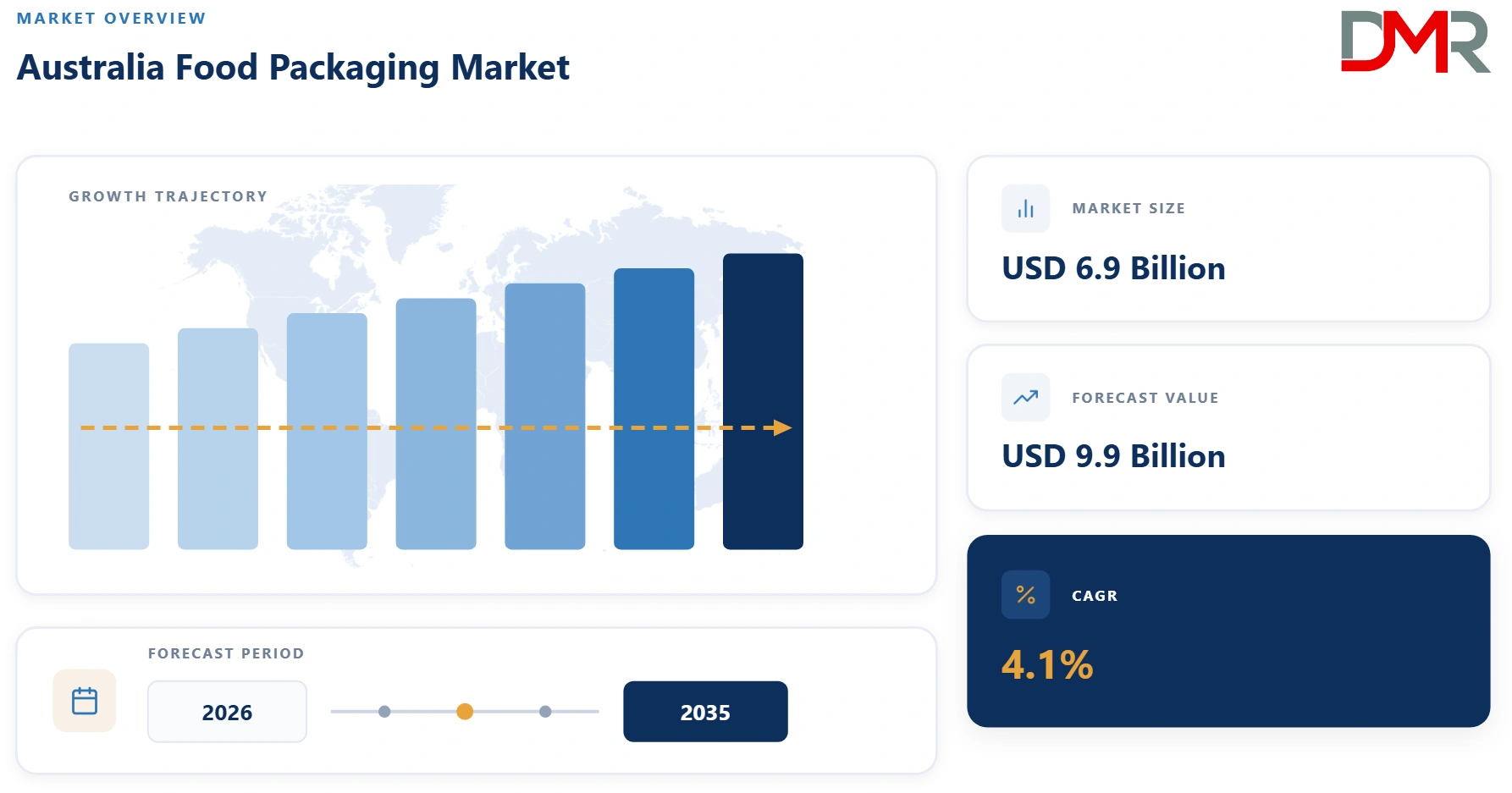
- Australia Food Packaging Market Size in 2026: USD 6.9 billion
- Australia Food Packaging Market Size in 2035: USD 9.9 billion
- Australia CAGR from 2026 to 2035: 4.1%
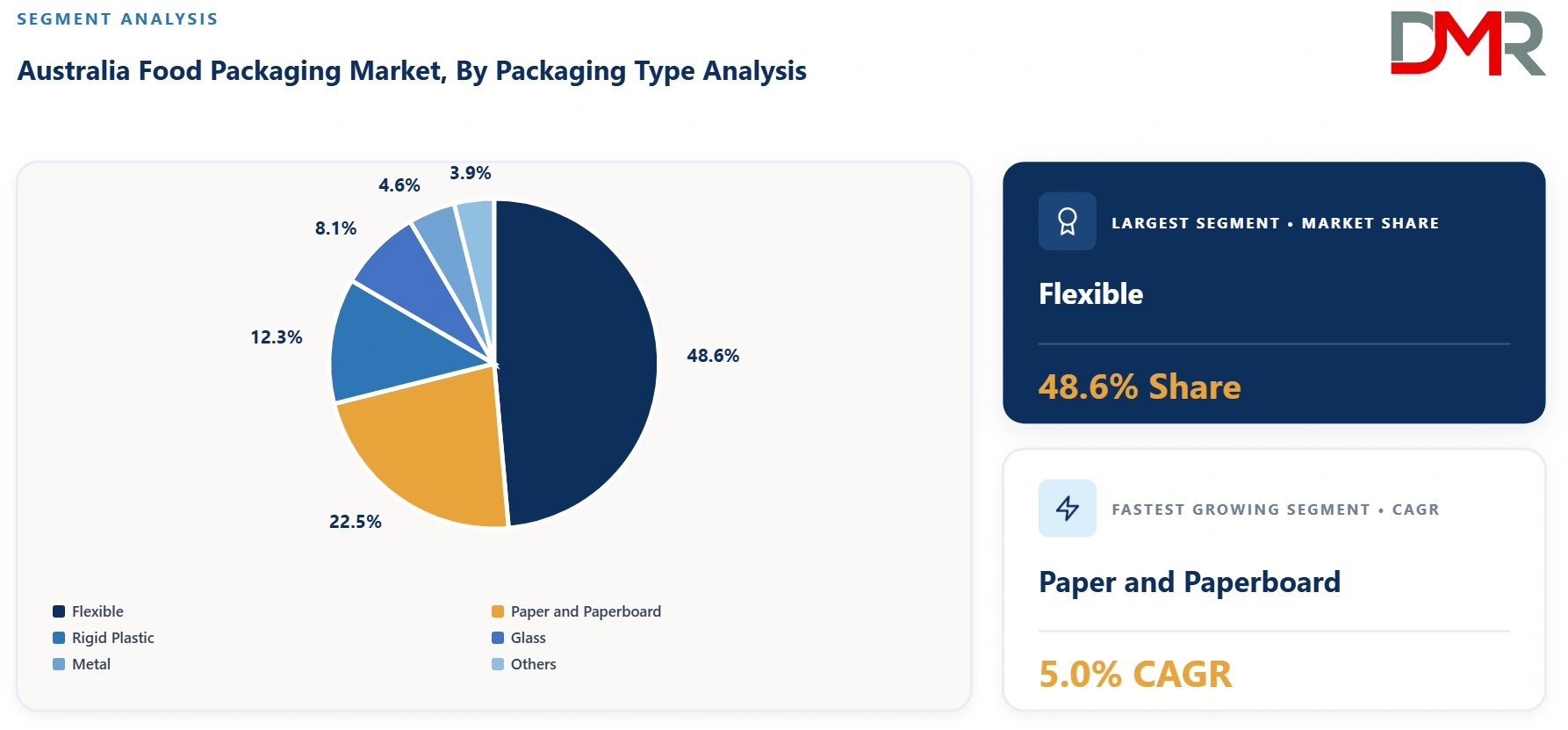
- Flexible is the leading packaging type segment in 2026: 48.6%
- Convenience Foods is the leading application segment in 2026: 22.7%
What is the Australia Food Packaging Market and its Market Size?
The Australia Food Packaging Market is projected to reach USD 6.9 billion in 2026 and grow at a compound annual growth rate of 4.1% through 2035 to reach USD 9.9 billion.
ℹ
To learn more about this report –
Download Your Free Sample Report Here
The Australia food packaging market covers materials and formats used to protect, preserve, transport, display, and communicate information about packaged foods. Demand is increasing as consumers purchase more convenience foods, portion-controlled products, fresh produce, dairy, meat, snacks, and online groceries. Manufacturers are prioritizing lightweight structures, extended shelf life, food safety, tamper evidence, recyclability, and clear labeling. Regulatory reform, recycled-content ambitions, brand sustainability commitments, automation, and evolving retail formats are reshaping material selection and packaging design nationwide.
Use Cases
- Shelf-Life Extension: Food processors use high-barrier flexible films, rigid trays, modified-atmosphere packs, vacuum packaging, and resealable closures to slow oxidation, moisture migration, and microbial deterioration. These solutions support meat, seafood, dairy, bakery, produce, and prepared-meal distribution across Australia’s long transport distances. Better preservation reduces product damage, improves inventory rotation, supports export readiness, and helps retailers offer fresher products while limiting avoidable food waste.
- Convenience and Portion Control: Ready meals, snacks, pasta, noodles, sauces, and side dishes rely on microwavable pouches, lidded trays, single-serve cups, sachets, and easy-open containers. Packaging provides portability, controlled serving sizes, safe reheating, and simplified preparation for time-constrained consumers. Brands use ergonomic formats and resealable features to improve usability, support on-the-go consumption, differentiate products on shelves, and address smaller households and changing eating occasions.
- Fresh Food Protection: Growers, meat processors, seafood suppliers, and dairy producers use food-contact packaging to maintain hygiene and reduce physical damage from processing through retail. Produce trays, cartons, wraps, vacuum packs, bottles, and tamper-evident seals protect products against contamination, crushing, leakage, and temperature fluctuations. Traceability labels and intelligent indicators can strengthen cold-chain control, recall responsiveness, stock management, and consumer confidence in product quality.
Key Takeaways
- Market Size: The Australian Food Packaging Market is anticipated to be valued at USD 6.9 billion in 2026 and is forecast to reach USD 9.9 billion by 2035, expanding at a CAGR of 4.1%.
- Growth Outlook: Market expansion is supported by demand for convenience foods, online grocery fulfillment, portion-controlled products, longer shelf life, premium presentation, improved food safety, recyclable formats, and lightweight packaging. Brand commitments, regulatory reform, modern retail, food exports, and investment in automated filling, sealing, inspection, and coding systems are further influencing packaging consumption and specification decisions.
- Primary Growth Drivers: Increasing consumption of packaged foods, pressure to reduce food waste, growth in chilled and prepared meals, demand for traceability, changing household structures, and longer distribution routes are encouraging investment. Australia wastes about 7.6 billion tonnes of food annually, strengthening interest in packaging that protects freshness while minimizing unnecessary material use and improving recovery outcomes.
- By Packaging Type Analysis: Flexible packaging is projected to lead with a 48.6% share in 2026 because of its low weight, barrier performance, printing flexibility, transport efficiency, and suitability for snacks, bakery goods, frozen foods, sauces, and convenience meals. Paper and paperboard is expected to expand at the fastest CAGR of around 6.4% as brands pursue fiber-based and recyclable alternatives.
- By Application Analysis: Convenience Foods is expected to account for the largest application share of 22.7% in 2026, supported by ready meals, meal kits, frozen products, and heat-and-eat formats. It is also projected to register the fastest CAGR of approximately 6.3%, slightly above overall market growth, as consumers prioritize speed, portability, portion control, and reduced preparation time.
How AI and Generative AI are Transforming the Australia Food Packaging Market?
Artificial intelligence is improving packaging-line inspection, predictive maintenance, demand forecasting, material optimization, and quality control. Vision systems identify seal defects, contamination, labeling errors, and damaged packs at production speed. Generative AI helps designers compare structures, reduce material use, simulate shelf impact, and accelerate artwork development while supporting regulatory review. Digital twins optimize filling and sealing parameters, and machine-learning models forecast demand to reduce packaging inventory and food losses. Adoption remains dependent on data quality, equipment integration, cybersecurity, validation, and workforce capability.
Key Drivers in the Australia Food Packaging Market
Rising Demand for Convenient and Longer-Lasting Foods
Urban lifestyles, smaller households, flexible working patterns, and greater use of online grocery channels are increasing demand for ready meals, snacks, portion packs, and resealable products. Packaging suppliers benefit from requirements for microwave compatibility, easy opening, tamper evidence, leak resistance, and cold-chain durability. Australia’s long distribution distances also make shelf-life performance strategically important. Barrier films, vacuum packs, modified-atmosphere systems, and protective cartons help reduce spoilage and maintain quality. With around 7.6 billion tonnes of food wasted nationally each year, packaging that demonstrably prevents product loss can create economic and sustainability value despite pressures to reduce material consumption.
Sustainability Commitments and Packaging Regulation Reform
Australia is moving toward packaging rules aligned with circular-economy principles, including improved recyclability, recovery, reuse, safe reprocessing, and greater producer responsibility. APCO reported that 86% of packaging was reusable, recyclable, or compostable in 2023–24, while the plastic packaging recycling rate was only 20% and average recycled content was 44%. These gaps are accelerating redesign, mono-material development, recycled resin adoption, fiber substitution, lightweighting, and clearer disposal labels. Food-contact safety and performance remain essential, creating demand for innovations that balance barrier protection with recoverability. Suppliers able to document material provenance and recyclability can strengthen relationships with major food brands and retailers.
Restraints in the Australia Food Packaging Market
Recycling Infrastructure and Material Complexity
Multilayer films, laminates, contaminated food packs, small-format items, colored plastics, and mixed-material structures can be difficult or uneconomic to collect and recycle. Inconsistent collection services and limited end markets for recovered materials weaken circularity, particularly for flexible plastics. Converting a high-barrier food pack into a recyclable mono-material structure may require extensive testing to preserve seal integrity, shelf life, machinability, and food safety. If performance declines, food waste can rise and offset environmental gains. Packaging producers must therefore manage trade-offs among material reduction, product protection, recycling compatibility, cost, and consumer disposal behavior, which can slow commercial adoption of new structures.
Volatile Input Costs and Compliance Burden
Resin, aluminum, steel, glass, paper, coatings, energy, freight, and recycled feedstock costs can fluctuate, affecting margins and contract pricing. Australia’s geographic scale and reliance on imported machinery, specialty films, additives, and components can increase lead times and exposure to currency movements. Smaller food manufacturers may struggle to fund tooling changes, packaging trials, certification, artwork revisions, and line modifications. Emerging design standards and extended producer responsibility requirements may add reporting and data-management obligations. Suppliers must invest in traceability and technical support while avoiding cost increases that could make sustainable formats commercially unattractive to price-sensitive customers.
Growth Opportunities in the Australia Food Packaging Market
Recyclable High-Barrier and Fiber-Based Formats
Significant white space exists for mono-material flexible packaging, recycle-ready pouches, coated paperboard, molded fiber trays, recyclable barrier papers, and hybrid structures designed for local recovery systems. Food producers need alternatives that maintain oxygen, moisture, grease, aroma, and light barriers without compromising processing speed or shelf life. Innovations that replace difficult laminates, reduce pack weight, and include verified recycled content can attract retailers pursuing packaging commitments. Opportunities are strongest where suppliers combine material science with packaging-line trials, lifecycle assessment, food-contact compliance, and consumer communication. Scalable solutions for snacks, bakery, frozen foods, produce, and dry foods can achieve broad adoption.
Smart Packaging and Food-Waste Reduction
Time-temperature indicators, freshness sensors, QR-enabled traceability, digital watermarks, variable data, and intelligent labels can improve cold-chain visibility and consumer confidence. Smart packaging allows producers and retailers to monitor conditions, support targeted recalls, communicate provenance, and provide storage or recycling instructions. Technologies that safely extend usable life are particularly valuable in meat, seafood, dairy, produce, and prepared meals. Investment opportunities also exist in active packaging, antimicrobial layers, moisture control, and resealable formats. Suppliers that quantify avoided food waste and demonstrate total lifecycle benefits can differentiate products and support customers facing sustainability, quality, and operational performance targets.
Trends in the Australia Food Packaging Market
Lightweighting and Circular Design
Brands are removing unnecessary components, reducing wall thickness, shifting toward mono-material structures, increasing recycled content, and adopting packaging compatible with established collection streams. Lightweighting reduces material use, transport emissions, and cost, although pack strength and barrier properties must be protected. Paper and paperboard formats are gaining attention where fiber recovery is practical, while rigid plastic producers are increasing recycled PET and HDPE content. Clear on-pack recycling instructions and design-for-recyclability assessments are becoming more influential in procurement. The trend favors suppliers that provide credible technical evidence rather than unverified environmental claims and can manage performance across the package lifecycle.
Automation, Digital Printing, and Connected Packaging
Food manufacturers are adopting automated filling, forming, sealing, labeling, inspection, palletizing, and coding systems to improve throughput and consistency. Packaging must run efficiently on high-speed equipment, tolerate variable temperatures, and support rapid format changes. Digital printing enables shorter production runs, customization, seasonal designs, and reduced obsolete inventory, making it useful for emerging brands and targeted product launches. QR codes and connected labels provide recipes, allergen information, provenance, authentication, and recycling guidance without overcrowding physical artwork. These technologies strengthen consumer engagement while giving producers access to product-level data, provided privacy and information accuracy are properly governed.
Research Scope and Analysis
The Australia Food Packaging Market is analyzed by packaging type, flexible, paper and paperboard, rigid plastic, glass, metal, others, by application, bakery confectionery pasta and noodles, dairy products, sauces dressings and condiments, snacks and side dishes, convenience foods, meat fish and poultry, fruits and vegetables, others- with market forecasts covering 2026 through 2035 across the country.
ℹ
To learn more about this report –
Download Your Free Sample Report Here
By Packaging Type Analysis
Flexible packaging is projected to hold the highest market share of 48.6% in 2026, supported by lightweight construction, strong barrier properties, printability, and widespread use across snacks, bakery products, frozen foods, and sauces. Paper and paperboard is anticipated to record the fastest CAGR of approximately 5.0% through 2035, as recyclable fiber-based designs gain adoption.
By Application Analysis
Convenience Foods is expected to lead the application segment with a 22.7% share in 2026, driven by ready meals, frozen dishes, meal kits, and heat-and-eat products. The segment is also projected to register the fastest CAGR of around 5.3% from 2026 to 2035, as consumers increasingly prioritize portability, portion control, and rapid preparation.
The Australia Food Packaging Market Report is segmented based on the following:
By Packaging Type
- Flexible
- Paper and Paperboard
- Rigid Plastic
- Glass
- Metal
- Others
By Application
- Bakery, Confectionery, Pasta, and Noodles
- Dairy Products
- Sauces, Dressings, and Condiments
- Snacks and Side Dishes
- Convenience Foods
- Meat, Fish, and Poultry
- Fruits and Vegetables
- Others
Regulatory Landscape
Australia’s packaging policy is transitioning from a largely co-regulatory framework toward stronger national requirements built around circular-economy principles. Proposed reforms emphasize packaging design, recovery, reuse, recycling, safe reprocessing, and producer responsibility, while potential design standards could address kerbside recyclability and chemicals of concern. This creates opportunities for suppliers of mono-material structures, recycled-content packs, compliant coatings, labeling systems, and packaging data services. Risks include fragmented implementation, higher compliance costs, and uncertainty over technical thresholds or transition periods. Food packaging producers must also preserve food-contact safety, traceability, allergen communication, and product protection, making early design validation and regulatory monitoring essential to investment decisions.
Technology Analysis
Technology development is concentrating on recyclable high-barrier films, molded fiber, functional paper coatings, recycled food-grade polymers, active packaging, digital printing, intelligent labels, and automated inspection. Machine vision improves defect detection, while sensors and QR-enabled platforms strengthen traceability and cold-chain visibility. The opportunity lies in solutions that reduce material use and food waste simultaneously, operate on existing filling lines, and match Australia’s recovery infrastructure. Commercial risks include higher unit costs, uncertain recycling pathways, equipment incompatibility, and limited consumer engagement with connected features. Technologies demonstrating measurable shelf-life gains, reliable machinability, verified recyclability, and scalable feedstock supply are likely to generate the strongest market impact.
Competitive Landscape
The Australia food packaging market includes multinational converters, domestic packaging groups, specialist flexible-packaging producers, glass and metal container suppliers, paperboard manufacturers, label companies, and sustainable-material innovators. Competition centers on barrier performance, cost efficiency, food-contact compliance, recyclable design, recycled content, printing capability, technical service, and dependable local supply. Large participants benefit from integrated recycling, material procurement, and national manufacturing networks, while specialists compete through customization and shorter production runs. Partnerships with food processors and retailers are accelerating the development of lighter, recycle-ready, fiber-based, and smart packaging formats.
Some of the Prominent Players in the Australia Food Packaging Market Are:
- Amcor plc
- Visy Industries
- Pact Group Holdings Ltd
- Orora Limited
- Detmold Group
- Pro-Pac Packaging Limited
- Opal Packaging Australia
- Huhtamaki Oyj
- Tetra Pak
- SIG Group
- Sealed Air Corporation
- Sonoco Products Company
- Berry Global Group
- Mondi plc
- Smurfit Westrock
- Graphic Packaging International
- International Paper
- Oji Fibre Solutions
- Nippon Paper Industries
- Australian Paper
- Ball Corporation
- Crown Holdings Inc
- Ardagh Group
- Jamestrong Packaging
- NCI Packaging
- O-I Glass Inc
- Plasdene Glass-Pak
- Cospak
- Schütz Australia
- Caspak Products
- Integrated Packaging Group
- Omniverse Foster Packaging Group
- Australian Plastic Profiles
- BioPak
- Pak360
- The Packaging People
- Jet Technologies
- Close the Loop Limited
- Labelmakers Group
- Result Group
- Other Key Players
Recent Developments
- June 2025: Pact Group launched rFresh 100 food-grade recycled plastic for milk bottles, supporting greater use of domestically sourced recycled content in Australian dairy packaging and advancing bottle-to-bottle circularity.
- April 2025: Amcor completed its combination with Berry Global, creating a larger global consumer-packaging platform with expanded flexible and rigid packaging capabilities, broader innovation resources, and greater scale serving food and beverage customers.
- December 2024: Australia’s Design Standard Working Group released a draft Design for Kerbside Recyclability Grading Framework, followed by stakeholder feedback during 2025, supporting the development of clearer national packaging design requirements.
Report Details
| Report Characteristics |
| Market Size (2026) |
USD 6.9 Bn |
| Forecast Value (2035) |
USD 9.9 Bn |
| CAGR (2026–2035) |
4.1% |
| Historical Data |
2021 – 2025 |
| Forecast Data |
2026 – 2035 |
| Base Year |
2025 |
| Segments Covered |
By Packaging Type, By Application |
Frequently Asked Questions
How big is the Australia Food Packaging Market?
▾ The Australia Food Packaging Market is projected to reach USD 6.9 billion in 2026 and USD 9.9 billion by 2035.
What is the CAGR of the Australia Food Packaging Market from 2026 to 2035?
▾ The market is expected to expand at a compound annual growth rate of 4.1% from 2026 to 2035.
What factors are driving the growth of the Australia Food Packaging Market?
▾ Growth is driven by convenience-food consumption, shelf-life requirements, online grocery sales, food safety priorities, sustainability commitments, packaging regulation reform, automation, and demand for recyclable and lightweight formats.
What are the major trends in the Australia Food Packaging Market?
▾ Major trends include mono-material flexible structures, fiber-based packaging, lightweighting, recycled content, smart labels, digital printing, automation, connected packaging, and solutions designed to reduce food waste.
Who are the key players in the Australia Food Packaging Market?
▾ Prominent participants include Amcor, Visy Industries, Pact Group, Orora, Detmold Group, Pro-Pac Packaging, Opal Packaging Australia, Huhtamaki, Tetra Pak, SIG, and Sealed Air.
How is the Australia Food Packaging Market segmented?
▾ The market is segmented by packaging type into flexible, paper and paperboard, rigid plastic, glass, metal, and others. By application, it is segmented into bakery, confectionery, pasta and noodles, dairy products, sauces, dressings and condiments, snacks and side dishes, convenience foods, meat, fish and poultry, fruits and vegetables, and others.