Australia Food Safety Testing Market Snapshot
- Australia Food Safety Testing Market Size in 2026: USD 666.4 million
- Australia Food Safety Testing Market Size in 2035: USD 1,412.0 million
- Australia CAGR from 2026 to 2035: 8.7%
- Pathogen is the leading type segment in 2026: 40.4%
- Meat and Meat Products is the leading food-tested segment in 2026: 31.7%
- PCR-based Assay is the leading technology segment in 2026: 37.2%
What is the Australia Food Safety Testing Market and its Market Size?
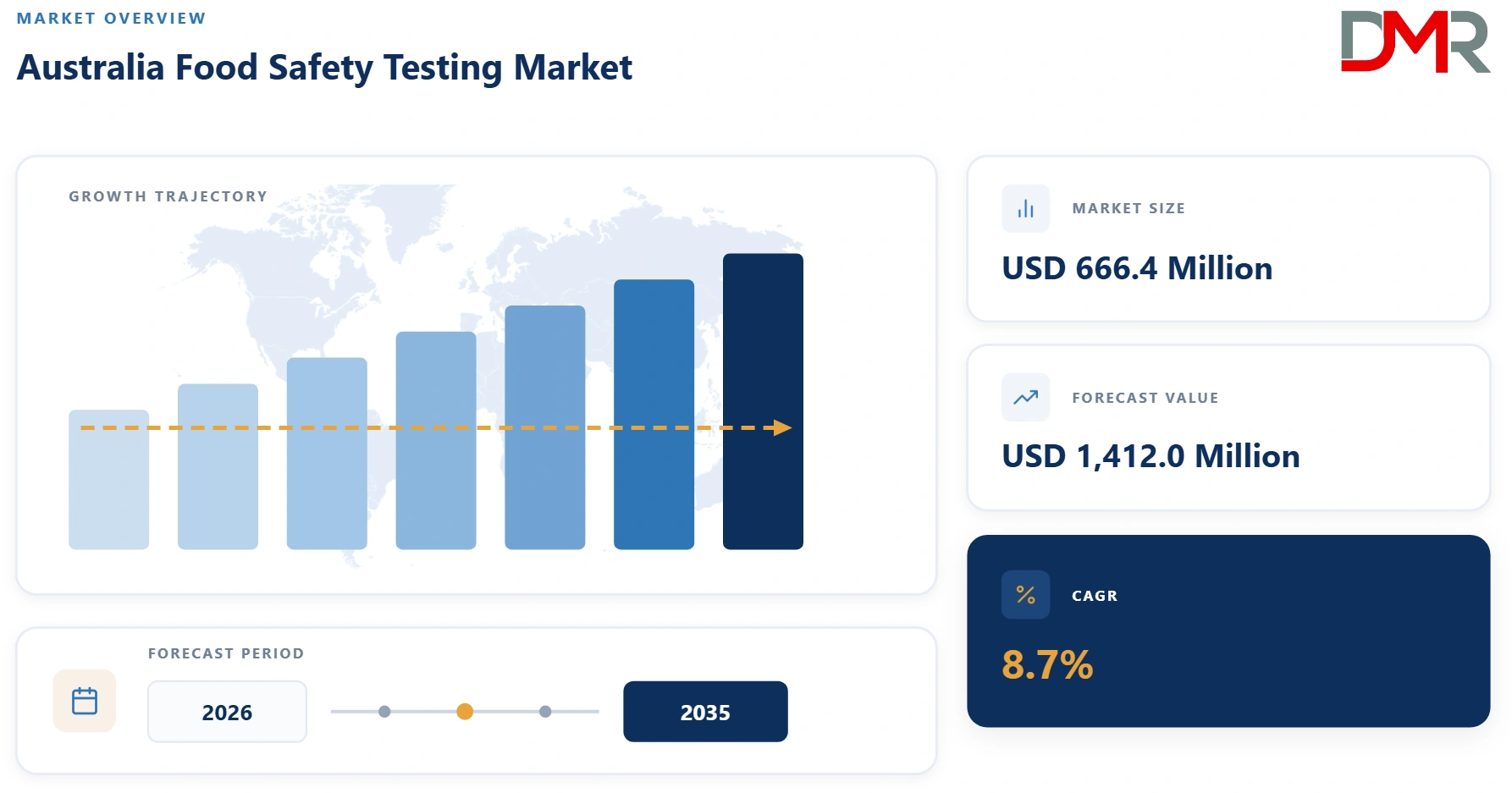
The Australia Food Safety Testing Market is projected to reach USD 666.4 million in 2026 and grow at a compound annual growth rate of 8.7% until 2035 to reach a value of USD 1,412.0 million.
ℹ
To learn more about this report –
Download Your Free Sample Report Here
Food safety testing involves laboratory and on-site procedures used to identify pathogens, genetically modified organisms, toxins, pesticide residues, allergens, heavy metals, veterinary drug residues, and other contaminants in food. Australia’s market is supported by strict regulatory requirements, extensive agricultural exports, technologically advanced laboratories, increasing processed-food consumption, and demand for rapid and accurate results. Testing protects consumers, enables compliance with the Australia New Zealand Food Standards Code, supports product recalls, and helps exporters satisfy importing-country requirements across meat, dairy, grain, seafood, and processed-food supply chains.
Use Cases
- Pathogen detection in meat processing: Meat processors use microbiological cultures, PCR assays, and immunoassays to identify Salmonella, Listeria monocytogenes, Campylobacter, and pathogenic E. coli. Testing is performed on raw materials, production surfaces, processing water, and finished goods. Early detection allows manufacturers to isolate affected batches, undertake sanitation measures, verify process controls, prevent recalls, and comply with domestic and export-market microbiological requirements.
- Chemical residue and toxin monitoring: Agricultural producers, grain handlers, dairy companies, and food manufacturers test products for pesticide residues, mycotoxins, veterinary medicines, heavy metals, and processing contaminants. Laboratories apply chromatography, mass spectrometry, and immunoassay techniques to confirm compliance with maximum residue limits. These services protect public health, support supplier verification, reduce border rejection risks, and strengthen the credibility of Australian food exports.
- Authenticity and GMO verification: Food companies apply DNA-based testing to verify species, ingredients, geographical claims, allergen status, and genetically modified material. These tests are particularly valuable for meat products, seafood, grains, plant-based foods, and imported ingredients. Reliable authentication helps prevent food fraud, supports accurate labelling, protects brand reputation, demonstrates compliance, and gives consumers greater confidence in product origin and composition claims.
Key Takeaways
- Market Size: The Australia Food Safety Testing Market is anticipated to be valued at USD 666.4 million in 2026 and is forecast to reach USD 1,412.0 million by 2035, expanding at a CAGR of 8.7%.
- Growth Rate and Outlook: Market expansion is supported by stricter compliance requirements, growing agricultural exports, increasing processed-food consumption, heightened allergen awareness, food fraud concerns, laboratory automation, and broader adoption of rapid molecular diagnostics. Demand for shorter turnaround times and traceable digital results will strengthen the outlook.
- Primary Growth Drivers: Recurring recalls, pathogen outbreaks, undeclared allergens, chemical contamination risks, export certification requirements, supplier-quality programs, and consumer expectations for transparent food production are increasing testing volumes. FSANZ coordinated 92 recalls in 2025, compared with a ten-year annual average of 87, highlighting the continuing importance of effective surveillance and verification.
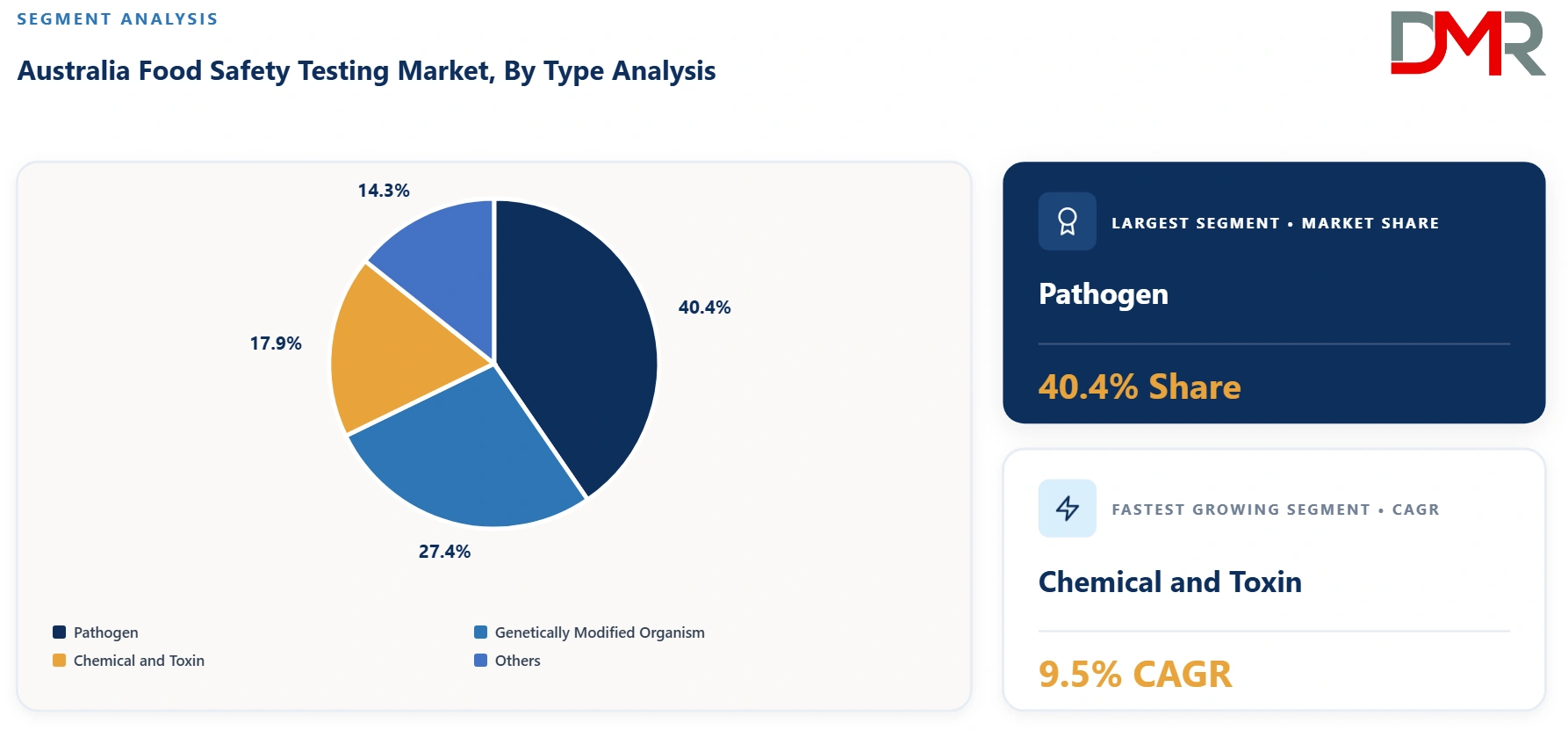
- By Type Analysis: Pathogen testing is projected to dominate with a 40.4% share in 2026, supported by mandatory and preventive testing for Salmonella, Listeria, Campylobacter, and E. coli. Chemical and Toxin testing is expected to record the fastest CAGR of approximately 9.5% through 2035 as residue and contaminant monitoring becomes more comprehensive.
- By Food Tested Analysis: Meat and Meat Products is expected to lead with a 31.7% share in 2026, driven by Australia’s major meat-processing and export industries. Processed Food is projected to grow fastest at approximately 9.6%, reflecting complex ingredient chains, ready-to-eat consumption, allergen risks, and frequent product innovation.
- By Technology Analysis: PCR-based Assay is anticipated to lead with a 37.2% share in 2026 because of its high sensitivity, specificity, automation potential, and faster detection. Immunoassay-based testing is expected to expand at approximately 9.2%, supported by rapid allergen, toxin, pathogen, and residue screening applications.
How AI and Generative AI are Transforming the Australia Food Safety Testing Market?
Artificial intelligence is improving food safety testing by identifying contamination patterns, prioritising high-risk samples, interpreting complex analytical results, and supporting predictive maintenance of laboratory instruments. Machine-learning models can combine supplier records, environmental monitoring, recall histories, and production data to forecast pathogen or allergen risks. Computer vision also supports automated colony counting and quality inspection. Generative AI assists laboratories with report preparation, method documentation, regulatory summaries, and investigation workflows. However, validated datasets, explainable outputs, cybersecurity controls, human review, and compliance with accredited laboratory procedures remain essential before AI-generated findings can inform release decisions.
Key Drivers in the Australia Food Safety Testing Market
Stringent Regulation and Increasing Recall Activity
Australia’s food-control system requires businesses to supply safe, accurately labelled products and maintain effective traceability and recall procedures. FSANZ coordinated 866 recalls between 2016 and 2025, including 92 recalls during 2025. Undeclared allergens represented 38% of recalls in 2025, with milk, wheat and gluten, and tree nuts among the most common allergens. These incidents encourage manufacturers, importers, retailers, and foodservice businesses to expand pathogen, allergen, authenticity, and chemical testing. Stronger supplier assurance, environmental monitoring, verification schedules, and corrective-action programs consequently generate recurring demand for accredited laboratory services, rapid test kits, and in-house testing systems. F
Export-Oriented Agriculture and Market-Access Requirements
Australia exports around 71% of its agricultural production, including approximately 85% of canola, 82% of mutton and lamb, 77% of beef and veal, and 75% of wheat. This substantial export exposure makes testing essential for demonstrating compliance with varying microbiological standards, residue limits, certification rules, and buyer specifications. Export establishments must meet Australian export standards and importing-country requirements. Consequently, meat processors, grain exporters, dairy suppliers, seafood companies, and horticultural businesses require routine testing, documentation, traceability, and contaminant surveillance to preserve market access and reduce costly shipment rejections.
Restraints in the Australia Food Safety Testing Market
High Testing Costs and Laboratory Infrastructure Requirements
Advanced food testing requires accredited facilities, specialised analysts, reference materials, sample-preparation systems, quality controls, and costly instruments such as real-time PCR platforms and mass spectrometers. Small food manufacturers may struggle to absorb the expense of comprehensive testing, especially when managing numerous products, ingredients, suppliers, and production sites. Rural businesses also encounter sample transportation expenses and longer logistical cycles. Although rapid kits reduce analysis time, they still require validation, staff training, controls, and confirmatory testing. Cost pressures can cause smaller companies to adopt minimum compliance programs instead of risk-based, high-frequency testing, restricting broader market penetration.
Technical Complexity and Sample-Matrix Limitations
Food matrices vary considerably in fat, moisture, acidity, microbial load, processing conditions, and ingredient complexity. These characteristics can inhibit PCR amplification, interfere with antibody reactions, or complicate chemical extraction, producing false-positive, false-negative, or inconclusive results. Laboratories must therefore validate methods for individual matrices and maintain strong proficiency-testing and quality-control systems. Emerging contaminants, novel foods, cultured products, and alternative proteins also require new reference materials and analytical procedures. Differences between domestic and importing-country standards add further complexity, while limited availability of highly skilled microbiologists, molecular biologists, chemists, and data specialists can constrain laboratory capacity.
Growth Opportunities in the Australia Food Safety Testing Market
Expansion of Rapid, Portable, and On-Site Testing
Food processors increasingly require results within hours rather than days to release products faster, reduce cold-storage costs, and respond immediately to contamination. This creates opportunities for portable PCR instruments, lateral-flow immunoassays, biosensors, ATP systems, microfluidic platforms, and automated sample-preparation solutions. Suppliers can develop validated kits tailored to Australian meat, dairy, grain, seafood, and ready-to-eat food matrices. Combining rapid screening with confirmatory laboratory analysis can improve operational efficiency without compromising reliability. Subscription-based instruments, reagent-rental arrangements, remote technical support, and simplified workflows could make advanced testing more accessible to regional processors and small food businesses.
Digital Traceability and Predictive Food-Safety Services
Integrating laboratory results with manufacturing execution systems, supplier databases, temperature records, audit findings, and blockchain-enabled traceability creates opportunities for data-driven food-safety management. Laboratories can move beyond individual test reports by offering dashboards, trend analysis, contamination mapping, supplier benchmarking, and predictive risk alerts. These services can help customers identify recurring hygiene failures or high-risk ingredients before incidents occur. Cloud-based laboratory information management systems also improve sample tracking, regulatory reporting, and multi-site visibility. Providers capable of delivering secure analytics, interoperable data, rapid testing, and consulting services can build stronger recurring relationships with food manufacturers and retailers.
Trends in the Australia Food Safety Testing Market
Growing Adoption of Molecular and Multiplex Testing
PCR-based assays are gaining adoption because they provide rapid, sensitive, and specific detection of foodborne microorganisms and ingredient DNA. Multiplex assays enable laboratories to screen several targets within one workflow, reducing labour, consumable use, and time to result. Automated nucleic-acid extraction and integrated result-analysis software further improve throughput and consistency. Molecular methods are increasingly used for pathogen confirmation, meat and fish species authentication, GMO detection, and verification of vegan or halal claims. Culture methods remain important for regulatory confirmation and organism isolation, but laboratories are progressively combining traditional microbiology with rapid molecular screening.
Increasing Focus on Allergens and Chemical Contaminants
Allergen testing is becoming increasingly important as manufacturers manage complex ingredient supply chains, shared equipment, reformulations, and precautionary labelling. Undeclared allergens remained Australia’s leading recall cause in 2025, encouraging wider use of protein-specific immunoassays and DNA-based verification. Chemical testing is simultaneously expanding to cover pesticide residues, veterinary medicines, mycotoxins, heavy metals, per- and polyfluoroalkyl substances, and processing contaminants. Australia applies maximum residue limits, extraneous residue limits, and maximum levels through its food-standard framework. Greater analytical sensitivity and multi-residue methods are broadening monitoring programs.
Research Scope and Analysis
Australia food safety testing market covers pathogen testing, genetically modified organism testing, chemical and toxin testing, other testing, meat and meat products, dairy and dairy products, cereals grains and pulses, processed food, other foods, agar culturing, PCR based assays, immunoassay based methods, other technologies, laboratory services, testing instruments, consumables, rapid diagnostics, regulatory compliance, quality assurance, forecasting.
ℹ
To learn more about this report –
Download Your Free Sample Report Here
By Type Analysis
Pathogen testing is projected to hold the highest market share of 40.4% in 2026, supported by extensive monitoring for Salmonella, Listeria, Campylobacter, and pathogenic E. coli. Chemical and Toxin testing is expected to register the highest CAGR of approximately 9.5% through 2035 as regulators, manufacturers, and exporters strengthen surveillance for pesticides, mycotoxins, heavy metals, veterinary residues, and processing contaminants.
By Food Tested Analysis
Meat and Meat Products is anticipated to dominate with a 31.7% share in 2026, owing to Australia’s large meat-processing industry and stringent domestic and export safety requirements. Processed Food is projected to record the highest CAGR of approximately 9.6% through 2035, driven by complex product formulations, rising ready-to-eat food consumption, allergen concerns, and increased testing across multi-tier ingredient supply chains.
By Technology Analysis
PCR-based Assay is expected to lead with a 37.2% share in 2026, driven by its high sensitivity, specificity, rapid turnaround, and suitability for pathogen, GMO, and food-authenticity testing. Immunoassay-based technology is projected to achieve the highest CAGR of approximately 9.2% through 2035, supported by convenient and cost-effective screening for allergens, mycotoxins, residues, toxins, and foodborne pathogens.
The Australia Food Safety Testing Market Report is Segmented Based on the Following
By Type
- Pathogen
- Genetically Modified Organism
- Chemical and Toxin
- Others
By Food Tested
- Meat and Meat Products
- Dairy and Dairy Products
- Cereals, Grains and Pulses
- Processed Food
- Others
By Technology
- Agar Culturing
- PCR-based Assay
- Immunoassay-based
- Others
Regulatory Landscape
Australia’s food safety testing environment is governed through the Australia New Zealand Food Standards Code, FSANZ, state and territory enforcement agencies, the Department of Agriculture, Fisheries and Forestry, and export-control frameworks. Requirements cover microbiological limits, allergens, contaminants, residues, labelling, imported food, traceability, and recalls. Laboratories testing referred imported foods must satisfy government appointment conditions, while exporters must meet Australian and destination-market standards. Regulatory expansion increases demand for accredited testing but raises compliance costs and method-validation burdens. Opportunities exist in allergen verification, rapid pathogen detection, residue screening, authenticity testing, and digital reporting. Regulatory inconsistency across export markets remains a significant operational risk.
Technology Analysis
Australia’s food testing sector is shifting from conventional end-point analysis toward rapid molecular assays, multiplex PCR, automated immunoassays, mass spectrometry, biosensors, and integrated laboratory information systems. PCR enables highly specific pathogen and authenticity testing, while chromatography and mass spectrometry support increasingly sensitive multi-residue analysis. Automation improves reproducibility and throughput but requires investment, method validation, cybersecurity, and skilled operators. Portable systems create white-space opportunities among regional processors and farms, particularly where laboratory access is limited. Artificial intelligence can strengthen colony recognition, spectral interpretation, and contamination forecasting. However, culture-based confirmation will remain important because regulators and outbreak investigators may require viable isolates for characterisation and epidemiological linkage.
Competitive Landscape
The Australia Food Safety Testing Market features global testing corporations, Australian laboratory networks, instrument manufacturers, diagnostic-kit suppliers, and specialised accreditation-supported laboratories. ALS, Eurofins, SGS, Intertek, Symbio Laboratories, and AsureQuality compete through laboratory coverage, turnaround time, technical expertise, accreditation, and comprehensive testing portfolios. Instrument and consumable suppliers such as Thermo Fisher Scientific, Bio-Rad, Neogen, Merck, Agilent Technologies, and QIAGEN support molecular, immunological, microbiological, and chemical workflows. Competition is increasing around rapid diagnostics, automated sample preparation, multi-residue analysis, digital reporting, and value-added consulting. Partnerships, acquisitions, laboratory expansion, and validated product launches remain important market-development strategies.
Some of the Prominent Players in the Australia Food Safety Testing Market Are
- ALS Limited
- Eurofins Scientific SE
- SGS SA
- Intertek Group plc
- Bureau Veritas SA
- AsureQuality Limited
- Symbio Laboratories
- Microtech Laboratories
- Agrifood Technology
- National Measurement Institute Australia
- DTS Food Laboratories
- Merieux NutriSciences
- Thermo Fisher Scientific Inc.
- Bio-Rad Laboratories Inc.
- Neogen Corporation
- Merck KGaA
- Agilent Technologies Inc.
- QIAGEN N.V.
- Shimadzu Corporation
- PerkinElmer Inc.
- Bruker Corporation
- Waters Corporation
- Sartorius AG
- Hygiena LLC
- R-Biopharm AG
- Romer Labs
- Charm Sciences Inc.
- IDEXX Laboratories Inc.
- 3M Company
- Abbott Laboratories
- Danaher Corporation
- BIOMÉRIEUX SA
- FOSS
- Nelson-Jameson Inc.
- Labcorp
- NSF International
- TÜV SÜD
- TÜV NORD Group
- Mettler-Toledo International Inc.
- Promega Corporation
- Other Key Players
Recent Developments
- May 2026: ALS reported record FY2026 results, including revenue growth of 10.7% and underlying net profit growth of 25.8%. The performance demonstrated the company’s capacity to continue investing in technology, laboratory infrastructure, and growth opportunities across its testing operations.
- January 2026: Eurofins reported that it had achieved its 2025 objectives, with Food and Feed Testing producing solid growth across most European markets. Continued global investment and network development strengthen technologies and expertise that can also support Eurofins’ Australian food-testing operations.
- May 2025: ALS announced a USD 350 million equity raising to support future developments and growth after reporting strong performance in Life Sciences. The investment provides additional capacity for acquisitions, laboratory development, automation, and expansion across resilient analytical-testing markets.
- June 2025: FSANZ released 2024 recall data showing that recalls exceeded the preceding ten-year annual average. The agency identified stronger regulatory oversight, improved business self-monitoring, and greater consumer vigilance as contributors to increased issue detection.
Report Details
| Report Characteristics |
| Market Size (2026) |
USD 666.4 Mn |
| Forecast Value (2035) |
USD 1,412.0 Mn |
| CAGR (2026–2035) |
8.7% |
| Historical Data |
2021 – 2025 |
| Forecast Data |
2026 – 2035 |
| Base Year |
2025 |
| Segments Covered |
By Type, By Food Tested, By Technology |
Frequently Asked Questions
How big is the Australia Food Safety Testing Market?
▾ The Australia Food Safety Testing Market is projected to be valued at USD 666.4 million in 2026 and reach USD 1,412.0 million by 2035.
What is the CAGR of the Australia Food Safety Testing Market from 2026 to 2035?
▾ The market is expected to expand at a compound annual growth rate of 8.7% during the forecast period from 2026 to 2035.
What factors are driving the growth of the Australia Food Safety Testing Market?
▾ Growth is driven by stringent food standards, agricultural exports, recurring product recalls, rising allergen awareness, processed-food consumption, technological advancement, food fraud concerns, and demand for rapid and reliable contaminant detection.
What are the major trends in the Australia Food Safety Testing Market?
▾ Major trends include rapid PCR adoption, multiplex pathogen testing, laboratory automation, portable diagnostics, digital traceability, allergen testing, multi-residue chemical analysis, artificial intelligence, and predictive food-safety monitoring.
Which segment dominates the Australia Food Safety Testing Market?
▾ Pathogen testing is expected to dominate the type category with a 40.4% share in 2026. Meat and Meat Products leads food tested, while PCR-based Assay leads the technology category.
Who are the key players in the Australia Food Safety Testing Market?
▾ Major players include ALS Limited, Eurofins Scientific, SGS, Intertek, Bureau Veritas, AsureQuality, Symbio Laboratories, Thermo Fisher Scientific, Bio-Rad Laboratories, Neogen, Merck, Agilent Technologies, and QIAGEN.
How is the Australia Food Safety Testing Market segmented?
▾ The market is segmented by type into Pathogen, Genetically Modified Organism, Chemical and Toxin, and Others; by food tested into Meat and Meat Products, Dairy and Dairy Products, Cereals, Grains and Pulses, Processed Food, and Others; and by technology into Agar Culturing, PCR-based Assay, Immunoassay-based, and Others.