Australia Solar Plant Weather Monitoring Equipment Market Snapshot
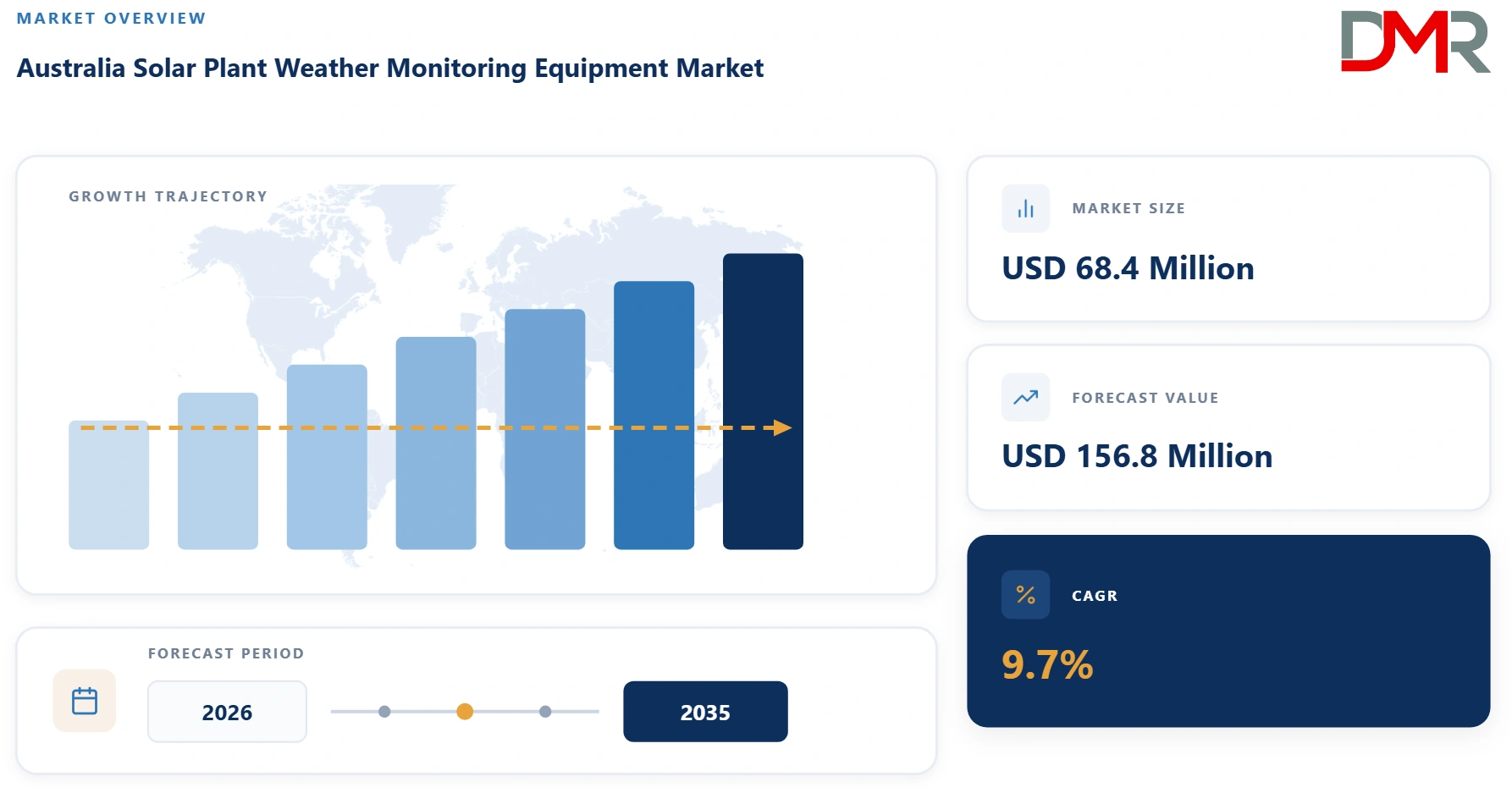
- Australia Solar Plant Weather Monitoring Equipment Market Size in 2026: USD 68.4 Million
- Australia Solar Plant Weather Monitoring Equipment Market Size in 2035: USD 156.8 Million
- Australia CAGR from 2026 to 2035: 9.7%
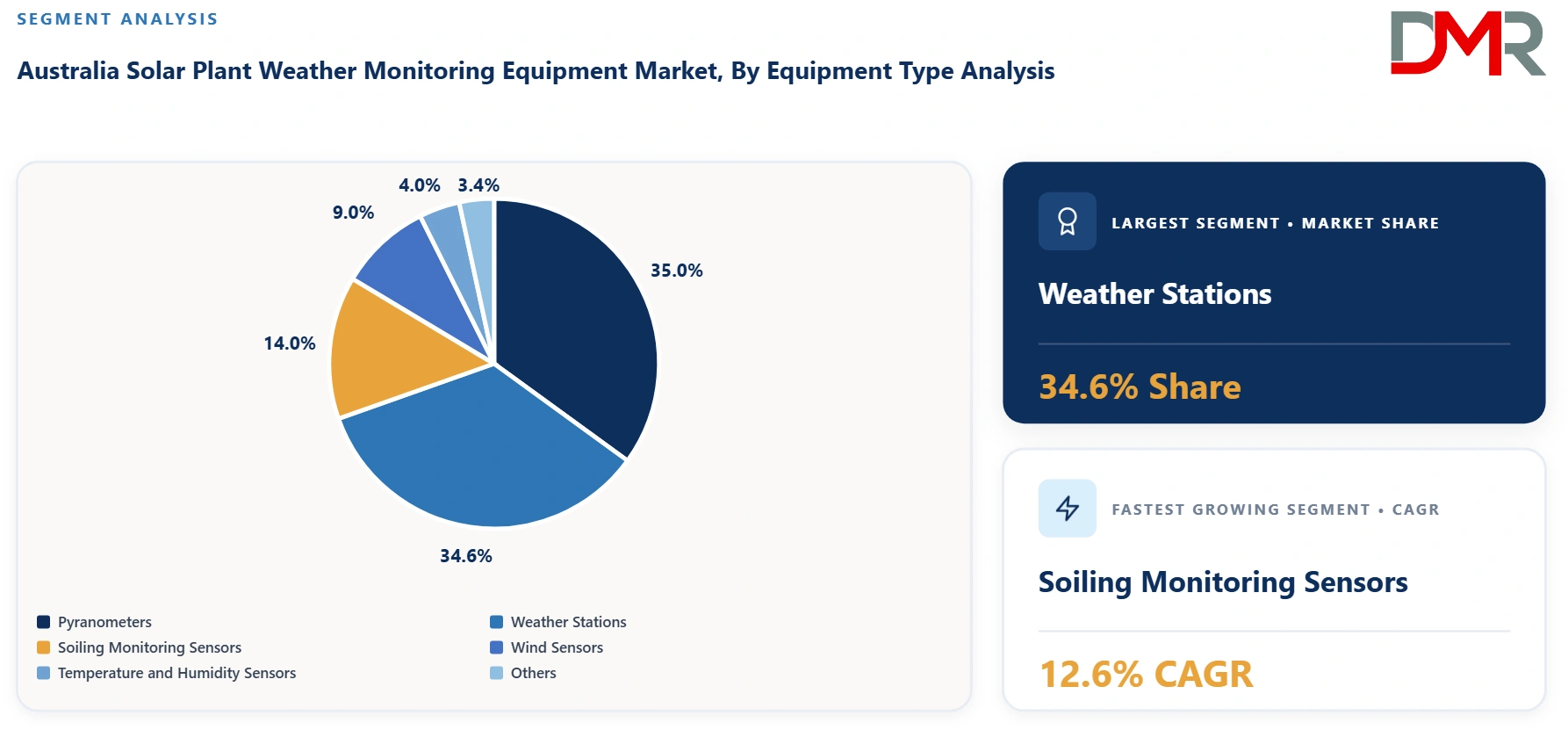
- Weather Stations is the leading equipment type segment in 2026: 34.6%
- Utility-Scale Solar Farms is the leading solar plant type segment in 2026: 58.3%
- Performance Monitoring and Forecasting is the leading application segment in 2026: 42.8%
- Independent Power Producers/Solar Farm Operators is the leading end user segment in 2026: 54.7%
What is the Australia Solar Plant Weather Monitoring Equipment Market and its Market Size?
The Australia Solar Plant Weather Monitoring Equipment Market is projected to be valued at USD 68.4 Million in 2026 and is projected to reach USD 156.8 Million by 2035, expanding at a CAGR of 9.7% during the forecast period.
ℹ
To learn more about this report –
Download Your Free Sample Report Here
Growth is being propelled by Australia's substantial and continuing utility-scale solar farm development pipeline supporting the country's renewable energy transition, the Australian Energy Market Operator's increasing emphasis on accurate solar generation forecasting to support grid stability amid rising variable renewable energy penetration, and growing solar farm operator recognition of the operational and financial value provided by accurate weather monitoring data supporting performance verification, predictive maintenance, and energy trading decisions. The maturing of advanced soiling monitoring technology helping Australian solar farm operators optimize panel cleaning schedules amid the country's dust and bushfire smoke-related soiling challenges, growing integration of weather monitoring data with AI-enhanced solar generation forecasting platforms supporting improved grid integration and energy market trading decisions, and continued expansion of Australia's utility-scale solar development pipeline across New South Wales, Queensland, and Victoria are reshaping the market from a basic solar resource assessment function into an increasingly sophisticated, operationally integrated component of solar plant management. Investment is accelerating as Australian solar farm operators and equipment providers expand weather monitoring infrastructure to support both new project development and ongoing operational optimization of the country's substantial existing solar generation fleet.
Use Cases
- Solar Resource Assessment for Utility-Scale Project Development: Solar developers deploy weather monitoring equipment including pyranometers and weather stations during project development phases to validate solar resource assumptions and refine energy yield projections supporting financing and investment decisions for new utility-scale solar farm projects.
- Generation Forecasting Supporting AEMO Grid Integration Requirements: Solar farm operators deploy comprehensive weather monitoring infrastructure to support accurate short-term generation forecasting required for participation in Australia's National Electricity Market, helping the Australian Energy Market Operator manage grid stability amid rising variable renewable energy penetration.
- Soiling Monitoring for Panel Cleaning Schedule Optimization: Solar farm operators across Australia's dust-prone rural regions and areas affected by periodic bushfire smoke use soiling monitoring sensors to track panel performance degradation and optimize cleaning schedules, balancing cleaning costs against energy yield losses from accumulated soiling.
- Predictive Maintenance Supporting Operations and Maintenance Cost Optimization: Solar asset managers use integrated weather and performance monitoring data to identify equipment performance anomalies potentially indicating maintenance needs, supporting more proactive and cost-effective operations and maintenance program management across their solar farm portfolios.
Key Takeaways
- Market Size: The Australia Solar Plant Weather Monitoring Equipment Market is anticipated to be valued at USD 68.4 Million in 2026 and is forecast to reach USD 156.8 Million by 2035, expanding at a CAGR of 9.7%.
- Growth Outlook: Market expansion is sustained by Australia's substantial utility-scale solar development pipeline, growing AEMO emphasis on accurate generation forecasting for grid stability, and increasing operator recognition of weather monitoring's operational and financial value.
- Primary Growth Drivers: Continued utility-scale solar farm development pipeline growth, increasing grid operator emphasis on accurate solar generation forecasting, growing recognition of weather monitoring value for predictive maintenance and performance verification, and rising soiling-related monitoring needs amid dust and bushfire smoke conditions are accelerating market growth.
- By Equipment Type Analysis: Weather Stations is projected to lead the equipment type segment with a 34.6% share in 2026, reflecting their comprehensive, multi-parameter monitoring capability valued across solar farm applications. Soiling Monitoring Sensors is the fastest-growing equipment type segment at 12.6% CAGR, driven by growing operator focus on optimizing panel cleaning economics amid Australia's dust and smoke-related soiling conditions.
- By Solar Plant Type Analysis: Utility-Scale Solar Farms is expected to dominate with a 58.3% share in 2026, reflecting the scale of Australia's utility-scale solar development pipeline. Commercial and Industrial Solar Installations is the fastest-growing solar plant type segment at 10.8% CAGR, driven by continued growth in Australia's commercial rooftop and ground-mount solar installation base.
- By Application Analysis: Performance Monitoring and Forecasting is poised to lead with a 42.8% share in 2026, reflecting the central operational role of weather data in ongoing solar plant performance management. Predictive Maintenance is the fastest-growing application segment at 11.9% CAGR, driven by growing solar asset manager interest in proactive, data-driven maintenance program optimization.
- By End User Analysis: Independent Power Producers/Solar Farm Operators are projected to dominate with a 54.7% share in 2026, reflecting their central role in utility-scale solar farm operation and grid market participation. Utilities and Grid Operators is the fastest-growing end user segment at 10.4% CAGR, driven by AEMO and network operator investment in improved renewable generation forecasting capability.
Key Drivers in the Australia Solar Plant Weather Monitoring Equipment Market
Substantial and Continuing Utility-Scale Solar Development Pipeline
Australia maintains a substantial and continuing utility-scale solar farm development pipeline supporting the country's renewable energy transition objectives, with new large-scale solar projects continuing to reach financial close and construction across New South Wales, Queensland, and Victoria. Each new utility-scale solar project requires comprehensive weather monitoring infrastructure supporting both initial resource assessment during development and ongoing operational performance monitoring following commissioning, providing sustained underlying demand growth for solar plant weather monitoring equipment directly tied to Australia's continued solar capacity expansion trajectory.
Increasing Grid Operator Emphasis on Accurate Solar Generation Forecasting
The Australian Energy Market Operator places growing emphasis on accurate short-term solar generation forecasting as variable renewable energy penetration continues rising within Australia's National Electricity Market, given the grid stability challenges associated with managing increasing shares of weather-dependent generation capacity. This grid operator emphasis is driving solar farm operators to invest in more comprehensive and accurate weather monitoring infrastructure supporting the generation forecasting capability increasingly required for effective and compliant participation in Australia's electricity market structure.
Restraints in the Australia Solar Plant Weather Monitoring Equipment Market
Harsh Climate Conditions Affecting Equipment Durability and Maintenance Requirements
Australia's harsh climate conditions, including extreme heat, dust exposure in rural solar farm locations, and periodic severe weather events, represent a meaningful restraint on the Australia Solar Plant Weather Monitoring Equipment Market by increasing equipment durability requirements and associated maintenance and replacement costs relative to installations in more moderate climate conditions. Weather monitoring equipment must be specifically engineered to maintain accurate, reliable performance despite these demanding environmental conditions, requiring more robust and often more expensive equipment specifications than might be required in less climatically challenging solar markets.
Growth Opportunities in the Australia Solar Plant Weather Monitoring Equipment Market
Advanced Soiling Monitoring Technology for Dust and Bushfire Smoke Conditions
Australia's distinctive dust exposure and periodic bushfire smoke conditions affecting solar panel soiling present a substantial opportunity for weather monitoring equipment companies to develop specialized soiling monitoring technology specifically calibrated to these Australian environmental conditions. Companies capable of providing accurate, reliable soiling detection and quantification technology suited to Australia's distinctive climate and environmental challenges can capture premium positioning and strengthen relationships with the country's solar farm operators seeking to optimize panel cleaning economics.
AI-Enhanced Generation Forecasting Platform Integration
Growing solar farm operator and grid operator interest in AI-enhanced generation forecasting capability presents a substantial opportunity for weather monitoring equipment companies to develop integrated hardware and software platforms combining accurate on-site weather data collection with sophisticated forecasting algorithms. Companies capable of offering comprehensive, integrated weather monitoring and forecasting solutions can differentiate from basic hardware-only equipment providers and capture premium positioning within Australia's increasingly forecasting-focused solar market environment.
Trends in the Australia Solar Plant Weather Monitoring Equipment Market
Growing Integration of Weather Monitoring Data with Digital Solar Asset Management Platforms
Australian solar farm operators increasingly integrate weather monitoring data directly with broader digital solar asset management platforms, supporting comprehensive performance analytics combining weather conditions, equipment performance, and financial reporting within unified operational dashboards. This integration trend reflects growing sophistication in Australian solar asset management practices as the market's substantial existing operational fleet matures beyond initial commissioning toward increasingly professionalized long-term asset management.
Continued Expansion of Utility-Scale Solar Development Across Regional Australia
Australia's utility-scale solar development pipeline continues to expand across regional areas of New South Wales, Queensland, and Victoria, often in more remote locations with distinctive local climate and dust exposure characteristics requiring site-specific weather monitoring equipment specification. This continued regional development expansion trend is driving demand for weather monitoring equipment companies with strong technical capability adapting equipment specifications to Australia's geographically diverse and often remote solar farm development locations.
Research Scope and Analysis
The Australia Solar Plant Weather Monitoring Equipment Market is segmented by equipment type, solar plant type, application, and end user, covering pyranometers, weather stations, soiling sensors, utility-scale and commercial solar plant types, and resource assessment, performance monitoring, and predictive maintenance applications.
ℹ
To learn more about this report –
Download Your Free Sample Report Here
By Equipment Type Analysis
Weather Stations is projected to dominate the Australia Solar Plant Weather Monitoring Equipment Market with 34.6% share in 2026, reflecting their comprehensive, multi-parameter monitoring capability spanning irradiance, temperature, wind, and humidity measurement valued across the full range of solar farm operational applications. Soiling Monitoring Sensors is expected to register the highest CAGR of 12.6% during 2026-2035, driven by growing operator focus on optimizing panel cleaning economics amid Australia's distinctive dust and periodic bushfire smoke-related soiling conditions.
By Solar Plant Type Analysis
Utility-Scale Solar Farms are anticipated to dominate the Australia Solar Plant Weather Monitoring Equipment Market by solar plant type, accounting for 58.3% share in 2026, reflecting the substantial scale of Australia's utility-scale solar development pipeline requiring comprehensive weather monitoring infrastructure at each project site. Commercial and Industrial Solar Installations are projected to register the highest CAGR of 10.8% between 2026 and 2035, driven by continued growth in Australia's commercial rooftop and ground-mount solar installation base seeking improved performance monitoring capability.
By Application Analysis
Performance Monitoring and Forecasting is projected to lead the Australia Solar Plant Weather Monitoring Equipment Market with an estimated 42.8% share in 2026, reflecting the central and ongoing operational role weather data plays in solar plant performance management and electricity market generation forecasting compliance. Predictive Maintenance is expected to register the fastest CAGR of 11.9% through 2035, driven by growing solar asset manager interest in proactive, data-driven maintenance program optimization reducing unplanned downtime and associated revenue loss.
By End User Analysis
Independent Power Producers/Solar Farm Operators are projected to dominate the Australia Solar Plant Weather Monitoring Equipment Market with 54.7% share in 2026, reflecting their central role in utility-scale solar farm operation, electricity market participation, and generation forecasting compliance requirements. Utilities and Grid Operators is expected to register the fastest CAGR of 10.4% through 2035, driven by AEMO and network operator investment in improved renewable generation forecasting capability supporting broader grid stability management objectives.
The Australia Solar Plant Weather Monitoring Equipment Market Report is segmented based on the following:
By Equipment Type
- Pyranometers
- Weather Stations
- Soiling Monitoring Sensors
- Wind Sensors
- Temperature and Humidity Sensors
- Others
By Solar Plant Type
- Utility-Scale Solar Farms
- Commercial and Industrial Solar Installations
- Residential Solar Installations
By Application
- Solar Resource Assessment
- Performance Monitoring and Forecasting
- Predictive Maintenance
- Grid Integration Support
By End User
- Independent Power Producers/Solar Farm Operators
- Commercial and Industrial Enterprises
- Utilities and Grid Operators
Technology Analysis
Technology development is increasingly shaping competitiveness in the Australia Solar Plant Weather Monitoring Equipment Market as companies invest in advanced, climate-hardened sensor technology capable of maintaining accuracy and reliability under Australia's extreme heat and dust exposure conditions, AI-enhanced generation forecasting algorithms integrating on-site weather data with broader meteorological modeling, and specialized soiling detection technology calibrated to Australia's distinctive dust and bushfire smoke soiling patterns. Growing use of satellite-based irradiance data integration is supplementing ground-based sensor networks to improve broader regional generation forecasting accuracy. Opportunities are expanding for companies developing climate-hardened equipment specifically engineered for Australia's demanding rural and remote solar farm environmental conditions, as well as integrated hardware and software platforms combining weather monitoring with sophisticated forecasting capability. However, achieving consistent equipment reliability and measurement accuracy amid Australia's harsh and variable climate conditions remains an ongoing technical and maintenance consideration for equipment providers and solar farm operators.
Investment and White Space Analysis
Investment opportunities in the Australia Solar Plant Weather Monitoring Equipment Market are expanding alongside the country's substantial utility-scale solar development pipeline, growing grid operator emphasis on accurate generation forecasting, and increasing operator recognition of weather monitoring's operational value. Significant white space exists in advanced soiling monitoring technology suited to Australia's distinctive dust and bushfire smoke conditions, AI-enhanced generation forecasting platform integration, and climate-hardened equipment specifically engineered for the country's demanding rural solar farm environments. Companies with strong climate-adapted equipment design capability, established relationships with Australia's growing utility-scale solar operator base, and integrated forecasting software capability are positioned to capture premium, longer-duration growth opportunities. However, harsh climate conditions affecting equipment durability and maintenance requirements can increase total cost of ownership and create ongoing technical challenges for equipment providers and solar farm operators alike.
Competitive Landscape
The Australia Solar Plant Weather Monitoring Equipment Market is moderately fragmented and increasingly competitive, comprising large diversified global weather monitoring and solar technology companies with Australian distribution operations, specialized solar-focused weather sensor manufacturers, and Australian solar asset management and monitoring software companies. Competition centers on climate-hardened equipment reliability and accuracy, integrated forecasting software capability, established relationships with Australia's utility-scale solar farm operators and developers, and technical support capability suited to the country's remote regional solar farm locations. Large diversified global companies benefit from established sensor technology and international solar market experience, while specialized and domestic Australian companies compete through deep understanding of local climate conditions and closer, more responsive operator relationships. Companies increasingly differentiate through climate-adapted equipment design and integrated forecasting platform capability rather than basic sensor hardware alone.
Some of the prominent players in the Australia Solar Plant Weather Monitoring Equipment Market are:
- Campbell Scientific Australia
- Kipp & Zonen
- OTT HydroMet
- Vaisala
- Hukseflux Thermal Sensors
- EKO Instruments
- Apogee Instruments
- Delta-T Devices
- Lufft
- Thies Clima
- Lambrecht Meteo
- Ahlborn
- Gill Instruments
- R. M. Young Company
- Davis Instruments
- Environdata Weather Stations
- ESS Earth Sciences
- Unidata
- Proa Energy
- Meteocontrol
- Gantner Instruments
- Seven Sensor Solutions
- Weidmüller
- Si Clean Energy
- Fulcrum3D
- Wattwatchers
- EdgeConX
- Selectronic Australia
- Magellan Power
- Redarc Electronics
- Max Power Solar
- iStore
- Electrisave
- Zeus Appollo
- ProSense Instruments
- Middleton Solar
- Skye Instruments
- Solar-Log GmbH
- GreenPowerMonitor
- NRG Systems
- Other Key Players
Recent Developments
- March 2026: CSIRO tested AI-powered autonomous robots for monitoring large-scale solar farms inAustralia. The system combines autonomous navigation, mapping, inspection, and AI-based site analysis to improve predictive maintenance and reduce manual inspection requirements at utility-scale PV facilities.
- June 2026: CSIRO and TERN introduced 14 new satellite-based solar irradiance and cloud-monitoring data products for Australia. Using Himawari-8/9 satellite data, the products provide solar radiation and cloud information at approximately 10-minute intervals, supporting solar-resource assessment and renewable-power operations.
- May 2026: OTT HydroMet/Kipp & Zonen highlighted expanded smart weather monitoring for solar PV plants. The Lufft WS501-UMB combines irradiance measurement with temperature, wind speed, wind direction, humidity, and air-pressure monitoring and can integrate directly with Solar-Log monitoring platforms through Modbus/UMB communication.
Report Details
| Report Characteristics |
| Market Size (2026) |
USD 68.4 Mn |
| Forecast Value (2035) |
USD 156.8 Mn |
| CAGR (2026–2035) |
9.7% |
| Historical Data |
2021 – 2025 |
| Forecast Data |
2026 – 2035 |
| Base Year |
2025 |
| Segments Covered |
By Equipment Type, By Solar Plant Type, By Application, and By End User |
| Country Coverage |
Australia |
Frequently Asked Questions
How big is the Australia Solar Plant Weather Monitoring Equipment Market?
▾ The Australia Solar Plant Weather Monitoring Equipment Market is valued at USD 68.4 Million in 2026 and is projected to reach USD 156.8 Million by 2035, reflecting Australia's substantial utility-scale solar development pipeline and growing emphasis on accurate generation forecasting.
What is the CAGR of the Australia Solar Plant Weather Monitoring Equipment Market from 2026 to 2035?
▾ The market is projected to expand at a compound annual growth rate (CAGR) of 9.7% between 2026 and 2035, supported by continued solar development, AEMO forecasting requirements, and growing predictive maintenance adoption.
What factors are driving the growth of the Australia Solar Plant Weather Monitoring Equipment Market?
▾ Growth is driven by continued utility-scale solar farm development pipeline growth, increasing grid operator emphasis on accurate solar generation forecasting, growing recognition of weather monitoring value for predictive maintenance and performance verification, and rising soiling-related monitoring needs amid dust and bushfire smoke conditions.
What are the major trends in the Australia Solar Plant Weather Monitoring Equipment Market?
▾ Major trends include growing integration of weather monitoring data with digital solar asset management platforms, continued expansion of utility-scale solar development across regional Australia, and rising adoption of AI-enhanced generation forecasting technology.
Who are the key players in the Australia Solar Plant Weather Monitoring Equipment Market?
▾ Key market participants include Kipp & Zonen (OTT HydroMet), Campbell Scientific, Vaisala, and other global and Australian solar monitoring technology companies.
How is the Australia Solar Plant Weather Monitoring Equipment Market segmented?
▾ The market is segmented by equipment type, solar plant type, application, and end user, with demand analysis concentrated across New South Wales, Queensland, and Victoria.