What is the Global Automation Testing Market Size?
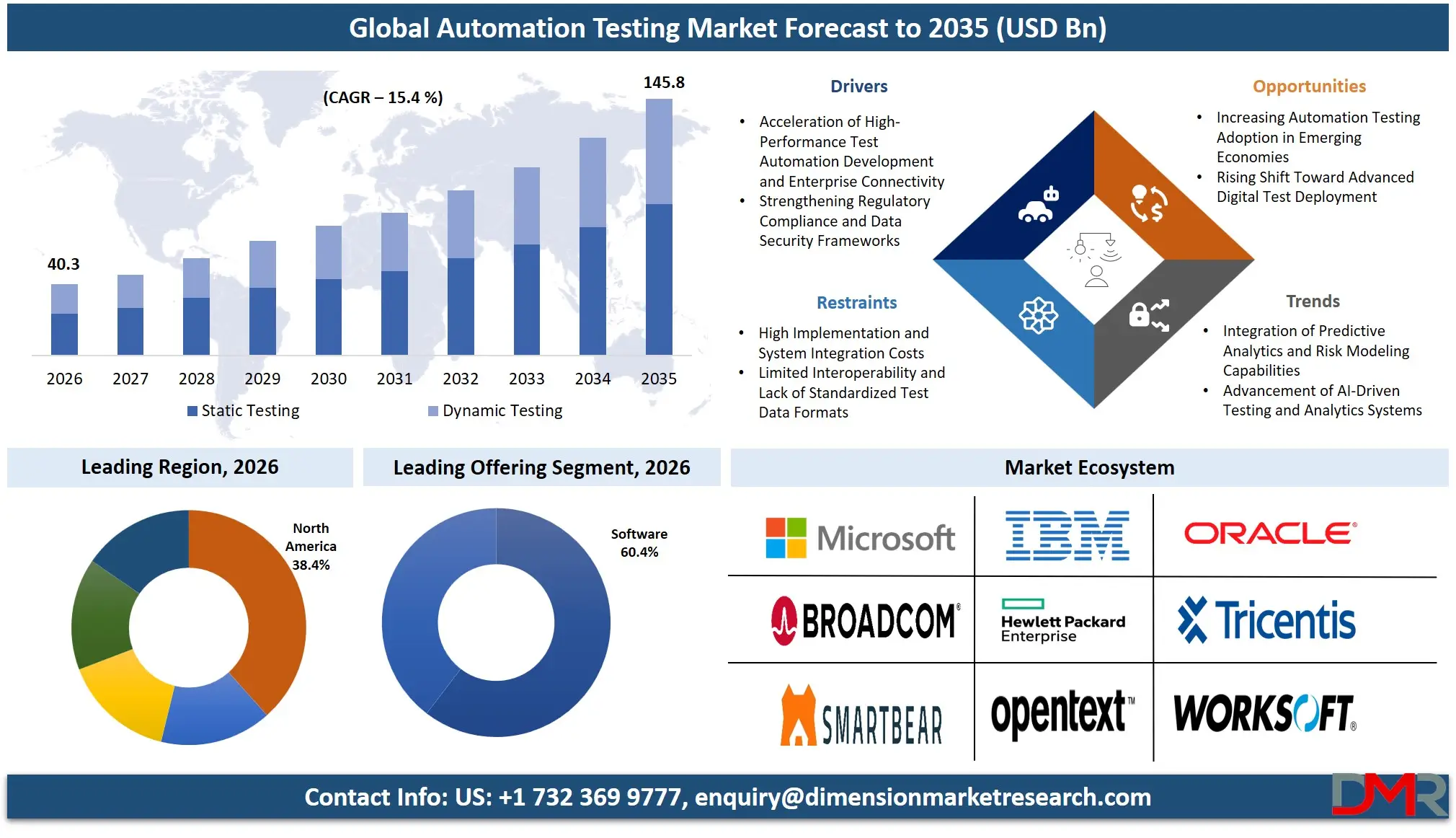
The Global Automation Testing Market size is estimated at USD 40.3 billion in 2026 and is projected to reach USD 145.8 billion by 2035, exhibiting a CAGR of 15.4% during the forecast period, driven by the rising use of continuous testing in CI/CD pipelines, AI-driven test script generation, shift-left testing adoption in hybrid architectures, and connected quality governance and compliance management systems.
ℹ
To learn more about this report –
Download Your Free Sample Report Here
The global automation testing market is expanding because of increasing use of intelligent test execution analytics and failure pattern recognition in detecting and analyzing anomalous application behavior, increasing regulatory mandates, which reduce the chance of data breaches during cross-system testing and speed up compliance audits for new digital projects, and more funding in automating privacy-preserving test data management. Some other reasons for expansion in this market include new technologies in runtime test environment stability management, test flakiness prediction through behavior analytics, automated event-driven test orchestration, high-volume parallel test execution platforms, and improved cross-supplier test data-sharing rules. The digital shift in hybrid and multi-cloud application development has been helpful in speeding up product development and making sensitive transaction testing easier. This includes encryption key analytics research for test data. In addition, government plans focusing on preventing data breaches and the secure digital economy have ensured steady research in automation testing systems.
ℹ
To learn more about this report –
Download Your Free Sample Report Here
The US Automation Testing Market
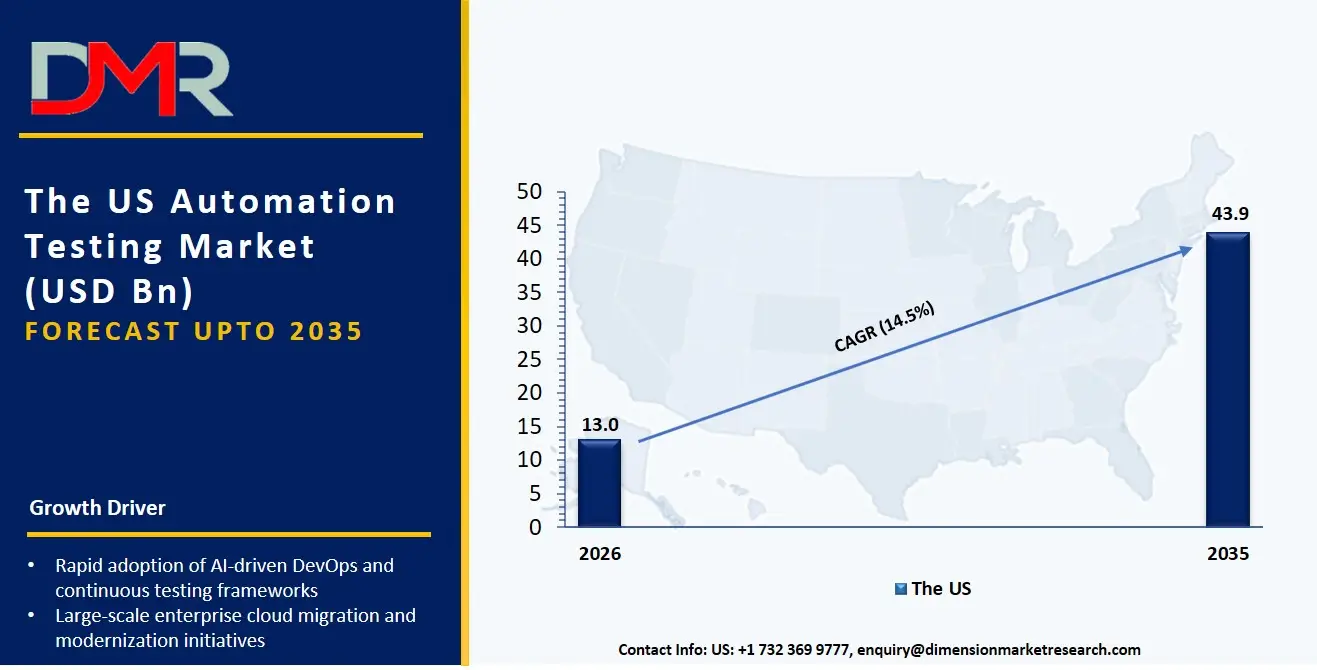
The US Automation Testing Market is estimated to grow to USD 13.0 billion in 2026 with a compound annual growth rate of 14.5% during the forecast period.
The US market is shaped by major federal and state-level programs promoting secure software development architectures, digital adoption supported by NIST and CISA, and DOD-led DevSecOps modernization initiatives. These programs encourage the use of high-fidelity test data processing, real-time test-in-transit protection, and predictive compliance software for testing workflows. Automated test security platforms are being rapidly adopted, and the US continues to invest in better test data sharing between R&D labs, encrypted audit systems for test results, and reliable test leakage detection tools for automation testing platforms. Service providers are also influenced by laws like HIPAA, SOX, and national digital strategies to offer services that ensure test data security, rule-following, and seamless integration across hybrid and multi-cloud testing environments.
ℹ
To learn more about this report –
Download Your Free Sample Report Here
Europe Automation Testing Market
The European Automation Testing Market is estimated to be valued at USD 10.2 billion in 2026, witnessing growth at a CAGR of 14.0%, during the forecast period.
Europe's automation testing market is well-established, shaped by EU-wide policies such as the Digital Single Market Strategy, the Data Governance Act, and national policies to support sustainable digital markets (e.g., Germany's industrial software testing plans and France's national digital strategies). Countries are also making test data security management more flexible to align platform operators and customer demands and enable the sharing of anonymized test integration data across borders. The market grows due to new tools like software for real-time test validation and risk scoring systems for test script stability. Teamwork between public and private groups and shared digital security rules make adoption easier. Manufacturers have access to technologies such as AI-based test process fine-tuning, test interaction modeling, and secure audit logging, and Europe is at the forefront of the digitisation of safe and efficient testing operations.
Japan Automation Testing Market
The Japan Automation Testing Market is projected to be valued at USD 2.1 billion in 2026, progressing at a CAGR of 13.2%, during the period spanning from 2026 to 2035.
Japan's automation testing market is well developed, with high-precision encryption test data platforms, connected secure test process blending management systems, and a wide array of system aging simulation software tools for test environments. National focus on automation, efficiency, and data integrity is delivered via test activity models and smart process protection. Growth opportunities are helped by government measures under the Digital Transformation Strategy by Japan's Ministry of Economy, Trade and Industry (METI), and continued investment in cloud modernization. AI-driven test research, multi-party analytics for application-specific test data sharing, and virtualized secure test environments all need effective automation testing software to keep pace with high-volume digital testing. Higher costs for validating new automation testing systems and connecting them with older test infrastructure are significant, but there are opportunities for the export of Japanese testing technologies to the Asian and Pacific markets.
Key Takeaways
- Market Size & Forecast: The Global Automation Testing Market is estimated to be valued at USD 40.3 billion in 2026 and is expected to grow to USD 145.8 billion by 2035.
- Growth Rate & Outlook: The market is expected to witness growth at a CAGR of 15.4% in the forecast period.
- Primary Growth Drivers: The availability of new testing technologies that use real-time test degradation detection, the need to speed up compliance results and improve success rates of test data sharing, and more government investment in national secure digital infrastructure are key growth drivers.
- Key Market Trends: The real-time profiling of test script stability risks, encrypted test data handling, and the shift to AI-driven test automation platforms and automated digital asset inventory management for test assets are key market trends.
- By Offering: The Software segment is expected to take the largest revenue share in the global automation testing market in 2026.
- By Testing Type: The Functional Testing segment is expected to take the largest revenue share in 2026.
- By End-Use Industry: The IT and Telecommunications segment is estimated to take the lead in 2026 with the largest share in the automation testing market.
- Regional Leadership: North America is estimated to take the lead in 2026 with 38.4% share in the automation testing market.
What is an Automation Testing?
Automation Testing refers to a combination of software tools and cloud-based execution technologies that provide QA teams, DevOps engineers, and compliance teams with enhanced capabilities beyond manual testing, including helping to improve test data handling during transfer, reducing test script failures through intelligent error detection, and enabling secure test analytics across environments. They include test automation frameworks, continuous testing platforms, test management tools, and performance visualization systems. These platforms use modern systems such as real-time test execution monitoring, test asset tracking, and remote test orchestration to manage, verify, and track software testing processes and results. To improve test reliability, manage process variability, and support application-specific testing programs, these systems help deliver secure and integrated testing workflows across enterprise environments.
Use Cases
- Market Stability for Daily Operations: Automation testing platforms provide operational stability through software (test analytics, monitoring) and control systems to reduce test execution failures and support faster validation cycles compared to manual testing.
- Long-Term Test Asset Management: Long-term data on test execution issues, including test flakiness, environment instability, and system degradation, is analyzed to improve software quality and support continuous testing strategies.
- Workload Balancing: Test execution workloads are managed through automation testing platforms in hybrid and multi-cloud environments to support high-volume parallel testing and efficient resource utilization.
- Government & Regulated Programs: Automation testing software supports secure software development and compliance requirements, helping organizations meet regulatory standards and adopt secure digital testing practices.
How AI Is Transforming the Global Automation Testing Market?
Artificial intelligence (AI) is increasingly used in automation testing platforms to improve test case generation, identify quality trends in test execution patterns, and detect anomalies in application behavior. It enables faster and more scalable test creation and execution across complex software environments. AI-based analytics of test results helps QA teams identify defects earlier in the development cycle, reduce human errors, and improve overall testing accuracy and reliability.
AI is also enhancing research and development by improving test risk assessment and enabling more efficient planning of test execution cycles in CI/CD pipelines. It helps QA teams estimate test coverage requirements, detect potential execution delays, and monitor system performance more effectively across web, mobile, API, and cloud applications. In addition, automation of routine testing tasks and compliance validation is reducing operational workload, lowering costs, and improving productivity. This shift is enabling organizations to achieve faster release cycles, higher software quality, and more stable, scalable, and efficient software delivery processes across enterprise environments.
Market Dynamics
Key Drivers of the Global Automation Testing Market
Acceleration of High-Performance Test Automation Development and Enterprise Connectivity
The market is growing with the rise of advanced cloud-based testing systems, improved management of test data streams, and a closer connection between performance monitoring and secure software testing. Automation testing platforms provide real-time data that allows monitoring of test execution activity, helping to identify performance issues early and improve test reliability. This has enhanced operational efficiency and reduced human errors and production costs. At the same time, demand for automated testing is being supported by increased use of predictive analytics for test risk assessment, as data science further improves workflow automation and test execution management.
Strengthening Regulatory Compliance and Data Security Frameworks
There is increasing emphasis on test data security, data integrity, and regulatory compliance within automation testing systems. Standards and frameworks such as GDPR, CCPA, HIPAA, SOX, and digital governance initiatives in key markets are encouraging better test data handling practices and structured security processes. These developments are supporting the need for systems that provide continuous monitoring of sensitive test data and standardized reporting. At the same time, efforts to improve test execution visibility and reduce validation errors are strengthening the need for more effective management systems across both public and private enterprises.
Restraints in the Global Automation Testing Market
High Implementation and System Integration Costs
The implementation process of the automation testing systems continues to be an expensive process, entailing substantial financial resources for acquiring test automation software, writing test scripts, integrating the systems, and fitting into continuous integration and continuous delivery processes. Moreover, the need to adhere to data-related laws such as GDPR makes the installation process more difficult.
Limited Interoperability and Lack of Standardized Test Data Formats
There is still fragmentation in test data formats and testing frameworks. Although some enterprises have adopted modern test management systems, many continue to operate hybrid environments combining legacy and automated testing tools. The lack of standardized test execution and reporting formats limits seamless integration between QA teams and platform providers, resulting in inefficiencies in testing workflows and deployment processes.
Growth Opportunities in the Global Automation Testing Market
Increasing Automation Testing Adoption in Emerging Economies
Emerging economies such as Brazil, Indonesia, Nigeria, the UAE, and Vietnam are gradually expanding their digital testing capabilities. These regions are witnessing increased adoption of cloud-based testing platforms and growing awareness of test security practices. As enterprises modernize their IT infrastructure, automation testing solutions are being deployed to improve software quality and reduce manual testing dependency.
Rising Shift Toward Advanced Digital Test Deployment
The shift toward cloud-based testing systems, distributed IT environments, and real-time performance monitoring is driving the adoption of advanced automation testing platforms. These systems enable centralized test execution, improved collaboration between QA teams, and more efficient management of test environments. As operational efficiency becomes a key competitive factor, organizations are increasingly investing in scalable automation testing solutions.
Global Automation Testing Market Trends
Integration of Predictive Analytics and Risk Modeling Capabilities
Automation testing platforms are increasingly integrating data-driven technologies to identify performance degradation trends and improve test execution efficiency. These systems allow QA teams to better analyze test behavior patterns, optimize test management, and enhance overall execution quality. This is gradually shifting the industry toward a more proactive and data-driven testing approach.
Advancement of AI-Driven Testing and Analytics Systems
The use of AI-based testing systems is becoming a core component of modern cloud-based testing environments. These systems enable real-time monitoring of test execution, centralized test management, and improved coordination across QA teams. Advanced automation testing platforms are enhancing operational efficiency by reducing dependence on manual testing and enabling scalable, intelligent test execution across global environments.
Research Scope and Analysis
The global automation testing market is witnessing strong growth driven by rising adoption of advanced testing technologies, batch process optimization, and increasing demand for high-security and high-efficiency test automation processes. The market is segmented based on offering, testing type, testing execution mode, deployment mode, interface, organization size, and end-use industry.
ℹ
To learn more about this report –
Download Your Free Sample Report Here
By Offering Analysis
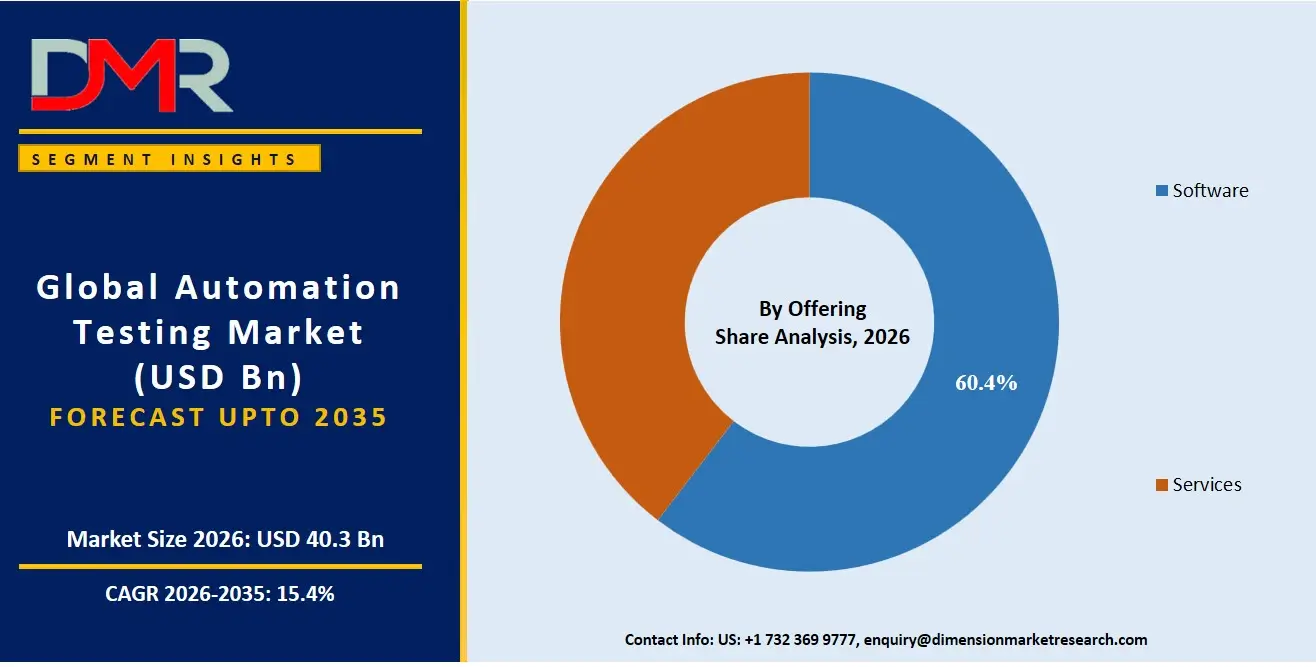
The Software segment is likely to continue dominating the market in 2026, accounting for approximately 60.4% of the global automation testing market share. This is due to its key role in enabling seamless test script creation, execution, and maintenance across enterprise applications, cloud environments, and hybrid IT infrastructures, along with its ability to support operational efficiency and enterprise-wide test interoperability. Within this segment, the Functional Testing Software sub-segment holds the largest share, driven by increasing CI/CD adoption, rising demand for regression test automation, and the need for real-time enterprise test connectivity. The Services segment is the fastest-growing, supported by increasing consulting, implementation, and managed services mandates.
By Testing Type Analysis
The Functional Testing segment is likely to continue holding the lead in 2026, accounting for approximately 42.0% of the global automation testing market share, driven by strong demand for regression testing, smoke testing, and user acceptance testing automation across industries. This segment reflects the continued shift toward agile and data-driven test operations. The Non-Functional Testing segment is the second-largest and fastest-growing, supported by enterprise needs for performance testing, security testing, and usability validation. Within Non-Functional Testing, Performance Testing holds the largest share, while Security Testing is the fastest-growing due to rising cyber threats.
By Testing Execution Mode Analysis
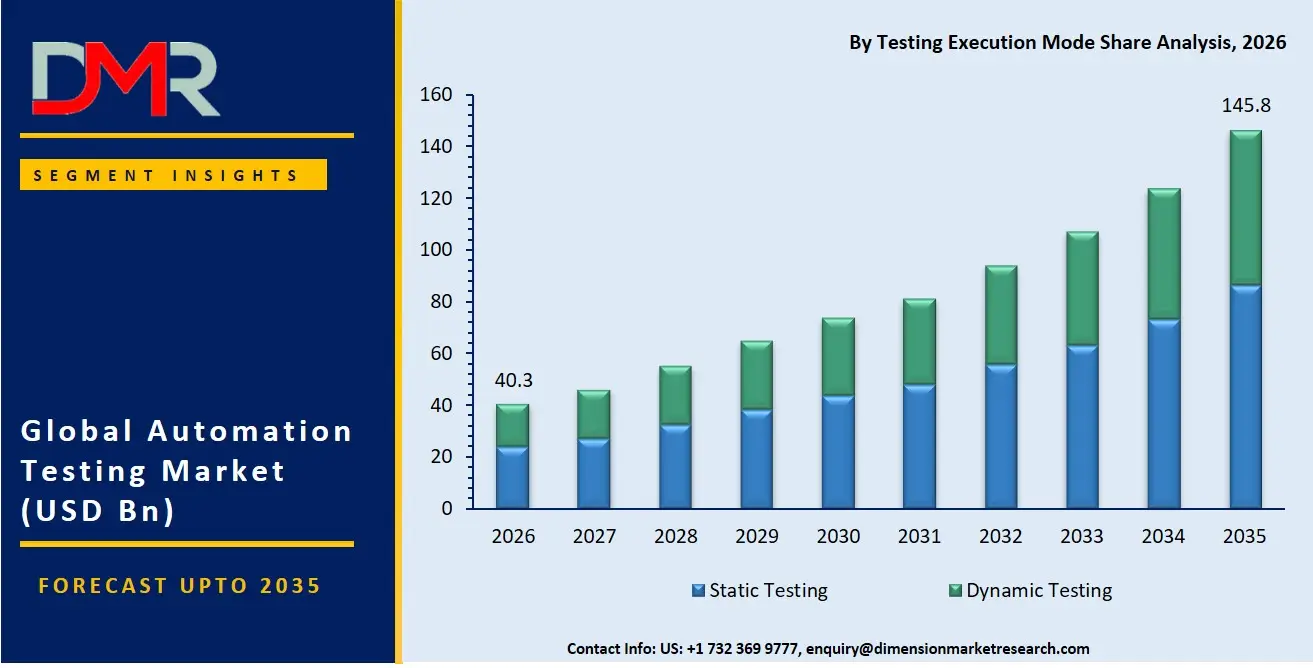
The Dynamic Testing segment is expected to dominate with around 59.4% market share in 2026, driven by the need for runtime validation, real-time behavior analysis, and execution-based defect detection. Dynamic testing platforms are adopting AI to optimize test execution and ensure operational excellence. The Static Testing segment is the second-largest, supported by early bug detection, code quality analysis, and lower cost of defect remediation.
By Deployment Mode Analysis
The Cloud-Based segment is likely to continue holding the lead in 2026, accounting for approximately 58.2% of the global automation testing market share, driven by strong demand for scalable, pay-per-execution testing, regulatory flexibility, and flexible processing across technologies. The On-Premises segment remains a mature segment focused on regulated industries where test data security and compliance are critical.
By Interface Analysis
The Web Testing segment is the largest in 2026, accounting for approximately 31.5% share, driven by the proliferation of web applications, cross-browser compatibility needs, and responsive design validation requirements. The Mobile Testing segment is the second-largest and fastest-growing, supported by the surge in mobile app adoption, device fragmentation, and need for real-device cloud testing. API Testing and Embedded Testing represent specialized segments with dedicated automation requirements for microservices and IoT/automotive systems.
By Organization Size Analysis
The Large Enterprises segment is expected to dominate with around 65.4% market share in 2026, driven by the need for enterprise-wide digital transformation, multi-system standardization, and significant capital budgets. Large-scale enterprises are adopting test automation platforms to optimize global test networks and ensure operational excellence. The Small & Medium-Sized Enterprises (SMEs) segment is the fastest-growing, supported by lower entry costs with open-source tools, subscription-based pricing, and increasing awareness of automation benefits.
By End-Use Industry Analysis
The IT and Telecommunications segment is the largest end-use industry in 2026, accounting for approximately 27.8% share, driven by the need for continuous testing in agile development, high release frequency, and API/ microservices validation. This segment reflects the continued shift toward digitalization of large-scale continuous integration pipelines. The BFSI segment is the second-largest and fastest-growing, supported by regulatory mandates for test traceability (e.g., SOX, PCI-DSS), high-mix low-volume transaction testing requirements, and fraud detection validation needs. Healthcare & Life Sciences and Retail & E-commerce represent specialized segments with dedicated automation testing requirements for HIPAA compliance and omnichannel user experience validation.
The Global Automation Testing Market Report is segmented based on the following:
By Offering
By Testing Type
- Functional Testing
- Non-Functional Testing
- Performance Testing
- Security Testing
- Usability Testing
- Others
By Testing Execution Mode
- Static Testing
- Dynamic Testing
By Deployment Mode
By Interface
- Web Testing
- Mobile Testing
- Desktop Testing
- API Testing
- Embedded Testing
By Organization Size
- Large Enterprises
- Small & Medium-Sized Enterprises (SMEs)
By End-Use Industry
- BFSI
- IT and Telecommunications
- Healthcare and Life Sciences
- Retail and E-Commerce
- Manufacturing
- Transportation and Logistics
- Government and Public Sector
- Energy and Utilities
- Others
Regional Analysis
Largest Region in the Automation Testing Market
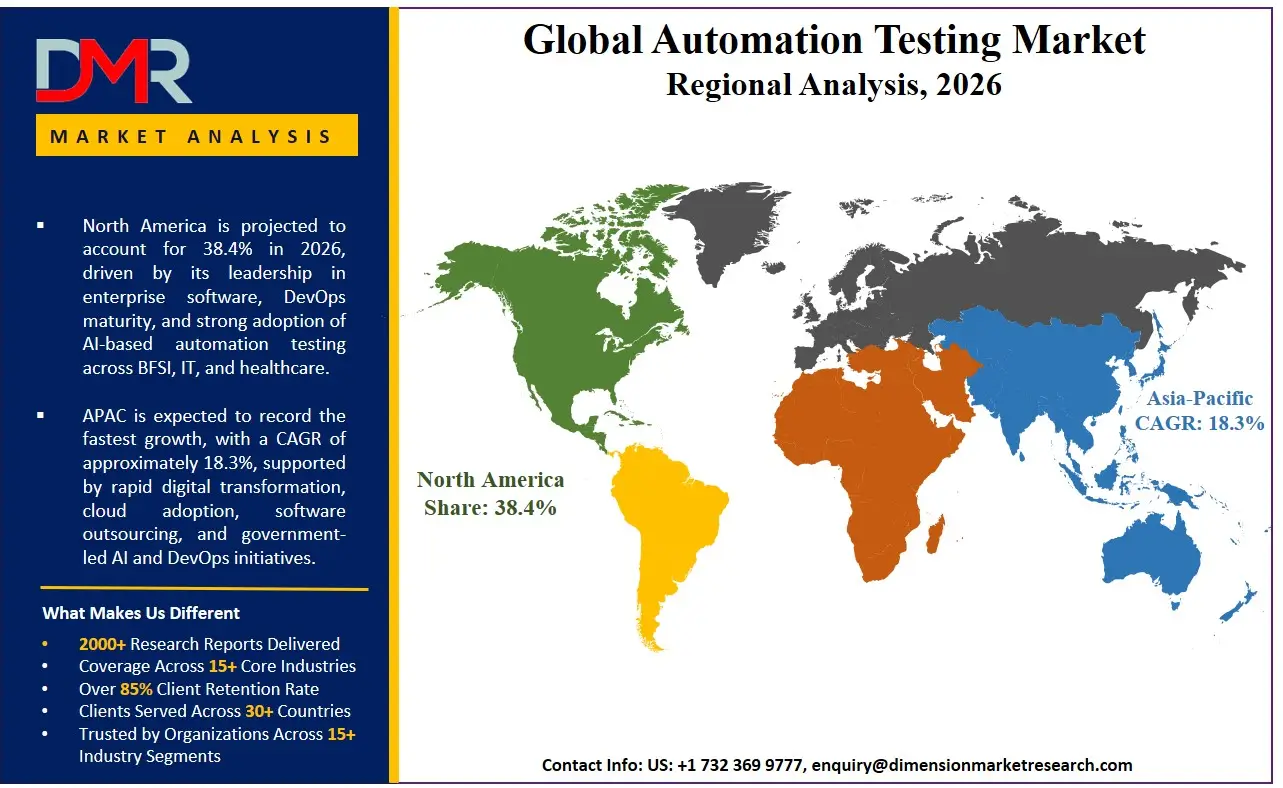
It is projected that North America will take the lead in the global automation testing market, covering a market share of about 38.4% in the year 2026. The region's dominance is driven by the presence of major test automation vendors, strong regulatory frameworks such as HIPAA, SOX, and state-level data privacy mandates, and early adoption of AI-driven test simulation and predictive maintenance technologies across the BFSI and healthcare sectors. North America benefits from significant investment in enterprise digitalization, the highest concentration of cloud modernization projects in the US, and strong government support through NIST funding for secure testing. The region is also home to major test automation platform providers and system integrators, enabling rapid deployment of enterprise-wide test automation. Additionally, ongoing investments in workforce training using AI-powered test assistants further strengthen North America's leading position. The widespread adoption of advanced test automation for continuous testing, test optimization, and batch test execution continues to reinforce the region's market leadership.
ℹ
To learn more about this report –
Download Your Free Sample Report Here
Fastest-Growing Region in the Automation Testing Market
Asia-Pacific is the fastest-growing region, supported by aggressive domestic cloud expansion in China and India, substantial government funding for smart factory and Industry 4.0 initiatives, and increasing investments in greenfield digital testing complexes that integrate test automation from the initial design phase. The region is witnessing rapid growth in cloud-based test environment construction, driving demand for cloud-based test simulation and process optimization software. Asia-Pacific is also at the forefront of AI-driven test automation deployment in high-growth sectors like manufacturing and e-commerce. The region benefits from lower labor costs, driving faster ROI on test automation, along with rising corporate commitments to operational excellence and security compliance. Growing focus on test data traceability for export markets further accelerates market expansion. Moreover, increasing data regulations and the need to reduce data breaches in rapidly industrializing economies are expected to keep Asia-Pacific's growth momentum as the highest CAGR region during the forecast period.
By Region
North America
Europe
- Germany
- The U.K.
- France
- Italy
- Russia
- Spain
- Benelux
- Nordic
- Rest of Europe
Asia-Pacific
- China
- Japan
- South Korea
- India
- ANZ
- ASEAN
- Rest of Asia-Pacific
Latin America
- Brazil
- Mexico
- Argentina
- Colombia
- Rest of Latin America
Middle East & Africa
- Saudi Arabia
- UAE
- South Africa
- Israel
- Egypt
- Rest of MEA
Competitive Landscape
The Automation Testing market is highly competitive, with new technologies and strategic partnerships shaping the competitive environment. To gain an advantage, companies and providers are focused on developing advanced automation testing platforms (such as AI-powered test generation, automated test flakiness detection systems, and software development kits for test management and security), enhanced test execution analytics, and cloud-based test environment monitoring. There are moderate to high barriers to entry due to the significant investment required for platform development, specialized test automation expertise, and the need for mature CI/CD-integrated software systems and regulatory compliance capabilities.
Strategic approaches to increase market presence include partnerships with technology providers and enterprise clients, mergers between testing software vendors and system integrators, and long-term enterprise contracts with commercial and regulated industry customers. Additionally, R&D in test data management, AI-driven test optimization, and scalable cloud testing frameworks is important for staying competitive and meeting the evolving requirements of the automation testing ecosystem.
Some of the prominent players in the Global Automation Testing Market are:
- International Business Machines Corporation (IBM)
- Microsoft Corporation
- Oracle Corporation
- Broadcom Inc.
- Hewlett Packard Enterprise Company
- Tricentis GmbH
- SmartBear Software, Inc.
- Open Text Corporation
- Parasoft Corporation
- Worksoft, Inc.
- Ranorex GmbH
- Katalon, Inc.
- Leapwork A/S
- Sauce Labs Inc.
- BrowserStack Software Private Limited
- LambdaTest Inc.
- Applitools Ltd.
- Perforce Software, Inc.
- Mabl, Inc.
- Accenture plc
- Other Key Players
Recent Developments
- March 2026: Microsoft Corporation announced the retirement of Microsoft Playwright Testing Preview (effective March 8, 2026) and initiated migration toward Azure App Testing Playwright Workspaces, enabling scalable cross-browser testing integrated into CI/CD pipelines and GitHub Actions workflows.
- January 2026: BrowserStack Software Private Limited announced a USD 125 million share buyback program, providing liquidity to approximately 500 employees and early investors, reinforcing its strong financial position and continued expansion in cloud-based cross-browser and mobile application testing services.
- October 2025: Tricentis GmbH announced a major expansion of its AI-powered quality engineering platform at Tricentis Transform 2025, introducing a unified AI workspace, agentic test automation capabilities, and Model Context Protocol (MCP)-based orchestration across its Tosca, qTest, NeoLoad, and SeaLights portfolio, enabling enterprises to scale autonomous testing across CI/CD pipelines.
- October 2025: Sauce Labs Inc. expanded its continuous testing platform with enhanced AI-driven test analytics and deeper CI/CD integrations across GitHub Actions, GitLab, and Jenkins, strengthening its position in cloud-based cross-browser and mobile application testing infrastructure for enterprise DevOps teams.
Report Details
| Report Characteristics |
| Market Size (2026) |
USD 40.3 Bn |
| Forecast Value (2035) |
USD 145.8 Bn |
| CAGR (2026–2035) |
15.4% |
| The US Market Size (2026) |
USD 13.0 Bn |
| Historical Period |
2021 – 2025 |
| Forecast Period |
2027 – 2035 |
| Base Year |
2025 |
| Estimated Year |
2026 |
| Segments Covered |
By Offering, By Testing Type, By Testing Execution Mode, By Deployment Mode, By Interface, By Organization Size, By End-Use Industry |
| Regional Coverage |
North America – The US and Canada; Europe – Germany, The UK, France, Russia, Spain, Italy, Benelux, Nordic, & Rest of Europe; Asia-Pacific – China, Japan, South Korea, India, ANZ, ASEAN, Rest of APAC; Latin America – Brazil, Mexico, Argentina, Colombia, Rest of Latin America; Middle East & Africa – Saudi Arabia, UAE, South Africa, Turkey, Egypt, Israel, & Rest of MEA |
Frequently Asked Questions
How big is the Global Automation Testing Market?
▾ The Global Automation Testing Market is estimated to be valued at USD 40.3 billion in 2026 and is expected to reach USD 145.8 billion by the end of 2035.
What is the CAGR of the Global Automation Testing Market from 2026 to 2035?
▾ The market is growing at a CAGR of 15.4% over the forecasted period.
What factors are driving the growth of the Global Automation Testing Market?
▾ The market is driven by advances in real-time test process degradation detection and automated test enforcement, regulatory pressure to speed up test compliance results and reduce test script failure mistakes, and increased government investment in national secure digital infrastructure.
What are the major trends in the Global Automation Testing Market?
▾ The key market trends include the adoption of real-time test script stability tracking and encrypted test data analysis, along with a growing shift toward AI-driven test automation platforms and data-enabled digital asset inventory management systems for test assets.
Which region held the largest share of the Global Automation Testing Market in 2026?
▾ North America is expected to account for the largest market share in 2026, with a share of about 38.4%.
Which region is expected to grow the fastest in the Global Automation Testing Market?
▾ Asia Pacific is the fastest-growing region in the market during the forecast period.
Who are the key players in the Global Automation Testing Market?
▾ Some of the major key players in the Global Automation Testing Market are Tricentis GmbH, IBM, Microsoft Corporation, Broadcom, Inc., Oracle Corporation, SmartBear Software, Inc., Parasoft Corporation, and many others.
How is the Global Automation Testing Market segmented?
▾ The market is segmented by offering, testing type, testing execution mode, deployment mode, interface, organization size, and end-use industry.