Market Snapshot
- The Global Automotive AI Agents Market is valued at USD 3.8 Billion in 2025.
- Analysts project the market to reach USD 13.01 Billion by 2035.
- Autonomous Driving AI Agents lead the agent type segment with a 41.2% share.
- Passenger Vehicles dominate the vehicle type segment with a 69.1% share.
- Driver Assistance and Safety leads applications with a 45.8% share.
- Edge and On-Board AI Agents dominate deployment type with a 49.2% share.
- North America leads the regional landscape with a 40.2% share.
Market Overview
The automotive AI agents market covers software systems that perceive, decide, and act inside a vehicle or across a fleet without constant human input. It excludes standalone infotainment screens and basic cruise control systems that follow fixed rules rather than adaptive reasoning. Dealerships now sit inside Automotive AI Agents Market too, since AI agents guide buyers before a vehicle is even built. A Salesforce survey of over 1,000 car owners found 70% would use an AI agent to diagnose and address car issues in real time.
Sonatus opened an engineering design center in Pune in November 2024 to expand its software-defined vehicle work. That move signals a shift away from Silicon Valley as the sole source of automotive AI talent. Waymo's driving agents were involved in 92% fewer crashes causing serious injuries than human drivers over the same period. Insurers and regulators now treat that gap as evidence rather than marketing.
Vehicles built after 2024 increasingly ship with centralized compute rather than dozens of separate control units. That architecture shift lets one AI agent govern safety, navigation, and cabin comfort at once. Suppliers who miss this transition risk losing the software layer to companies built around AI from the start.
Market Size and Forecast
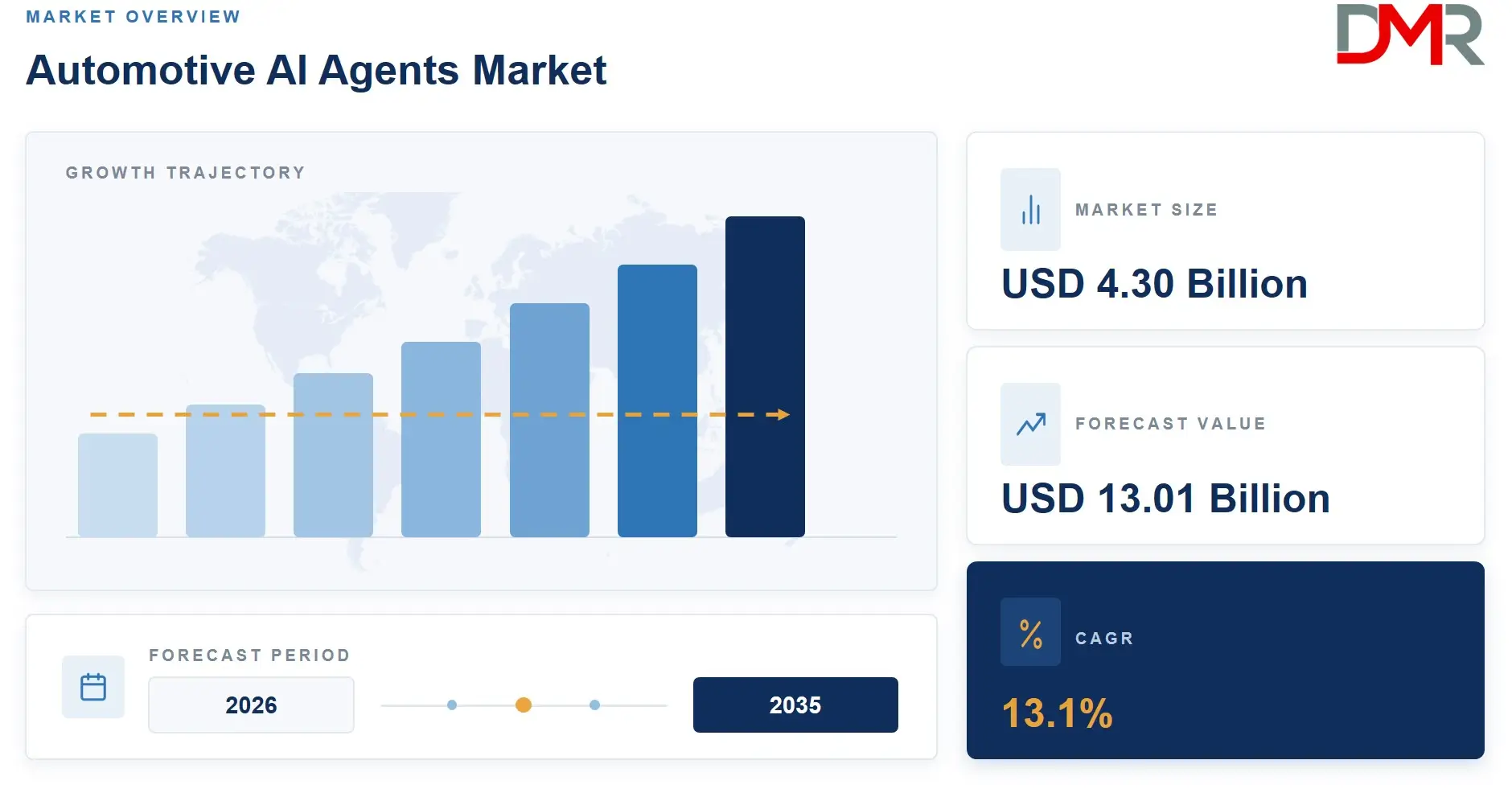
The Global Automotive AI Agents Market size is estimated at USD 4.30 Billion in 2026 from USD 3.8 Billion in 2025, and is projected to reach USD 13.01 Billion by 2035, exhibiting a CAGR of 13.1% during the forecast period.
Dealership adoption underpins much of the near-term climb. Cox Automotive's 2025 study of 516 franchise dealership leaders found 81% believe AI is now a permanent fixture in auto retail. Toyota Connected's dealership assistant, built on Amazon Bedrock, now serves over 2,300 dealerships and handles more than 7,000 monthly interactions. That scale shows AI agents moving from pilot to daily infrastructure inside a single year.
ℹ
To learn more about this report –
Download Your Free Sample Report Here
Ride volume adds a second growth track outside the dealership. Waymo served over 14 million autonomous trips in 2025, more than tripling its prior-year volume. [Stat 20 → USED] Qualcomm's April 2025 acquisition of Movian AI strengthened its edge AI stack for exactly this kind of scaling. Applied Intuition raised USD 600 million in a Series F round in June 2025, reaching a USD 15 billion valuation to expand its vehicle intelligence platform. Funding at that size confirms investors expect the agent layer to become as valuable as the vehicle itself.
Agent Type Analysis
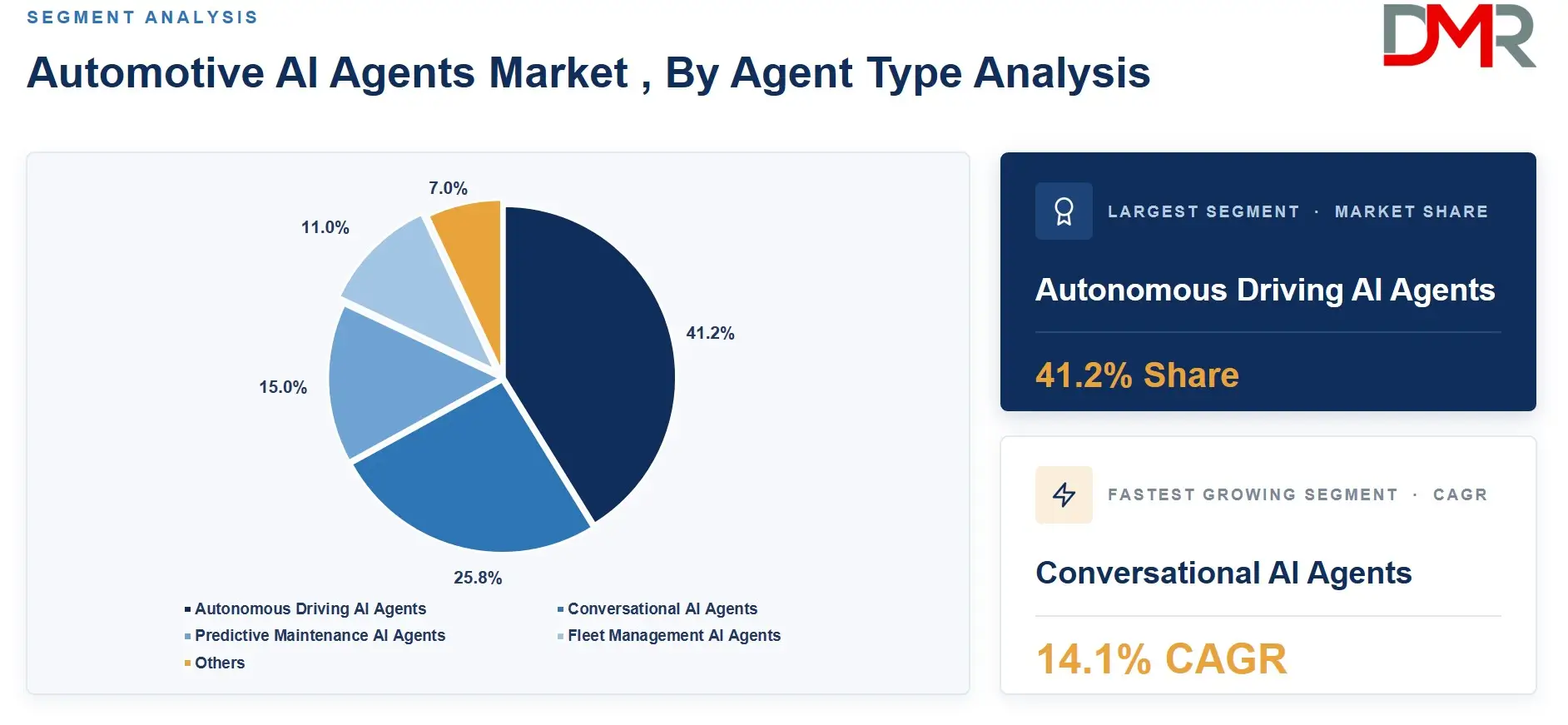
Autonomous Driving AI Agents led the agent type segment with a 41.2% share in 2026.
Autonomous Driving AI Agents took the lead because OEMs now treat driving decisions as software, not hardware. Tesla and Waymo compete on how fast their agents learn, not on sensor count alone. That shift rewards companies with the largest real-world driving datasets.
Conversational AI Agents grow the fastest among the remaining categories as OEMs replace scripted voice commands with open dialogue. Predictive Maintenance AI Agents follow close behind, pulled forward by fleet operators chasing lower repair bills. Fleet Management AI Agents remain a smaller category today but carry outsized value for logistics buyers managing hundreds of vehicles at once. Vendors that bundle these four categories into one subscription stand to capture more revenue per vehicle than those selling driving software alone.
ℹ
To learn more about this report –
Download Your Free Sample Report Here
Vehicle Type Analysis
With a 69.1% share in 2026, Passenger Vehicles outpaced all other vehicle type categories.
Passenger Vehicles hold this lead because consumer purchase volume simply dwarfs commercial fleet volume. Every new passenger model launch now becomes an opportunity to sell an AI subscription tier. Automakers protect margin this way as vehicle hardware itself commoditizes.
Electric Vehicles show the sharpest momentum within the category, since EV platforms already carry the centralized compute agents need. Commercial Vehicles trail passenger volume but generate higher per-unit AI value through fleet-wide coordination. Autonomous Vehicles remain the smallest category by volume yet attract the largest share of new investment dollars. Buyers weighing near-term revenue should watch EVs, while buyers weighing long-term margin should watch autonomous fleets.
Application Analysis
Driver Assistance and Safety accounted for 45.8% of application demand in 2026, the highest of any category.
Safety mandates across major markets forced this category to the top. AI-enabled dealerships on the Impel platform recorded a 27% higher showroom appointment-set rate than non-AI dealerships in 2025. Regulators effectively subsidized this segment's growth by tightening collision-avoidance rules.
In-Vehicle Virtual Assistants grow quickly as voice interfaces become the default control method inside the cabin. Impel-enabled dealerships also posted a 27% increase in repair orders from existing customers. Toyota's AI-driven visual inspection system cut inspection time per vehicle by 73% while raising defect detection by 16%. Predictive Maintenance and Fleet and Logistics Management now compete for the same buyer, the fleet operator counting downtime in dollars per hour.
Deployment Type Analysis
A 49.2% share made Edge and On-Board AI Agents the clear leader across deployment type categories in 2026.
Edge deployment leads because latency inside a moving vehicle cannot tolerate a round trip to the cloud. Safety decisions measured in milliseconds simply cannot wait on network conditions. Chipmakers building faster on-vehicle silicon capture the most value in this category.
Cloud-Based AI Agents remain useful for tasks without hard timing limits, such as route history and personalization profiles. Hybrid Deployment is emerging as the practical middle path, running safety logic on-vehicle while offloading heavier reasoning to the cloud. Vendors betting only on cloud architecture risk losing safety-critical contracts entirely.
Key Market Segments
By Agent Type
- Autonomous Driving AI Agents
- Highway Autopilot Agents
- Urban Navigation Agents
- Conversational AI Agents
- Predictive Maintenance AI Agents
- Fleet Management AI Agents
- Others
By Vehicle Type
- Passenger Vehicles
- Commercial Vehicles
- Electric Vehicles (EVs)
- Autonomous Vehicles
By Application
- Driver Assistance and Safety
- In-Vehicle Virtual Assistants
- Predictive Maintenance
- Fleet and Logistics Management
- Infotainment Personalization
By Deployment Type
- Edge and On-Board AI Agents
- Cloud-Based AI Agents
- Hybrid Deployment
Regional Analysis
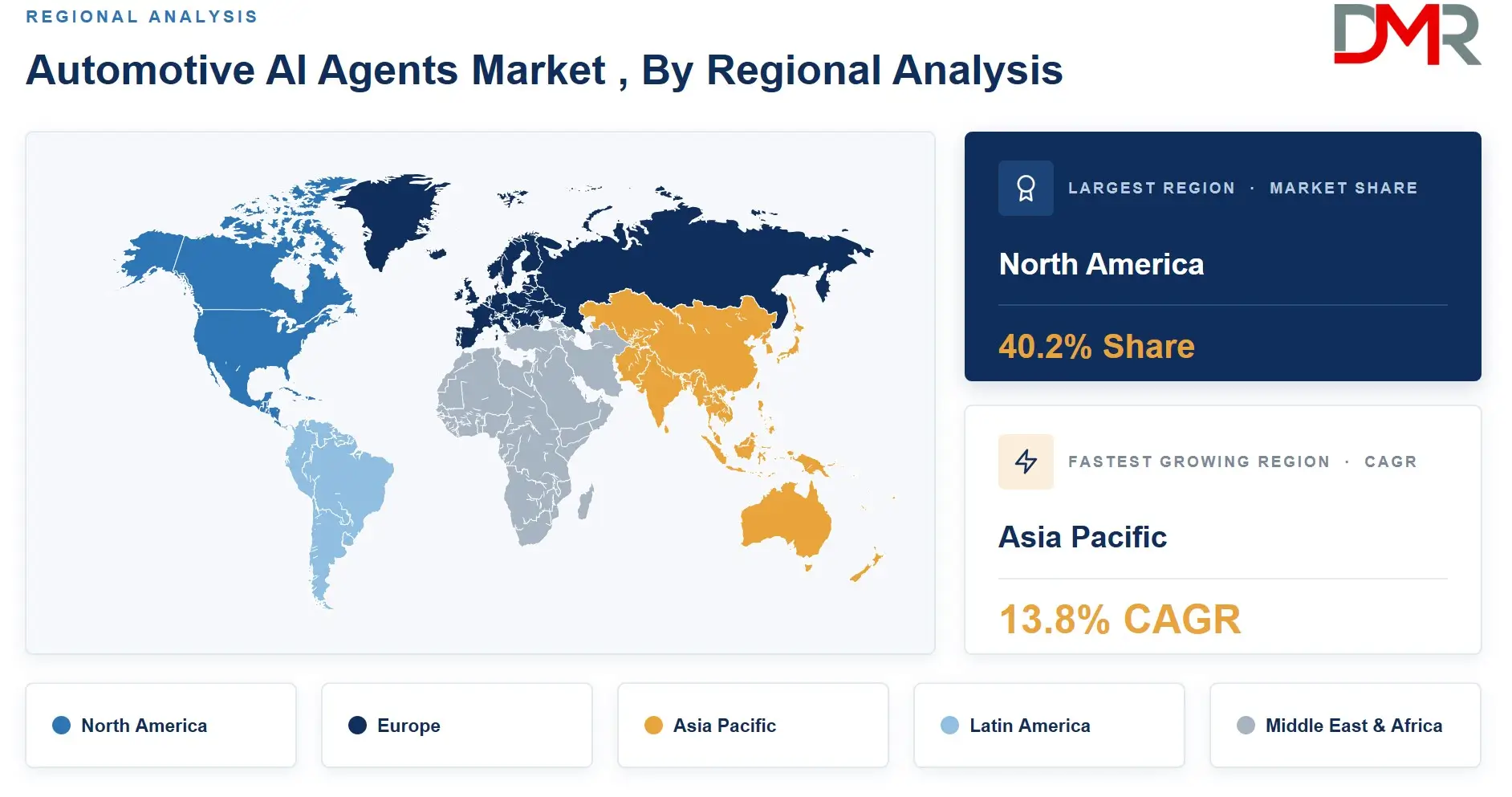
North America led the market with a 40.2% share, worth roughly USD 1.53 Billion in 2026.
North America leads because its dealership networks and autonomous ride operators moved first and moved fastest. Waymo's electric fleet helped riders avoid over 18 million kilograms of CO2 emissions in 2025, three times the prior year. [Stat 17 → USED] With roughly 250,000 EV trips per week in the San Francisco Bay Area, Waymo's agents prevent an estimated 315 tons of CO2 emissions weekly, and 36% of riders connect to public transit afterward. [Stat 18 → USED] That density of deployment gives North America a data advantage rivals cannot close quickly.
ℹ
To learn more about this report –
Download Your Free Sample Report Here
Asia Pacific grows fastest as Chinese and Korean automakers push agent software into mass-market EVs at lower price points. Europe holds steady demand, anchored by German and French OEMs integrating voice agents into flagship models. Latin America and the Middle East and Africa remain early-stage markets, but both offer low competitive density for vendors willing to enter now rather than after the segment matures.
Key Regions and Countries
North America
Europe
- Germany
- France
- The UK
- Spain
- Italy
- Rest of Europe
Asia Pacific
- China
- Japan
- South Korea
- India
- Australia
- Rest of APAC
Latin America
- Brazil
- Mexico
- Rest of Latin America
Middle East & Africa
- GCC
- South Africa
- Rest of MEA
Market Dynamics
Centralized Compute Replaces Distributed ECUs
Automakers are consolidating dozens of separate control units into one centralized compute platform. This architecture lets a single AI agent govern safety, comfort, and diagnostics together instead of managing isolated modules. TRATON Group partnered with Applied Intuition in March 2025 to accelerate exactly this shift for software-defined trucks.
Predictive maintenance reinforces this driver on the factory floor. Toyota's in-house AI Platform is projected to save 10,000 hours of manual work annually across quality inspection and defect detection. AI-powered predictive maintenance more broadly delivers a 50% reduction in unplanned downtime compared to reactive strategies. [Stat 14 → USED] Manufacturers now treat AI agents as a cost center killer rather than an optional upgrade.
Edge Compute Limits Cap Onboard Reasoning
Vehicles carry limited processing power and battery budget, which forces trade-offs between compact models and full reasoning capacity. Commercial deployments in 2025 and 2026 hold perception agents to latency under 50 milliseconds and safety monitor agents under 10 milliseconds. [Stat 19 → USED] Engineers cannot simply add a bigger model when a decision must land inside a fixed time window.
Cybersecurity compounds this constraint. Every sensor, model weight, and actuator becomes a possible attack surface once a vehicle runs autonomous decision software. Suppliers now design hardware root-of-trust systems before fleet-wide rollout, adding cost and delay that smaller vendors struggle to absorb.
Hybrid Cloud-Edge Architecture Opens New Contracts
Isuzu Motors partnered with Applied Intuition in August 2025 to build Level 4 autonomous trucks, a deal that depends on balancing onboard and cloud reasoning. Volvo Trucks and Mack Trucks' AI and IoT remote diagnostics system, covering over 175,000 trucks, cut diagnostic time by 70%. [Stat 15 → USED] Fleet operators now demand this hybrid model as the default rather than an experimental option.
Siemens' Senseye generative AI solution can extend machine life by up to 50% and cut spare parts consumption by 20%. [Stat 16 → USED] Applied Intuition's June 2025 partnership with OpenAI to embed advanced AI into in-vehicle dashboards points toward the same hybrid direction. Vendors offering pre-built hybrid stacks will win contracts faster than those forcing OEMs to build from scratch.
Market Trends
Cockpit Compute Becomes the New Product Center
CES 2026 repositioned the industry from software-defined vehicles toward AI-defined vehicles, placing compute at the center of the cockpit rather than the engine bay. Sonatus showcased edge AI and predictive diagnostics at the same event alongside Bosch, Michelin, NXP, and Renesas. Driver sentiment backs this shift directly, with roughly 70% of drivers open to agents managing their vehicle in real time. Early movers who ship agent-first cockpits now will set the interface standard competitors chase for the next decade.
Market Competition Overview
The market remains fragmented, split between chipmakers, cloud providers, and pure-software autonomy specialists rather than dominated by one type of player. NVIDIA and Qualcomm compete on silicon while Alphabet's Waymo and Tesla compete on driving data volume. A peer-reviewed study covering 56.7 million Waymo miles found 96% fewer injury-involving intersection crashes than human benchmarks. That kind of safety data becomes a competitive moat few rivals can replicate quickly.
Waymo also reported 92% fewer pedestrian injury crashes and 85% fewer cyclist injury crashes relative to human drivers. Traditional Tier 1 suppliers like Bosch and Continental are losing software margin to companies built around AI from inception. Consolidation through acquisition, rather than organic build-out, is becoming the fastest path to catching up.
Company Profiles
NVIDIA Corporation supplies the compute hardware underneath most automotive AI agent stacks sold today. Its position rests on chip performance rather than any single OEM relationship, which insulates it from losing one contract. At Waymo's current operating scale, its driving agents are estimated to prevent one serious-injury crash every 8 days. [Stat 12 → USED] Chip-first positioning gives NVIDIA leverage across nearly every other company in this market.
Alphabet Inc. (Waymo) competes on driving miles rather than hardware specifications. Automotive component facilities using comparable AI visual inspection methods report 37% fewer defects and a 22% increase in Overall Equipment Effectiveness. [Stat 13 → USED] Sonatus, a smaller but fast-moving rival, closed 2025 with its software deployed across more than six million vehicles worldwide alongside an expanded Nissan collaboration. Waymo's risk lies in regulatory pushback outpacing its mileage advantage before rivals catch up on safety data.
Key Players
- NVIDIA Corporation
- Alphabet Inc. (Waymo)
- Tesla Inc.
- Intel Corporation (Mobileye)
- Qualcomm Technologies
- Microsoft Corporation
- Amazon Web Services (AWS)
- IBM Corporation
- Bosch
- Continental AG
- Other Key Players\
Recent Developments
- March 2024 Applied Intuition raised USD 250 Million in a Series E round, reaching a 6 billion valuation to accelerate autonomous driving software.
- March 2024 Applied Intuition partnered with Porsche to jointly develop next-generation automotive software and AI-enabled vehicle technologies.
- April 2024 Applied Intuition announced a collaboration with Audi to develop automated driving systems and AI-powered vehicle software.
- June 2024 Applied Intuition launched its off-road autonomy software stack, enabling AI-powered navigation across unstructured terrain.
- January 2025 Sonatus introduced generative AI enhancements to its AI Technician and Automator AI platforms at CES 2025.
- May 2025 Applied Intuition launched Axion and Acuity, two AI-powered autonomy products for defense and vehicle systems.
- June 2025 Qualcomm completed its acquisition of Autotalks to strengthen vehicle-to-everything communication technology.
- September 2025 Sonatus launched AI Director, an edge AI platform for large-scale deployment across software-defined vehicles.
Report Details
| Report Characteristics |
| Market Value (2025) |
USD 3.8 Billion |
| Market Value (2026) |
USD 4.30 Billion |
| Forecast Revenue (2035) |
USD 4.30 Billion |
| CAGR (2026–2035) |
13.1% |
| Base Year for Estimation |
2025 |
| Historic Period |
2020 – 2024 |
| Forecast Period |
2026 – 2035 |
| Report Coverage |
Revenue Forecast, Market Dynamics, Competitive Landscape, Recent Developments |
| Segments Covered |
By Agent Type (Autonomous Driving AI Agents, Conversational AI Agents, Predictive Maintenance AI Agents, Fleet Management AI Agents, Others), By Vehicle Type (Passenger Vehicles, Commercial Vehicles, Electric Vehicles, Autonomous Vehicles), By Application (Driver Assistance and Safety, In-Vehicle Virtual Assistants, Predictive Maintenance, Fleet and Logistics Management, Infotainment Personalization), By Deployment Type (Edge and On-Board AI Agents, Cloud-Based AI Agents, Hybrid Deployment) |
| Regional Analysis |
North America – US and Canada; Europe – Germany, France, The UK, Spain, Italy, and Rest of Europe; Asia Pacific – China, Japan, South Korea, India, Australia, and Rest of APAC; Latin America – Brazil, Mexico, and Rest of Latin America; Middle East & Africa – GCC, South Africa, and Rest of MEA |
| Competitive Landscape |
NVIDIA Corporation, Alphabet Inc. (Waymo), Tesla Inc., Intel Corporation (Mobileye), Qualcomm Technologies, Microsoft Corporation, Amazon Web Services (AWS), IBM Corporation, Bosch, Continental AG, Other Key Players |
| Customization Scope |
Customization for segments and region or country level will be provided. Additional customization can be done based on requirements. |
| Purchase Options |
Three license options: Single User License, Multi-User License (Up to 5 Users), and Corporate Use License (Unlimited Users and Printable PDF) |
Frequently Asked Questions
What is the biggest investment opportunity in Automotive AI Agents Market ?
▾ Hybrid cloud-edge architecture stands out as the clearest opportunity through 2035. Vendors that pre-build this balance for OEMs win contracts faster than those forcing custom builds.
Who are the top companies in Automotive AI Agents Market ?
▾ NVIDIA Corporation and Alphabet Inc. (Waymo) lead through chip performance and driving mileage data respectively. Tesla, Qualcomm, and Bosch round out the next tier of competitors.
Which segment is growing fastest in Automotive AI Agents Market and why?
▾ Electric Vehicles grow fastest within vehicle type since EV platforms already carry the centralized compute AI agents require. That head start lowers integration cost for automakers.
Which region is growing fastest in Automotive AI Agents Market and why?
▾ Asia Pacific grows fastest as Chinese and Korean automakers push agent software into mass-market EVs at lower price points than North American rivals.
What is the biggest challenge holding Automotive AI Agents Market back?
▾ Onboard compute limits force engineers to trade model size for speed. Safety monitor agents must respond in under 10 milliseconds, leaving little room for larger, more capable models.