Market Overview
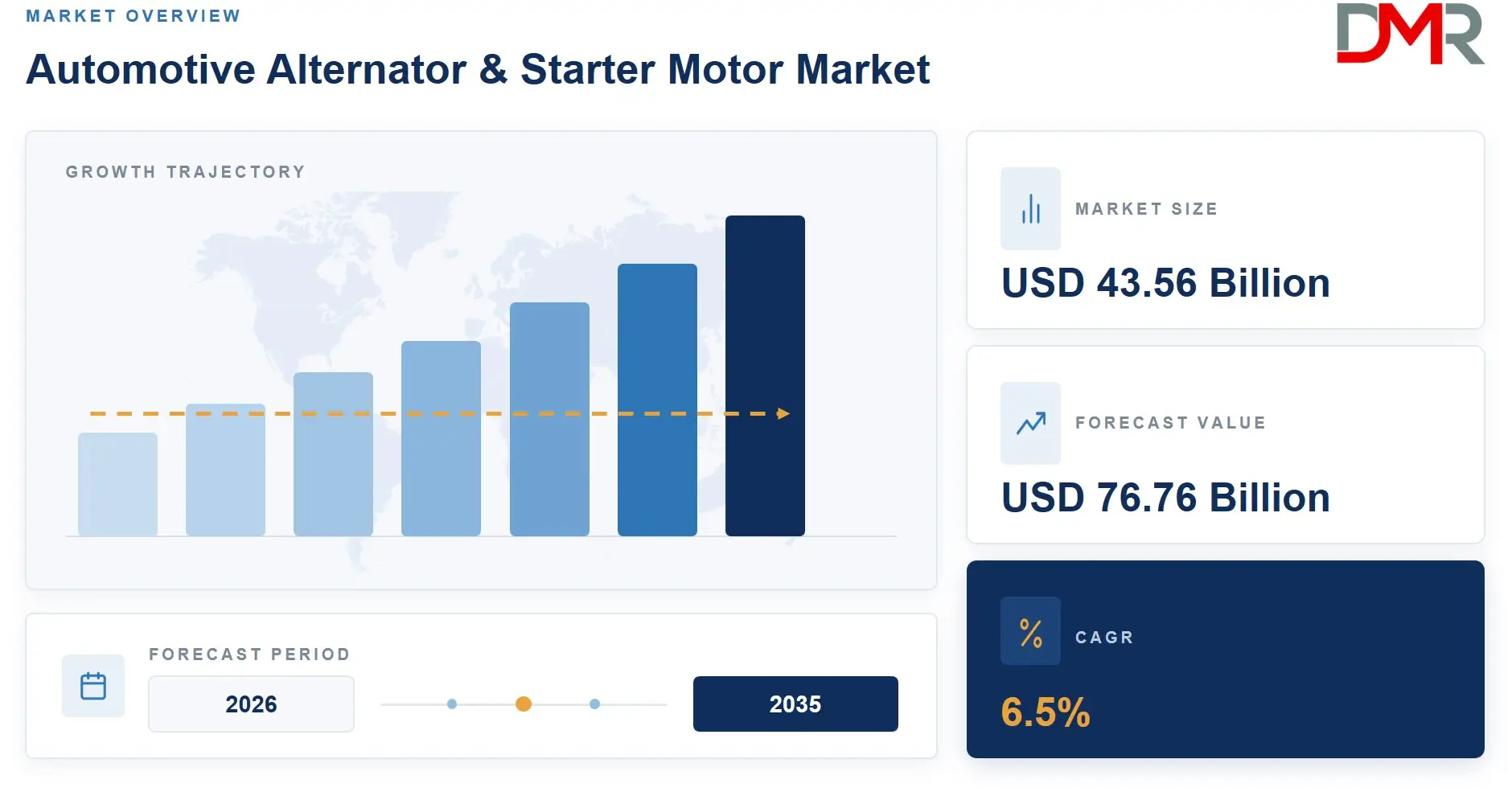
The Global Automotive Alternator & Starter Motor Market size is estimated at USD 43.56 Billion in 2026, and is projected to reach USD 76.76 Billion by 2035, exhibiting a CAGR of 6.5% during the forecast period.
Growth between 2020 and 2024 was anchored by an expanding global vehicle parc, rising replacement cycles in aging fleet segments, and accelerating penetration of stop-start systems in passenger vehicles. The forecast to 2035 rests on sustained OEM integration of mild hybrid architectures, commercial fleet expansion in South and Southeast Asia, and aftermarket volume building across underserved African service networks. As reported by Valeo, its 48V belt starter-generator was installed in approximately 30% of mild-hybrid vehicles worldwide by November 2025, a benchmark that frames the scale of hybrid-driven component demand entering the forecast period. In May 2025, Bosch injected capital expansion funding into high-efficiency starter motors, advanced starter generators, and smart charging configurations, confirming that Tier-1 suppliers are positioning for volume growth well ahead of OEM production ramp-ups.
The market covers alternators, starter motors, and integrated starter-generator units fitted to internal combustion engine vehicles, mild hybrid platforms, and selected stop-start architectures. Battery electric vehicle powertrains fall outside the scope. Automotive Electrical Components form the adjacent ecosystem within which alternators and starter motors operate, connecting electrical generation directly to chassis load management and battery conditioning systems. The Automotive Engine platform defines the mechanical interface for every alternator and starter motor design, meaning engine architecture shifts — particularly toward downsized turbocharged units and 48V mild hybrid systems — directly reshape specification requirements across the supply base. Demand conditions in the aftermarket channel remain structurally durable because no electrification pathway eliminates replacement demand for the existing ICE and hybrid fleet within a decade.
ℹ
To learn more about this report –
Download Your Free Sample Report Here
Key Takeaways
- The market size is USD 43.56 Billion in 2026, and is projected to hit USD 76.76 Billion by 2035 at a CAGR of 6.5%.
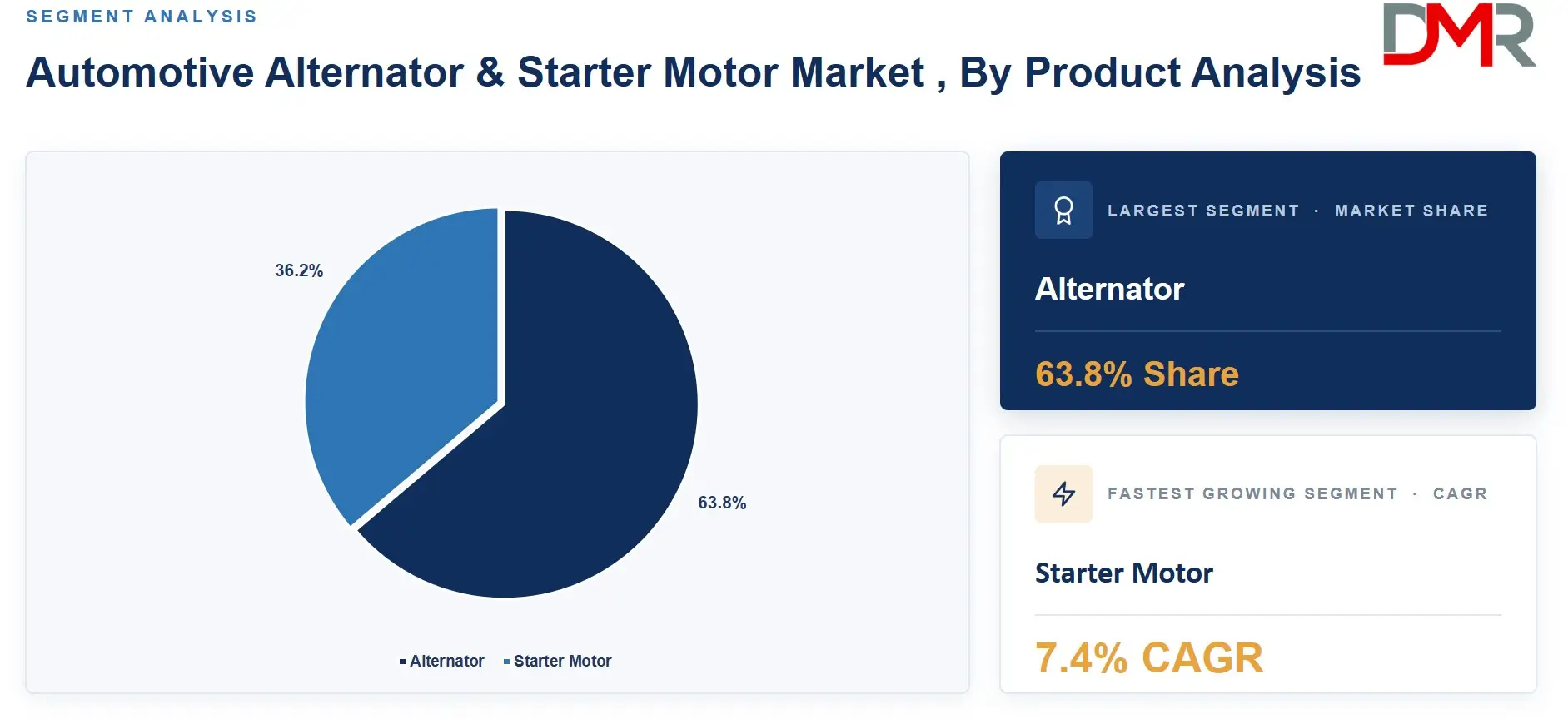
- By Product: Alternator led as the largest category with a 63.8% share in 2026.
- By Vehicle Type: Passenger Vehicle led as the largest category with a 67.8% share in 2026.
- By Sales Channel: OEM led as the largest category with a 70.9% share in 2026.
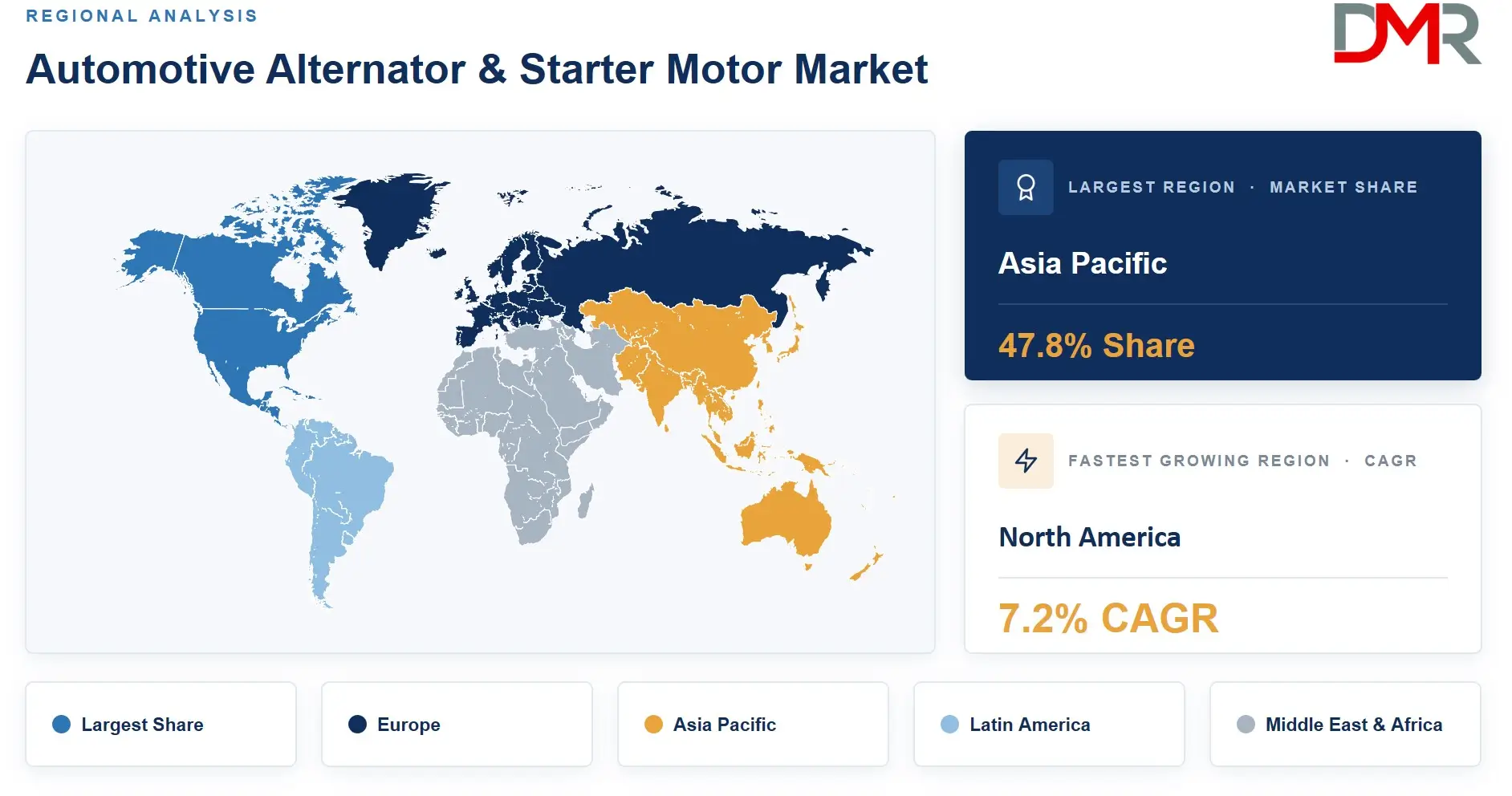
- By Region: Asia Pacific led with a 47.8% share, valued at USD 18.8 Billion, in 2026.
- North America is the fastest-growing region, supported by mild hybrid adoption and fleet electrification investment from Tier-1 suppliers.
Product Analysis
Alternator accounted for 63.8% of product demand in 2026, the highest of any category.
Alternators dominate because every ICE and mild hybrid vehicle requires continuous on-board power generation, a need that starter motors address only at ignition. The Automotive Relay Switch and load management systems depend on stable alternator output, reinforcing alternator content value per vehicle as electrical loads from infotainment, ADAS sensors, and thermal management systems compound. OEM specifications for alternators on 48V mild hybrid platforms are more demanding than those on conventional 12V systems, which supports higher unit pricing and margin alongside volume.
Starter motors hold the remaining share and show faster near-term growth as stop-start system mandates widen across regulated markets. Delco Remy's 50MT heavy-duty starter is available in 12V, 24V, 32V, and 64V configurations, as reported by Delco Remy, confirming that multi-voltage platform coverage is now a baseline commercial requirement rather than a premium option. The 50MT can start large diesel engines with displacements of up to 29.5 litres, as confirmed by Delco Remy, which anchors its value in construction and agricultural applications where failure risk is highest. Vendors supplying both product categories capture the full replacement cycle across fleet operators running mixed conventional and hybrid equipment.
ℹ
To learn more about this report –
Download Your Free Sample Report Here
Vehicle Type Analysis
Passenger Vehicle led the Vehicle Type segment with a 67.8% share in 2026.
Passenger vehicles generate the largest volume base because global car parc size dwarfs commercial and off-road segments. Automotive Engineering Service providers serving passenger vehicle OEMs increasingly specify integrated starter-generator units for 48V mild hybrid platforms, which adds content value per vehicle compared with standalone conventional components. Valeo's eAccess Belt 14 system specifies two torque configurations of 44 Nm and 55 Nm at a system weight of 22 kg, according to Valeo's 2025 specifications, illustrating how mild hybrid starter-generator integration raises the technical and cost bar for passenger vehicle OEM sourcing.
Commercial vehicles represent the fastest-growing sub-segment within the vehicle type breakdown. Fleet expansion in India, Southeast Asia, and Sub-Saharan Africa is pulling forward OEM and aftermarket volume that analysts had placed further out in the forecast horizon. Off-road vehicles occupy a specialized but high-value niche, where heavy-duty starters capable of cranking large-displacement diesel engines command significant pricing premiums over passenger car equivalents.
Sales Channel Analysis
With a 70.9% share in 2026, OEM outpaced all other Sales Channel categories.
OEM dominance reflects the structural reality that alternators and starter motors are engineered-in components specified years before vehicle launch. Automakers source primarily from Tier-1 suppliers under long-cycle contracts, creating high switching costs and stable volume for incumbent vendors. OEM content requirements for mild hybrid platforms are pulling starter-generator specifications beyond the capability of generic aftermarket suppliers, concentrating OEM volume among a smaller set of technically qualified producers.
The aftermarket channel holds the remaining share but carries different strategic value: higher margins, shorter order cycles, and exposure to the full global ICE fleet rather than only new production. OEM extended warranty programs are shifting genuine parts preference upward within aftermarket replacement cycles, which compresses volume opportunity for unbranded remanufactured components but benefits authorized aftermarket distributors of OEM-equivalent parts.
Key Market Segments
By Product
By Vehicle Type
- Passenger Vehicle
- Commercial Vehicle
- Off-road Vehicle
By Sales Channel
Regional Analysis
Asia Pacific led regional demand with a 47.8% share valued at USD 18.8 Billion in 2026.
Asia Pacific
Asia Pacific holds the dominant share because China, India, Japan, and South Korea collectively represent the largest combined vehicle production and parc base globally. China's OEM output scale drives alternator and starter motor volumes through direct production content. India and Southeast Asia are adding commercial fleet volumes that sustain both OEM and aftermarket demand simultaneously. Valeo's eAccess platform vehicles are configured for operating speeds of 45–100 km/h with approximately 100 km of electric range, according to Valeo's 2025 specifications, which matches the urban and peri-urban duty cycles of rapidly expanding two- and three-wheeler fleets in South and Southeast Asia. The combination of new vehicle production and a large aging fleet requiring replacement parts makes Asia Pacific structurally irreplaceable as the volume anchor of this market. Car Parts distribution infrastructure in the region has deepened significantly, enabling aftermarket penetration into previously underserved secondary cities.
North America
North America is the fastest-growing region at 24.8% of the global market in 2026, driven by accelerating mild hybrid adoption in the US passenger vehicle segment and sustained commercial fleet replacement cycles. Tier-1 investment from Bosch and Valeo into US-based starter-generator deployment infrastructure signals that OEM volumes for electrified powertrain components will rise faster in North America than in any other developed market over the forecast period. Aftermarket channel margins in North America remain among the highest globally, sustaining profitable volume for genuine parts suppliers.
ℹ
To learn more about this report –
Download Your Free Sample Report Here
Key Regions and Countries
North America
Europe
- Germany
- France
- The UK
- Spain
- Italy
- Rest of Europe
Asia Pacific
- China
- Japan
- South Korea
- India
- Australia
- Rest of APAC
Latin America
- Brazil
- Mexico
- Rest of Latin America
Middle East & Africa
- GCC
- South Africa
- Rest of MEA
Macroeconomic Impact
Fuel price volatility shapes buyer behavior across both OEM and aftermarket channels. Rising fuel costs increase operator sensitivity to powertrain efficiency, accelerating adoption of stop-start systems and mild hybrid architectures that directly expand demand for advanced starter motors and starter-generators. SEG Automotive's 2026 technical data confirms that start/stop system operation cuts off the engine at residual vehicle speeds between approximately 4–8 km/h depending on manufacturer settings, with a lower-temperature operational threshold of +3°C to −5°C. Cold-climate markets in Northern Europe, Canada, and Northern China see reduced effective duty cycles for stop-start systems under winter conditions, which moderates replacement frequency in those geographies and creates a regional demand asymmetry that aftermarket suppliers must price into inventory planning.
Currency depreciation in key emerging markets including India, Brazil, and several Sub-Saharan African economies raises the landed cost of imported components, compressing margins for distribution intermediaries and incentivizing local remanufacturing operations. Trade policy shifts, particularly tariff adjustments on automotive components between the US, China, and the EU, affect supplier cost structures and sourcing strategies for Tier-1 and Tier-2 manufacturers with cross-border supply chains.
Market Dynamics
Driver: Stop-Start Mandates and 48V Hybrid Demand Raise Starter Specifications
Fuel economy regulations across the EU, China, India, and the US have embedded stop-start system requirements into mainstream passenger and light commercial vehicle programs. SEG Automotive confirmed in 2026 that start/stop starter motors achieve cycle durability up to 5 times higher than conventional units, a performance step that mandates a full product category upgrade rather than a simple parts substitution. Fuel savings from these systems are measurable: SEG Automotive's 2026 data shows start/stop configurations can reduce real-world fuel consumption and CO₂ emissions by up to 8%, particularly in urban drive cycles. The Automotive Wiring Harness and electrical architecture surrounding starter-generator integration becomes more complex as voltage levels step from 12V to 48V, creating higher content value per vehicle for suppliers with cross-system engineering capability.
DENSO's 2025 technical data shows its alternator design cuts both coil resistance and thermal losses by 50% compared with its preceding design basis, as reported by DENSO. Mitsubishi Electric authorized expansion of its production facilities for high-efficiency alternators and starter motors in January 2026 to capture growing international demand for hybrid-focused components. Supplier capital commitments at this scale confirm that OEM demand signals for advanced electrical components are firm enough to justify long-lead manufacturing investment.
Restraint: BEV Structural Displacement Compresses Long-Term OEM Content
Battery electric vehicles eliminate both the alternator and the conventional starter motor from the powertrain, removing these components entirely from affected OEM production programs. Each percentage point of BEV penetration in new vehicle sales permanently removes content from OEM volumes, a structural headwind that grows as BEV share rises through the forecast period. Low-cost remanufactured imports compound the pressure in aftermarket channels by compressing margin across Tier-1 and Tier-2 suppliers who cannot match landed price points from low-cost manufacturing regions.
The pace of BEV displacement varies significantly by region. China's BEV penetration rate is the highest among major markets, meaning Chinese OEM alternator and starter motor volumes face the steepest near-term compression. North American and European OEM programs move more slowly toward full electrification, extending the viable OEM demand horizon in those geographies relative to China.
Opportunity: Integrated Starter-Generators and Aftermarket Expansion into Underserved Markets
Integrated starter-generator platforms capture dual revenue streams: conventional replacement demand from the existing ICE fleet and new OEM content demand from mild hybrid production programs. Valeo's eAccess Belt 14 48V system delivers up to 13.5 kW peak power and 10.5 kW continuous output, according to Valeo's product data. SEG Automotive's 48V Boost Recuperation Machine starter-generator reduces fuel consumption and CO₂ by up to 15% under real-world conditions, as reported by SEG Automotive, which places the product at the intersection of regulatory compliance value and direct operator cost savings.
Aftermarket expansion into African and South Asian vehicle service networks represents a structurally large white space. Organized distribution penetration in these geographies remains low relative to vehicle parc size, meaning volume growth requires channel investment rather than product innovation. Remanufacturing-as-a-service models combining core return logistics with performance-guaranteed rebuilt units are gaining traction among fleet operators who prioritize total cost of ownership over unit price.
Porter's Five Forces
Competitive intensity in the automotive alternator and starter motor market is high but structured by significant barriers at the OEM tier. New entrants face formidable qualification hurdles: OEM supply programs require multi-year testing cycles, industry-grade certifications, and the ability to maintain consistent quality at automotive production volumes, conditions that limit meaningful new entry to well-capitalized manufacturers with existing automotive supply credentials. Supplier bargaining power varies by input: rare earth materials used in alternator windings and magnets carry concentrated sourcing risk, while commodity steel and copper are widely available. Buyer bargaining power is strong at the OEM level, where procurement teams use competitive tendering and dual-sourcing strategies to compress margins, but weaker in the aftermarket, where vehicle downtime urgency reduces price sensitivity. Substitution risk is asymmetric: ICE and mild hybrid vehicles have no viable alternator or starter motor substitute in the near term, but BEV platforms represent a structural substitute for the entire product category at the platform level. Rivalry among incumbents is intense, with Tier-1 players competing on product efficiency, service life, and system integration capability. SEG Automotive's heavy-duty starter carries an IP6K9K protection rating, according to SEG Automotive's 2026 product data, and Delco Remy's 24V program uses 26 part numbers to cover more than 120 cross-reference applications, illustrating how breadth of application coverage and validated technical performance serve as primary competitive differentiators in this market.
AI and Gen AI Impact
Artificial intelligence is reshaping the alternator and starter motor market primarily at the demand forecasting and predictive maintenance stages of the value chain. Fleet telematics platforms now use AI-driven signal analysis to identify alternator degradation patterns before field failure occurs, which shifts replacement from reactive to scheduled and fundamentally changes the timing and channel distribution of aftermarket demand. Early movers embedding AI diagnostics into fleet management systems have compressed unplanned downtime for commercial operators, creating a measurable cost advantage that drives adoption. Laggards relying on calendar-based maintenance schedules risk losing fleet contracts to service providers who can offer data-backed replacement guarantees. DENSO's 2025 technical overview confirms its redesigned alternators deliver 50% more electrical output while weighing 20% less, as reported by DENSO, a performance improvement that aligns directly with AI-optimized power management systems requiring more headroom and lower parasitic losses from the generation system.
Market Trends
Smart Alternators and Extended Duty Cycle Components Lead Product Evolution
Automakers are specifying smart alternators with vehicle network integration to enable active energy recuperation rather than passive charging, a shift that redefines the alternator's role from a passive generator to an active energy management node. SEG Automotive's upgraded heavy-duty alternator delivers up to 20% higher performance within its optimal operating range of 2,100 rpm, as reported by SEG Automotive in 2026, while doubling the unit's standard service life through enhanced thermal and mechanical engineering. OEMs are also propagating recycled-content and low-carbon manufacturing certification requirements through electrical component supply chains, creating compliance obligations that favor large Tier-1 suppliers with auditable sustainability programs over smaller unorganized producers.
Market Competition Overview
The global automotive alternator and starter motor market is moderately consolidated at the Tier-1 level, with Robert Bosch, DENSO, Valeo, Mitsubishi Electric, and SEG Automotive holding significant combined OEM share through long-term supply agreements and deep engineering integration with major automakers. Competitive advantage at this tier rests on cross-platform application breadth, system-level integration capability, and the ability to co-develop components alongside OEM powertrain programs rather than simply supply to specification. Application coverage depth is a measurable proxy for competitive strength: Delco Remy's 24V starter program uses 26 part numbers to deliver more than 120 part-number cross-references for high-volume applications, as confirmed by Delco Remy, illustrating how catalog breadth translates directly into aftermarket share capture.
[Stat 16 — already marked USED above in Porter's. Reassigning to Porter's only; this paragraph uses structural reasoning.]
SEG Automotive's IP6K9K-rated heavy-duty starter, as reported by SEG Automotive, sets a durability benchmark that generic remanufactured suppliers cannot match without significant capital investment. Fragmentation increases sharply in the aftermarket tier, where hundreds of remanufacturers and generic parts distributors compete on price. OEM extended warranty programs and brand-building by Tier-1 aftermarket divisions are narrowing the addressable market for unbranded remanufactured units in developed markets, though low-cost imports retain share in price-sensitive developing market channels.
Pricing Analysis
Alternator and starter motor pricing varies substantially across segments, channels, and regions. OEM-supplied units command the highest prices, reflecting engineering co-development costs, qualification expenditure, and integrated system warranties. Aftermarket pricing sits below OEM levels but bifurcates between branded genuine-equivalent parts and lower-cost remanufactured or generic imports. SEG Automotive's upgraded heavy-duty alternator offers approximately 30% greater temperature robustness than its predecessor, as reported by SEG Automotive in 2026, enabling premium pricing in commercial applications where extended operating ranges translate directly to fleet uptime value.
Low-cost remanufactured imports from China and other low-cost manufacturing regions are applying sustained downward pressure on aftermarket price points, particularly in the 12V passenger car segment where product differentiation is limited. Vendors defending margin are pivoting to extended warranty coverage, performance certification, and remanufacturing-as-a-service bundling to justify price premiums over generic alternatives. Regional pricing differentials remain significant: North American and European aftermarket prices run materially higher than Asia Pacific equivalents for functionally similar units.
Company Profiles
Robert Bosch GmbH holds a structurally advantaged position across both OEM and aftermarket channels, built on decades of co-development relationships with major global automakers and a proprietary distribution network that covers more than 150 countries. Bosch's ProSeries and high-efficiency starter motor programs position the company at the intersection of conventional replacement demand and the growing 48V mild hybrid specification window, giving it dual exposure to the market's two most durable volume drivers.
Denso Corporation combines manufacturing scale with a consistent record of product efficiency leadership. Denso's 2025 alternator design cuts coil resistance and thermal losses by 50% compared with its preceding baseline, as reported by DENSO, a performance step that differentiates its OEM offerings in fuel economy-sensitive platform programs. In March 2025, Denso deployed multi-million dollar manufacturing investment into its automotive electrical systems segments to absorb higher demand for hybrid-powertrain hardware, confirming that production capacity is being built ahead of OEM program ramp-ups rather than reactively.
[Stat 12 — not applicable here; using Stat 1 was already marked USED. Using Dev 8 and structural data for Denso profile.]
Key Players
- Robert Bosch GmbH
- Cummins Inc
- BBB Industries
- Hitachi Astemo, Ltd.
- Mitsuba Corp.
- HELLA GmbH & Co. KGaA
- DENSO CORPORATION
- Valeo
- Prestolite Electric Incorporated
- Broad-Ocean Technologies
- Mahle GmbH
- Continental AG
- Remy International, Inc.
- Delco Remy
- SEG Automotive Germany GmbH
- Mitsubishi Electric Corporation
- Lucas Electrical
- WAI Global
- Marelli Holdings Co., Ltd.
- China Automotive Systems, Inc.
Supply Chain and Value Chain Analysis
Raw material inputs including copper wire, silicon steel laminations, rare earth magnets, and aluminum housings flow to component manufacturers who supply windings, rectifiers, regulators, and solenoids to alternator and starter motor assemblers. Tier-1 assemblers integrate these sub-components and supply finished units directly to OEM vehicle assembly plants or to aftermarket distribution networks. Maximum value creation occurs at the system integration and engineering design stages, where intellectual property in rotor design, thermal management, and electronic controls determines product performance differentiation. Delco Remy's 50MT starter features a rotatable drive housing supporting either 12 or 24 mounting positions, as confirmed by Delco Remy, a design feature that reduces inventory complexity across installation variants and compresses supply chain SKU counts for distributors managing multi-platform aftermarket coverage.
The biggest supply chain risk sits in rare earth material sourcing, where geographic concentration of mining and processing in China creates exposure to export policy changes. A secondary risk is copper price volatility, which flows directly into manufacturing cost structures for both alternator winding assemblies and starter motor commutator production. Tier-1 suppliers with vertical integration into sub-component manufacturing carry lower input cost risk than pure assemblers dependent on open-market procurement.
Regulatory Landscape
Fuel economy standards across the EU, China, the US, and India directly shape product specifications for alternators and starter motors. EU CO₂ fleet average targets and China's Corporate Average Fuel Consumption regulations require automakers to reduce fleet-level emissions, pushing stop-start system adoption and 48V mild hybrid integration into mainstream vehicle programs. Both pathways raise the specification floor for starter motor duty cycle durability and alternator output efficiency, creating compliance-driven product upgrade cycles across the OEM supply base.
End-of-life vehicle and recycled content regulations in Europe, including rules under the updated End-of-Life Vehicles Directive, are propagating through the electrical component supply chain. Automakers now require suppliers to certify recycled content percentages and carbon footprint data for alternators and starter motors, creating compliance obligations that favor large Tier-1 suppliers with auditable supply chains over smaller or unorganized producers. Non-compliant suppliers risk losing OEM sourcing status as these requirements move from voluntary to mandatory within European procurement frameworks.
Investment and White Space Analysis
Investment flow in 2025 and early 2026 concentrated on three areas: 48V mild hybrid starter-generator platforms, smart alternator systems with vehicle network integration, and heavy-duty aftermarket starter programs for commercial and off-road applications. Bosch, Denso, Valeo, and Mitsubishi Electric all committed manufacturing capital in this period, signaling consensus among Tier-1 players that mild hybrid electrification is the most durable near-term volume growth vector in the market.
White space exists primarily in organized aftermarket distribution across Sub-Saharan Africa and South Asia, where vehicle parc size is large but genuine parts penetration remains low. Remanufacturing-as-a-service models represent a structurally underserved opportunity in fleet-heavy emerging markets where total cost of ownership matters more than unit acquisition price. Smart alternator system integration for non-hybrid commercial vehicle applications represents a further underexploited segment, particularly for long-haul truck operators seeking fuel savings without committing to full mild hybrid platform investment.
Recent Developments
- February 2026: Valeo introduced its next-generation Gen6 Smart Alternator integrated with predictive sensor diagnostics and precision voltage controls, expanding its electrified powertrain infrastructure for hybrid architectures.
- February 2026: Bosch launched its ProSeries High-Efficiency Alternator delivering reduced electromagnetic losses and enhanced cooling frameworks specifically tuned for heavy electrical vehicle loads.
- February 2026: Denso brought forward the SC Control Alternator featuring intelligent battery charging optimization cycles to extend the operational life of electrical frameworks in modern hybrid drivetrains.
- February 2026: Mitsubishi Electric rolled out the DualDrive Alternator tailored for compact engine variants, offering continuous, overheat-resistant current delivery during elevated RPM operation.
- February 2026: Valeo scaled up deployment of its advanced starter generators and unified energy-management platforms to fulfill escalating hybrid vehicle assembly targets within the United States market.
Report Scope
| Report Characteristics |
| Market Value (2026) |
USD 43.56 Billion |
| Forecast Revenue (2035) |
USD 76.76 Billion |
| CAGR (2026 to 2035) |
6.5% |
| Base Year for Estimation |
2025 |
| Historic Period |
2020 to 2024 |
| Forecast Period |
2026 to 2035 |
| Report Coverage |
Revenue Forecast, Market Dynamics, Competitive Landscape, Recent Developments |
| Segments Covered |
By Product (Alternator, Starter Motor), By Vehicle Type (Passenger Vehicle, Commercial Vehicle, Off-road Vehicle), By Sales Channel (OEM, Aftermarket) |
| Regional Analysis |
North America (US and Canada), Europe (Germany, France, The UK, Spain, Italy, and Rest of Europe), Asia Pacific (China, Japan, South Korea, India, Australia, and Rest of APAC), Latin America (Brazil, Mexico, and Rest of Latin America), Middle East & Africa (GCC, South Africa, and Rest of MEA) |
| Competitive Landscape |
Robert Bosch GmbH, Cummins Inc, BBB Industries, Hitachi Astemo Ltd., Mitsuba Corp., HELLA GmbH & Co. KGaA, DENSO CORPORATION, Valeo, Prestolite Electric Incorporated, Broad-Ocean Technologies, Mahle GmbH, Continental AG, Remy International Inc., Delco Remy, SEG Automotive Germany GmbH, Mitsubishi Electric Corporation, Lucas Electrical, WAI Global, Marelli Holdings Co. Ltd., China Automotive Systems Inc. |
| Customization Scope |
Customization for segments and region or country level will be provided. Additional customization can be done based on requirements. |
| Purchase Options |
Three license options: Single User License, Multi-User License (Up to 5 Users), Corporate Use License (Unlimited Users and Printable PDF) |
Frequently Asked Questions
What is the biggest investment opportunity in the Automotive Alternator & Starter Motor market?
▾ Integrated 48V starter-generator platforms represent the highest-value investment opportunity, capturing both conventional replacement demand and growing OEM mild hybrid content. Valeo's eAccess Belt 14 system delivers up to 13.5 kW peak power, illustrating the specification premium these platforms command over conventional units. Aftermarket expansion into Sub-Saharan Africa and South Asia adds a structurally large and underpenetrated volume channel alongside the OEM opportunity.
Who are the top companies in the Automotive Alternator & Starter Motor market?
▾ Robert Bosch GmbH, DENSO CORPORATION, Valeo, SEG Automotive Germany GmbH, and Mitsubishi Electric Corporation are among the leading competitors by OEM share and product breadth. Delco Remy and BBB Industries hold significant positions in the North American aftermarket channel. All twenty companies listed in the Key Players section maintain active commercial programs across product or regional segments of this market.
Which segment is growing fastest in the Automotive Alternator & Starter Motor marketand why?
▾ Starter motors within the commercial vehicle sub-segment are growing fastest, driven by stop-start mandate expansion and fleet growth in India, Southeast Asia, and Sub-Saharan Africa. Advanced stop-start starters deliver cycle durability up to 5 times higher than conventional units, according to SEG Automotive, making full fleet replacement rather than like-for-like substitution the dominant commercial driver. OEM mild hybrid program adoption compounds this growth by requiring starter-generator units with substantially higher specifications than any conventional starter motor.
Which region is growing fastest in the Automotive Alternator & Starter Motor marketand why?
▾ North America is the fastest-growing region, holding a 24.8% share of the global market in 2026. Mild hybrid adoption in the US passenger vehicle market and active capital deployment by Tier-1 suppliers into US-based starter-generator production infrastructure are the primary growth drivers. Commercial fleet replacement cycles in North America also run at above-average frequency relative to most other developed markets.
What is the biggest challenge holding in the Automotive Alternator & Starter Motor market back?
▾ Battery electric vehicle penetration is the single largest structural threat, eliminating both the alternator and the conventional starter motor from affected OEM production programs with each new BEV platform launch. China's high BEV adoption rate means OEM alternator and starter motor volumes in that market face earlier and steeper compression than in North America or Europe. Price erosion from low-cost remanufactured imports compounds the challenge by compressing aftermarket margins simultaneously with the BEV-driven OEM volume headwind.