Market Overview
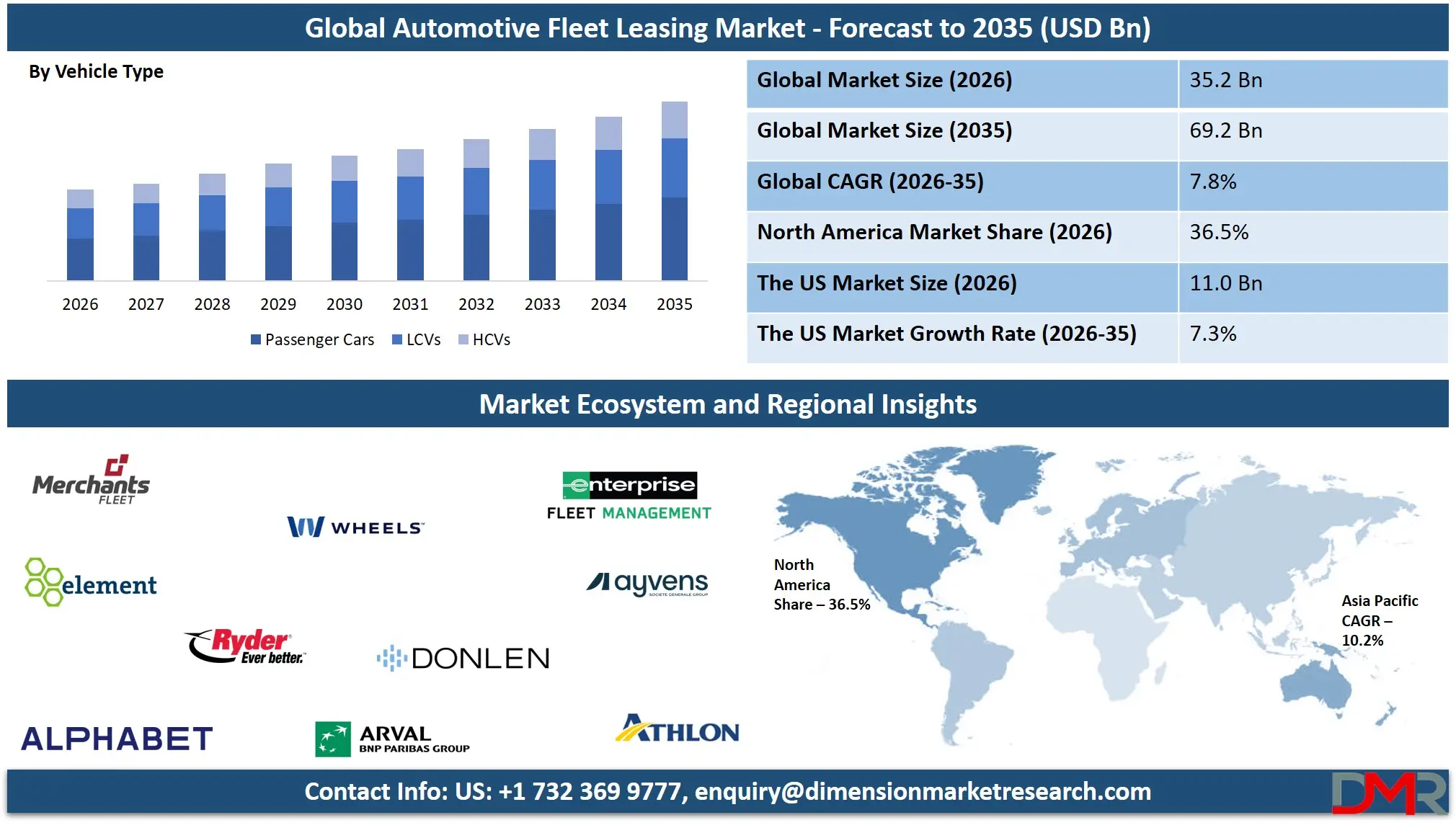
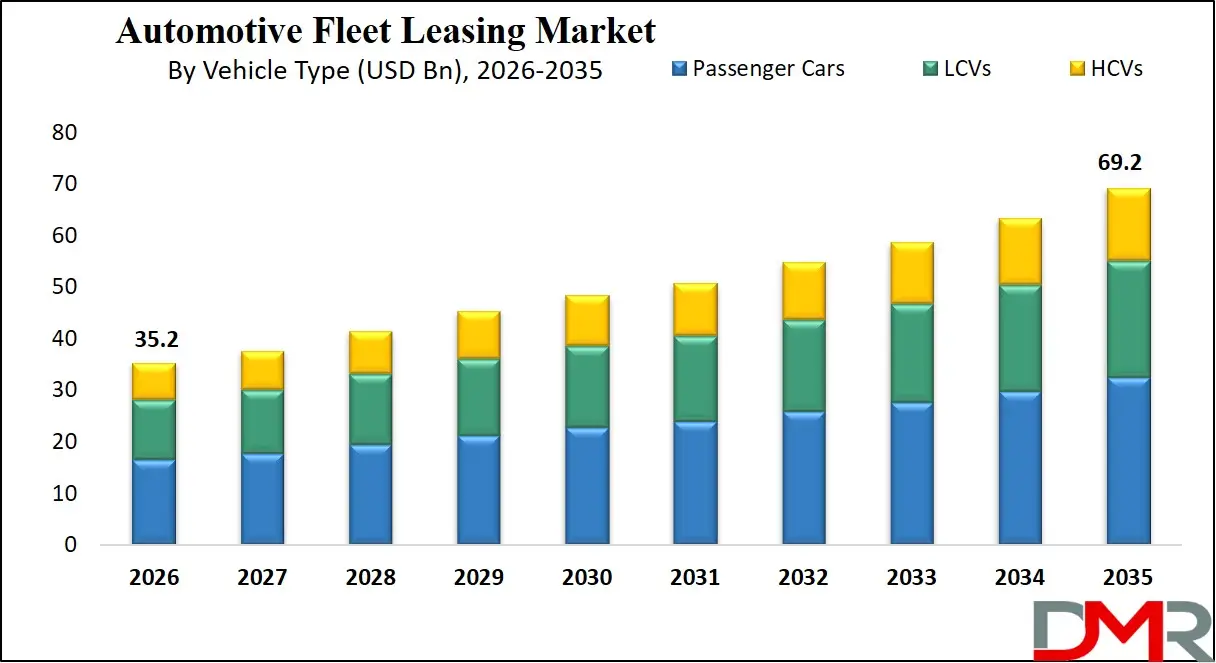
The Global Automotive Fleet Leasing Market size is projected to reach USD 35.2 billion in 2026 and grow at a compound annual growth rate of 7.8% to reach a value of USD 69.2 billion in 2035.
ℹ
To learn more about this report –
Download Your Free Sample Report Here
Automotive fleet leasing refers to a financing and asset management approach where organizations or individuals obtain vehicles for business use through long-term contractual agreements rather than purchasing them outright. In this model, a leasing provider retains ownership of the vehicles while the customer pays periodic fees for usage over a predetermined period. The arrangement typically includes services such as vehicle procurement, maintenance, insurance management, compliance support, and fleet lifecycle planning. Automotive fleet leasing plays a crucial role in corporate mobility strategies, enabling businesses to access modern vehicles while preserving capital and maintaining operational flexibility.
The concept has become increasingly significant as organizations seek cost-efficient fleet management solutions while adapting to changing transportation needs. Businesses across logistics, healthcare, government, and corporate sectors are shifting toward leasing models to reduce upfront investment and simplify vehicle administration. Advances in telematics, connected vehicle technologies, and digital fleet management platforms are transforming the ecosystem by enabling real-time monitoring, predictive maintenance, and route optimization. The rising adoption of electric vehicles (EVs) within corporate fleets is also reshaping leasing strategies as companies look for flexible financing structures that support sustainability goals.
ℹ
To learn more about this report –
Download Your Free Sample Report Here
Industry transformation is further supported by regulatory frameworks encouraging low-emission mobility and fleet electrification. Leasing providers are expanding their service portfolios to include vehicle analytics, energy management for EV fleets, and integrated mobility services. Partnerships between automakers, financial institutions, and fleet service providers are strengthening the market's operational ecosystem. As organizations prioritize operational efficiency, environmental responsibility, and financial flexibility, automotive fleet leasing continues to evolve as a strategic mobility solution within the broader transportation and mobility services industry.
The US Automotive Fleet Leasing Market
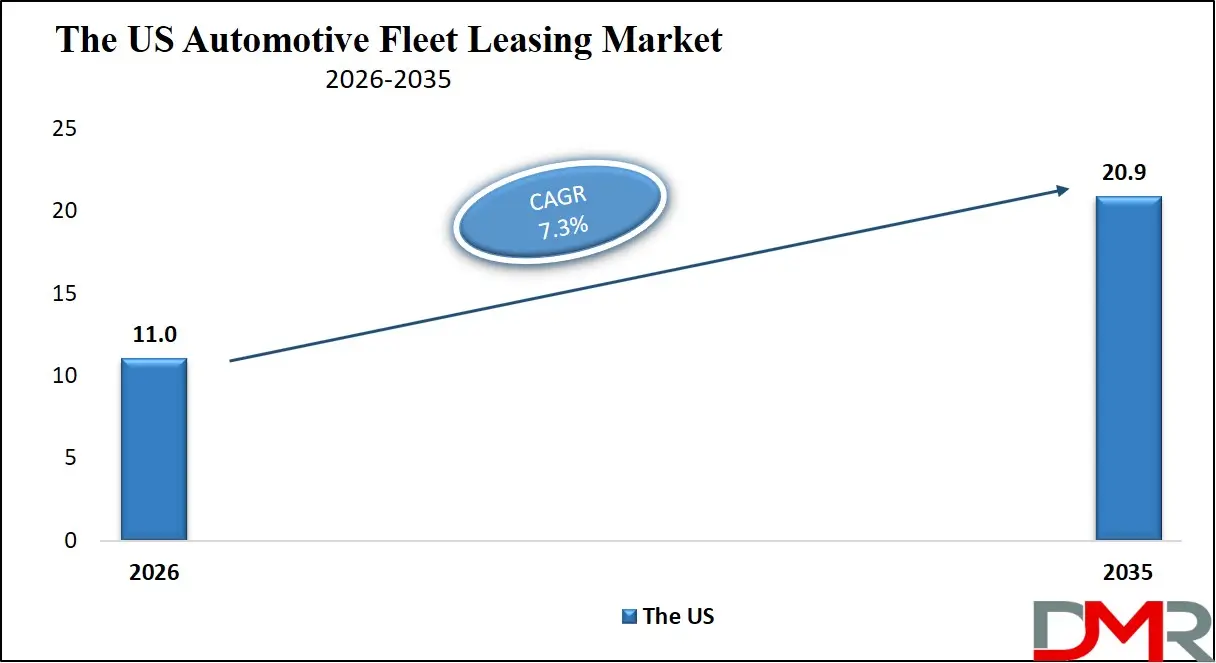
The US Automotive Fleet Leasing Market size is projected to reach USD 11.0 billion in 2026 at a compound annual growth rate of 7.3% over its forecast period.
ℹ
To learn more about this report –
Download Your Free Sample Report Here
The US automotive fleet leasing market is characterized by strong corporate adoption, mature financial services infrastructure, and high vehicle ownership demand across commercial sectors. Large corporations, logistics providers, and government agencies commonly rely on fleet leasing to manage vehicle procurement and lifecycle costs. Favorable tax structures and financial regulations support leasing models, enabling businesses to preserve capital while maintaining access to newer vehicles. The growing shift toward electric and hybrid vehicles is also influencing fleet leasing strategies, as companies seek flexible contracts that allow gradual electrification of their fleets. Advanced telematics systems and fleet analytics platforms widely adopted across the U.S. further strengthen operational efficiency and encourage broader adoption of leasing solutions.
Europe Automotive Fleet Leasing Market
Europe Automotive Fleet Leasing Market size is projected to reach USD 8.8 billion in 2026 at a compound annual growth rate of 7.5% over its forecast period.
Europe represents a highly structured and regulation-driven automotive fleet leasing landscape. Environmental policies and carbon-reduction targets strongly influence fleet management strategies across the region. Initiatives linked to the European Green Deal encourage businesses to adopt low-emission vehicles, which has increased demand for leasing solutions that support electric and hybrid fleets. Corporate mobility programs, government fleet modernization projects, and growing subscription-based vehicle usage models contribute to market expansion. Many European countries also provide tax advantages for leased company vehicles, which further strengthens adoption. Additionally, strong automotive manufacturing ecosystems and well-developed leasing providers support the rapid integration of digital fleet management technologies.
Japan Automotive Fleet Leasing Market
Japan Automotive Fleet Leasing Market size is projected to reach USD 1.8 billion in 2026 at a compound annual growth rate of 7.7% over its forecast period.
Japan's automotive fleet leasing market is supported by advanced automotive manufacturing capabilities, strong urban infrastructure, and a technology-driven transportation ecosystem. Corporate fleets in sectors such as logistics, manufacturing, and service industries increasingly rely on leasing to maintain operational efficiency while minimizing capital expenditures. Government initiatives promoting smart mobility and low-emission vehicles are encouraging companies to upgrade their fleets through flexible leasing arrangements. Urban density and limited parking availability also make leasing attractive, as businesses prefer structured fleet management rather than vehicle ownership. Furthermore, Japan's focus on vehicle connectivity, automation technologies, and telematics integration is strengthening the role of leasing providers in delivering intelligent fleet solutions.
Automotive Fleet Leasing Market: Key Takeaways
- Market Growth: The Automotive Fleet Leasing Market size is expected to grow by USD 31.5 billion, at a CAGR of 7.8%, during the forecasted period of 2027 to 2035.
- By Vehicle Type: The passenger cars segment is anticipated to get the majority share of the Automotive Fleet Leasing market in 2026.
- By Service Type: The full-service leasing segment is expected to get the largest revenue share in 2026 in the Automotive Fleet Leasing market.
- Regional Insight: North America is expected to hold a 36.5% share of revenue in the global Automotive Fleet Leasing market in 2026.
- Use Cases: Some of the use cases of Automotive Fleet Leasing include logistics & delivery operations, healthcare service mobility, and more.
Automotive Fleet Leasing Market: Use Cases
- Corporate Mobility Programs: Large enterprises lease fleets to provide vehicles for employees involved in sales, service, and management operations. Leasing helps organizations control mobility costs while ensuring access to modern, fuel-efficient vehicles.
- Logistics and Delivery Operations: E-commerce and logistics companies lease large fleets of vans and trucks to support delivery networks. Leasing enables quick fleet scaling during peak demand periods without heavy capital investment.
- Government and Public Services: Government departments lease vehicles for administrative transport, law enforcement, and municipal operations. Leasing simplifies procurement and maintenance while ensuring regular fleet upgrades.
- Healthcare Service Mobility: Hospitals and healthcare service providers lease vehicles for patient transport, medical supply delivery, and field healthcare staff mobility, ensuring reliability and operational readiness.
- Utilities and Field Operations: Utility companies lease specialized vehicles used by field technicians for maintenance and repair services. Fleet leasing allows easy vehicle replacement and compliance with operational safety standards.
- Ride-Hailing and Mobility Services: Mobility service providers lease vehicles to drivers operating within ride-sharing and car-sharing platforms, reducing the financial burden of purchasing vehicles.
- SME Business Transport: Small and medium enterprises use leased vehicles for employee transport, delivery services, and operational mobility, benefiting from predictable monthly costs and reduced administrative overhead.
Stats & Facts
- U.S. Department of Energy reported in 2024 that transportation accounted for approximately 28% of total U.S. greenhouse gas emissions, driving corporate fleets toward electrified leasing solutions.
- International Energy Agency (IEA) stated in 2024 that global electric car sales exceeded 14 million units, influencing fleet leasing companies to expand EV leasing programs.
- European Commission reported in 2025 that road transport contributes nearly 20% of the European Union's total CO₂ emissions, accelerating corporate fleet transitions to low-emission vehicles.
- U.S. General Services Administration (GSA) indicated in 2024 that the federal fleet includes over 657,000 vehicles, representing one of the largest government fleet management systems.
- International Transport Forum (OECD) reported in 2024 that global urban freight demand is expected to increase by over 40% by 2030, boosting demand for leased logistics fleets.
- Japan Ministry of Land, Infrastructure, Transport and Tourism reported in 2025 that Japan operates over 82 million registered vehicles, creating strong demand for fleet management and leasing services.
- European Environment Agency reported in 2024 that commercial vehicles account for roughly 12% of total vehicles on EU roads but produce a disproportionately higher share of emissions.
- U.S. Energy Information Administration (EIA) reported in 2025 that gasoline consumption in the transportation sector averaged about 8.9 million barrels per day, encouraging fleet efficiency programs.
- International Monetary Fund (IMF) estimated in 2024 that global corporate mobility and logistics activities contribute to over 10% of global economic activity, supporting fleet expansion.
- United Nations Department of Economic and Social Affairs reported in 2024 that 68% of the global population is projected to live in urban areas by 2050, increasing commercial fleet demand in cities.
- European Automobile Manufacturers' Association (ACEA) reported in 2024 that light commercial vehicles represent nearly 12% of all vehicles registered in Europe.
- Japan Automobile Manufacturers Association stated in 2025 that Japan produced over 8.9 million vehicles annually, reinforcing the country's strong automotive ecosystem supporting leasing services.
Market Dynamic
Driving Factors in the Automotive Fleet Leasing Market
Rising Corporate Preference for Asset-Light Mobility Models
Businesses are increasingly shifting toward asset-light operational models to optimize capital allocation and reduce financial risk. Automotive fleet leasing allows companies to access modern vehicles without significant upfront investments associated with vehicle ownership. This model provides predictable monthly expenses, easier fleet upgrades, and reduced administrative burdens. Companies also benefit from bundled services such as maintenance, insurance management, and vehicle lifecycle monitoring. As organizations expand operations across multiple locations, leasing offers flexibility to scale fleets up or down based on business demand. This shift toward operational efficiency and financial flexibility is becoming a key catalyst for the expansion of automotive fleet leasing services globally.
Expansion of Telematics and Connected Fleet Technologies
Technological advancements in telematics, vehicle connectivity, and digital fleet management platforms are transforming the automotive fleet leasing ecosystem. Modern fleets integrate GPS tracking, fuel monitoring systems, driver behavior analytics, and predictive maintenance technologies. These capabilities help businesses optimize routes, reduce fuel consumption, and improve vehicle utilization rates. Leasing providers are increasingly incorporating advanced telematics solutions into service packages, allowing customers to access data-driven insights into fleet performance. As companies prioritize operational efficiency and sustainability goals, connected fleet technologies are strengthening the value proposition of leasing models and driving wider adoption across commercial sectors.
Restraints in the Automotive Fleet Leasing Market
High Long-Term Contractual Commitments
One of the primary challenges associated with automotive fleet leasing is the long-term contractual structure typically involved in leasing agreements. Businesses may be required to commit to multi-year contracts, limiting their flexibility to adjust fleet sizes quickly in response to economic fluctuations or operational changes. Early termination fees and mileage restrictions can further increase operational costs for organizations that require dynamic mobility solutions. Additionally, companies operating in volatile industries may hesitate to enter extended leasing agreements due to uncertainties in demand or revenue streams, which can slow broader adoption of fleet leasing models.
Limited Awareness Among Small Businesses
Despite its advantages, automotive fleet leasing remains underutilized among many small and medium-sized enterprises. Limited awareness of leasing benefits, perceived complexity of contracts, and concerns about long-term financial commitments often discourage SMEs from adopting leasing solutions. In some markets, SMEs still prefer purchasing used vehicles as a cost-saving strategy. Additionally, the lack of customized leasing packages designed specifically for smaller fleets may restrict accessibility for smaller businesses. Overcoming these perception barriers through financial education and flexible leasing structures will be essential to expanding adoption among SME customers.
Opportunities in the Automotive Fleet Leasing Market
Rapid Growth of Electric Vehicle Fleet Leasing
The global transition toward electric mobility presents significant opportunities for automotive fleet leasing providers. Businesses aiming to reduce carbon emissions and meet sustainability commitments are increasingly exploring EV fleet adoption. Leasing models allow organizations to test electric vehicle technologies without the long-term risks associated with purchasing rapidly evolving EV assets. Leasing providers can also bundle charging infrastructure services, battery maintenance, and energy management solutions into their offerings. As governments worldwide introduce incentives for electric vehicle adoption, leasing companies have the opportunity to expand specialized EV fleet financing programs and attract sustainability-focused corporate clients.
Expansion of Mobility-as-a-Service (MaaS) Ecosystems
The emergence of Mobility-as-a-Service platforms is creating new opportunities for automotive fleet leasing providers. MaaS ecosystems integrate ride-sharing, car-sharing, subscription vehicles, and other mobility services within unified digital platforms. Leasing companies can partner with technology firms and mobility operators to supply vehicles for these platforms, creating diversified revenue streams. As urban populations grow and consumers shift toward shared mobility models, leasing providers are positioned to support flexible vehicle supply for dynamic transportation networks, particularly in large metropolitan regions.
Trends in the Automotive Fleet Leasing Market
Integration of Digital Fleet Management Platforms
Digitalization is becoming a defining trend in the automotive fleet leasing sector. Leasing companies are adopting cloud-based fleet management systems that allow customers to monitor vehicle performance, maintenance schedules, and operational costs in real time. These platforms often integrate telematics data, fuel tracking, and driver analytics, enabling businesses to make data-driven decisions about fleet utilization. Digital dashboards also simplify compliance reporting and sustainability tracking. As digital transformation continues across the transportation sector, integrated fleet management platforms are becoming a critical component of modern leasing services.
Increasing Demand for Sustainable Fleet Solutions
Sustainability considerations are significantly shaping corporate fleet strategies worldwide. Companies are increasingly prioritizing low-emission vehicles, fuel-efficient fleets, and environmentally responsible mobility practices. Leasing providers are responding by expanding offerings that include electric vehicles, hybrid fleets, and carbon tracking services. Corporate sustainability reporting requirements and environmental regulations are encouraging businesses to adopt cleaner transportation alternatives. This shift toward sustainable fleet solutions is influencing leasing contracts, vehicle procurement strategies, and service offerings across the industry.
Impact of Artificial Intelligence in Automotive Fleet Leasing Market
- Predictive Maintenance: AI algorithms analyze vehicle sensor data to predict mechanical failures before they occur, allowing fleet operators to schedule proactive maintenance and reduce unexpected downtime.
- Smart Route Optimization: AI-powered navigation systems analyze traffic patterns, weather conditions, and delivery schedules to determine the most efficient routes, improving delivery times and fuel efficiency.
- Driver Behavior Analytics: AI monitors driving patterns such as acceleration, braking, and speed to identify risky behavior, helping fleet managers enhance safety and reduce accident-related costs.
- Demand Forecasting: Machine learning models help leasing providers anticipate future vehicle demand across industries, enabling better fleet allocation and asset utilization.
- Fleet Utilization Optimization: AI systems analyze usage patterns to ensure vehicles are deployed efficiently, preventing underutilization or excessive wear on certain vehicles.
- Automated Customer Support: AI-driven chatbots and digital assistants streamline leasing inquiries, contract management, and service scheduling for customers.
- Fraud Detection: AI systems help detect irregularities in leasing contracts, payment patterns, and insurance claims, reducing financial risks for leasing providers.
- Electric Fleet Energy Management: AI tools manage EV charging schedules, monitor battery health, and optimize charging costs across electric fleets.
- Lifecycle Cost Analysis: AI analytics evaluate total vehicle ownership and operating costs, enabling leasing providers to design more competitive and cost-effective leasing packages.
Research Scope and Analysis
By Vehicle Type Analysis
Passenger cars represent the dominant segment in automotive fleet leasing due to their extensive usage across corporate mobility programs, employee transportation, and administrative operations. Companies frequently lease sedans, hatchbacks, and SUVs to provide vehicles for sales teams, field executives, and management personnel. In 2026, passenger cars are expected to account for 46.8% of the total automotive fleet leasing market share, reflecting their strong adoption across corporate enterprises and government organizations. Businesses prefer leasing passenger cars because it ensures regular fleet upgrades, predictable monthly costs, and reduced maintenance management responsibilities. Additionally, the increasing integration of hybrid and electric passenger vehicles into corporate fleets is further strengthening the segment's position. Leasing providers are also offering flexible contracts, telematics-enabled vehicle monitoring, and bundled maintenance services to enhance fleet efficiency. The growing focus on employee mobility, sustainability initiatives, and cost optimization strategies continues to drive strong demand for leased passenger vehicles across multiple industries.
Light commercial vehicles (LCVs) are the fastest-growing vehicle type in automotive fleet leasing, driven primarily by the rapid expansion of e-commerce, last-mile delivery services, and urban logistics operations. Businesses increasingly lease vans and pickup trucks to support delivery networks, service technicians, and field operations. Leasing allows companies to scale vehicle fleets quickly based on demand fluctuations without heavy capital investment. LCV leasing is also benefiting from the rising demand for electric delivery vans in urban areas, where emission regulations are becoming stricter. Additionally, logistics providers and courier companies prefer leasing as it simplifies vehicle replacement cycles and operational cost management.
By Lease Type Analysis
Operating leases dominate the automotive fleet leasing market as they offer flexibility and reduced financial risk for businesses. Under this structure, companies lease vehicles for a defined period while the leasing provider retains ownership and residual value risk. In 2026, operating leases are expected to hold approximately 52.4% of the total market share, as organizations increasingly prefer short-to-medium-term leasing agreements rather than asset ownership. Businesses benefit from predictable costs, minimal upfront investment, and simplified accounting treatment. Additionally, operating leases typically include value-added services such as maintenance, insurance management, and vehicle lifecycle planning. As companies focus on improving financial efficiency and avoiding depreciation risks associated with vehicle ownership, operating leases remain the preferred option for many corporate fleets.
Closed-end leases are witnessing rapid growth due to their clear contractual structure and predictable financial obligations. In this arrangement, businesses return vehicles at the end of the lease period without worrying about resale value risks. This model is particularly attractive for companies that want to regularly upgrade their fleets to newer, more fuel-efficient or electric vehicles. Closed-end leases also provide fixed mileage limits and predefined costs, making budgeting easier for businesses. The rising demand for EV fleet leasing is further accelerating the adoption of closed-end lease agreements.
By Service Type Analysis
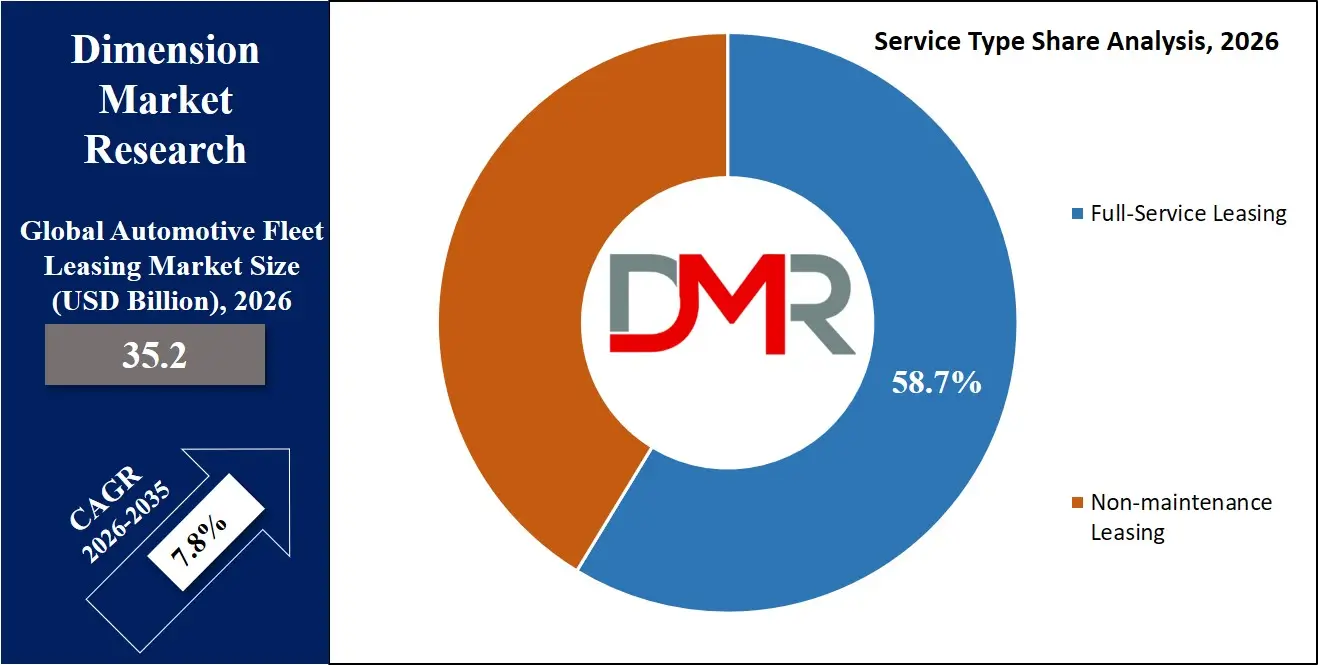
Full-service leasing is the most dominant service type in the automotive fleet leasing market as it provides a comprehensive package of vehicle-related services. In 2026, this segment is projected to account for around 58.7% of the market share, reflecting strong demand from corporations seeking integrated fleet management solutions. Full-service leasing typically includes maintenance and repair services, insurance coverage, telematics integration, and vehicle replacement support. Organizations benefit from reduced administrative burden, as leasing providers handle operational tasks such as compliance management, servicing schedules, and vehicle lifecycle optimization. The growing complexity of fleet management, combined with the rising adoption of connected vehicles, is encouraging companies to adopt full-service leasing models that provide centralized and data-driven fleet oversight.
ℹ
To learn more about this report –
Download Your Free Sample Report Here
Non-maintenance leasing is emerging as a fast-growing service segment, particularly among companies that already operate internal fleet management departments. In this model, businesses lease vehicles but manage maintenance and operational services independently. This structure allows companies to reduce leasing costs and maintain greater control over service providers and maintenance schedules. Large logistics firms and transportation companies often prefer this model as they already have dedicated infrastructure for vehicle servicing and fleet monitoring.
By Fleet Size Analysis
Large fleets represent the dominant segment in the automotive fleet leasing market, driven by high demand from multinational corporations, logistics providers, and government agencies that operate extensive vehicle networks. In 2026, large fleets are expected to account for approximately 49.3% of the market share, reflecting the strong adoption of leasing solutions by organizations managing hundreds or thousands of vehicles. Leasing providers offer specialized solutions for large fleets, including telematics integration, centralized fleet monitoring platforms, predictive maintenance services, and customized financing options. These features help large organizations optimize vehicle utilization, reduce operational costs, and maintain regulatory compliance. Additionally, large enterprises often transition toward electric and hybrid fleets through leasing arrangements, enabling them to modernize transportation operations without heavy upfront investments.
Medium-sized fleets are expected to experience significant growth as expanding mid-sized enterprises increasingly adopt leasing solutions. Businesses operating fleets of 26–100 vehicles are recognizing the benefits of leasing in terms of cost predictability, fleet flexibility, and reduced administrative responsibilities. Leasing providers are also developing tailored packages for mid-sized organizations that combine fleet financing with digital fleet management tools. As SMEs expand their operations and delivery networks, the adoption of medium-sized leased fleets continues to grow rapidly.
By End User Analysis
Corporate enterprises dominate the automotive fleet leasing market due to their large workforce mobility requirements and extensive operational networks. In 2026, corporate enterprises are projected to hold around 41.6% of the total market share. Large companies across industries such as pharmaceuticals, consulting, financial services, and manufacturing lease fleets to support employee transportation, sales activities, and field service operations. Leasing allows corporations to streamline fleet procurement processes while maintaining cost efficiency and access to modern vehicles. Additionally, corporations are increasingly incorporating electric vehicles into their leased fleets to meet sustainability targets and reduce operational emissions.
The transportation and logistics sector is the fastest-growing end-user segment due to the expansion of e-commerce, urban delivery networks, and supply chain operations. Companies operating in last-mile delivery, courier services, and freight transportation rely heavily on leased vehicles to maintain flexible and scalable fleets. Leasing allows logistics providers to upgrade vehicles frequently and adopt newer technologies such as electric delivery vans and telematics-enabled fleet monitoring systems.
The Automotive Fleet Leasing Market Report is segmented on the basis of the following:
By Vehicle Type
- Passenger Cars
- Light Commercial Vehicles (LCVs)
- Heavy Commercial Vehicles (HCVs)
By Lease Type
- Operating Lease
- Finance Lease
- Open-End Lease
- Closed-End Lease
By Service Type
- Full-Service Leasing
- Maintenance & Repair
- Insurance
- Telematics & Fleet Monitoring
- Vehicle Replacement Services
- Non-Maintenance Leasing
By Fleet Size
- Small Fleet (1–25 Vehicles)
- Medium Fleet (26–100 Vehicles)
- Large Fleet (Above 100 Vehicles)
By End User
- Corporate Enterprises
- SMEs
- Government & Public Sector
- Transportation & Logistics
- Healthcare
- Utilities & Field Services
Regional Analysis
Leading Region in the Automotive Fleet Leasing Market
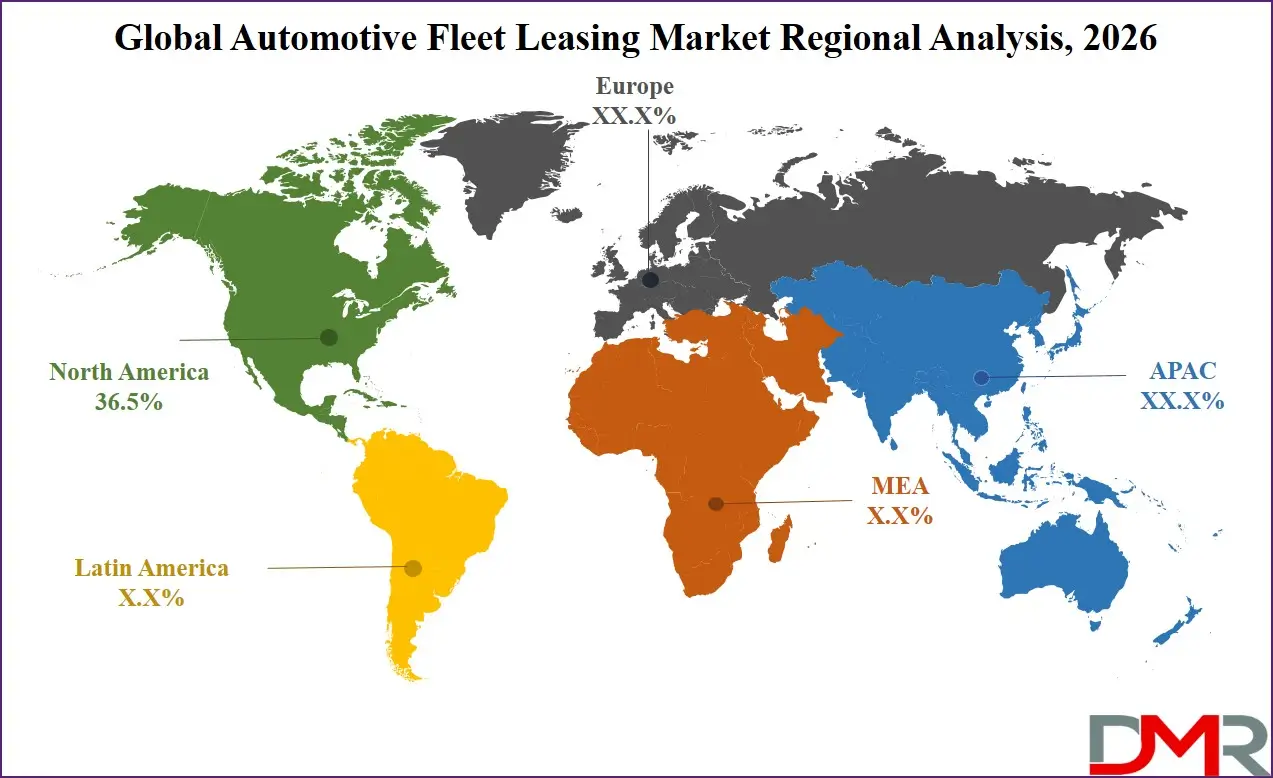
North America holds the leading position in the automotive fleet leasing market due to its mature corporate mobility ecosystem, strong automotive industry presence, and advanced financial services infrastructure. In 2026, North America is projected to account for approximately 36.5% of the global automotive fleet leasing market share. The region has a high concentration of large corporations, logistics providers, and government agencies that operate extensive vehicle fleets.
ℹ
To learn more about this report –
Download Your Free Sample Report Here
Additionally, the increasing adoption of electric and hybrid vehicles is accelerating the demand for flexible leasing solutions. Strong telematics adoption and advanced digital fleet management platforms further support market growth. Regulatory incentives encouraging low-emission vehicles and sustainable transportation also contribute to the region's dominant position.
Fastest Growing Region in the Automotive Fleet Leasing Market
Asia Pacific is expected to be the fastest-growing region in the automotive fleet leasing market due to rapid economic development, expanding urban infrastructure, and increasing commercial transportation demand. Countries such as China, India, Japan, and South Korea are witnessing strong growth in logistics services, e-commerce delivery networks, and corporate mobility programs. Businesses in the region are increasingly adopting leasing models to reduce capital expenditure while maintaining access to modern vehicles. Government initiatives promoting electric vehicle adoption and sustainable transportation are also encouraging companies to upgrade their fleets through leasing arrangements. Additionally, the growing number of small and medium enterprises across Asia Pacific is creating new opportunities for fleet leasing providers.
By Region
North America
Europe
- Germany
- The U.K.
- France
- Italy
- Russia
- Spain
- Benelux
- Nordic
- Rest of Europe
Asia-Pacific
- China
- Japan
- South Korea
- India
- ANZ
- ASEAN
- Rest of Asia-Pacific
Latin America
- Brazil
- Mexico
- Argentina
- Colombia
- Rest of Latin America
Middle East & Africa
- Saudi Arabia
- UAE
- South Africa
- Israel
- Egypt
- Rest of MEA
Competitive Landscape
The automotive fleet leasing market is characterized by intense competition driven by innovation, service diversification, and strategic partnerships. Leasing providers focus on expanding their service portfolios by integrating telematics solutions, digital fleet management platforms, and sustainability-focused mobility services. Many companies are investing heavily in research and development to improve vehicle analytics, predictive maintenance capabilities, and electric fleet management systems. Strategic alliances with automotive manufacturers, financial institutions, and mobility technology firms are becoming increasingly common to strengthen service offerings. Market participants also compete through flexible leasing contracts, customized fleet management solutions, and value-added services designed to improve operational efficiency for clients. High capital requirements, regulatory compliance standards, and established brand relationships create moderate barriers to entry, favoring companies with strong financial resources and extensive service networks.
Some of the prominent players in the global Automotive Fleet Leasing are:
- Ayvens
- Element Fleet Management
- Arval
- Alphabet (BMW Group)
- Athlon
- Wheels Inc.
- Donlen Corporation
- Enterprise Fleet Management
- Ryder System
- Merchants Fleet
- Holman Fleet Services (ARI)
- Emkay
- SG Fleet Group
- Sixt Leasing
- Volkswagen Financial Services Fleet
- Toyota Fleet Management / Toyota Financial Services
- Ford Motor Credit Company
- GM Financial
- Hitachi Capital Vehicle Solutions
- ORIX Corporation
- Other Key Players
Recent Developments
- In March 2025, ALD Automotive announced the completion of a major integration project aimed at enhancing its global digital mobility platform following its operational expansion in the fleet leasing sector. The company deployed advanced fleet management technologies, including AI-driven predictive maintenance systems, connected vehicle analytics, and real-time fleet monitoring dashboards. The integration allows corporate clients to manage large vehicle fleets more efficiently while improving cost transparency and operational performance.
- In January 2025, LeasePlan announced the expansion of its electric vehicle fleet leasing program aimed at accelerating corporate fleet electrification across Europe and North America. The initiative includes integrated EV leasing packages that combine vehicle financing, charging infrastructure support, energy management software, and battery performance monitoring. The program was introduced to help corporate clients transition toward low-emission fleets while minimizing operational risks associated with EV adoption.
Report Details
| Report Characteristics |
| Market Size (2026) |
USD 35.3 Bn |
| Forecast Value (2035) |
USD 69.2 Bn |
| CAGR (2026–2035) |
7.8% |
| The US Market Size (2026) |
USD 11.0 Bn |
| Historical Data |
2021 – 2025 |
| Forecast Data |
2027 – 2035 |
| Base Year |
2025 |
| Estimate Year |
2026 |
| Report Coverage |
Market Revenue Estimation, Market Dynamics, Competitive Landscape, Growth Factors and etc. |
| Segments Covered |
By Vehicle Type (Passenger Cars, Light Commercial Vehicles (LCVs), Heavy Commercial Vehicles (HCVs)), By Lease Type (Operating Lease, Finance Lease, Open-End Lease, Closed-End Lease), By Service Type (Full-Service Leasing, Non-Maintenance Leasing), By Fleet Size (Small Fleet, Medium Fleet, Large Fleet), By End User (Corporate Enterprises, SMEs, Government & Public Sector, Transportation & Logistics, Healthcare, Utilities & Field Services) |
| Regional Coverage |
North America – The US and Canada; Europe – Germany, The UK, France, Russia, Spain, Italy, Benelux, Nordic, & Rest of Europe; Asia-Pacific – China, Japan, South Korea, India, ANZ, ASEAN, Rest of APAC; Latin America – Brazil, Mexico, Argentina, Colombia, Rest of Latin America; Middle East & Africa – Saudi Arabia, UAE, South Africa, Turkey, Egypt, Israel, & Rest of MEA |
| Prominent Players |
Ayvens, Element Fleet Management, Arval, Alphabet (BMW Group), Athlon, Wheels Inc., Donlen Corporation, Enterprise Fleet Management, Ryder System, Merchants Fleet, Holman Fleet Services (ARI), Emkay, SG Fleet Group, Sixt Leasing, Volkswagen Financial Services Fleet, Toyota Fleet Management / Toyota Financial Services, Ford Motor Credit Company, GM Financial, Hitachi Capital Vehicle Solutions, ORIX Corporation, and Other Key Players |
| Purchase Options |
We have three licenses to opt for: Single User License (Limited to 1 user), Multi-User License (Up to 5 Users) and Corporate Use License (Unlimited User) along with free report customization equivalent to 0 analyst working days, 3 analysts working days and 5 analysts working days respectively. |
Frequently Asked Questions
How big is the Global Automotive Fleet Leasing Market?
▾ The Global Automotive Fleet Leasing Market size is expected to reach USD 35.2 billion by 2026 and is projected to reach USD 69.2 billion by the end of 2035.
Which region accounted for the largest Global Automotive Fleet Leasing Market?
▾ North America is expected to have the largest market share in the Global Automotive Fleet Leasing Market, with a share of about 36.5% in 2026.
How big is the Automotive Fleet Leasing Market in the US?
▾ The US Automotive Fleet Leasing market is expected to reach USD 11.0 billion by 2026.
Who are the key players in the Automotive Fleet Leasing Market?
▾ Some of the major key players in the Global Automotive Fleet Leasing Market include Avyens, Arval, Athlon, and others.
What is the growth rate in the Global Automotive Fleet Leasing Market?
▾ The market is growing at a CAGR of 7.8 percent over the forecasted period.