Market Overview
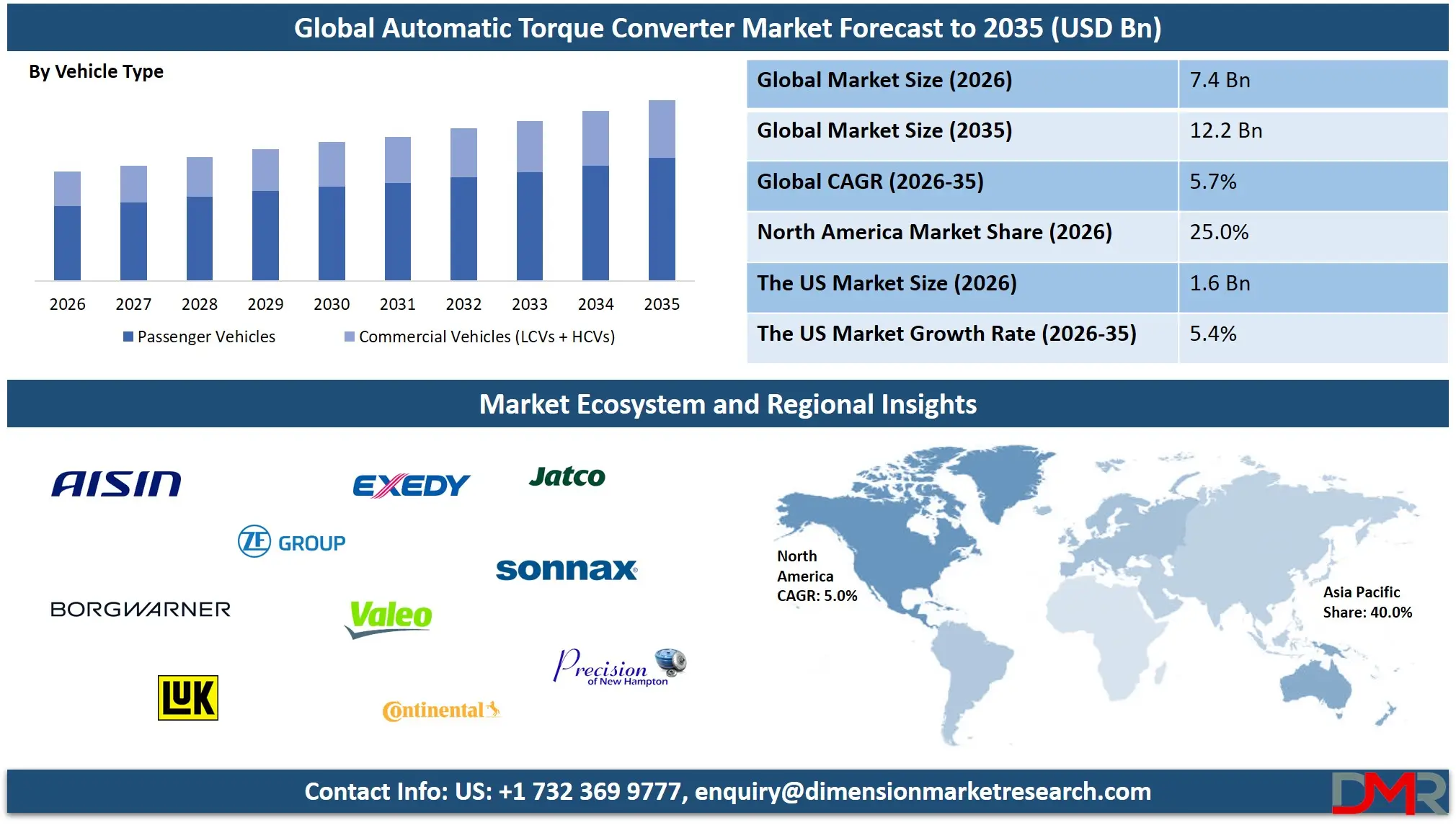
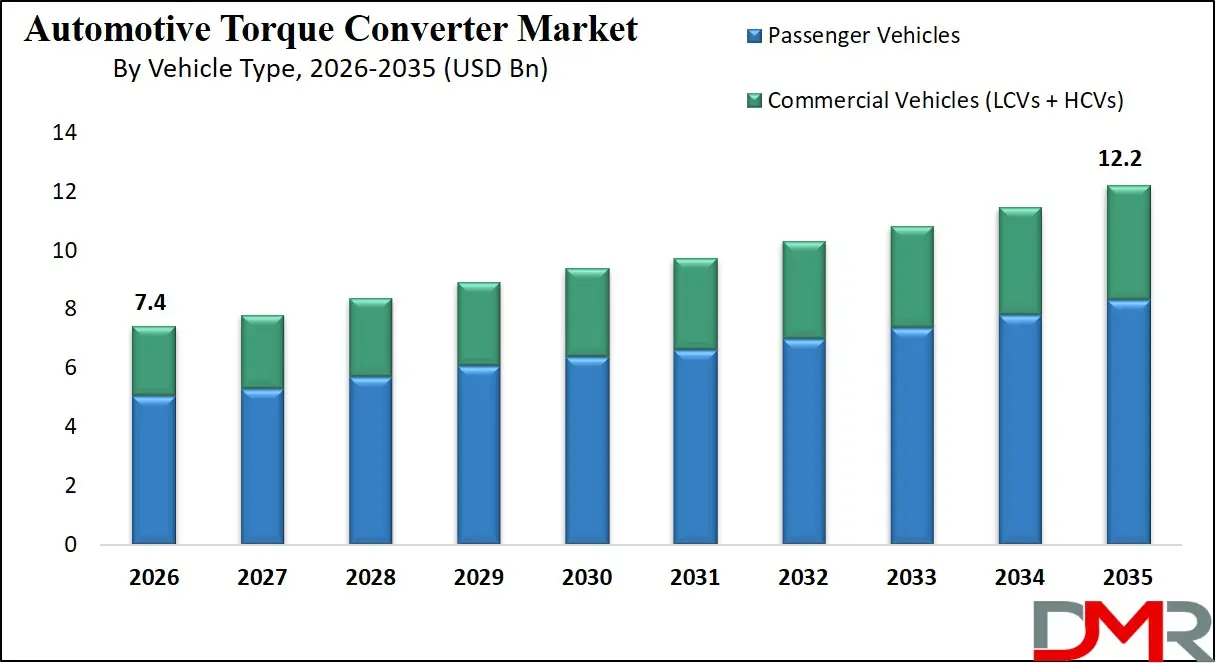
The global automotive torque converter market is expected to reach at USD 7.4 billion in 2026 and is anticipated to expand at a CAGR of 5.7%, reaching USD 12.2 billion by 2035. Growth is driven by rising demand for automatic transmissions, hybrid vehicle adoption, and advancements in torque multiplication and fuel-efficient drivetrain technologies.
ℹ
To learn more about this report –
Download Your Free Sample Report Here
An automotive torque converter is a fluid coupling device used in vehicles to transfer rotational power from the engine to the transmission system while allowing for a variable connection between the two components. It facilitates smooth acceleration by multiplying engine torque during low-speed operation and reducing mechanical losses during cruising. This component plays a critical role in automatic transmissions by eliminating the need for a manual clutch, enabling seamless gear changes, and improving overall drivability. Torque converters also help absorb engine vibrations and provide torque multiplication, which enhances vehicle performance and efficiency, especially in heavy-duty or high-torque applications. With advances in materials and design, modern torque converters contribute to improved fuel economy, lower emissions, and enhanced vehicle responsiveness, making them a vital element in both passenger and commercial vehicles.
The global automotive torque converter market encompasses the production, distribution, and adoption of torque converters across passenger vehicles, commercial vehicles, and hybrid platforms. This market is influenced by increasing demand for automatic transmissions, technological innovations in torque multiplication systems, and rising automotive production in emerging economies. The market includes a diverse range of products such as single-stage converters, multi-stage converters, and lock-up torque converters that cater to different vehicle classes and engine types. Industry growth is further driven by the need for fuel-efficient drivetrains, enhanced performance, and reduced environmental impact. Key stakeholders in this market include original equipment manufacturers, transmission suppliers, and aftermarket service providers who are focused on delivering high-quality and durable torque converter solutions.
ℹ
To learn more about this report –
Download Your Free Sample Report Here
Globally, the automotive torque converter market is experiencing steady expansion due to the rising adoption of automatic and continuously variable transmissions, increasing vehicle sales in Asia-Pacific and North America, and advancements in hybrid and electric vehicle powertrains. Manufacturers are investing in research and development to produce converters with higher torque capacity, improved thermal efficiency, and lightweight designs to meet evolving automotive standards. The market is also shaped by regional factors such as production hubs in China, Japan, and India, stringent fuel economy regulations, and growing demand for passenger comfort and smooth driving experiences. As a result, the market landscape is competitive, with major players focusing on innovation, partnerships, and strategic collaborations to capture market share and address the changing requirements of modern vehicles.
The US Automotive Torque Converter Market
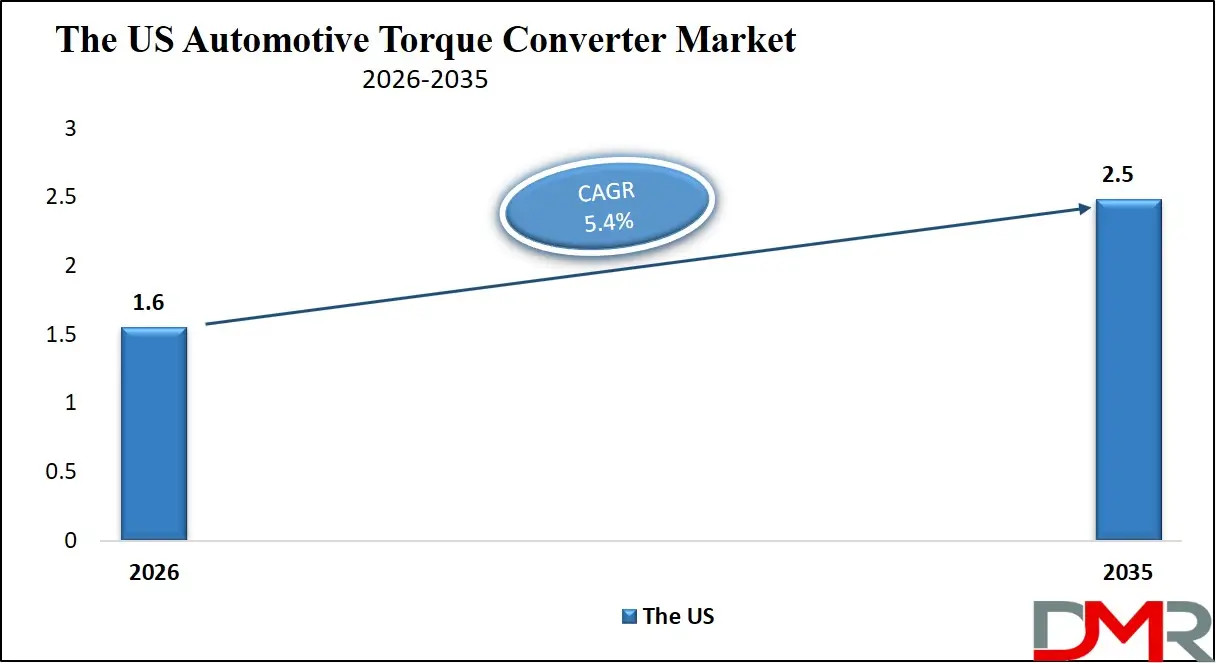
The US Automotive Torque Converter Market size is expected to reach at USD 1.6 billion in 2026. It is further expected to witness subsequent growth in the upcoming period, holding USD 2.5 billion in 2035 at a CAGR of 5.4%.
ℹ
To learn more about this report –
Download Your Free Sample Report Here
The US automotive torque converter market is witnessing steady growth driven by increasing adoption of automatic transmissions in passenger vehicles and light commercial vehicles. Rising consumer preference for smoother driving experiences and fuel-efficient vehicles has accelerated the demand for advanced torque converters, including lock-up and multi-stage designs. The market is also influenced by stringent emission standards and fuel economy regulations, which encourage manufacturers to optimize torque converter efficiency. Key players in the US focus on technological innovations, high-torque designs, and collaborations with OEMs to maintain a competitive edge.
In addition, the US market benefits from a well-established automotive manufacturing ecosystem and a strong aftermarket segment for torque converter replacement and upgrades. The growth of hybrid and electric vehicles with integrated automatic or continuously variable transmissions is further shaping market dynamics, driving demand for lighter, high-performance converters. Increasing investment in research and development, coupled with strategic partnerships between transmission component suppliers and automakers, is enhancing product quality, reliability, and fuel efficiency. As a result, the US automotive torque converter market is poised for sustained expansion in the coming decade.
The Europe Automotive Torque Converter Market
The Europe automotive torque converter market is projected to reach approximately USD 1.7 billion in 2026, growing at a CAGR of 4.0%. This steady growth is driven by the region’s mature automotive industry and high adoption of automatic and continuously variable transmissions. The market is supported by a strong presence of passenger vehicles and commercial fleets, where torque converters ensure smooth power transfer, improved fuel efficiency, and enhanced drivability. Stringent emission regulations and increasing demand for fuel-efficient drivetrains further encourage the adoption of advanced torque converter technologies.
Growth in Europe is also fueled by the integration of multi-stage and lock-up torque converters, which optimize engine torque, reduce slippage, and improve vehicle performance. Technological advancements in lightweight materials, hybrid powertrains, and energy-efficient transmission systems are being increasingly applied in passenger cars and commercial vehicles. Investments in research and development, along with strategic OEM collaborations, enable the production of high-performance and durable torque converters that align with evolving regulatory standards and consumer expectations, reinforcing the market’s stable expansion.
The Japan Automotive Torque Converter Market
The Japan automotive torque converter market is projected to reach approximately USD 592 million in 2026, expanding at a CAGR of 4.8%. The market growth is primarily driven by the country’s established automotive manufacturing sector, high adoption of automatic and continuously variable transmissions, and increasing focus on fuel-efficient and low-emission vehicles. Torque converters play a crucial role in ensuring smooth power delivery, optimal torque management, and improved drivability in passenger cars and light commercial vehicles, which form the bulk of Japan’s vehicle fleet.
The market is further supported by technological advancements, including multi-stage and lock-up torque converters that enhance engine performance and reduce energy losses. The growing presence of hybrid vehicles and lightweight designs in Japanese passenger and commercial vehicles has accelerated the demand for efficient torque converter systems. Additionally, collaborations between OEMs and torque converter manufacturers, along with investments in research and development, are enabling high-performance, durable, and energy-efficient converters that meet Japan’s stringent emission regulations and consumer expectations for smooth and reliable vehicle operation.
Global Automotive Torque Converter Market: Key Takeaways
- Global Market Size & Growth: The market is projected to reach at USD 7.4 billion in 2026, reaching USD 12.2 billion by 2035 at a CAGR of 5.7%.
- Product & Transmission Dominance: Single-stage converters hold 62.0% share, while automatic transmissions account for 58.0%, leading their segments.
- Vehicle & Engine Type Share: Passenger vehicles dominate with 68.0% share, and gasoline engine vehicles lead at 47.0 share%.
- Technology & Sales Channel: Standard steel converters hold 65% share, and OEMs control 80% of the market share.
- Emerging Vehicle Technologies: Multi-stage and lock-up torque converters are expected to cover over 45.0% of advanced transmission applications by 2026, reflecting rising adoption in hybrid, high-performance, and fuel-efficient vehicles.
Global Automotive Torque Converter Market: Use Cases
- Passenger Vehicles for Smooth Driving: Torque converters in passenger vehicles enable seamless power transfer from the engine to the transmission, ensuring smooth acceleration and gear shifts. They improve driving comfort, reduce vibrations, and support fuel-efficient performance, particularly in vehicles with automatic or continuously variable transmissions.
- Commercial and Heavy-Duty Vehicles: In trucks, buses, and LCVs, torque converters provide high torque multiplication to handle heavy loads and challenging terrains. They enhance drivetrain durability, optimize engine efficiency, and reduce wear on transmission components, supporting long-distance logistics and fleet operations.
- Hybrid and Electric Vehicle Applications: Advanced torque converters are integrated into hybrid and mild-hybrid vehicles to optimize energy use, reduce fuel consumption, and improve regenerative braking performance. They support smooth transitions between electric and combustion engines while maintaining efficient torque delivery.
- Aftermarket Replacement and Upgrades: The aftermarket segment drives demand for replacement torque converters in aging vehicles, ensuring continued performance and reliability. Upgrades to high-efficiency or multi-stage converters improve fuel economy and transmission responsiveness, catering to both passenger and commercial vehicle owners.
Global Automotive Torque Converter Market: Stats & Facts
- OICA (International Organization of Motor Vehicle Manufacturers)
- In 2023, global motor vehicle production reached approximately 93.5 million units, reflecting the worldwide scale of automotive manufacturing.
- China led global vehicle production in 2023 with over 30 million vehicles output, maintaining its position as the top manufacturing nation.
- The United States produced about 10.6 million vehicles in 2023, making it one of the largest producers.
- Japan manufactured around 8.99 million vehicles in 2023, ranking among the top global production countries.
- India’s total vehicle production exceeded 6 million units in 2024, indicating rapid automotive sector growth in emerging economies.
- Mexico’s vehicle output was over 4.2 million units in 2024, highlighting its role in North American automotive manufacturing.
- France produced around 1.36 million vehicles in 2024, underlining continued European manufacturing activity.
Global Automotive Torque Converter Market: Market Dynamic
Driving Factors in the Global Automotive Torque Converter Market
Rising Adoption of Automatic Transmissions
The growing preference for automatic transmissions in passenger and commercial vehicles is a major driver for the torque converter market. Drivers increasingly seek smooth gear shifts, reduced engine load, and enhanced fuel efficiency, all of which are enabled by advanced torque converters. This shift is particularly evident in regions like Asia-Pacific and North America, where convenience, comfort, and urban commuting demand are shaping vehicle design. The rise in hybrid and continuously variable transmission vehicles further accelerates adoption.
Demand for Fuel Efficiency and Emission Compliance
Stringent fuel economy and emission regulations worldwide are pushing manufacturers to adopt torque converters that optimize engine torque transfer while reducing energy loss. High-efficiency lock-up and multi-stage converters help lower fuel consumption and CO2 emissions, supporting compliance with standards such as Corporate Average Fuel Economy (CAFE) and Euro 7 regulations. This focus on sustainable powertrains strengthens the market demand across passenger, commercial, and hybrid vehicles.
Restraints in the Global Automotive Torque Converter Market
High Manufacturing and Maintenance Costs
Advanced torque converters, especially multi-stage and lock-up variants, involve complex engineering and precision manufacturing, increasing production costs. For fleet operators and small OEMs, these costs can limit adoption, particularly in price-sensitive markets. Additionally, maintenance and replacement costs in aging vehicles can constrain aftermarket demand, slowing overall market growth.
Competition from Alternative Transmission Technologies
Emerging alternatives like direct-drive electric motors in battery electric vehicles and dual-clutch transmissions reduce reliance on conventional torque converters. As EV adoption grows globally, the need for traditional torque converter systems in new vehicles may decrease, restraining market expansion in certain regions.
Opportunities in the Global Automotive Torque Converter Market
Expansion in Hybrid and Electric Vehicle Segments
Hybrid vehicles present significant opportunities for torque converter manufacturers, as specialized converters help optimize power transfer between electric motors and internal combustion engines. Mild-hybrid and plug-in hybrid vehicles demand lighter, high-performance converters, creating scope for innovative designs and new product lines.
Aftermarket Growth for Replacement and Upgrades
The increasing number of vehicles with automatic transmissions on the road creates a growing aftermarket for torque converter replacement and performance upgrades. High-efficiency converters, multi-stage systems, and durable designs provide opportunities for aftermarket suppliers to capture additional revenue, particularly in mature markets like North America and Europe.
Trends in the Global Automotive Torque Converter Market
Integration of Advanced Materials and Lightweight Designs
Manufacturers are adopting aluminum, high-strength steel, and composite materials to reduce torque converter weight, improve fuel efficiency, and enhance thermal management. Lightweight designs also support hybrid and electric powertrains by reducing overall vehicle mass and improving energy efficiency.
Focus on Multi-Stage and Lock-Up Converters
The market is shifting toward multi-stage and lock-up torque converters to improve torque multiplication, reduce slippage, and enhance driving performance. This trend is particularly evident in high-torque commercial vehicles and premium passenger cars, where smooth acceleration and fuel efficiency are critical selling points.
Global Automotive Torque Converter Market: Research Scope and Analysis
By Product Analysis
In the global automotive torque converter market, single-stage torque converters are expected to maintain a leading position, capturing approximately 62.0% of the total market share in 2026. These converters are widely preferred due to their simplicity, cost-effectiveness, and reliability, making them suitable for a broad range of passenger vehicles and light commercial vehicles. Single-stage torque converters efficiently transmit engine power to the transmission while providing smooth acceleration and enhanced drivability. Their widespread adoption is driven by the demand for automatic transmissions and the need for consistent performance in both conventional and hybrid powertrains.
Multi-stage torque converters, on the other hand, are gaining traction as they provide higher torque multiplication and improved efficiency, particularly in heavy-duty vehicles, premium passenger cars, and performance-oriented models. By incorporating multiple impeller stages, these converters can optimize engine power output across different speed ranges, reducing slippage and enhancing fuel economy. Multi-stage torque converters are increasingly being integrated into hybrid and continuously variable transmission vehicles, where enhanced torque management and energy efficiency are critical. Their growing adoption reflects the market’s shift toward advanced drivetrain solutions and the demand for improved performance and emission compliance in modern vehicles.
By Transmission Type Analysis
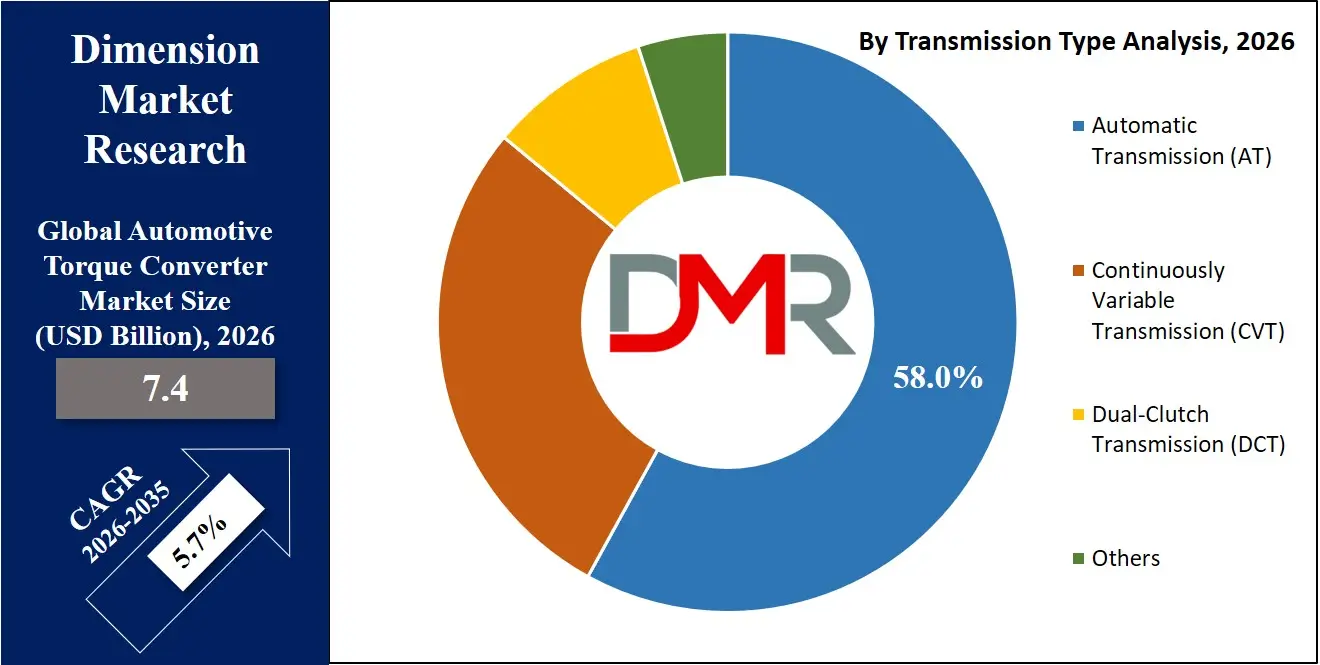
In the automotive torque converter market, automatic transmissions are expected to dominate the transmission type segment, accounting for approximately 58.0% of the total market share in 2026. Automatic transmissions remain highly preferred in passenger vehicles and light commercial vehicles due to their ability to provide smooth gear shifts, reduced driver effort, and improved overall driving comfort. Torque converters in automatic transmissions facilitate seamless power transfer from the engine to the drivetrain, enhance fuel efficiency, and support better torque management, making them essential for conventional and hybrid vehicles. Their widespread adoption is further supported by consumer preference for convenience and ease of use, particularly in urban and high-traffic regions.
ℹ
To learn more about this report –
Download Your Free Sample Report Here
Continuously variable transmissions are also gaining traction within this market segment, offering a flexible and efficient alternative to traditional automatic systems. CVTs allow for a smooth and continuous change in gear ratios without discrete shifts, optimizing engine performance and improving fuel economy. Torque converters designed for CVT systems are engineered to manage variable torque delivery efficiently, supporting hybrid and lightweight vehicle applications. The increasing focus on fuel-efficient drivetrains, urban mobility, and environmentally friendly vehicles is driving the adoption of CVT-compatible torque converters, particularly in compact cars, hybrids, and emerging markets where energy efficiency is a critical consideration.
By Vehicle Type Analysis
In the automotive torque converter market, passenger vehicles are expected to lead the vehicle type segment, accounting for approximately 68.0% of the total market share in 2026. The dominance of passenger vehicles is driven by the increasing adoption of automatic transmissions and the growing demand for comfortable, smooth, and fuel-efficient driving experiences. Torque converters in passenger cars and SUVs facilitate seamless power transfer from the engine to the transmission, enhance acceleration performance, and reduce engine load during low-speed driving. Rising consumer preference for convenience and the proliferation of hybrid and continuously variable transmission vehicles further reinforce the strong presence of passenger vehicles in this market.
Commercial vehicles, including light commercial vehicles and heavy commercial vehicles, also constitute a significant portion of the market. Torque converters in LCVs and HCVs are designed to handle higher loads and deliver enhanced torque multiplication for long-distance and heavy-duty operations. These converters improve drivetrain durability, reduce transmission wear, and optimize fuel efficiency under demanding conditions. The growth of logistics, freight transport, and urban delivery services drives the demand for reliable torque converters in commercial vehicles, while technological advancements such as multi-stage and lock-up designs are increasingly being adopted to improve vehicle performance and operational efficiency.
By Engine Analysis
In the automotive torque converter market, gasoline engine vehicles are expected to dominate the engine segment, capturing approximately 47.0% of the total market share in 2026. Gasoline vehicles are widely used across passenger cars and light commercial vehicles, and their compatibility with automatic and continuously variable transmissions drives the demand for torque converters. These converters efficiently transfer engine power to the transmission, enhance acceleration performance, and contribute to smoother driving experiences. The preference for gasoline-powered vehicles is reinforced by their lower upfront costs, widespread fuel availability, and suitability for urban and suburban driving conditions, making them a leading segment in this market.
Diesel engine vehicles also represent a substantial portion of the market, particularly in commercial vehicles and heavy-duty applications. Torque converters in diesel-powered trucks, buses, and vans are engineered to handle higher torque loads and provide improved torque multiplication for heavy payloads and challenging terrains. Diesel engines, known for their fuel efficiency and durability, rely on advanced torque converters to optimize drivetrain performance and reduce engine strain during long-distance operations. The adoption of multi-stage and lock-up torque converters in diesel vehicles enhances fuel economy and ensures smooth power delivery, making them an important segment within the global automotive torque converter market.
By Technology Analysis
In the automotive torque converter market, standard steel converters are expected to dominate the technology segment, capturing approximately 65.0% of the total market share in 2026. Standard steel converters are widely used due to their cost-effectiveness, durability, and compatibility with a broad range of passenger vehicles and light commercial vehicles. They efficiently transfer engine power to the transmission, provide reliable torque multiplication, and support smooth acceleration and gear shifts. Their widespread adoption is driven by the balance of performance, manufacturing simplicity, and affordability, making them the preferred choice for conventional automatic and continuously variable transmissions.
Aluminum converters, on the other hand, are gaining traction as automotive manufacturers focus on lightweight designs and improved fuel efficiency, particularly in hybrid and electric vehicles. Aluminum torque converters reduce overall vehicle weight, improve thermal management, and enhance energy efficiency, contributing to lower fuel consumption and emissions. These converters are increasingly integrated into premium passenger cars, hybrids, and urban mobility vehicles where performance optimization and environmental compliance are key priorities. The growing emphasis on lightweight materials and energy-efficient drivetrains is driving the adoption of aluminum converters in the global market.
By Sales Channel Analysis
In the automotive torque converter market, OEM (Original Equipment Manufacturers) are expected to dominate the sales channel segment, capturing approximately 80.0% of the total market share in 2026. OEMs supply torque converters directly to vehicle manufacturers for installation in new vehicles, ensuring high-quality performance, durability, and compatibility with automatic and continuously variable transmissions. The dominance of OEMs is driven by the growing production of passenger and commercial vehicles, the rising adoption of advanced transmission technologies, and increasing consumer demand for smooth and fuel-efficient driving experiences. OEM partnerships with torque converter suppliers also facilitate innovation and integration of multi-stage and lock-up designs.
The aftermarket segment also holds significance in the global market, catering to the replacement and upgrade needs of aging vehicles. Torque converters in the aftermarket are used for maintenance, performance enhancement, and repair of automatic and hybrid vehicles. Rising vehicle fleets, increasing vehicle lifespan, and the demand for improved fuel efficiency drive aftermarket adoption. Aftermarket torque converters often include high-performance and advanced designs that improve drivetrain efficiency, reduce slippage, and support enhanced acceleration, making this segment a growing contributor to the overall automotive torque converter market.
By Application Analysis
In the automotive torque converter market, conventional torque transmission systems are expected to dominate the application segment, capturing approximately 55.0% of the total market share in 2026. These systems are widely used in automatic transmissions across passenger vehicles and light commercial vehicles, providing smooth power transfer from the engine to the transmission. Conventional torque converters efficiently multiply engine torque during acceleration, reduce engine load at low speeds, and enhance overall drivability. Their simplicity, reliability, and cost-effectiveness make them the preferred choice for standard vehicles, contributing to their strong presence in the global market.
Lock-up torque converter systems are increasingly being adopted to improve fuel efficiency and minimize energy loss in vehicles. These systems feature a clutch mechanism that locks the converter at higher speeds, reducing slippage and enabling a more direct connection between the engine and transmission. Lock-up converters are commonly integrated into passenger cars, hybrid vehicles, and high-performance commercial vehicles to enhance torque delivery, optimize fuel consumption, and reduce emissions. The growing emphasis on sustainable and fuel-efficient drivetrains is driving the adoption of lock-up torque converter systems across the global automotive market.
The Global Automotive Torque Converter Market Report is segmented on the basis of the following:
By Product
- Single-Stage Torque Converters
- Multi-Stage Torque Converters
By Transmission Type
- Automatic Transmission (AT)
- Continuously Variable Transmission (CVT)
- Dual-Clutch Transmission (DCT)
- Others
By Vehicle Type
- Passenger Vehicles
- Commercial Vehicles (LCVs + HCVs)
By Engine
- Gasoline Engine Vehicles
- Diesel Engine Vehicles
- Hybrid Electric Vehicles (HEVs)
- Battery Electric Vehicles (BEVs)
By Technology
- Standard Steel Converters
- Aluminum Steel Converters
- Reinforced Designs
By Sales Channel
- OEM (Original Equipment Manufacturer)
- Aftermarket
By Application
- Conventional Torque Transmission
- Lock Up Torque Converter Systems
- Torque Multiplication
Impact of Artificial Intelligence in the Global Automotive Torque Converter Market
Artificial intelligence is increasingly influencing the global automotive torque converter market by enhancing design, development, and manufacturing processes. AI-driven simulation and modeling tools enable engineers to optimize torque converter efficiency, reduce slippage, and predict performance under various driving conditions. Machine learning algorithms analyze vehicle drivetrain data to refine torque delivery, improve fuel efficiency, and ensure smoother gear shifts in both passenger and commercial vehicles. The technology also supports the development of advanced multi-stage and lock-up torque converters, making them more efficient and adaptable to hybrid and continuously variable transmission systems.
In addition, AI plays a key role in predictive maintenance and quality control across the torque converter supply chain. By monitoring performance data in real time, AI systems can forecast potential failures, reduce downtime, and extend the lifespan of components in commercial fleets. Automated production lines powered by AI enhance precision, reduce material waste, and accelerate the introduction of lightweight and high-performance torque converters. Overall, AI integration drives innovation, operational efficiency, and competitive advantage for manufacturers in the evolving global torque converter market.
Global Automotive Torque Converter Market: Regional Analysis
Region with the Largest Revenue Share
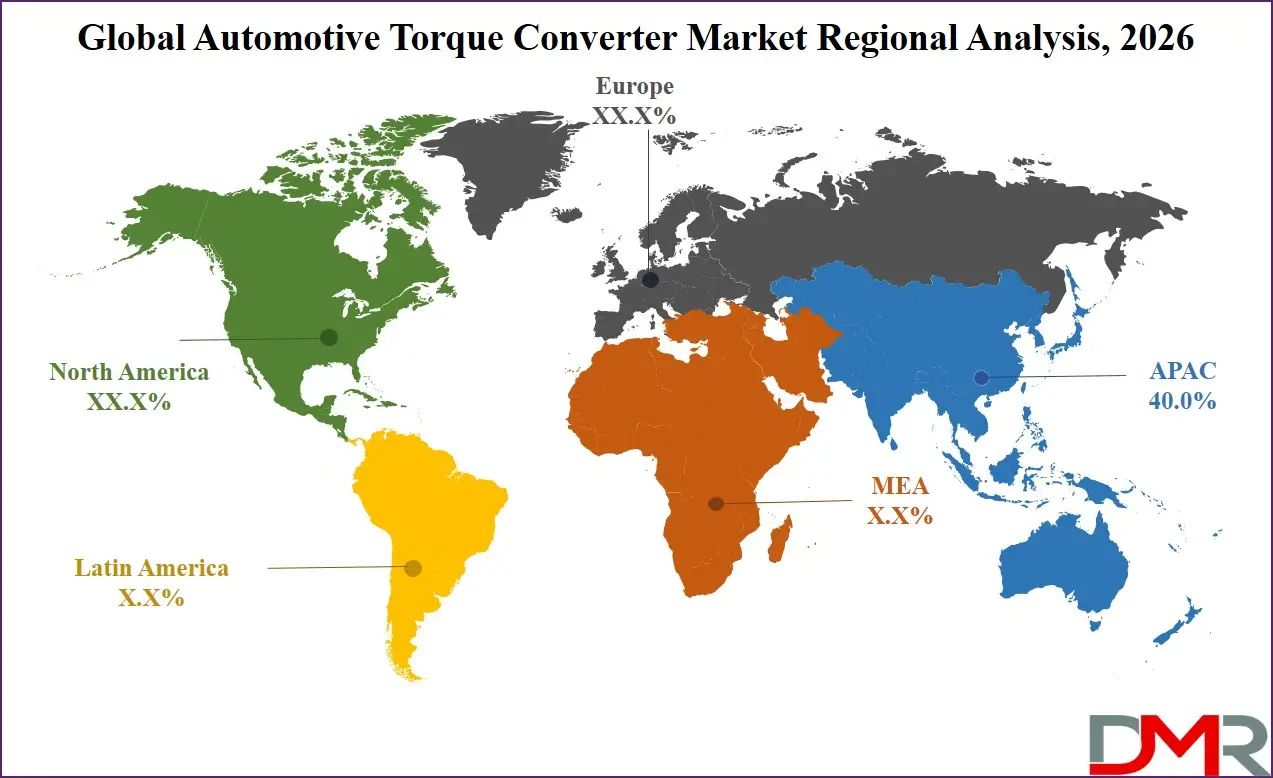
Asia Pacific is expected to lead the global automotive torque converter market, accounting for approximately 40.0% of total market revenue in 2026. The region’s dominance is driven by large-scale vehicle production in countries such as China, Japan, and India, rising adoption of automatic and continuously variable transmissions, and growing demand for passenger and commercial vehicles. Increasing focus on hybrid powertrains, fuel efficiency, and emission compliance further supports market growth. Additionally, strong OEM presence, technological advancements, and expanding automotive manufacturing infrastructure contribute to Asia Pacific’s leading position in the global torque converter market.
ℹ
To learn more about this report –
Download Your Free Sample Report Here
Region with the Highest CAGR
The Asia Pacific region is projected to register the highest CAGR in the global automotive torque converter market, driven by rapid growth in vehicle production, increasing adoption of automatic and continuously variable transmissions, and rising demand for fuel-efficient and hybrid vehicles. Strong investment in automotive manufacturing, expansion of passenger and commercial vehicle fleets, and a focus on advanced drivetrain technologies such as multi-stage and lock-up torque converters are further accelerating market growth. These factors position Asia Pacific as the fastest-growing regional market for torque converters over the forecast period.
By Region
North America
Europe
- Germany
- The U.K.
- France
- Italy
- Russia
- Spain
- Benelux
- Nordic
- Rest of Europe
Asia-Pacific
- China
- Japan
- South Korea
- India
- ANZ
- ASEAN
- Rest of Asia-Pacific
Latin America
- Brazil
- Mexico
- Argentina
- Colombia
- Rest of Latin America
Middle East & Africa
- Saudi Arabia
- UAE
- South Africa
- Israel
- Egypt
- Rest of MEA
Global Automotive Torque Converter Market: Competitive Landscape
The global automotive torque converter market is highly competitive, characterized by intense innovation, technological advancements, and strategic partnerships among key players. Companies are focusing on developing high-efficiency, multi-stage, and lightweight torque converters to meet the growing demand for fuel-efficient, hybrid, and electric vehicles. Investment in research and development, along with collaborations with OEMs and transmission system suppliers, is driving product differentiation and market penetration. The competitive landscape is further shaped by regional production hubs, aftermarket growth, and continuous improvements in performance, durability, and emission-compliant designs across passenger and commercial vehicle segments.
Some of the prominent players in the Global Automotive Torque Converter Market are:
- Aisin Corporation
- ZF Friedrichshafen AG
- BorgWarner Inc.
- Schaeffler Group (LuK)
- EXEDY Corporation
- Valeo SA
- Continental AG
- Jatco Ltd.
- Sonnax Transmission Company
- Precision of New Hampton
- Transtar Industries, Inc.
- Allison Transmission Holdings Inc.
- Dynamic Manufacturing, Inc.
- Allomatic Products Company
- Raybestos Powertrain
- Mitsubishi Heavy Industries, Ltd.
- Yutaka Giken Co., Ltd.
- TREMEC Corporation
- Hyundai Dymos / Hyundai Transys
- Isuzu Motors Ltd.
- Other Key Players
Recent Developments in the Global Automotive Torque Converter Market
- Mar 2026: Denso, the Toyota‑affiliated auto parts supplier, made a major bid to acquire Japanese chipmaker Rohm in a transaction valued at about USD 8.3 billion to enhance its semiconductor capabilities for future automotive systems.
- Jan 2026: Škoda Auto India launched the facelifted Kushaq SUV featuring a segment‑first eight‑speed torque converter automatic transmission, highlighting enhanced drivability and transmission efficiency in its mid‑size SUV lineup.
- Dec 2025: Schaeffler released its new LuK TorCon 4L60E torque converter, expanding its product offerings with a high‑durability solution engineered for improved performance and extended service life in passenger cars and light vehicles.
- May 2025: American Axle & Manufacturing completed the acquisition of Dowlais Group (parent of GKN Automotive) in a strategic move to broaden its drivetrain and powertrain component portfolio, strengthening its global automotive supply chain presence.
Report Details
| Report Characteristics |
| Market Size (2026) |
USD 7.4 Bn |
| Forecast Value (2035) |
USD 12.2 Bn |
| CAGR (2026–2035) |
5.7% |
| The US Market Size (2026) |
USD 1.6 Bn |
| Historical Data |
2021 – 2025 |
| Forecast Data |
2027 – 2035 |
| Base Year |
2025 |
| Estimate Year |
2026 |
| Report Coverage |
Market Revenue Estimation, Market Dynamics, Competitive Landscape, Growth Factors and etc. |
| Segments Covered |
By Product (Single-Stage Torque Converters, Multi-Stage Torque Converters), By Transmission Type (Automatic Transmission, Continuously Variable Transmission, Dual-Clutch Transmission, Others), By Vehicle Type (Passenger Vehicles, Commercial Vehicles), By Engine (Gasoline Engine Vehicles, Diesel Engine Vehicles, Hybrid Electric Vehicles, Battery Electric Vehicles), By Technology (Standard Steel Converters, Aluminum Steel Converters, Reinforced Designs), By Sales Channel (OEM, Aftermarket), and By Application (Conventional Torque Transmission, Lock Up Torque Converter Systems, Torque Multiplication) |
| Regional Coverage |
North America – The US and Canada; Europe – Germany, The UK, France, Russia, Spain, Italy, Benelux, Nordic, & Rest of Europe; Asia-Pacific – China, Japan, South Korea, India, ANZ, ASEAN, Rest of APAC; Latin America – Brazil, Mexico, Argentina, Colombia, Rest of Latin America; Middle East & Africa – Saudi Arabia, UAE, South Africa, Turkey, Egypt, Israel, & Rest of MEA |
| Prominent Players |
Aisin Corporation, ZF Friedrichshafen AG, BorgWarner Inc., Schaeffler Group (LuK), EXEDY Corporation, Valeo SA, Continental AG, Jatco Ltd., Sonnax Transmission Company, Precision of New Hampton, Transtar Industries, Inc., Allison Transmission Holdings Inc., Dynamic Manufacturing, Inc., Allomatic Products Company, Raybestos Powertrain, Mitsubishi Heavy Industries, Ltd., Yutaka Giken Co., Ltd., TREMEC Corporation, Hyundai Dymos / Hyundai Transys, Isuzu Motors Ltd., and Other Key Players |
| Purchase Options |
We have three licenses to opt for: Single User License (Limited to 1 user), Multi-User License (Up to 5 Users) and Corporate Use License (Unlimited User) along with free report customization equivalent to 0 analyst working days, 3 analysts working days and 5 analysts working days respectively. |
Frequently Asked Questions
How big is the Global Automotive Torque Converter Market?
▾ The Global Automotive Torque Converter Market size is estimated to have a value of USD 7.4 billion in 2026 and is expected to reach USD 12.2 billion by the end of 2035.
What is the growth rate in the Global Automotive Torque Converter Market in 2026?
▾ The market is growing at a CAGR of 5.7% over the forecasted period of 2026.
What is the size of the US Automotive Torque Converter Market?
▾ The US Automotive Torque Converter market is projected to be valued at USD 1.6 billion in 2026. It is expected to witness subsequent growth in the upcoming period as it holds USD 2.5 billion in 2035 at a CAGR of 5.4%.
Which region accounted for the largest Global Automotive Torque Converter Market?
▾ Asia Pacific is expected to have the largest market share in the Global Automotive Torque Converter Market with a share of about 40.0% in 2026.
Who are the key players in the Global Automotive Torque Converter Market?
▾ Some of the major key players in the Global Automotive Torque Converter Market are Aisin Corporation, ZF Friedrichshafen AG, BorgWarner Inc., Schaeffler Group (LuK), EXEDY Corporation, Valeo SA, Continental AG, Jatco Ltd., Sonnax Transmission Company, Precision of New Hampton, Transtar Industries, Inc., Allison Transmission Holdings Inc., Dynamic Manufacturing, Inc., Allomatic Products Company, Raybestos Powertrain, and many others.