Market Overview
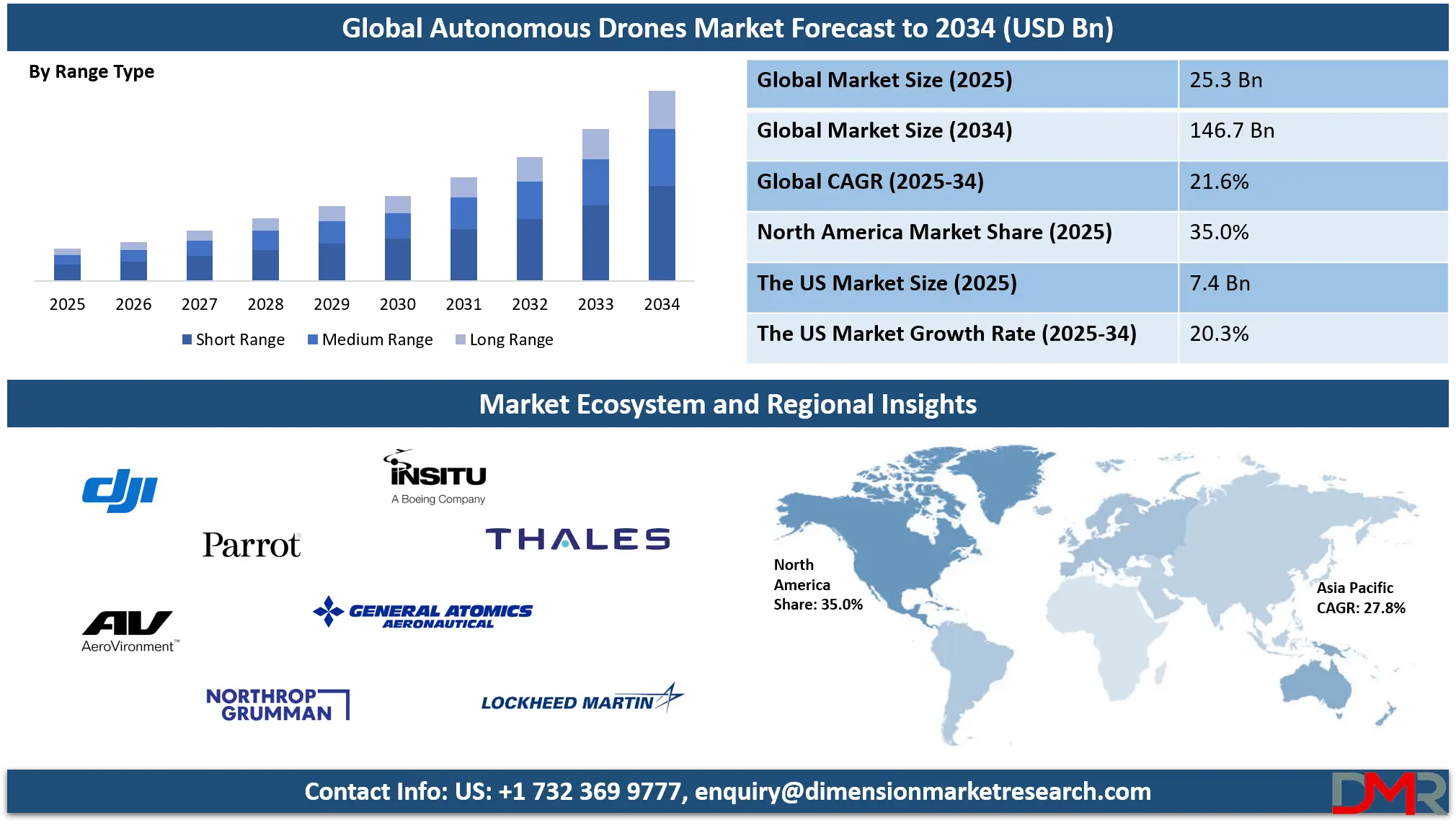
The global autonomous drones market is projected to reach USD 25.3 billion in 2025 and is expected to grow at a strong CAGR of 21.6%, attaining a value of USD 146.7 billion by 2034. This growth reflects rising adoption of AI-powered UAVs across defense, agriculture, logistics, and industrial inspection applications.
Autonomous drones are unmanned aerial vehicles equipped with advanced onboard sensors, navigation systems, artificial intelligence, and machine learning capabilities, enabling them to operate without continuous human intervention. These drones are designed to perform tasks such as obstacle avoidance, real-time data collection, terrain mapping, surveillance, delivery, and precision agriculture by following preprogrammed flight paths or dynamically adjusting to environmental conditions.
Unlike conventional remotely piloted drones, autonomous models rely heavily on computer vision, GPS, and sensor fusion technologies to make independent decisions during flight, which enhances efficiency, safety, and adaptability across a wide range of applications, from defense to commercial operations.
The global autonomous drones market represents a rapidly evolving industry that integrates robotics, artificial intelligence, and aerospace innovation to meet the growing demand for intelligent aerial solutions. Rising investments in defense modernization, the growing adoption of smart agriculture practices, and expanding commercial use cases such as infrastructure inspection, logistics, and environmental monitoring are driving market expansion. Regulatory bodies across regions are also gradually creating frameworks that support the use of beyond visual line of sight operations, which further strengthen adoption.
In addition, the global market is witnessing a shift toward hybrid platforms and fully autonomous systems capable of extended flight times and higher payload capacities. This evolution is supported by advancements in battery technology, computer vision algorithms, and 5G connectivity that enable faster communication and data processing.
North America currently leads the market due to robust defense budgets and widespread industrial adoption, while Asia Pacific is emerging as the fastest-growing region owing to large-scale investments in agriculture, logistics, and smart city infrastructure. Overall, the industry is positioned for sustained growth as technology maturation and regulatory support open new opportunities across multiple sectors.
The US Autonomous Drones Market
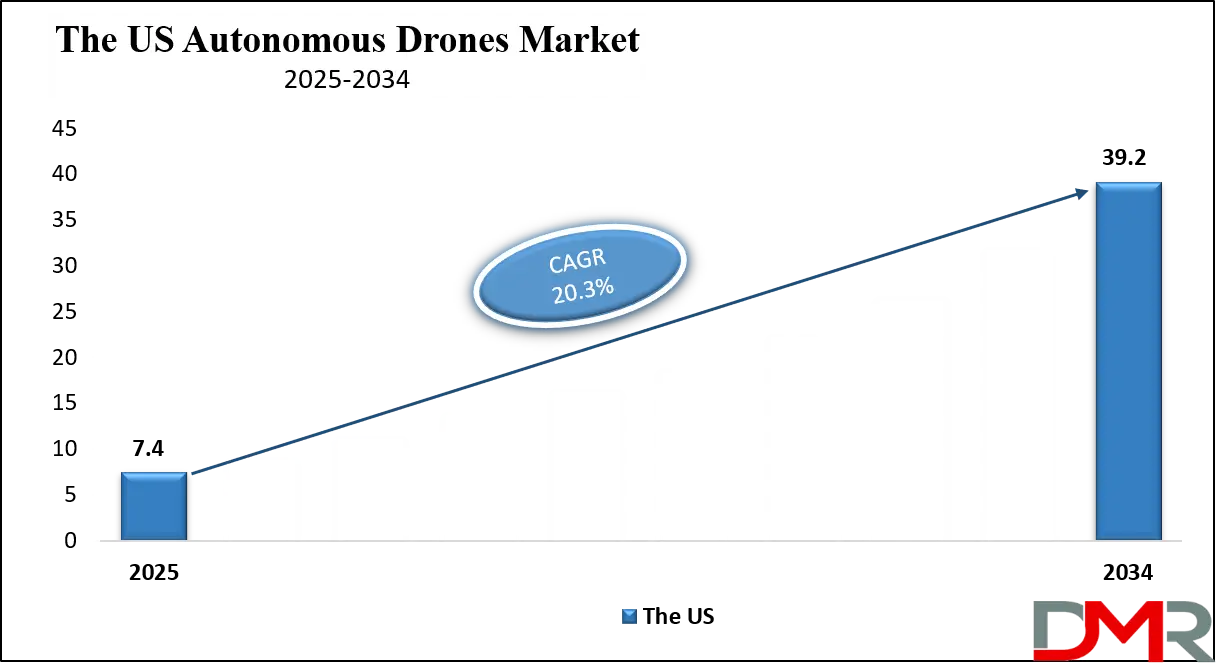
The US Autonomous Drones Market is projected to be valued at USD 7.4 billion in 2025. It is expected to witness subsequent growth in the upcoming period as it holds USD 39.2 billion in 2034 at a CAGR of 20.3%.
The United States autonomous drones market is experiencing significant growth, driven by strong defense spending, rapid adoption of AI-enabled UAVs in commercial sectors, and supportive regulatory advancements. The US military continues to dominate demand with extensive use of autonomous drones for intelligence gathering, border surveillance, and tactical missions, supported by companies such as Northrop Grumman, General Atomics, and Boeing.
Alongside defense, industries including agriculture, energy, mining, and infrastructure are increasingly deploying autonomous drones for precision mapping, pipeline monitoring, crop spraying, and safety inspections. The integration of computer vision, machine learning, and beyond visual line of sight capabilities is enabling US enterprises to improve efficiency and reduce operational risks, fueling market expansion.
Moreover, the US autonomous drones market is benefiting from innovation hubs and government-backed initiatives that encourage testing and commercialization of advanced UAV systems. With the rise of logistics and last-mile delivery services, companies like Amazon Prime Air, Zipline, and UPS Flight Forward are pioneering drone delivery solutions, which are expected to reshape the country’s e-commerce and healthcare supply chains.
The presence of advanced telecom infrastructure and the rollout of 5G networks further enhance real-time drone communication, making autonomous operations more reliable and scalable. As regulatory agencies like the Federal Aviation Administration continue to relax restrictions and expand permissible use cases, the US market is positioned as a global leader in autonomous drone deployment across both defense and commercial ecosystems.
Europe Autonomous Drones Market
The European autonomous drones market is projected to reach approximately USD 3.0 billion in 2025, reflecting steady growth driven by growing adoption across defense, commercial, and industrial sectors. In defense, several countries are investing heavily in AI-powered UAVs for surveillance, reconnaissance, and tactical missions, supported by government modernization programs. Commercial applications such as infrastructure inspection, logistics, and precision agriculture are also contributing significantly, as autonomous drones enable cost savings, enhanced operational efficiency, and improved safety in complex or hazardous environments.
The market is further bolstered by advancements in drone technology, including AI-enabled navigation, obstacle avoidance, and real-time data analytics, which enhance the versatility and reliability of UAV operations. Strong regulatory frameworks in Europe, including approvals for beyond visual line of sight (BVLOS) operations and integration into national airspace, are facilitating wider deployment. Additionally, industrial automation trends and the adoption of smart city initiatives are creating new opportunities for autonomous drones, positioning Europe as a rapidly expanding region in the global market with a projected CAGR of 14.3%.
Japan Autonomous Drones Market
The Japanese autonomous drones market is projected to reach approximately USD 700 million in 2025, driven by growing adoption across defense, commercial, and industrial applications. In the defense sector, autonomous UAVs are increasingly deployed for surveillance, reconnaissance, and disaster management, helping to enhance national security and operational efficiency. On the commercial front, industries such as agriculture, infrastructure, and logistics are leveraging drones for precision farming, industrial inspections, and last-mile delivery. The use of AI-powered navigation, real-time data collection, and automated flight systems enables businesses to optimize operations while reducing labor costs and enhancing safety in complex or hazardous environments.
Technological advancements and government support are key factors propelling growth in Japan. The integration of AI, computer vision, and sensor technologies enhances the capabilities of autonomous drones, allowing them to perform complex tasks with minimal human intervention. Regulatory frameworks are gradually evolving to permit beyond visual line of sight (BVLOS) operations and ensure safe integration into national airspace, which is facilitating broader commercial adoption. Coupled with the growing focus on smart city initiatives, industrial automation, and disaster response solutions, Japan is poised for steady market growth with a projected CAGR of 11.5% during the forecast period.
Global Autonomous Drones Market: Key Takeaways
- Market Value: The global Autonomous Drones market size is expected to reach a value of USD 146.7 billion by 2034 from a base value of USD 25.3 billion in 2025 at a CAGR of 21.6%.
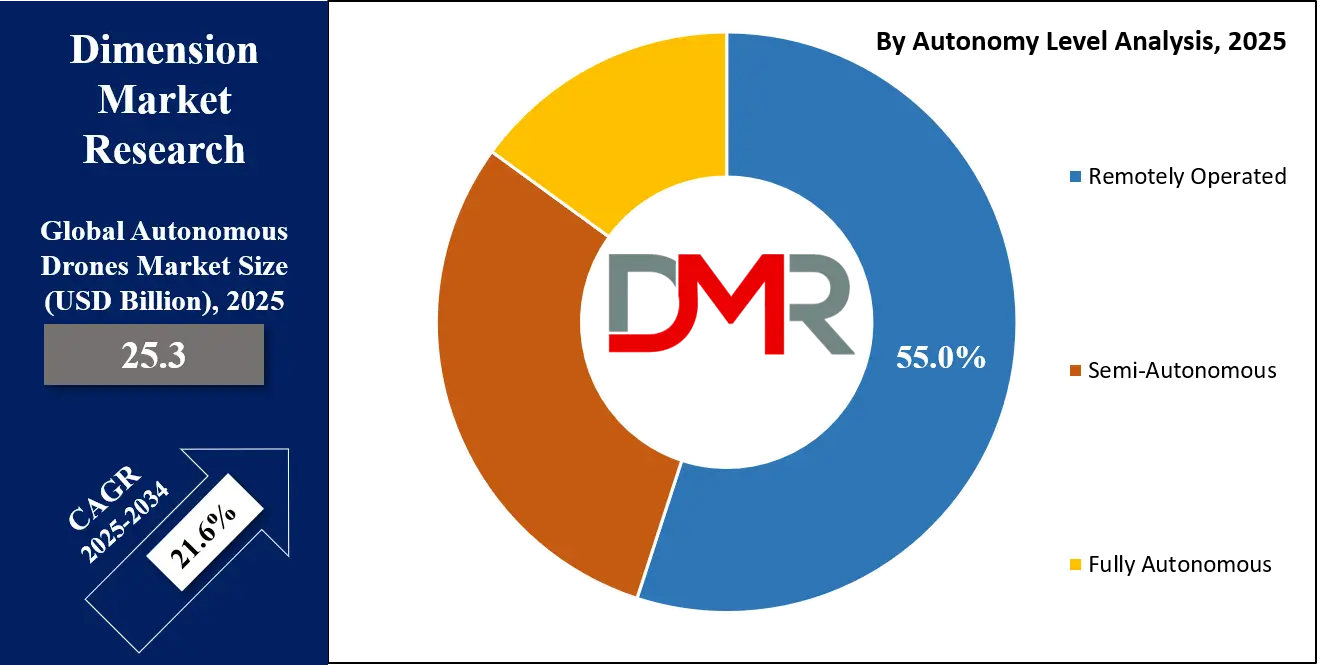
- By Autonomy Level Segment Analysis: Remotely Operated drones will dominate the autonomy level segment, capturing 55.0% of the market share in 2025.
- By Product Type Segment Analysis: Multirotor / Rotary-Wing types are anticipated to dominate the product type segment, capturing 60.0% of the total market share in 2025.
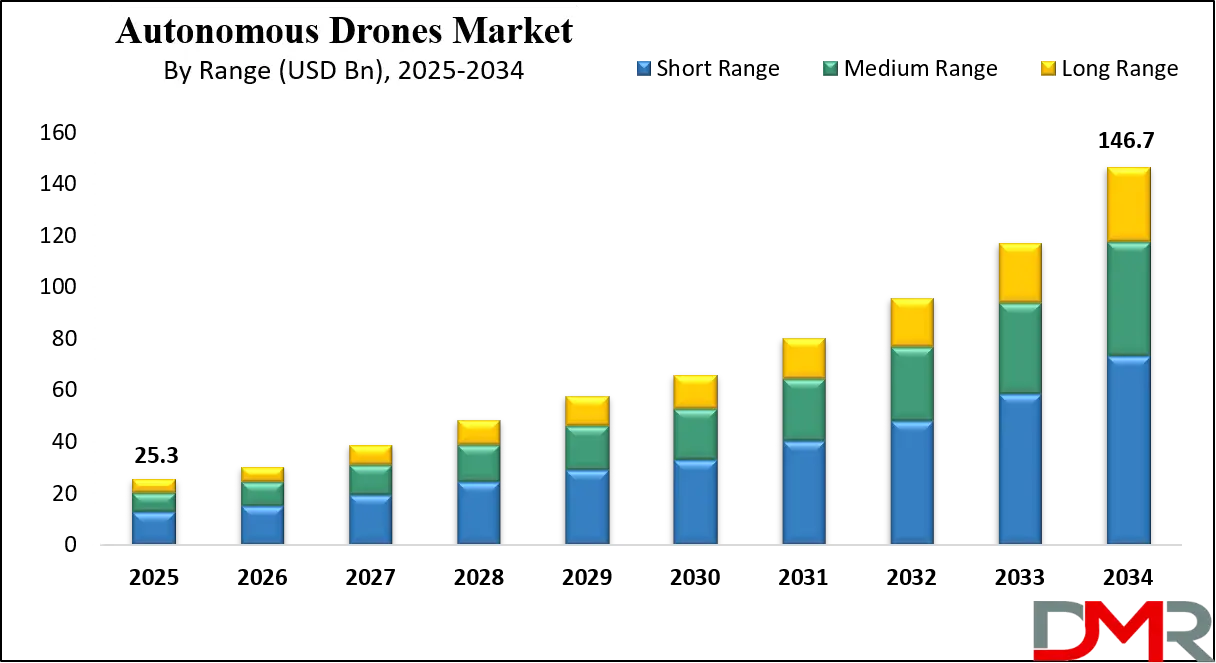
- By Range Segment Analysis: Short-range drones will dominate the range segment, capturing 50.0% of the market share in 2025.
- By End-Use Industry Segment Analysis: Military & Defense users will account for the maximum share in the end-use industry segment, capturing 65.0% of the market share in 2025.
- Regional Analysis: North America is anticipated to lead the global Autonomous Drones market landscape with 35.0% of total global market revenue in 2025.
- Key Players: Some key players in the global Autonomous Drones market include DJI, Parrot SA, AeroVironment Inc., Northrop Grumman Corporation, General Atomics Aeronautical Systems, Boeing (Insitu), Lockheed Martin Corporation, Thales Group, Raytheon Technologies, Elbit Systems Ltd., Israel Aerospace Industries (IAI), Textron Inc., Kratos Defense & Security Solutions, and Others.
Global Autonomous Drones Market: Use Cases
- Defense and Border Surveillance: Autonomous drones play a pivotal role in modern defense strategies, offering real-time intelligence, reconnaissance, and tactical surveillance without risking human lives. Equipped with advanced sensors, AI-powered navigation, and computer vision, these UAVs can monitor border zones, detect threats, and provide live situational awareness to defense forces. In the United States and other major economies, defense budgets continue to drive large-scale adoption of autonomous drones for both homeland security and overseas missions, reinforcing their dominance in the global market.
- Precision Agriculture and Forestry: The agriculture sector increasingly relies on autonomous drones for crop monitoring, spraying, and yield optimization. These UAVs collect multispectral imaging data, analyze soil health, and detect irrigation needs, which helps farmers reduce costs and improve productivity. Autonomous drones in precision agriculture also minimize the need for manual labor while ensuring targeted pesticide and fertilizer application, boosting sustainability. With large-scale farmland in regions like North America and the Asia Pacific, agriculture remains one of the fastest-growing applications of drone technology.
- Infrastructure Inspection and Industrial Monitoring: Energy companies, construction firms, and mining operators deploy autonomous drones for pipeline inspection, power line monitoring, and structural analysis of bridges and high-rise buildings. These drones reduce downtime and enhance worker safety by performing hazardous inspections in challenging environments. AI-driven autonomous systems enable predictive maintenance, detect anomalies, and deliver actionable insights in real time. As industries embrace digital transformation, autonomous drones are becoming integral to smart infrastructure and industrial asset management.
- Logistics and Last Mile Delivery: Autonomous drones are transforming logistics by enabling fast, cost-effective, and eco-friendly last-mile delivery solutions. Companies such as Amazon Prime Air, Zipline, and UPS Flight Forward are leading in deploying UAVs for delivering e-commerce packages, medical supplies, and emergency relief materials. With autonomous flight control and beyond visual line of sight capabilities, drones can reach remote and congested areas more efficiently than traditional vehicles. As regulatory frameworks mature, drone-based logistics is expected to revolutionize supply chain management globally.
Impact of Artificial Intelligence on the global Autonomous Drones market
- Enhanced Autonomous Navigation: AI enables drones to autonomously plan routes, avoid obstacles, and adjust to dynamic environmental conditions without human intervention.
- Improved Object Detection and Recognition: Machine learning and computer vision allow drones to identify targets, monitor crops, inspect infrastructure, and detect anomalies in real time.
- Predictive Maintenance and Operational Efficiency: AI algorithms analyze drone performance data to predict failures, optimize battery usage, and extend operational lifespan.
- Advanced Data Analytics: AI processes vast amounts of aerial data from sensors, LiDAR, and cameras, providing actionable insights for defense, agriculture, and industrial applications.
- Autonomous Decision Making: AI-driven UAVs can make instant flight and mission decisions based on environmental inputs, reducing reliance on human pilots.
- Scalability in Logistics and Delivery: AI facilitates autonomous fleet management for last-mile delivery, optimizing routes, payload allocation, and operational timing.
- Integration with IoT and Smart Systems: AI allows drones to communicate with IoT networks, enabling real-time monitoring and automated responses in smart cities and industrial sites.
- Market Expansion and Innovation: AI adoption accelerates the development of fully autonomous drones, driving growth across defense, agriculture, infrastructure inspection, and commercial logistics sectors.
Global Autonomous Drones Market: Stats & Facts
Federal Aviation Administration (FAA) – U.S.
- The FAA forecasts an expansion of the small drone fleet by 25,000, or 7% of the currently calculated effective/active fleet of around 388,000 units.
- The FAA anticipates that the commercial drone fleet will exceed the one million mark in 2025 and total 1.118 million by 2029, 22% above the total as of the end of 2024.
Indian Government – Drone Policy
- The Indian government has reduced the Goods and Services Tax (GST) on commercial drones to 5% and fully exempted GST on military drones, flight motion simulators, high-performance batteries, and communication equipment.
- The Indian government has exempted customs duty on 18 categories of defense-related imports, including military transport aircraft, deep submergence rescue vessels, unmanned underwater vehicles, and high-performance batteries for drones.
China – Drone Developments
- China has successfully tested the SA750U, an unmanned civilian drone capable of carrying up to 3.2 metric tons of cargo, marking a significant milestone in drone technology.
- China’s SA750U drone has a maximum cruise speed of 191.3 mph and a 1,367-mile flight range, highlighting its capabilities in long-distance cargo transport.
Ukraine – Drone Acquisition and Deployment
- In 2024, Ukrainian forces began purchasing 10,000 AI-enhanced drones, marking a significant step toward broader adoption of advanced autonomous systems.
- Ukraine has completed testing its new kamikaze strike drone, branded as Brave1, which is designed to resist electronic warfare systems and has a range of over 50 kilometers.
U.S. Defense Budget and Drone Investment
- The U.S. Defense Department’s budget request for fiscal year 2026 includes nearly USD 6 billion allocated for unmanned and counter-drone systems, a 78% increase from the previous year.
- Venture capital investment in battlefield technology, including drones, has surged to a decade-high of USD 14.17 billion by August 2025, reflecting growing interest in drone technologies.
U.S. Defense Policy and Drone Export
- The U.S. State Department has reclassified certain drones, like the MQ-9 Reaper, as fighter jets instead of missile systems, facilitating drone sales to countries like Saudi Arabia and the UAE.
- A potential USD 142 billion deal involving over 100 MQ-9 drones to Saudi Arabia has been highlighted, indicating a significant shift in U.S. drone export policy.
Global Autonomous Drones Market: Market Dynamics
Global Autonomous Drones Market: Driving Factors
Rising Defense and Security Investments
Increasing defense budgets across North America, Europe, and the Asia Pacific are driving the adoption of autonomous drones for surveillance, reconnaissance, and tactical operations. Advanced UAVs equipped with AI, computer vision, and real-time data analytics allow armed forces to conduct missions with reduced human risk, enhancing operational efficiency. Government initiatives to modernize military capabilities are further fueling the demand for autonomous drones in both domestic and overseas deployments.
Growth of Commercial Applications
The expansion of commercial sectors such as agriculture, logistics, infrastructure inspection, and environmental monitoring is boosting market demand. Autonomous drones enable precision agriculture by monitoring crop health, optimizing irrigation, and managing pesticide application. In logistics, UAVs enhance last-mile delivery efficiency, reduce operational costs, and improve supply chain reliability. These AI-powered aerial solutions are becoming critical for industries seeking automation and digital transformation.
Global Autonomous Drones Market: Restraints
Regulatory and Airspace Limitations
Strict aviation regulations and restrictions on beyond visual line of sight (BVLOS) operations limit the deployment of autonomous drones, especially in urban and densely populated areas. Variations in regulations across regions create operational challenges for commercial and defense operators, slowing large-scale adoption. Compliance with safety and privacy standards often increases operational costs and delays market growth.
High Initial Investment and Technology Costs
Advanced autonomous drones with AI capabilities, high-resolution sensors, and long-range communication systems require significant upfront investment. Small and medium enterprises often find it challenging to adopt these solutions due to high acquisition and maintenance costs. Additionally, integrating AI algorithms, machine learning models, and IoT connectivity adds to the overall expenditure, acting as a barrier to widespread market penetration.
Global Autonomous Drones Market: Opportunities
Expansion in Emerging Economies
Emerging markets in the Asia Pacific, Latin America, and the Middle East present substantial growth potential for autonomous drones. Increasing adoption of smart agriculture, industrial automation, and logistics solutions in these regions creates opportunities for UAV manufacturers. Government initiatives promoting digital infrastructure and UAV testing zones further support market expansion.
Integration with AI, IoT, and 5G Networks
The convergence of AI, Internet of Things, and 5G connectivity enables real-time data processing, autonomous decision-making, and fleet management. Drones can perform complex tasks such as predictive maintenance, precision mapping, and emergency delivery with enhanced efficiency. These technological integrations create opportunities for new service models, drone as a service (DaaS), and enterprise adoption across diverse sectors.
Global Autonomous Drones Market: Trends
Adoption of Hybrid and Fully Autonomous Platforms
The market is witnessing a shift from semi-autonomous drones to fully autonomous and hybrid VTOL platforms that combine vertical takeoff capabilities with long-range flight efficiency. These drones are increasingly deployed in logistics, border surveillance, and infrastructure monitoring, reflecting a trend toward advanced, versatile UAV designs.
Use of AI-Driven Analytics and Machine Learning
AI-powered analytics is transforming the way autonomous drones collect, process, and interpret aerial data. From crop health assessment to industrial inspection and defense surveillance, machine learning algorithms enhance predictive insights, optimize mission planning, and improve operational accuracy. This trend is driving the development of intelligent UAV ecosystems and advanced commercial drone solutions.
Global Autonomous Drones Market: Research Scope and Analysis
By Autonomy Level Analysis
In the autonomy level segment of the global autonomous drones market, remotely operated drones are expected to maintain dominance, capturing approximately 55.0% of the market share in 2025. These drones continue to be widely preferred due to their proven reliability, ease of deployment, and lower regulatory complexities compared to fully autonomous systems.
Operators can manually control the drones while leveraging features like automated flight stabilization and GPS navigation, making them suitable for applications in defense surveillance, industrial inspections, and commercial monitoring. The presence of skilled human operators ensures real-time decision making in dynamic or unpredictable environments, which reduces operational risk and increases mission accuracy.
Alongside remotely operated systems, semi-autonomous drones are gaining traction in the market as they combine automated flight capabilities with human oversight. These drones can perform tasks such as obstacle avoidance, route planning, and data collection autonomously while still allowing operators to intervene when necessary. This blend of autonomy and human control provides flexibility and enhances operational efficiency, making semi-autonomous drones particularly attractive for applications in precision agriculture, infrastructure monitoring, and logistics. As technology continues to advance, semi-autonomous drones are expected to bridge the gap between fully manual and fully autonomous systems, driving adoption across commercial and industrial sectors.
By Product Type Analysis
In the product type segment of the global autonomous drones market, multirotor or rotary-wing drones are anticipated to dominate, capturing approximately 60.0% of the total market share in 2025. Their popularity is largely driven by their versatility, ability to hover in place, and ease of maneuverability, which make them suitable for a wide range of applications including surveillance, infrastructure inspection, precision agriculture, and commercial deliveries.
These drones are equipped with advanced sensors, AI-based navigation systems, and high-resolution cameras, enabling precise data collection and real-time monitoring even in challenging environments. The relatively lower cost of deployment and maintenance, integrated with their adaptability to urban and confined spaces, further reinforces their dominance in the market.
Fixed-wing drones, on the other hand, are gaining adoption for applications that require longer flight endurance, greater coverage areas, and higher speed. They are particularly suitable for tasks such as large-scale agricultural mapping, environmental monitoring, and long-range surveillance missions. While they generally require more space for takeoff and landing compared to multirotor drones, fixed-wing UAVs offer superior energy efficiency and payload capacity, allowing for extended operational periods. As a result, fixed-wing drones serve niche markets where endurance, range, and coverage are prioritized over hover and maneuverability capabilities.
By Range Analysis
In the range segment of the global autonomous drones market, short-range drones are expected to dominate, capturing approximately 50.0% of the market share in 2025. These drones are widely adopted due to their suitability for applications that require quick deployment, precise maneuvering, and operations within confined or urban areas. They are commonly used for tasks such as infrastructure inspection, security surveillance, commercial deliveries in local areas, and precision agriculture monitoring. Short-range drones are often easier to operate, require less power, and can be deployed rapidly for real-time data collection, making them highly efficient for industries that prioritize speed, flexibility, and operational convenience.
Medium-range drones are increasingly being deployed for applications that require coverage of larger areas and moderate flight durations. These UAVs are suitable for tasks such as regional agricultural surveys, industrial inspections across wide facilities, and mid-distance delivery services. Medium-range drones provide a balance between endurance and operational flexibility, enabling longer missions compared to short-range models while maintaining manageable energy consumption and payload capacity. Their versatility allows industries to expand operational reach without significantly growing costs or complexity, making them an important segment for commercial and industrial adoption.
By End-Use Industry Analysis
In the end-use industry segment of the global autonomous drones market, military and defense applications are expected to account for the largest share, capturing approximately 65.0% of the market in 2025. The dominance of this segment is driven by the growing demand for advanced surveillance, reconnaissance, and tactical operations that minimize human risk.
Autonomous drones equipped with AI, real-time analytics, and high-resolution sensors are extensively used for border monitoring, intelligence gathering, and combat support missions. The substantial defense budgets of countries such as the United States, China, and European nations, combined with ongoing modernization programs, further reinforce the prominence of military and defense applications in the global market.
Commercial and industrial applications are also emerging as significant contributors to the autonomous drones market. These drones are increasingly deployed in sectors such as agriculture, construction, energy, mining, and logistics for tasks including crop monitoring, infrastructure inspection, pipeline surveillance, and last-mile delivery.
AI-powered navigation, obstacle avoidance, and data collection capabilities allow commercial and industrial drones to optimize operational efficiency, reduce labor costs, and improve safety. With industries embracing digital transformation and automation, the commercial and industrial segment is expected to grow steadily, complementing the larger defense-driven demand in the market.
The Autonomous Drones Market Report is segmented on the basis of the following:
By Autonomy Level
- Remotely Operated
- Semi-Autonomous
- Fully Autonomous
By Product Type
- Multirotor / Rotary-Wing
- Fixed-Wing
- Hybrid / VTOL
By Range
- Short Range
- Medium Range
- Long Range
By End-Use Industry
- Military & Defense
- Commercial & Industrial
- Agriculture & Forestry
- Delivery & Logistics
- Others
Global Autonomous Drones Market: Regional Analysis
Region with the Largest Revenue Share
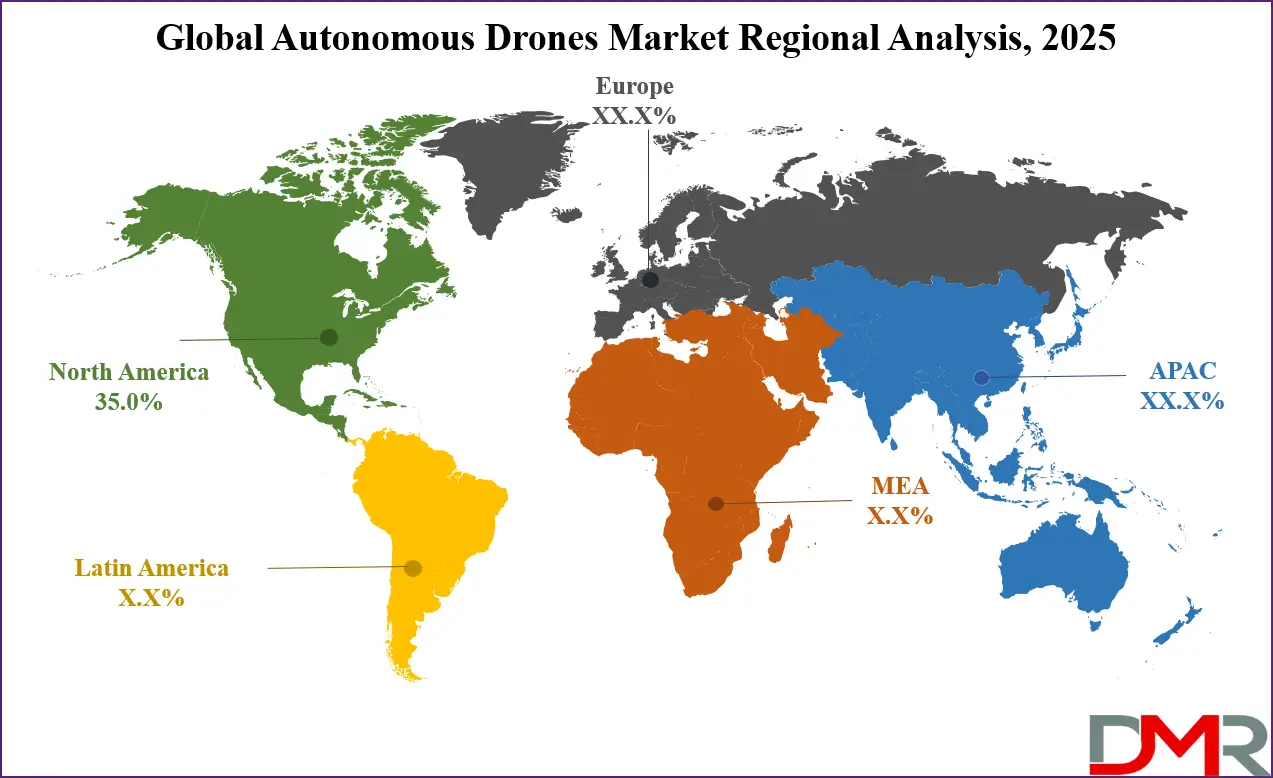
North America is anticipated to lead the global autonomous drones market in 2025, accounting for approximately 35.0% of total market revenue. The region’s dominance is driven by high defense expenditure, early adoption of AI-powered UAVs, and a well-established commercial drone ecosystem. Strong investments in military surveillance, border security, and industrial automation, combined with supportive regulatory frameworks from the Federal Aviation Administration, enable widespread deployment of autonomous drones across multiple sectors. Additionally, the presence of key manufacturers and technology innovators, along with advanced infrastructure and telecom networks, facilitates real-time drone operations and data analytics, reinforcing North America’s position as a global leader in the autonomous drones market.
Region with significant growth
The Asia Pacific region is expected to witness significant growth in the autonomous drones market due to growing adoption across agriculture, logistics, infrastructure inspection, and industrial sectors. Rapid urbanization, government initiatives promoting smart city projects, and expanding e-commerce and delivery networks are driving demand for UAVs with AI-enabled navigation and real-time data analytics. Countries such as China, India, and Japan are investing heavily in drone technology, supported by emerging drone startups and industrial automation trends. Favorable regulatory developments and growing awareness of the operational efficiency and cost-saving benefits of autonomous drones further contribute to the region’s robust market expansion.
By Region
North America
Europe
- Germany
- The U.K.
- France
- Italy
- Russia
- Spain
- Benelux
- Nordic
- Rest of Europe
Asia-Pacific
- China
- Japan
- South Korea
- India
- ANZ
- ASEAN
- Rest of Asia-Pacific
Latin America
- Brazil
- Mexico
- Argentina
- Colombia
- Rest of Latin America
Middle East & Africa
- Saudi Arabia
- UAE
- South Africa
- Israel
- Egypt
- Rest of MEA
Global Autonomous Drones Market: Competitive Landscape
The global autonomous drones market is highly competitive, driven by a mix of established aerospace and defense players, innovative technology providers, and emerging startups. Companies are focusing on developing AI-powered drones with advanced navigation, real-time data analytics, and autonomous operational capabilities to serve defense, commercial, industrial, and agricultural applications. The market is characterized by continuous innovation, strategic partnerships, and investments in research and development, which are accelerating technological advancements, expanding product portfolios, and enhancing service offerings. This dynamic competitive environment is fostering rapid adoption of autonomous drones across various sectors and supporting sustained global market growth.
Some of the prominent players in the global Autonomous Drones market are:
- DJI
- Parrot SA
- AeroVironment Inc.
- Northrop Grumman Corporation
- General Atomics Aeronautical Systems
- Boeing (Insitu)
- Lockheed Martin Corporation
- Thales Group
- Raytheon Technologies
- Elbit Systems Ltd.
- Israel Aerospace Industries (IAI)
- Textron Inc.
- Kratos Defense & Security Solutions
- Skydio Inc.
- EHang Holdings Ltd.
- Zipline International
- Airobotics
- Autel Robotics
- Percepto
- Delair
- Other Key Players
Global Autonomous Drones Market: Recent Developments
- September 2025: A Ukrainian defense technology company secured USD 1 million in funding from various investors to scale production and develop autonomous UAV systems capable of operating without GPS.
- September 2025: A provider of autonomous systems software for defense raised USD 130 million in a Series B funding round led by a venture capital firm. The funds are intended to support the development of drone swarms for defense applications, enhancing operational efficiency and capability.
- May 2024: A prominent defense technology firm announced the successful completion of its acquisition of a startup specializing in drone swarm and counter-drone technologies. This acquisition aims to enhance the company's capabilities in autonomous systems and electronic warfare.
- October 2024: A public safety technology leader finalized the acquisition of a company known for its airspace security solutions. This move is expected to bolster the acquirer's ability to protect communities and improve responses to critical incidents through advanced drone technologies.
- September 2024: A leading drone manufacturer introduced a new docking station designed for their autonomous drones, enabling remote operations and data collection without the constant need for a skilled pilot. This advancement aims to enhance scalability and accessibility in various sectors.
Report Details
| Report Characteristics |
| Market Size (2025) |
USD 25.3 Bn |
| Forecast Value (2034) |
USD 146.7 Bn |
| CAGR (2025–2034) |
21.6% |
| The US Market Size (2025) |
USD 7.4 Bn |
| Historical Data |
2019 – 2024 |
| Forecast Data |
2026 – 2034 |
| Base Year |
2024 |
| Estimate Year |
2025 |
| Report Coverage |
Market Revenue Estimation, Market Dynamics, Competitive Landscape, Growth Factors, etc. |
| Segments Covered |
By Autonomy Level (Remotely Operated, Semi-Autonomous, Fully Autonomous), By Product Type (Multirotor / Rotary-Wing, Fixed-Wing, Hybrid / VTOL), By Range (Short Range, Medium Range, Long Range), and By End-Use Industry (Military & Defense, Commercial & Industrial, Agriculture & Forestry, Delivery & Logistics, Others) |
| Regional Coverage |
North America – US, Canada; Europe – Germany, UK, France, Russia, Spain, Italy, Benelux, Nordic, Rest of Europe; Asia-Pacific – China, Japan, South Korea, India, ANZ, ASEAN, Rest of APAC; Latin America – Brazil, Mexico, Argentina, Colombia, Rest of Latin America; Middle East & Africa – Saudi Arabia, UAE, South Africa, Turkey, Egypt, Israel, Rest of MEA |
| Prominent Players |
DJI, Parrot SA, AeroVironment Inc., Northrop Grumman Corporation, General Atomics Aeronautical Systems, Boeing (Insitu), Lockheed Martin Corporation, Thales Group, Raytheon Technologies, Elbit Systems Ltd., Israel Aerospace Industries (IAI), Textron Inc., Kratos Defense & Security Solutions, and Others. |
| Purchase Options |
We have three licenses to opt for: Single User License (Limited to 1 user), Multi-User License (Up to 5 Users), and Corporate Use License (Unlimited User) along with free report customization equivalent to 0 analyst working days, 3 analysts working days, and 5 analysts working days respectively. |
Frequently Asked Questions
The global Autonomous Drones market size is estimated to have a value of USD 25.3 billion in 2025 and is expected to reach USD 146.7 billion by the end of 2034.
The US Autonomous Drones market is projected to be valued at USD 7.4 billion in 2025. It is expected to witness subsequent growth in the upcoming period as it holds USD 39.2 billion in 2034 at a CAGR of 20.3%.
North America is expected to have the largest market share in the global Autonomous Drones market, with a share of about 35.0% in 2025.
Some of the major key players in the global Autonomous Drones market are DJI, Parrot SA, AeroVironment Inc., Northrop Grumman Corporation, General Atomics Aeronautical Systems, Boeing (Insitu), Lockheed Martin Corporation, Thales Group, Raytheon Technologies, Elbit Systems Ltd., Israel Aerospace Industries (IAI), Textron Inc., Kratos Defense & Security Solutions, and Others.
The market is growing at a CAGR of 21.6 percent over the forecasted period
Contents