Global Back End Revenue Cycle Management Market Snapshot
- Global Back End Revenue Cycle Management Market Size in 2026: USD 102.9 billion
- Global Back End Revenue Cycle Management Market Size in 2035: USD 259.2 billion
- Global CAGR from 2027 to 2035: 12.2%
- Services are the leading Component segment in 2026: 71.5%
- Hospitals is the leading End User segment in 2026: 62.9%
- Software is the fastest-growing Component segment: 15.20%
- Ambulatory Surgical Centers is the fastest-growing End User segment: 15.5% CAGR
- North America is the leading Region in 2026: 41.2%
- Asia Pacific is the fastest-growing Region: 13.4% CAGR
What is the Global Back End Revenue Cycle Management and its Market Size?
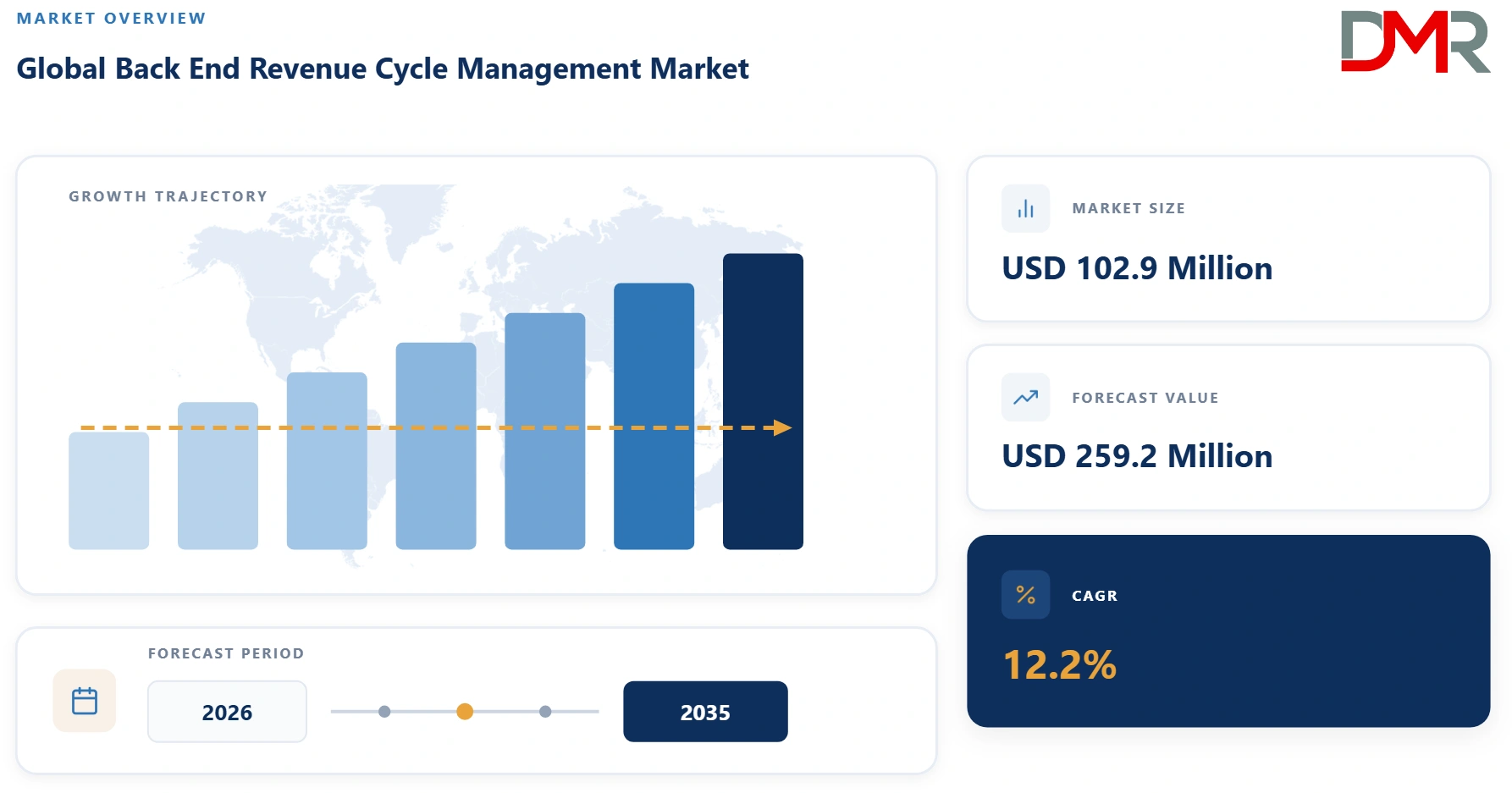
The Global Back End Revenue Cycle Management Market size is projected to be valued at USD 102.9 billion in 2026, and it is further anticipated to reach a market value of USD 259.2 billion by 2035 at a CAGR of 12.2%.
ℹ
To learn more about this report –
Download Your Free Sample Report Here
The global back-end revenue cycle management market has been growing steadily over the past decade owing to the increasing technological advancements in healthcare IT, automation, artificial intelligence, and digital healthcare. Back-end revenue cycle management encompasses the management of financial transactions of healthcare organizations. It encompasses the management of medical billing, claims, payment postings, denials, and accounts receivable in order to ensure proper reimbursements to the healthcare providers. The expansion of this market has been primarily driven by the increased demand for efficient financial transactions in the healthcare industry. Hospitals, clinics, diagnostic centres and other healthcare facilities are adopting automated revenue cycle management solutions to cut down on administrative expenses. This technology is utilized in the healthcare billing process to ensure quick settlement of claims, shortening payment times, increasing revenue, and improving financial performance using high-level analytics, artificial intelligence, and automated claims management.
Use Cases
- Medical Billing and Claims Processing: Back end revenue cycle management is widely used by healthcare organizations to manage the process of billing, submission of insurance claims, and payments. The use of automated billing helps to increase billing accuracy, reduce the number of mistakes made by people, improve claim processing time, and reduce administrative expenses.
- Denial Management and Claims Recovery: One of the most important functions of back end revenue cycle management in healthcare is to track denied insurance claims and to correct billing errors. These systems allow healthcare organizations to recover unpaid claims, avoid losses, and achieve higher reimbursement rates for smooth financial operation of hospitals and clinics.
- Accounts Receivable Management: Automation also makes great changes in the sphere of financial processes in healthcare, as systems allow to track unpaid bills and payments and to conduct proper payment follow-up. This helps to get payments faster, avoid delays, and reduce administrative efforts.
- Payment Posting and Revenue Collection: Payment posting automation allows to receive payments from patients and insurance companies with great accuracy and without any additional efforts. These systems allow detection of discrepancies between payments, tracking of financial information, and avoid billing mistakes.
Key Takeaways
- Global Market Value: The Global Back End Revenue Cycle Management Market is valued at a revenue of USD 102.9 billion in 2026 and is further anticipated to reach USD 259.2 billion by 2035.
- Global Growth Rate: The Global Back End Revenue Cycle Management Market is expected to have a CAGR of 12.2% during the forecast period from 2027 to 2035.
- Technology Trends: The increasing developments in technology such as AI, machine learning, RPA, cloud revenue cycle management software, and predictive analytics are improving the processes involved in claims management, denial management, payment posting, collections, and financial management in healthcare organizations.
- Market Drivers: The complexity of health care billing, increasing claims denials, the need for automated payments, and the need to increase revenue collection efficiency are the factors that are fuelling the growth of the Global Back End Revenue Cycle Management Market.
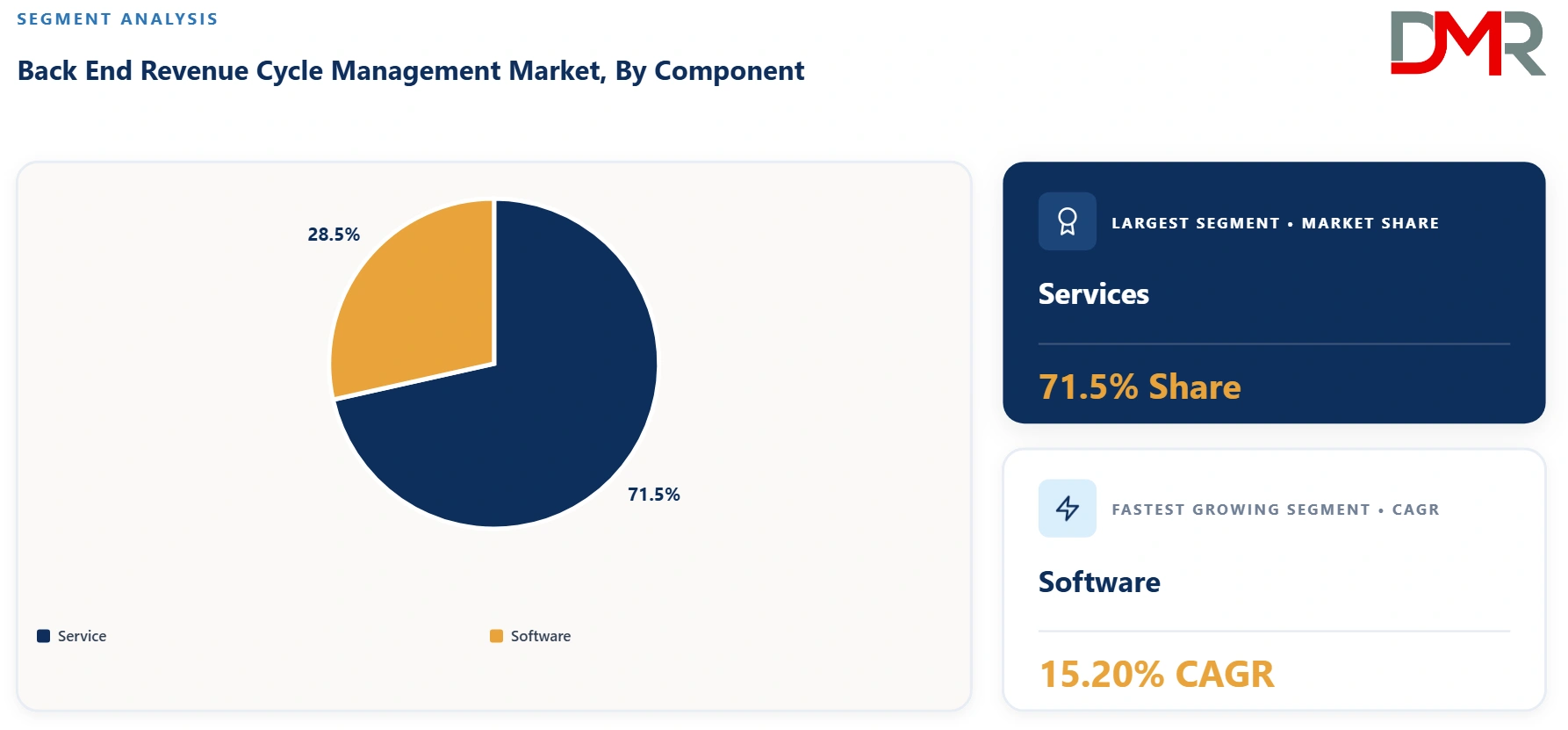
- Component Segment Analysis: The Services segment is anticipated to be the largest Component segment, having a market share of 71.5% by the end of 2026. Whereas the Software segment is expected to be the fastest-growing segment with a CAGR of 15.20% from 2027 to 2035.
- End User Segment Analysis: Hospitals is the major end-user segment, representing the highest market share of 62.95% in 2026, while the Ambulatory Surgical Centers segment is projected to have the highest growth rate with a CAGR of 15.56% during the forecast period.
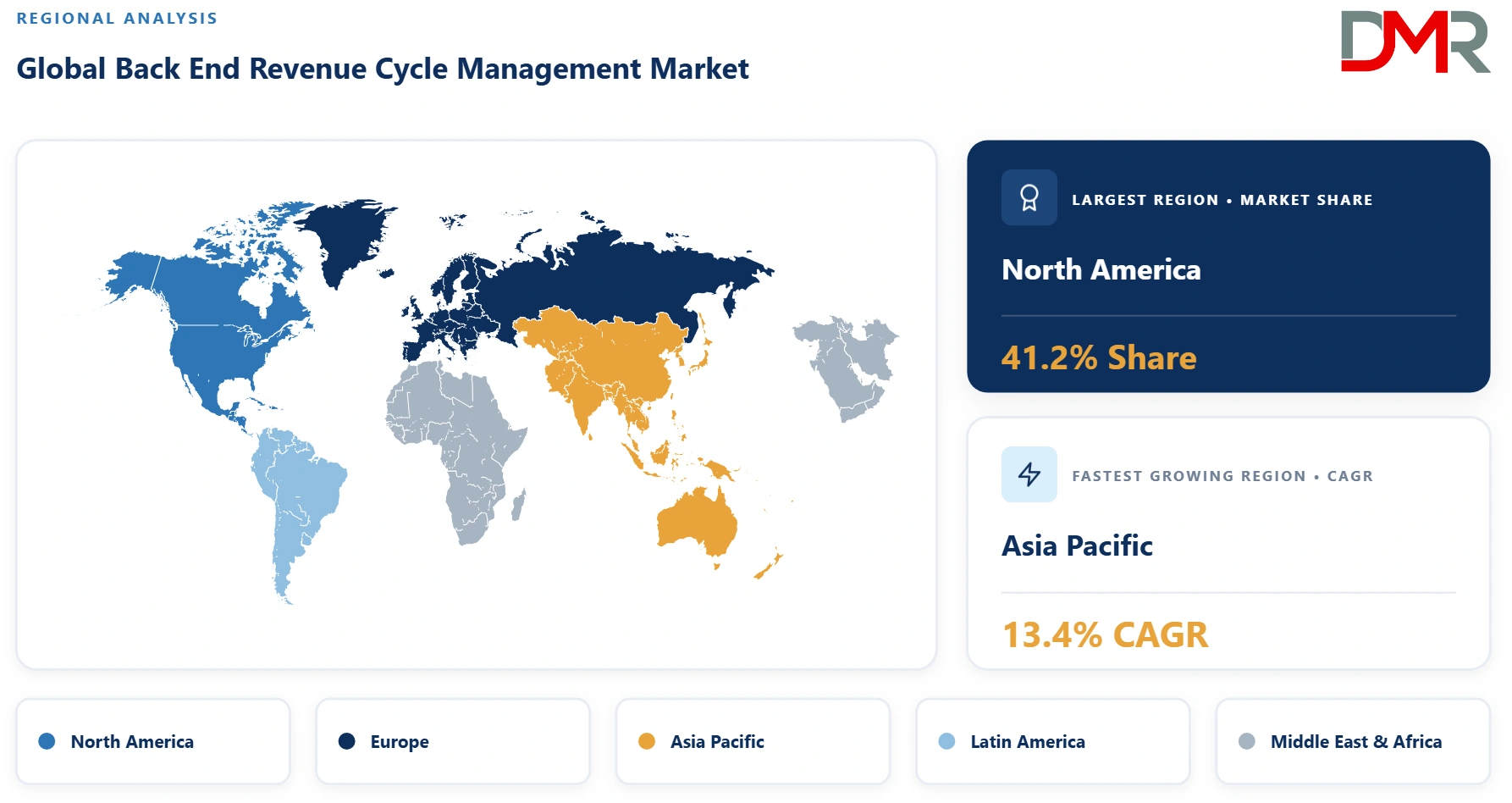
- Regional Analysis: The North America region is poised to hold the largest market share of 41.2% in the global market in 2026. The Asia Pacific region is expected to be the fastest-growing region with a CAGR of 13.4% during the forecast period.
How AI/Gen AI is Transforming the Back End Revenue Cycle Management Market?
Artificial intelligence (AI) and generative artificial intelligence (GenAI) are making the back-end revenue cycle management industry better by increasing speed and accuracy for medical billing, claims processing, and collections of payments. Artificial intelligence assists healthcare organizations in finding out mistakes in medical billing, unpaid bills, and claim denials. Generative artificial intelligence also assists in checking insurance paperwork, making claims, and solving payment issues. Artificial intelligence technology is becoming increasingly popular in financial processes in hospitals, clinics, diagnostic centers, and other healthcare institutions. Machine learning, predictive analytics, and cloud technologies can be utilized in further improvement of financial processes by providing assistance to organizations in handling their billing data.
Key Drivers in the Global Back End Revenue Cycle Management Market
Market Drivers
Increased Requirement for Speedier Medical Billing and Insurance Claims Process Management
Due to an increased number of patients coming to hospitals and health care centers, there is an increasing requirement for speedier medical billing and insurance claims process management. The reason behind delays in payments made to hospitals and healthcare facilities lies behind the fact that they have been caused due to incorrect medical billing, missing data, and insurance claim rejection. With the assistance of back end revenue cycle management, hospitals can effectively perform these activities through automation of billing, payment tracking, and elimination of manual processes.
Increasing Adoption of Automation and Digital Health Care System
An increasing trend towards automation and digitalization of the health care system is propelling the back-end revenue cycle management market growth. Automated processes of managing insurance claims, payment posting, and outstanding bills have become common without much dependence on manual activities.
Market Restraints
Security Issues Related to Data and Patient Information Privacy
Increased chances of data breaches and cybersecurity threats are proving to be an issue for the back end revenue cycle management market. Such systems deal with confidential patient data such as patients' health information, insurance information, and information related to payments. This means that any breach of data can result in financial losses and tarnish the image of the healthcare organization. Hospitals have to abide by regulations when it comes to data security as well as purchase software systems to ensure that patient information is safe.
Higher Implementation and Maintenance Costs
One of the key barriers to the expansion of this market is higher costs associated with installation and maintenance of back-end revenue cycle management systems. There will be a need for hospitals and medical institutions to invest money in software, upgrades, employee training, and technical support. It might be rather difficult for small hospitals and clinics to implement such solutions due to their lack of financial capability. Moreover, there may be additional expenses and time needed to integrate new billing software with the current hospital software.
Market Opportunities
Increased Healthcare Infrastructure in Developing Nations
The increased development of hospitals and clinics in developing nations is providing great opportunities for the back-end revenue cycle management market. Healthcare infrastructure and technology are being developed in many countries in Asia Pacific, Latin America, and the Middle East. With an increased number of healthcare institutions adopting electronic billing and insurance management systems, there is growing demand for effective payment management. There are many opportunities for revenue cycle management companies to offer affordable and user-friendly software to small healthcare institutions. Increased health insurance and digitalization in the healthcare sector are also expected to promote the market.
Increasing Outsourcing of RCM Services
The increasing outsourcing of RCM services is also contributing to the growth of the market. Many healthcare institutions have started relying on external service providers for medical billing, insurance claims processing, payment recovery, and denied claims management. It allows them to lessen their administrative burden and spend more time on patient care. Smaller healthcare institutions find outsourcing to be a cost-effective way to access skilled professionals and modern technologies.
Market Trends
Increasingly Popular Cloud-Based Revenue Cycle Management Systems
The emergence of cloud-based revenue cycle management systems has become another important trend for the industry. With cloud-based solutions, health organizations gain access to their billing data, track insurance claims and payment status at any location through an internet-based system. Moreover, cloud-based technology saves money on costly computer-based systems and makes software upgrades easier. It also contributes to efficient collaboration between hospitals, billing services, and insurance providers. As health care companies seek ways to cut costs and gain more flexibility, the demand for cloud-based revenue cycle management solutions will continue to increase.
Increasing Use of Artificial Intelligence in Claims and Denial Management
Artificial intelligence is gaining popularity in the back-end revenue cycle management field. Organizations start using AI-powered technologies in order to spot billing issues, check claims, and identify potential payment delay risks. Such tools can analyze vast amounts of billing data and allow employees to fix errors in the billing process.
Research Scope and Analysis
The Global Back End Revenue Cycle Management Market is segmented based on component into software and services, while by deployment mode, the market is categorized into on-premises and cloud-based. Based on function, the Global Back End Revenue Cycle Management Market is segmented into medical coding, charge capture & charge entry, claims management & submission, payment posting & reconciliation, denial management & appeals, accounts receivable management, patient billing & collections, and others. By delivery model, the market is divided into in-house, outsourced, and hybrid. In terms of end user, the Global Back End Revenue Cycle Management Market consists of hospitals, physician practices & clinics, ambulatory surgical centers, diagnostic & imaging centers, and other healthcare providers.
ℹ
To learn more about this report –
Download Your Free Sample Report Here
By Component
Services are projected to dominate the Component segment in the Back End Revenue Cycle Management market as they will hold 71.5% of the total market share in 2026. The dominance is due to the growing demand for outsourced billing operations, complex claims processing, denial management, and accounts receivable services. Healthcare providers increasingly rely on specialized service providers to reduce administrative burdens, improve reimbursement accuracy, accelerate payment cycles, and enhance overall financial performance. Software is poised to have the highest CAGR of 15.20% during the forecast period (2027-2035) in the Component segment, driven by increasing adoption of cloud-based platforms, AI-powered automation, predictive analytics, and integrated solutions for improving healthcare financial operations.
By End User Analysis
Hospitals are expected to be the leading end-user segment in the Back End Revenue Cycle Management market, as it is poised to hold 62.95% of the market share by the end of 2026. Hospitals are dominating the end-user segment in the Back End Revenue Cycle Management market due to high patient volumes, complex billing procedures, extensive insurance claims processing, growing reimbursement challenges, and increasing demand for efficient revenue management solutions. On the other hand, Ambulatory Surgical Centers are projected to register the highest CAGR of 15.56% during the forecast period (2027–2035) in the Back End Revenue Cycle Management Market, driven by the growing number of outpatient surgical procedures, increasing adoption of automated billing solutions, rising complexity of insurance claims, and growing demand for efficient reimbursement processing and revenue optimization.
The Global Back End Revenue Cycle Management Market Report is segmented based on the following:
By Component
By Deployment Mode
By Function
- Medical Coding
- Charge Capture & Charge Entry
- Claims Management & Submission
- Payment Posting & Reconciliation
- Denial Management & Appeals
- Accounts Receivable Management
- Patient Billing & Collections
- Others
By Delivery Model
- In-House
- Outsourced
- Hybrid
By End User
- Hospitals
- Physician Practices & Clinics
- Ambulatory Surgical Centers
- Diagnostic & Imaging Centers
- Other Healthcare Providers
Regional Analysis
North America is the Leading Region in the Global Back End Revenue Cycle Management Market
North America is expected to become the dominant force within the Global Back End Revenue Cycle Management Market as it will hold a market share of 41.2% in 2026. This market dominance is due to the presence of developed healthcare facilities, increased healthcare spending, the implementation of automated billing, and complex insurance claims. The increasing need for claim management, denial management, and revenue maximization within hospitals is also contributing to market development.
ℹ
To learn more about this report –
Download Your Free Sample Report Here
Asia Pacific is the Fastest-Growing Region in the Global Back End Revenue Cycle Management Market
Asia Pacific is expected to witness the fastest-growing regional market with a compound annual growth rate of 13.49% during the forecast period from 2027 to 2035. The development of healthcare infrastructure, increase in patient populations, and adoption of digital billing solutions are some of the factors fueling the regional market growth. Countries like China, India, Japan, and South Korea are focusing on the adoption of healthcare technologies and revenue cycle management automation solutions. The increasing demand for efficient claims processing, error-free billing, and effective payment recovery is further contributing to market growth.
Europe Back End Revenue Cycle Management Market
Advantages such as the presence of an already established infrastructure for healthcare, the rise of digital healthcare systems, and efforts to improve hospital finance have been identified as some of the driving factors within this region. Countries like Germany, France, the UK, and Italy have started implementing Back End Revenue Cycle Management software to streamline their processes of medical billing, insurance claim processing, payment processing, and denial management. Government encouragement for digitization of healthcare services and use of EHR has been playing a significant role in encouraging the implementation of such advanced revenue management systems.
Middle East and Africa (MEA) Back End Revenue Cycle Management Market
The key drivers of the Middle East and Africa Back End Revenue Cycle Management Market include the growing investments in healthcare infrastructure, the growing adoption of healthcare solutions using technology, and the increasing need for effective systems for billing and claims processing. In the UAE and Saudi Arabia, there is increased investment in the digitalization of healthcare, hospital management systems, and revenue cycle solutions. In South Africa, healthcare service providers have been emphasizing improved billing, reduced claims denials, and payment collection. While the market may be nascent in several countries, increased healthcare facilities, adoption of EHR, and healthcare IT investment could drive market growth in the region.
Major Countries Analysis
United States Back End Revenue Cycle Management Market
The US Back End Revenue Cycle Management Market is projected to be valued at USD 30.9 billion in 2026. It is expected to witness subsequent growth in the upcoming period, reaching USD 77.8 billion in 2035. The US Back End Revenue Cycle Management market is experiencing significant growth due to increasing healthcare expenditure and the growing adoption of digital healthcare solutions. Hospitals, clinics, and other healthcare providers are increasingly using automated billing systems, claims management software, and revenue cycle outsourcing services to improve financial operations. In addition, rising insurance claim denials, complex reimbursement procedures, and the growing need to reduce administrative costs are driving market demand. Key trends include the integration of artificial intelligence, cloud-based platforms, and predictive analytics to improve billing accuracy and payment collection efficiency.
Japan Back End Revenue Cycle Management Market
Japan's Back End Revenue Cycle Management Market is growing due to its advanced healthcare infrastructure, aging population, and increasing adoption of digital healthcare solutions. Hospitals and healthcare providers are focusing on improving medical billing accuracy, payment processing, and administrative efficiency. The growing use of electronic health records, automated billing systems, and cloud-based revenue management platforms is supporting market growth. In addition, increasing healthcare expenditure and demand for efficient financial management are encouraging the adoption of advanced revenue cycle management solutions.
Saudi Arabia Back End Revenue Cycle Management Market
Growth in Saudi Arabia's Back End Revenue Cycle Management Market is supported by Vision 2030 initiatives, which focus on healthcare modernization, digital transformation, and improving healthcare service efficiency. Increasing investments in hospitals, healthcare IT infrastructure, and electronic health record systems are creating opportunities for advanced billing and revenue management solutions. Healthcare providers are increasingly adopting automated claims processing, payment management, and denial management systems to improve financial performance. Growing private healthcare investments and the expansion of health insurance coverage are further supporting market growth.
Regulatory Landscape
The Global Back End Revenue Cycle Management Market functions under a highly regulated industry structure concerning healthcare billing, medical coding, insurance claims management, patients' personal information protection, and financial transactions. HIPAA and CMS regulations are examples of factors that affect revenue cycle management in the U.S. GDPR regulates the processing of personal health data in Europe. At the same time, the regulations regarding healthcare reimbursement and billing differ by country in Europe. Other factors such as evolving regulations in healthcare, electronic insurance claims submission, cybersecurity requirements, and data protection laws affect the implementation of revenue cycle management solutions in Asia-Pacific and other regions of the world.
Investment and White Space Analysis
Increasing investment in healthcare IT infrastructure, artificial intelligence, cloud-based revenue cycle management platforms, and automated medical billing solutions is driving innovation within the Global Back End Revenue Cycle Management Market. Healthcare providers, technology companies, private equity firms, and outsourcing service providers are investing in advanced solutions to improve claims processing, denial management, payment reconciliation, and accounts receivable operations. Significant opportunities exist in AI-powered medical coding, predictive denial analytics, robotic process automation, automated claims submission, and integrated revenue cycle management platforms. Emerging markets across Asia Pacific, Latin America, and the Middle East & Africa offer additional growth potential due to healthcare digitalization, expanding insurance coverage, and increasing demand for cost-efficient billing and collection services.
By Region
North America
Europe
- Germany
- France
- The U.K.
- Italy
- Spain
- Rest of Europe
Asia Pacific
- China
- Japan
- India
- Australia
- South Korea
- Rest of APAC
Latin America
- Mexico
- Brazil
- Rest of LATAM
Middle East & Africa
- Saudi Arabia
- The UAE
- South Africa
- Rest of MEA
Competitive Landscape
The competitive environment within the Global Back End Revenue Cycle Management Market consists of established healthcare technology companies, specialized revenue cycle management service providers, and emerging automation solution providers. Leading companies such as R1 RCM Inc., Optum, Inc., Waystar Holding Corp., Experian plc, and FinThrive, Inc. focus on optimizing claims management, payment processing, denial management, and accounts receivable through advanced software and automation solutions. Oracle Corporation, Epic Systems Corporation, and athenahealth, Inc. support healthcare financial operations through integrated technology platforms, while AGS Health LLC, Conifer Health Solutions, LLC, and Ensemble Health Partners provide outsourced revenue cycle management services to hospitals and healthcare organizations. Modernizing Medicine (ModMed) also participates in the competitive landscape through its specialty-focused healthcare technology and revenue cycle management solutions. Key competitive trends include increasing investments in artificial intelligence, predictive analytics, cloud-based platforms, and robotic process automation to improve operational efficiency, reduce claim denials, and accelerate reimbursement cycles.
Some of the prominent players in the Global Back End Revenue Cycle Management Market are:
- R1 RCM Inc.
- Optum, Inc.
- Waystar Holding Corp.
- Oracle Corporation
- Epic Systems Corporation
- Athenahealth, Inc.
- Experian plc
- FinThrive, Inc.
- Conifer Health Solutions, LLC
- Ensemble Health Partners
- AGS Health LLC
- GeBBS Healthcare Solutions, Inc.
- Omega Healthcare Management Services
- Access Healthcare
- Infinx Healthcare
- CorroHealth
- Cognizant Technology Solutions Corporation
- Guidehouse Inc.
- IKS Health
- CareCloud, Inc.
- CureMD Corporation
- eClinicalWorks, LLC
- Veradigm LLC
- The SSI Group, LLC
- Solventum Corporation
- McKesson Corporation
- NextGen Healthcare, Inc.
- Medical Information Technology, Inc. (MEDITECH)
- Health Prime
- AKASA
- EnableComp, LLC
- Revecore
- Meduit
- Knowtion Health
- Med-Metrix, LLC
- Quadax, Inc.
- Availity, LLC
- Inovalon Holdings, Inc.
- Plutus Health Inc.
- AdvantEdge Healthcare Solutions
Recent Developments
- In September 2026, Oracle Health introduced new AI-driven features for all its revenue cycle management products that will enhance medical coding, charging, billing, and claims processing to help healthcare organizations cut down reimbursement delays, avoid claims rejection, and improve their bottom line.
- In August 2026, ModMed introduced its latest RCM AI Platform that will assist specialty healthcare providers in automating their revenue cycle processes, minimizing claims denial, speeding up their reimbursements processing, and managing their accounts receivable more efficiently using smart AI assistants in addition to the medical billing team.
- In June 2026, FinThrive introduced its innovative Denials Prevention Manager powered by AI that will help in identifying high-risk insurance claims before submission, increasing billing efficiency, avoiding preventable claims rejection, and accelerating reimbursement.
Report Details
| Report Characteristics |
| Market Size (2026) |
USD 102.9 Mn |
| Forecast Value (2035) |
USD 259.2 Mn |
| CAGR (2027–2035) |
12.2% |
| The US Market Size (2026) |
USD 30.9 Mn[H1] [M2] |
| Historical Data |
2021 – 2025 |
| Forecast Data |
2027 – 2035 |
| Base Year |
2026 |
| Segments Covered |
By Component, By Deployment Mode, By Function, By Delivery Model, By End User |
| Regional Coverage |
North America – The US and Canada; Europe – Germany, France, The UK, Italy, Spain, Rest of Europe; Asia-Pacific – China, Japan, India, Australia, South Korea, Rest of APAC; Latin America – Mexico, Brazil, Colombia, Argentina, Rest of LATAM; Middle East & Africa – Saudi Arabia, The UAE, South Africa, Rest of MEA |
Frequently Asked Questions
How big is the Back End Revenue Cycle Management Market?
▾ The Global Back End Revenue Cycle Management Market is projected to be valued at USD 102.9 billion in 2026 and is expected to reach USD 259.2 billion by 2035.
What is the CAGR of the Back End Revenue Cycle Management Market from 2027 to 2035?
▾ The Global Back End Revenue Cycle Management Market is anticipated to grow at a compound annual growth rate (CAGR) of 12.2% during the forecast period from 2027 to 2035.
What factors are driving the growth of the Back End Revenue Cycle Management Market?
▾ The growth in the market has been attributed to rising healthcare spending, increased demand for automated medical billing and claims process, growing popularity of artificial intelligence and cloud-based revenue cycle management systems, growing complexity of insurance reimbursement processes, need to minimize claim denials and administrative cost, and increased use of digital health technology solutions in hospitals, doctor’s office and clinics among others.
What are the major trends in the Back End Revenue Cycle Management Market?
▾ The important market trends in this field comprise increased use of artificial intelligence based medical billing and claims processing software, robotic process automation, machine learning, predictive analytics, cloud revenue cycle management software, and intelligent automation in denial management, payment posting, account receivable management, and healthcare finance operations.
Which region held the largest share of the Back End Revenue Cycle Management Market in 2026?
▾ North America is poised to hold the largest share of the Global Back End Revenue Cycle Management Market in 2026, accounting for 41.2% of the total market.
Which region is expected to grow the fastest in the Back End Revenue Cycle Management Market?
▾ Asia Pacific is projected to be the fastest-growing regional market during the forecast period, registering a CAGR of 13.49%.
Who are the key players in the Back End Revenue Cycle Management Market?
▾ Major companies operating in the market include R1 RCM Inc., Optum, Inc., Waystar Holding Corp., Oracle Corporation, Epic Systems Corporation, athenahealth, Inc., Experian plc, FinThrive, Inc., Conifer Health Solutions, LLC, Ensemble Health Partners, AGS Health LLC, GeBBS Healthcare Solutions, Inc., Omega Healthcare Management Services, Access Healthcare, Infinx Healthcare, CorroHealth, Cognizant Technology Solutions Corporation, Guidehouse Inc., IKS Health, CareCloud, Inc., and other key players.
How is the Back End Revenue Cycle Management Market segmented?
▾ Market Segmentation is done on the basis of Component which includes Software and Services. Based on Deployment Mode, the market has been segmented into On-Premises and Cloud-Based. Based on Function, it has been segmented into Medical Coding, Charge Capture & Charge Entry, Claims Management & Submission, Payment Posting & Reconciliation, Denial Management & Appeals, Accounts Receivable Management, Patient Billing & Collections, and Others. Based on Delivery Model, the market has been segmented into In-House, Outsourced, and Hybrid. Based on End User, it has been segmented into Hospitals, Physician Practices & Clinics, Ambulatory Surgical Centers, Diagnostic & Imaging Centers, and Other Healthcare Providers. Geographically, the market analysis is done for North America, Europe, Asia Pacific, Latin America, and the Middle East & Africa.