What is the Battery as a Service Market Size?
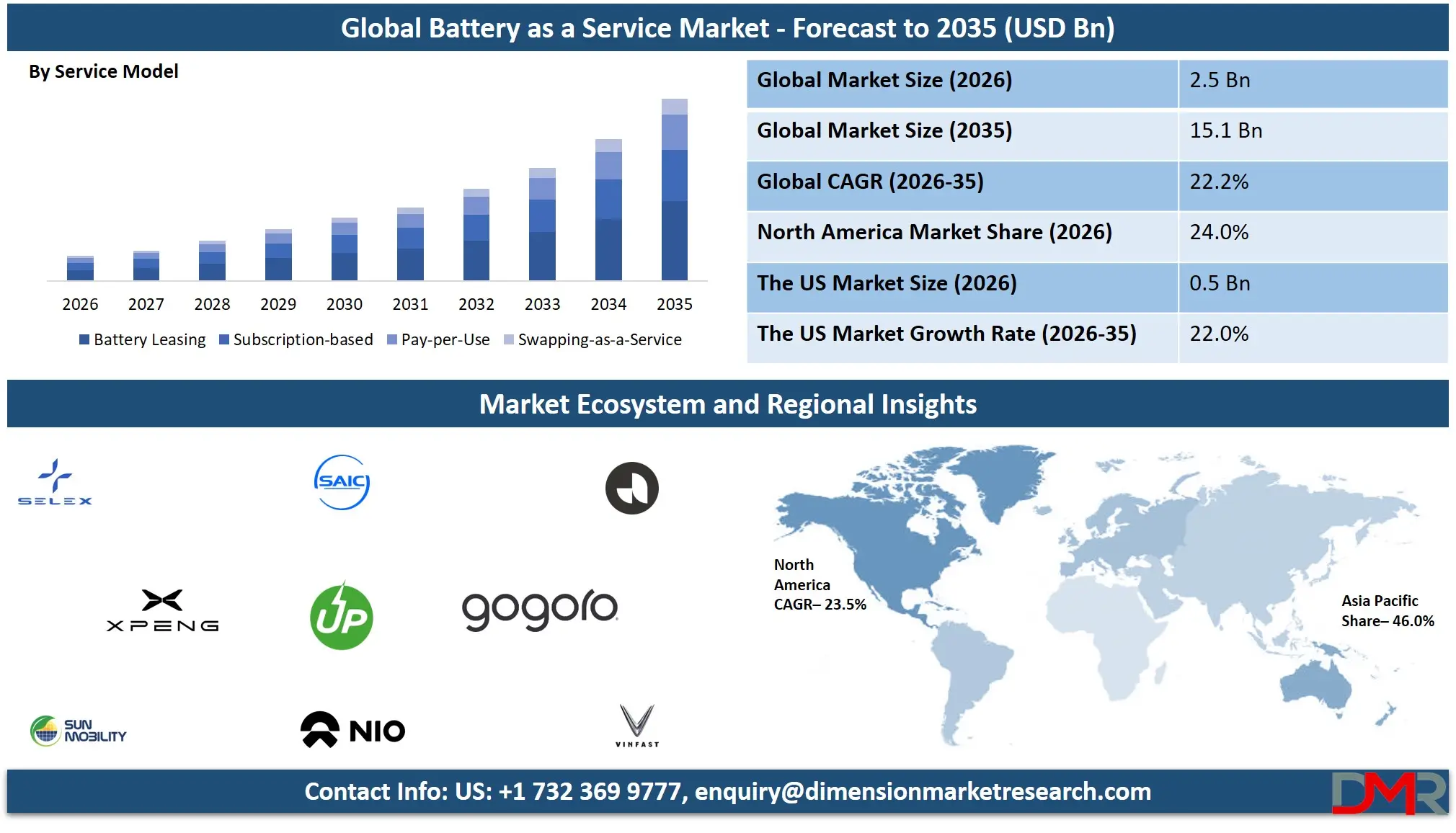
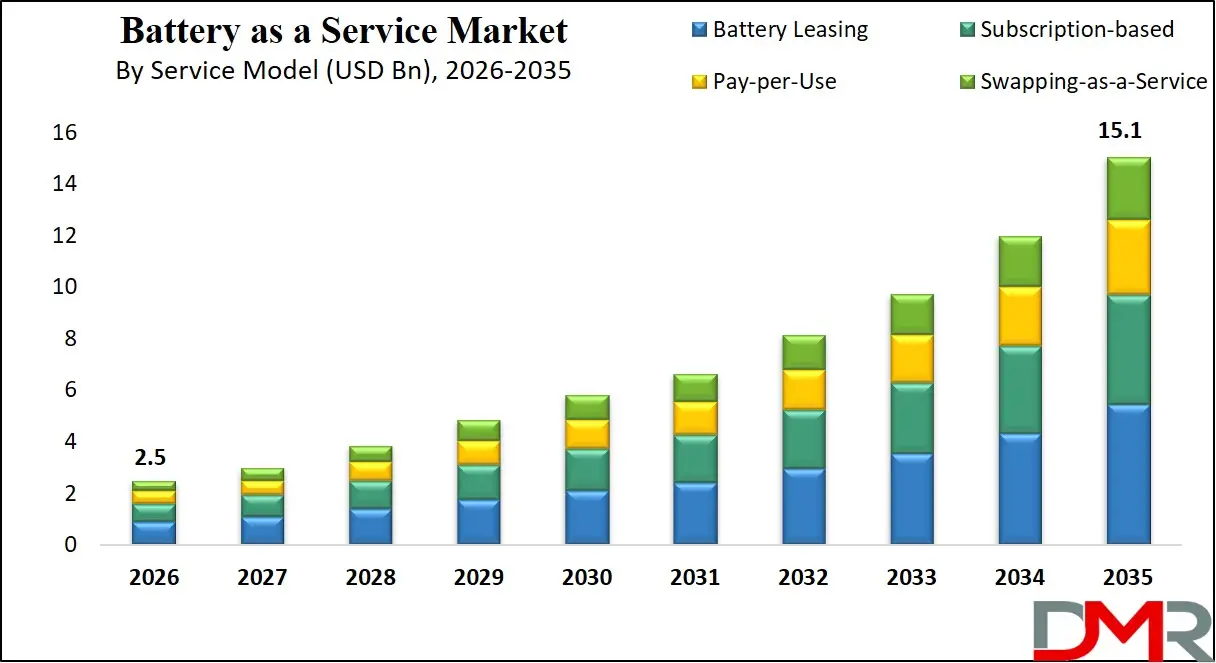
The Battery as a Service Market size is expected to be USD 2.5 billion in 2026 and increase at a compound annual growth rate of 22.2% to USD 15.1 billion in 2035 due to the growing use of renewable energy sources like solar and wind.
ℹ
To learn more about this report –
Download Your Free Sample Report Here
Battery as a Service (BaaS) is developing quickly as a business model that disrupts the energy and mobility industry. The service provides clients with the choice to rent or subscribe to batteries instead of buying them. The BaaS model avoids upfront costs and solves the problem of building a charging network, especially for electric vehicles (EV). Growth is expected due to the rising popularity of EVs and the focus on sustainability and urbanization. Advanced battery technology like lithium-ion batteries and future solid-state batteries as well as digital control are contributing to the service's evolution.
ℹ
To learn more about this report –
Download Your Free Sample Report Here
The US Battery as a Service Market
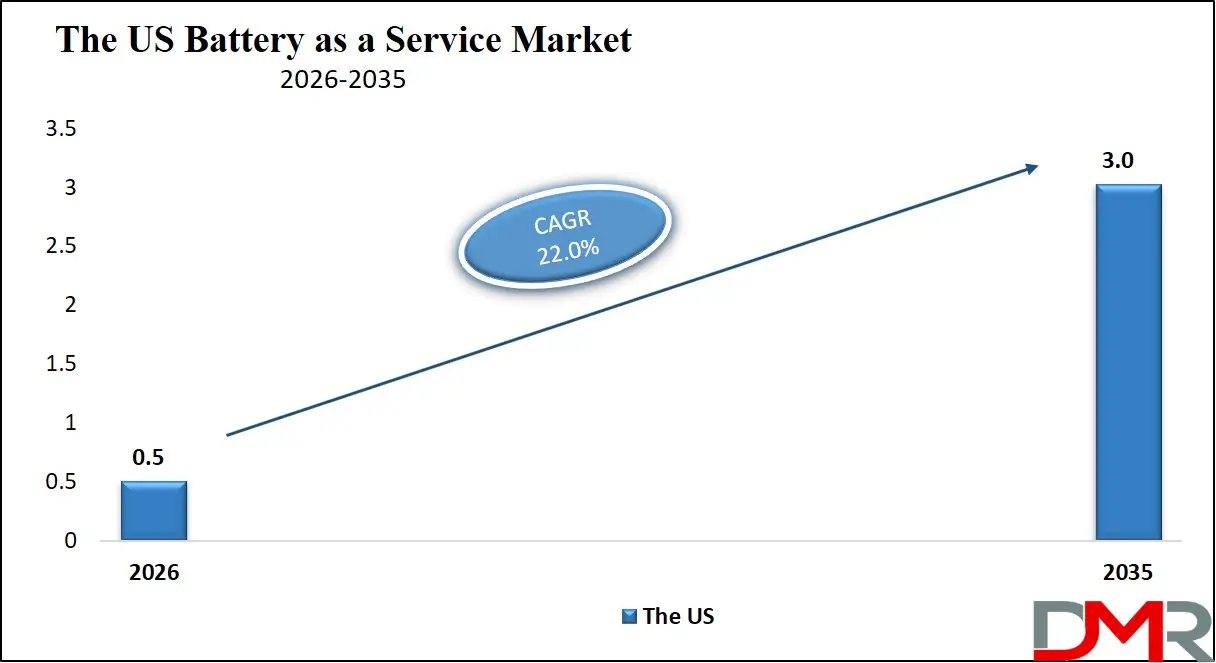
The US Battery as a Service Market size is estimated to be USD 500 million in 2026 and is expected to increase at a CAGR of 22.0% over the forecast period.
ℹ
To learn more about this report –
Download Your Free Sample Report Here
The US BaaS market will be propelled by the growing uptake of electric vehicles, government incentives, and battery technology innovations. Incentives for clean energy and local battery production are driving BaaS. Commercial transportation and fleet electrification sectors play a significant role, with growing smart grid integration. The market is also aided by private funding for charging and swapping networks, with regulatory support promoting sustainability and recycling.
Europe Battery as a Service Market
The Europe Battery as a Service Market size is estimated to be USD 550 million in 2026 and at a CAGR of 21.0% over the forecast period.
The Battery as a Service market in Europe is supported by strict environmental regulations, and ambitious climate action like the European Green Deal. There is an accelerating roll-out of electric vehicles and increased integration of renewables, driving the need for adaptable battery technologies. Sophisticated automotive manufacturing and favourable policies for circular economy projects stimulate development in battery reuse and recycling. The use is high in transportation and public transport.
Japan Battery as a Service Market
The market size of Japan Battery as a Service will be USD 175 million in 2026 and at a CAGR of 19.9% in the forecast period.
Japan's Battery as a Service market is driven by technological advancement, government support for sustainability, and robust manufacturing capabilities. Japan focuses on energy efficiency and resilient energy systems, driving the need for decentralised energy storage. The country benefits from rapid battery technology development and growing transport electrification. But limited space and high system costs are barriers, with opportunities in smart cities and automation.
Key Takeaways
- Market Size & Forecast: The Battery as a Service Market size is projected to reach USD 2.5 billion in 2026 and is anticipated to have a value of USD 15.1 billion in 2035.
- Growth Rate & Outlook: The Battery as a Service Market size is set to grow at a compound annual growth rate of 22.2% during the forecast period of 2026 to 2035.
- Primary Growth Drivers: Some of the major growth drivers in the market include Cost Reduction and Flexibility, Expansion of EV and Energy Storage Ecosystems, and more.
- Key Market Trends: Some of the major trends in the market are Integration of Digital Technologies, Shift Toward Modular and Swappable Batteries, and more.
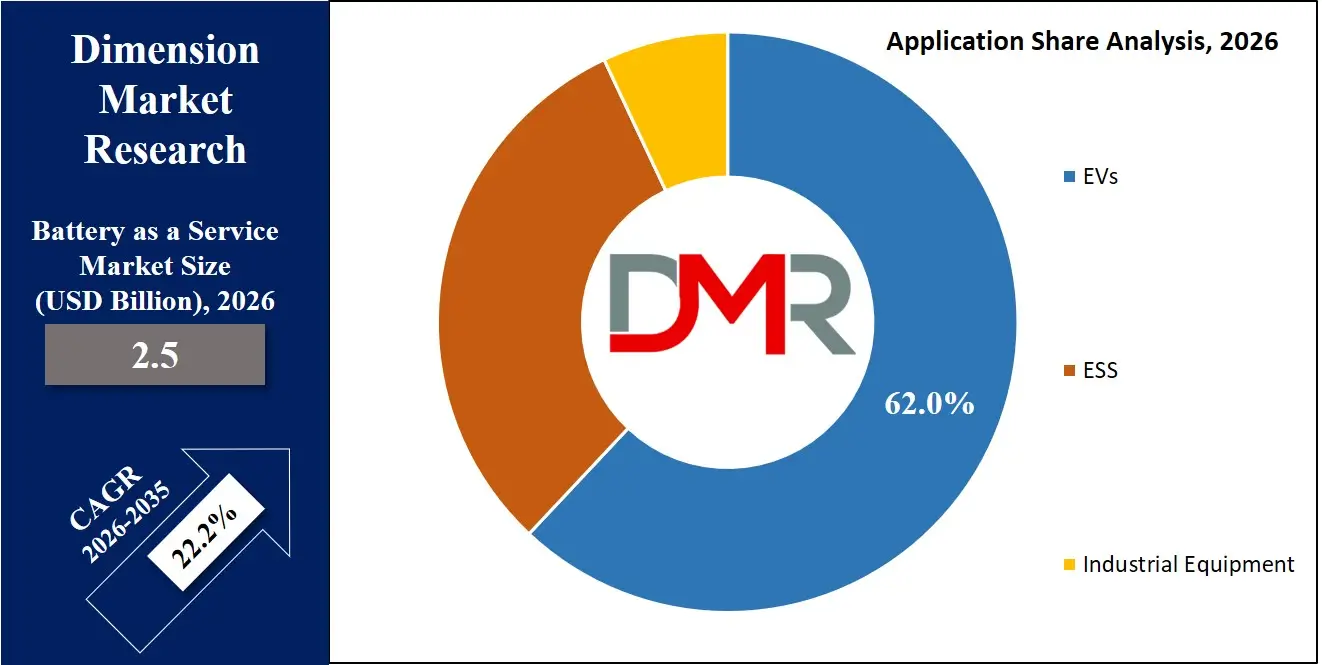
- By Application: The EVs segment is anticipated to get the majority share of the Battery as a Service market in 2026.
- By Service Model: The battery leasing segment is expected to get the largest revenue share in 2026 in the Battery as a Service market.
- By End User Industry: The mobility & automotive segment is expected to get the largest revenue share in 2026 in the Battery as a Service market.
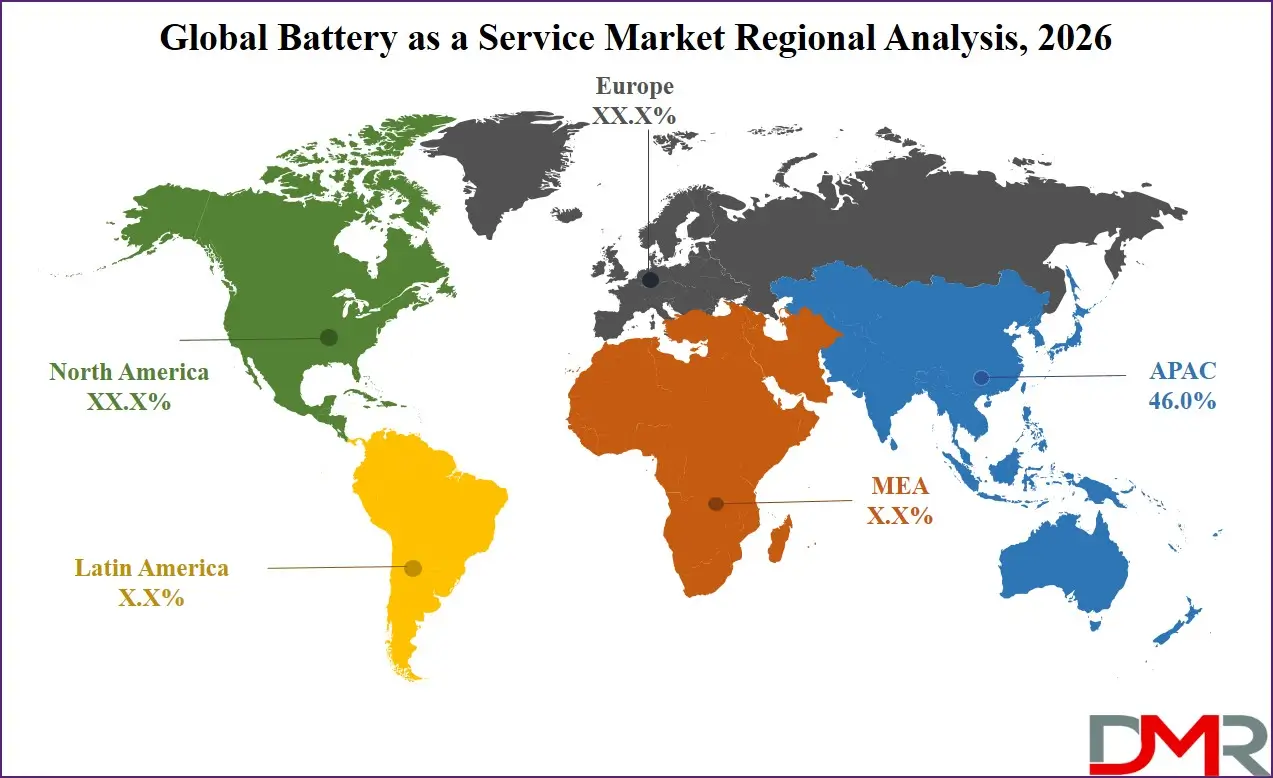
- Regional Leadership: Asia Pacific is set to lead the Battery as a Service market with an estimated 46.0% share in 2026.
What is the Battery as a Service?
Battery as a Service (BaaS) is a concept of providing batteries to customers on a lease, subscription or pay-per-use basis rather than selling them outright. This includes battery supply, charging or battery swap facilities, maintenance and monitoring, and life cycle management. BaaS integrates technologies like IoT-based battery monitoring, predictive maintenance and cloud-based analytics to enhance efficiency and safety. The concept is vital for cutting capital costs, improving efficiency, and facilitating electrification in transportation, industrial machinery, and stationary storage, and is essential for the clean energy transition.
Use Cases
- Electric Mobility Solutions: BaaS enables EV users to swap or lease batteries, reducing vehicle costs and eliminating long charging times, making it ideal for urban transportation and fleet operators.
- Grid Energy Storage: Utilities use BaaS for scalable energy storage solutions, balancing supply-demand fluctuations and supporting renewable energy integration efficiently.
- Industrial Equipment: Warehousing and logistics sectors utilize BaaS for forklifts and material handling equipment, ensuring uninterrupted operations with minimal downtime.
- Residential Energy Backup: Homeowners adopt BaaS for backup power systems, enhancing energy reliability and reducing dependency on traditional grid infrastructure.
How AI Is Transforming the Battery as a Service Market
AI is a key enabler of battery performance and service life in the BaaS market. This allows for predictive maintenance and minimises outages based on data-driven insights. This enhances user satisfaction and service provider efficiency.
Furthermore, AI helps with demand prediction, energy management and smart charging. It improves user experience by providing real-time data analytics and automated services and facilitates seamless integration with renewable energy sources and smart grids, leading to cost savings and sustainability.
Market Dynamic
Driving Factors in the Battery as a Service Market
Cost Reduction and Flexibility
Battery as a Service reduces the initial cost of electric vehicles and energy storage systems, making them more affordable by unbundling battery ownership. This helps to drive mass adoption by consumers and fleet managers. This allows businesses to expand more cost-effectively, with maintenance, upgrades, and guaranteed performance from service operators.
Expansion of EV and Energy Storage Ecosystems
Expansion of electric vehicle and renewable energy ecosystems are key drivers of BaaS. The need for effective charging and grid management opens up opportunities for battery-as-a-service models. Smart grids and renewable energy sources also increase the value of BaaS, making it an important part of energy systems.
Restraints in the Battery as a Service Market
High Infrastructure Investment Requirements
The setup of battery swapping and service networks is capital intensive. Building infrastructure, such as grid connections and buildings, can hinder market growth, especially in emerging markets. This poses barriers to market entry and hampers scalability in regions lacking infrastructure readiness.
Standardization and Compatibility Issues
Inconsistent battery design, size, and standardization across manufacturers pose a major challenge for BaaS. Differences in battery shape, size and technology limit compatibility and complicate the creation of a swapping network. This impacts performance and adds complexity for BaaS providers.
Opportunities in the Battery as a Service Market
Emergence of Circular Economy Practices
Increasing emphasis on sustainability and resource conservation is opening up opportunities for battery recycling and re-use. BaaS businesses can leverage this opportunity by offering lifecycle management services, minimising waste, and creating new revenue opportunities with repurposed batteries in less critical applications.
Government Incentives and Policy Support
Favorable government policies that encourage renewable energy, electric vehicle (EV) uptake, and infrastructure building offer considerable opportunities. Government grants, tax credits and policies promoting battery swap and leasing schemes are driving market expansion, particularly in developing markets.
Trends in the Battery as a Service Market
Integration of Digital Technologies
IoT, AI, and cloud computing is revolutionising BaaS. Smart battery management systems allow real-time monitoring, maintenance, and performance optimization, leading to better service quality and customer satisfaction.
Shift Toward Modular and Swappable Batteries
Battery manufacturers are also developing modular batteries that are compatible with swapping and leasing. This is accelerating the deployment of BaaS, by facilitating interoperability, minimising downtime and improving productivity and efficiency in mobility and industrial sectors.
Research Scope and Analysis
The Battery as a Service market is analyzed across key segments including battery types, service models, applications, service components, and end-user industries, highlighting dominance of lithium-ion, EV-driven demand, leasing models, and rapid growth in swapping and energy storage solutions.
ℹ
To learn more about this report –
Download Your Free Sample Report Here
By Battery Type Analysis
Lithium-ion batteries are prevalent in the Battery as a Service market because of their higher energy density, longer cycle life, and widespread use in electric vehicles and energy storage systems, with an estimated 68% market share in 2026. The established supply chain and cost reduction also enhance their market share. Lithium Iron Phosphate (LFP) batteries are gaining momentum in this category for their improved safety, stability and lower cost, particularly in EVs for mass markets and energy storage. On the other hand, solid-state batteries are the fastest-growing segment, owing to their high energy density, potential for rapid charging, and enhanced safety, and are attracting significant R&D funding. Sodium-ion batteries are also gaining traction as economically viable options, especially in large-scale energy storage, where cost is a critical factor, suggesting a robust diversification and resilience in battery technology.
By Service Model Analysis
Leasing continues to dominate the BaaS market, with a share of around 36% in 2026, primarily due to the cost reduction and flexibility it offers to consumers and businesses. It's especially popular among commercial fleet owners and businesses due to its predictable cost structure and minimised risk of asset depreciation. The subscription model is also popular in urban mobility applications, providing services such as maintenance, upgrades and monitoring. But swap-as-a-service is the fastest growing area due to its convenience, shorter charging times and reduced fleet downtime. This approach is particularly popular in urban areas and commercial fleets with high utilization, where efficiency and turnaround time are key to profitability.
By Application Analysis
Electric vehicles have been identified as the main product segment accounting for a market share of 62% in 2026 owing to the increased sales of electric vehicles across the globe, supportive government regulations, and the advancements being made in batteries. The two-wheeler segment and passenger vehicles are considered to be the main segments of this market due to their extensive use in urban transport. The development of commercial electric vehicles is another factor responsible for driving growth in this segment. Energy storage systems have emerged as one of the fast-growing segments due to the increasing adoption of renewable energy sources. This segment holds great significance in residential as well as large-scale energy storage applications where BaaS provides efficient and cost-effective energy storage solutions.
By Service Component Analysis
Charging and swapping infrastructure is the largest service component with a share of about 34% in 2026 as the backbone of BaaS. Deployment of these networks is essential to provide access and reliability of battery service, especially in densely populated areas. The growth in fast-charging and swapping technologies is also boosting the service component. Data monitoring and analytics, such as battery management systems and predictive maintenance, are the fastest-growing segment owing to the growing focus on performance, safety and maintenance. These software solutions facilitate real-time monitoring, lower risks and enhance efficiency, thereby playing a vital role in the scalable BaaS roll-out.
By End User Industry Analysis
The mobility and automotive industry is the dominant end user with a share of around 48% by 2026, due to rapid electrification, rising fuel prices, and the need for cost-effective and sustainable transport. BaaS is essential to drive EV uptake, overcoming cost and charging issues. Fleet and logistics companies are the fastest-growing users of BaaS, benefiting from flexibility, efficiency and uptime. BaaS is especially valuable for last-mile and urban logistics, where high fleet utilisation requires fast battery swap. Moreover, BaaS is also beginning to penetrate the energy and industrial market to improve efficiency and energy expenses.
The Battery as a Service Market Report is segmented on the basis of the following:
By Battery Type
- Lithium-ion Batteries
- Lithium Iron Phosphate (LFP)
- Nickel Manganese Cobalt (NMC)
- Nickel Cobalt Aluminum (NCA)
- Lithium Titanate (LTO)
- Lead-Acid Batteries
- Solid-State Batteries
- Sodium-ion Batteries
By Service Model
- Subscription-Based
- Pay-Per-Use (Energy Consumption / Distance-Based)
- Battery Leasing
- Swapping-as-a-Service
By Application
- Electric Vehicles (EVs)
- Two-Wheelers
- Three-Wheelers
- Passenger Cars
- Light Commercial Vehicles (LCVs)
- Heavy Commercial Vehicles (HCVs)
- Buses
- Energy Storage Systems (ESS)
- Residential Storage
- Commercial & Industrial (C&I)
- Utility-Scale Storage
- Industrial Equipment
- Forklifts & Material Handling
By Service Component
- Battery Provisioning & Leasing
- Charging & Swapping Infrastructure
- Monitoring & Analytics
- Battery Management Systems (BMS)
- IoT & Remote Diagnostics
- Predictive Maintenance
- Maintenance & Lifecycle Management
- Second-Life & Recycling Services
By End-User Industry
- Automotive & Mobility
- Logistics & Fleet Operators
- Energy & Utilities
- Manufacturing & Industrial
Regional Analysis
Leading Region in the Battery as a Service Market
Asia-Pacific accounts for the largest share of the Battery as a Service market, with around 46% of the market share forecasted in 2026. The reason behind this market dominance is the highly urbanized environment, high adoption of electric vehicles, and numerous governmental policies and projects encouraging the use of batteries as well as adoption of clean energy. Countries like China, India, and South Korea are aiming at developing ecosystems for electric vehicles as well as utilizing their domestic battery manufacturing capacity.
ℹ
To learn more about this report –
Download Your Free Sample Report Here
Fastest Growing Region in the Battery as a Service Market
The North American region will lead in the adoption of Battery as a Service due to increasing investments in electric transportation, renewable energy storage, and batteries in general. Incentives from governments in form of tax credits and renewable energy support are key drivers for growth within the market. EVs used for transportation in transport logistics as well as public transport systems have been identified as key growth areas for BaaS. Besides, digitalisation and smart grids are improving service provision in the region. Innovations and R&D continue to be key in the region.
By Region
North America
Europe
- Germany
- The U.K.
- France
- Italy
- Russia
- Spain
- Benelux
- Nordic
- Rest of Europe
Asia-Pacific
- China
- Japan
- South Korea
- India
- ANZ
- ASEAN
- Rest of Asia-Pacific
Latin America
- Brazil
- Mexico
- Argentina
- Colombia
- Rest of Latin America
Middle East & Africa
- Saudi Arabia
- UAE
- South Africa
- Israel
- Egypt
- Rest of MEA
Competitive Landscape
The market for Battery-as-a-Service is highly competitive, with emphasis on innovation, collaboration, and infrastructure development. Companies involved in the market emphasize the establishment of networks of batteries, digitization of operations, and battery management during their life cycle. The market entry barriers are very high owing to the financial investment and technical knowledge requirements. Collaborations with car manufacturers and energy providers aid companies to get established and operate globally.
Some of the prominent players in the global Battery as a Service are:
- NIO Inc.
- Gogoro Inc.
- XPeng Inc.
- SAIC Motor Corporation Limited
- VinFast
- Ample Inc.
- SUN Mobility
- Battery Smart
- Bounce Infinity
- Swobbee GmbH
- Oyika Pte. Ltd.
- Immotor Technology
- KYMCO (Ionex)
- VoltUp
- Spiro Mobility
- Selex Motors
- Aulton New Energy
- CATL (EVOGO)
- Yadea (Energy Cubes)
- Amara Raja Energy & Mobility
- Other Key Players
Recent Developments
- In April 2026, Alsym Energy revealed its proprietary physics-informed AI platform behind its Na-Series sodium-ion batteries. The system combines physics-based models, AI, autonomous testing, and molecular diagnostics in a closed loop to accelerate development of safer, low-cost batteries. Addressing lithium-ion limitations such as flammability and supply chain risks, the platform supports scalable energy storage innovation, helping meet rising electricity demand while improving safety, cost efficiency, and deployment speed in infrastructure projects.
- In March 2026, TVS Motor Company has launched a Battery-as-a-Service (BaaS) model for its electric scooters, separating battery cost from the vehicle price to reduce upfront expenses. Customers can purchase scooters starting at INR 49,999 (USD 530) and subscribe to battery usage via monthly plans from ₹862. The model offers flexible payments, extended battery warranty up to five years or 70,000 km, and aims to simplify EV adoption with clearer ownership and running costs.
Report Details
| Report Characteristics |
| Market Size (2026) |
USD 2.5 Bn |
| Forecast Value (2035) |
USD 15.1 Bn |
| CAGR (2026–2035) |
22.2% |
| Historical Period |
2021 – 2025 |
| Forecast Period |
2027 – 2035 |
| Base Year |
2025 |
| Estimate Year |
2026 |
| Segments Covered |
By Battery Type, By Service Model, By Application, By Service Component, By End-User Industry |
| Regional Coverage |
North America – The US and Canada; Europe – Germany, The UK, France, Russia, Spain, Italy, Benelux, Nordic, & Rest of Europe; Asia-Pacific – China, Japan, South Korea, India, ANZ, ASEAN, Rest of APAC; Latin America – Brazil, Mexico, Argentina, Colombia, Rest of Latin America; Middle East & Africa – Saudi Arabia, UAE, South Africa, Turkey, Egypt, Israel, & Rest of MEA |
Frequently Asked Questions
How big is the Battery as a Service Market?
▾ The Battery as a Service Market size is expected to reach USD 2.5 billion by 2026 and is projected to reach USD 15.1 billion by the end of 2035.
What is the CAGR of the Battery as a Service Market from 2026 to 2035?
▾ The market is growing at a CAGR of 22.2 percent over the forecasted period.
What factors are driving the growth of the Battery as a Service Market?
▾ Cost Reduction and Flexibility, Expansion of EV and Energy Storage Ecosystems, and more are the factors driving the growth of the Battery as a Service Market.
What are the major trends in the Battery as a Service Market?
▾ Integration of Digital Technologies, Shift Toward Modular and Swappable Batteries, and more are some of the major trends in the market.
Who are the key players in the Battery as a Service Market?
▾ Some of the key players in the Battery as a Service Market include NIO, Gogoro, Ample, and more
How is the Battery as a Service Market segmented?
▾ The Battery as a Service Market is segmented by battery type, service model, application, service component, end-user industry.
Which region held the largest share of the Battery as a Service Market in 2026?
▾ Asia Pacific is set to lead the Battery as a Service market with an estimated 46.0% share in 2026.
Which region is expected to grow the fastest in the Battery as a Service Market?
▾ North America is the fastest-growing region in the Battery as a Service market during the forecast period.