What is the Global Biodiversity Credit Market Size?
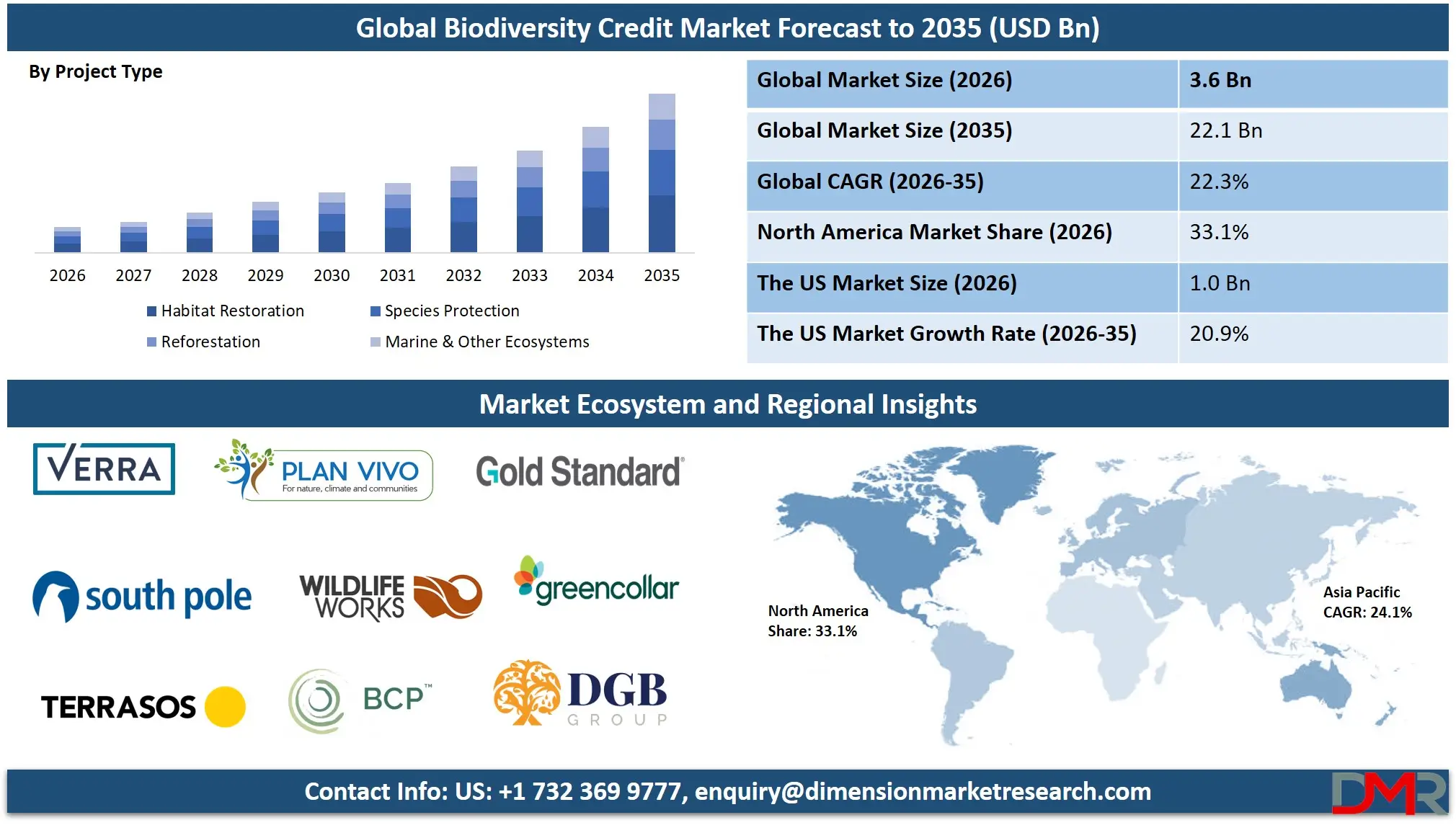
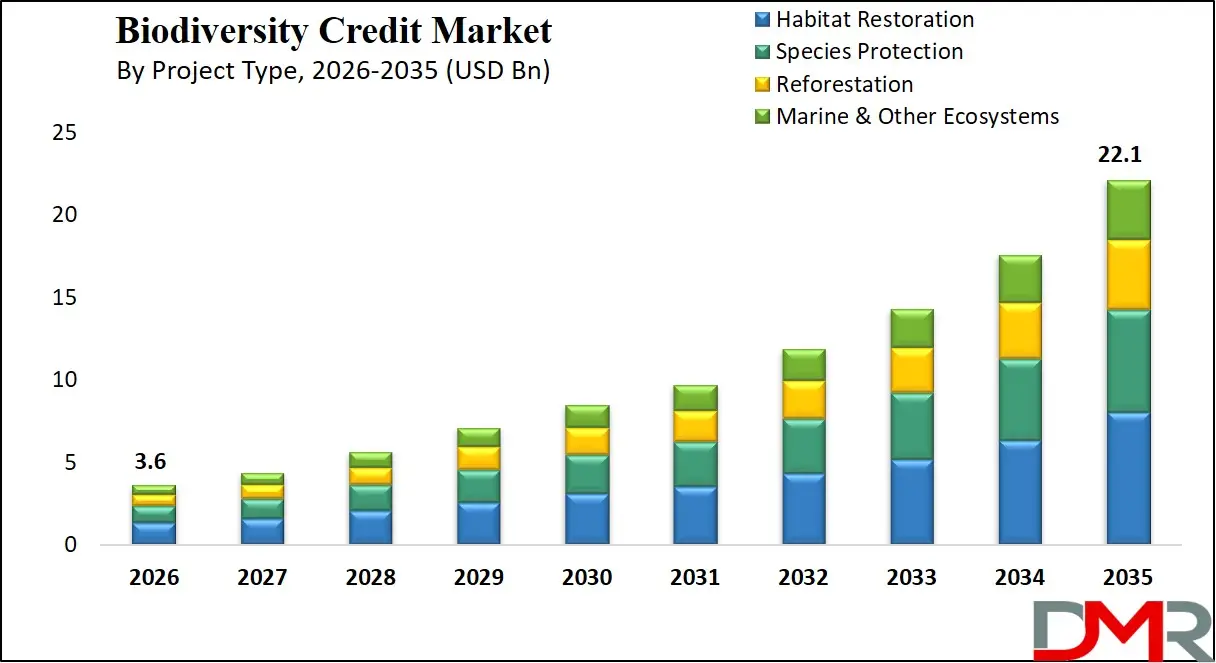
The Global Biodiversity Credit Market size is projected to reach USD 3.6 billion in 2026 and grow at a compound annual growth rate (CAGR) of 22.3% to reach a value of USD 22.1 billion by 2035, driven by continuous advancements in satellite remote sensing, environmental DNA (eDNA) analysis, and AI-powered monitoring, reporting, and verification (MRV) platforms, which are significantly enhancing the credibility, transparency, and scalability of biodiversity credit systems.
ℹ
To learn more about this report –
Download Your Free Sample Report Here
The Biodiversity Credit Market has seen a rising development as a result of the increasing nature-positive corporate commitments, compulsory biodiversity net gain (BNG) policies, and the requirement to transfer private capital into conservation results across the global ecosystems. It also covers such new technologies as AI-based habitat change detection, acoustic-monitoring cameras, cloud-based biodiversity accounting, and real-time habitat-species abundance tracking used in biodiversity credit projects.
Modernization is a significant investment that governments, corporations, and conservation stakeholders are pursuing to allow efficient allocation of capital, reduce the risk of greenwashing, and increase ecological integrity. The move towards automation, predictive modeling of credit permanence, and smart credit stacking (biodiversity + carbon) is increasing adoption. Moreover, the need to operationalize the Kunming-Montreal Global Biodiversity Framework (GBF) and the importance of sustainable land and sea use are driving digital changes in environmental finance, and biodiversity credit systems have become an essential part of the future nature-positive economy on a global scale.
ℹ
To learn more about this report –
Download Your Free Sample Report Here
The US Biodiversity Credit Market
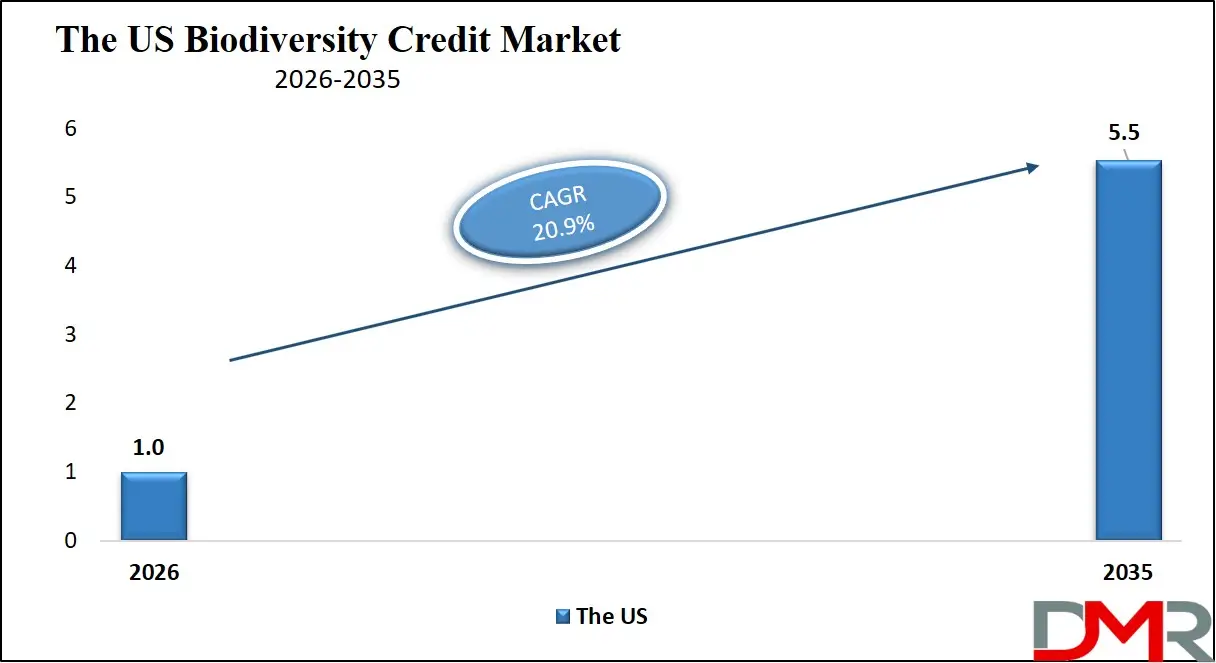
The US Biodiversity Credit Market is projected to reach USD 1.0 billion in 2026 at a compound annual growth rate of 20.9% over its forecast period.
ℹ
To learn more about this report –
Download Your Free Sample Report Here
The biodiversity credit market in the US is driven by corporate ESG pressures, state conservation requirements (e.g., natural and working lands programs in California) and the need to upgrade fragmented mitigation banking systems. There is increasing investment in smart habitat quantification systems, predictive credit valuation models based on AI, and satellite-enabled ecological performance monitoring. The adoption is promoted by federal funding programs such as the America the Beautiful Challenge. The Corporate ESG and Sustainability segment prevails, and digital tools improve the effectiveness of conservation finance. Major participants are concentrating on methodology innovation and registry collaborations to increase credit integrity. The regulatory frameworks that promote ecosystem protection and verifiable additionality also facilitate the adoption of digital MRV, and the need to have real-time ecological performance data and automated verification further determines the growth of markets.
Europe Biodiversity Credit Market
The Europe Biodiversity Credit Market is estimated to be valued at USD 969.8 million in 2026, witnessing growth at a CAGR of 25.2%, during the forecast period.
Europe is a developed biodiversity credit market, which has a strong impact on regulatory mandates and regional policies, including the EU Nature Restoration Law, the EU Deforestation Regulation (EUDR), and national biodiversity net gain schemes (e.g., France's "no net loss" and the UK's mandatory BNG introduced in 2024). Nations are also working on intelligent credit stacking systems to align carbon and biodiversity outcomes and enhance cross-border conservation interoperability. Innovation is driven by advanced remote sensing, such as Copernicus satellite data and LiDAR habitat mapping, and high-integrity biodiversity credits with embedded permanence planning. Adoption is supported by public-private partnerships (e.g., Business for Nature) and harmonization of environmental accounting standards (e.g., TNFD). Technologies like real-time species occurrence data transmission and smart contract-based credit issuance are commonly practiced as research-centric programs, and Europe is a frontrunner in terms of the digital transformation of nature-based finance.
Japan Biodiversity Credit Market
The Japan Biodiversity Credit Market is projected to be valued at USD 250.4 million in 2026, progressing at a CAGR of 23.3%, during the period spanning from 2026 to 2035.
Japan has a well-developed biodiversity credit market backed by good satellite and sensor technology, corporate biodiversity reporting culture (influenced by GRI and TNFD pilots), and an extensive conservation innovation network. Automation, precision, and ecological integrity are the priorities in the country and are achieved by AI-driven species identification systems (e.g., image recognition for forest and marine species) and predictive habitat resilience models for credit assets. Growth is stimulated by government actions under the Green Growth Strategy and constant investment in natural capital accounting infrastructure. The high volume of territorial, forest, and marine conservation requires efficient credit systems for ecosystem protection. The difficulties are high upfront project validation costs and integration with existing land use rights, yet the prospects are in exporting developed biodiversity credit technologies and methodologies to Southeast Asian markets.
Key Takeaways
- Market Size & Forecast: The Global Biodiversity Credit Market is estimated to be valued at USD 3.6 billion in 2026 and is expected to grow to USD 22.1 billion by 2035.
- Growth Rate & Outlook: The market size will experience a compound annual growth rate of 22.3% in the forecast period between 2026 and 2035.
- Primary Growth Drivers: Technological progress in remote sensing and eDNA to support MRV, regulatory requirements (EU Nature Restoration Law, UK BNG), and corporate nature-positive pledges (TNFD) are some of the key drivers of growth in the market.
- Key Market Trends: Some of the key trends in the market are the adoption of AI and data-driven decision making for credit verification and additionality testing, and the shift toward cloud-based biodiversity accounting and registry platforms.
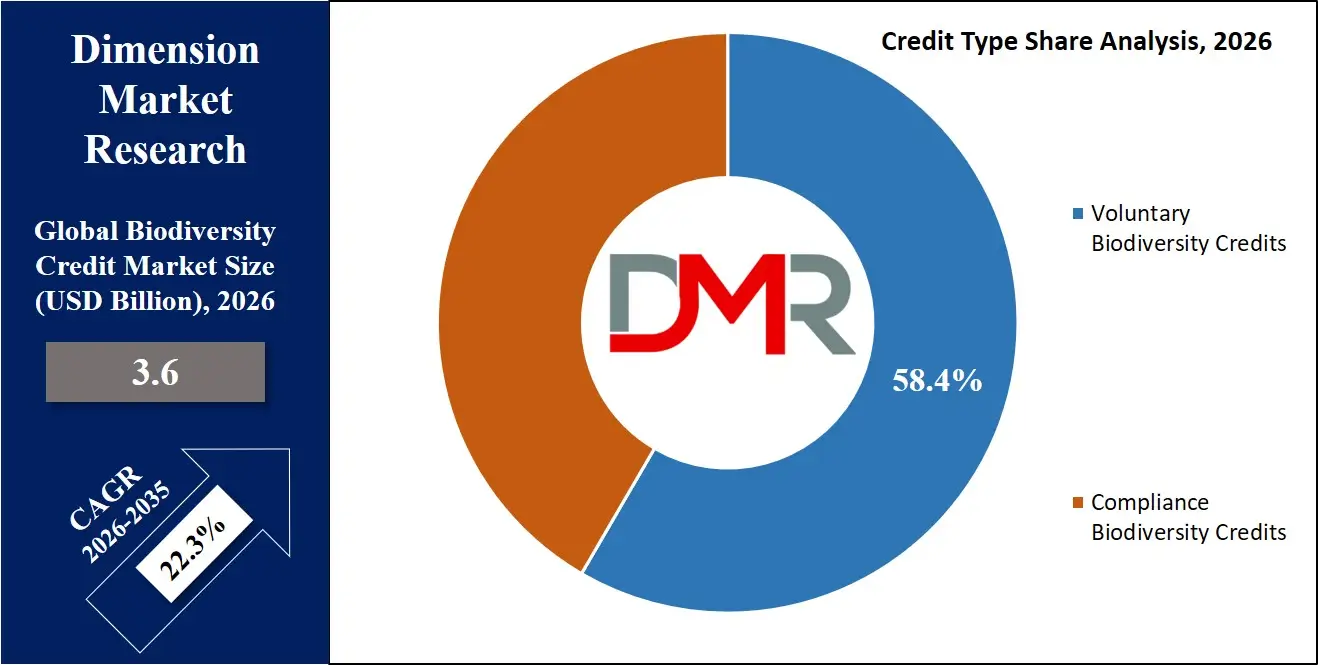
- By Credit Type: The voluntary biodiversity credits segment is anticipated to get the majority share of the Biodiversity Credit market in 2026.
- By Project Type: The habitat restoration segment is expected to get the largest revenue share in 2026 in the Biodiversity Credit market.
- By Trading Platform: The exchange-based platforms segment is expected to get the largest revenue share in 2026 in the Biodiversity Credit market.
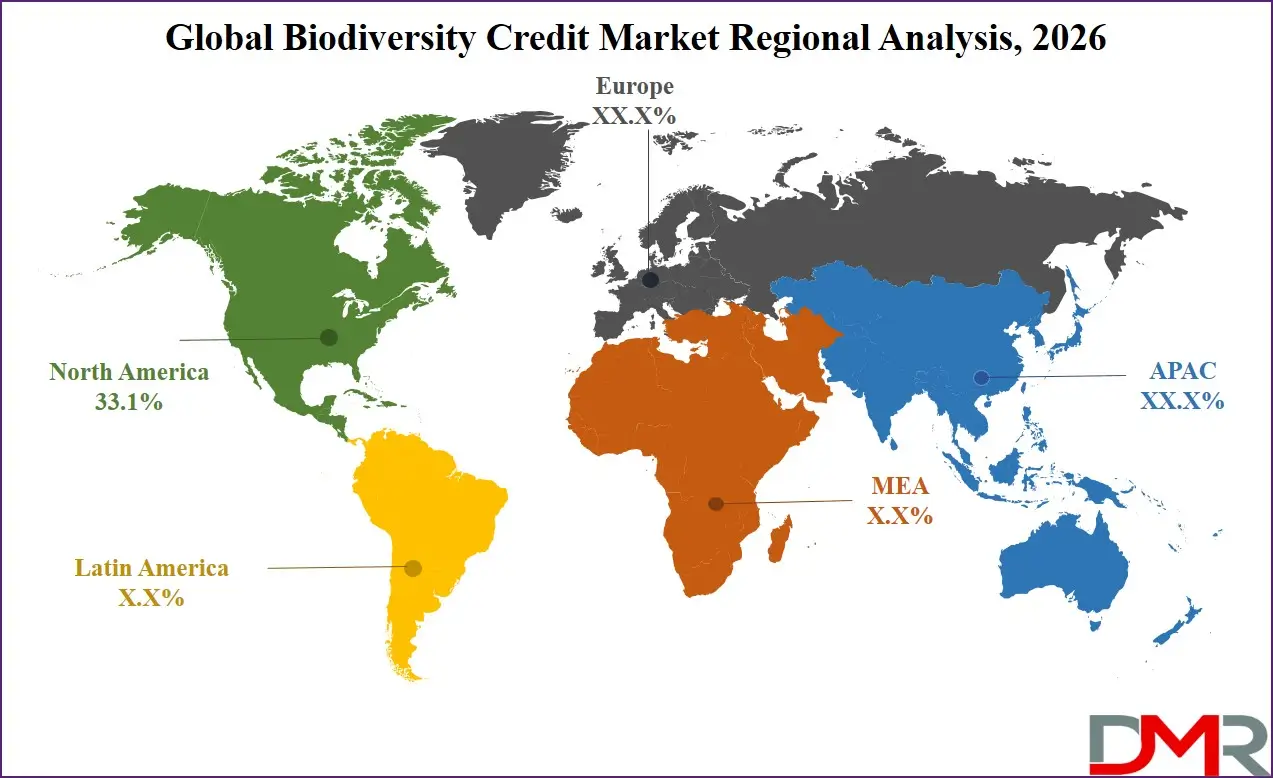
- Regional Leadership: North America is predicted to dominate the market with an estimated 33.1% share in 2026, with high credit prices and corporate demand.
What is the Biodiversity Credit?
A biodiversity credit is a verifiable and tradable unit of measured and permanent biodiversity benefits, like better habitat, less risk to species or reinstated ecosystems following conservation or restoration efforts. It uses satellite monitoring, environmental DNA (eDNA), and real-time analytics to promote transparency, tracking, and verification. The credits can facilitate effective ecosystem management, sustainable conservation planning, and assist in directing corporate, governmental, and other stakeholders' funds into scalable, sustainable nature finance. They also facilitate accountability by making sure that the biodiversity results are quantified, tracked, and in line with the global sustainability objectives.
Use Cases
- Conservation and Ecosystem Protection: Credit systems facilitate habitat surveillance, confirmed biodiversity benefits in IUCN frameworks, and resilience tracking, mitigating greenwashing threats and enhancing transparency, accountability and conservation finance integrity.
- Credit Buffer Pool Modeling (Permanence Risk): Ecological risk, such as wildfire or land-use change, is modeled to distribute buffer credits to keep biodiversity losses intact and ensure stability in the market in the long term and buyer confidence.
- Corporate ESG and Sustainability Use: Biodiversity credits are being used by companies to achieve nature-positive goals, provide sustainable supply chains, facilitate TNFD-related reporting, and compensate remaining environmental effects with quantifiable and verified conservation results.
- Government and Public Sector Programs: Advanced monitoring systems enhance conservation outcomes in the population, aid biodiversity goals, improve regulatory compliance efficiency, and improve policy implementation, including restoration requirements and biodiversity net gain models.
How AI Is Transforming the Global Biodiversity Credit Market
Biodiversity credit systems are also changing with artificial intelligence, which can predictively map habitats, automatically find species based on camera traps and acoustic data, and monitor the health of an ecosystem in real-time. AI algorithms can be used to analyze satellite and field data to identify any degradation or habitat loss and scale-optimise conservation results. This saves time, is verifiable and cheaper than manual surveys.
Moreover, AI enhances credit integrity through offering adaptive restoration planning, anticipating climate-driven threats to permanence, and intelligent prioritization of conservation funding. It is also involved in reducing the cost of baseline setting and ongoing monitoring, allowing credit operators to reduce the cost and physical footprint of field surveys and improve the reliability of conservation outcomes and their financial returns.
Market Dynamics
Key Drivers of the Global Biodiversity Credit Market
Technological Advancements in MRV and Automation
The market is being pushed by the use of AI, high-tech remote sensors (satellite, drone, LiDAR), environmental DNA (eDNA), and real-time analytics of an ecosystem. Such technologies will allow one to monitor the status of the habitat in real time, automatically identify species, predict permanence, and simplify verification, enhancing efficiency and transparency. Automation saves on costly manual field surveys, operational expenses, and conservation impact per dollar expended is maximized. Current constellation of satellites (e.g., Planet, Sentinel) and new machine learning classification results in increased credit worth and digital transformation is an essential component of modern nature infrastructure construction.
Regulatory Mandates and Nature-Positive Policies
Governments, worldwide, are introducing obligatory biodiversity policies (e.g., the Biodiversity Net Gain (BNG) in the UK, as of February 2024, the EU Nature Restoration Law, and the French policy of no net loss), generating a compliance need in biodiversity credits. Policy support, subsidies for habitat banking, and international frameworks (Kunming-Montreal GBF Target 19 - mobilizing $200B/year by 2030) are promoting the adoption of credit mechanisms. Corporate disclosure and ensuing credit demand is being driven by the implementation of TNFD (Taskforce on Nature-related Financial Disclosures) recommendations. Such drivers provide an attractive atmosphere to project developers, technology providers, and registries, directly enhancing the growth of the market.
Restraints in the Global Biodiversity Credit Market
High Upfront Project Validation and Monitoring Costs
The cost of biodiversity credit project implementation is high due to the initial investment in the baseline biodiversity testing and additionality testing, methodology validation by third party, and maintenance of MRV infrastructure (sensors, data processing). Land tenure and stakeholder agreement may be complex and costly procedures especially in developing nations where property rights are not clear. Such cost constraints can cause delays in project registration and credit issuance, especially with smaller developers, as the long-term revenue stream is uncertain and upfront capital is scarce.
Lack of Standardized Methodologies and Interoperability
Biodiversity credit systems entail multiple competing methodologies (e.g., Verra's SD VISta Nature Framework, Plan Vivo's Biodiversity Standard, Wallacea Trust's model), which are supposed to be interoperable for global buyers. The technical challenge of integrating different credit types, baseline calculations, and permanence requirements can be addressed but remains significant. The absence of universally accepted protocols (unlike carbon with VCS/GS) and regional registry compatibility may be a barrier to large-scale corporate adoption. Such difficulties make credit comparisons expensive and time-consuming, affecting the liquidity and expansion of the market in general.
Growth Opportunities in the Global Biodiversity Credit Market
Expansion in Emerging Economies (High Biodiversity, Low Protection)
Developing countries (e.g., Brazil, Indonesia, Colombia, Madagascar, Vietnam) are investing in the biodiversity credit readiness programs to enable ecosystem protection capabilities and to drive economic development through nature-based solutions. The regions represent significant potentials to produce high-quality credits, as they hold high-quality, high-additionality ecosystems (Amazon, Congo Basin, Coral Triangle) that have not yet been entangled in the legacy development. The growing need for efficient conservation monitoring and government incentives (e.g., REDD+ readiness funds) provides a good growth opportunity to project developers and credit aggregators.
Growth of Corporate TNFD Disclosure and Supply Chain Action
The trend of corporate adoption of TNFD (Taskforce on Nature-related Financial Disclosures) and Science Based Targets for Nature (SBTN) in the world is also providing biodiversity credit systems with new opportunities. Credits are a crucial part of the future nature-positive supply chain infrastructure by enabling companies to compensate for residual impacts, finance nature restoration in sourcing regions, and meet "nature positive" commitments by 2030. This is likely to be a long-term demand trend.
Global Biodiversity Credit Market Trends
Adoption of AI and Data-Driven MRV for Credit Verification
The use of AI, satellite data, and acoustic analytics in credit verification is gaining more and more momentum, aimed at reducing verification costs and improving additionality assurance. Information-based insights facilitate efficient restoration planning, predictive permanence modeling of natural assets, and enhanced species occurrence data collection. The trend is converting the conventional manual survey methods into smart, continuously monitored, responsive nature finance credits.
Shift Toward Cloud-Based Biodiversity Accounting and Registry Platforms
The trend of cloud computing and blockchain in credit systems is becoming a fundamental aspect of this sector, allowing the storage of ecological performance data and the availability of conservation information on a larger scale and in real-time. Cloud-based registry solutions facilitate remote project monitoring, centralized credit portfolio management (issuance, transfer, retirement), and enhanced transparency for buyers. This change increases trust in markets and minimizes the cost of infrastructure for smaller project developers.
Research Scope and Analysis
By Credit Type Analysis
The voluntary biodiversity credits segment is poised to have a market share of about 58.4% in 2026 due to the increasing demand for corporate ESG integration, supply chain nature neutrality, and early-mover brand leadership. Voluntary solutions of interest to corporations and financial institutions include real-time biodiversity uplift verification and supply chain impact compensation. The application of AI-based species tracking and modular credit portfolios (stacked with carbon) is on the increase, thereby facilitating this segment.
ℹ
To learn more about this report –
Download Your Free Sample Report Here
In the meantime, the segment of the Compliance Biodiversity Credits is the most promising, with the growing need for regulated, government-mandated operations (e.g., UK BNG, EU Restoration Law). Voluntary biodiversity credits will be right in the middle of the act as the digital transformation of environmental finance becomes more and more rapid, becoming the key to powering the smart nature finance ecosystem, though compliance credits are expected to catch up in market value post-2028.
By Project Type Analysis
The habitat restoration segment is expected to dominate with approximately 40.8% market share in the year 2026, owing to its high ecological uplift potential, verifiability via satellite imagery, and co-benefits with carbon sequestration (e.g., mangrove, peatland, forest restoration). Corporate and government buyers are shifting to higher-integrity project types in order to have greater ecosystem resilience and improve conservation outcomes. The restoration solutions are adaptable, making it easy to deploy and integrate with other types of environmental credits (e.g., water quality, carbon). Species protection projects can still be used, though, in places where there are endangered species priorities (e.g., elephant corridors, pollinator habitats). The multi-project usage with habitat restoration, species protection, reforestation, and marine ecosystems simultaneously has the quickest development, and the credit portfolios are more flexible to different biomes and conservation contexts.
By Trading Platform Analysis
It is expected that the exchange-based platforms segment will have the highest share of around 55.6% in 2026, considering its pivotal role in facilitating transparent price discovery, standardized credit contracts, and real-time settlement. The integrated verification and registry systems (e.g., via blockchain) provide continuous ownership tracking, which improves the efficiency and safety of transactions. Liquidity and bid-ask spreads are determined by the platform type, and the most common are digital registries with smart contracts. The Over-the-Counter (OTC) Markets segment controls direct bilateral trades, such as long-term offtake agreements (pre-purchases from project developers) and customized credit portfolios for large corporate buyers. The fastest growing area is the exchange-based platforms segment, which enhances the power to automate trading and standardize credit verification by means of smart contracts and tokenization. The fusion of platform integration and AI is generating smarter credit markets, which results in innovation and expands the technological market.
By Application Analysis
The conservation and ecosystem protection application is likely to take the lead with an estimated share of 44.6% in 2026, owing to the demand for enhanced habitat integrity, endangered species recovery, and climate resilience operations. Digital solutions enhance conservation efficiencies and minimize risks to ecosystems. The Corporate ESG and Sustainability Use application relies heavily on credits for supply chain decarbonization and nature-positive reporting, TNFD alignment, and green bond allocation. Government and Public Sector Programs applications include national biodiversity targets (NBSAPs), protected area management, and nature restoration compliance (e.g., EU Nature Restoration Law). The fastest-growing area is the others segment, driven by the need to have real-time biodiversity net gain for development projects (e.g., infrastructure, mining), mitigation hierarchy compensation, and insurance-linked credit products. With increasing ecosystem degradation concerns and regulatory frequencies, corporate, government, and NGO agencies have been spending more on autonomous tools to improve conservation success rates and nature finance efficiency.
By End-User Analysis
The corporates segment represents the largest end-user segment in 2026, accounting for approximately 46.0% share of the market, driven by rising ESG reporting mandates (CSRD, TNFD), supply chain nature risks (e.g., deforestation-free regulations), and net-zero aligned biodiversity strategies. Governments form the second-largest segment, utilizing credits for national conservation commitments, protected area financing, and regulatory compliance (e.g., purchasing credits to meet infrastructure BNG requirements). NGOs & Philanthropy end users, particularly in habitat purchase and species protection, are adopting credits for results-based conservation and to demonstrate additionality to donors. Landowners & Project Developers represent a steadily growing segment, leveraging credit revenues for sustainable land management, restoration activities, and as an alternative income stream to agriculture or timber. Other end users include financial institutions (credit for investment products) and insurers (parametric insurance for habitat resilience). The diversification across end users highlights the broadening adoption of biodiversity credit technology beyond traditional conservation philanthropy.
The Global Biodiversity Credit Market Report is segmented based on the following:
By Credit Type
- Voluntary Biodiversity Credits
- Compliance Biodiversity Credits
By Project Type
- Habitat Restoration
- Species Protection
- Reforestation
- Marine and Other Ecosystems
By Trading Platform
- Exchange-Based Platforms
- Over-the-Counter (OTC) Markets
By Application
- Conservation and Ecosystem Protection
- Corporate ESG and Sustainability Use
- Government and Public Sector Programs
- Others
By End-User
- Corporates
- Governments
- NGOs & Philanthropy
- Landowners & Project Developers
- Others
Regional Analysis
Leading Region in the Biodiversity Credit Market
It is projected that North America will take the lead in the global biodiversity credit market (by value), covering a market share of about 33.1% in the year 2026. The region's dominance is driven by strong corporate ESG spending (US-based multinationals), high credit prices relative to other regions, mature mitigation banking infrastructure (wetland and species credits under CWA and ESA), and the presence of key technology and registry providers. The widespread adoption of biodiversity credit systems for conservation, corporate use, and state-level programs further strengthens North America's leading position in the market. Additionally, continuous investments in AI-enabled ecosystem monitoring and nature finance capabilities are further reinforcing regional technological leadership.
ℹ
To learn more about this report –
Download Your Free Sample Report Here
Fastest-Growing Region in the Biodiversity Credit Market
Europe is the fastest-growing region, supported by strong regulatory frameworks, increasing biodiversity conservation initiatives, rising investments in nature-based solutions, and growing adoption of biodiversity credit mechanisms. The region benefits from well-established environmental policies, increasing corporate participation, and alignment with biodiversity net gain and restoration targets. Countries across the region are actively deploying credit systems to enhance conservation efficiency and strengthen natural capital markets. Growing emphasis on environmental research and structured credit development further accelerates market expansion in the region. Moreover, increasing regulatory support and nature-positive commitments are expected to sustain high growth momentum.
By Region
North America
Europe
- Germany
- The U.K.
- France
- Italy
- Russia
- Spain
- Benelux
- Nordic
- Rest of Europe
Asia-Pacific
- China
- Japan
- South Korea
- India
- ANZ
- ASEAN
- Rest of Asia-Pacific
Latin America
- Brazil
- Mexico
- Argentina
- Colombia
- Rest of Latin America
Middle East & Africa
- Saudi Arabia
- UAE
- South Africa
- Israel
- Egypt
- Rest of MEA
Competitive Landscape
The biodiversity credit market is very competitive, with innovation and strategic alliances being the order of the day. In order to achieve a competitive advantage, companies and NGOs are oriented towards the creation of new advanced methodologies (e.g., for marine, grassland, soil biodiversity), AI-powered ecosystem monitoring, and satellite-enabled MRV platforms. There are high barriers to entry because of capital-intensive methodology development, technical MRV know-how, and the need for trusted registry relationships. Strategic approaches in the market to increase market presence include partnerships with landowners, mergers between project developers and tech providers, and long-term credit offtake contracts with corporate buyers. Moreover, research and development in remote sensing and eDNA are important factors in staying competitive and meeting the changing needs of the nature finance industry.
Some of the prominent players in the Global Biodiversity Credit Market are:
- Verra
- Plan Vivo Foundation
- Gold Standard Foundation
- South Pole Group
- Wildlife Works Carbon, LLC
- GreenCollar Group Pty Ltd
- Terrasos S.A.S. BIC
- BioCarbon Partners Limited
- DGB Group N.V.
- Earthbanc AB
- NatureMetrics Ltd
- Sylvera Ltd
- Climate Impact X Pte. Ltd.
- ClimateTrade S.L.
- Regen Network Development, PBC
- The Landbanking Group, Inc.
- CreditNature Ltd
- NCX, Inc.
- Everland LLC
- Blue Forest Conservation, Inc.
- Other Key Players
Recent Developments
- March 2026: Terrasos S.A.S. BIC announced its 2026 roadmap to scale biodiversity credit markets, including the launch of a digital platform for credit traceability, commercialization, and reporting, along with expansion into Brazil and new pilot projects across Africa and Latin America.
- February 2026: Verra-supported projects enabled large-scale issuance of environmental credits, including a 3.0 million credit issuance tied to ecosystem restoration, demonstrating scaling of nature-linked credit mechanisms.
- September 2025: South Pole Group responded to Verra's review of the Kariba REDD+ project and strengthened its risk, compliance, and governance frameworks, alongside leadership restructuring to improve project integrity.
- January 2025: NatureMetrics Ltd raised USD 25.0 million in Series B funding to scale its biodiversity monitoring platform using AI and environmental DNA (eDNA), supporting high-integrity measurement in biodiversity credit markets.
Report Details
| Report Characteristics |
| Market Size (2026) |
USD 3.6 Bn |
| Forecast Value (2035) |
USD 22.1 Bn |
| CAGR (2026–2035) |
22.3% |
| The US Market Size (2026) |
USD 1.0 Bn |
| Historical Period |
2021 – 2025 |
| Forecast Period |
2027 – 2035 |
| Base Year |
2025 |
| Estimated Year |
2026 |
| Segments Covered |
By Credit Type (Voluntary Biodiversity Credits, Compliance Biodiversity Credits), By Project Type (Habitat Restoration, Species Protection, Reforestation, Marine and Other Ecosystems), By Trading Platform (Exchange-Based Platforms, Over-the-Counter (OTC) Markets), By Application (Conservation and Ecosystem Protection, Corporate ESG and Sustainability Use, Government and Public Sector Programs, Others), By End-User (Corporates, Governments, NGOs & Philanthropy, Landowners & Project Developers, Others) |
| Regional Coverage |
North America – The US and Canada; Europe – Germany, The UK, France, Russia, Spain, Italy, Benelux, Nordic, & Rest of Europe; Asia-Pacific – China, Japan, South Korea, India, ANZ, ASEAN, Rest of APAC; Latin America – Brazil, Mexico, Argentina, Colombia, Rest of Latin America; Middle East & Africa – Saudi Arabia, UAE, South Africa, Turkey, Egypt, Israel, & Rest of MEA |
Frequently Asked Questions
How big is the Global Biodiversity Credit Market?
▾ The Global Biodiversity Credit Market size is estimated to have a value of USD 3.6 billion in 2026 and is expected to reach USD 22.1 billion by the end of 2035.
What is the CAGR of the Global Biodiversity Credit Market from 2026 to 2035?
▾ The market is growing at a CAGR of 22.3% over the forecasted period of 2026.
What factors are driving the growth of the Global Biodiversity Credit Market?
▾ Technological advancements in remote sensing and eDNA for MRV, regulatory mandates (EU Nature Restoration Law, UK BNG), and government funding for nature-based solutions are the factors driving the growth of the biodiversity credit market, globally.
What are the major trends in the Global Biodiversity Credit Market?
▾ Adoption of AI and data-driven MRV for credit verification and additionality testing, and a shift toward cloud-based biodiversity accounting and registry platforms (including blockchain) are the major trends in the market.
Which region held the largest share of the Global Biodiversity Credit Market in 2026?
▾ North America is expected to have the largest market share in the global biodiversity credit market with a share of about 33.1% in 2026.
Which region is expected to grow the fastest in the Global Biodiversity Credit Market?
▾ Europe is the fastest-growing region in the market during the forecast period.
Who are the key players in the Global Biodiversity Credit Market?
▾ Some of the major key players in the Global Biodiversity Credit Market are Verra, Plan Vivo Foundation, Wildlife Works Carbon, South Pole, Terrasos S.A.S. BIC, and many others.
How is the Global Biodiversity Credit Market segmented?
▾ The market is segmented by credit type, project type, trading platform, application, and end-user.