Market Overview
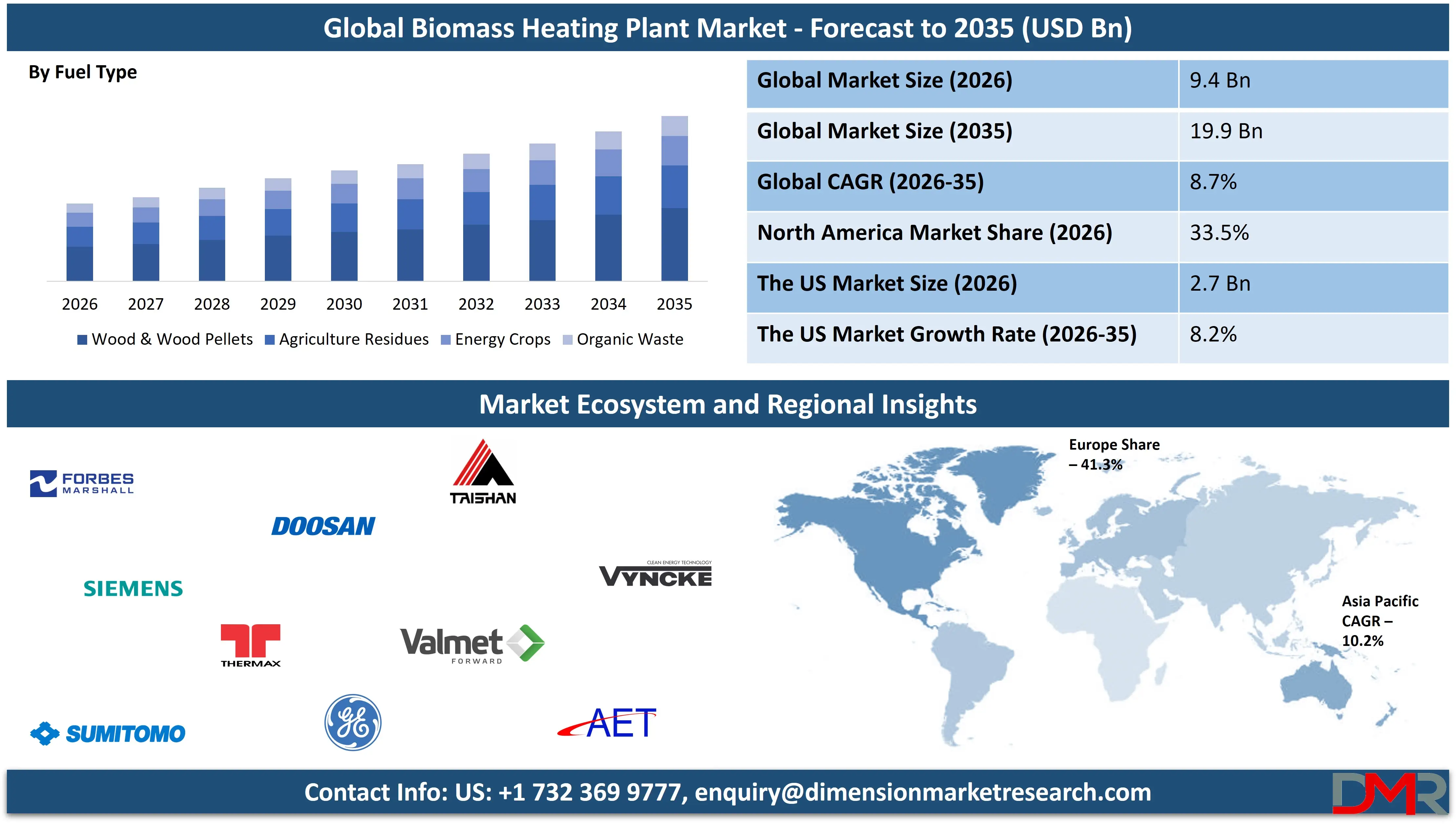
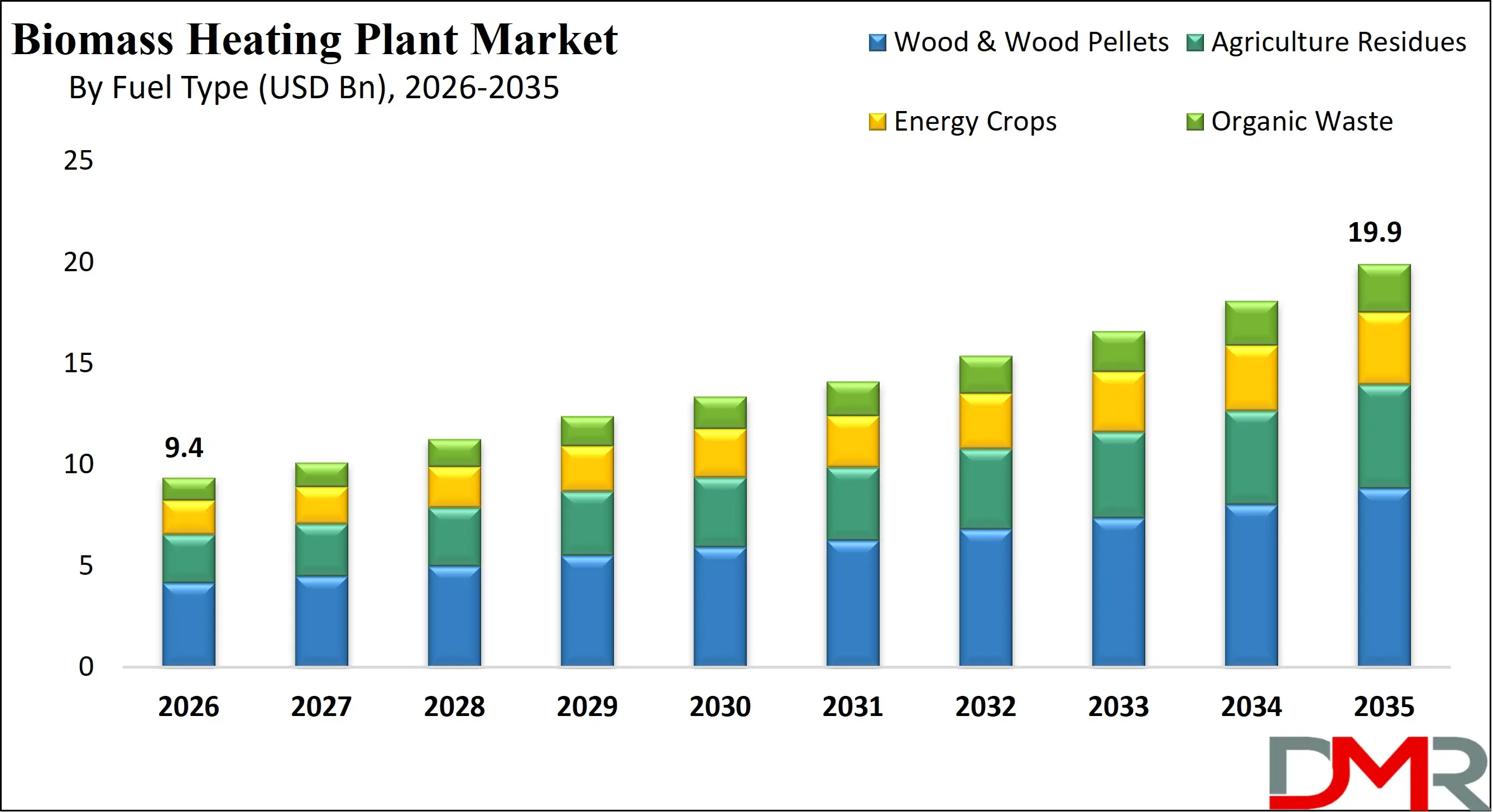
The Global Biomass Heating Plant Market size is projected to reach USD 9.4 billion in 2026 and grow at a compound annual growth rate of 8.7% to reach a value of USD 19.9 billion in 2035.
ℹ
To learn more about this report –
Download Your Free Sample Report Here
A Biomass Heating Plant is a facility that produces heat by burning or converting organic materials such as wood pellets, agricultural waste, energy crops, and food or organic waste. It uses technologies like direct combustion, gasification, anaerobic digestion, pyrolysis, and combined heat and power (CHP) systems. The heat generated is supplied to industries, district heating networks, commercial buildings, and homes. Biomass heating is considered a renewable alternative to fossil-fuel boilers because it can reduce greenhouse gas emissions when the fuel is sourced sustainably.
Concerned climate goals and the shift toward renewable energy are increasing the adoption of biomass heating plants worldwide. Improvements in high-efficiency boilers, automated fuel handling, emission control systems, and digital monitoring are making these plants more reliable and cost-effective. Government policies supporting carbon reduction, renewable heat incentives, and waste-to-energy programs are further driving demand. The sector is gradually moving from small rural systems to larger, grid-connected district heating and CHP installations.
ℹ
To learn more about this report –
Download Your Free Sample Report Here
Recent developments include replacing old coal-based district heating systems with biomass alternatives and forming partnerships to secure stable fuel supply chains. Integration with waste management systems is also expanding, allowing organic waste to be converted into useful heat. Investments in advanced gasification and pyrolysis technologies are broadening application areas, while stricter emission regulations are encouraging cleaner and more efficient combustion solutions.
The US Biomass Heating Plant Market
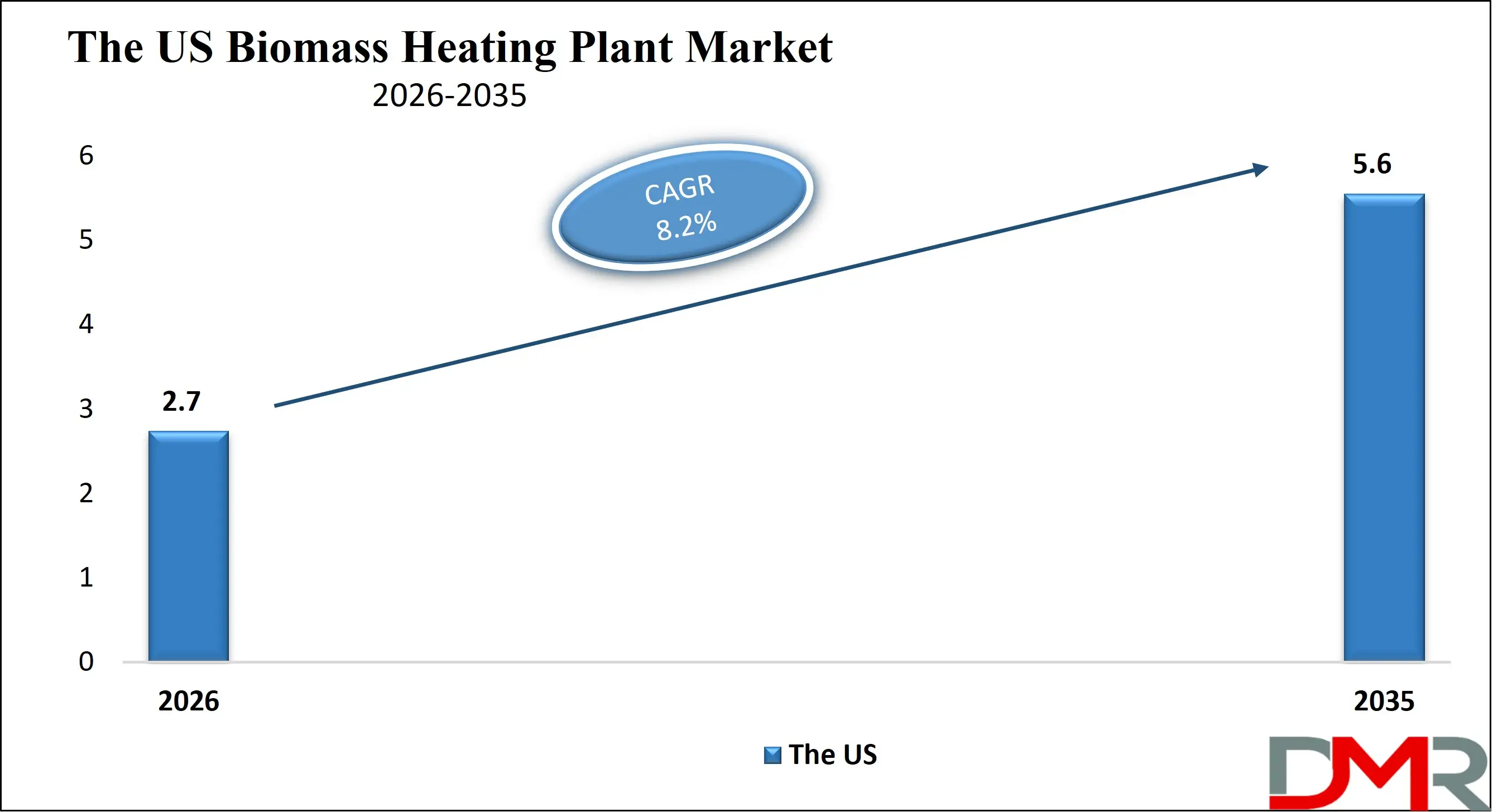
The US Biomass Heating Plant Market size is projected to reach USD 2.7 billion in 2026 at a compound annual growth rate of 8.2% over its forecast period.
ℹ
To learn more about this report –
Download Your Free Sample Report Here
The US biomass heating plant landscape is shaped by federal renewable energy programs, state-level Renewable Portfolio Standards (RPS), and incentives supporting bioenergy and waste-to-energy initiatives. Abundant forestry residues in states such as Maine, Oregon, and Washington support industrial and district-scale biomass heating systems. The Inflation Reduction Act and tax credits for renewable energy projects improve capital feasibility. Industrial manufacturing and university campuses are prominent adopters of combined heat and power systems to reduce operational emissions. However, regional variation in feedstock logistics and air quality regulations influences deployment rates. Strong private-sector investment in waste-to-energy and municipal heating upgrades supports steady expansion across select states.
Europe Biomass Heating Plant Market
Europe Biomass Heating Plant Market size is projected to reach USD 3.9 billion in 2026 at a compound annual growth rate of 8.0% over its forecast period.
Europe demonstrates mature adoption supported by climate-neutrality commitments and the European Green Deal. Countries such as Germany, Sweden, Finland, and Austria lead in district heating networks powered by biomass and CHP systems. Strict carbon pricing under the EU Emissions Trading System enhances competitiveness against fossil fuels. Subsidies, feed-in tariffs for renewable heat, and rural development programs strengthen agricultural residue utilization. Eastern European nations are modernizing coal-dependent heating infrastructure with biomass alternatives. High sustainability standards for forest management and lifecycle emission accounting shape project approvals. Technological innovation in automated pellet systems and hybrid renewable heating solutions accelerates regional market penetration.
Japan Biomass Heating Plant Market
Japan Biomass Heating Plant Market size is projected to reach USD 470 million in 2026 at a compound annual growth rate of 8.3% over its forecast period.
Japan’s biomass heating plant sector is expanding under national decarbonization policies and feed-in tariff mechanisms for renewable energy. Limited domestic fossil resources and strong waste management infrastructure support biomass utilization, particularly in municipal and industrial applications. Urban district heating projects in Hokkaido and regional agricultural hubs encourage adoption of wood pellet and agricultural residue-based systems. Government-backed incentives for carbon reduction and circular economy initiatives promote waste-to-energy facilities. However, feedstock import dependence and high logistics costs present structural challenges. Technological sophistication and efficient small-scale systems tailored for dense urban environments provide competitive opportunities for local manufacturers and utilities.
Biomass Heating Plant Market: Key Takeaways
- Market Growth: The Biomass Heating Plant Market size is expected to grow by USD 9.8 billion, at a CAGR of 8.7%, during the forecasted period of 2027 to 2035.
- By Fuel Type: The wood & wood pellets segment is anticipated to get the majority share of the Biomass Heating Plant Market in 2026.
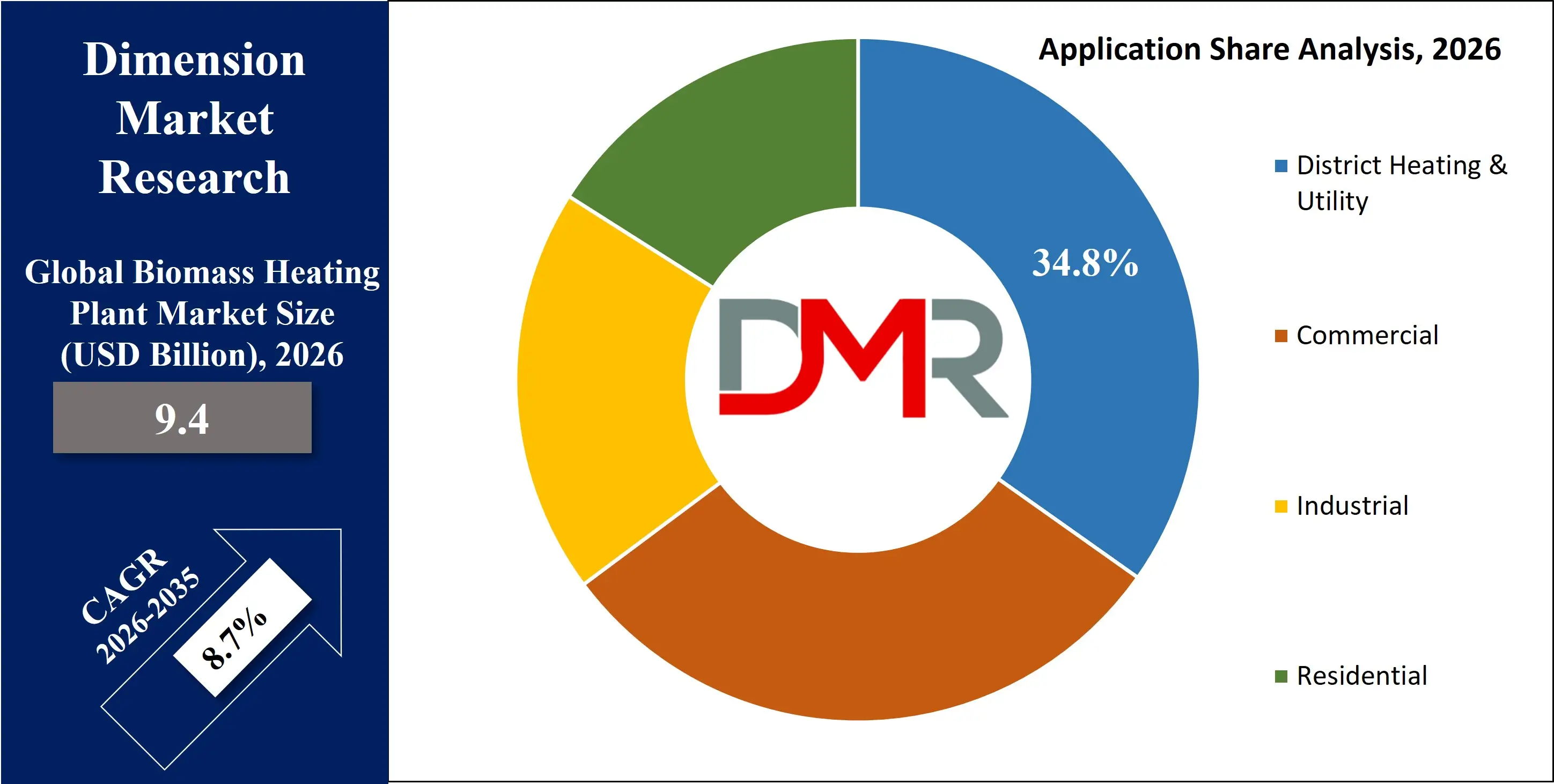
- By Application: The district heating & utility segment is expected to get the largest revenue share in 2026 in the Biomass Heating Plant Market.
- Regional Insight: Europe is expected to hold a 41.3% share of revenue in the Global Biomass Heating Plant Market in 2026.
- Use Cases: Some of the use cases of Biomass Heating Plant include agricultural facilities, commercial buildings, and more.
Biomass Heating Plant Market: Use Cases
- Industrial Manufacturing Heating: Provides process heat for cement, pulp & paper, food processing, and chemical industries, reducing reliance on coal and natural gas.
- District Heating Networks: Supplies centralized heat to residential and commercial buildings through insulated pipelines, enhancing energy efficiency at community scale.
- Agricultural Facilities: Supports greenhouse heating, crop drying, and livestock operations using locally sourced residues, lowering operational costs.
- Commercial Buildings: Delivers sustainable heating solutions for hotels, hospitals, and educational institutions seeking carbon footprint reduction.
- Residential Complexes: Enables multi-family housing projects to adopt renewable heating through pellet-based boiler systems.
- Waste-to-Energy Plants: Converts organic municipal waste into thermal energy, supporting landfill diversion strategies.
- Combined Heat and Power Applications: Simultaneously generates electricity and thermal energy, maximizing fuel efficiency and improving plant economics.
Stats & Facts
- U.S. Energy Information Administration reported in 2024 that biomass accounted for approximately 5% of total primary energy consumption in the United States.
- International Energy Agency stated in 2024 that modern bioenergy represents nearly 55% of global renewable energy consumption.
- European Commission confirmed in 2024 that renewable energy reached about 24% of the EU’s gross final energy consumption.
- Eurostat reported in 2024 that bioenergy contributed over 60% of renewable heat production in the EU.
- U.S. Department of Energy noted in 2025 that over 230 biomass power and CHP plants are operational across the country.
- Ministry of Economy, Trade and Industry Japan indicated in 2024 that biomass power capacity exceeded 6 GW installed nationwide.
- Food and Agriculture Organization stated in 2024 that global wood pellet production surpassed 45 million metric tons annually.
- International Renewable Energy Agency reported in 2024 that global bioenergy power capacity exceeded 150 GW.
- European Environment Agency confirmed in 2024 that district heating supplies around 12% of Europe’s total heat demand.
- U.S. Environmental Protection Agency documented in 2025 that landfill gas-to-energy projects number more than 500 nationwide.
- OECD reported in 2024 that renewable heat demand in member countries grew by over 3% year-on-year.
- Government of Canada Natural Resources Canada indicated in 2024 that bioenergy accounts for nearly 6% of Canada’s total energy supply.
Market Dynamic
Driving Factors in the Biomass Heating Plant Market
Decarbonization Policies and Renewable Energy Targets
National commitments to carbon neutrality and emission reduction are central growth drivers. Governments across North America, Europe, and Asia are introducing carbon pricing mechanisms, renewable heat mandates, and financial incentives supporting bioenergy infrastructure. Biomass heating plants provide a dispatchable and scalable renewable alternative to fossil-fuel boilers, aligning with climate action plans. The push to phase out coal-based district heating systems particularly strengthens demand in Europe and parts of Asia. As industries face stricter emission compliance requirements, biomass-based CHP systems offer a practical pathway to reduce Scope 1 emissions while maintaining operational continuity.
Advancements in High-Efficiency Conversion Technologies
Technological improvements in combustion efficiency, automated feedstock handling, and emission control systems significantly enhance operational reliability. Modern gasification and pyrolysis systems increase energy output while reducing particulate emissions. Integration with digital monitoring platforms enables predictive maintenance and optimized fuel usage. Enhanced efficiency lowers lifecycle operational costs, making biomass heating economically competitive with natural gas in certain regions. Additionally, modular plant designs facilitate scalable deployment in rural and industrial clusters, accelerating project implementation timelines and improving return on investment.
Restraints in the Biomass Heating Plant Market
High Capital Investment and Infrastructure Costs
Initial installation costs for biomass heating plants, including boilers, feedstock storage, emission control units, and district heating pipelines, can be substantial. Financing barriers particularly affect small municipalities and rural communities. Infrastructure requirements for consistent feedstock supply chains further increase logistical expenses. Without stable long-term policy incentives, investors may perceive risks associated with fluctuating biomass prices and regulatory shifts. These capital-intensive characteristics slow adoption, especially in developing regions with limited public funding or private financing mechanisms.
Feedstock Supply and Sustainability Concerns
Reliable sourcing of sustainable biomass remains a challenge. Seasonal variability, competition with other industries (such as pulp and paper), and transportation costs influence operational feasibility. Unsustainable harvesting practices can raise environmental concerns, potentially triggering stricter regulations. Lifecycle emission accounting and land-use considerations require compliance monitoring, adding administrative complexity. In import-dependent countries, global supply chain disruptions may affect price stability and long-term planning, constraining rapid expansion.
Opportunities in the Biomass Heating Plant Market
Expansion of District Heating Modernization Projects
Aging coal-fired district heating systems in Eastern Europe and parts of Asia present significant retrofit opportunities. Converting these systems to biomass reduces emissions while utilizing existing pipeline infrastructure. Urbanization trends and smart city initiatives encourage centralized renewable heating networks. International climate financing and green bonds further support large-scale district biomass projects, offering stable revenue through long-term heat supply contracts.
Integration with Circular Economy and Waste Management Systems
The rising emphasis on waste valorization creates strong growth prospects. Organic municipal waste, agricultural residues, and food waste can be converted into thermal energy, reducing landfill dependency. Public-private partnerships linking municipalities with energy providers strengthen feedstock security. This integration enhances environmental performance while generating economic value from waste streams, positioning biomass heating plants as a core component of circular economy frameworks.
Trends in the Biomass Heating Plant Market
Hybrid Renewable Heating Systems
Integration of biomass heating with solar thermal, heat pumps, and thermal storage systems is becoming prevalent. Hybrid models enhance flexibility and reduce seasonal supply fluctuations. This approach optimizes fuel consumption and increases overall system efficiency. Such systems are particularly attractive in regions with variable biomass availability or stringent emission norms.
Digitalization and Smart Plant Monitoring
Adoption of IoT-based sensors, AI-driven analytics, and remote monitoring platforms is transforming plant operations. Digitalization enables predictive maintenance, emission tracking, and real-time performance optimization. Improved transparency and automation reduce downtime and enhance regulatory compliance. These technological enhancements strengthen investor confidence and operational scalability across both small-scale and large-scale installations.
Impact of Artificial Intelligence in Biomass Heating Plant Market
- Predictive Maintenance: AI analyzes sensor data to forecast equipment failures, reducing downtime and maintenance costs.
- Feedstock Optimization: Machine learning models optimize fuel mix ratios for improved combustion efficiency.
- Emission Monitoring: AI-driven systems track emission levels in real time to ensure regulatory compliance.
- Demand Forecasting: Algorithms predict heat demand patterns for efficient production planning.
- Energy Efficiency Enhancement: AI identifies performance bottlenecks and suggests operational improvements.
- Supply Chain Analytics: Intelligent systems streamline biomass sourcing and logistics management.
- Automation of Plant Operations: AI-powered control systems enable autonomous adjustments in combustion processes.
- Cost Management: Advanced analytics optimize fuel procurement and operational budgeting decisions.
Research Scope and Analysis
By Technology Analysis
Direct combustion remains the dominant technology in the biomass heating plant market and is projected to account for 38.6% of the market share in 2026. Its leadership stems from technological maturity, cost-effectiveness, and compatibility with diverse feedstocks such as wood pellets, chips, and agricultural residues. Industrial facilities and district heating operators favor this method for its operational reliability and simpler maintenance compared to advanced systems. Continuous innovation in high-efficiency boilers, emission control equipment, and automated fuel feeding systems has enhanced environmental performance. Scalability across residential, commercial, and utility applications further strengthens its widespread global adoption.
Gasification is the fastest-growing technology segment, driven by its higher thermal efficiency and cleaner energy output compared to traditional combustion. The process converts biomass into syngas, which can be utilized for heating or combined heat and power generation. Industrial users increasingly adopt gasification for fuel flexibility and lower emission profiles. Advances such as fluidized bed reactors and modular gasifiers are reducing operational costs and improving system scalability. As emission regulations tighten worldwide, gasification is gaining strong traction in industrial zones and urban clusters seeking cleaner and more efficient renewable heating solutions.
By Fuel Type Analysis
Wood and wood pellets are projected to hold 44.2% of the biomass heating plant market share in 2026, maintaining their leadership due to established forestry supply chains and consistent fuel properties. Wood pellets offer high calorific value, uniform size, and automated handling compatibility, making them suitable for district and industrial heating systems. Forest-rich regions in North America and Europe support steady production and export. Sustainability certifications and improved pelletization technologies enhance environmental credibility. Government recognition of sustainably sourced biomass as renewable energy further reinforces demand across residential, commercial, and utility-scale heating projects.
Organic waste is the fastest-growing fuel segment, supported by rising circular economy initiatives and waste-to-energy integration. Biogas and biomethane derived from food and agricultural waste provide stable thermal output through anaerobic digestion systems. Municipalities increasingly combine waste management with renewable heating infrastructure to reduce landfill dependency. Urbanization and stricter disposal regulations accelerate adoption, especially in Europe and Japan. Technological advancements in digestion efficiency and gas purification further enhance reliability and commercial viability.
By Capacity Analysis
Plants with 5–10 MW capacity are expected to capture 29.4% of the market share in 2026, as they effectively balance efficiency, cost, and output. This capacity range is well-suited for district heating networks, universities, hospitals, and mid-sized industrial clusters. It provides sufficient thermal supply without the high infrastructure complexity of large utility-scale plants. Municipal decarbonization strategies and smart city initiatives increasingly favor mid-scale installations. Compatibility with combined heat and power systems enhances fuel utilization rates and economic returns, supporting this segment’s leadership across developed and developing markets.
Plants above 10 MW represent the fastest-growing capacity segment, largely driven by large-scale district heating modernization and coal-to-biomass conversion projects. These facilities supply heat to extensive urban networks and industrial corridors. International climate financing, green bonds, and infrastructure upgrades accelerate investment in this segment. High output efficiency and integration with CHP systems make them suitable for metropolitan regions pursuing aggressive decarbonization goals.
By Application Analysis
District heating and utility applications are projected to account for 34.8% of the market in 2026, supported by centralized renewable heat distribution systems. Biomass plants supplying grid-connected heating networks deliver improved energy efficiency and lower emissions per household. Europe leads adoption due to established pipeline infrastructure, while North America and Asia are expanding installations. Integration with CHP systems maximizes energy recovery and enhances economic feasibility. Strong policy backing, infrastructure funding, and carbon reduction commitments sustain this segment’s dominant market position.
ℹ
To learn more about this report –
Download Your Free Sample Report Here
Industrial applications are the fastest-growing segment as manufacturers pursue decarbonization of process heat. Industries such as cement, pulp and paper, chemicals, and food processing are investing in on-site biomass heating systems to reduce fossil fuel dependence. Rising carbon pricing and energy security concerns encourage industrial adoption. Operational cost stabilization and improved sustainability reporting further drive expansion.
By End User Industry Analysis
The energy and utilities sector is anticipated to hold 31.7% market share in 2026, primarily driven by district heating operators and independent power producers. Utilities are converting coal-fired heating plants to biomass to comply with emission regulations and renewable mandates. Long-term heat supply agreements provide stable revenue streams, encouraging continued investment. Integration with existing grid infrastructure strengthens operational efficiency. Government incentives and carbon pricing mechanisms further support the sector’s leading position in large-scale biomass heating deployment.
Manufacturing is the fastest-growing end-user segment due to increasing emphasis on emission reduction and energy diversification. Industrial clusters are adopting biomass heating plants to address Scope 1 emissions and reduce exposure to fossil fuel price volatility. Supportive sustainability targets, corporate ESG commitments, and government-backed decarbonization programs are accelerating installations. Technological improvements in combustion and gasification systems enhance industrial feasibility.
The Biomass Heating Plant Market Report is segmented on the basis of the following
By Technology
- Direct Combustion
- Gasification
- Anaerobic Digestion
- Pyrolysis
- Combined Heat and Power (CHP)
By Fuel Type
- Wood & Wood Pellets
- Wood Chips
- Wood Pellets
- Wood Logs
- Agricultural Residues
- Energy Crops
- Organic Waste
- Biogas / Biomethane
- Food & Organic Waste
By Capacity
- Less than 1 MW
- 1–5 MW
- 5–10 MW
- More than 10 MW
By Application
- Industrial
- Manufacturing
- Processing Plants
- Commercial
- Hotels & Resorts
- Hospitals
- Educational Institutions
- Residential
- Single-Family
- Multi-Family
- District Heating / Utility
- Grid-Connected Heat
- Community Heating Networks
By End-User Industry
- Energy & Utilities
- Manufacturing
- Agriculture
- Commercial Buildings
- Residential Sector
Regional Analysis
Leading Region in the Biomass Heating Plant Market
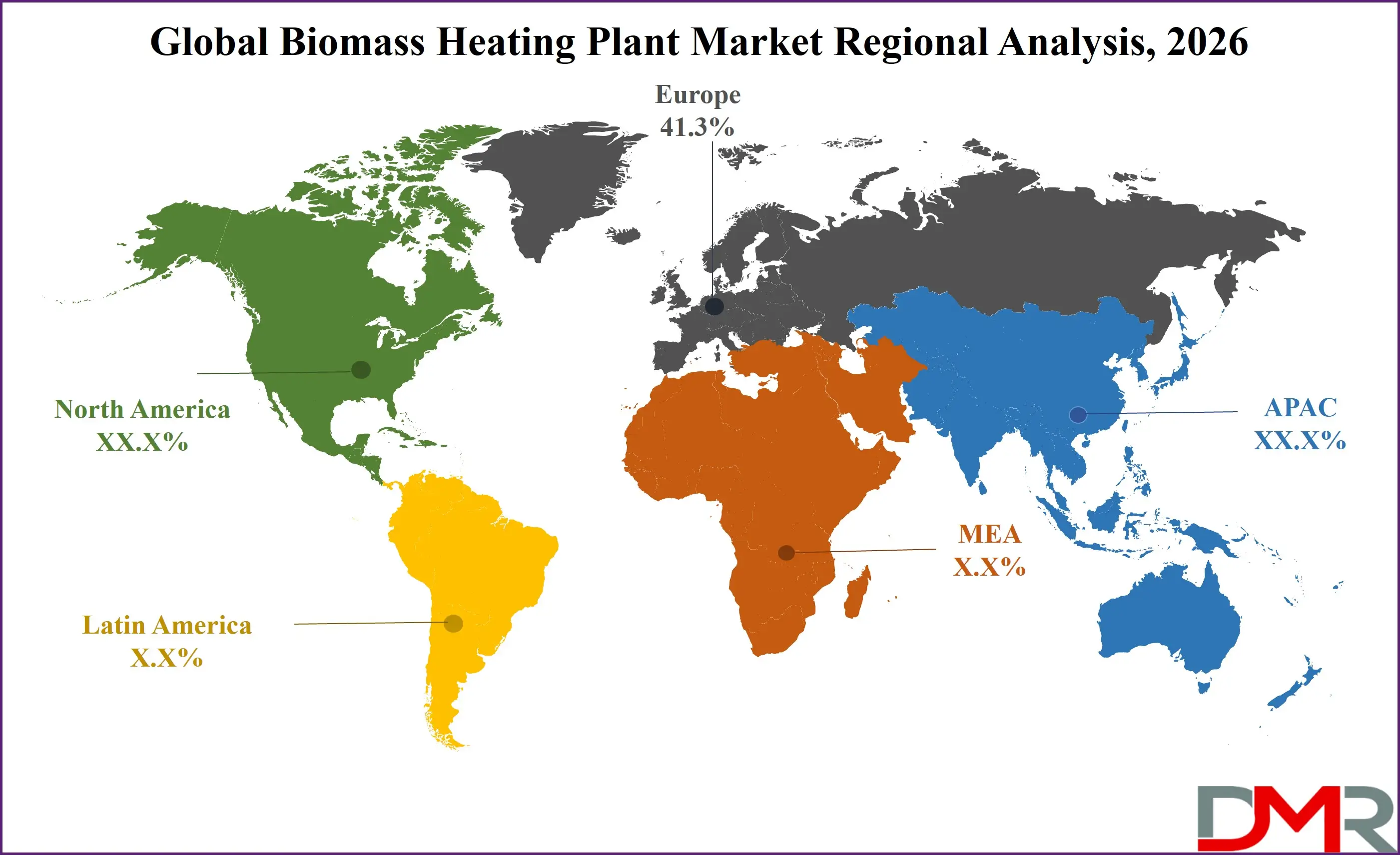
Europe is projected to lead the global biomass heating plant market with 41.3% share in 2026, supported by ambitious decarbonization policies and mature district heating infrastructure. The European Green Deal and EU Emissions Trading System enhance competitiveness of biomass over fossil fuels. Countries such as Germany, Sweden, and Finland demonstrate advanced adoption across residential, industrial, and utility sectors. High fossil fuel import dependency has accelerated renewable heat investments. Well-established pellet trade networks, strict sustainability certifications, and strong government incentives ensure supply stability and continued regional leadership.
ℹ
To learn more about this report –
Download Your Free Sample Report Here
Fastest Growing Region in the Biomass Heating Plant Market
Asia-Pacific is the fastest-growing region due to expanding industrialization, rapid urbanization, and supportive renewable energy policies. Japan and South Korea promote biomass through feed-in tariffs and carbon neutrality commitments, while Southeast Asian countries utilize agricultural residues for energy generation. Rising energy demand and modernization of heating infrastructure stimulate installations. Government incentives, foreign investment, and infrastructure upgrades accelerate project development. Growing awareness of sustainable waste management and circular economy principles further strengthens regional growth prospects.
By Region
North America
Europe
- Germany
- The U.K.
- France
- Italy
- Russia
- Spain
- Benelux
- Nordic
- Rest of Europe
Asia-Pacific
- China
- Japan
- South Korea
- India
- ANZ
- ASEAN
- Rest of Asia-Pacific
Latin America
- Brazil
- Mexico
- Argentina
- Colombia
- Rest of Latin America
Middle East & Africa
- Saudi Arabia
- UAE
- South Africa
- Israel
- Egypt
- Rest of MEA
Competitive Landscape
The biomass heating plant market is characterized by moderate fragmentation with competition centered on technological efficiency, feedstock integration capabilities, and long-term service agreements. Companies focus on expanding engineering, procurement, and construction (EPC) capabilities to offer turnkey district heating and industrial solutions. Strategic partnerships with agricultural suppliers and municipal authorities strengthen feedstock security. Continuous R&D investment enhances combustion efficiency and emission reduction technologies, creating competitive differentiation. Entry barriers remain moderately high due to capital intensity and regulatory compliance requirements. Market participants increasingly pursue geographic expansion, hybrid renewable integration, and digital monitoring capabilities to secure sustained market share growth.
Some of the prominent players in the global Biomass Heating Plant are
- Siemens AG
- Valmet Corporation
- ANDRITZ AG
- Babcock & Wilcox Enterprises
- Thermax Limited
- Mitsubishi Heavy Industries
- Sumitomo SHI FW
- Doosan Enerbility
- Wärtsilä Corporation
- General Electric Company
- Vyncke
- Aalborg Energie Technik (AET)
- HoSt Energy Systems
- DP CleanTech
- Dongfang Electric Corporation
- Taishan Group
- Kohlbach Group
- Binder Energietechnik
- Hurst Boiler & Welding Co.
- Forbes Marshall
- Other Key Players
Recent Developments
- In February 2026, Northern Ireland-based manufacturer O&S Doors has announced a £9 million (USD 12.3 million) investment to install a biomass-fuelled combined heat and power (CHP) system at its Dungannon facility to enhance energy efficiency and lower carbon emissions. The project has secured £2.4 million (USD 3.3 million) in funding from the Shared Island Sustainability Capital Grant Scheme. The system will convert over 10,000 tonnes of MDF dust annually into energy for heating and production, generating 6.3 million energy units and 1 MW of electricity, cutting emissions by 1,500 tonnes per year.
- In January 2026, NewYork GreenCloud acquired the Buena Vista Biomass Power facility in Ione, California, as part of plans to develop its first large-scale carbon-negative AI factory. The project will integrate biomass-to-pyrolysis energy systems with behind-the-meter, liquid-cooled AI computing infrastructure to power high-performance workloads using renewable baseload energy. The existing 18 MW plant will be expanded to 41 MW to support advanced GPU clusters. The redevelopment is being carried out with its engineering partner, with advisory support provided on capital strategy and financing.
Report Details
| Report Characteristics |
| Market Size (2026) |
USD 9.4 Bn |
| Forecast Value (2035) |
USD 19.9 Bn |
| CAGR (2026–2035) |
8.7% |
| The US Market Size (2026) |
USD 2.7 Bn |
| Historical Data |
2021 – 2025 |
| Forecast Data |
2027 – 2035 |
| Base Year |
2025 |
| Estimate Year |
2026 |
| Report Coverage |
Market Revenue Estimation, Market Dynamics, Competitive Landscape, Growth Factors, etc. |
| Segments Covered |
By Technology (Direct Combustion, Gasification, Anaerobic Digestion, Pyrolysis, Combined Heat and Power (CHP)), By Fuel Type (Wood & Wood Pellets, Agricultural Residues, Energy Crops, Organic Waste), By Capacity (Less than 1 MW, 1–5 MW, 5–10 MW, More than 10 MW), By Application (Industrial, Commercial, Residential, District Heating / Utility), By End-User Industry (Energy & Utilities, Manufacturing, Agriculture, Commercial Buildings, Residential Sector) |
| Regional Coverage |
North America – US, Canada; Europe – Germany, UK, France, Russia, Spain, Italy, Benelux, Nordic, Rest of Europe; Asia-Pacific – China, Japan, South Korea, India, ANZ, ASEAN, Rest of APAC; Latin America – Brazil, Mexico, Argentina, Colombia, Rest of Latin America; Middle East & Africa – Saudi Arabia, UAE, South Africa, Turkey, Egypt, Israel, Rest of MEA |
| Prominent Players |
Prominent Players Siemens AG, Valmet Corporation, ANDRITZ AG, Babcock & Wilcox Enterprises, Thermax Limited, Mitsubishi Heavy Industries, Sumitomo SHI FW, Doosan Enerbility, Wärtsilä Corporation, General Electric Company, Vyncke, Aalborg Energie Technik (AET), HoSt Energy Systems, DP CleanTech, Dongfang Electric Corporation, Taishan Group, Kohlbach Group, Binder Energietechnik, Hurst Boiler & Welding Co., Forbes Marshall, and Other Key Players |
| Purchase Options |
We have three licenses to opt for: Single User License (Limited to 1 user), Multi-User License (Up to 5 Users), and Corporate Use License (Unlimited User) along with free report customization equivalent to 0 analyst working days, 3 analysts working days, and 5 analysts working days respectively. |
Frequently Asked Questions
How big is the Global Biomass Heating Plant Market?
▾ The Global Biomass Heating Plant Market size is expected to reach USD 9.4 billion by 2026 and is projected to reach USD 19.9 billion by the end of 2035.
Which region accounted for the largest Global Biomass Heating Plant Market?
▾ Europe is expected to have the largest market share in the Global Biomass Heating Plant Market, with a share of about 41.3% in 2026.
How big is the Biomass Heating Plant Market in the US?
▾ The US Biomass Heating Plant market is expected to reach USD 2.7 billion by 2026.
Who are the key players in the Biomass Heating Plant Market?
▾ Some of the major key players in the Global Biomass Heating Plant Market include Siemens, Forbes Marshall, Thermax Ltd, and others
What is the growth rate in the Global Biomass Heating Plant Market?
▾ The market is growing at a CAGR of 8.7 percent over the forecasted period.