Market Overview
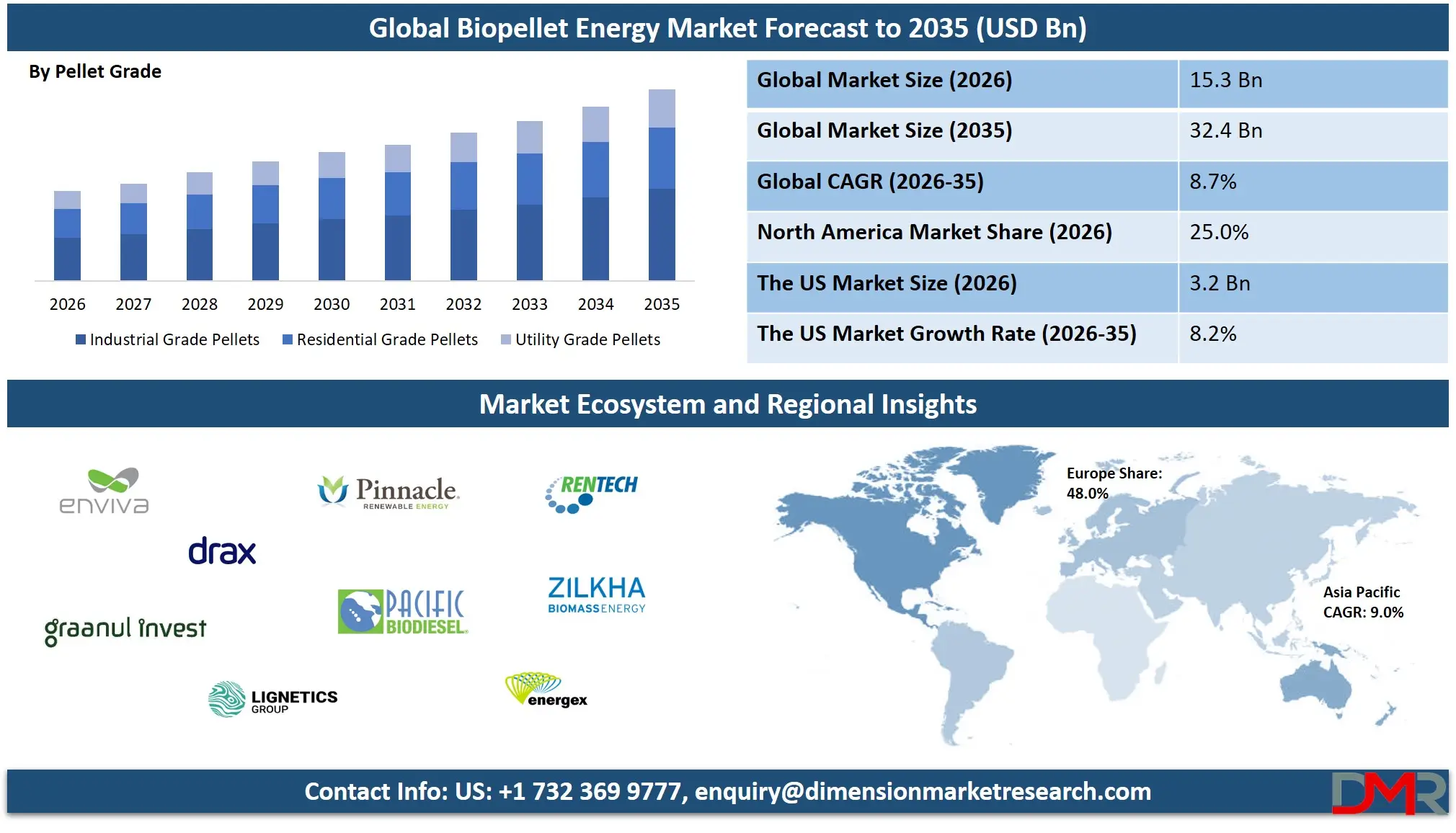
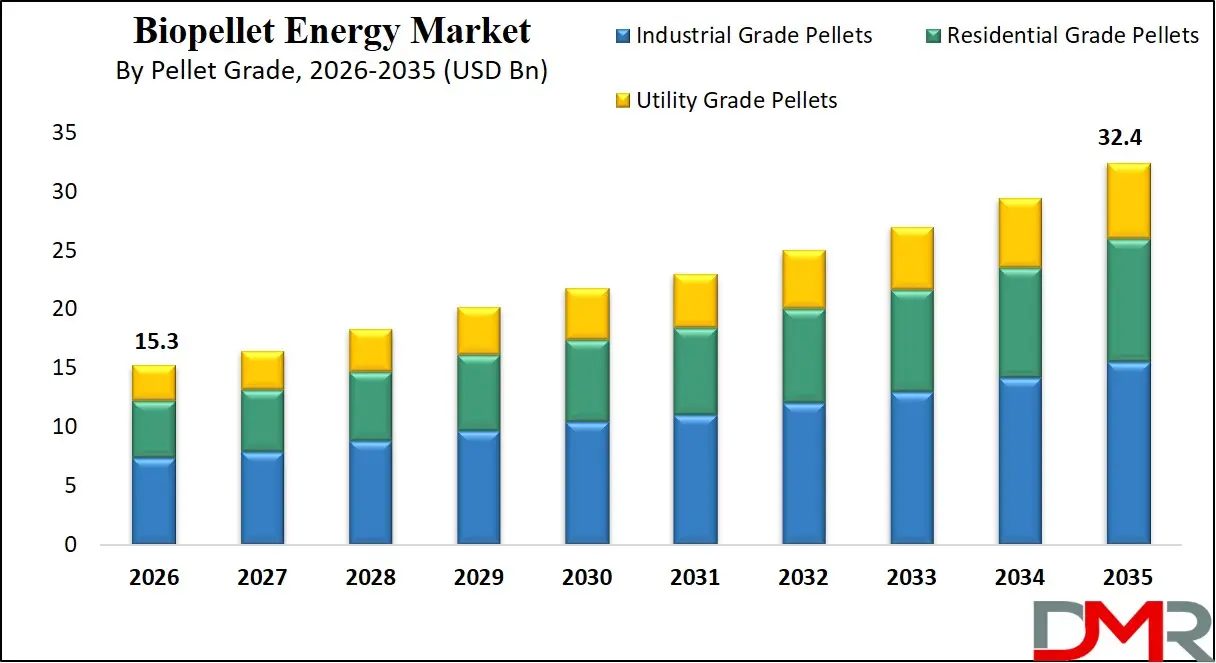
The global biopellet energy market is expected to reach USD 15.3 billion in 2026 and is projected to grow at a CAGR of 8.7% through 2035, reaching USD 32.4 billion in 2035, driven by rising demand for biomass fuel, renewable heating solutions, and sustainable power generation technologies.
ℹ
To learn more about this report –
Download Your Free Sample Report Here
Biopellet energy refers to renewable energy generated from compressed biomass pellets produced by processing organic materials such as wood residues, forestry waste, agricultural byproducts, and other biodegradable materials. These pellets are manufactured by drying, grinding, and compressing biomass into dense cylindrical forms that offer high energy efficiency and uniform combustion properties. Biopellets are widely used as a sustainable alternative to fossil fuels for heating and electricity generation because they produce lower greenhouse gas emissions and support carbon neutral energy cycles. The compact structure of pellets improves storage, transportation, and combustion efficiency, making them suitable for residential heating systems, industrial boilers, and utility scale biomass power plants. Their use supports waste utilization, promotes circular bioeconomy practices, and contributes to global efforts toward cleaner energy transition and reduced environmental impact.
The global biopellet energy market represents the commercial ecosystem that includes the production, processing, distribution, and utilization of biomass pellets for energy generation across residential, industrial, and utility sectors. The market is expanding as governments and energy providers increasingly adopt biomass based fuels to replace coal and other carbon intensive energy sources. Growing investments in renewable power infrastructure, supportive environmental regulations, and rising demand for sustainable heating fuels are encouraging the adoption of pellet based bioenergy systems. In many regions, biomass pellet fuel is integrated into district heating networks and combined heat and power facilities, improving energy efficiency while reducing dependence on conventional fossil fuels.
ℹ
To learn more about this report –
Download Your Free Sample Report Here
In addition, the global biopellet energy market is influenced by the availability of feedstock resources, advancements in pellet manufacturing technologies, and increasing cross border trade of biomass fuel. Countries with large forest resources and agricultural residues have become major pellet exporters supplying energy demanding regions with limited biomass supply. The growing emphasis on decarbonization, climate change mitigation, and renewable energy diversification continues to drive market expansion. As industries and power utilities seek cleaner fuel alternatives, biopellets are gaining importance as a reliable solid biofuel solution that supports sustainable energy production and long term energy security.
The US Biopellet Energy Market
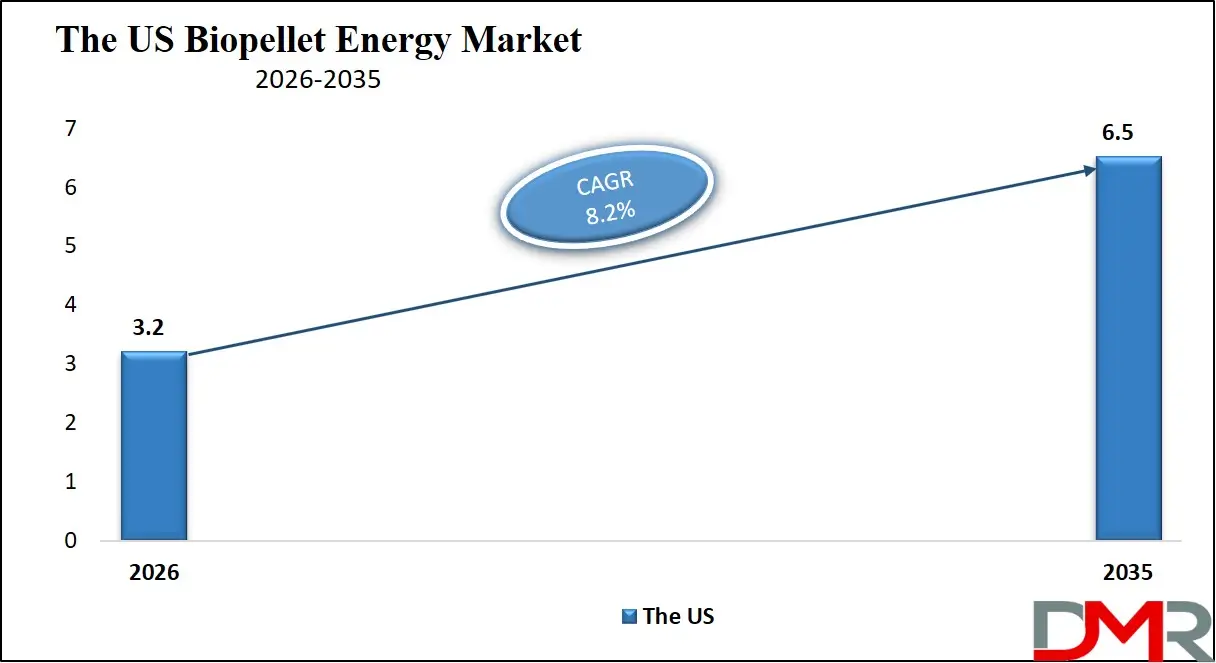
The U.S. Biopellet Energy Market size is expected to reach at USD 3.2 billion in 2026. It is further expected to witness subsequent growth in the upcoming period, holding USD 6.5 billion in 2035 at a CAGR of 8.2%.
ℹ
To learn more about this report –
Download Your Free Sample Report Here
The United States biopellet energy market has emerged as a key component of the country's renewable energy landscape, supported by abundant forest resources, advanced biomass processing infrastructure, and increasing demand for sustainable fuel alternatives. The country is one of the largest producers and exporters of wood pellets globally, supplying significant volumes to energy utilities and heating markets. Biomass pellets derived from forestry residues and wood processing waste are widely used for power generation, industrial heating, and residential pellet stoves. Growing emphasis on reducing carbon emissions and expanding bioenergy capacity continues to encourage investments in pellet manufacturing facilities.
Strong export demand from regions such as Europe and Asia has significantly strengthened the position of the United States in the global biopellet supply chain. Several biomass producers operate large scale pellet plants near forest rich areas to ensure a stable feedstock supply and efficient logistics. Domestic demand is also gradually increasing as industries adopt biomass fuel for cleaner energy generation and thermal applications. Government incentives supporting renewable energy adoption and sustainable forestry practices are further contributing to market expansion, positioning the United States as a strategic hub for global biomass pellet production and trade.
The Europe Biopellet Energy Market
The Europe biopellet energy market is projected to reach approximately USD 7.3 billion in 2026, reflecting its position as the largest regional market globally. The region's strong market presence is driven by well-established biomass production infrastructure, widespread adoption of pelletized fuel in residential heating, industrial boilers, and utility-scale power plants, and supportive regulatory frameworks promoting renewable energy. Wood pellets and agricultural biomass pellets are widely used due to their high energy density, uniform size, and low moisture content, which ensure efficient combustion and reduced emissions compared to conventional fossil fuels.
The market's robust growth, with a projected CAGR of 9.5%, is fueled by increasing investment in renewable energy infrastructure and rising demand for carbon-neutral energy solutions. Expansion of combined heat and power systems, integration of pelletized biomass in district heating networks, and technological advancements in pellet manufacturing further strengthen market growth. The emphasis on sustainability, energy efficiency, and greenhouse gas reduction encourages continuous adoption of pelletized biomass fuel across multiple applications, positioning Europe as the leading and fastest-growing market in the global biopellet energy landscape.
The Japan Biopellet Energy Market
The Japan biopellet energy market is projected to reach approximately USD 918 million in 2026, reflecting steady growth in renewable energy adoption across the country. The market is supported by the increasing use of biomass pellets for residential heating, industrial boilers, and power generation, particularly in efforts to reduce reliance on imported fossil fuels. Wood pellets and agricultural biomass pellets are commonly utilized due to their high energy efficiency, uniform size, and lower ash content, which enable cleaner and more reliable combustion in Japan's energy systems.
The market is expected to grow at a CAGR of 8.0%, driven by government initiatives promoting renewable energy, sustainable biomass utilization, and carbon emission reduction targets. Expansion of small- and medium-scale pellet-based energy systems, technological advancements in pellet production, and integration of biomass in district heating and industrial energy applications further support market development. Japan's focus on energy efficiency and sustainable fuel alternatives ensures consistent demand for biopellets, positioning the country as a key growth market in the Asia-Pacific renewable energy sector.
Global Biopellet Energy Market: Key Takeaways
- Rapid Market Expansion: Global biopellet energy market is projected at USD 15.3 Bn in 2026, growing at CAGR 8.7% to reach USD 32.4 Bn by 2035.
- Europe Leads: Europe holds 48.0% of global market share in 2026 with the highest CAGR of 9.5%, driven by biomass power and district heating adoption.
- US Market Growth: The U.S. market is expected at USD 3.2 Bn in 2026, reaching USD 6.5 Bn by 2035 at a CAGR of 8.2%, fueled by exports and industrial usage.
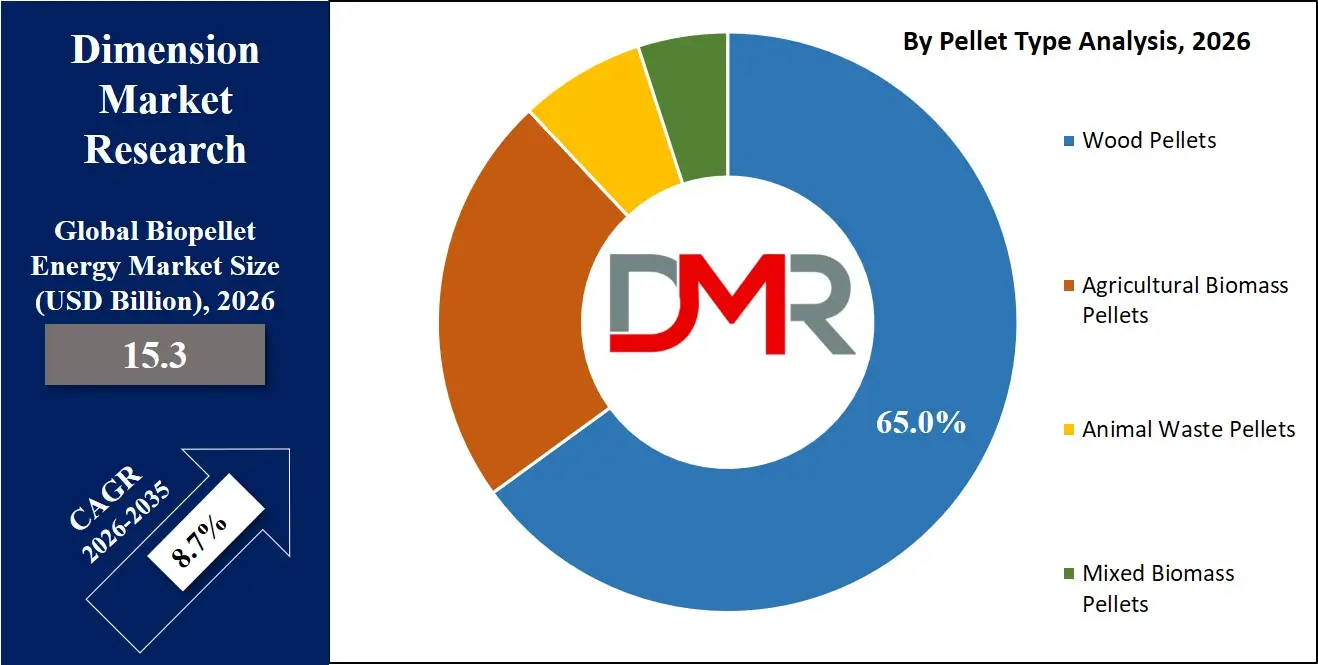
- Feedstock Dominance: Forestry residues capture 40.0% of the feedstock segment, while wood pellets dominate with 65.0% of pellet type share globally in 2026.
- Application Focus: Power generation leads with 45.0% of application share, and utilities account for 40.0% of end-use, reflecting strong industrial and residential adoption.
Global Biopellet Energy Market: Use Cases
- Residential Heating: Biopellet energy is widely used in residential pellet stoves and biomass boilers for space heating. Wood pellets and agricultural biomass pellets offer efficient combustion, lower emissions, and easier storage compared to traditional firewood or coal. Increasing demand for renewable heating solutions and carbon-neutral fuel is encouraging households to adopt pellet based heating systems.
- Power Generation: Biopellets are used in biomass power plants and coal co-firing facilities to generate renewable electricity. Their high energy density and uniform size improve combustion efficiency in large boilers. Power utilities are increasingly using pelletized biomass fuel to reduce carbon emissions and meet renewable energy targets.
- Industrial Heating: Industries such as food processing, pulp and paper, and chemicals use biopellets in industrial boilers for steam and thermal energy production. Biomass pellets provide stable calorific value and support decarbonization initiatives. This makes pellet fuel a practical substitute for coal and other fossil fuels in industrial energy systems.
- Combined Heat and Power: Combined heat and power systems use biopellets to generate electricity and useful heat simultaneously. Biomass CHP plants improve overall energy efficiency and are widely used in district heating networks and industrial facilities. This application supports sustainable energy production and better utilization of renewable biomass resources.
Global Biopellet Energy Market: Stats & Facts
- World Bioenergy Association & Global Bioenergy Statistics
- Bioenergy contributed to global power generation of 698–711 TWh in 2024.
- Bioenergy produced about 7% of global renewable electricity in 2024.
- Bioenergy heat production supplied 73% of renewable heat worldwide.
- Solid bioenergy accounted for 3.5% of total final energy consumption (TFEC) in 2023.
- Solid bioenergy supplied 8.3% of global heat consumption in 2023.
- Global biopower capacity reached approximately 150.8 GW in 2024, with an annual increase of 4.6 GW.
- REN21 Global Status Report – Bioenergy (Govt/UN supported)
- Solid bioenergy delivered 3.5% of TFEC in 2023.
- Solid bioenergy contributed 8.3% of global heat consumption in 2023.
- Over 30% of district heating worldwide utilized solid bioenergy in 2023.
- Global wood pellet production reached approximately 46.9 million tonnes in 2023.
- US Energy Information Administration (EIA)
- Biomass accounted for about 5% of total U.S. energy consumption (~4,978 TBtu) in 2023.
- Wood and wood waste contributed 39% of total U.S. biomass energy use in 2023.
- U.S. wood and densified biomass fuel exports reached 8.6 million tons in 2023.
- US EIA Densified Biomass Fuel Report (Sep 2025)
- The U.S. had approximately 74 operating densified biomass fuel manufacturing facilities in 2025.
- Total capacity of these facilities was 13.03 million tons per year.
- Production in September 2025 included 1.5 million tons of raw biomass feedstock.
- Approximately 0.88 million tons of densified biomass fuel were produced in the same period.
- USDA FAS – EU Wood Pellets Annual Reports
- EU wood pellet consumption was approximately 24.5 MMT in 2023, down 1.2% from 2022.
- EU consumed about 22.6 MMT of pellets in 2024, down 5.9% from 2023.
- EU imports of wood pellets from the U.S. were 1.9 MMT in 2024.
- EU production of wood pellets was projected at 20.5 MMT in 2025.
- EU Renewable Energy Policy – EUROSTAT / European Commission
- Renewable energy, including solid bioenergy, accounted for 26.2% of total EU energy consumption in 2023.
- Solid, liquid, and gaseous biomass together made up about 50% of all renewable energy consumption in the EU.
- Solid biomass remained the largest renewable energy source in the EU in 2023.
- Bioenergy Report by EU Directorate‑General for Energy
- Primary solid biomass supply in the EU grew from 3,336,811 TJ (2008) to 4,454,768 TJ (2021), an increase of 33.5%.
- Wood pellet and forest biomass consumption increased by over 400% from early years to 2021.
- India Ministry of Power Annual Report
- India mandated 7% biomass pellet co‑firing with coal in thermal power plants by 2025–26.
- Policies promote biomass use in electricity generation to reduce dependence on fossil fuels (2023–24 report period).
Global Biopellet Energy Market: Market Dynamic
Driving Factors in the Global Biopellet Energy Market
Rising Demand for Renewable and Low Carbon Energy Sources
Growing global focus on reducing greenhouse gas emissions is significantly driving demand for biopellet energy. Governments and energy utilities are increasingly shifting toward renewable fuels such as biomass pellets to replace coal and other carbon intensive fuels. Pelletized biomass provides a cleaner combustion profile and supports carbon neutral energy cycles. As countries expand renewable power capacity and implement climate action strategies, demand for wood pellets, agricultural biomass fuel, and sustainable solid biofuels continues to rise across power generation, residential heating, and industrial energy applications.
Expansion of Biomass Power Plants and Co Firing Technologies
The increasing installation of biomass power plants and biomass co firing systems in existing coal facilities is accelerating market growth. Energy producers are integrating pelletized biomass fuel into thermal power plants to reduce fossil fuel dependence while maintaining reliable electricity generation. Biopellets offer high energy density, consistent quality, and easier handling compared to raw biomass. Growing investments in renewable electricity infrastructure, combined heat and power facilities, and biomass based energy systems are strengthening the demand for biopellet fuel worldwide.
Restraints in the Global Biopellet Energy Market
High Production and Logistics Costs
The biopellet energy market faces challenges related to high production costs and complex supply chain logistics. Pellet manufacturing requires specialized equipment, drying processes, and feedstock preparation, which increases operational expenses. In addition, transportation and storage costs can be significant, particularly for long distance export markets. Fluctuations in raw biomass availability and rising energy costs during pellet production can also impact overall pricing, creating barriers for wider adoption compared to conventional fossil fuels.
Feedstock Availability and Sustainability Concerns
The availability of consistent biomass feedstock remains a critical challenge for the market. Dependence on forestry residues, agricultural waste, and wood processing byproducts makes pellet production sensitive to supply fluctuations. In some regions, concerns related to deforestation, land use changes, and sustainable forestry practices have also raised environmental scrutiny. Ensuring sustainable biomass sourcing and maintaining stable raw material supply chains are essential for long term growth of the biopellet energy industry.
Opportunities in the Global Biopellet Energy Market
Growing Adoption in Emerging Economies
Emerging economies are creating significant opportunities for the biopellet energy market as they seek affordable and sustainable energy alternatives. Rapid industrialization and urbanization are increasing demand for reliable power generation and heating fuels. Biomass pellets derived from agricultural residues provide an accessible renewable energy solution in regions with abundant biomass resources. Expanding biomass energy infrastructure and government programs promoting clean energy adoption are expected to create new market growth avenues in developing countries.
Technological Advancements in Pellet Manufacturing
Innovations in pellet production technology are improving efficiency, product quality, and energy output. Advanced pelletizing equipment, improved biomass drying techniques, and automated processing systems are helping manufacturers increase production capacity while reducing operational costs. Research into alternative feedstock materials such as energy crops and organic waste is also expanding the range of biomass sources available for pellet fuel production. These technological improvements are expected to strengthen the competitiveness of biopellet energy in the global renewable energy mix.
Trends in the Global Biopellet Energy Market
Increasing International Trade of Biomass Pellets
Global trade of biomass pellets is expanding as countries with abundant biomass resources export pellet fuel to regions with high energy demand. Large scale pellet production hubs are emerging in forest rich areas where feedstock supply is stable and manufacturing costs are competitive. These pellets are transported to power utilities and heating markets in regions that rely heavily on imported renewable fuels. The growth of international biomass supply chains is strengthening the global biopellet energy market.
Integration of Biopellets in District Heating Systems
District heating networks are increasingly incorporating biopellet fuel to provide sustainable heating for residential and commercial buildings. Biomass based heating systems use pelletized fuel to generate centralized thermal energy distributed through district heating infrastructure. This approach improves energy efficiency and reduces reliance on fossil fuel heating systems. Growing investment in urban heating networks and renewable heating solutions is encouraging wider adoption of biopellet energy in modern energy infrastructure.
Global Biopellet Energy Market: Research Scope and Analysis
By Feedstock Type Analysis
Forestry residues are anticipated to dominate the feedstock type segment of the global biopellet energy market, capturing around 40.0% of the total market share in 2026. This dominance is primarily driven by the large availability of biomass materials such as logging residues, wood chips, tree bark, and sawdust generated during forestry operations. These materials provide a reliable and cost effective raw material source for pellet manufacturing while supporting sustainable forest management practices. Forestry residues also offer consistent calorific value and moisture characteristics, which improve pellet quality and combustion efficiency in biomass boilers, power plants, and residential heating systems. The growing focus on utilizing forest waste for renewable energy production and reducing biomass disposal has further strengthened the adoption of forestry based pellet feedstock across global biomass energy supply chains.
Wood processing waste also plays a significant role in the feedstock type segment of the biopellet energy market. This category includes residues generated from sawmills, furniture manufacturing units, and wood processing industries such as wood shavings, planer chips, and sanding dust. These byproducts are widely used in pellet production because they require minimal additional processing and have relatively uniform particle size and moisture content. Utilizing wood processing waste for pellet fuel manufacturing supports circular bio economy practices by converting industrial byproducts into valuable renewable energy resources. As the global wood products industry continues to expand, the steady generation of processing residues is expected to support consistent feedstock supply for biomass pellet manufacturers.
By Pellet Type Analysis
Wood pellets are anticipated to dominate the pellet type segment of the global biopellet energy market, capturing around 65.0% of the total market share in 2026. This strong dominance is mainly attributed to the high energy density, low moisture content, and efficient combustion properties of wood based biomass pellets. These pellets are widely produced from sawdust, wood chips, and forestry residues generated by timber and wood processing industries. Their uniform size and stable calorific value make them highly suitable for residential pellet stoves, industrial boilers, and biomass power plants. In addition, well established supply chains and large scale pellet manufacturing facilities in regions such as Europe and North America further strengthen the global demand for wood pellets as a reliable renewable solid biofuel.
ℹ
To learn more about this report –
Download Your Free Sample Report Here
Agricultural biomass pellets represent another important segment in the biopellet energy market and are produced from agricultural residues such as rice husk, wheat straw, corn stover, bagasse, and other crop based biomass materials. These pellets are gaining increasing attention as they provide an effective method to utilize agricultural waste for renewable energy generation. Agricultural pellets offer a sustainable alternative fuel for industrial heating systems, biomass boilers, and rural energy applications, particularly in regions with abundant agricultural resources such as Asia. Growing interest in waste to energy solutions and the need to reduce open field burning of crop residues are further supporting the development of agricultural biomass pellet production.
By Pellet Grade Analysis
Industrial grade pellets are anticipated to dominate the pellet grade segment of the global biopellet energy market, capturing around 48.0% of the total market share in 2026. These pellets are primarily used in large scale biomass power plants and industrial energy facilities where significant volumes of solid biofuel are required for electricity generation and thermal energy production. Industrial pellets are typically produced from forestry residues, wood processing waste, and other biomass feedstocks, offering high energy density and consistent combustion performance. Their large scale consumption by power utilities and combined heat and power plants, particularly in regions such as Europe, continues to drive strong demand for industrial grade pellet fuel.
Residential grade pellets also represent an important segment of the biopellet energy market and are mainly used in household heating systems such as pellet stoves and small biomass boilers. These pellets are manufactured with stricter quality standards, including lower ash content, reduced moisture levels, and uniform pellet size to ensure efficient and cleaner combustion in residential appliances. Demand for residential grade pellets is growing as households increasingly adopt renewable heating solutions to reduce reliance on conventional fuels such as heating oil and coal. Rising interest in sustainable home heating and energy efficiency, particularly in regions such as North America, is supporting the steady growth of this segment.
By Pellet Size Analysis
8 mm pellets are anticipated to dominate the pellet size segment of the biopellet energy market, capturing around 40.0% of the total share in 2026. These pellets are preferred due to their optimal balance of energy density and combustion efficiency, allowing stable and uniform burning in industrial boilers, pellet stoves, and biomass power systems. The consistent shape and durability of 8 mm pellets ensure efficient fuel feeding and reduced ash production. Their mechanical strength and reliable performance make them the most widely adopted pellet size across both residential and large-scale energy applications.
6 mm pellets represent another important segment, often used in smaller heating systems and domestic pellet stoves. Their smaller diameter provides faster ignition and more controlled combustion, ensuring precise heat output in compact biomass boilers. The ease of handling, storage, and feeding in residential appliances enhances their usability. These characteristics make 6 mm pellets a practical choice for household heating, smaller commercial boilers, and applications where uniform and efficient burning is required on a smaller scale.
By Distribution Channel Analysis
Direct supply contracts are anticipated to dominate the distribution channel segment of the biopellet energy market, capturing around 55.0% of the total market share in 2026. These contracts involve long-term agreements between pellet manufacturers and large consumers such as power plants, industrial facilities, and utility companies. Direct supply ensures a stable and consistent supply of high-quality pelletized biomass fuel, reduces dependency on intermediaries, and allows buyers to negotiate pricing and delivery schedules according to their operational needs. This method also supports better inventory management, reliable logistics, and efficient fuel handling, making it the preferred distribution channel for large-scale energy consumers.
Energy traders and bulk fuel suppliers represent another significant segment in the biopellet energy market. These intermediaries purchase biomass pellets in large quantities from manufacturers and redistribute them to smaller industrial clients, commercial establishments, and regional distributors. Their role is crucial in markets where direct contracts are not feasible or where customers require flexible supply options. Energy traders and bulk suppliers help maintain market liquidity, manage storage and transport logistics, and provide access to pelletized biomass for a broader range of end users, supporting the overall growth of the distribution network in the biopellet energy sector.
By Application Analysis
Power generation is anticipated to dominate the application segment of the biopellet energy market, capturing around 45.0% of the total market share in 2026. Biopellets are extensively used in biomass power plants and coal co-firing systems to produce renewable electricity while reducing dependence on fossil fuels. Their high energy density, consistent size, and stable combustion characteristics make them suitable for large-scale boilers and turbine systems. The use of pelletized biomass in electricity generation helps utilities achieve renewable energy targets, reduce greenhouse gas emissions, and maintain reliable baseload power supply.
Heat generation represents another important application segment in the biopellet energy market. Industrial and commercial facilities, as well as residential buildings, use biopellets in biomass boilers and pellet stoves to produce thermal energy for space heating, water heating, and process heating. The uniform quality and energy content of pellets ensure efficient heat production and controlled combustion. As demand for sustainable and low-carbon heating solutions grows, biopellets are increasingly adopted as an alternative to conventional fuels such as coal, oil, and natural gas, supporting energy efficiency and carbon reduction goals.
By End Use Analysis
Utilities such as power plants are anticipated to dominate the end-use segment of the biopellet energy market, capturing around 40.0% of the total market share in 2026. Large-scale power generation facilities use pelletized biomass as a renewable fuel source to replace or co-fire with coal and other conventional fuels. Biopellets provide high energy density, consistent combustion, and ease of handling, which are critical for maintaining continuous electricity generation. Their adoption allows utilities to meet renewable energy targets, reduce greenhouse gas emissions, and improve overall energy efficiency in large-scale operations.
The industrial sector represents another key end-use segment for biopellets. Manufacturing industries such as food processing, pulp and paper, textiles, and chemicals use pelletized biomass fuel in boilers and thermal systems to produce steam, hot water, and process heat. Biopellets provide stable energy output and a cleaner alternative to fossil fuels, supporting sustainability initiatives and reducing operational carbon footprints. The versatility and reliability of pelletized biomass make it a preferred fuel choice for industrial energy applications where consistent heat generation is required.
The Global Biopellet Energy Market Report is segmented on the basis of the following:
By Feedstock Type
- Forestry Residues
- Wood Processing Waste
- Agricultural Residues
- Energy Crops
- Organic Waste & Manure Biomass
By Pellet Type
- Wood Pellets
- Agricultural Biomass Pellets
- Animal Waste Pellets
- Mixed Biomass Pellets
By Pellet Grade
- Industrial Grade Pellets
- Residential Grade Pellets
- Utility Grade Pellets
By Pellet Size
- 8 mm Pellets
- 6 mm Pellets
- 10 mm Pellets
- 12 mm Pellets
- Other Sizes
By Distribution Channel
- Direct Supply Contracts
- Energy Traders & Bulk Fuel Suppliers
- Retail Distribution
- Online
By Application
- Power Generation
- Heat Generation
- Combined Heat & Power (CHP)
- Industrial Process Energy
By End Use
- Utilities (Power Plants)
- Industrial Sector
- Residential Heating
- Commercial Buildings
Impact of Artificial Intelligence in the Global Biopellet Energy Market
The impact of artificial intelligence in the global biopellet energy market is emerging as a significant enabler of efficiency, optimization, and cost reduction across the supply chain. AI driven analytics and machine learning algorithms are being applied in pellet manufacturing to optimize feedstock selection, drying patterns, and compression parameters, which enhances pellet quality and energy output while reducing waste and operational costs. Predictive maintenance powered by AI helps pellet production facilities foresee equipment failures, minimize downtime, and extend machinery life, leading to improved plant availability and lower lifecycle expenses.
AI technologies also support advanced forecasting and demand planning by analyzing historical consumption patterns, weather data, and market trends to optimize inventory levels and logistics operations. In distribution and logistics, AI based route planning and real‑time tracking improve transportation efficiency, reduce fuel consumption, and enhance delivery reliability. Additionally, AI enabled energy management systems in power plants and industrial facilities allow for smarter integration of biopellet fuel with other energy sources, enabling dynamic load balancing and improved combustion control. Overall, artificial intelligence is helping the biopellet energy market become more cost effective, sustainable, and responsive to changing energy demands.
Global Biopellet Energy Market: Regional Analysis
Region with the Largest Revenue Share
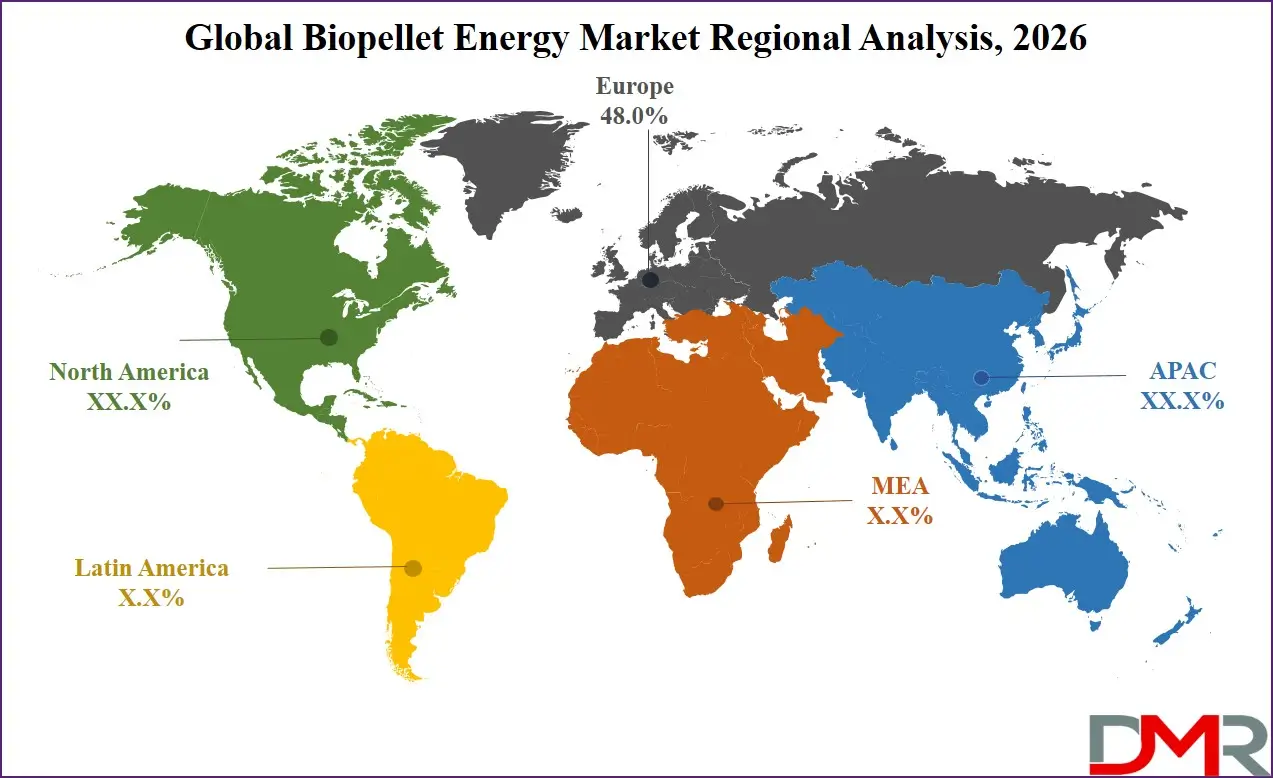
Europe is anticipated to lead the global biopellet energy market, accounting for approximately 48.0% of the total market revenue in 2026. The region's dominance is driven by strong government policies promoting renewable energy, extensive adoption of biomass heating systems, and well-established pellet production infrastructure. High demand for carbon-neutral fuels in power generation, industrial heating, and residential applications supports steady market growth. Additionally, Europe's emphasis on sustainability, energy efficiency, and reducing greenhouse gas emissions encourages widespread use of wood pellets and agricultural biomass pellets, making it the largest and most mature market for biopellet energy globally.
ℹ
To learn more about this report –
Download Your Free Sample Report Here
Region with the Highest CAGR
Europe is also expected to register the highest CAGR in the global biopellet energy market during the forecast period. Strong regulatory support for renewable energy, widespread adoption of biomass-based heating and power systems, and ongoing investments in sustainable energy infrastructure are driving rapid market growth. Increasing focus on carbon emission reduction, energy efficiency, and the transition from fossil fuels to renewable solid biofuels further accelerates demand. These factors position Europe as not only the largest but also the fastest-growing region in the global biopellet energy market.
By Region
North America
Europe
- Germany
- The U.K.
- France
- Italy
- Russia
- Spain
- Benelux
- Nordic
- Rest of Europe
Asia-Pacific
- China
- Japan
- South Korea
- India
- ANZ
- ASEAN
- Rest of Asia-Pacific
Latin America
- Brazil
- Mexico
- Argentina
- Colombia
- Rest of Latin America
Middle East & Africa
- Saudi Arabia
- UAE
- South Africa
- Israel
- Egypt
- Rest of MEA
Global Biopellet Energy Market: Competitive Landscape
The competitive landscape of the global biopellet energy market is characterized by the presence of well‑established pellet manufacturers, integrated biomass fuel producers, and energy firms focusing on renewable solid biofuels. Market players are increasingly investing in capacity expansion, strategic partnerships, and technological advancements to enhance production efficiency and pellet quality. Competition is driven by efforts to secure long‑term supply contracts, optimize logistics networks, and differentiate product offerings through improved energy density and lower ash content. Emphasis on sustainable feedstock sourcing, cost‑effective manufacturing processes, and scaling operations to meet growing global demand further shapes competitive dynamics in this evolving renewable energy sector.
Some of the prominent players in the Global Biopellet Energy Market are:
- Enviva
- Drax Group
- Graanul Invest
- Lignetics
- Pinnacle Renewable Energy
- Pacific BioEnergy
- Rentech
- Zilkha Biomass Energy
- Energex
- Viridis Energy
- Fram Renewable Fuels
- Pfeifer Group
- Highland Pellets
- Green Circle Bio Energy
- The Westervelt Company
- Segezha Group
- Vyborgskaya Cellulose
- Premium Pellet Ltd
- Aoke Ruifeng
- Suzano
- Other Key Players
Recent Developments in the Global Biopellet Energy Market
- November 2025: Innovative hybrid pellet formulations and advanced torrefied pellets were introduced across the biomass fuel market, featuring mixed wood and agricultural residue blends with higher energy output and reduced ash issues, along with smart pellet stoves offering automized feeding and emissions monitoring systems.
- May 2025: Averra Group AB completed the acquisition of a controlling stake in Nordic BioPower AB, strengthening its renewable biomass and carbon‑negative energy portfolio including wood pellet and chip production assets.
Report Details
| Report Characteristics |
| Market Size (2026) |
USD 15.3 Bn |
| Forecast Value (2035) |
USD 32.4 Bn |
| CAGR (2026–2035) |
8.7% |
| The US Market Size (2026) |
USD 3.2 Bn |
| Historical Data |
2021 – 2025 |
| Forecast Data |
2027 – 2035 |
| Base Year |
2025 |
| Estimate Year |
2026 |
| Report Coverage |
Market Revenue Estimation, Market Dynamics, Competitive Landscape, Growth Factors and etc. |
| Segments Covered |
By Feedstock Type (Forestry Residues, Wood Processing Waste, Agricultural Residues, Energy Crops, Organic Waste & Manure Biomass), By Pellet Type (Wood Pellets, Agricultural Biomass Pellets, Animal Waste Pellets, Mixed Biomass Pellets), By Pellet Grade (Industrial Grade Pellets, Residential Grade Pellets, Utility Grade Pellets), By Pellet Size (8 mm Pellets, 6 mm Pellets, 10 mm Pellets, 12 mm Pellets, Other Sizes), By Distribution Channel (Direct Supply Contracts, Energy Traders & Bulk Fuel Suppliers, Retail Distribution, Online), By Application (Power Generation, Heat Generation, Combined Heat & Power (CHP), Industrial Process Energy), and By End Use (Utilities (Power Plants), Industrial Sector, Residential Heating, Commercial Buildings) |
| Regional Coverage |
North America – The US and Canada; Europe – Germany, The UK, France, Russia, Spain, Italy, Benelux, Nordic, & Rest of Europe; Asia-Pacific – China, Japan, South Korea, India, ANZ, ASEAN, Rest of APAC; Latin America – Brazil, Mexico, Argentina, Colombia, Rest of Latin America; Middle East & Africa – Saudi Arabia, UAE, South Africa, Turkey, Egypt, Israel, & Rest of MEA |
| Prominent Players |
Enviva, Drax Group, Graanul Invest, Lignetics, Pinnacle Renewable Energy, Pacific BioEnergy, Rentech, Zilkha Biomass Energy, Energex, Viridis Energy, Fram Renewable Fuels, Pfeifer Group, Highland Pellets, and many others. |
| Purchase Options |
We have three licenses to opt for: Single User License (Limited to 1 user), Multi-User License (Up to 5 Users) and Corporate Use License (Unlimited User) along with free report customization equivalent to 0 analyst working days, 3 analysts working days and 5 analysts working days respectively. |
Frequently Asked Questions
How big is the Global Biopellet Energy Market?
▾ The Global Biopellet Energy Market size is estimated to have a value of USD 15.3 billion in 2026 and is expected to reach USD 32.4 billion by the end of 2035.
What is the growth rate in the Global Biopellet Energy Market in 2026?
▾ The market is growing at a CAGR of 8.7% over the forecasted period of 2026.
What is the size of the US Biopellet Energy Market?
▾ The US Biopellet Energy market is projected to be valued at USD 3.2 billion in 2026. It is expected to witness subsequent growth in the upcoming period as it holds USD 6.5 billion in 2035 at a CAGR of 8.2%.
Which region accounted for the largest Global Biopellet Energy Market?
▾ Europe is expected to have the largest market share in the Global Biopellet Energy Market with a share of about 48.0% in 2026.
Who are the key players in the Global Biopellet Energy Market?
▾ Some of the major key players in the Global Biopellet Energy Market Enviva, Drax Group, Graanul Invest, Lignetics, Pinnacle Renewable Energy, Pacific BioEnergy, Rentech, Zilkha Biomass Energy, Energex, Viridis Energy, Fram Renewable Fuels, Pfeifer Group, Highland Pellets, and many others.