Market Overview
The biopharmaceutical process analytical technology (PAT) market covers instruments, sensors, software, and integrated platforms used to monitor and control critical quality attributes during drug substance manufacturing. Scope extends from upstream cell culture through downstream purification and formulation. End-point batch testing falls outside Biopharma PAT Market 's boundary. So does general laboratory instrumentation sold without bioprocess integration.
PAT sits at the intersection of analytical chemistry, bioprocess engineering, and digital manufacturing. Regulatory frameworks from the U.S. FDA and EMA, particularly ICH Q8 Quality-by-Design guidance, created the foundational demand for continuous in-process measurement rather than retrospective batch release. Biopharmaceutical manufacturers now treat PAT not as optional compliance infrastructure but as a prerequisite for commercial-scale biologics approval.
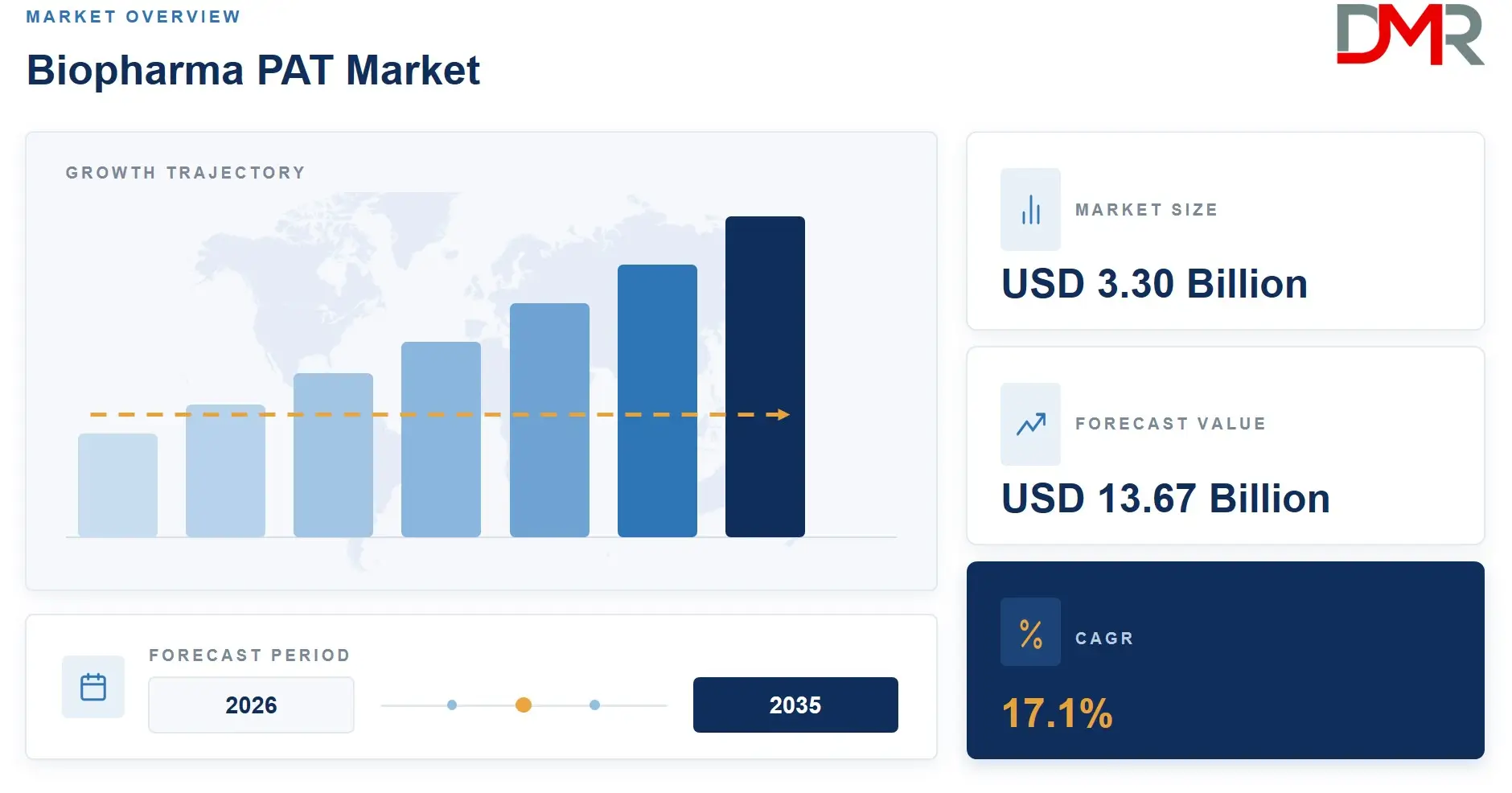
The market valued at USD 3.30 Billion in 2026 reflects accelerating capital deployment by contract development and manufacturing organizations, large integrated biopharma, and a growing cohort of cell and gene therapy developers. Scale-up complexity in living-cell processes and the regulatory expectation of process understanding across biologics lifecycle have made PAT a non-discretionary spend category rather than a technology upgrade cycle.
Key Takeaways
- The market size is USD 3.30 Billion in 2026, and is projected to hit USD 13.67 Billion by 2035 at a CAGR of 17.1%.
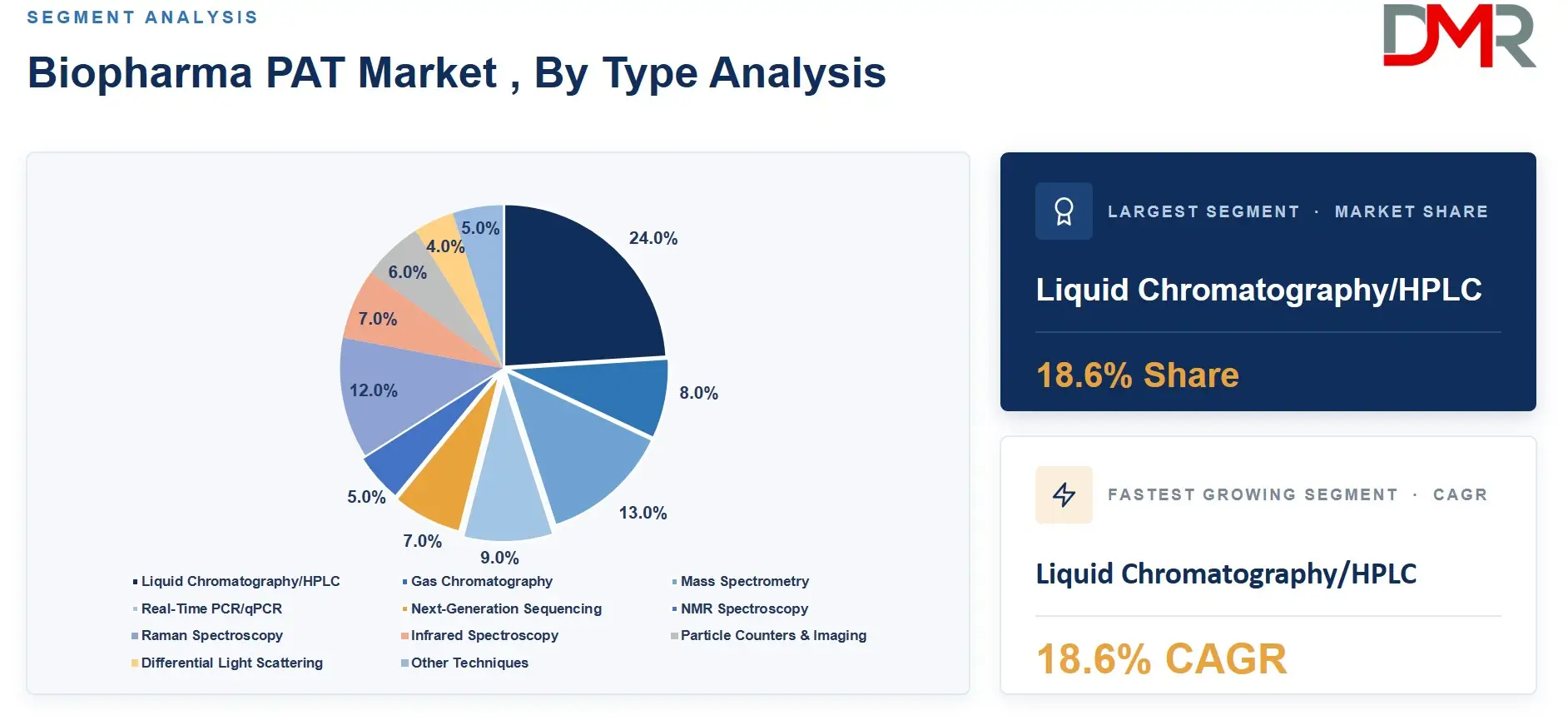
- By Type: Liquid Chromatography/HPLC led as the largest category with the highest CAGR of 18.6% in 2025.
- By Product Type: Analyzers led with a 40.5% share in 2025.
- By Mode: Online Mode led with a 47.8% share in 2025.
- By Application: Biosimilars and Biologics led with a 42.9% share in 2025.
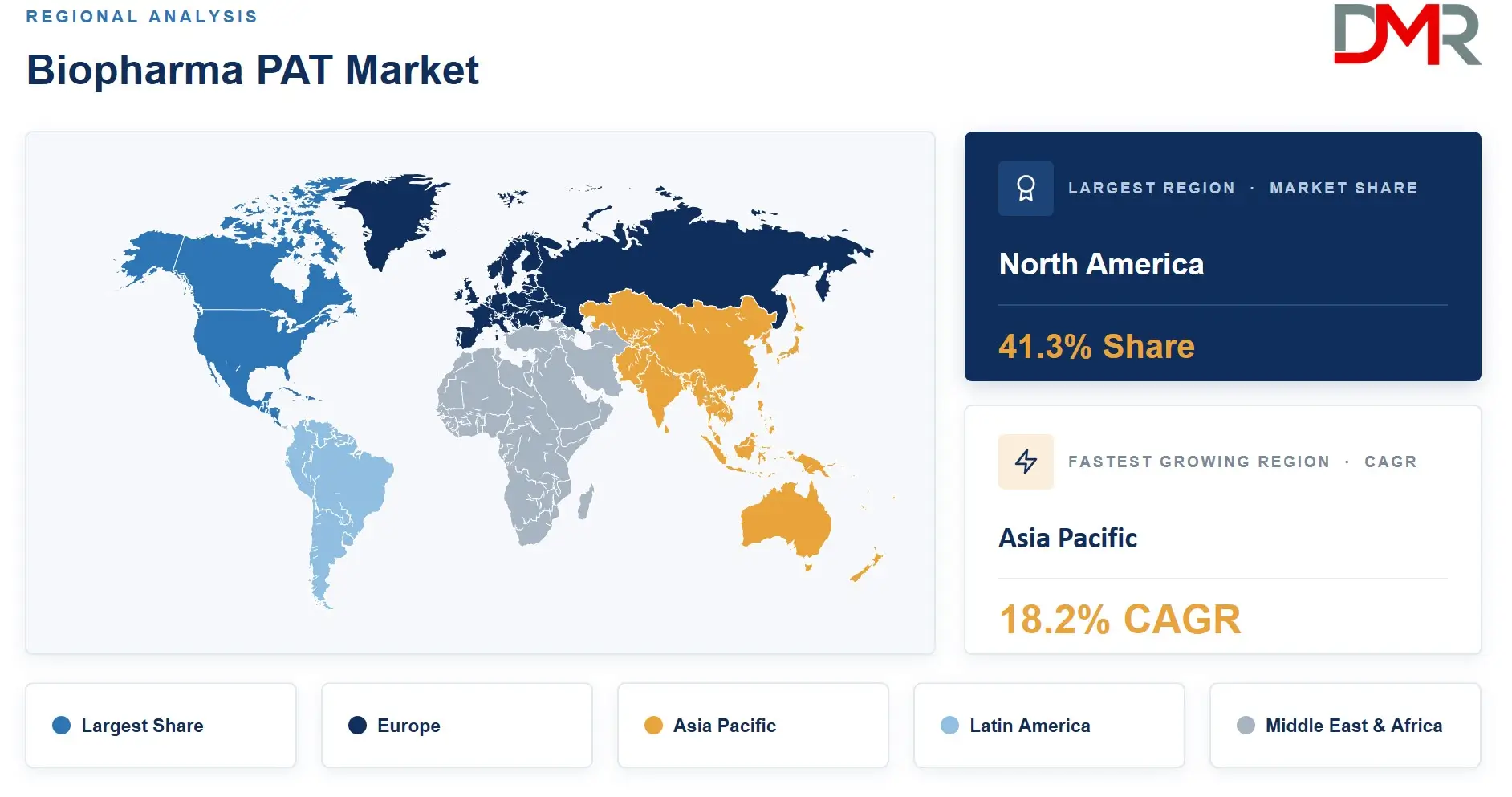
- By Region: North America led with a 41.3% share, valued at USD 1.36 Billion, in 2026.
- Asia Pacific is the fastest-growing region, driven by rapid biopharmaceutical manufacturing expansion across China, India, and South Korea.
Market Size and Forecast
The Global Biopharmaceutical Process Analytical Technology Market size is estimated at USD 3.30 Billion in 2026, and is projected to reach USD 13.67 Billion by 2035, exhibiting a CAGR of 17.1% during the forecast period.
Historical growth from 2020 to 2024 was anchored by mandatory Quality-by-Design implementation across biologics manufacturing and a wave of biosimilar approvals requiring validated in-process controls. Continuous bioprocessing pilots at large CDMOs converted what were once single-use demonstration projects into permanent production infrastructure. That conversion pulled PAT capital expenditure forward by two to three planning cycles.
ℹ
To learn more about this report –
Download Your Free Sample Report Here
Forecast assumptions rest on four compounding factors: commercial-scale cell and gene therapy approvals multiplying PAT touchpoints per batch, single-use bioreactor adoption embedding sensors directly into process hardware, regulatory agency expectations for real-time release testing, and multi-site biologics manufacturers standardizing PAT platforms across global facilities. As reported by Sartorius in 2025, Raman PAT models transferred from 2 L development vessels to 50 L production bioreactors maintained RMSEP values of 0.48 g/L for glucose and 0.14 g/L for titer, confirming that scale-transfer fidelity now meets commercial-process requirements and removes a key implementation barrier that constrained earlier capital commitments.
Segment Analysis
Type Analysis
Liquid Chromatography/HPLC led the Type segment with the highest CAGR of 18.6%, outpacing all other analytical technique categories.
LC/HPLC's structural advantage in downstream PAT stems from its established regulatory acceptance as a reference method for protein purity, antibody titer, and host-cell impurity measurement. Online HPLC's speed advantage is now validated at commercial scale. As reported by a 2025 peer-reviewed downstream PAT review published on PMC, specialized online HPLC PAT reduced sampling and measurement cycles to between 1.30 and 2.35 minutes. Downstream-process decisions may require resolution within seconds, making cycle compression a direct competitive differentiator for instruments capable of real-time feedback integration.
ℹ
To learn more about this report –
Download Your Free Sample Report Here
Raman Spectroscopy is the fastest-rising technique for upstream monitoring, with growing penetration into nucleic-acid biomanufacturing. Gas Chromatography retains a defined role in residual solvent and volatile organic compound testing but faces limited upside as biologics portfolios shift away from synthetic chemistry. Mass Spectrometry accelerates fastest in multi-attribute monitoring workflows where simultaneous peptide mapping, glycan profiling, and charge-variant analysis reduce analyst time per batch. Next-Generation Sequencing and Real-Time PCR serve cell and gene therapy quality control but remain volume-constrained by the relatively small number of commercial CGT batches produced annually. A 2025 study published on d-nb.info showed that supplemented fed-batch Raman models produced RMSEP values of 3.06 mM for glucose, 8.65 mM for ethanol, and 0.99 g/L for biomass, compared with 1.71 mM, 4.20 mM, and 0.17 g/L for batch processes, confirming that fed-batch conditions introduce measurable complexity that vendors must address through model design, not hardware alone.
Product Type Analysis
Analyzers accounted for 40.5% of Product Type demand in 2026, the highest of any category.
Analyzers command the largest share because they function as the primary measurement node in any PAT architecture. Biopharmaceutical manufacturers procure analyzers as capital equipment with multi-year validation cycles, creating revenue visibility and sticky installed bases for vendors. Thermo Fisher's 2025 Raman proof-of-concept for nucleic-acid biomanufacturing achieved an R² of 0.93 and a prediction error of ±1 adenine when measuring poly(A)-tail composition, demonstrating that analyzer precision in emerging therapeutic modalities has crossed the threshold required for regulatory submission data packages.
Sensors and Probes represent the fastest-growing product type as single-use bioreactor adoption embeds disposable sensing directly into process flow paths. Software earns the highest margin per unit as chemometric model development, data historians, and process control integration command premium pricing. Samples remain a recurring consumable revenue stream with predictable volume tied to installed analyzer counts. Vendors bundling sensors, software, and service contracts with analyzer sales extract significantly higher lifetime revenue per customer than hardware-only competitors.
Mode Analysis
With a 47.8% share in 2026, Online Mode outpaced all other operational mode categories.
Online mode's dominance reflects the fundamental PAT objective: eliminating latency between process events and corrective action. Manufacturers running continuous perfusion or intensified fed-batch processes cannot tolerate the delays inherent in offline sampling, transport, and laboratory analysis. Regulatory guidance under ICH Q8 and Q10 explicitly rewards online and inline measurement by reducing required end-point release testing, creating a direct compliance incentive for capital investment in real-time instrumentation.
At-line mode serves development and scale-up stages where full online integration is premature but manual grab-sampling is insufficiently frequent. Offline mode persists for release testing of attributes where real-time measurement lacks regulatory acceptance. In-line mode is expanding fastest across upstream cell culture as embedded sensors in single-use bioreactors reduce sample handling risk and contamination probability. The shift from offline to online and inline architectures defines the hardware replacement cycle that underpins the 17.1% CAGR forecast.
Application Analysis
Biosimilars and Biologics captured 42.9% of the Application segment in 2026, ahead of all rivals.
Biosimilars and large-molecule biologics dominate because their manufacturing processes involve living cells, protein folding, and post-translational modifications that require continuous monitoring to maintain product comparability. A biosimilar manufacturer must demonstrate process consistency to a degree that small-molecule generics never face, making PAT a regulatory and commercial necessity rather than a quality upgrade. Cell and gene therapy is the fastest-growing application, with commercial approvals for CAR-T, AAV-based gene therapies, and mRNA products multiplying the number of PAT touchpoints per manufacturing suite. Vaccines represent a stable volume application anchored by pandemic preparedness investments from 2020 through 2024 that permanently raised national manufacturing capacity. Hormonal therapy applications remain mature with moderate PAT intensity, as established API processes carry well-validated legacy analytical methods.
Key Market Segments
By Type
- Liquid Chromatography/HPLC
- Gas Chromatography
- Mass Spectrometry
- Real-Time PCR/qPCR
- Next-Generation Sequencing
- Nuclear Magnetic Resonance Spectroscopy
- Raman Spectroscopy
- Infrared Spectroscopy
- Particle Counters & Imaging
- Differential Light Scattering
- Other Techniques
By Product Type
- Analyzers
- Sensors & Probes
- Samples
- Software
By Mode
- Online Mode
- Offline Mode
- At-Line Mode
- In-Line Mode
By Application
- Biosimilars & Biologics
- Vaccines
- Cell & Gene Therapy
- Hormonal Therapy
- Other Applications
Regional Analysis
North America led all regions with a 41.3% share, valued at USD 1.36 Billion, in 2026.
North America
North America's dominance originates from the concentration of large-molecule drug originators, contract manufacturers, and CDMOs in the United States. FDA's ICH Q8 and PAT guidance framework, active since 2004 and continuously reinforced through subsequent draft guidances, created a compliance environment that rewards continuous process verification. Biopharmaceutical manufacturers seeking FDA biologics license approval must demonstrate process understanding that only real-time PAT systems can credibly document. Canada contributes a smaller but growing share through publicly funded biosimilar manufacturing capacity added post-2021.
ℹ
To learn more about this report –
Download Your Free Sample Report Here
Europe
Europe holds the second-largest share, anchored by Germany, Switzerland, and the United Kingdom, where vertically integrated biopharma companies and precision-instrument manufacturers co-locate. EMA's parallel guidance on Quality-by-Design for biological medicinal products reinforces PAT investment across the region. Germany's CDMO sector made substantial in-line monitoring investments between 2022 and 2024 to support biosimilar manufacturing for European launch markets, compressing what would have been a five-year adoption curve into three years.
Asia Pacific
Asia Pacific is the fastest-growing region, with China, India, and South Korea driving the acceleration. Chinese biopharmaceutical manufacturers expanded commercial-scale biologics capacity after the National Medical Products Administration published biosimilar technical guidelines aligned with ICH standards in 2023. Indian CDMOs won large-molecule outsourcing contracts from North American and European originators, pulling PAT capital requirements into their facility upgrade cycles. South Korea's Samsung Biologics and Celltrion expansions through 2024 added multi-thousand-liter bioreactor capacity requiring fully integrated PAT infrastructure from day one of commercial operation.
Latin America
Latin America remains an early-stage PAT market, with Brazil and Mexico representing the primary demand centers. Brazilian investment in domestic biologics production under public health procurement mandates creates selective PAT adoption at government-affiliated manufacturers. Market penetration stays limited by the dominance of imported finished biologics, which reduces the number of local production sites requiring in-process monitoring.
Middle East & Africa
The Middle East and Africa represent the smallest regional share, with Saudi Arabia and the UAE deploying PAT infrastructure in state-owned pharmaceutical manufacturing facilities aligned with national pharmaceutical self-sufficiency strategies. South Africa hosts the continent's most advanced biologics manufacturing activity. Broader regional adoption depends on foreign direct investment in local manufacturing, which remains selective and project-specific rather than sector-wide.
Key Regions and Countries
North America
Europe
- Germany
- France
- The UK
- Spain
- Italy
- Rest of Europe
Asia Pacific
- China
- Japan
- South Korea
- India
- Australia
- Rest of APAC
Latin America
- Brazil
- Mexico
- Rest of Latin America
Middle East & Africa
- GCC
- South Africa
- Rest of MEA
Macroeconomic Impact
Sustained biopharmaceutical R&D investment from both private capital and government post-pandemic resilience programs insulates the PAT market from typical capital-expenditure cyclicality. When inflation pressures raised instrument manufacturing costs between 2022 and 2024, large biopharma maintained PAT budgets because regulatory timelines do not flex with macroeconomic conditions. Smaller manufacturers absorbed the cost pressure by delaying non-mandatory analytical investments, concentrating PAT purchases among CDMOs and integrated originators.
Currency movements create regional asymmetry in purchasing power. A strong U.S. dollar raised the effective cost of European and Japanese instrument imports for buyers in Asia Pacific and Latin America between 2023 and 2025. Vendors responding to this pressure by establishing local instrument assembly, calibration, and service networks in China and India captured first-mover advantages that competitors relying on pure export models are now struggling to recover.
Market Dynamics
Driver: Real-Time CQA Monitoring Becomes a Biologics Manufacturing Prerequisite
Biologics and biosimilar manufacturers face regulatory pressure to demonstrate continuous process understanding rather than retrospective batch release. Quality-by-Design frameworks embedded in ICH Q8 and Q10 make in-line and online CQA monitoring a submission requirement for new biologics license applications. A 2025 CHO-cell bioprocess study published on PubMed confirmed that Raman PAT partial-least-squares models achieved R²>0.90 when predicting nutrients, metabolites, IgG titer, and cell densities across five 10 L cultures, providing the analytical precision that regulatory reviewers require from process validation data packages.
Continuous biomanufacturing intensifies this demand by eliminating batch boundaries, where end-point testing previously served as the quality checkpoint. As reported by a 2025 peer-reviewed review on PMC, online HPLC PAT compressed measurement cycles to between 1.30 and 2.35 minutes. Downstream process decisions may require resolution within seconds, meaning instruments that cannot sustain high-frequency feedback loops disqualify themselves from continuous bioprocessing applications regardless of price.
Restraint: Validation Costs and Talent Scarcity Restrict Smaller Manufacturers
PAT implementation at a commercial biologics facility requires instrument qualification, method development, regulatory validation, and software integration, a sequence that takes 12 to 24 months and costs several million dollars per process step. Smaller biotech companies and emerging-market CDMOs cannot absorb these costs without materially delaying product timelines. Regulatory agencies have yet to issue streamlined PAT validation pathways for early-phase clinical manufacturing, leaving smaller operators with full commercial-grade requirements at clinical scale.
Cross-trained professionals who understand bioprocess biology, chemometrics, and data-science integration are scarce globally. A manufacturer deploying Raman spectroscopy in a fed-batch process needs staff capable of building and transferring calibration models across vessel scales, a skill set that academic training programs produce in small numbers. Contract service organizations offering managed PAT method development partially alleviate this constraint, but demand for such services already exceeds current supply in North America and Europe.
Opportunity: Modular and Multimodal PAT for Decentralized and Personalized Therapy Manufacturing
Cell and gene therapy manufacturing occurs at smaller batch volumes and more diverse production sites than conventional biologics, creating demand for modular PAT platforms that deploy rapidly without full infrastructure overhaul. Hospital-based and near-patient manufacturing for autologous CAR-T therapies places PAT instruments in clinical environments rather than industrial facilities. Vendors designing compact, software-configurable platforms for these settings face limited competition from large instrument manufacturers whose products are optimized for multi-thousand-liter commercial-scale operations.
Model transfer across scales is an addressable technical barrier with measurable commercial value. A 2025 study on d-nb.info showed that single-compound supplementation reduced relative Raman prediction errors by 82.72% for glucose, 90.05% for ethanol, and 69.26% for biomass when transferring models from batch to fed-batch operation. Vendors who embed such transfer protocols into validated software packages convert a technical capability into a procurement differentiator. Multimodal sensor-fusion platforms combining Raman, mass spectrometry, and soft sensors can address low-volume personalized-medicine batches where no single technique covers all required CQAs simultaneously.
Porter's Five Forces
Competitive intensity in the biopharmaceutical PAT market is moderate to high, shaped by high capital barriers that reduce new entrant frequency but sustained by a concentrated supplier base that limits buyer negotiating power. Instrument manufacturers depend on specialty optical components, high-performance detectors, and chemometric software that draw from a narrow supplier pool, giving component vendors meaningful pricing influence over finished-instrument margins. Buyers, primarily large CDMOs and integrated biopharma, hold some countervailing power through multi-instrument procurement negotiations, but regulatory validation lock-in reduces their willingness to switch vendors mid-lifecycle. Substitutes are limited because no analytical approach combines the real-time, non-destructive measurement capability of spectroscopic PAT with equivalent regulatory acceptance. Rivalry centers on measurement speed, scale-transfer robustness, and software integration depth rather than price, because buyers prioritize compliance confidence over cost minimization when selecting PAT systems for commercial biologics manufacturing.
AI and Gen AI Impact
Artificial intelligence is most consequential in the chemometric modeling layer of PAT, where machine learning converts high-frequency spectral data into predictive bioprocess control signals. Manual calibration model development previously required specialized chemometrics expertise and weeks of experimental runs. AI-assisted model building compresses this to days and enables automated model maintenance as process conditions drift. As reported by a 2025 peer-reviewed review published on PMC, Raman systems combined with hardware automation and machine learning measured protein aggregation and fragmentation every 38 seconds, a measurement frequency that enables closed-loop process control rather than manual intervention.
Vendors who embed AI model-transfer capabilities into their PAT software platforms reduce the scale-up risk that has historically discouraged smaller manufacturers from full PAT adoption. Laggards who delay AI integration into their PAT offerings risk losing specification-round selection to competitors whose platforms promise faster validation timelines and automated regulatory documentation.
Market Trends
Online PAT Architectures and AI Chemometrics Redefine Bioprocess Control
Online PAT architectures are displacing manual offline sampling across both upstream and downstream bioprocess operations as regulatory agencies raise process understanding expectations. Single-use bioreactors now incorporate embedded sensors and disposable flow-path analytics, embedding PAT capability directly into hardware rather than as an add-on layer. A 2025 PubMed study confirmed Raman PAT prediction errors of 0.51 g/L for glucose and 0.12 g/L for IgG titer during CHO-cell monitoring, setting a precision benchmark that online instruments must meet to compete in commercial biologics suites. Bioprocess instrument consolidation through strategic acquisitions is bringing real-time analyzers into integrated equipment portfolios, compressing the vendor landscape and raising the entry threshold for standalone instrument makers.
Market Competition Overview
The biopharmaceutical PAT market is moderately consolidated at the top, with a small group of diversified analytical instrument and life science tool companies holding the largest share across multiple product and application segments. Market leaders compete through breadth of portfolio rather than single-instrument dominance, bundling analyzers, sensors, software, and service contracts into integrated PAT programs. This bundling strategy raises switching costs and creates sticky revenue relationships with CDMOs managing complex multi-product biologics facilities.
Mid-tier competitors differentiate through application specialization, particularly in cell and gene therapy and nucleic-acid therapeutics, where established leaders have moved slower to develop purpose-built PAT solutions. Acquisition activity is accelerating as large players acquire niche instrument developers to close application gaps rather than develop internally, compressing the organic growth window available to smaller specialists. Regional competitors in Asia are gaining share within domestic markets as local biopharma manufacturers prefer vendors who offer on-site method development and validation support in native-language regulatory environments.
Pricing Analysis
PAT instrument pricing varies substantially by technique, integration complexity, and regulatory support scope. Raman spectroscopy systems for commercial biologics suites command premium pricing, reflecting the chemometric software development, regulatory validation packages, and scale-transfer support that buyers require alongside the hardware. Waters' 2025 LC-MS analytical method for RNA therapeutics, capable of detecting product-related impurities below 0.1% in under 5 minutes as reported by Waters Corporation, illustrates the performance-per-run precision that justifies high instrument acquisition and maintenance costs in high-value nucleic-acid biomanufacturing.
Market leaders maintain price discipline through long-term service agreements and application-specific validation bundles that challengers cannot replicate at equal regulatory credibility. Challengers typically price hardware 15 to 25 percent below leaders while offering narrower software functionality, a gap that buyers with established method libraries are reluctant to absorb given revalidation costs.
Company Profiles
Thermo Fisher Scientific Inc. holds a cross-segment position spanning analyzers, spectroscopic instruments, and biomanufacturing software, giving it reach across upstream and downstream PAT applications. Thermo Fisher's 2025 Raman proof-of-concept for nucleic-acid biomanufacturing, which achieved an R² of 0.93 and a prediction error of ±1 adenine for poly(A)-tail composition, as reported by Thermo Fisher, signals a deliberate expansion into mRNA and oligonucleotide therapeutic manufacturing where PAT adoption is earliest-stage and competitive differentiation is highest. Scale and regulatory credibility across global markets create procurement advantages in multi-site CDMO contracts where instrument standardization is a sourcing requirement.
Sartorius AG positions as a bioprocess-native PAT provider, integrating Raman spectroscopy directly into its bioreactor and cell culture hardware ecosystem. As reported by Sartorius in 2025, calibration models developed from six 250 mL CHO fed-batch cultivations all achieved observed-versus-predicted correlation coefficients above 0.93, a validation data set embedded directly into commercial customer support packages. Sartorius's strategy of bundling PAT instruments with single-use bioreactor consumables creates recurring revenue streams and makes instrument replacement economically disruptive for customers running validated Sartorius-platform processes.
Key Players
- Agilent Technologies Inc.
- Bruker Corporation
- Danaher Corporation
- Mettler Toledo
- Shimadzu Corporation
- Thermo Fisher Scientific Inc.
- Waters Corporation
- PerkinElmer
- Sartorius AG
- ABB
- Emerson Electric Co.
- Merck KGaA
- Process Insights
- Verum Analytics LLC
Supply Chain and Value Chain Analysis
The PAT value chain begins with specialty component manufacturers supplying optical detectors, laser sources, and flow cells to instrument assemblers. Instrument companies add chemometric software, application-specific validation data packages, and regulatory documentation before selling to biopharmaceutical manufacturers or CDMOs. Maximum value accrues at the software and service layer, where method development and validation support commands margins well above the hardware tier. The most significant supply chain risk sits in specialty optical components and high-resolution detector supply, where a small number of Tier 1 component vendors serve the entire instrument manufacturing sector. A disruption in laser diode or spectrometer-grade optical fiber supply propagates rapidly across multiple instrument categories simultaneously.
Regulatory Landscape
FDA's 2004 PAT Guidance for Industry and subsequent ICH Q8, Q9, Q10, and Q11 harmonized guidelines created the foundational regulatory structure within which Biopharma PAT Market operates. EMA's parallel Guideline on Process Validation for Finished Products reinforces continuous process verification requirements across European marketing authorization applications. Both agencies now expect biosimilar and biologics applicants to include PAT data within process validation packages, converting what was previously best-practice evidence into a submission standard.
China's National Medical Products Administration aligned its biologics manufacturing guidelines with ICH standards between 2022 and 2024, opening the regulatory pathway for PAT adoption across Chinese biopharmaceutical manufacturers seeking international market approvals. Japan's PMDA maintains equivalent ICH alignment. Regulatory divergence persists only at the level of post-approval process change reporting, where FDA and EMA differ in their requirements for revalidation when PAT models are updated or transferred across manufacturing sites.
Investment and White Space Analysis
Capital flows within Biopharma PAT Market concentrate on three areas: single-use bioreactor-integrated sensor platforms, AI-driven chemometric software, and modular PAT systems for cell and gene therapy manufacturing. The white space with the highest near-term commercial potential is vendor-neutral PAT middleware, software that connects proprietary instruments from multiple vendors to legacy distributed-control and manufacturing-execution systems. No dominant player has captured this integration layer, leaving an open market for pure-play software developers and system integrators.
Asia Pacific represents the highest-growth white space by geography. Local PAT instrument servicing, method development, and regulatory validation support in Chinese, Korean, and Indian manufacturing environments is undersupplied relative to the bioreactor capacity being added annually. Vendors who establish local application laboratories and regulatory-affairs-trained service teams in these markets before 2027 will capture a partner-of-record position that compounds through the forecast period.
Recent Developments
- March 2025 — Repligen Corporation acquired the desktop analytics assets of 908 Devices for $70 million, adding the MAVERICK and MAVEN real-time bioprocess monitoring platforms, the REBEL at-line cell-culture media analyzer, and the ZipChip separations platform to its portfolio.
- March 2025 — HORIBA launched the Veloci biopharma analyzer and PoliSpectra Rapid Raman Plate Reader, targeting applications including cell-media monitoring, vaccine characterization, monoclonal-antibody analysis, and real-time reaction monitoring.
- May 2025 — Waters Corporation launched BioResolve Protein A Affinity Columns with MaxPeak Premier Technology, enabling earlier and more sensitive antibody-titer measurement during clone selection and bioprocess monitoring.
- May 2025 — Sartorius introduced the Octet R8e biolayer-interferometry system for real-time, label-free biomolecular analysis across process development, bioprocessing quality control, and manufacturing-control applications.
- 2025 — Danaher's Cytiva expanded the Xcellerex X-platform with 500-liter and 2,000-liter single-use bioreactor formats; Danaher's SCIEX introduced the ZenoTOF 8600 high-resolution mass spectrometer for drug-development analysis. Danaher reported both developments in January 2026 as 2025 innovation highlights.
Report Details
| Report Characteristics |
| Market Value (2026) |
USD 3.30 Billion |
| Forecast Revenue (2035) |
USD 13.67 Billion |
| CAGR (2026–2035) |
17.1% |
| Base Year for Estimation |
2025 |
| Historic Period |
2020 – 2024 |
| Forecast Period |
2026 – 2035 |
| Report Coverage |
Revenue Forecast, Market Dynamics, Competitive Landscape, Recent Developments |
| Segments Covered |
By Type (Liquid Chromatography/HPLC, Gas Chromatography, Mass Spectrometry, Real-Time PCR/qPCR, Next-Generation Sequencing, Nuclear Magnetic Resonance Spectroscopy, Raman Spectroscopy, Infrared Spectroscopy, Particle Counters & Imaging, Differential Light Scattering, Other Techniques), By Product Type (Analyzers, Sensors & Probes, Samples, Software), By Mode (Online Mode, Offline Mode, At-Line Mode, In-Line Mode), By Application (Biosimilars & Biologics, Vaccines, Cell & Gene Therapy, Hormonal Therapy, Other Applications) |
| Regional Analysis |
North America – US and Canada; Europe – Germany, France, The UK, Spain, Italy, and Rest of Europe; Asia Pacific – China, Japan, South Korea, India, Australia, and Rest of APAC; Latin America – Brazil, Mexico, and Rest of Latin America; Middle East & Africa – GCC, South Africa, and Rest of MEA |
| Competitive Landscape |
Agilent Technologies Inc., Bruker Corporation, Danaher Corporation, Mettler Toledo, Shimadzu Corporation, Thermo Fisher Scientific Inc., Waters Corporation, PerkinElmer, Sartorius AG, ABB, Emerson Electric Co., Merck KGaA, Process Insights, Verum Analytics LLC |
| Customization Scope |
Customization for segments and region or country level will be provided. Additional customization can be done based on requirements. |
| Purchase Options |
Three license options: Single User License, Multi-User License (Up to 5 Users), and Corporate Use License (Unlimited Users and Printable PDF) |
Frequently Asked Questions
What is the biggest investment opportunity in the Biopharmaceutical Process Analytical Technology market?
▾ Vendor-neutral PAT middleware connecting proprietary instruments to legacy distributed-control and manufacturing-execution systems represents the least-served high-value segment. Modular PAT platforms for decentralized cell and gene therapy manufacturing also offer substantial near-term opportunity, as no large incumbent has built purpose-built solutions for hospital-based or near-patient production environments. Asia Pacific localized service and method development infrastructure compounds both of these opportunities for vendors who move early.
Who are the top companies in the Biopharmaceutical Process Analytical Technology market?
▾ Leading participants include Agilent Technologies Inc., Thermo Fisher Scientific Inc., Waters Corporation, Sartorius AG, Danaher Corporation, Bruker Corporation, Mettler Toledo, Shimadzu Corporation, PerkinElmer, ABB, Emerson Electric Co., Merck KGaA, Process Insights, and Verum Analytics LLC. Thermo Fisher and Sartorius hold particularly strong positions through cross-segment portfolio breadth and bioprocess hardware integration, respectively.
Which segment is growing fastest in the Biopharmaceutical Process Analytical Technology market and why?
▾ Liquid Chromatography/HPLC leads all Type segments with the highest CAGR of 18.6%, driven by its established regulatory acceptance for protein purity and antibody titer measurement and its proven capability to compress online measurement cycles to under 2.35 minutes for downstream bioprocess applications. Cell and Gene Therapy is the fastest-growing Application segment, as commercial CAR-T and AAV-based approvals multiply the number of PAT monitoring touchpoints per manufacturing suite. Both growth vectors reflect regulatory and commercial necessity rather than discretionary technology upgrades.
Which region is growing fastest in the Biopharmaceutical Process Analytical Technology market and why?
▾ Asia Pacific is the fastest-growing region, with China, India, and South Korea driving acceleration through new commercial biologics capacity additions, ICH-aligned regulatory frameworks adopted between 2022 and 2024, and large CDMO outsourcing contract wins from North American and European originators. Samsung Biologics and Celltrion expansions in South Korea alone added multi-thousand-liter bioreactor capacity requiring integrated PAT infrastructure from day one of operation. Localized PAT servicing and method development in these markets remains undersupplied, amplifying the growth signal for vendors who invest now.
What is the biggest challenge holding Biopharma PAT Market back?
▾ Capital-intensive instrument deployment combined with product-specific regulatory validation creates prohibitive implementation costs for smaller manufacturers, concentrating PAT adoption among large CDMOs and integrated originators. A shortage of professionals trained across bioprocess biology, chemometrics, and data science simultaneously constrains method development capacity even at well-funded organizations. Until regulatory agencies introduce streamlined PAT validation pathways for early-phase clinical manufacturing, the cost and complexity barrier will continue to exclude a significant portion of the potential customer base from full PAT adoption.