Market Overview
The blood culture tests market spans the full ecosystem of products and processes used to detect microbial pathogens directly from blood specimens. Covered categories include automated blood culture instruments, single-use consumable bottles, and the software platforms that connect culture results to clinical decision-making. The market excludes broader diagnostic categories such as urine culture, respiratory PCR panels, and general microbiome testing, though procurement decisions for blood culture systems increasingly intersect with hospital-wide microbiology automation strategies.
ℹ
To learn more about this report –
Download Your Free Sample Report Here
As reported by the National Institute of General Medical Sciences, at least 1.7 million adults in the United States develop sepsis annually, placing blood culture testing at the center of one of acute care's costliest diagnostic workflows. Sepsis management protocols in high-income markets now treat microbiological confirmation as a clinical standard rather than an optional step, converting what was once discretionary laboratory spend into a near-mandatory capital and consumables commitment for accredited hospitals.
Roche's Diagnostics Day 2025 signaled a broader industry shift, with the company presenting sepsis-related diagnostic evidence development as a core pipeline priority. Vendors across the competitive landscape are moving from standalone instrument sales toward integrated platforms that connect blood culture results directly to electronic health records and antimicrobial stewardship software. That transition repositions blood culture testing from a laboratory function into a clinical workflow tool, expanding the addressable buyer base beyond laboratory procurement managers to include hospital pharmacists, infectious disease physicians, and quality-improvement committees.
Key Takeaways
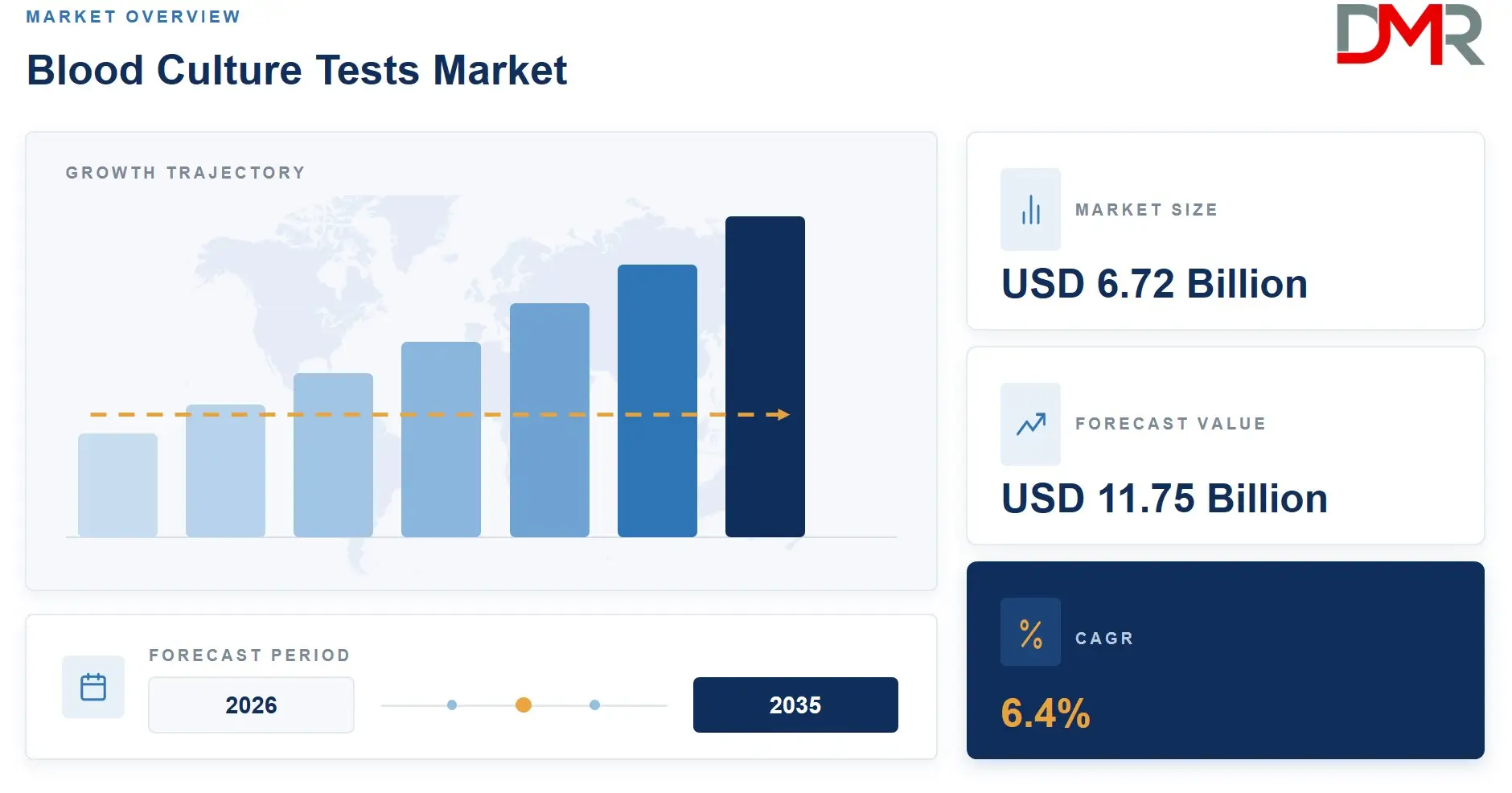
- The market size is USD 6.72 Billion in 2026, and is projected to hit USD 11.75 Billion by 2035 at a CAGR of 6.4%.
- By Product: Consumables led as the largest category with a 74.1% share in 2026.
- By Method: Conventional/Manual Blood Culture led with a 64.1% share in 2026.
- By Technology: Culture-Based led with a 73.8% share in 2026.
- By Application: Bacterial Infections led with a 70.2% share in 2026.
- By End User: Hospital Laboratories led with a 72.3% share in 2026.
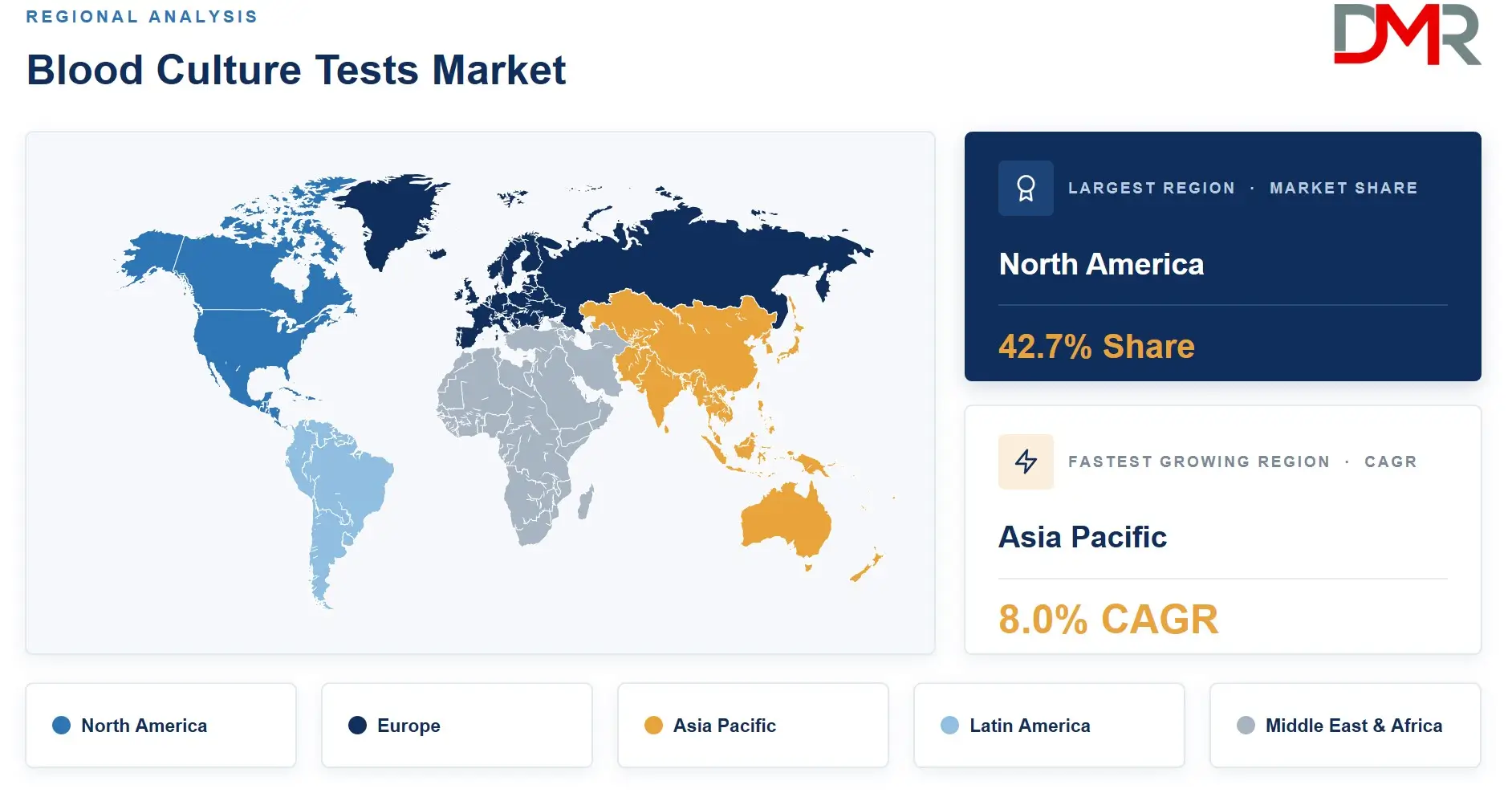
- By Region: North America led with a 42.7% share in 2026, with Asia Pacific identified as the fastest-growing region.
- The competitive landscape is anchored by large diversified diagnostics corporations with vertically integrated consumable supply chains, limiting independent entry.
Market Size and Forecast
The Global Blood Culture Tests Market size is estimated at USD 6.72 Billion in 2026, and is projected to reach USD 11.75 Billion by 2035, exhibiting a CAGR of 6.4% during the forecast period.
Danaher reported Q4 2025 revenue of $6.8 billion, up 4.5% year over year, as reported by Danaher investor relations. That performance across a portfolio that includes blood culture-adjacent diagnostics platforms reflects sustained institutional procurement in high-acuity care settings. Consistent mid-single-digit growth across major diagnostics conglomerates validates the forecast assumption that hospital capital budgets will continue to prioritize infection-detection infrastructure through the next decade.
Waters Corporation reported Biosciences and Diagnostic Solutions revenue of $817 million with 9% organic growth in constant currency for Q2 2026, per Waters investor relations. That rate of organic expansion in diagnostics instrumentation above broader market averages signals that buyer appetite for advanced microbiological detection platforms remains ahead of earlier consensus projections. The 6.4% CAGR reflects a structural demand floor set by sepsis protocol mandates rather than cyclical technology adoption, making the forecast relatively insensitive to short-term economic softness.
Product Analysis
Consumables accounted for 74.1% of product demand in 2026, the highest of any category.
Consumable blood culture bottles generate recurring, non-deferrable revenue for vendors and recurring non-discretionary spend for hospitals. Each blood draw requires new bottles, and sepsis protocol volumes in high-acuity centers run to hundreds of sets per day. That volume dynamic transforms consumable supply contracts into a competitive moat: once a hospital standardizes on a proprietary bottle format, switching costs encompass instrument recalibration, staff retraining, and regulatory revalidation.
Instruments and Software and Services complete the product ecosystem. Instrument spend is episodic and capital-budget dependent, but the transition toward reagent-rental and managed-service contracts is converting instrument revenue from lumpy procurement cycles into annuity-style cash flows. Software and Services, the smallest product category, carries the highest margin profile, and vendors that embed EHR connectivity and antimicrobial stewardship dashboards into their software layer gain a structural renewal advantage as hospitals deepen workflow integration.
Method Analysis
With a 64.1% share in 2026, Conventional/Manual Blood Culture outpaced all other method categories.
Conventional blood culture remains the procurement default across most hospital laboratories globally, anchored by established clinical validation, regulatory familiarity, and the absence of capital retraining costs. Low- and middle-income markets rely almost entirely on manual methods, where infrastructure for automated incubation systems is limited. That concentration creates a durable installed base that automated platform vendors must displace rather than simply add to.
.webp)
ℹ
To learn more about this report –
Download Your Free Sample Report Here
Automated Blood Culture is the faster-growing method, driven by the speed-to-result advantage that sepsis protocols increasingly demand. Automated systems reduce time-to-positivity by continuous monitoring versus periodic manual inspection. Vendors offering reagent-rental models remove the capital barrier that previously confined automated adoption to large academic medical centers, pulling mid-sized community hospitals and independent laboratories into the automated segment for the first time.
Technology Analysis
Culture-Based led the technology segment with a 73.8% share in 2026.
Culture-based detection retains dominance because regulatory bodies globally treat a positive blood culture as the gold standard for bacteremia confirmation. No molecular or proteomic platform has yet displaced culture as the primary evidentiary basis for antibiotic therapy initiation. Vendors building molecular and proteomic reflex testing position those technologies as culture companions rather than replacements, preserving culture-based instrument installed bases while adding downstream testing revenue.
Proteomic and Molecular Technologies are growing as reflex identification tools applied directly to positive blood culture bottles. MALDI-TOF proteomics delivers species-level identification within minutes of flagging a positive culture. Molecular syndromic panels simultaneously identify organisms and resistance genes, compressing the diagnostic timeline from days to hours. Buyers investing in reflex molecular capacity are concentrated in high-volume reference laboratories and academic medical centers where rapid identification directly reduces intensive care unit length of stay.
Application Analysis
Bacterial Infections captured 70.2% of application demand in 2026, ahead of all rivals.
Bacterial bloodstream infections, particularly gram-negative sepsis and gram-positive bacteremia from central-line-associated bloodstream infections, drive the majority of blood culture test volumes in acute care settings. Sepsis quality-improvement mandates in the United States, Europe, and Australia require documented microbiological workups within defined timeframes, converting bacterial infection testing from a discretionary clinical order into a protocol-mandated step with measurable compliance metrics.
Mycobacterial Infections and Fungemia are clinically distinct and diagnostically more demanding, requiring extended incubation periods and specialized media. Both categories are growing as immunocompromised patient populations expand, driven by oncology treatment volumes, HIV prevalence, and post-transplant care. Fungemia in particular is associated with high mortality rates and represents a white-space segment where few vendors have achieved broad commercial penetration with rapid culture solutions.
End User Analysis
A 72.3% share made Hospital Laboratories the clear leader across end user categories in 2026.
Hospital laboratories control the dominant share of blood culture test volume because sepsis and bloodstream infection workups originate at the bedside and require same-facility turnaround to influence active therapy decisions. Procurement in this segment is driven by hospital administration and infection control committees, making capital purchasing cycles longer but contract tenures more durable than in outpatient or reference settings.
Reference Laboratories handle overflow volumes and serve smaller facilities lacking full automated blood culture infrastructure. Academic Research Laboratories drive early adoption of novel platforms, providing clinical validation data that vendors require for regulatory submissions and commercial expansion. Other End Users, including public health laboratories and military medical facilities, represent niche but strategically important channels for vendors seeking government procurement contracts in emerging markets.
The Blood Culture Tests Market Report is segmented on the basis of the following:
By Product
- Consumables
- Instruments
- Software & Services
By Method
- Conventional/Manual Blood Culture
- Automated Blood Culture
By Technology
- Culture-Based
- Proteomic Technology
- Molecular Technology
By Application
- Bacterial Infections
- Mycobacterial Infections
- Fungemia
By End User
- Hospital Laboratories
- Reference Laboratories
- Academic Research Laboratories
- Other End Users
Regional Analysis
North America led the blood culture tests market with a 42.7% share in 2026, the highest of any region.
North America
North America commands the largest regional share through a combination of mandatory sepsis reporting requirements, dense hospital network coverage, and the highest per-capita diagnostic spending globally. The United States accounts for the bulk of regional revenue, supported by structural conditions that force high blood culture test volumes: Medicare reimbursement pathways tied to sepsis bundle compliance, Joint Commission accreditation requirements, and active antimicrobial stewardship programs in virtually every accredited acute care facility. China announced plans to reduce import tariffs on medical products, including diagnostic kits, beginning in 2026, a policy signal that, while directed at Asia Pacific, reflects the cross-regional trade dynamics shaping vendor pricing and supply chain planning in North America as well.
ℹ
To learn more about this report –
Download Your Free Sample Report Here
Asia Pacific
Asia Pacific is the fastest-growing regional market, propelled by hospital infrastructure expansion, rising infectious disease burden, and increasing government investment in diagnostic capacity. The World Bank approved $7.7 billion for 47 East Asia and Pacific operations in fiscal year 2025, as reported by the World Bank Group, with healthcare infrastructure among the priority investment categories. Countries including China, India, and South Korea are scaling laboratory automation programs, creating procurement pipelines for automated blood culture platforms that were previously concentrated in high-income Western markets.
Europe
Europe operates under a cohesive regulatory framework through the EU In Vitro Diagnostic Regulation, which mandates conformity assessment for all blood culture systems marketed across member states. Germany, France, and the United Kingdom anchor regional revenue with well-funded hospital laboratory systems and active antimicrobial stewardship programs. Eastern European markets are at an earlier stage of automated blood culture adoption, representing a secondary growth tier as national health system modernization programs expand laboratory capacity.
Latin America
Latin America presents a market characterized by strong clinical need but constrained capital budgets. Brazil and Mexico represent the largest national markets, where public hospital procurement decisions are subject to government tender cycles and foreign exchange volatility. Reagent-rental and managed-service contract models are gaining traction in the region precisely because they remove the upfront capital barrier that has historically limited automated blood culture penetration in public health facilities.
Middle East and Africa
The Middle East and Africa region spans a wide spectrum of laboratory infrastructure maturity. Gulf Cooperation Council countries, particularly Saudi Arabia and the UAE, operate advanced hospital laboratory networks with procurement sophistication comparable to Western European standards. Sub-Saharan Africa remains overwhelmingly reliant on conventional manual blood culture methods, where cold-chain logistics, electricity reliability, and skilled laboratory personnel constraints limit automated instrument deployment. Vendors addressing this gap with simplified, low-maintenance automated platforms are positioned to capture a structurally underserved patient population with high sepsis burden and minimal current testing infrastructure.
Key Regions
North America
Europe
- Germany
- France
- The UK
- Spain
- Italy
- Rest of Europe
Asia Pacific
- China
- Japan
- South Korea
- India
- Australia
- Rest of APAC
Latin America
- Brazil
- Mexico
- Rest of Latin America
Middle East & Africa
- GCC
- South Africa
- Rest of MEA
Macroeconomic Impact
U.S. health expenditure represented 17.2% of GDP in 2024, as reported by the OECD, with per-capita spending reaching approximately $14,885 compared with an OECD average of $5,967 on a purchasing-power-parity basis. That spending differential directly inflates blood culture test volumes and instrumentation investment in North America relative to all other regions. High health expenditure ratios translate into faster capital replacement cycles for laboratory instruments and greater tolerance for premium-priced automated platforms with faster time-to-result.
Medical goods accounted for 6.9% of global merchandise trade in 2022, down from a peak of 8.3% in 2020, as reported by the WTO. That normalization from pandemic-elevated levels reflects easing of emergency procurement but does not signal demand contraction for blood culture diagnostics, which are driven by endemic sepsis burden rather than acute health crises. Currency volatility and tariff policy shifts, particularly in Asia Pacific and Latin America, create real procurement risk for hospital systems buying instrument platforms denominated in U.S. dollars or euros.
Market Dynamics
Driver: Sepsis Burden and AMR Pressure Force Earlier Pathogen Detection
Global sepsis burden was estimated at 48.9 million cases and 11 million sepsis-related deaths, equal to approximately 20% of all global deaths, as reported by the WHO. Blood culture testing sits at the front line of sepsis management: a confirmed pathogen identification is the clinical prerequisite for targeted antibiotic therapy initiation. Hospitals operating under sepsis bundle compliance requirements cannot defer or eliminate blood culture orders without breaching accreditation standards.
Approximately one in six laboratory-confirmed bacterial infections worldwide was resistant to antibiotic treatment in 2023, per WHO data. Antibiotic resistance rose across more than 40% of monitored antibiotics between 2018 and 2023, with an average annual increase of 5% to 15%, as reported by the Pan American Health Organization. Blood culture-guided susceptibility testing has become the cornerstone of antibiotic stewardship programs precisely because empirical therapy without culture data accelerates resistance development. BD's BACTEC FXI Culture System received FDA 510(k) clearance with detection time declining from 20 hours to 17 hours, a three-hour improvement that directly shortens the empirical therapy window and reduces resistance selection pressure.
Restraint: Contamination Rates and Capital Costs Slow Net Adoption
Blood specimen contamination events generate false-positive culture results that trigger unnecessary antibiotic courses, prolonged hospital stays, and additional laboratory workload. Contamination rates in routine clinical practice range widely by phlebotomy technique and patient population, and laboratories with persistent contamination problems face both clinical risk and payer scrutiny on avoidable treatment costs. The diagnostic uncertainty created by false positives undermines the economic case for increased blood culture ordering that vendors depend on to grow consumable volumes.
High capital outlay for automated instruments, combined with recurring proprietary consumable commitments, creates a procurement barrier that resource-constrained hospitals struggle to clear. Abbott's Diagnostics segment sales declined 4.5% in 2025 excluding foreign-exchange effects, as reported by Abbott investor relations. That contraction in a leading diagnostics franchise signals that even well-established vendors are not immune to hospital budget pressure, particularly in mid-tier and emerging markets where reimbursement structures do not fully offset instrument acquisition costs.
Opportunity: Managed-Service Models and Integrated Stewardship Platforms Open New Buyer Segments
Reagent-rental and managed-service contracts eliminate the capital barrier to automated blood culture adoption for mid-sized hospitals and independent laboratories. bioMérieux's VITEK REVEAL analyzer was deployed at ECU Health's microbiology laboratory, enabling blood-culture antibiotic identification approximately 24 hours earlier than conventional workflows, as reported by CLP Magazine. That deployment model, where the vendor installs, maintains, and services the instrument in exchange for long-term consumable supply commitments, converts formerly unreachable accounts into recurring revenue streams for platform vendors.
The Lancet forecasts 39.1 million cumulative deaths attributable to antimicrobial resistance between 2025 and 2050. That projection is driving government procurement programs and multilateral health organization investment toward blood-culture-to-stewardship software platforms that create closed-loop therapy optimization. Vendors that embed stewardship software directly into blood culture reporting workflows can capture both the laboratory and pharmacy buyer simultaneously, extending contract value beyond the instrument and consumable layer into clinical decision-support subscriptions.
Porter's Five Forces
The blood culture tests market operates under moderate-to-high competitive intensity, shaped by structural factors that simultaneously protect incumbents and constrain challengers. Barriers to entry are high: regulatory clearance timelines for blood culture instruments and consumables span years, proprietary bottle-instrument compatibility locks existing customers into vendor ecosystems, and clinical validation requirements demand extensive published outcome data before hospital procurement committees will consider a new entrant's platform. Supplier bargaining power is moderate, as the key inputs, specialized growth media, sensor chemistry, and detection components, are sourced from a limited pool of specialty chemical and electronics suppliers, giving established vendors with scale advantages over smaller challengers. Buyer bargaining power is rising as hospital group purchasing organizations consolidate contract negotiations across multi-facility health systems, pressuring vendors on price and service terms. Substitutes, particularly culture-independent molecular syndromic testing, present a credible but incomplete threat: molecular panels deliver faster results but cannot replace culture for antibiotic susceptibility testing, preserving a non-substitutable role for blood culture platforms in every accredited acute care laboratory. Competitive rivalry among the top five to seven players is high, with technology differentiation concentrated in time-to-result performance, EHR connectivity, and stewardship software integration rather than price alone.
AI and Gen AI Impact
Artificial intelligence is reshaping the blood culture market most visibly at the result-interpretation and workflow-routing layer rather than at specimen detection. Machine learning algorithms embedded in blood culture management software now flag likely contaminant organisms versus true pathogens by cross-referencing patient clinical data, prior culture history, and organism prevalence patterns, reducing the clinician time spent evaluating equivocal positive results. EHR-connected rapid diagnostic reporting systems increasingly use rule-based and AI-assisted logic to trigger real-time antimicrobial decision support alerts when a blood culture turns positive, compressing the interval between laboratory notification and therapy adjustment from hours to minutes.
Generative AI applications are entering the market at the antimicrobial stewardship layer, where large language model-assisted platforms synthesize blood culture results, susceptibility data, and clinical notes into structured therapy recommendations. Early movers embedding generative AI into their stewardship software modules are building a switching-cost advantage that extends well beyond the instrument contract. Laggards relying on standalone instrument platforms without integrated AI reporting risk commoditization as hospitals increasingly procure blood culture systems as components of broader clinical intelligence platforms rather than as standalone laboratory tools.
Market Trends
Automation and Rapid Molecular Identification Converge Toward Closed-Loop Diagnostics
End-to-end clinical microbiology automation is standardizing incubation, bottle handling, Gram staining, and result reporting into unified workflows that reduce hands-on laboratory labor and time-to-result simultaneously. QIAGEN's QIAstat-Dx BCID GPF Plus AMR Panel received U.S. FDA clearance, detecting 20 pathogen targets and 10 antimicrobial-resistance markers directly from positive blood cultures, as reported by BioSpace. MALDI-TOF identification and reflex molecular syndromic panels are converging with culture-based workflows to deliver species-level identification and resistance gene data within hours of bottle flagging, fundamentally compressing the diagnostic-to-therapy timeline in high-acuity care settings.
Market Competition Overview
The blood culture tests market is moderately consolidated at the top, with a small number of large diversified diagnostics corporations controlling the majority of global instrument installed bases and consumable supply agreements. Thermo Fisher Scientific reported full-year 2025 revenue of $44.56 billion, up 4% year over year, as reported by Thermo Fisher investor relations, with the Specialty Diagnostics segment generating $1.174 billion in Q3 2025 alone. Abbott reported full-year 2025 Diagnostics sales of $8.937 billion, as reported by Abbott investor relations, reflecting the scale at which diversified diagnostics leaders operate relative to pure-play blood culture specialists.
Market share competition below the top tier is concentrated among vendors differentiating on time-to-result, EHR connectivity, and reagent-rental economics. Pure-play and mid-sized competitors are gaining commercial footing in hospital segments where large-platform vendors have historically underinvested: mid-sized community hospitals, pediatric specialty centers, and laboratories in emerging markets seeking lower total-cost-of-ownership alternatives to premium automated systems. Competitive intensity is highest in the automated instrument and consumable interface, where proprietary bottle-detector compatibility remains the primary mechanism for customer retention.
Pricing Analysis
Blood culture test pricing operates across two distinct economic models. Instrument acquisition pricing is capital-intensive, typically ranging from $50,000 to over $200,000 per automated system depending on capacity and connectivity features, and is subject to group purchasing organization negotiated rates in the United States and government tender pricing in most other markets. Consumable bottle pricing is set by proprietary supply agreements that lock volume commitments in exchange for preferential instrument placement, creating a structure where instrument margin is subsidized and consumable margin is the primary profit engine for platform vendors.
Reagent-rental and managed-service models are compressing upfront price sensitivity among mid-tier buyers while simultaneously extending contract terms, shifting pricing competition from instrument list price toward total cost of ownership over contract duration. Vendors in emerging markets face additional downward pressure from local and regional manufacturers offering lower-priced consumables compatible with imported Western instruments, a dynamic that is most acute in China and India where domestic diagnostics manufacturers hold regulatory and logistical advantages in their home markets.
Company Profiles
Becton, Dickinson and Company (BD) holds a commanding position in the blood culture tests market through its BACTEC instrument platform and proprietary bottle portfolio, which together define the procurement standard for automated blood culture in North American acute care. BD reported FY2025 revenue of $21.8 billion, an 8.2% reported increase, as confirmed by BD investor relations, with BD Medical generating Q4 FY2025 revenue of $3.155 billion, growing 11.2% year over year. BD's vertical integration across instrument manufacturing, consumable production, and software development creates a reinforcing competitive structure: hospitals that adopt BACTEC instruments become long-term buyers of BD's proprietary bottles, and BD's EHR connectivity investments deepen that lock-in further with each software update cycle.
bioMérieux SA differentiates through its BacT/ALERT and VITEK product families, positioning the company as the leading European-headquartered blood culture platform vendor with strong penetration in hospital microbiology laboratories across both high-income and emerging markets. bioMérieux generated consolidated 2025 sales of €4.070 billion, with 6.2% like-for-like growth, as reported by bioMérieux. The company's strategic priority of connecting blood culture results to rapid antimicrobial susceptibility testing, exemplified by the VITEK REVEAL AST System, aligns directly with the clinical demand for closed-loop sepsis management and positions bioMérieux to capture stewardship software revenue beyond the traditional instrument and consumable contract.
Some of the Prominent Players in the Blood Culture Tests Market are :
- Becton, Dickinson and Company (BD)
- bioMérieux SA
- Thermo Fisher Scientific Inc.
- F. Hoffmann-La Roche Ltd
- Danaher Corporation
- Siemens Healthineers
- Abbott Laboratories
- Bruker Corporation
- DiaSorin S.p.A.
- Accelerate Diagnostics, Inc.
- T2 Biosystems, Inc.
- QIAGEN N.V.
- Autobio Diagnostics Co., Ltd.
- Shenzhen Mindray Bio-Medical Electronics Co., Ltd.
- QuidelOrtho Corporation
- Terumo Corporation
- Bio-Rad Laboratories, Inc.
- Waters Corporation
- Hardy Diagnostics
- HiMedia Laboratories Pvt. Ltd.
Supply Chain and Value Chain Analysis
The WTO medical-goods dataset classifies medical trade into five product categories, including pharmaceutical products, medical equipment, orthopaedic equipment, and personal protective products, as reported by the WTO. Blood culture consumables and instruments fall within the medical equipment category, subject to the same cross-border regulatory and customs classifications that govern trade flow data for the sector. Raw material inputs for blood culture bottles include specialized nutrient broths, antibiotic-neutralizing resins, and headspace gas mixtures, each sourced from specialty chemistry suppliers whose geographic concentration in North America and Europe creates single-region supply dependency risk.
Maximum value in the blood culture value chain is created at the consumable bottle manufacturing and software analytics layers, where proprietary formulation and data integration generate the strongest margin protection. The most significant supply chain risk sits at the specialty media and sensor chemistry input level, where limited alternative supplier availability means a quality failure at a single supplier can disrupt bottle production across an entire vendor's global laboratory customer base. Distribution logistics for blood culture consumables require temperature-controlled handling, adding cost and complexity in markets where cold-chain infrastructure is unreliable.
Regulatory Landscape
Blood culture instruments and consumables are regulated as medical devices in all major markets. The U.S. FDA classifies automated blood culture systems under 21 CFR Part 866, requiring 510(k) clearance or premarket approval before commercial distribution. The European Union's In Vitro Diagnostic Regulation enforces conformity assessment through notified bodies, with classification levels that require clinical evidence demonstrating analytical and diagnostic performance. Vendors marketing blood culture platforms across both jurisdictions face parallel submission timelines and differing post-market surveillance obligations, creating a regulatory execution burden that smaller entrants struggle to absorb.
Japan's Pharmaceutical and Medical Device Act and China's National Medical Products Administration each impose domestic registration requirements with clinical data expectations that may differ from FDA or EU standards, effectively fragmenting the regulatory pathway for global product launches. Antimicrobial resistance policy frameworks are now indirectly shaping blood culture regulatory strategy, as national stewardship programs in the UK, Germany, and Australia mandate microbiological confirmation requirements that increase demand for cleared rapid diagnostic platforms and motivate regulatory bodies to expedite review timelines for systems demonstrating meaningful time-to-result improvements.
Investment and White Space Analysis
Investment in the blood culture tests market is concentrated in three areas: automated instrument platform upgrades, rapid molecular identification reflex panel development, and stewardship software integration. Managed-service and reagent-rental contract structures are attracting private equity interest in diagnostics distribution businesses that can aggregate laboratory accounts across mid-sized hospital networks, creating a new investor access point below the publicly traded diagnostics conglomerate tier.
White space opportunities are clearest in three underserved segments. Pediatric and neonatal low-volume blood culture workflows represent a clinical need where no vendor has established a dominant commercial position, as standard adult bottle formats are suboptimal for the microvolume specimens available from neonates. Sub-Saharan Africa and parts of South Asia carry some of the world's highest sepsis mortality rates but near-zero automated blood culture penetration, creating a market entry opportunity for vendors capable of delivering simplified, low-maintenance platforms at a price point compatible with public health procurement budgets. Blood-culture-to-stewardship software integration is the highest-margin white space, where no single vendor has yet achieved category leadership across both the laboratory diagnostics and clinical pharmacy buyer simultaneously.
Recent Developments
- December 2025 — QIAGEN completed the acquisition of Parse Biosciences, extending its Sample Technologies portfolio into single-cell analysis.
- 2025 — QIAGEN's acquisition of a clinical-genomics business was expected to contribute approximately $5 million in 2025 sales.
- 2025 — bioMérieux received FDA 510(k) clearance for the VITEK REVEAL AST System, delivering antimicrobial-susceptibility results directly from positive blood cultures.
- March 2026 — T2 Biosystems extended its Vizient supplier agreement through March 2026 to support hospital access to rapid sepsis diagnostics.
- 2025 — T2 Biosystems reported that its direct-from-blood sepsis diagnostics had reached the 250,000th novel sepsis test milestone.
- Q4 2025 — Danaher reported revenue of $6.8 billion and net earnings of $1.2 billion for the quarter.
- Full-Year 2025 — Abbott reported total sales of $44.328 billion, a 5.7% reported increase year over year.
- Q3 FY2025 — BD reported revenue of $5.5 billion, up 10.4% on a reported basis, with GAAP diluted EPS of $2.00.
- Q4 2025 — Thermo Fisher reported quarterly revenue of $12.21 billion, up 7% year over year, with full-year 2025 revenue of $44.56 billion.
Report Details
| Report Characteristics |
| Market Value (2026) |
USD 6.72 Billion |
| Forecast Revenue (2035) |
USD 11.75 Billion |
| CAGR (2026–2035) |
6.4% |
| Historical Data |
2020 – 2024 |
| Forecast Data |
2026 – 2035 |
| Base Year |
2025 |
| Estimate Year |
2026 |
| Report Coverage |
Revenue Forecast, Market Dynamics, Competitive Landscape, Recent Developments |
| Segments Covered |
By Product (Consumables, Instruments, Software & Services); By Method (Conventional/Manual Blood Culture, Automated Blood Culture); By Technology (Culture-Based, Proteomic Technology, Molecular Technology); By Application (Bacterial Infections, Mycobacterial Infections, Fungemia); By End User (Hospital Laboratories, Reference Laboratories, Academic Research Laboratories, Other End Users) |
| Regional Coverage |
North America – US, Canada; Europe – Germany, France, UK, Spain, Italy, Rest of Europe; Asia-Pacific – China, Japan, South Korea, India, Australia, Rest of APAC; Latin America – Brazil, Mexico, Rest of Latin America; Middle East & Africa – GCC, South Africa, Rest of MEA |
| Prominent Players |
Becton, Dickinson and Company (BD), bioMérieux SA, Thermo Fisher Scientific Inc., F. Hoffmann-La Roche Ltd, Danaher Corporation, Siemens Healthineers, Abbott Laboratories, Bruker Corporation, DiaSorin S.p.A., Accelerate Diagnostics, Inc., T2 Biosystems, Inc., QIAGEN N.V., Autobio Diagnostics Co., Ltd., Shenzhen Mindray Bio-Medical Electronics Co., Ltd., QuidelOrtho Corporation, Terumo Corporation, Bio-Rad Laboratories, Inc., Waters Corporation, Hardy Diagnostics, HiMedia Laboratories Pvt. Ltd., and Other Key Players |
| Customization Scope |
Customization for segments and region or country level will be provided. Additional customization can be done based on requirements. |
| Purchase Options |
Three license options: Single User License, Multi-User License (Up to 5 Users), and Corporate Use License (Unlimited Users and Printable PDF) |
Frequently Asked Questions
What is the biggest investment opportunity in the Blood Culture Tests market?
▾ Blood-culture-to-antimicrobial-stewardship software integration represents the highest-margin white space, where vendors can capture both laboratory diagnostics and clinical pharmacy buyers simultaneously. Pediatric and neonatal low-volume workflows and automated platform deployment in Sub-Saharan Africa and South Asia are secondary opportunities with high unmet clinical need and minimal current commercial penetration.
Who are the top companies in the Blood Culture Tests market?
▾ The leading competitors include Becton, Dickinson and Company (BD), bioMérieux SA, Thermo Fisher Scientific Inc., F. Hoffmann-La Roche Ltd, Danaher Corporation, Siemens Healthineers, Abbott Laboratories, and QIAGEN N.V. BD and bioMérieux hold the strongest installed base positions across automated blood culture instruments globally, anchored by proprietary instrument-bottle compatibility ecosystems.
Which segment is growing fastest in the Blood Culture Tests market and why?
▾ Automated Blood Culture is the fastest-growing method segment, as sepsis protocol mandates and antimicrobial stewardship program requirements increase demand for continuous-monitoring systems over manual periodic inspection. Reagent-rental contract models are pulling mid-sized community hospitals into automated procurement for the first time, accelerating adoption beyond large academic medical centers where automation has been standard for over a decade.
Which region is growing fastest in the Blood Culture Tests market and why?
▾ Asia Pacific is the fastest-growing region, driven by hospital infrastructure expansion, rising infectious disease burden, and government healthcare investment across China, India, and Southeast Asia. The World Bank approved $7.7 billion for East Asia and Pacific healthcare and infrastructure operations in fiscal year 2025, providing structural financing that is accelerating laboratory modernization programs and automated instrument procurement in markets previously reliant on manual blood culture methods.
What is the biggest challenge holding Blood Culture Tests Market back?
▾ Blood specimen contamination generating false-positive results is the most operationally disruptive restraint, as it creates avoidable treatment costs, diagnostic uncertainty, and payer scrutiny that can suppress blood culture ordering volumes in high-contamination-rate facilities. High capital outlay for automated instruments compounds the challenge in resource-constrained markets, where hospital procurement budgets cannot absorb the upfront costs of next-generation platforms without reagent-rental or managed-service contract alternatives.