What is the Boiler Water Treatment Chemicals Market Size?
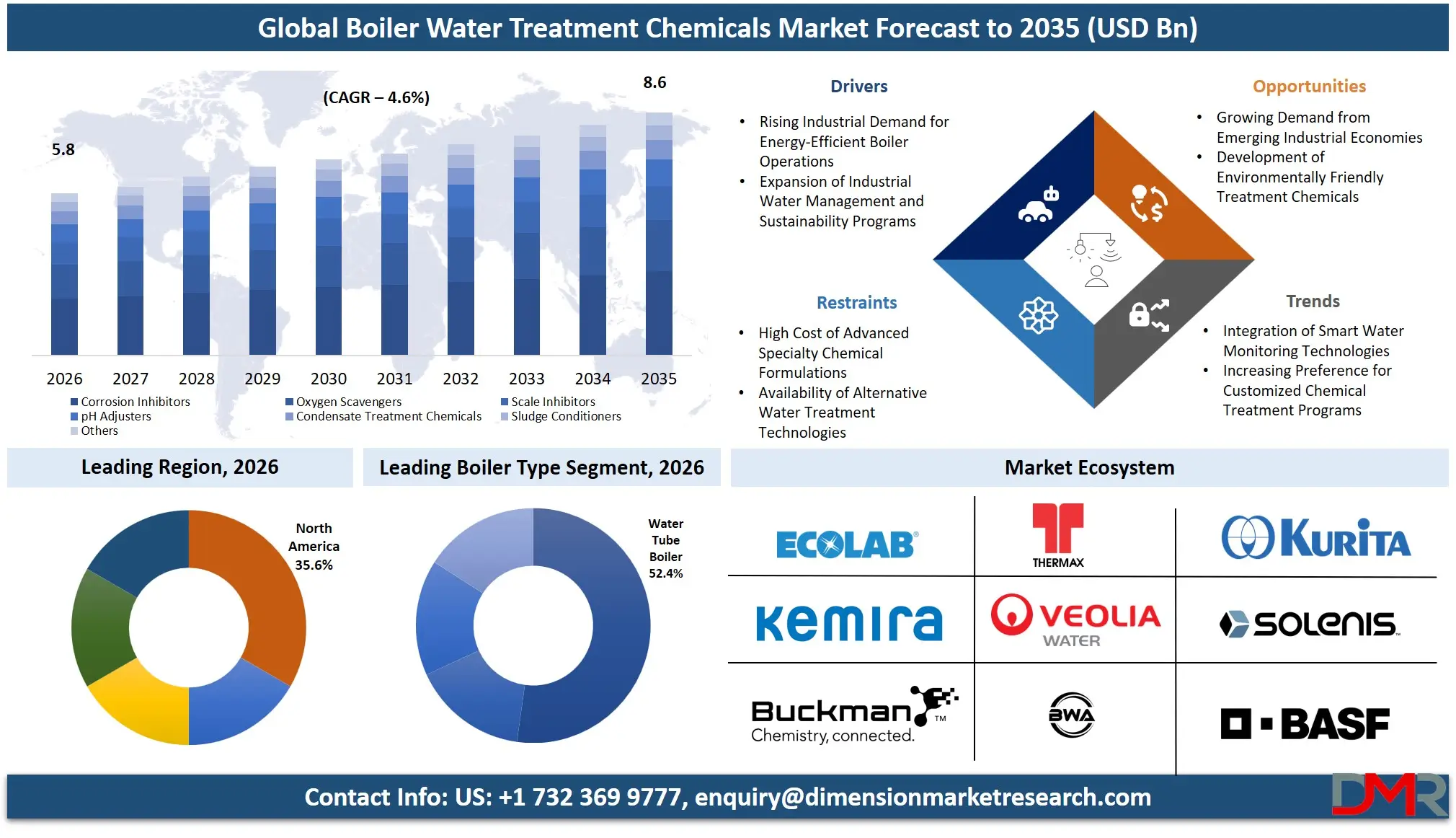
The Boiler Water Treatment Chemicals Market size is expected to be USD 5.8 billion in 2026 and increase at a compound annual growth rate of 4.6% to USD 8.6 billion in 2035 due to Rising Industrial Demand for Energy-Efficient Boiler Operations.
ℹ
To learn more about this report –
Download Your Free Sample Report Here
Boiler Water Treatment Chemicals Market comprises specialty chemical formulations designed to improve boiler efficiency, minimize corrosion, prevent scale formation, control sludge, regulate pH, and enhance the operational lifespan of industrial boiler systems. The market includes oxygen scavengers, corrosion inhibitors, scale inhibitors, pH adjusters, condensate treatment chemicals, sludge conditioners, and related specialty formulations used across power generation, oil and gas, chemicals, food processing, pharmaceuticals, and manufacturing industries. Growing industrialization, stricter environmental regulations, increased focus on energy efficiency, water conservation initiatives, and digital monitoring technologies are driving sustained market expansion while encouraging the adoption of advanced, environmentally friendly treatment solutions.
The US Boiler Water Treatment Chemicals Market
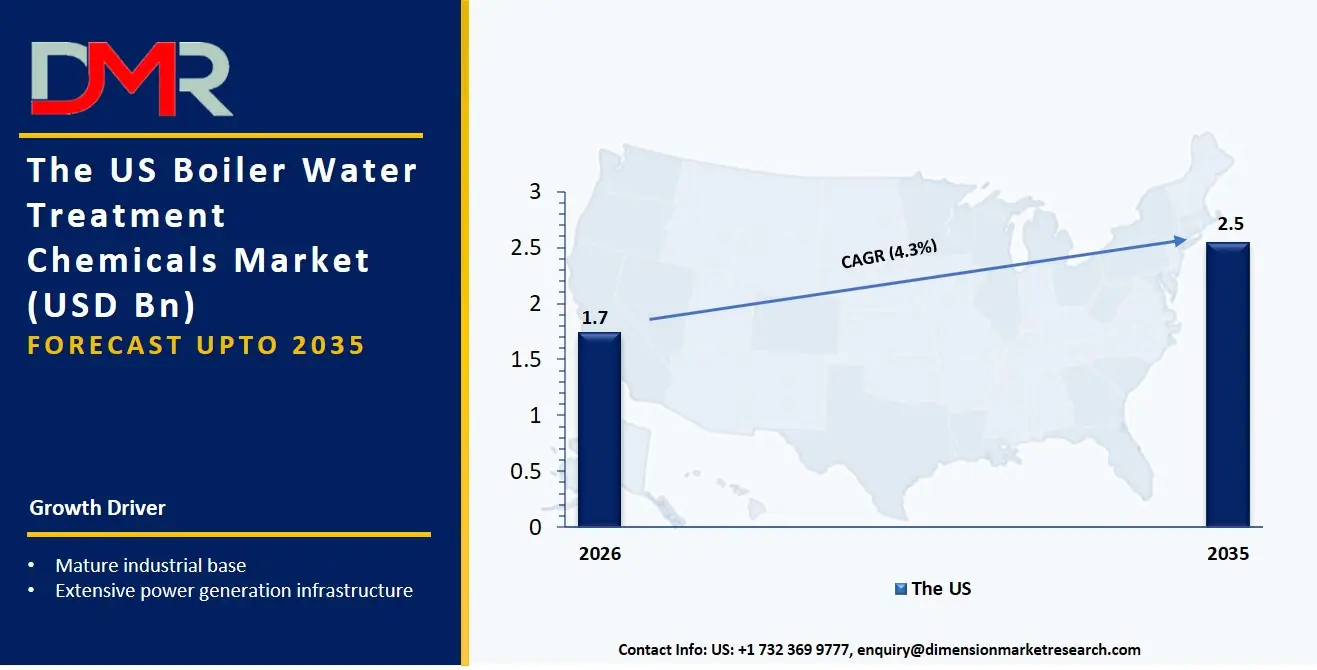
The US Boiler Water Treatment Chemicals Market size is estimated to be USD 1.7 billion in 2026 and is expected to increase at a CAGR of 4.3% over the forecast period.
ℹ
To learn more about this report –
Download Your Free Sample Report Here
The US Boiler Water Treatment Chemicals Market is supported by a mature industrial base, extensive power generation infrastructure, and widespread adoption of advanced water treatment technologies. Demand remains strong across oil and gas, chemicals, food processing, pharmaceuticals, and manufacturing industries where operational efficiency and equipment reliability are critical. Strict environmental regulations governing wastewater discharge and industrial emissions continue to encourage the use of high-performance and environmentally compliant chemical formulations. Technological innovation, predictive maintenance, and digital water management solutions further strengthen market growth while established manufacturers continuously expand their specialty chemical portfolios.
Europe Boiler Water Treatment Chemicals Market
The Europe Boiler Water Treatment Chemicals Market size is estimated to be USD 1.5 billion in 2026 and is expected to increase at a CAGR of 4.5% over the forecast period.
Europe Boiler Water Treatment Chemicals Market is characterized by stringent environmental legislation, ambitious sustainability initiatives, and widespread adoption of energy-efficient industrial processes. Policies promoting resource efficiency and reduced industrial emissions encourage industries to utilize environmentally responsible treatment chemicals. Chemical manufacturing, food and beverage processing, district heating systems, and pharmaceutical production remain major application sectors. Continuous innovation in biodegradable formulations, circular economy practices, and advanced water recycling technologies enhances market competitiveness while supporting long-term industrial sustainability goals throughout the region.
Japan Boiler Water Treatment Chemicals Market
The market size of Japan Boiler Water Treatment Chemicals will be USD 290 million in 2026 and at a CAGR of 4.6% in the forecast period.
Japan Boiler Water Treatment Chemicals Market benefits from advanced manufacturing capabilities, high-quality industrial infrastructure, and strong emphasis on operational reliability. Industries including electronics, chemicals, pharmaceuticals, food processing, and power generation increasingly adopt premium treatment chemicals to maximize equipment performance and minimize maintenance costs. Government support for energy conservation, efficient industrial operations, and sustainable water management encourages continuous technological innovation. Growing modernization of industrial facilities and demand for high-performance specialty chemicals further contribute to steady market development despite relatively mature industrial conditions.
Key Takeaways
- Market Size & Forecast: The Boiler Water Treatment Chemicals Market size is projected to reach USD 5.8 billion in 2026 and is anticipated to have a value of USD 8.6 billion in 2035.
- Growth Rate & Outlook: The Boiler Water Treatment Chemicals Market size is set to grow at a compound annual growth rate of 4.6% during the forecast period of 2026 to 2035.
- Primary Growth Drivers: Some of the major growth drivers in the market are Rising Industrial Demand for Energy-Efficient Boiler Operations, and more.
- Key Market Trends: Some of the major trends in the market are Integration of Increasing Preference for Customized Chemical Treatment Programs, and more.
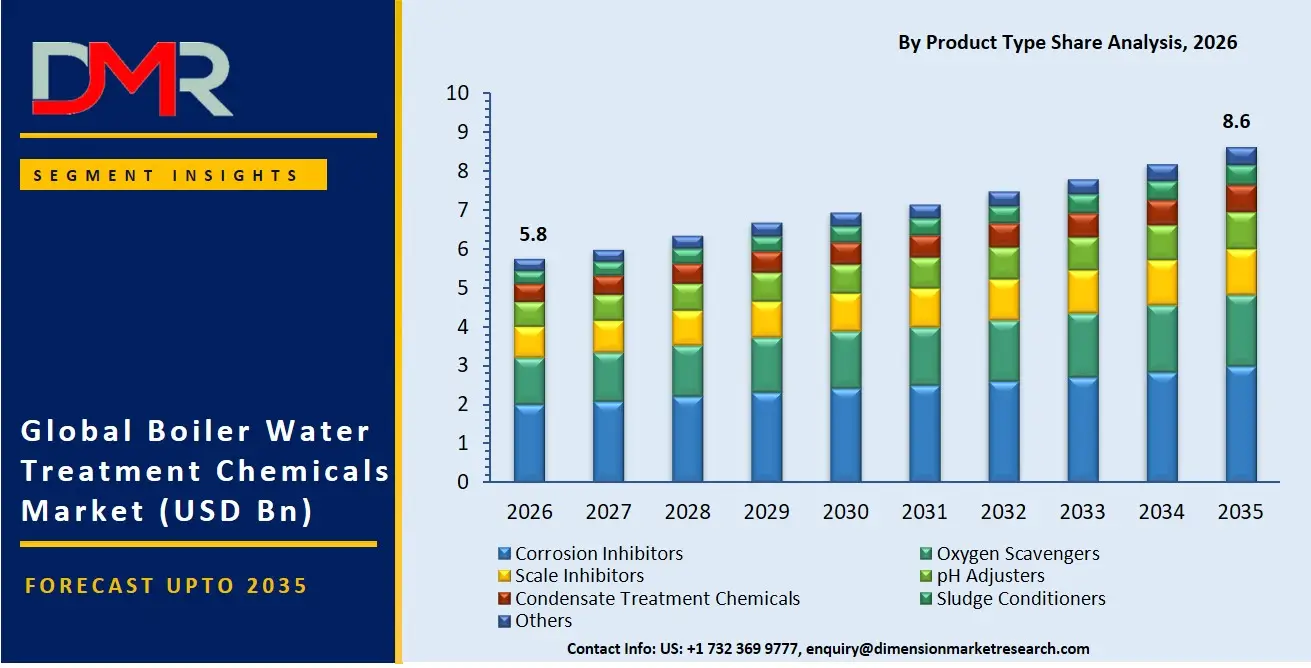
- By Product Type: Corrosion Inhibitors is anticipated to get the majority share of the Boiler Water Treatment Chemicals Market in 2026.
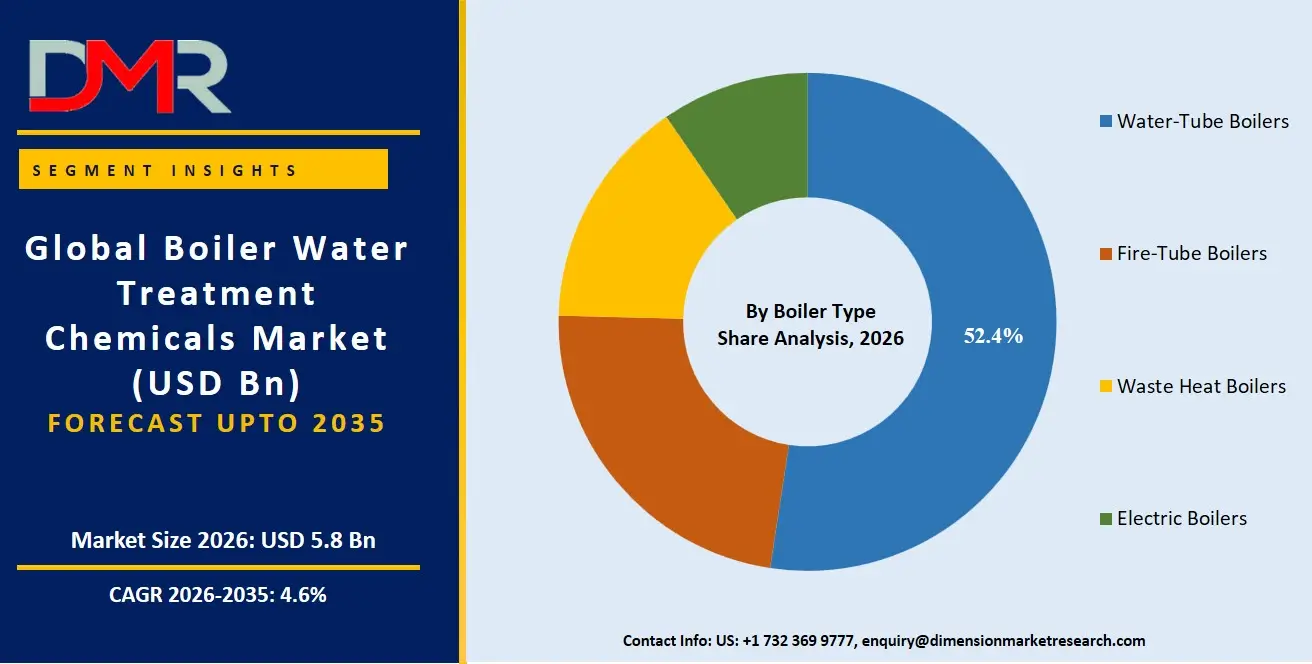
- By Boiler Type: Water tube boilers are expected to get the largest revenue share in 2026 in the Boiler Water Treatment Chemicals Market.
- Regional Leadership: North America is set to lead the Boiler Water Treatment Chemicals Market with an estimated 35.6% share in 2026.
What is the Boiler Water Treatment Chemicals?
Boiler water treatment chemicals are specialized formulations used to maintain water quality within boiler systems by preventing corrosion, scale deposition, sludge accumulation, microbial contamination, and excessive foaming. These chemicals optimize heat transfer efficiency, reduce maintenance requirements, extend equipment lifespan, lower energy consumption, and ensure reliable steam generation across industrial, commercial, and institutional applications while supporting safe and efficient boiler operation.
Use Cases
- Power Plant Boiler Protection: Boiler water treatment chemicals are extensively used in thermal and combined-cycle power plants to prevent corrosion, scaling, and fouling within high-pressure boilers. Proper treatment improves steam generation efficiency, minimizes unplanned shutdowns, lowers maintenance expenses, and extends equipment lifespan while ensuring continuous electricity production.
- Food and Beverage Manufacturing: Food processing facilities rely on treated boiler systems for steam generation used in cooking, sterilization, cleaning, and packaging operations. Water treatment chemicals help maintain hygiene standards, improve energy efficiency, reduce equipment deterioration, and ensure uninterrupted production while complying with strict industrial quality requirements.
- Chemical and Petrochemical Processing: Chemical processing facilities operate high-capacity boilers under demanding operating conditions. Specialized treatment chemicals prevent scale formation, corrosion, and sludge accumulation, improving operational safety, maintaining heat transfer efficiency, reducing production interruptions, and lowering long-term maintenance expenditures throughout complex industrial processes.
- Pharmaceutical Manufacturing: Pharmaceutical production requires reliable steam systems for sterilization, cleaning, and manufacturing processes. Boiler water treatment chemicals ensure consistent steam quality, protect expensive boiler equipment from corrosion and mineral deposits, improve operational efficiency, and support compliance with stringent manufacturing and quality standards.
How AI Is Transforming the Boiler Water Treatment Chemicals Market
Artificial intelligence is transforming the Boiler Water Treatment Chemicals Market by enabling predictive water quality monitoring, automated chemical dosing, and real-time boiler performance optimization. AI-powered analytics process operational data from sensors to detect scaling, corrosion, fouling, and water chemistry deviations before they become critical issues. This reduces unplanned downtime, improves equipment reliability, lowers maintenance costs, and extends boiler service life across industrial facilities.
AI also enhances product development by helping manufacturers formulate high-performance, environmentally sustainable treatment chemicals through advanced simulation and data analysis. Machine learning algorithms optimize chemical consumption based on changing operating conditions, while digital twins and predictive maintenance platforms improve asset management. AI-driven customer support, remote monitoring services, and intelligent reporting further strengthen operational efficiency, regulatory compliance, and decision-making throughout industrial water treatment operations.
Market Dynamic
Driving Factors in the Boiler Water Treatment Chemicals Market
Rising Industrial Demand for Energy-Efficient Boiler Operations
Growing industrial emphasis on energy efficiency and operational optimization continues to drive demand for boiler water treatment chemicals. Proper chemical treatment significantly improves heat transfer efficiency, minimizes scale accumulation, reduces corrosion, and lowers fuel consumption. Industries increasingly recognize that optimized boiler performance directly reduces operating costs while extending equipment lifespan. As manufacturers pursue sustainability objectives and productivity improvements, investments in advanced treatment chemicals continue to increase across multiple industrial sectors including power generation, food processing, petrochemicals, pharmaceuticals, and heavy manufacturing.
Restraints in the Boiler Water Treatment Chemicals Market
High Cost of Advanced Specialty Chemical Formulations
One of the primary challenges limiting market growth is the relatively high cost associated with advanced boiler water treatment chemicals. Premium formulations offering superior corrosion protection, environmentally friendly chemistry, and enhanced operational performance require greater investment than conventional alternatives. Small and medium-sized industrial facilities often prioritize short-term cost reductions over long-term operational efficiency, slowing adoption of premium treatment programs despite their proven lifecycle economic benefits.
Opportunities in the Boiler Water Treatment Chemicals Market
Growing Demand from Emerging Industrial Economies
Rapid industrialization across emerging economies creates significant opportunities for boiler water treatment chemical manufacturers. Expanding power generation capacity, chemical manufacturing, food processing, pharmaceutical production, and industrial infrastructure investments increase demand for reliable boiler systems. Many newly established manufacturing facilities are adopting modern water treatment technologies from the beginning, creating substantial opportunities for suppliers offering high-performance, environmentally sustainable chemical formulations and integrated water management solutions.
Trends in the Boiler Water Treatment Chemicals Market
Increasing Preference for Customized Chemical Treatment Programs
Industrial operators increasingly prefer customized boiler water treatment programs specifically designed for individual operating conditions, water quality characteristics, and industry requirements. Chemical suppliers are expanding technical consulting, laboratory analysis, and performance monitoring services to deliver tailored solutions. This shift from standardized products toward integrated service-based offerings strengthens customer relationships while improving treatment effectiveness and creating additional revenue opportunities for solution providers.
Research Scope and Analysis
The research scope analyzes the Boiler Water Treatment Chemicals Market through product type, boiler type, and end-use industry segmentation. It evaluates market trends, growth drivers, regional performance, competitive dynamics, technological developments, and emerging opportunities influencing industry expansion.
ℹ
To learn more about this report –
Download Your Free Sample Report Here
By Product Type Analysis
Among product types, Corrosion Inhibitors are estimated to account for 34.8% of the global Boiler Water Treatment Chemicals Market in 2026, making them the leading segment owing to their critical role in protecting boiler components, pipelines, condensate systems, and associated equipment from metal degradation. Industries operating high-pressure boilers prioritize corrosion prevention to reduce maintenance costs, extend equipment lifespan, improve operational reliability, and minimize production downtime. Continuous industrial expansion across power generation, chemicals, pharmaceuticals, food processing, and oil & gas further strengthens demand for corrosion inhibitors.
ℹ
To learn more about this report –
Download Your Free Sample Report Here
Technological advancements have also resulted in environmentally friendly and highly efficient inhibitor formulations that comply with increasingly stringent environmental regulations. Meanwhile, Scale Inhibitors are projected to be the fastest-growing product segment due to rising awareness regarding energy efficiency and the need to maintain optimal heat transfer performance. Increasing use of hard water, growing industrial infrastructure, and expanding investment in high-capacity boiler installations are expected to accelerate adoption of advanced scale control technologies throughout the forecast period.
By Boiler Type Analysis
Based on boiler type, Water-Tube Boilers are projected to hold the largest market share at 52.4% in 2026 because they are widely deployed in power generation facilities, petrochemical plants, refineries, heavy manufacturing, and large industrial operations requiring high-pressure steam production. These systems demand sophisticated water treatment programs to prevent scaling, corrosion, and sludge formation that could significantly affect operational efficiency and safety. Their widespread installation across industrial sectors supports sustained demand for premium treatment chemicals. Electric Boilers are anticipated to register the fastest growth during the forecast period owing to increasing industrial electrification, decarbonization initiatives, and adoption of clean energy solutions. Growing investment in sustainable industrial infrastructure and low-emission heating technologies is encouraging organizations to install electric boilers that require specialized water treatment formulations for reliable long-term performance.
By End Use Industry Analysis
The Power Generation segment is expected to dominate the Boiler Water Treatment Chemicals Market with an estimated 36.7% market share in 2026. Thermal, nuclear, biomass, and combined-cycle power plants operate extensive boiler networks that require continuous chemical treatment to maintain steam quality, prevent corrosion, minimize scaling, and maximize plant efficiency. Increasing electricity demand, modernization of aging power infrastructure, and expansion of utility-scale generating facilities continue supporting the segment's leadership. At the same time, the Pharmaceuticals segment is anticipated to witness the fastest growth due to expanding pharmaceutical manufacturing capacity, rising regulatory requirements for high-purity steam systems, and increasing investments in biotechnology and healthcare production facilities. These industries require advanced boiler treatment chemicals to ensure operational reliability, equipment longevity, and compliance with stringent quality standards.
The Boiler Water Treatment Chemicals Market Report is segmented on the basis of the following:
By Product Type
- Oxygen Scavengers
- Scale Inhibitors
- Corrosion Inhibitors
- pH Adjusters
- Condensate Treatment Chemicals
- Sludge Conditioners
- Others
By Boiler Type
- Fire-Tube Boilers
- Water-Tube Boilers
- Waste Heat Boilers
- Electric Boilers
By End-Use Industry
- Power Generation
- Oil & Gas
- Chemicals & Petrochemicals
- Food & Beverage
- Pharmaceuticals
- Pulp & Paper
- Metals & Mining
- Textile
- Others
Regional Analysis
Leading Region in the Boiler Water Treatment Chemicals Market
ℹ
To learn more about this report –
Download Your Free Sample Report Here
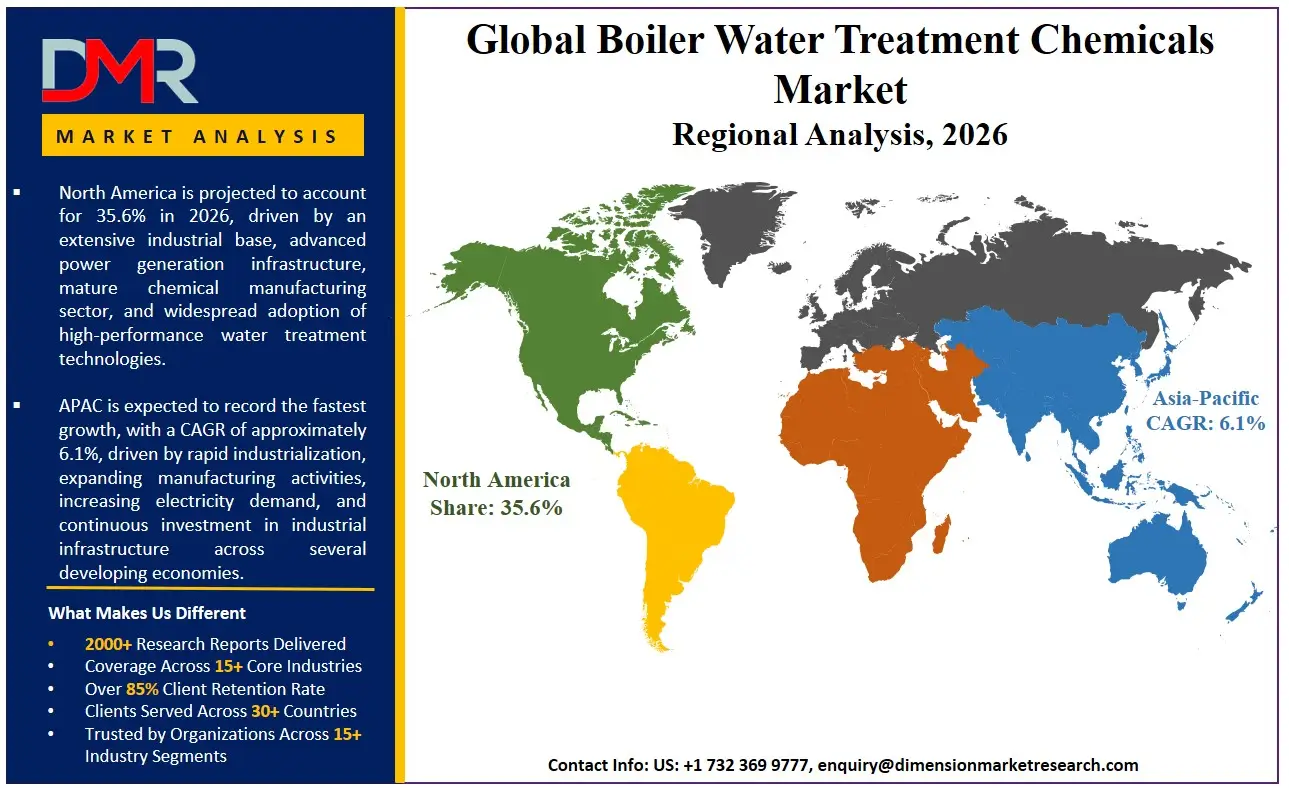
North America is projected to remain the leading regional market with an estimated 35.6% share of the global Boiler Water Treatment Chemicals Market in 2026. The region benefits from an extensive industrial base, advanced power generation infrastructure, mature chemical manufacturing sector, and widespread adoption of high-performance water treatment technologies. Strict environmental regulations governing industrial emissions, wastewater discharge, and equipment efficiency encourage continuous investment in advanced treatment chemicals. Strong research and development capabilities, rapid adoption of digital water management systems, and significant demand from oil & gas, food processing, pharmaceuticals, and manufacturing industries further reinforce North America's leadership position. Continuous modernization of industrial facilities and emphasis on operational sustainability are expected to sustain regional market dominance throughout the forecast period.
Fastest Growing Region in the Boiler Water Treatment Chemicals Market
Asia-Pacific is expected to record the fastest growth during the forecast period due to rapid industrialization, expanding manufacturing activities, increasing electricity demand, and continuous investment in industrial infrastructure across several developing economies. Countries throughout the region are significantly expanding power generation capacity, chemical production, food processing, pharmaceuticals, and heavy manufacturing, creating substantial demand for efficient boiler water treatment solutions. Government initiatives promoting industrial modernization, water conservation, environmental protection, and energy efficiency further support market expansion. Rising foreign direct investment, urbanization, infrastructure development, and growing awareness regarding preventive equipment maintenance encourage industries to adopt advanced boiler treatment chemicals, positioning Asia-Pacific as the fastest-growing regional market.
By Region
North America
Europe
- Germany
- The U.K.
- France
- Italy
- Russia
- Spain
- Benelux
- Nordic
- Rest of Europe
Asia-Pacific
- China
- Japan
- South Korea
- India
- ANZ
- ASEAN
- Rest of Asia-Pacific
Latin America
- Brazil
- Mexico
- Argentina
- Colombia
- Rest of Latin America
Middle East & Africa
- Saudi Arabia
- UAE
- South Africa
- Israel
- Egypt
- Rest of MEA
Competitive Landscape
The Boiler Water Treatment Chemicals Market is characterized by strong competition driven by product innovation, technical expertise, service capabilities, and long-term customer relationships. Market participants focus on developing advanced formulations with improved efficiency, reduced environmental impact, and compatibility with modern boiler systems. Competitive advantages are strengthened through investments in research and development, expansion of service networks, customized treatment programs, and digital monitoring solutions. Companies are increasingly adopting partnership strategies with industrial operators to provide integrated water management services rather than standalone chemical products. High technical requirements, regulatory compliance standards, and the need for specialized application knowledge create entry barriers for new participants. Strategic expansion into emerging economies, sustainable chemistry development, and adoption of smart water treatment technologies remain key approaches for maintaining market competitiveness.
Some of the prominent players in the global Boiler Water Treatment Chemicals are:
- Veolia Water Technologies
- Ecolab Inc. (Nalco Water)
- Kurita Water Industries Ltd.
- Solenis LLC
- Kemira Oyj
- SUEZ Water Technologies & Solutions
- Thermax Limited
- ChemTreat, Inc.
- Buckman Laboratories International, Inc.
- BWA Water Additives
- Accepta Ltd.
- Aries Chemical, Inc.
- Wilhelmsen
- Wego Chemical Group
- Hubbard-Hall Inc.
- Cortec Corporation
- Henkel AG & Co. KGaA
- BASF SE
- Dow Inc.
- Nouryon
- Other Key Players
Recent Developments
- In September 2025, Veolia announced further development of its industrial water treatment capabilities by integrating advanced digital technologies with chemical treatment services. The initiative focused on improving industrial water optimization, operational efficiency, and sustainability performance for customers managing complex boiler and steam systems. Through enhanced monitoring, data analytics, and customized treatment approaches, Veolia aimed to help industries reduce resource consumption and improve equipment reliability.
- In June 2025, Kurita Water Industries expanded its sustainable water treatment initiatives by introducing enhanced solutions focused on reducing environmental impact while improving industrial water system efficiency. The company emphasized advanced chemical formulations and service technologies designed for energy-intensive industries operating boiler and steam systems. The development supported growing customer demand for environmentally responsible treatment programs that reduce chemical consumption and improve operational performance.
- In February 2025, Ecolab announced advancements in its digital water management capabilities through enhanced monitoring and analytics solutions designed to improve industrial water efficiency. The company expanded the application of its digital platforms to support predictive insights, optimized chemical usage, and improved boiler system performance for industrial customers. The initiative focused on helping facilities reduce water consumption, minimize operational disruptions, and achieve sustainability objectives.
Report Details
| Report Characteristics |
| Market Size (2026) |
USD 5.8 Bn |
| Forecast Value (2035) |
USD 8.6 Bn |
| CAGR (2026–2035) |
4.6% |
| Historical Period |
2021 – 2025 |
| Forecast Period |
2027 – 2035 |
| Base Year |
2025 |
| Estimate Year |
2026 |
| Segments Covered |
By Product Type, By Boiler Type, By End-Use Industry |
| Regional Coverage |
North America – The US and Canada; Europe – Germany, The UK, France, Russia, Spain, Italy, Benelux, Nordic, & Rest of Europe; Asia-Pacific – China, Japan, South Korea, India, ANZ, ASEAN, Rest of APAC; Latin America – Brazil, Mexico, Argentina, Colombia, Rest of Latin America; Middle East & Africa – Saudi Arabia, UAE, South Africa, Turkey, Egypt, Israel, & Rest of MEA |
Frequently Asked Questions
How big is the Boiler Water Treatment Chemicals Market?
▾ The Boiler Water Treatment Chemicals Market size is expected to reach USD 5.8 billion by 2026 and is projected to reach USD 8.6 billion by the end of 2035.
What is the CAGR of the Boiler Water Treatment Chemicals Market from 2026 to 2035?
▾ The market is growing at a CAGR of 4.6 percent over the forecasted period.
What factors are driving the growth of the Boiler Water Treatment Chemicals Market?
▾ Rising Industrial Demand for Energy-Efficient Boiler Operations, and more are the factors driving the growth of the Boiler Water Treatment Chemicals Market.
What are the major trends in the Boiler Water Treatment Chemicals Market?
▾ Increasing Preference for Customized Chemical Treatment Programs, and more are some of the major trends in the market.
Who are the key players in the Boiler Water Treatment Chemicals Market?
▾ Some of the key players in the Boiler Water Treatment Chemicals Market include Thermax, Ecolab, BASF, and more
How is the Boiler Water Treatment Chemicals Market segmented?
▾ The Boiler Water Treatment Chemicals Market is segmented by product type, boiler type, end-use industry.
Which region held the largest share of the Boiler Water Treatment Chemicals Market in 2026?
▾ North America is set to lead the Boiler Water Treatment Chemicals Market with an estimated 35.6% share in 2026.
Which region is expected to grow the fastest in the Boiler Water Treatment Chemicals Market?
▾ Asia Pacific is the fastest-growing region in the Boiler Water Treatment Chemicals Market during the forecast period.