Brazil Cold Chain Logistics Market Snapshot
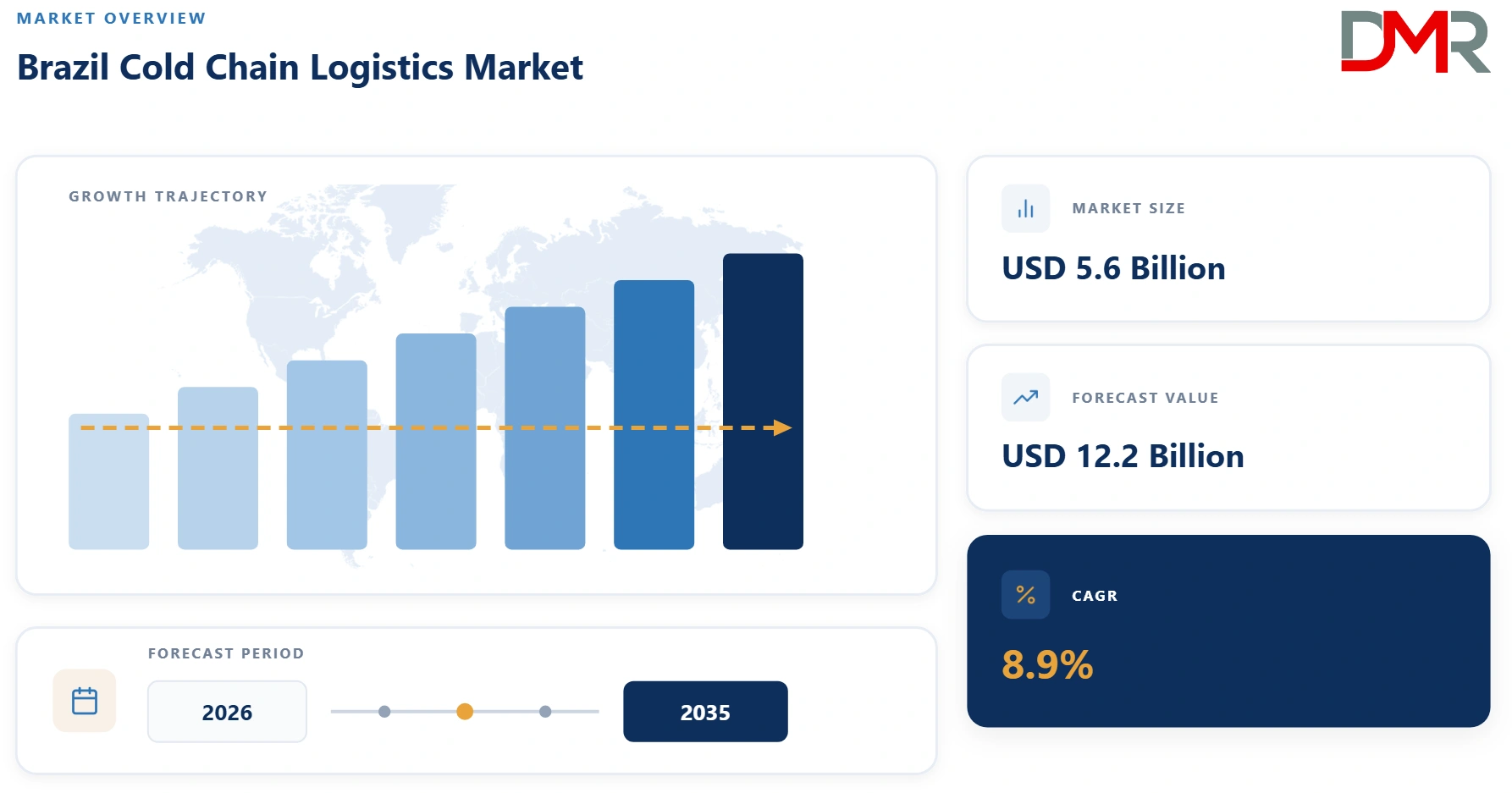
- Market Size in 2026: USD 5.6 billion
- Market Size in 2035: USD 12.2 billion
- CAGR, 2026-2035: 8.9%
- Leading Service Segment, 2026: Refrigerated Warehouse, 50.6%
- Leading Application Segment, 2026: Meat, 29.0%
- Leading Temperature Segment, 2026: Frozen, 58.0%
- Fastest-Growing Segment: Alternative Protein, 12.4% CAGR
What is the Brazil Cold Chain Logistics and its Market Size?
The Brazil cold chain logistics market is estimated at USD 5.6 billion in 2026 and is projected to reach approximately USD 12.2 billion by 2035, representing an 8.9% CAGR.
ℹ
To learn more about this report –
Download Your Free Sample Report Here
Brazil cold chain logistics comprises the infrastructure, transportation, warehousing, handling, monitoring and distribution services required to preserve temperature-sensitive products from origin to final customer. The market includes refrigerated warehouses, reefer trucks and containers, cross-docking, temperature-controlled last-mile distribution, cold-chain packaging and associated monitoring services. Its primary value proposition is maintaining product quality, safety, shelf life and regulatory compliance while minimizing spoilage, inventory losses and temperature excursions. Brazil's importance is amplified by its large meat, poultry, seafood, dairy, horticulture and processed-food industries, as well as expanding temperature-sensitive pharmaceutical distribution.
Use Cases
- Meat and poultry distribution: Maintains frozen and chilled products from slaughterhouses and processors through retail and food-service networks.
- Seafood preservation: Protects highly perishable seafood during inland transport, port handling, storage and export movements.
- Fruit and vegetable logistics: Extends shelf life through controlled temperature, humidity management, rapid cooling and optimized transportation.
- Dairy distribution: Supports temperature-controlled movement of milk, cheese, yogurt, butter and other dairy products.
- Frozen food fulfillment: Enables inventory buffering and reliable distribution of frozen meals, desserts, ingredients and convenience foods.
- Alternative protein distribution: Provides specialized storage and transportation for plant-based, cultivated and other emerging protein products.
Key Takeaways
- Market Size and Growth: Brazil's cold chain logistics market is estimated at USD 5.64 billion in 2026 and is expected to reach USD 12.16 billion by 2035 at an 8.9% CAGR.
- Growth Drivers: Agrifood exports, urbanization, modern retail, food-service expansion, pharmaceutical cold chains and infrastructure modernization underpin demand.
- Segment Dominance: Refrigerated warehousing leads service revenue with approximately 50.6% share, while frozen products represent the largest temperature category.
- Application Leadership: Meat remains the largest application because of Brazil's exceptionally large domestic processing and export ecosystem.
- Fastest Growth: Alternative protein is expected to grow fastest as food manufacturers expand plant-based and other novel-protein portfolios.
- Technology: IoT monitoring, predictive analytics, automated warehouses and energy-efficient refrigeration are increasingly important competitive differentiators.
How AI/Gen AI is Transforming the Brazil Cold Chain Logistics Market?
AI, IoT and cloud platforms are increasingly being integrated across Brazilian cold chains through connected temperature sensors, GPS fleet tracking, automated warehouse systems, digital dashboards and predictive analytics. These systems enable operators to monitor temperature, humidity, location, vehicle performance and inventory conditions in near real time. Brazil-based operators are already emphasizing digital dashboards, mobility and operational intelligence, while global logistics providers increasingly offer real-time shipment visibility and condition monitoring.
The principal benefits are lower spoilage, faster exception management, improved asset utilization, better route planning and more accurate inventory decisions. Predictive analytics can identify refrigeration failures before products are exposed to unacceptable conditions, while cloud-based control towers connect shippers, warehouses and carriers.
Key Drivers in the Brazil Cold Chain Logistics Market
Expansion of Agrifood Production and Export-Oriented Supply Chains
Brazil's position as a major global producer and exporter of meat, poultry, seafood, fruit and processed food creates structural demand for temperature-controlled logistics. Export supply chains require refrigerated staging near processing facilities, ports and airports, together with reliable inland transportation. Meat and poultry in particular require strict temperature management from processing through export terminals. The growing geographic distance between agricultural production zones and domestic consumption centers further increases dependence on refrigerated transportation and strategically located warehouses. Expansion of modern food retail, food service and distribution networks adds recurring domestic demand. Consequently, logistics providers are investing in multi-temperature facilities, regional hubs and integrated storage-and-transport services.
Rising Outsourcing and Temperature-Sensitive Product Complexity
Manufacturers and distributors increasingly outsource cold storage and transportation to specialized third-party logistics providers to avoid heavy capital expenditure and gain access to qualified infrastructure. The trend is particularly important for companies handling multiple temperature regimes, seasonal demand and geographically dispersed customers. Pharmaceutical and advanced healthcare products also raise the value of specialized temperature-controlled services. Brazil's regulatory framework requires appropriate monitoring, qualified transportation environments and contingency arrangements for thermolabile medicines, reinforcing demand for professional operators.
Restraints in the Brazil Cold Chain Logistics Market
High Energy, Refrigeration and Infrastructure Costs
Cold-chain operations are significantly more energy intensive than conventional logistics. Refrigeration systems, backup power, insulated facilities, reefer vehicles and temperature-monitoring equipment increase both capital and operating expenditure. Electricity-price volatility can compress margins, particularly for operators serving price-sensitive food customers. Brazil's long transport distances and climatic diversity further increase refrigeration requirements. Older warehouses may also have inefficient refrigeration equipment and inadequate insulation, creating opportunities for modernization but raising the upfront investment required. Smaller logistics companies can find it difficult to finance advanced refrigeration, automation and digital monitoring systems, contributing to uneven service quality and continued market fragmentation.
High Energy, Refrigeration and Infrastructure Costs
Cold-chain operations are significantly more energy intensive than conventional logistics. Refrigeration systems, backup power, insulated facilities, reefer vehicles and temperature-monitoring equipment increase both capital and operating expenditure. Electricity-price volatility can compress margins, particularly for operators serving price-sensitive food customers. Brazil's long transport distances and climatic diversity further increase refrigeration requirements. Older warehouses may also have inefficient refrigeration equipment and inadequate insulation, creating opportunities for modernization but raising the upfront investment required. Smaller logistics companies can find it difficult to finance advanced refrigeration, automation and digital monitoring systems, contributing to uneven service quality and continued market fragmentation.
Growth Opportunities in the Brazil Cold Chain Logistics Market
Regional Cold-Chain Hubs in Underserved Agricultural Corridors
The expansion of Brazilian agricultural production creates opportunities for decentralized cold-chain hubs closer to production regions. Facilities located near protein processors, fruit-growing areas, dairy clusters and major highways can reduce empty miles, improve product consolidation and lower time between harvest or processing and refrigerated storage. Multi-temperature facilities are particularly attractive because they allow operators to serve food manufacturers, wholesalers, retailers and food-service customers from the same asset base. Southern and Central-Western agricultural corridors offer attractive opportunities for new facilities, while secondary Northeast markets can benefit from investments connecting producers to urban consumers and export gateways
Digital, Sustainable and Energy-Efficient Cold Chains
Energy-efficient refrigeration, renewable electricity, automated warehouses, IoT monitoring and predictive maintenance create an expanding technology investment opportunity. Operators can reduce electricity consumption while differentiating themselves through lower emissions and stronger service-level performance. Friozem, for example, reports integrated information systems for inventory, distribution and fleet tracking and has highlighted renewable-energy use in its network. Digitalization also creates new recurring revenue opportunities around visibility platforms, analytics, temperature-monitoring subscriptions and supply-chain control towers. As customers increasingly demand measurable ESG performance, low-carbon refrigeration and optimized transportation can become commercial differentiators rather than merely compliance initiatives.
Trends in the Brazil Cold Chain Logistics Market
Consolidation and Integrated Cold-Chain Platforms
Brazil's cold-chain market is gradually moving toward larger integrated providers capable of combining storage, transportation, distribution and value-added services. Recent acquisitions and facility investments demonstrate a strategy of increasing geographic density and capturing more customer spend. Emergent Cold LatAm's acquisition of Comfrio expanded its Brazilian network to 37 facilities, 4 million cubic meters and 610,000 pallet positions, illustrating the scale of consolidation.
Multi-Temperature and Technology-Enabled Warehousing
Customers increasingly prefer facilities capable of handling frozen, chilled and sometimes ambient products within integrated distribution networks. Automated inventory systems, real-time dashboards and temperature sensors are being combined with multi-temperature chambers. This increases asset flexibility and enables operators to serve multiple end markets while reducing customer reliance on separate logistics providers. Friozem's recent digital transformation initiatives specifically emphasize real-time operational dashboards, mobility, automation and data intelligence.
Research Scope and Analysis
The Brazil cold chain logistics market is segmented by Service Type, Application, Temperature Type and Technology. The analysis evaluates refrigerated storage and transportation, major temperature-sensitive end markets, frozen versus chilled flows, and thermal-control technologies used for specialized shipments.
ℹ
To learn more about this report –
Download Your Free Sample Report Here
By Service Type Analysis
Refrigerated Warehouse is estimated to dominate Brazil's cold-chain logistics market in 2026 with approximately 50.6% share, supported by the need to buffer seasonal agricultural production, consolidate food shipments and synchronize inland distribution with retail and export schedules. Published market research similarly identifies refrigerated storage as the largest service category at approximately 50.6% of the market. Refrigerated Transportation represents the second-largest sub-segment at approximately 39.8%, benefiting from Brazil's large geographic footprint and reliance on road freight. The fastest-growing service sub-segment is Refrigerated Transportation, estimated at approximately 9.4% CAGR, as producers increasingly outsource fleet operations and require temperature-controlled last-mile and interregional distribution. Warehouse growth remains strong because operators continue adding strategically located facilities near metropolitan consumption centers and agricultural corridors. The combination of storage, cross-docking and transportation is increasingly becoming a competitive requirement, reducing the attractiveness of standalone cold-storage assets.
By Application Analysis
Meat is estimated to be the leading application in 2026, representing approximately 29.0% of market revenue. Brazil's global importance in beef and poultry production, substantial domestic consumption and export-oriented processing ecosystem create recurring demand for frozen and chilled logistics. Fruit & Vegetable is the second-largest application at an estimated 22.5% share, supported by Brazil's large horticultural production and growing demand for shelf-life extension. Alternative Protein is forecast to be the fastest-growing application, at approximately 12.4% CAGR, albeit from a smaller base, as plant-based foods and emerging protein categories expand their presence in supermarkets and food service. Seafood, dairy and other processed foods provide additional demand pools. The broad application mix reduces market dependence on any single commodity and allows multi-temperature logistics providers to improve warehouse utilization throughout the year.
By Temperature Analysis
Frozen products account for an estimated 58.0% share of the Brazil cold-chain market in 2026, making frozen the dominant temperature category. The leadership reflects the large scale of frozen meat and poultry distribution, frozen food consumption, long-distance transportation and export logistics. Chilled products account for approximately 42.0%, supported by fresh meat, dairy, seafood, fruit, vegetables and premium food products. Chilled logistics is nevertheless expected to grow faster, at approximately 9.7% CAGR, as consumers increasingly prioritize freshness and minimally processed products and retailers expand chilled assortments. Frozen logistics retains a structural advantage because products can generally tolerate longer storage periods and can be moved across longer distances, making frozen facilities particularly important for export-oriented supply chains. Meanwhile, chilled logistics is becoming more technologically sophisticated because shorter temperature excursions can materially affect quality and shelf life.
By Technology Analysis
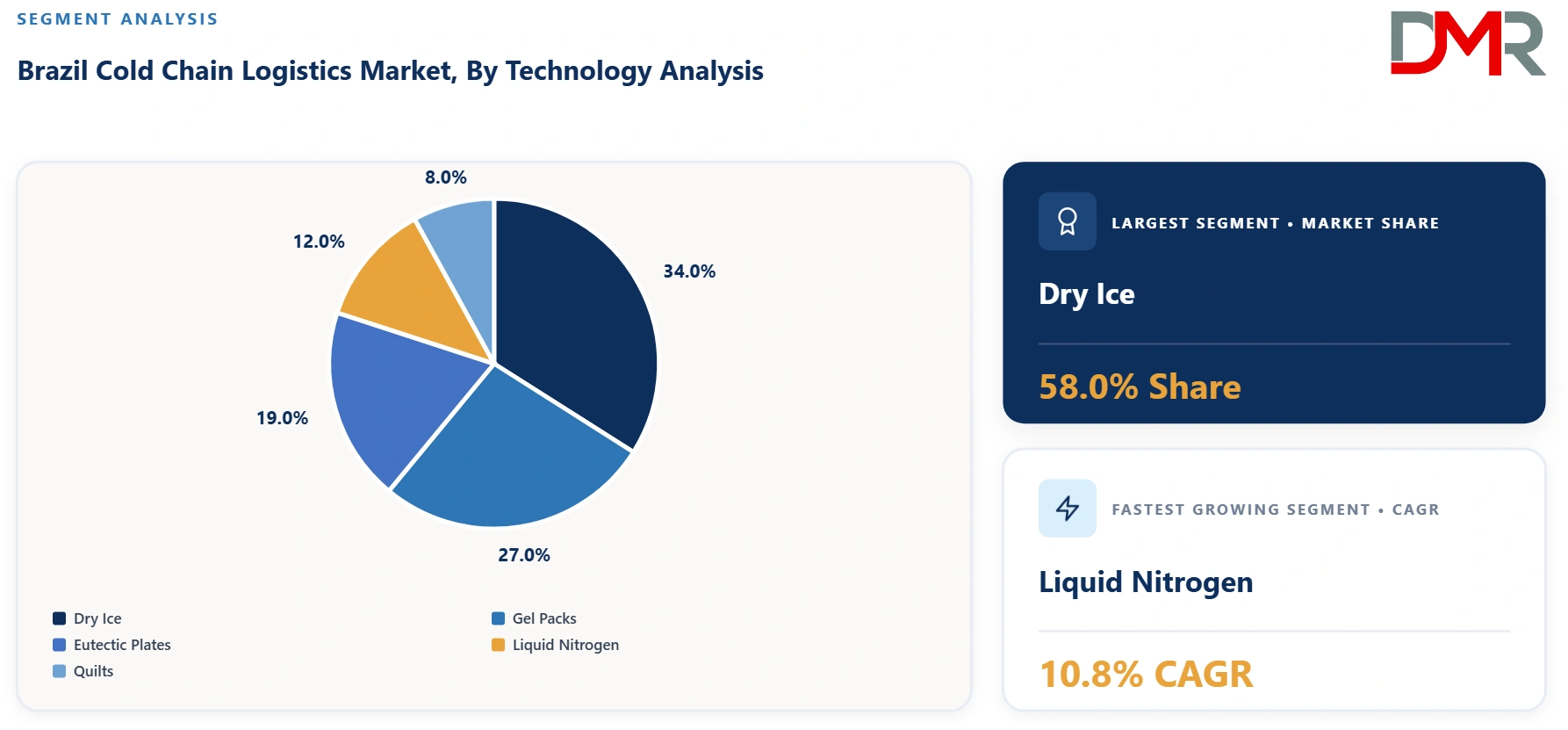
Among the specified thermal-control technologies, Dry Ice is estimated to hold the largest share at approximately 34.0% of technology-specific revenue in 2026, particularly in specialized frozen shipments, pharmaceutical applications and shipments requiring portable thermal control. Gel Packs represent the second-largest category at approximately 27.0%, supported by their reusability, lower handling complexity and suitability for chilled products and smaller shipments. Liquid Nitrogen is expected to be the fastest-growing technology, with an estimated 10.8% CAGR, driven by specialized ultra-low-temperature requirements, advanced healthcare applications and high-value biological materials. Eutectic Plates and Quilts remain important for reusable and passive temperature-control applications. The technology mix is expected to evolve toward reusable systems, sensor-enabled packaging and energy-efficient thermal solutions. Importantly, these percentages refer to the specified technology categories, rather than the entire refrigeration-equipment market.
The Brazil Cold Chain Logistics Market Report is segmented on the basis of the following:
By Service Type
- Refrigerated Warehouse
- Refrigerated Transportation
By Application
- Seafood
- Meat
- Fruit & Vegetable
- Dairy Products
- Alternative Protein
- Others
By Temperature Type
By Technology
- Dry Ice
- Gel Packs
- Eutectic Plates
- Liquid Nitrogen
- Quilts
Regulatory Landscape
Brazil's regulatory environment increasingly favors qualified cold-chain providers because temperature-sensitive products require documented handling, monitoring and contingency procedures. ANVISA's RDC 430 establishes good practices for distribution, storage and transportation of medicines and specifically defines cold-chain activities covering storage, handling, distribution and transportation of temperature-sensitive products. For thermolabile medicines, transportation must use thermally qualified environments, while temperature monitoring and control are required during storage and transportation. For food applications, sanitary requirements and product-specific temperature controls similarly raise the value of reliable infrastructure. Regulatory compliance creates entry barriers for informal operators but increases demand for validated systems, calibrated sensors, documented procedures and specialized staff. The major risk is that changing requirements increase compliance costs, especially for smaller providers.
Investment and White Space Analysis
Investment opportunities are strongest in regional multi-temperature warehouses, integrated transport networks, digital control towers and energy-efficient refrigeration. Recent investment activity demonstrates market confidence: Friozem invested approximately BRL 95 million in its Rio 2 facility, adding 116,000 m³ and 19,200 pallet positions, while Emergent Cold LatAm's Comfrio acquisition created a network spanning 37 facilities and 4 million m³. White space remains in secondary agricultural corridors, Northeast distribution and technology-enabled small-to-mid-sized facilities. Investors should prioritize locations near production clusters, highways, ports and large consumption centers. Risks include high electricity costs, long payback periods, customer concentration and climate-related disruption to infrastructure.
Competitive Landscape
Brazil's cold-chain logistics industry is moderately fragmented but consolidating, with domestic specialists competing against multinational logistics companies and increasingly well-capitalized regional platforms. Major competitive strategies include acquisitions, greenfield warehouse development, customer-dedicated facilities, geographic expansion, multi-temperature capability and technology investments. Providers compete primarily on network coverage, storage capacity, temperature reliability, service quality, transportation availability, technology integration and price. The market is shifting toward integrated solutions combining warehousing, transport, cross-docking, inventory management and digital visibility. The acquisition of Comfrio by Emergent Cold LatAm illustrates the consolidation trend, while Friozem and SuperFrio continue expanding specialized infrastructure.
Some of the prominent players in the Brazil Cold Chain Logistics Market are:
- Emergent Cold LatAm
- SuperFrio Logística Frigorificada
- Comfrio Logística
- Friozem Armazéns Frigoríficos
- Brado Logística
- Localfrio
- Arfrio Armazéns Frigoríficos
- Refrio Armazéns Gerais
- Brasfrigo
- Movecta
- CAP Logística Frigorificada
- JSL Logística
- Logfrio
- Solistica
- DHL Supply Chain
- Kuehne+Nagel
- DSV
- Lineage Logistics
- Americold Logistics
- Nippon Express
- Yusen Logistics
- Maersk
- CEVA Logistics
- DB Schenker
- FedEx Logistics
- UPS Supply Chain Solutions
- Ransa Comercial
- Luft Logistics
- AGL Transportes Internacionais
- Abreu e Lima Logística
- TCP Logística
- Martini Meat
- Cargill Brasil
- JBS
- BRF
- Marfrig Global Foods
- Aurora Coop
- Frimesa
- Frigorífico Mercosul
- Minerva Foods
- Other Key Players
Recent Developments
- In May 2026, Friozem inaugurated its Rio 2 distribution center in Duque de Caxias, backed by approximately BRL 95 million, adding 116,000 m³ and 19,200 pallet positions to its network.
- In April 2026, Friozem highlighted a new operational dashboard using real-time data to improve separation, checking, mobility, productivity and management intelligence across its cold-chain operations.
- In September 2025, Emergent Cold LatAm completed its acquisition of Comfrio, expanding its Brazilian platform to 37 facilities, 4 million m³, 610,000 pallet positions and 3,500 employees.
- In April 2025, Emergent Cold LatAm announced its acquisition of Comfrio, targeting stronger Brazilian market coverage and synergies across temperature-controlled food storage and logistics.
- In March 2025, DHL Group acquired CRYOPDP to strengthen specialized healthcare logistics, supporting temperature-sensitive pharmaceutical, clinical-trial and advanced-therapy supply chains.
Report Details
| Report Characteristics |
| Market Size (2026) |
USD 5.6 Bn |
| Forecast Value (2035) |
USD 12.2 Bn |
| CAGR (2026–2035) |
8.9% |
| Historical Data |
2021 – 2025 |
| Forecast Data |
2026 – 2035 |
| Base Year |
2025 |
| Segments Covered |
By Service Type, By Application, By Temperature Type, By Technology |
| Country Coverage |
Brazil |
Frequently Asked Questions
What is the size of the Brazil Cold Chain Logistics Market in 2026?
▾ The Brazil Cold Chain Logistics Market is estimated at USD 5.6 billion in 2026, covering refrigerated warehousing, transportation and related temperature-controlled services.
What will the Brazil Cold Chain Logistics Market size reach by 2035?
▾ The Brazil Cold Chain Logistics Market is projected to reach approximately USD 12.2 billion by 2035, driven by rising demand for temperature-controlled logistics.
What is the CAGR of the Brazil Cold Chain Logistics Market from 2026 to 2035?
▾ The Brazil Cold Chain Logistics Market is expected to expand at approximately 8.9% CAGR between 2026 and 2035.
What are the key growth drivers of the Brazil Cold Chain Logistics Market?
▾ Major drivers include agrifood exports, meat and poultry production, modern retail, food-service expansion, pharmaceutical logistics, outsourcing and cold-chain infrastructure modernization.
Which segment dominates the Brazil Cold Chain Logistics Market?
▾ Refrigerated Warehouse is the leading service segment in the Brazil Cold Chain Logistics Market, accounting for approximately 50.6% share in 2026.
Which is the fastest-growing segment in the Brazil Cold Chain Logistics Market?
▾ Alternative Protein is projected to be the fastest-growing application in the Brazil Cold Chain Logistics Market, with an estimated 12.4% CAGR.
Who are the major players in the Brazil Cold Chain Logistics Market?
▾ Major participants in the Brazil Cold Chain Logistics Market include Friozem, SuperFrio, Emergent Cold LatAm, DHL and other domestic and international logistics providers.
How is the Brazil Cold Chain Logistics Market segmented?
▾ The Brazil Cold Chain Logistics Market is segmented by Service Type, Application, Temperature Type and Technology, covering refrigerated logistics and temperature-sensitive products.