Brazil Food Packaging Market Snapshot
- Brazil Food Packaging Market Size in 2026: USD 10.0 Billion
- Brazil Food Packaging Market Size in 2035: USD 15.8 Billion
- Brazil CAGR from 2026 to 2035: 5.2%
- Flexible Packaging is the leading packaging type segment in 2026: 46.8%
- Plastic is the leading material type segment in 2026: 51.5%
- Meat, Poultry and Seafood is the leading food category segment in 2026: 26.7%
- Food Processing Companies is the leading end use channel segment in 2026: 61.4%
What is the Brazil Food Packaging Market and its Market Size?
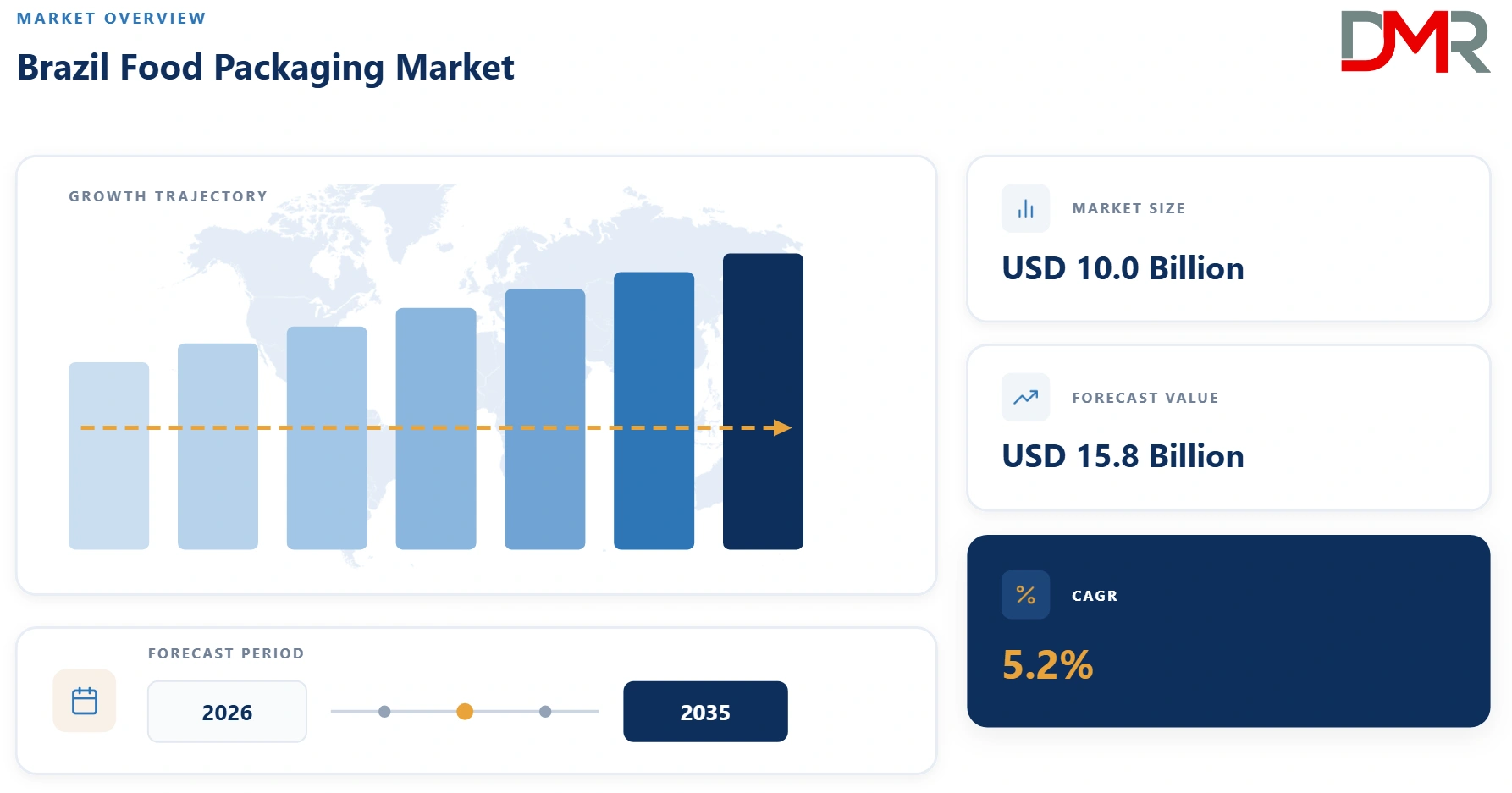
The Brazil Food Packaging Market is projected to be valued at USD 10.0 Billion in 2026 and is projected to reach USD 15.8 Billion by 2035, expanding at a CAGR of 5.2% during the forecast period.
ℹ
To learn more about this report –
Download Your Free Sample Report Here
Growth is being propelled by Brazil's position as one of the world's largest exporters of processed meat, poultry, and soy-based food products, the rapid expansion of retail and foodservice channels demanding shelf-ready and extended shelf-life formats, and tightening national packaging-recovery regulation that is pushing converters toward recyclable and mono-material structures. The maturing of Brazilian converters into full-service partners offering barrier-film development, digital printing, and traceability support alongside base packaging supply, combined with rising demand for compostable and bio-based materials among quick-service and retail private-label programs, is reshaping the market from commodity-format supply toward differentiated, certification-backed packaging partnerships. Investment is accelerating as converters modernize pulp-based and flexible-film capacity and pursue ANVISA food-contact and sustainability certifications that widen the range of clients they can serve.
Use Cases
- Protein Export Packaging: Brazil's meat, poultry, and seafood processors contract specialized barrier-film and vacuum-pack suppliers to meet the shelf-life and traceability requirements of both domestic retail and international export shipments.
- Retail Private Label Expansion: National and regional grocery chains work with converters to produce store-brand snack, dairy, and beverage packaging, supporting private-label assortment growth without owning in-house converting capacity.
- Foodservice and Quick Service Packaging: Quick-service and delivery-oriented food businesses adopt molded-fiber and compostable containers to meet ANVISA food-contact rules while responding to municipal restrictions on single-use plastics.
- Ecommerce and Direct to Consumer Packaging: Emerging direct-to-consumer food and beverage brands contract flexible-format and small-batch packaging suppliers to support online fulfilment without large minimum order commitments.
Key Takeaways
- Market Size: The Brazil Food Packaging Market is anticipated to be valued at USD 10.0 Billion in 2026 and is forecast to reach USD 15.8 Billion by 2035, expanding at a CAGR of 5.2%.
- Growth Outlook: Market expansion is sustained by continued growth of Brazil's protein and processed-food export industries, expanding retailer and foodservice demand for convenience formats, and regulatory pressure favoring recyclable and bio-based packaging materials.
- Primary Growth Drivers: Rising processed-food and beverage consumption, expanding retail and ecommerce channels, tightening plastic-reduction and packaging-recovery regulation, and converters' growing ability to offer barrier-film, printing, and traceability services alongside base supply are accelerating market growth.
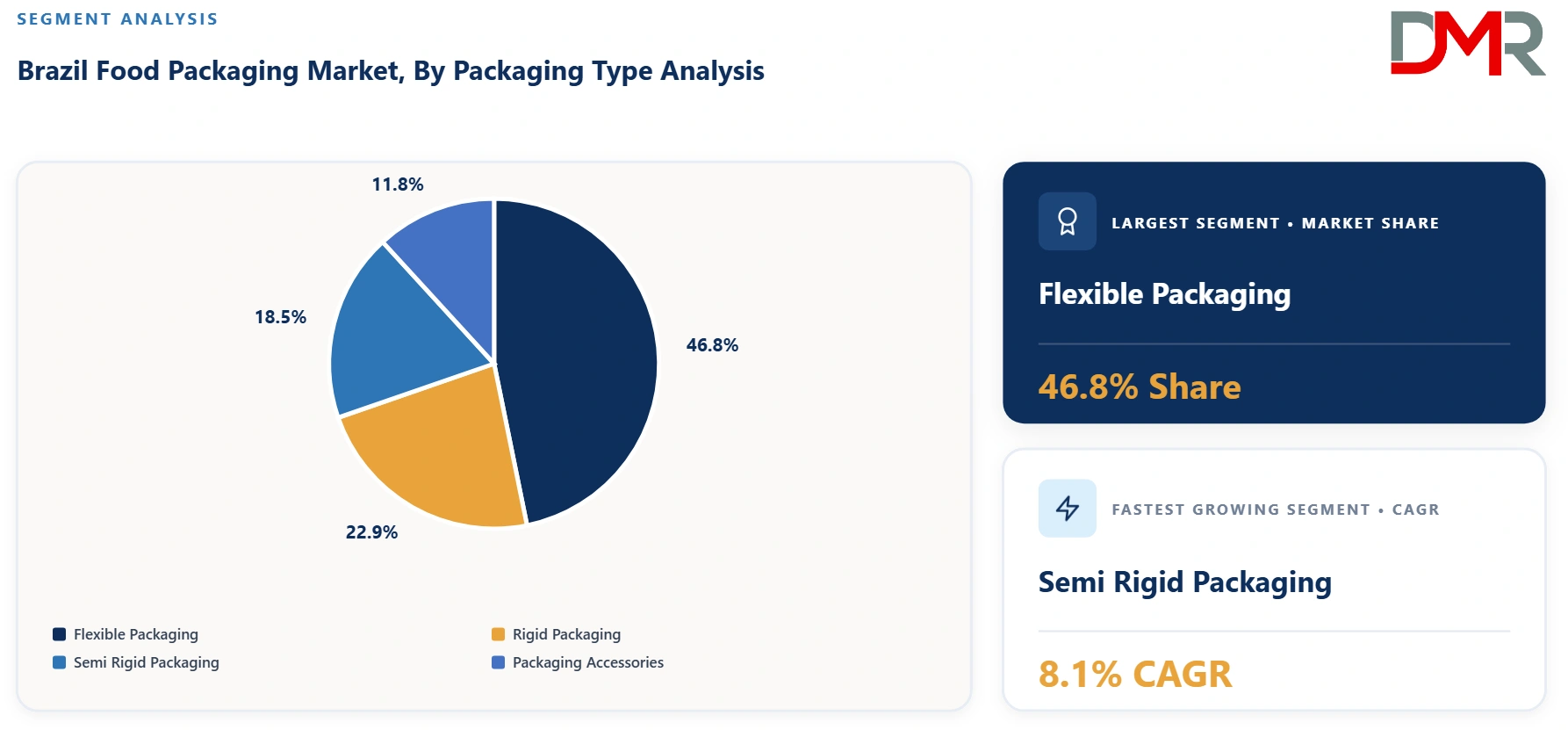
- By Packaging Type Analysis: Flexible Packaging is projected to lead the segment with a 46.8% share in 2026, reflecting sustained demand for pouches, films, and wraps across food categories. Semi Rigid Packaging is the fastest-growing packaging type at 8.1% CAGR, driven by rising adoption of spouted pouches and barrier trays.
- By Material Type Analysis: Plastic is expected to dominate with a 51.5% share in 2026, supported by its cost efficiency and moisture-barrier performance. Bioplastic Materials is the fastest-growing material type at 12.8% CAGR, driven by regulatory and retailer pressure toward compostable formats.
- By Food Category Analysis: Meat, Poultry and Seafood is poised to lead with a 26.7% share in 2026, reflecting Brazil's scale as a global protein exporter. Snacks and Convenience Foods is the fastest-growing food category at 8.6% CAGR, driven by urbanization and rising demand for on-the-go formats.
- By End Use Channel Analysis: Food Processing Companies are expected to command a 61.4% share in 2026, reflecting primary demand originating at the point of processing. Ecommerce and Direct to Consumer is the fastest-growing end use channel at 9.3% CAGR, driven by continued growth in online grocery and direct-to-consumer food brands.
Key Drivers in the Brazil Food Packaging Market
Expansion of Brazil's Protein Export and Processed Food Industries
Brazil's position as a leading global exporter of beef, poultry, and processed soy products is a structural driver of packaging demand. Export-grade barrier films, vacuum packs, and traceability-enabled labeling are required to meet both international food-safety standards and domestic retail specifications. As processors such as JBS, BRF, and Marfrig continue expanding processing capacity, sustained demand for high-barrier, export-compliant packaging formats is expected to persist across the forecast period.
Retailer and Ecommerce Growth Accelerating Demand for Shelf Ready Packaging
Brazilian grocery retailers and the fast-growing online grocery channel are steadily increasing demand for shelf-ready, extended shelf-life, and tamper-evident packaging formats. This shift is driving converters to invest in modified-atmosphere packaging, resealable closures, and lightweight flexible formats suited to both in-store and last-mile delivery. Retailers increasingly favor suppliers offering rapid new-format development and consistent ANVISA compliance across large production volumes, strengthening long-term supply relationships.
Restraints in the Brazil Food Packaging Market
Currency Volatility and Import Dependence on Specialty Barrier Resins
Brazil's reliance on imported high-barrier resins such as EVOH and specialty nylon for premium flexible packaging represents an important restraint on the market. Exchange-rate volatility against the US dollar can significantly affect input costs for converters dependent on imported materials, creating pricing pressure that is difficult to pass through to price-sensitive food processors. These dynamics can delay format upgrades and push some manufacturers toward lower-performance domestic alternatives, affecting shelf-life outcomes for premium product categories.
Growth Opportunities in the Brazil Food Packaging Market
Recyclable and Compostable Packaging Innovation Under Tightening Regulation
Converters developing mono-material recyclable films and molded-fiber alternatives to multi-layer laminates represent an attractive opportunity as national and municipal regulation increasingly restricts non-recyclable plastics. Companies that secure ANVISA food-contact clearance for compostable and fiber-based formats early can capture premium contracts with quick-service and retail private-label clients seeking to meet sustainability commitments ahead of regulatory deadlines.
Small Batch Packaging Solutions for Emerging Direct to Consumer Brands
Growing demand from early-stage and direct-to-consumer food and beverage brands for smaller, flexible production runs presents an opportunity for converters willing to lower minimum order thresholds and invest in quick-changeover digital printing equipment. Suppliers serving this underserved segment can build long-term relationships with brands as they scale into national retail distribution.
Trends in the Brazil Food Packaging Market
Consolidation Among Regional Converters and Private Equity Backed Platforms
The Brazil Food Packaging Market is experiencing increasing consolidation as larger diversified converters and private-equity-backed platforms acquire regional packaging producers to build multi-material, multi-facility production networks. Consolidation allows combined entities to offer broader material capabilities and shared investment in sustainability certification, gradually reshaping the competitive landscape toward fewer, larger-scale converting groups.
Adoption of Smart Packaging and Digital Traceability Systems
Converters are increasingly investing in freshness indicators, RFID traceability, and digital production monitoring to strengthen quality-control consistency and support export compliance requirements. Real-time visibility tools are also being extended to food processing clients, allowing them to track batch quality and inventory remotely, a capability expected to improve margins while supporting shorter lead times.
Research Scope and Analysis
The Brazil Food Packaging Market is segmented by packaging type, material type, food category, and end use channel, covering flexible and rigid formats, plastic, paper, metal, and glass materials, and packaging demand across protein, dairy, bakery, beverage, and snack categories serving food processors, retailers, foodservice operators, and ecommerce channels.
ℹ
To learn more about this report –
Download Your Free Sample Report Here
By Packaging Type Analysis
Flexible Packaging is projected to dominate the Brazil Food Packaging Market with 46.8% share in 2026, reflecting sustained demand for pouches, films, and wraps across protein, snack, and beverage categories. Semi Rigid Packaging is expected to register the highest CAGR of 8.1% during 2026-2035, as food processors increasingly adopt barrier trays and spouted pouches for convenience-oriented formats.
By Material Type Analysis
Plastic is anticipated to dominate the Brazil Food Packaging Market by material type, accounting for 51.5% share in 2026, supported by its cost efficiency, lightweight properties, and moisture-barrier performance. Bioplastic Materials is projected to register the highest CAGR of 12.8% between 2026 and 2035, driven by rising regulatory and retailer demand for compostable and bio-based formats.
By Food Category Analysis
Meat, Poultry and Seafood is projected to dominate the Brazil Food Packaging Market with an estimated 26.7% share in 2026, reflecting the scale of Brazil's domestic and export-oriented protein processing industry. Snacks and Convenience Foods is expected to register the fastest CAGR of 8.6% through 2035, as urbanization and rising disposable income drive demand for on-the-go food formats.
By End Use Channel Analysis
Food Processing Companies are expected to lead the Brazil Food Packaging Market by end use channel, accounting for 61.4% share in 2026, reflecting the concentration of primary packaging demand at the point of processing. Ecommerce and Direct to Consumer is projected to achieve the fastest CAGR of 9.3% during 2026-2035, driven by continued growth in online grocery and direct-to-consumer food brand penetration.
The Brazil Food Packaging Market Report is segmented based on the following:
By Packaging Type
- Flexible Packaging
- Pouches and Sachets
- Films and Wraps
- Bags and Liners
- Rigid Packaging
- Semi-Rigid Packaging
- Packaging Accessories
By Material Type
- Plastic
- Paper and Paperboard
- Metal
- Glass
- Bioplastic Materials
- Polylactic Acid (PLA)
- Polybutylene Adipate Terephthalate (PBAT)
- Polyhydroxyalkanoates (PHA)
By Food Category
- Meat, Poultry and Seafood
- Dairy and Frozen Foods
- Bakery and Confectionery
- Fruits and Vegetables
- Beverages
- Snacks and Convenience Foods
- Sauces, Dressings and Condiments
- Others
By End Use Channel
- Food Processing Companies
- Retail and Supermarkets
- Foodservice Establishments
- E-commerce and Direct-to-Consumer
Technology Analysis
Technology investment is increasingly central to competitiveness in the Brazil Food Packaging Market as converters adopt digital printing, high-speed pouch-forming lines, and predictive maintenance systems to improve throughput and reduce downtime. Growing use of freshness indicators and RFID traceability strengthens transparency across export and domestic retail supply chains. Opportunities are expanding for converters investing in mono-material recyclable film lines and molded-fiber production suited to compostable formats. However, high automation capital costs and dependence on imported specialty resins remain adoption barriers for smaller regional converters.
Investment and White Space Analysis
Investment opportunities in the Brazil Food Packaging Market are expanding as private equity and strategic acquirers continue consolidating regional converting capacity and as export-driven protein processing sustains structural packaging demand. Significant white space exists in compostable foodservice packaging, small-batch flexible production for direct-to-consumer brands, and mono-material recyclable structures aligned with national packaging-recovery targets. However, currency volatility, import dependence on specialty barrier resins, and capacity constraints at top-tier certified facilities can pressure margins and limit near-term scalability for undercapitalized converters.
Competitive Landscape
The Brazil Food Packaging Market is fragmented and increasingly consolidating, comprising large diversified converting platforms, regional and family-owned packaging producers, and category-specialist suppliers. Competition centers on material innovation, food-safety certification breadth, barrier performance, minimum order volume thresholds, and proximity to Brazil's Southeast industrial and export logistics corridor. Large diversified platforms benefit from multi-facility scale and established retailer and processor relationships, while regional producers compete on responsiveness and category expertise. Companies increasingly differentiate through investment in recyclable materials, digital printing, and integrated barrier-film development rather than competing on base capacity alone.
Some of the prominent players in the Brazil Food Packaging Market are:
- Amcor plc
- Klabin S.A.
- Tetra Pak International S.A.
- Smurfit WestRock
- Sonoco Products Company
- Sealed Air Corporation
- Huhtamaki Oyj
- Graphic Packaging International, LLC
- Mondi plc
- Berry Global Group, Inc.
- International Paper Company
- Ball Corporation
- Trivium Packaging
- Braskem S.A.
- Zaraplast S.A.
- Videplast Indústria de Embalagens Ltda.
- Valgroup
- Gualapack Brasil
- Inapel Embalagens Ltda.
- Finepack Embalagens
- Canguru Plásticos Ltda.
- Camargo Embalagens
- Converplast Embalagens
- Embaquim Indústria e Comércio Ltda.
- O-I Glass, Inc.
- Verallia S.A.
- Wheaton Brasil
- Oji Holdings Corporation
- ProAmpac
- Coveris
- DS Smith plc
- Stora Enso Oyj
- ALPLA Group
- Greif, Inc.
- Winpak Ltd.
- Pactiv Evergreen Inc.
- Genpak, LLC
- CCL Industries Inc.
- Avery Dennison Corporation
- CANPACK S.A.
- Other Key Players
Recent Developments
- June 2026: Amcor installed Brazil’s first Moda rotary vacuum chamber sealing systems in partnership with Barra Mansa Alimentos. Three Moda Vac systems are being deployed to increase throughput, vacuum consistency, and packaging efficiency for meat products.
- January 2026: Tetra Pak reported investing BRL 27.1 million during 2025 in sustainability initiatives in Brazil, including post-consumer carton recycling, factory sustainability projects, and support for approximately 230 recycling cooperatives.
- October 2025: Valgroup, together with Dow and Movimento Circular, launched what it described as Brazil’s first coffee packaging designed for recycling. The polyethylene-based structure eliminates internal metallization while maintaining moisture and oxygen barrier performance.
Report Details
| Report Characteristics |
| Market Size (2026) |
USD 10.0 Bn |
| Forecast Value (2035) |
USD 15.8 Bn |
| CAGR (2026–2035) |
5.2% |
| Historical Data |
2021 – 2025 |
| Forecast Data |
2026 – 2035 |
| Base Year |
2025 |
| Segments Covered |
By Packaging Type, By Material Type, By Food Category, and By End Use Channel |
| Country Coverage |
Brazil |
Frequently Asked Questions
How big is the Brazil Food Packaging Market?
▾ The Brazil Food Packaging Market is valued at USD 10.0 Billion in 2026 and is poised to be projected to reach USD 15.8 Billion by 2035, reflecting sustained demand from protein export processors, retail private label programs, and Brazil's expanding foodservice and ecommerce channels.
What is the CAGR of the Brazil Food Packaging Market from 2026 to 2035?
▾ The market is projected to expand at a compound annual growth rate (CAGR) of 5.2% between 2026 and 2035, supported by growth in processed protein and beverage exports, retailer demand for shelf-ready formats, and tightening packaging-recovery regulation.
What factors are driving the growth of the Brazil Food Packaging Market?
▾ Growth is driven by the scale of Brazil's meat, poultry, and beverage export industries, expanding retail and ecommerce channels, tightening plastic-reduction regulation, and converters' growing ability to offer barrier-film, printing, and traceability services alongside base packaging supply.
What are the major trends in the Brazil Food Packaging Market?
▾ Major trends include consolidation among regional converters and private-equity-backed platforms, growing adoption of smart packaging and digital traceability systems, and rising demand for compostable and mono-material recyclable formats among quick-service and retail clients.
Who are the key players in the Brazil Food Packaging Market?
▾ Key market participants include Klabin S.A., Tetra Pak Brasil, WestRock, Amcor, and Huhtamaki, among other diversified and regional packaging converters.
How is the Brazil Food Packaging Market segmented?
▾ The market is segmented by packaging type, material type, food category, and end use channel, with demand analysis concentrated across Brazil's Southeast, South, and Northeast industrial and export regions.