Brazil Food Processing Equipment Market Snapshot
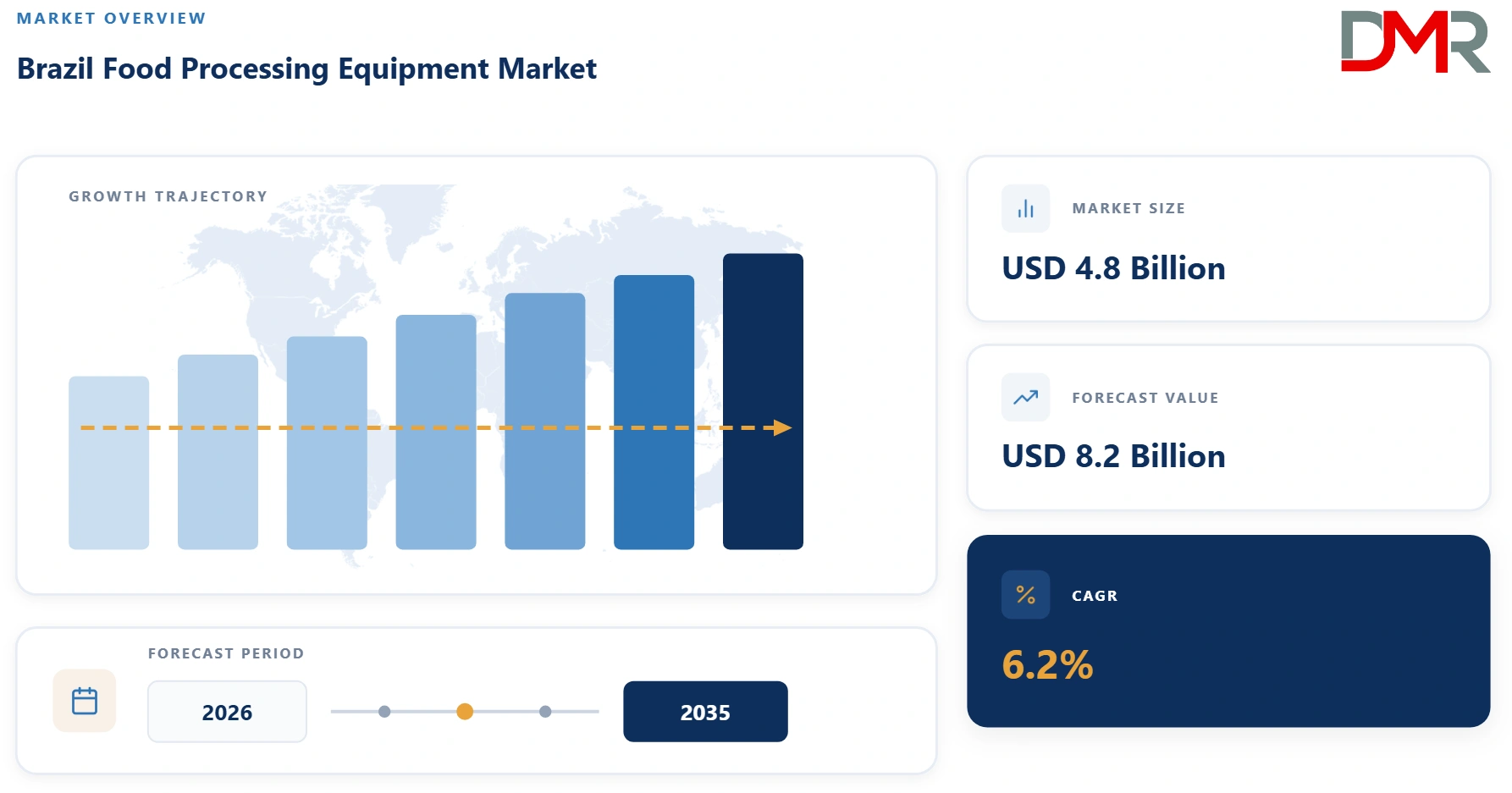
- Brazil Food Processing Equipment Market Size in 2026: USD 4.8 Billion
- Brazil Food Processing Equipment Market Size in 2035: USD 8.2 Billion
- Brazil CAGR from 2026 to 2035: 6.2%
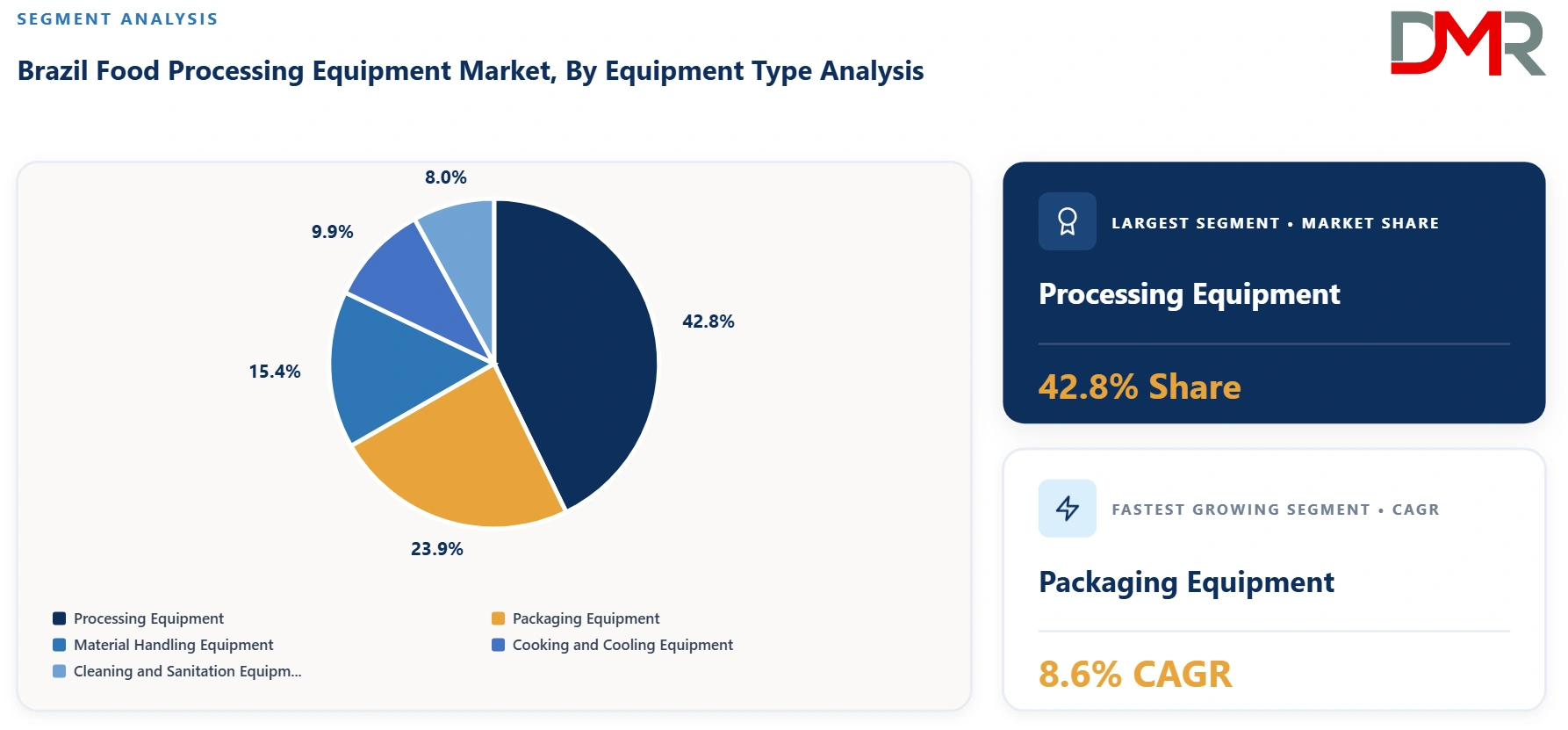
- Processing Equipment is the leading equipment type segment in 2026: 42.8%
- Automatic is the leading mode of operation segment in 2026: 51.6%
- Meat, Poultry and Seafood is the leading food category segment in 2026: 29.4%
- Large-Scale Food Processors is the leading end user segment in 2026: 59.7%
What is the Brazil Food Processing Equipment Market and its Market Size?
The Brazil Food Processing Equipment Market is projected to be valued at USD 4.8 Billion in 2026 and is projected to reach USD 8.2 Billion by 2035, expanding at a CAGR of 6.2% during the forecast period.
ℹ
To learn more about this report –
Download Your Free Sample Report Here
Growth is being propelled by Brazil's position as one of the world's largest agricultural producers and food exporters, particularly across soybean, beef, poultry, and sugar categories, sustained investment by major Brazilian meatpacking and food companies in expanding processing capacity to serve both robust domestic consumption and substantial international export markets, and continued modernization of Brazil's diverse regional food processing base spanning industrial-scale and smaller domestic producers. The maturing of automated, export-compliant processing equipment meeting international food safety standards required for Brazil's substantial global food export trade, growing investment in sugarcane processing and ethanol-adjacent food and beverage production technology, and continued expansion of Brazil's coffee, orange juice, and other agricultural commodity processing industries where the country holds leading global production and export positions are reshaping the market from a historically fragmented, regionally varied equipment procurement pattern into an increasingly automated, export-oriented industry. Investment is accelerating as Brazilian food processors modernize facilities to meet both growing global food export demand and expanding domestic consumption.
Use Cases
- Automated Meat and Poultry Processing for Global Export Leadership: Brazilian meatpacking companies, among the world's largest beef and poultry exporters, invest in automated cutting, deboning, and packaging equipment to expand production capacity meeting substantial international export demand across multiple continents while maintaining food safety compliance required for diverse export market access.
- Sugar and Ethanol-Adjacent Processing Equipment Investment: Brazilian sugar producers, operating within one of the world's largest sugarcane processing industries, invest in modernized milling, crystallization, and refining equipment supporting both sugar production and the integrated ethanol production that characterizes much of Brazil's sugarcane processing infrastructure.
- Coffee Processing and Roasting Equipment for Global Export Markets: Brazilian coffee producers and processors, representing the world's largest coffee producing and exporting nation, invest in modernized processing, sorting, and roasting equipment to maintain quality standards and expand capacity serving substantial global coffee export demand.
- Fruit Juice and Beverage Processing for Orange Juice Export Leadership: Brazilian juice processors, particularly within the orange juice industry where Brazil holds global production and export leadership, invest in automated extraction, concentration, and packaging equipment supporting substantial international export volumes.
Key Takeaways
- Market Size: The Brazil Food Processing Equipment Market is anticipated to be valued at USD 4.8 Billion in 2026 and is forecast to reach USD 8.2 Billion by 2035, expanding at a CAGR of 6.2%.
- Growth Outlook: Market expansion is sustained by Brazil's position as one of the world's largest agricultural producers and food exporters, continued investment by major Brazilian food companies in export-oriented processing capacity, and ongoing modernization across the country's diverse regional food processing base.
- Primary Growth Drivers: Brazil's global leadership in beef, poultry, sugar, coffee, and orange juice production and export, sustained domestic food consumption growth, continued investment in export-compliant processing technology, and expanding agricultural commodity processing capacity are accelerating equipment investment.
- By Equipment Type Analysis: Processing Equipment is projected to lead the equipment type segment with a 42.8% share in 2026, reflecting its central role across Brazil's diverse meat, sugar, coffee, and juice processing operations. Packaging Equipment is the fastest-growing equipment type segment at 8.6% CAGR, driven by rising demand for automated packaging lines supporting export product formats.
- By Mode of Operation Analysis: Automatic equipment is expected to dominate with a 51.6% share in 2026, supported by substantial investment among large-scale, export-oriented Brazilian food processors. Automatic is also the fastest-growing mode of operation segment at 8.9% CAGR, as continued export-driven capacity expansion incorporates advanced automation technology.
- By Food Category Analysis: Meat, Poultry and Seafood is expected to command a 29.4% share in 2026, underpinned by Brazil's position as one of the world's largest beef and poultry exporters. Beverages is the fastest-growing food category segment at 8.3% CAGR, driven by continued investment across Brazil's substantial coffee, juice, and broader beverage processing industries.
- By End User Analysis: Large-Scale Food Processors are projected to dominate with a 59.7% share in 2026, reflecting the substantial scale of Brazil's major meatpacking, sugar, and agricultural commodity processing companies. Small and Medium-Sized Processors is the fastest-growing end user segment at 8.8% CAGR, driven by falling automation equipment costs and growing domestic market development.
Key Drivers in the Brazil Food Processing Equipment Market
Brazil's Global Leadership in Agricultural Production and Food Export
Brazil's position as one of the world's largest producers and exporters across multiple agricultural commodity categories, including beef, poultry, soybeans, sugar, coffee, and orange juice, provides a substantial and durable foundation for the country's food processing equipment market. This established global agricultural and food export leadership, supported by Brazil's vast agricultural land base and favorable growing conditions across multiple crop and livestock categories, generates sustained demand for processing equipment capable of meeting both the volume requirements and food safety and quality certification standards required for Brazil's diverse and substantial international export markets.
Sustained Investment by Major Brazilian Food Companies in Export-Oriented Capacity
Brazil's major food companies, particularly within the meatpacking, sugar, and agricultural commodity processing sectors, continue to invest substantially in expanding and modernizing processing capacity to serve both growing global food demand and Brazil's efforts to diversify export markets across multiple continents including Asia, the Middle East, and Europe. This sustained corporate investment reflects both the scale advantages available to well-capitalized Brazilian food companies and continued confidence in Brazil's long-term position as a leading global food exporter across multiple agricultural commodity categories.
Restraints in the Brazil Food Processing Equipment Market
Infrastructure and Logistics Challenges Affecting Processing Facility Investment Decisions
Brazil's transportation and logistics infrastructure limitations, particularly in more remote agricultural production regions, represent a meaningful restraint on the Food Processing Equipment Market, as these infrastructure gaps can complicate the economics of establishing processing facilities close to agricultural production sources and affect the reliability of moving processed food products to export ports and domestic distribution centers. These infrastructure considerations require food companies to carefully evaluate processing facility location decisions, potentially limiting the geographic distribution of processing capacity investment relative to the full extent of Brazil's agricultural production regions.
Growth Opportunities in the Brazil Food Processing Equipment Market
Export Compliance and Traceability-Integrated Processing Equipment
Growing international buyer requirements for verified traceability and food safety documentation, particularly important given Brazil's periodic need to address international market access concerns related to food safety and environmental compliance, present an opportunity for equipment vendors offering processing systems with integrated digital traceability and quality documentation capability. Vendors capable of supporting Brazilian food exporters' compliance with diverse international market requirements can capture premium positioning among the country's substantial export-oriented processing sector.
Regional Processing Capacity Expansion Serving Underdeveloped Agricultural Regions
Brazil's vast and only partially developed agricultural production regions, particularly in areas of continued agricultural frontier expansion, present an opportunity for equipment vendors and processors to establish new processing capacity serving these developing production areas. Companies capable of navigating the infrastructure and logistics challenges associated with more remote regions, while establishing modern, efficient processing capacity, can capture growth opportunities as Brazil's agricultural production continues expanding into new regions.
Trends in the Brazil Food Processing Equipment Market
Growing Investment in Environmental and Sustainability Compliance Technology
Brazilian food processors, particularly within the beef and soybean sectors, are increasingly investing in processing and traceability technology supporting environmental sustainability compliance and deforestation-free supply chain verification, responding to growing international buyer and regulatory scrutiny of Brazilian agricultural supply chain environmental impact. This trend reflects the increasing importance of sustainability credentials in maintaining and expanding international market access for Brazilian food exports.
Continued Modernization and Automation Investment Among Regional Food Processors
Brazilian food processors across the country's diverse regions are increasingly investing in automation technology to address labor cost considerations and improve production consistency, extending beyond the large, export-oriented national champions to a broader base of regional and mid-sized food processing companies. This broader modernization trend reflects growing automation technology accessibility and Brazil's substantial and diverse domestic food processing sector beyond its internationally prominent export-oriented segments.
Research Scope and Analysis
The Brazil Food Processing Equipment Market is segmented by equipment type, mode of operation, food category, and end user, covering processing, packaging, material handling, cooking and cooling, and cleaning and sanitation equipment across meat, beverage, sugar, coffee, and juice processing categories.
ℹ
To learn more about this report –
Download Your Free Sample Report Here
By Equipment Type Analysis
Processing Equipment is projected to dominate the Brazil Food Processing Equipment Market with 42.8% share in 2026, reflecting its central role across Brazil's diverse meat, sugar, coffee, and juice processing operations serving both domestic and substantial export markets. Packaging Equipment is expected to register the highest CAGR of 8.6% during 2026-2035, driven by rising processor investment in automated packaging lines supporting the varied product format requirements of Brazil's diverse international export destinations.
By Mode of Operation Analysis
Automatic equipment is anticipated to dominate the Brazil Food Processing Equipment Market by mode of operation, accounting for 51.6% share in 2026, supported by substantial investment among Brazil's large-scale, export-oriented meatpacking, sugar, and agricultural commodity processing companies. Automatic equipment is also projected to register the highest CAGR of 8.9% between 2026 and 2035, as continued export-driven capacity expansion and rising labor cost considerations favor increasing automation levels across Brazilian processing facilities.
By Food Category Analysis
Meat, Poultry and Seafood is expected to lead the Brazil Food Processing Equipment Market by food category, accounting for a 29.4% share in 2026, underpinned by Brazil's position as one of the world's largest beef and poultry exporters requiring substantial automated processing equipment investment. Beverages is projected to achieve the fastest CAGR of 8.3% during 2026-2035, driven by continued modernization investment across Brazil's substantial coffee, orange juice, and broader beverage processing industries serving global export markets.
By End User Analysis
Large-Scale Food Processors are projected to dominate the Brazil Food Processing Equipment Market with a 59.7% share in 2026, reflecting the substantial scale of Brazil's major meatpacking, sugar, and agricultural commodity processing companies serving both domestic and international markets. Small and Medium-Sized Processors are expected to register the fastest CAGR of 8.8% through 2035, driven by falling automation equipment costs and growing domestic food manufacturing sector development beyond Brazil's large export-oriented national champions.
The Brazil Food Processing Equipment Market Report is segmented based on the following:
By Equipment Type
- Processing Equipment
- Packaging Equipment
- Material Handling Equipment
- Cooking and Cooling Equipment
- Cleaning and Sanitation Equipment
By Mode of Operation
- Automatic
- Semi-Automatic
- Manual
By Food Category
- Meat, Poultry and Seafood
- Beverages
- Bakery and Confectionery
- Dairy Products
- Fruits and Vegetables
- Grain Milling and Processing
- Others
By End User
- Large-Scale Food Processors
- Small and Medium-Sized Processors
- Artisanal and Specialty Food Producers
Technology Analysis
Technology development is increasingly shaping competitiveness in the Brazil Food Processing Equipment Market as vendors invest in export-compliant automation systems, digital traceability technology supporting environmental sustainability and deforestation-free supply chain verification, and processing equipment suited to Brazil's diverse tropical and subtropical agricultural production conditions. Growing use of predictive maintenance and remote monitoring technology is helping processors in more remote agricultural regions manage equipment reliability despite infrastructure and technical support access limitations. Opportunities are expanding for vendors developing equipment specifically designed to meet diverse international food safety and environmental compliance standards required for Brazil's varied export destinations, as well as processing technology suited to expanding agricultural frontier regions. However, infrastructure and logistics limitations in more remote production regions, along with the need to navigate diverse and evolving international market access requirements, remain important considerations for equipment vendors and processor customers.
Investment and White Space Analysis
Investment opportunities in the Brazil Food Processing Equipment Market are expanding alongside the country's global agricultural production and export leadership, sustained investment by major Brazilian food companies, and continued modernization across the country's diverse regional food processing base. Significant white space exists in export compliance and environmental traceability-integrated processing equipment, regional processing capacity expansion serving developing agricultural production areas, and automation solutions supporting Brazil's broader domestic food manufacturing sector beyond large export-oriented companies. Vendors with strong export compliance expertise, established relationships with major Brazilian food companies, and technology suited to Brazil's diverse regional production conditions are positioned to capture premium, longer-duration contracts. However, infrastructure and logistics challenges in more remote regions, along with the need to navigate diverse international market access and sustainability compliance requirements, can constrain and shape the geographic and technical scope of equipment investment opportunity.
Competitive Landscape
The Brazil Food Processing Equipment Market is moderately consolidated and increasingly competitive, comprising large diversified global food processing equipment manufacturers, specialty equipment suppliers serving Brazil's coffee, sugar, and juice processing industries, and international meat processing equipment companies serving the country's substantial beef and poultry export sector. Competition centers on export compliance certification capability, specialized expertise in Brazil's leading agricultural commodity categories, sustainability and traceability technology integration, and comprehensive service and support capability across Brazil's vast geography. Large diversified global equipment manufacturers benefit from broad product portfolios and international food safety certification credibility relevant to Brazil's diverse export markets, while specialty suppliers compete on deep expertise in specific agricultural commodity processing categories. Companies increasingly differentiate through export compliance and sustainability technology integration rather than equipment sales alone.
Some of the prominent players in the Brazil Food Processing Equipment Market are:
- Krones AG
- GEA Group AG
- KHS GmbH
- Tetra Pak International S.A.
- Alfa Laval AB
- SPX FLOW, Inc.
- Sidel Group
- Pentair plc
- JBT Marel Corporation
- Bucher Industries AG
- ProMach, Inc.
- CFT Group
- Praj Industries Ltd.
- HRS Process Systems Ltd.
- Paul Mueller Company
- Statco-DSI Process Systems
- A Due S.p.A.
- Goma Engineering Pvt. Ltd.
- Bajaj Processpack Limited
- VLS Technologies
- IC Filling Systems
- Central States Industrial
- Syntegon Technology GmbH
- MULTIVAC Group
- SACMI Beverage
- Omnia Technologies
- Della Toffola Group
- TMCI Padovan
- Bertolaso S.p.A.
- GAI Macchine Imbottigliatrici S.p.A.
- Newamstar Packaging Machinery Co., Ltd.
- Tech-Long Packaging Machinery Co., Ltd.
- Zhangjiagang King Machine Co., Ltd.
- Zhangjiagang Comark Machinery Co., Ltd.
- Zhangjiagang Alps Machine Co., Ltd.
- Barry-Wehmiller Companies, Inc.
- ProMinent GmbH
- Equipos de Proceso Industriales (EPI)
- SYMTEC – Sistemas y Maquinaria Alimentaria, S.A. de C.V.
- Muccini S.A. de C.V.
- Other Key Players
Recent Developments
- May 2026: Tetra Pak Mexico highlighted processing technologies aimed at reducing water consumption in food and beverage plants, including membrane filtration, dry lubrication, automated processes and Rotary Jet Head technology, which can reduce tank-cleaning times by 40–60%.
- September 2025: Krones introduced its Ingeniq fully automated beverage line concept, initially configured for non-carbonated water in PET containers at speeds of 100,000 bottles per hour, emphasizing higher efficiency, sustainability and lower lifecycle costs.
- July 2025: Sidel supported Grupo GEPP, PepsiCo’s exclusive bottler in Mexico, with expanded returnable PET and glass bottling lines. The project strengthens beverage-production capacity while supporting GEPP’s shift toward reusable packaging and more sustainable bottling operations.
- June 2025: ProMach showcased beverage processing and packaging technologies at EXPO PACK Guadalajara 2025, including bottling, capping, container handling, precision filling, sealing, pasteurization, labeling and coding solutions for beverage manufacturers across Mexico and Latin America.
Report Details
| Report Characteristics |
| Market Size (2026) |
USD 4.8 Bn |
| Forecast Value (2035) |
USD 8.2 Bn |
| CAGR (2026–2035) |
6.2% |
| Historical Data |
2021 – 2025 |
| Forecast Data |
2026 – 2035 |
| Base Year |
2025 |
| Segments Covered |
By Equipment Type, By Mode of Operation, By Food Category, By End User |
| Country Coverage |
Brazil |
Frequently Asked Questions
How big is the Brazil Food Processing Equipment Market?
▾ The Brazil Food Processing Equipment Market is valued at USD 4.8 Billion in 2026 and is projected to reach USD 8.2 Billion by 2035, reflecting Brazil's global leadership in agricultural production and food export across multiple commodity categories.
What is the CAGR of the Brazil Food Processing Equipment Market from 2026 to 2035?
▾ The market is projected to expand at a compound annual growth rate (CAGR) of 6.2% between 2026 and 2035, supported by sustained export growth, continued investment by major Brazilian food companies, and ongoing modernization across the country's diverse regional processing base.
What factors are driving the growth of the Brazil Food Processing Equipment Market?
▾ Growth is driven by Brazil's global leadership in beef, poultry, sugar, coffee, and orange juice production and export, sustained domestic food consumption growth, continued investment in export-compliant processing technology, and expanding agricultural commodity processing capacity.
What are the major trends in the Brazil Food Processing Equipment Market?
▾ Major trends include growing investment in environmental and sustainability compliance technology, continued modernization and automation investment among regional food processors, and rising demand for processing capacity serving expanding agricultural frontier regions.
Who are the key players in the Brazil Food Processing Equipment Market?
▾ Key market participants include GEA Group, Tetra Pak, Bühler Group, JBT Corporation, and Marel, among other global and specialty equipment manufacturers serving Brazil's meat, sugar, coffee, and juice processing industries.
How is the Brazil Food Processing Equipment Market segmented?
▾ The market is segmented by equipment type, mode of operation, food category, and end user, with demand analysis concentrated across São Paulo, Mato Grosso, Paraná, and Minas Gerais.