Brazil Meat Processing Equipment Market Snapshot
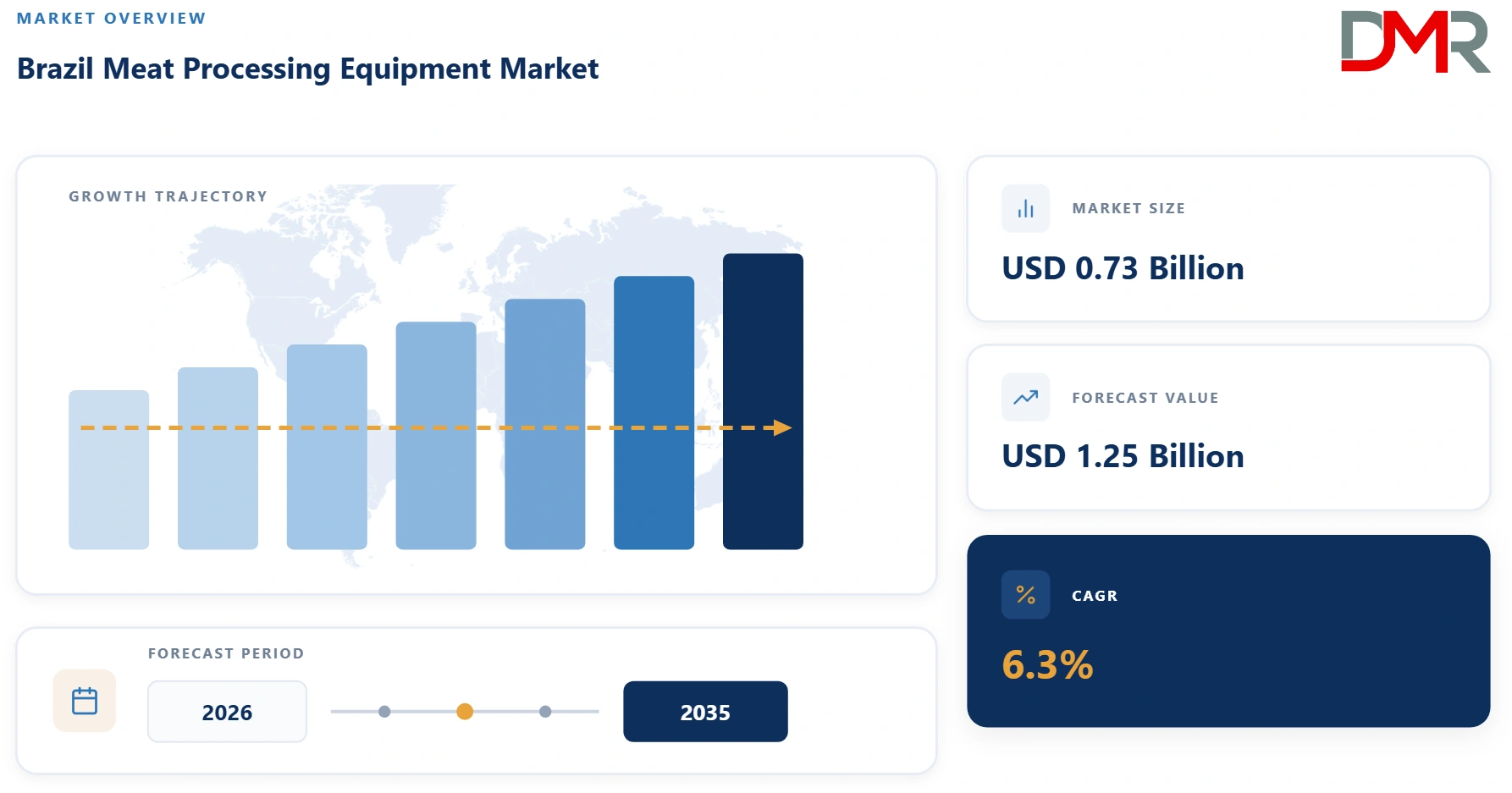
- Market Size 2026: USD 0.73 Billion
- Market Size 2035: USD 1.25 Billion
- CAGR, 2026-2035: 6.16%
- Leading Equipment Segment: Cutting & Slicing Equipment, 22.0%
- Leading Meat Type: Beef, 46.0%
- Leading Processing Stage: Further Processing, 29.0%
- Fastest-Growing Segment: Fully Automated Equipment, 9.0% CAGR
What is the Brazil Meat Processing Equipment and its Market Size?
The Brazil meat processing equipment market is estimated at approximately USD 0.73 billion in 2026 and is forecast to reach about USD 1.25 billion by 2035, representing a 6.16% CAGR.
ℹ
To learn more about this report –
Download Your Free Sample Report Here
Brazil Meat Processing Equipment comprises industrial machinery and integrated systems used to transform livestock and poultry into fresh, chilled, frozen, portioned, processed, cooked, packaged, and ready-to-eat meat products. The market includes primary-processing equipment such as slaughtering, stunning, evisceration and carcass-handling systems, as well as secondary-processing machinery including cutting, deboning, grinding, mixing, forming, injecting, marinating, cooking, smoking, weighing and packaging equipment. Its primary value proposition is to increase throughput, yield, hygiene, consistency and worker safety while reducing labor dependency, product waste and operating costs. Brazil's unusually large livestock and poultry processing base creates sustained demand for both replacement machinery and greenfield production lines.
Use Cases
- High-throughput slaughtering: Automates animal handling, stunning, slaughtering, evisceration and carcass movement at industrial facilities.
- Cutting and deboning: Produces standardized portions while improving yield, precision and production-line throughput.
- Grinding and mixing: Converts meat trim and raw materials into sausages, burgers, nuggets and other processed products.
- Marinating and injecting: Improves product consistency, moisture retention, flavor distribution and value-added processing economics.
- Cooking and smoking: Enables production of cooked, smoked, cured and ready-to-eat meat products at commercial scale.
- Automated packaging: Provides weighing, portion control, sealing, inspection, labeling and traceability while reducing manual handling.
Key Takeaways
- The Brazil meat processing equipment market is estimated at USD 0.73 billion in 2026 and projected to reach USD 1.25 billion by 2035, implying a 6.16% CAGR.
- Protein production growth and export expansion remain fundamental demand drivers for processing machinery.
- Cutting and slicing equipment is expected to remain the largest equipment category, supported by demand for standardized, portion-controlled products.
- Beef is projected to remain the leading meat-type segment because of Brazil's enormous cattle-processing and export ecosystem.
- Further processing is expected to represent the largest processing-stage category as producers increase investment in higher-value products.
- Fully automated systems are expected to be the fastest-growing automation category, supported by labor scarcity, yield optimization, traceability and digitalization.
- Artificial intelligence, computer vision, robotics and production-data platforms are increasingly shifting competition from standalone machines toward integrated processing ecosystems.
How AI/Gen AI is Transforming the Brazil Meat Processing Equipment Market?
Artificial intelligence, machine vision, robotics, IoT sensors and cloud-connected production software are increasingly being embedded across Brazilian meat-processing operations. Applications include automated carcass grading, yield measurement, product inspection, robotic cutting and deboning, predictive maintenance, automated weighing, process monitoring and production traceability. JBT Marel's 2026 Brazilian demonstrations emphasize automation, data intelligence, integrated processing and digital traceability, while BAADER has introduced AI-powered monitoring for poultry processing and automated deboning technologies.
These technologies improve throughput, reduce repetitive labor, increase cutting accuracy and enable processors to identify yield losses in real time. Computer vision can make product grading more objective, while predictive analytics can reduce unplanned downtime and improve maintenance planning. AI-enabled systems also help processors optimize every kilogram of raw material, an increasingly important factor as input costs and sustainability requirements rise.
Key Drivers in the Brazil Meat Processing Equipment Market
Expansion of Meat Production and Export Activities
Brazil’s large-scale beef, poultry, and pork industries continue to generate strong demand for modern meat-processing equipment. Rising processing volumes, export-oriented production, and investments in new and upgraded facilities are increasing requirements for cutting, deboning, grinding, portioning, packaging, and automated material-handling systems. Export-focused processors also require higher levels of consistency, hygiene, traceability, and throughput to meet international customer requirements. The expansion of processed and value-added meat products is further increasing demand for specialized equipment across secondary and further-processing operations.
Increasing Automation and Labor Productivity Requirements
Automation is becoming an important investment priority as processors seek to reduce dependence on manual labor, improve workplace safety, increase throughput, and achieve more consistent product quality. Robotic cutting, automated grading, machine vision, intelligent conveying, and digitally connected equipment allow processors to optimize yields while minimizing production losses. The broader meat-processing-equipment industry is increasingly driven by automation adoption, labor optimization, food-safety requirements, and yield improvement, trends that are particularly relevant to Brazil’s high-volume processing facilities.
Restraints in the Brazil Meat Processing Equipment Market
High Capital Investment and Financing Requirements
Advanced processing machinery requires significant upfront investment, particularly for fully automated production lines incorporating robotics, machine vision, software, conveyors, inspection systems, and automated packaging. Smaller and medium-sized Brazilian processors may therefore delay modernization or select semi-automated equipment instead of complete automated systems. Currency fluctuations can further increase the cost of imported machinery and components, creating uncertainty around investment planning. Maintenance, installation, employee training, software integration, and plant modifications can also increase the total cost of ownership. Consequently, investment decisions are often strongly dependent on expected throughput, labor savings, yield improvements, and return on investment.
Complexity of Equipment Integration and Regulatory Compliance
Meat-processing facilities must maintain stringent hygiene, food-safety, worker-safety, and operational standards. Integrating advanced machinery into existing plants can be technically challenging, particularly where older equipment and infrastructure remain in operation. Automated systems also require trained technicians, software expertise, preventive maintenance, and reliable spare-parts availability. Inadequate integration between processing stages can create bottlenecks and reduce the expected benefits of automation. These factors can extend installation timelines and increase project complexity. As a result, processors increasingly favor equipment suppliers that provide engineering, installation, commissioning, training, maintenance, and local technical support alongside the machinery itself.
Growth Opportunities in the Brazil Meat Processing Equipment Market
AI-Enabled Smart Processing and Integrated Automation
The adoption of artificial intelligence, machine vision, robotics, IoT sensors, and digital production-management systems presents a major opportunity for Brazil’s meat-processing equipment industry. AI-enabled systems can improve carcass grading, cutting accuracy, product inspection, yield monitoring, predictive maintenance, and process control. Integrated platforms can connect multiple stages of production, allowing processors to monitor performance and identify inefficiencies in real time. Large Brazilian meat processors are particularly attractive customers because even incremental improvements in yield, throughput, labor productivity, and equipment uptime can generate significant financial benefits at high production volumes.
Expansion of Value-Added and Further-Processed Meat Products
Increasing demand for processed, portioned, convenient, and ready-to-cook meat products is creating opportunities for equipment manufacturers across grinding, mixing, forming, stuffing, injecting, marinating, cooking, smoking, slicing, and packaging applications. Processors seeking higher margins can diversify beyond commodity meat into sausages, burgers, nuggets, cooked meats, sliced products, and other prepared foods. This increases equipment requirements per unit of processed meat and encourages investment in flexible production lines capable of handling multiple products and rapid changeovers. Equipment suppliers offering modular, hygienic, automated, and digitally connected systems can benefit from this shift toward higher-value processing.
Trends in the Brazil Meat Processing Equipment Market
Shift Toward Smart and Connected Processing Lines
Brazil’s meat-processing industry is gradually moving from standalone machinery toward integrated production systems combining processing equipment, robotics, sensors, software, inspection, and packaging. The emphasis is increasingly on measurable improvements in throughput, yield, labor productivity, traceability, and equipment utilization rather than machinery capacity alone. This trend is strengthening demand for suppliers capable of delivering complete processing solutions.
Growing Focus on Yield Optimization and Resource Efficiency
Processors are placing greater emphasis on maximizing usable meat recovery, reducing product giveaway, minimizing waste, and improving energy and water efficiency. Advanced cutting, grading, inspection, and portioning technologies can improve raw-material utilization while automated process monitoring helps identify inefficiencies. These priorities are increasingly influencing equipment-selection decisions alongside conventional factors such as throughput, reliability, and purchase price.
Research Scope and Analysis
The Brazil Meat Processing Equipment market is segmented by Equipment Type, Meat Type, Processing Stage, Automation Level and End User. The analysis evaluates 2026 revenue shares, technology adoption, investment intensity, replacement demand, production volumes and expected growth through 2035.
ℹ
To learn more about this report –
Download Your Free Sample Report Here
By Equipment Type Analysis
Cutting & Slicing Equipment is estimated to represent the dominant equipment category in 2026 with approximately 22.0% market share, demand is supported by the need for standardized cuts, portion control and high throughput across beef, pork and poultry operations. Grinding & Mincing Equipment is estimated to hold the second-largest position at 15.0%, driven by sausages, burgers and other processed products. Cooking & Smoking Equipment and Mixing & Blending Equipment each represent approximately 12.0%, reflecting growth in value-added products. Forming & Portioning Equipment, at approximately 10.0%, is projected to be the fastest-growing equipment sub-segment at about 8.0% CAGR, supported by convenience foods, ready-to-eat products and automated portion control. Stuffing & Filling accounts for about 9%, Injecting & Marinating 7%, Tenderizing 5%, and Others 8%. The trend favors multifunctional equipment that can handle multiple SKUs and integrate with weighing, inspection and packaging systems.
By Meat Type Analysis
Beef is estimated to remain the dominant meat-type segment in 2026 with approximately 46.0% share, reflecting Brazil's enormous cattle-processing ecosystem and export orientation. Brazil slaughtered a record 42.94 million cattle in 2025, while beef exports generated a record USD 17.9 billion. Poultry represents the second-largest category at approximately 34.0%, supported by extremely high processing volumes and demand for automated cut-up, deboning, grading and packaging. Pork represents approximately 16.0% and is expected to be the fastest-growing meat category at around 7.1% CAGR, driven by expanding processing capacity, export growth and increasing automation. Brazil slaughtered 60.69 million hogs and pigs in 2025, another record. Mutton & Goat is estimated at 2.5%, while Other Meat represents approximately 1.5%. Poultry remains highly automation-intensive, while beef presents substantial opportunities for robotic cutting, grading and deboning.
By Processing Stage Analysis
Further Processing is projected to be the largest processing-stage segment in 2026 at approximately 29.0% share, reflecting increasing investment in sausages, burgers, nuggets, cooked meats, ready-to-eat products and other value-added formats. Slaughtering & Primary Processing follows at 26.0%, supported by replacement of legacy equipment and new processing capacity. Cutting & Deboning accounts for approximately 22.0% and remains a major automation opportunity because yield, precision and labor productivity are critical at this stage. Cooking & Curing represents approximately 13.0%, while Packaging accounts for 10.0%. Cooking and curing are expected to be the fastest-growing processing-stage category at roughly 7.5% CAGR, supported by consumer demand for convenience and higher-margin processed foods. Automation is particularly attractive in further processing because standardized recipes and product formats make repetitive production tasks easier to mechanize.
By Automation Level Analysis
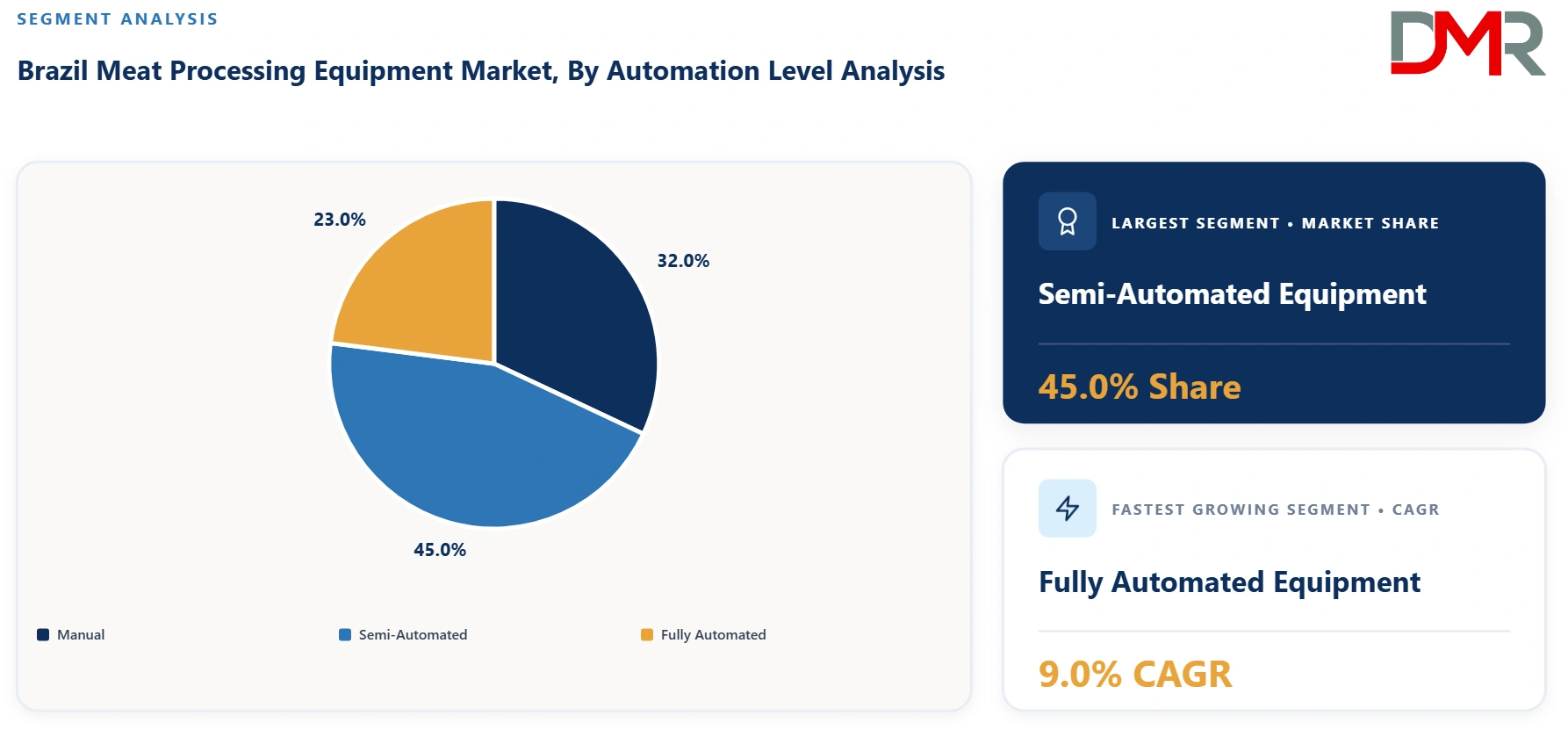
Semi-Automated Equipment is estimated to remain the largest automation category in 2026 at approximately 45.0% share because it provides processors with productivity improvements without the capital intensity and integration requirements associated with complete automation. Fully Automated Equipment represents approximately 32.0%, while Manual Equipment accounts for approximately 23.0%. Fully automated systems are expected to be the fastest-growing category, achieving approximately 9.0% CAGR through 2035. Growth is driven by labor scarcity, rising productivity requirements, improved robotics, machine vision, digital controls and the economic advantages of high-throughput facilities. Manual equipment will remain important among smaller processors, butcher operations and lower-volume facilities, but its relative share should decline. Brazil's large industrial protein processors provide an attractive customer base for integrated automated systems, while modular semi-automation will remain the preferred pathway for medium-sized plants.
By End User Analysis
Meat Processing Plants are estimated to account for approximately 34.0% of 2026 demand, making them the largest end-user group because they operate extensive cutting, grinding, mixing, forming and packaging processes. Slaughterhouses & Abattoirs account for approximately 26.0%, followed by Poultry Processing Plants at 19.0%. Meatpacking Facilities represent approximately 10.0%, while Foodservice & Commercial Operations account for 7.0% and Other End Users for approximately 4.0%. Poultry processing plants are expected to be among the fastest-growing customer groups at approximately 7.8% CAGR, given the extremely high production volumes and strong economic case for automation. Large meat processors and slaughterhouses will continue to dominate capital expenditure because their scale allows them to justify automated deboning, grading, conveying and packaging. Smaller commercial facilities will favor compact modular equipment with lower acquisition and maintenance costs.
The Brazil Meat Processing Equipment Market Report is segmented on the basis of the following:
By Equipment Type
- Cutting & Slicing Equipment
- Grinding & Mincing Equipment
- Mixing & Blending Equipment
- Forming & Portioning Equipment
- Stuffing & Filling Equipment
- Injecting & Marinating Equipment
- Tenderizing Equipment
- Cooking & Smoking Equipment
- Others
By Meat Type
- Beef
- Pork
- Poultry
- Mutton & Goat
- Other Meat
By Processing Stage
- Slaughtering & Primary Processing
- Cutting & Deboning
- Further Processing
- Cooking & Curing
- Packaging
By Automation Level
- Manual
- Semi-Automated
- Fully Automated
By End User
- Slaughterhouses & Abattoirs
- Meat Processing Plants
- Poultry Processing Plants
- Meatpacking Facilities
- Foodservice & Commercial Operations
- Other End Users
Regulatory Landscape
Brazil's meat-processing equipment market operates within a demanding regulatory environment involving food safety, sanitation, worker safety, animal welfare, machinery conformity and export-market requirements. Regulatory compliance increases the importance of hygienic equipment design, cleanability, traceability and validated process controls. Imported machinery may face additional documentation and conformity requirements, making local technical support and engineering capabilities commercially important. Export-oriented processors must also meet requirements imposed by overseas customers and destination markets, reinforcing demand for precise weighing, inspection and traceability systems. Regulation therefore acts both as a restraint and market catalyst: compliance increases equipment costs but encourages modernization and replacement of older machinery. Suppliers with local service networks, spare-parts availability and experience integrating equipment into compliant facilities are likely to outperform low-cost suppliers lacking technical support.
Technology Analysis
Technology is becoming the principal differentiator in Brazil's meat-processing-equipment market. AI-powered computer vision, robotic cutting, automated grading, digital traceability, IoT monitoring and predictive maintenance are moving equipment beyond mechanical productivity toward data-driven process optimization. Suppliers capable of integrating hardware and software can help processors improve yield, reduce labor dependency and identify quality deviations in real time. BAADER's recent technology developments include AI-powered evisceration monitoring, automated deboning and AI-based rest-meat detection, while JBT Marel emphasizes data intelligence and integrated digital processing.
Competitive Landscape
The Brazil meat-processing-equipment market is moderately fragmented, with a small group of international full-line suppliers competing alongside specialized domestic manufacturers and regional equipment companies. Global players compete through automation, integrated line engineering, robotics, digitalization, yield optimization and after-sales service, while local manufacturers often differentiate through price, customization, local engineering and faster service. JBT Marel has a particularly strong Brazilian presence through Marel and Sulmaq, while BAADER and Frontmatec compete strongly in poultry and red-meat automation.
Some of the prominent players in the Brazil Meat Processing Equipment Market are:
- JBT Marel
- GEA Group
- Sulmaq
- BAADER
- Frontmatec
- Handtmann Maschinenfabrik
- Bizerba
- Weber Maschinenbau
- Vemag Maschinenbau
- Seydelmann
- Metalbud Nowicki
- Minerva Omega Group
- Provisur Technologies
- The Middleby Corporation
- Bettcher Industries
- Risco
- Ross Industries
- Marel
- FPEC
- Heat and Control
- Grote Company
- K+G Wetter
- BANSS
- Stephan Machinery
- Hollymatic
- Jarvis Products
- Mepaco
- Magurit
- Meyn
- Meyn Food Processing Technology
- Equipamientos Cárnicos
- Biro Manufacturing
- Braher International
- Millard Manufacturing
- Apache Stainless Equipment
- PSS Svidnik
- Nu-Meat Technology
- Prime Equipment Group
- Key Technology
- Duravant
- Other Key Players
Recent Developments
- August 2026: JBT Marel announced a September 2026 workshop at its Campinas demonstration center focused on end-of-line automation, productivity, standardization, packaging sustainability and connected protein-processing operations.
- April 2026: JBT Marel highlighted the commissioning of Frimesa's new pork-processing facility in Assis Chateaubriand, Brazil, equipped with advanced automation, robotics and software designed to improve capacity, yield, consistency and labor productivity.
- March 2026: At Mercoagro 2026 in Chapecó, JBT Marel showcased automated pork deboning, skinning, carcass grading and prepared-food technologies, emphasizing automation, data integration, yield optimization and labor reduction.
- January 2025: BAADER presented AI-based evisceration monitoring, AI-enabled rest-meat detection, automated front-half deboning and new grading technology, reinforcing the shift toward intelligent poultry-processing automation.
- January 2025: Frontmatec demonstrated robotic cattle splitting, robotic beef loin separation and robotic chine-bone sawing technologies designed to improve cutting precision, ergonomics, yield and labor productivity in red-meat processing.
Report Details
| Report Characteristics |
| Market Size (2026) |
USD 0.73 Bn |
| Forecast Value (2035) |
USD 1.25 Bn |
| CAGR (2026–2035) |
6.16% |
| Historical Data |
2021 – 2025 |
| Forecast Data |
2026 – 2035 |
| Base Year |
2025 |
| Segments Covered |
By Equipment Type, By Meat Type, By Processing Stage, By Automation Level, By End User |
| Country Coverage |
Brazil |
Frequently Asked Questions
What is the size of the Brazil Meat Processing Equipment market in 2026?
▾ The Brazil Meat Processing Equipment market is estimated at approximately USD 0.73 billion in 2026, covering primary, secondary, further-processing and packaging equipment.
What will the Brazil Meat Processing Equipment market be worth by 2035?
▾ The Brazil Meat Processing Equipment market is projected to reach approximately USD 1.25 billion by 2035, supported by modernization, production growth and increasing automation.
What is the CAGR of the Brazil Meat Processing Equipment market from 2026 to 2035?
▾ The Brazil Meat Processing Equipment market is forecast to expand at approximately 6.3% CAGR between 2026 and 2035, driven by automation and processing-capacity investments.
What is the largest segment in the Brazil Meat Processing Equipment market?
▾ Cutting & Slicing Equipment is expected to be the largest segment in the Brazil Meat Processing Equipment market, accounting for approximately 22.0% share in 2026.
Which meat type dominates the Brazil Meat Processing Equipment market?
▾ Beef is projected to dominate the Brazil Meat Processing Equipment market, accounting for approximately 46.0% share in 2026 because of Brazil's large cattle-processing and export industry.
What are the key growth drivers of the Brazil Meat Processing Equipment market?
▾ The Brazil Meat Processing Equipment market is driven by meat-production growth, export expansion, plant modernization, labor productivity requirements, food-safety standards and increasing automation.
What are the major technology trends in the Brazil Meat Processing Equipment market?
▾ Major trends in the Brazil Meat Processing Equipment market include AI-powered vision systems, robotics, automated grading, predictive maintenance, digital traceability and connected processing equipment.
Who are the key players in the Brazil Meat Processing Equipment market?
▾ Key players in the Brazil Meat Processing Equipment market include JBT Marel, BAADER, Frontmatec, GEA, The Middleby Corporation, Bettcher Industries, TOMRA, Minerva Omega and Sulmaq.