Market Overview
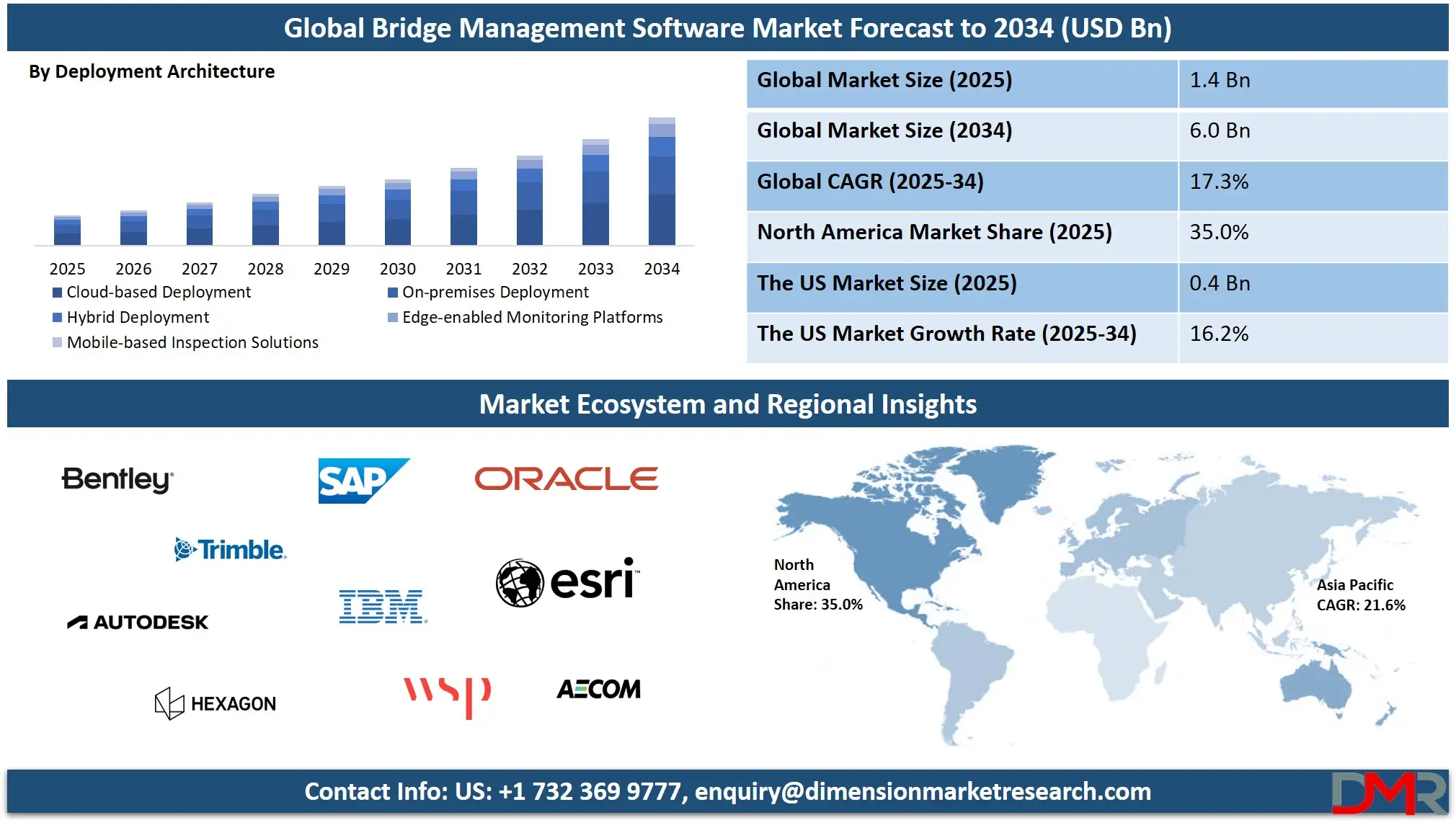
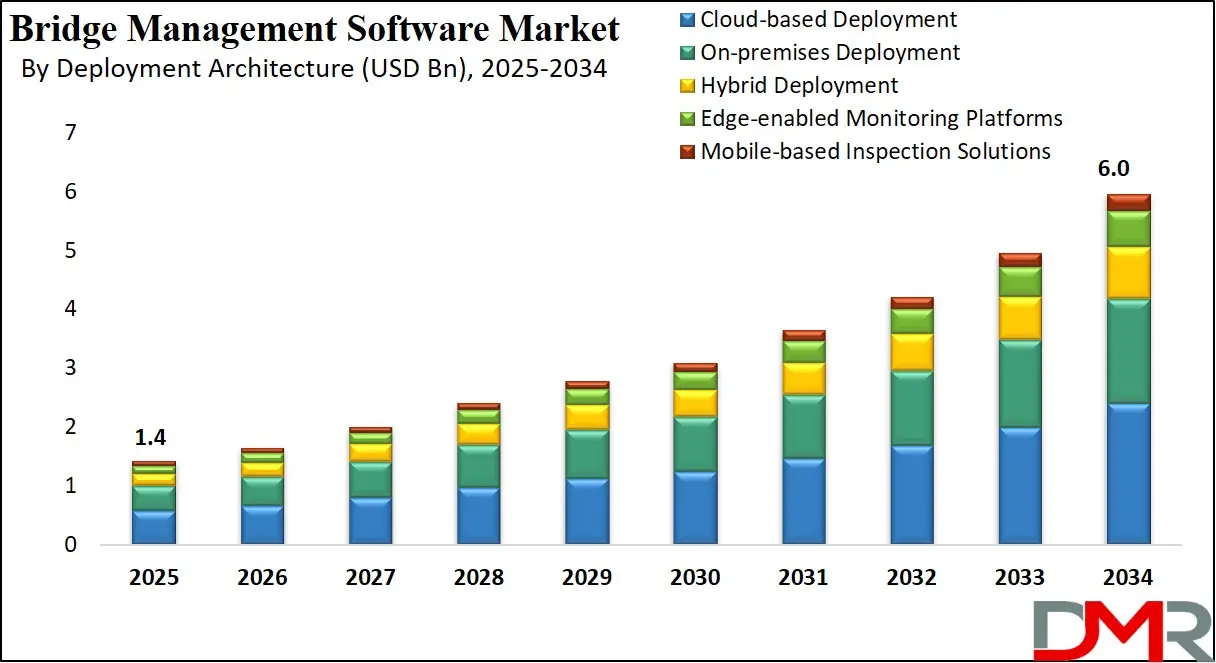
The Global Bridge Management Software Market is expected to be valued at approximately USD 1.4 billion in 2025 and is projected to reach USD 6.0 billion by 2034, expanding at a compound annual growth rate of 17.3%, driven by rising adoption of digital infrastructure asset management, bridge inspection systems, and lifecycle maintenance solutions globally.
Bridge Management Software is a specialized digital solution designed to support the systematic inspection, assessment, maintenance planning, and lifecycle management of bridge assets. It enables infrastructure owners and engineers to collect condition data, analyze structural performance, prioritize maintenance activities, and allocate budgets efficiently across bridge networks. By integrating inspection records, geospatial data, structural analytics, and historical performance information, the software helps improve safety, extend asset life, reduce unexpected failures, and support data driven decision making for critical transportation infrastructure.
ℹ
To learn more about this report –
Download Your Free Sample Report Here
The global Bridge Management Software Market refers to the global ecosystem of software platforms and related services developed to manage bridges across road, rail, and multimodal transportation networks. This market is driven by the increasing age of bridge infrastructure, rising public safety concerns, and the need for efficient asset management practices among transportation authorities and infrastructure owners. Governments and public agencies across developed and emerging economies are adopting digital bridge management systems to comply with inspection regulations, improve maintenance efficiency, and optimize long-term capital planning.
ℹ
To learn more about this report –
Download Your Free Sample Report Here
At a global level, the market is also shaped by advancements in digital technologies such as cloud computing, geographic information systems, digital twin modeling, and sensor-based structural monitoring. These technologies are enabling more predictive and performance-based approaches to bridge maintenance rather than reactive repairs. Growing infrastructure investments, urbanization, and the integration of intelligent transportation systems are further expanding the adoption of bridge management software across regions, making it a critical component of modern infrastructure management strategies.
The US Bridge Management Software Market
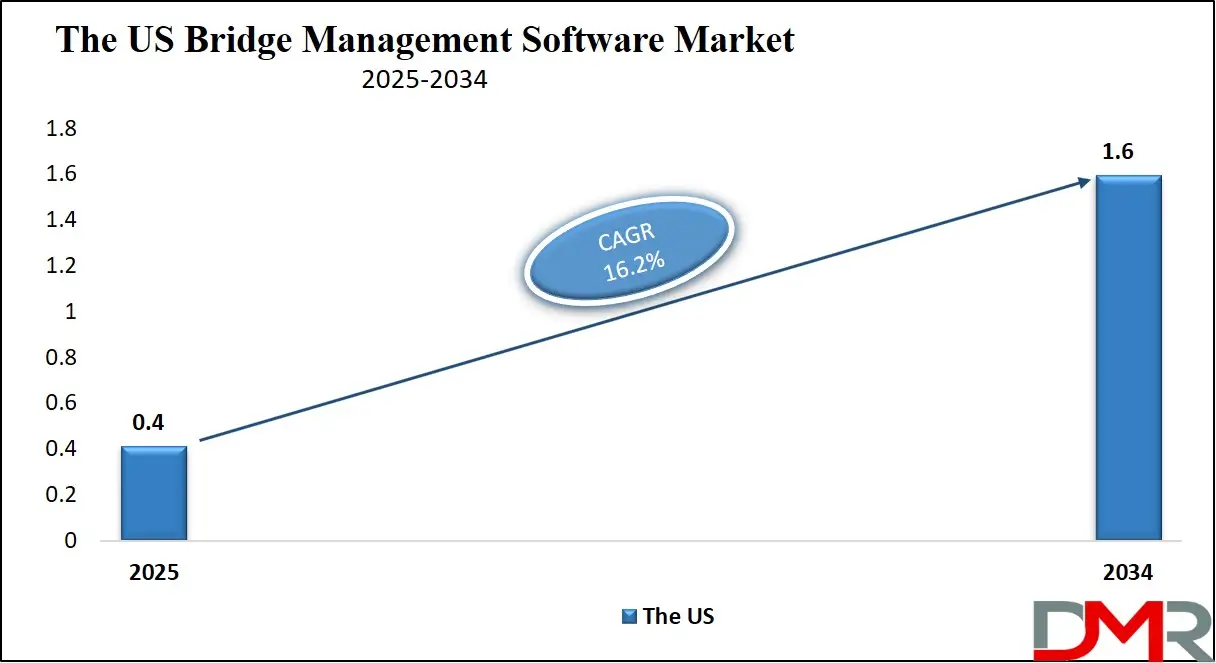
The U.S. Bridge Management Software market size is projected to be valued at USD 0.4 billion by 2025. It is further expected to witness subsequent growth in the upcoming period, holding USD 1.6 billion in 2034 at a CAGR of 16.2%.
The United States Bridge Management Software market is driven by the country’s vast inventory of aging bridges and the strong regulatory emphasis on public safety and structural integrity. Federal and state transportation agencies rely heavily on digital bridge management systems to support routine inspections, condition assessment, maintenance prioritization, and long-term capital planning.
ℹ
To learn more about this report –
Download Your Free Sample Report Here
Programs administered by agencies such as state departments of transportation have accelerated the adoption of asset management software that integrates inspection data, structural ratings, and historical performance records. Increasing funding for infrastructure modernization and compliance with national bridge inspection standards continues to reinforce demand for advanced bridge lifecycle management platforms across the US.
Technological advancement is a key factor shaping the US market, with growing deployment of cloud-based bridge management solutions, geographic information system integration, and data analytics tools. Infrastructure owners are increasingly adopting predictive maintenance capabilities, digital twin models, and sensor-based structural health monitoring to move from reactive repair approaches toward data-driven decision making.
The market also benefits from the presence of leading software providers and engineering firms offering integrated inspection, maintenance planning, and asset optimization solutions. As infrastructure resilience, climate adaptation, and smart transportation initiatives gain importance, the US Bridge Management Software market is expected to maintain strong growth over the forecast period.
Europe Bridge Management Software Market
The Europe Bridge Management Software market is projected to reach approximately USD 350 million in 2025, reflecting steady growth driven by increasing investments in transportation infrastructure, the need to maintain aging bridges, and stringent regulatory standards across the region. Government transportation authorities and infrastructure operators are adopting advanced bridge management platforms to support inspection workflows, condition assessment, and maintenance planning.
These solutions help agencies comply with European Union safety regulations, optimize lifecycle costs, and improve the operational reliability of critical road and rail networks. The emphasis on infrastructure resilience, safety, and long-term asset management is encouraging widespread digital adoption across the continent.
The market in Europe is further supported by technological advancements, including cloud-based deployment, digital twin modeling, predictive analytics, and sensor integration for structural health monitoring. These innovations enable real-time monitoring, data-driven decision making, and proactive maintenance planning, reducing the risk of unexpected failures. The regional market is forecast to grow at a compound annual growth rate of 15.8%, reflecting moderate but consistent expansion as both mature economies and emerging European countries invest in smart infrastructure initiatives. Collaboration between software providers, engineering firms, and transportation authorities is also enhancing platform adoption and driving competitive differentiation in the market.
Japan Bridge Management Software Market
The Japan Bridge Management Software market is projected to reach approximately USD 98.0 million in 2025, driven by the country’s extensive transportation network and a high focus on infrastructure safety and modernization. Aging bridges and stringent national safety regulations are prompting government transportation authorities and private infrastructure operators to adopt advanced bridge management platforms for inspection, condition assessment, and maintenance planning. These systems enable efficient monitoring of structural integrity, accurate documentation of inspections, and optimized allocation of maintenance budgets, ensuring the safety and reliability of both road and railway bridges across Japan.
Technological innovation is a key factor supporting market growth in Japan, with increasing adoption of cloud-based solutions, sensor-enabled structural health monitoring, predictive maintenance tools, and digital twin modeling. These platforms allow real-time monitoring, data-driven decision making, and proactive maintenance interventions, which help reduce lifecycle costs and prevent unexpected infrastructure failures. The market is expected to grow at a compound annual growth rate of 16.5%, reflecting strong adoption trends as Japan continues to invest in smart infrastructure initiatives, modern transportation projects, and the integration of intelligent bridge management systems for long-term asset optimization.
Global Bridge Management Software Market: Key Takeaways
- Rapid Market Growth: The Global Bridge Management Software Market will grow from USD 1.4 Bn in 2025 to USD 6.0 Bn by 2034 at 17.3% CAGR, driven by cloud, digital twin, and predictive maintenance adoption.
- Leading Solutions: Asset lifecycle and bridge inspection software dominate, enabling centralized data, cost optimization, and regulatory compliance across all bridge types.
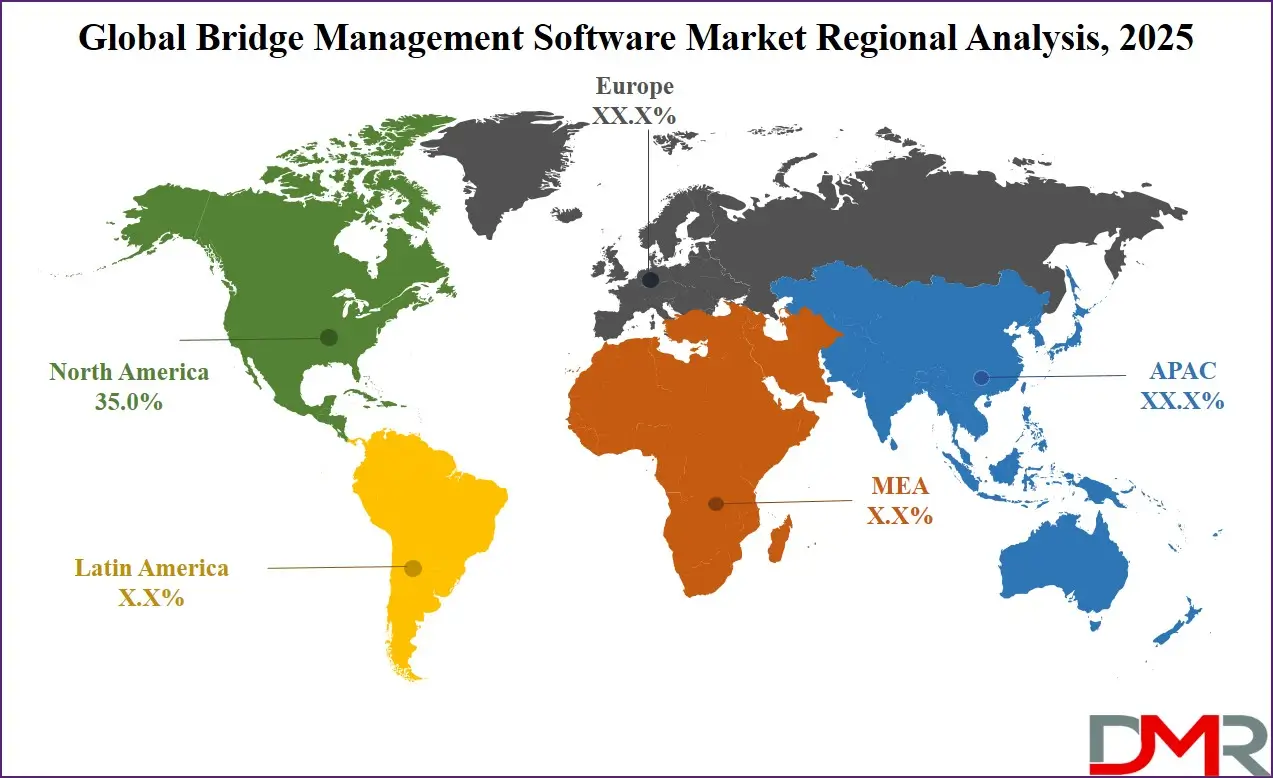
- Regional Insights: North America leads with 35.0% share, while Asia Pacific grows fastest due to urbanization, infrastructure expansion, and digital adoption.
- AI and Predictive Maintenance: AI improves defect detection, risk assessment, and maintenance planning, enhancing safety, reducing costs, and extending bridge life.
- Flexible Deployment: Perpetual licenses dominate large-scale use, while cloud and subscription models enable cost-effective, scalable access for smaller agencies and emerging markets.
Global Bridge Management Software Market: Use Cases
- Bridge Inspection and Condition Assessment: Bridge management software is extensively used to support systematic bridge inspection and condition assessment across road and rail networks. Transportation agencies utilize these platforms to collect inspection data, structural ratings, images, and defect records in a centralized system. Integration with geographic information systems improves asset visibility and location accuracy, while standardized digital workflows enhance regulatory compliance and reporting efficiency. This use case improves data reliability, reduces manual errors, and strengthens decision-making related to bridge safety and performance monitoring.
- Maintenance Planning and Lifecycle Asset Management: Bridge management software plays a vital role in maintenance planning and lifecycle asset management by helping infrastructure owners evaluate deterioration patterns and prioritize repair activities. The software enables analysis of historical condition data, maintenance costs, and remaining service life to support optimized budgeting and long-term capital planning. Predictive maintenance capabilities allow agencies to shift from reactive repairs to proactive asset preservation, reducing lifecycle costs and improving the sustainability of bridge infrastructure.
- Structural Health Monitoring and Performance Evaluation: Structural health monitoring is a growing use case within the global bridge management software market, driven by the need for real-time performance evaluation of critical structures. The software integrates sensor data such as strain, vibration, and load measurements to monitor structural behavior under traffic and environmental conditions. By combining monitoring data with analytics and visualization tools, infrastructure owners can detect early signs of deterioration, assess risk levels, and enhance resilience planning for high-value bridge assets.
- Risk Assessment and Capital Investment Decision Support: Bridge management software is increasingly used for risk assessment and capital investment decision support at network and program levels. Transportation authorities rely on these systems to evaluate structural risk, traffic criticality, and socioeconomic impact associated with bridge failures or closures. By supporting scenario analysis and performance-based planning, the software enables data-driven prioritization of rehabilitation and replacement projects. This use case helps optimize infrastructure funding, improve transparency, and align bridge investment strategies with long-term transportation objectives.
Impact of Artificial Intelligence on the global Bridge Management Software market
The impact of artificial intelligence on the global Bridge Management Software market is transforming how infrastructure owners inspect, evaluate, and maintain bridge assets. AI-powered analytics enhance the interpretation of large volumes of inspection and sensor data, enabling automated defect detection, pattern recognition, and risk scoring that far exceed traditional manual methods.
By leveraging machine learning models trained on historical condition records and structural performance indicators, bridge management platforms can predict deterioration trends with higher accuracy and provide early warnings for critical failures. This shift toward predictive asset management reduces unplanned maintenance costs, extends service life, and improves the overall safety and reliability of bridge networks.
AI integration also accelerates workflow efficiency by automating routine tasks such as image classification, anomaly detection, and data validation from field inspections. Computer vision techniques enable rapid analysis of photographic and drone surveillance data to identify cracks, corrosion, and deformation, while natural language processing assists in organizing and standardizing inspector notes.
Furthermore, AI-driven decision support systems help transportation authorities optimize maintenance prioritization and budget allocation by simulating multiple intervention scenarios based on risk, performance, and cost inputs. Overall, artificial intelligence is a key growth driver in the bridge management software market, enhancing predictive maintenance, enabling advanced structural health monitoring, and supporting smarter infrastructure investment strategies globally.
Global Bridge Management Software Market: Stats & Facts
- U.S. Department of Transportation Federal Highway Administration (National Bridge Inventory data)
- As of 2025, there are over 624,000 public highway bridges in the United States, according to the National Bridge Inventory dataset.
- The National Bridge Inventory dataset is compiled annually and includes detailed condition and inspection data for bridges on public roads as required by federal law.
- Bridge condition data for 2025 shows statewide counts of bridges rated “good,” “fair,” and “poor” as part of the official safety inspection program.
- The National Bridge Inventory data is published each year by June 15th with final condition and structural inspection reporting.
- The NBI requires element-level condition data collection on all bridges on the National Highway System, which is a core basis for federal asset management planning.
- UK Government Official Bridge Data
- Across Great Britain, approximately 3,000 bridges are currently unable to support the heaviest vehicles, according to official UK government infrastructure announcements.
- These substandard bridges in the UK fail to meet the weight capacity standards required for modern freight and commercial traffic.
- India Government Bridge Safety Initiative
- After a major bridge collapse in 2025, the Gujarat state government ordered structural inspection of more than 1,800 bridges across the region to improve safety practices.
- Official records show that 20 bridges were closed completely and 113 were closed partially following the inspections in Gujarat post-collapse.
- National Bridge Inventory (2025 Catalog Metadata)
- The U.S. federal National Bridge Inventory describes bridge locations, classifications, functional conditions, and inspection data as part of official asset reporting.
- By June 20, 2025, the NBI dataset included comprehensive condition and classification data for more than 624,000 bridges on public highways.
- The NBI is maintained as part of the U.S. Department of Transportation and Bureau of Transportation Statistics National Transportation Atlas Database, serving official planning and compliance functions.
Global Bridge Management Software Market: Market Dynamics
Global Bridge Management Software Market: Driving Factors
Rising Aging Infrastructure and Regulatory Compliance Requirements
One of the key drivers of the Bridge Management Software market is the increasing number of aging bridges across developed and emerging economies. Governments and transportation authorities are under pressure to ensure structural safety, comply with inspection mandates, and avoid costly failures. Bridge management platforms enable systematic condition assessment, inspection scheduling, and maintenance prioritization, supporting data-driven decision making. Integration with geographic information systems and digital reporting tools allows agencies to meet regulatory standards efficiently, while reducing the risk of infrastructure deterioration and improving public safety outcomes.
Adoption of Advanced Digital Technologies
The growing implementation of cloud computing, structural health monitoring, digital twin modeling, and predictive analytics is driving market adoption. Bridge management software increasingly leverages sensor data, IoT-enabled monitoring, and AI-powered performance evaluation to enhance predictive maintenance capabilities. These technological advancements allow infrastructure owners to optimize asset lifecycle management, reduce unplanned repair costs, and extend service life. The demand for intelligent infrastructure management solutions and smart city initiatives is further accelerating the adoption of these advanced bridge management systems globally.
Global Bridge Management Software Market: Restraints
High Initial Implementation and Integration Costs
Despite the benefits, the adoption of bridge management software is restrained by high upfront costs associated with software licensing, sensor deployment, and system integration. Smaller municipalities or private infrastructure owners may find it difficult to justify the investment, particularly when budgets are limited. Customization, training, and ongoing software maintenance add additional financial burdens, which can slow adoption rates and limit market penetration in certain regions.
Data Management and Interoperability Challenges
The effective use of bridge management platforms depends on accurate and consistent data collection from multiple sources, including inspections, sensors, and GIS systems. Inconsistencies in data formats, legacy systems, and a lack of interoperability between platforms can hamper system efficiency. Ensuring reliable data integration across large bridge networks remains a challenge, impacting the effectiveness of predictive analytics, reporting, and maintenance planning workflows.
Global Bridge Management Software Market: Opportunities
Integration of Artificial Intelligence and Predictive Analytics
The incorporation of AI, machine learning, and predictive analytics in bridge management software presents significant growth opportunities. These technologies allow infrastructure owners to detect structural anomalies early, forecast maintenance needs, and optimize repair schedules. AI-driven decision support enhances resource allocation, reduces lifecycle costs, and improves safety standards, creating potential for new product offerings and service-based revenue streams.
Expansion in Emerging Economies
Rapid urbanization, increased infrastructure investments, and government initiatives in countries across the Asia Pacific, Latin America, and the Middle East are creating strong demand for digital bridge management solutions. Emerging economies with expanding transportation networks are seeking advanced asset management tools to maintain safety, extend service life, and optimize capital expenditure. This geographic expansion represents a significant opportunity for software vendors to capture new markets and scale operations globally.
Global Bridge Management Software Market: Trends
Shift toward Predictive and Performance-Based Maintenance
The market is witnessing a transition from reactive repair models to predictive and performance-based maintenance approaches. Bridge management software is increasingly incorporating real-time sensor data, structural health monitoring, and analytics platforms to anticipate deterioration before failures occur. This trend enhances decision-making, reduces maintenance costs, and aligns with smart infrastructure and intelligent transportation initiatives.
Integration of Digital Twin and Cloud-Based Platforms
Digital twin technology combined with cloud-based software is transforming bridge management practices. Virtual replicas of bridge structures enable simulation of stress, load, and environmental conditions, allowing agencies to optimize maintenance strategies. Cloud deployment ensures centralized data access, collaboration among stakeholders, and scalable software solutions, driving efficiency and reducing operational challenges in large-scale bridge networks.
Global Bridge Management Software Market: Research Scope and Analysis
By Solution Type Analysis
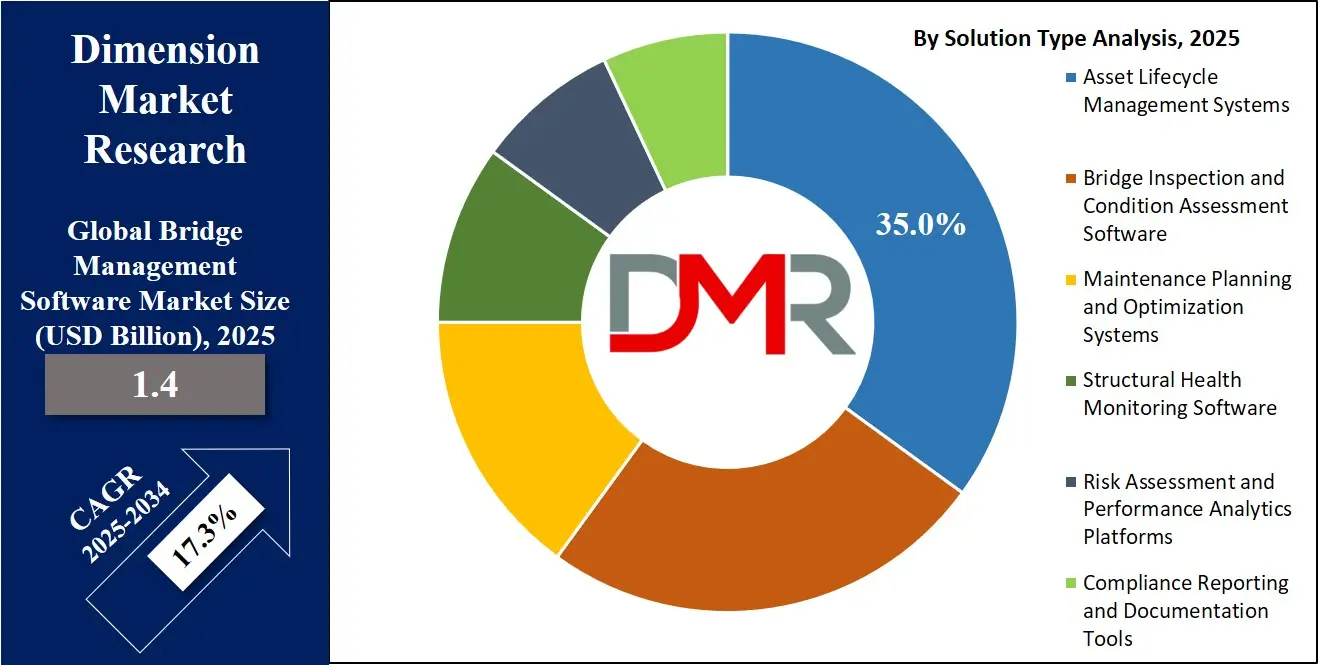
Asset Lifecycle Management Systems are expected to lead the solution type segment in the global Bridge Management Software market, capturing approximately 35.0% of the total market share in 2025. These systems provide infrastructure owners and transportation authorities with a comprehensive platform to manage the full lifecycle of bridge assets, from initial construction and inspection records to maintenance scheduling and end-of-life planning.
By consolidating structural data, inspection reports, maintenance history, and cost information into a centralized system, asset lifecycle management solutions enable more informed decision-making, better budget allocation, and long-term optimization of bridge performance. The integration of predictive analytics, digital twin modeling, and geospatial information allows agencies to identify potential structural risks, plan proactive maintenance, and reduce unexpected failures, thereby enhancing overall safety and extending the service life of bridge infrastructure.
ℹ
To learn more about this report –
Download Your Free Sample Report Here
Bridge Inspection and Condition Assessment Software plays a complementary yet critical role within this market segment by focusing specifically on evaluating the current health of bridge structures. These platforms streamline the collection and analysis of inspection data, including visual inspections, sensor readings, and photographic records, to determine structural integrity and compliance with regulatory standards.
By providing real-time insights into crack propagation, corrosion, and load-bearing performance, condition assessment software helps agencies prioritize repair activities, allocate maintenance budgets efficiently, and maintain a reliable transportation network. The adoption of such software also reduces manual reporting errors, accelerates inspection workflows, and supports data-driven strategies for preventive and predictive maintenance across diverse bridge types and geographies.
By Bridge Infrastructure Type Analysis
Highway and road bridges are expected to dominate the bridge infrastructure type segment in the global Bridge Management Software market, capturing approximately 60.0% of the total market share in 2025. These bridges form the backbone of national and regional transportation networks and carry the highest traffic volumes, making their maintenance and structural integrity a top priority for transportation authorities.
Bridge management software for highway and road bridges enables agencies to monitor structural conditions, plan routine inspections, and schedule maintenance activities efficiently. By integrating asset data, inspection reports, and predictive analytics, these platforms help reduce unexpected failures, optimize repair budgets, and extend the service life of critical road infrastructure. The high demand for maintaining safety, regulatory compliance, and operational efficiency drives the widespread adoption of digital solutions in this subsegment.
Railway bridges represent another important segment within the market, providing essential support for freight and passenger rail networks. Bridge management software designed for railway infrastructure focuses on monitoring load-bearing capacity, structural fatigue, and track alignment to ensure safe and uninterrupted rail operations. These platforms facilitate detailed inspection documentation, historical performance tracking, and predictive maintenance planning tailored to the unique demands of railway systems.
By leveraging sensor integration, digital modeling, and analytics, railway bridge software enables infrastructure owners to identify potential risks, prioritize repairs, and optimize maintenance schedules. Although smaller in market share compared to highway bridges, railway bridges are critical for national transportation efficiency, and their maintenance requires specialized software solutions capable of addressing high-speed loads and operational safety requirements.
By Procurement Model Analysis
Perpetual software licensing is expected to dominate the procurement model segment in the global Bridge Management Software market, capturing approximately 45.0% of the total market share in 2025. Under this model, infrastructure owners and transportation authorities purchase a one-time software license that provides indefinite access to the platform, along with optional support and maintenance services.
This approach is preferred by government agencies and large organizations that require full control over their bridge management systems, including data security, customization, and integration with existing enterprise infrastructure. Perpetual licensing allows agencies to avoid recurring subscription costs while enabling long-term planning for asset management, inspection workflows, and maintenance scheduling. The model is particularly suitable for managing extensive bridge networks where centralized data ownership and compliance with regulatory standards are critical for operational efficiency and safety.
Subscription-based software services represent a growing alternative within the procurement model segment, offering flexible, cloud-based access to bridge management platforms through recurring payments. This model allows infrastructure owners to deploy the software without significant upfront capital expenditure, enabling smaller agencies and private operators to benefit from advanced inspection, condition assessment, and predictive maintenance capabilities.
Subscription services often include automatic updates, cloud storage, and remote accessibility, which simplify deployment, reduce IT management overhead, and enhance collaboration among inspection teams. By providing scalable solutions that adapt to network size and operational requirements, subscription-based software services are increasingly favored in regions with emerging infrastructure development and for agencies seeking cost-effective, flexible bridge management solutions.
By Deployment Architecture Analysis
Cloud-based deployment is expected to dominate the deployment architecture segment in the global Bridge Management Software market, capturing approximately 40.0% of the total market share in 2025. Cloud-based platforms enable transportation authorities, infrastructure owners, and engineering firms to access bridge management systems remotely, facilitating real-time data collection, centralized asset monitoring, and collaboration across multiple locations.
These solutions offer scalable storage for inspection records, maintenance history, and sensor data while reducing the need for significant on-site IT infrastructure. The integration of cloud computing with geographic information systems, predictive analytics, and digital twin modeling allows agencies to perform advanced condition assessments, risk evaluations, and maintenance planning efficiently. Cloud deployment also supports software updates, cybersecurity measures, and remote accessibility, making it increasingly attractive for organizations seeking flexible and cost-effective bridge management solutions.
On-premises deployment continues to be a significant segment, catering primarily to government agencies and large infrastructure owners that require full control over data and system configurations. In this model, the software is installed and maintained on local servers, allowing agencies to manage sensitive inspection records, structural analytics, and operational workflows within their own IT environment.
On-premises solutions are preferred for compliance with strict regulatory standards, ensuring that all bridge data remains securely within organizational boundaries. These deployments enable high customization to match specific reporting formats, integration with legacy systems, and internal maintenance processes. While cloud solutions are growing rapidly, on-premises deployment remains essential for agencies prioritizing data security, operational independence, and direct control over their bridge management infrastructure.
By Technology Capability Level Analysis
Advanced analytics and decision support systems are expected to dominate the technology capability level segment in the global Bridge Management Software market, capturing approximately 28.0% of the total market share in 2025. These systems leverage artificial intelligence, machine learning, and predictive modeling to analyze vast volumes of inspection data, sensor readings, and historical performance records.
By providing actionable insights on structural integrity, deterioration trends, and maintenance priorities, advanced analytics platforms enable infrastructure owners and transportation authorities to make informed decisions that enhance bridge safety and optimize lifecycle costs. Decision support functionalities allow agencies to simulate various maintenance scenarios, forecast budget requirements, and prioritize interventions based on risk assessment and criticality, making it a central technology for data-driven bridge management strategies.
Digital twin and three-dimensional modeling solutions represent a complementary technology within this segment, providing highly detailed virtual representations of bridge structures. These platforms integrate inspection data, structural geometry, and real-time monitoring information to create interactive 3D models that replicate the physical behavior of bridges under different load and environmental conditions.
By visualizing structural performance, potential stress points, and deterioration patterns, digital twin solutions assist engineers in planning maintenance, evaluating design modifications, and predicting future performance. The adoption of three-dimensional modeling improves communication between stakeholders, enhances inspection accuracy, and supports scenario-based analysis, making it an essential tool for modern infrastructure management and long-term asset preservation.
By End-User Analysis
Government transportation authorities are expected to dominate the end-user segment in the global Bridge Management Software market, capturing approximately 45.0% of the total market share in 2025. These agencies are responsible for managing extensive bridge networks and ensuring public safety, which requires regular inspections, condition assessments, and timely maintenance interventions.
Bridge management software provides government authorities with centralized platforms to track structural health, monitor deterioration trends, plan preventive maintenance, and comply with regulatory standards. By integrating data from inspections, sensors, and historical records, these systems enable agencies to prioritize repair activities, optimize budget allocation, and reduce unplanned failures. The use of such software enhances operational efficiency, improves asset reliability, and supports long-term infrastructure planning across highways, roads, and critical transport corridors.
Infrastructure asset management organizations represent another significant segment, focusing on the systematic management of bridge portfolios across public and private sectors. These organizations use bridge management software to evaluate asset condition, forecast maintenance needs, and optimize investment strategies for multiple structures simultaneously. By leveraging predictive analytics, lifecycle cost modeling, and performance monitoring, asset managers can make informed decisions about rehabilitation, replacement, and resource allocation.
The software also allows for better reporting and documentation of bridge performance to stakeholders, ensuring accountability and transparency. While smaller than the government segment, infrastructure asset management organizations increasingly adopt digital solutions to improve efficiency, reduce lifecycle costs, and maintain safe and resilient bridge networks.
The Bridge Management Software Market Report is segmented on the basis of the following:
By Solution Type
- Asset Lifecycle Management Systems
- Bridge Inspection and Condition Assessment Software
- Maintenance Planning and Optimization Systems
- Structural Health Monitoring Software
- Risk Assessment and Performance Analytics Platforms
- Compliance Reporting and Documentation Tools
By Bridge Infrastructure Type
- Highway and Road Bridges
- Railway Bridges
- Pedestrian Bridges
- Movable and Special-purpose Bridges
- Other Bridge Structures
By Procurement Model
- Perpetual Software Licensing
- Subscription-based Software Services
- Managed Software and Monitoring Services
- Professional Consulting and System Integration Services
- Turnkey Digital Infrastructure Programs
By Deployment Architecture
- Cloud-based Deployment
- On-premises Deployment
- Hybrid Deployment
- Edge-enabled Monitoring Platforms
- Mobile-based Inspection Solutions
By Technology Capability Level
- Advanced Analytics and Decision Support Systems
- Digital Twin and 3-D Modeling Solutions
- Geographic Information System Integrated Platforms
- Sensor-enabled Structural Monitoring Systems
- Standard Inspection and Data Management Software
- Other Specialized Capabilities
By End-User
- Government Transportation Authorities
- Infrastructure Asset Management Organizations
- Engineering and Consulting Firms
- Public-Private Partnership Operators
- Safety Certification and Regulatory Bodies
Global Bridge Management Software Market: Regional Analysis
Region with the Largest Revenue Share
North America is expected to lead the global Bridge Management Software market, accounting for approximately 35 percent of total market revenue in 2025. The region’s dominance is driven by a combination of aging bridge infrastructure, stringent regulatory requirements, and substantial investments in transportation safety and modernization programs. Federal and state transportation agencies actively adopt advanced bridge management platforms to support inspections, condition assessments, predictive maintenance, and lifecycle asset management.
ℹ
To learn more about this report –
Download Your Free Sample Report Here
The integration of digital technologies such as cloud computing, geographic information systems, and sensor-based structural health monitoring further enhances operational efficiency and data-driven decision making. Strong government funding, widespread adoption of smart infrastructure initiatives, and the presence of leading software providers contribute to North America maintaining its position as the largest regional market for bridge management solutions.
Region with significant growth
The Asia Pacific region is expected to witness significant growth in the global Bridge Management Software market over the forecast period. Rapid urbanization, expanding road and rail networks, and increasing government investment in infrastructure development are driving the adoption of digital bridge management solutions in countries such as China, India, Japan, and Australia.
The growing need for efficient inspection, maintenance planning, and lifecycle asset management of newly constructed and aging bridges is encouraging agencies to implement cloud-based platforms, sensor integration, and predictive analytics. Additionally, rising awareness of structural safety standards and the adoption of smart transportation initiatives are accelerating market penetration, making the Asia Pacific one of the fastest-growing regions for bridge management software globally.
By Region
North America
Europe
- Germany
- The U.K.
- France
- Italy
- Russia
- Spain
- Benelux
- Nordic
- Rest of Europe
Asia-Pacific
- China
- Japan
- South Korea
- India
- ANZ
- ASEAN
- Rest of Asia-Pacific
Latin America
- Brazil
- Mexico
- Argentina
- Colombia
- Rest of Latin America
Middle East & Africa
- Saudi Arabia
- UAE
- South Africa
- Israel
- Egypt
- Rest of MEA
Global Bridge Management Software Market: Competitive Landscape
The competitive landscape of the global Bridge Management Software market is characterized by the presence of established infrastructure technology vendors, specialized software providers, and engineering service firms offering comprehensive asset management and inspection solutions. Key players compete on the basis of technology innovation, with a strong emphasis on integrating advanced analytics, predictive maintenance capabilities, cloud deployment options, and sensor‑based structural health monitoring into their platforms.
Strategic initiatives such as product enhancements, partnerships with transportation authorities, and expansion into emerging markets help differentiate offerings and address varying regulatory and operational requirements across regions. The market also sees ongoing investments in research and development to incorporate digital twin modeling, mobile field inspection tools, and geographic information system integration, thereby enabling more efficient data collection, visualization, and decision support for bridge owners and operators globally.
Some of the prominent players in the global Bridge Management Software market are
- Bentley Systems, Inc.
- Trimble Inc.
- Autodesk, Inc.
- Hexagon AB
- SAP SE
- IBM Corporation
- Oracle Corporation
- ESRI (Environmental Systems Research Institute)
- WSP Global Inc.
- AECOM
- Fugro N.V.
- Topcon Corporation
- Siemens AG
- Atkins (SNC-Lavalin Group)
- Aurigo Software Technologies Inc.
- AssetWorks LLC
- AgileAssets, Inc.
- Bridgeware Systems, Inc.
- Deighton Associates, Ltd. (dTIMS)
- AASHTOWare (AASHTO)
- Other Key Players
Global Bridge Management Software Market: Recent Developments
- December 2025: A leading global IT solutions distributor announced the launch of a new AI assistant integrated with a widely used collaboration platform to enhance solution enablement and real‑time access to vendor program data for partners.
- December 2025: An enterprise software infrastructure startup secured USD 3.5 million in pre‑Series A funding to expand its engineering team and enhance its AI‑driven modernization and automation platform.
- December 2025: A global technology investment firm announced its acquisition of a digital infrastructure specialist for approximately USD 4 billion, aiming to strengthen its AI and connected infrastructure portfolio.
- October 2025: A technology startup focused on creating an AI‑native operating system for complex workflow management raised USD 5.1 million in seed financing led by a venture firm, supporting accelerated platform deployment.
Report Details
| Report Characteristics |
| Market Size (2025) |
USD 1.4 Bn |
| Forecast Value (2034) |
USD 6.0 Bn |
| CAGR (2025–2034) |
17.3% |
| The US Market Size (2025) |
USD 0.4 Bn |
| Historical Data |
2019 – 2024 |
| Forecast Data |
2026 – 2034 |
| Base Year |
2024 |
| Estimate Year |
2025 |
| Report Coverage |
Market Revenue Estimation, Market Dynamics, Competitive Landscape, Growth Factors and etc. |
| Segments Covered |
By Solution Type (Asset Lifecycle Management Systems, Bridge Inspection and Condition Assessment Software, Maintenance Planning and Optimization Systems, Structural Health Monitoring Software, Risk Assessment and Performance Analytics Platforms, Compliance Reporting and Documentation Tools), By Bridge Infrastructure Type (Highway and Road Bridges, Railway Bridges, Pedestrian Bridges, Movable and Special-purpose Bridges, Other Bridge Structures), By Procurement Model (Perpetual Software Licensing, Subscription-based Software Services, Managed Software and Monitoring Services, Professional Consulting and System Integration Services, Turnkey Digital Infrastructure Programs), By Deployment Architecture (Cloud-based Deployment, On-premises Deployment, Hybrid Deployment, Edge-enabled Monitoring Platforms, Mobile-based Inspection Solutions), By Technology Capability Level (Advanced Analytics and Decision Support Systems, Digital Twin and 3-D Modeling Solutions, Geographic Information System Integrated Platforms, Sensor-enabled Structural Monitoring Systems, Standard Inspection and Data Management Software, Other Specialized Capabilities), and By End-User (Government Transportation Authorities, Infrastructure Asset Management Organizations, Engineering and Consulting Firms, Public-Private Partnership Operators, Safety Certification and Regulatory Bodies) |
| Regional Coverage |
North America – The US and Canada; Europe – Germany, The UK, France, Russia, Spain, Italy, Benelux, Nordic, & Rest of Europe; Asia-Pacific – China, Japan, South Korea, India, ANZ, ASEAN, Rest of APAC; Latin America – Brazil, Mexico, Argentina, Colombia, Rest of Latin America; Middle East & Africa – Saudi Arabia, UAE, South Africa, Turkey, Egypt, Israel, & Rest of MEA |
| Prominent Players |
Bentley Systems, Trimble, Autodesk, Hexagon, SAP, IBM, Oracle, ESRI, WSP Global, AECOM, Fugro, Topcon, Siemens, Atkins, Aurigo Software, AssetWorks, AgileAssets, Bridgeware Systems, and Others. |
| Purchase Options |
We have three licenses to opt for: Single User License (Limited to 1 user), Multi-User License (Up to 5 Users), and Corporate Use License (Unlimited User), along with free report customization equivalent to 0 analyst working days, 3 analyst working days, and 5 analyst working days respectively. |
Frequently Asked Questions
How big is the global Bridge Management Software market?
▾ The global Bridge Management Software market size is estimated to have a value of USD 1.4 billion in 2025 and is expected to reach USD 6.0 billion by the end of 2034.
What is the size of the US Bridge Management Software market?
▾ The US Bridge Management Software market is projected to be valued at USD 0.4 billion in 2025. It is expected to witness subsequent growth in the upcoming period as it holds USD 1.6 billion in 2034 at a CAGR of 16.2%.
Which region accounted for the largest global Bridge Management Software market?
▾ North America is expected to have the largest market share in the global Bridge Management Software market, with a share of about 35.0% in 2025.
Who are the key players in the global Bridge Management Software market?
▾ Some of the major key players in the global Bridge Management Software market are Bentley Systems, Trimble, Autodesk, Hexagon, SAP, IBM, Oracle, ESRI, WSP Global, AECOM, Fugro, Topcon, Siemens, Atkins, Aurigo Software, AssetWorks, AgileAssets, Bridgeware Systems, and Others.