What is the Business Intelligence Market Size?
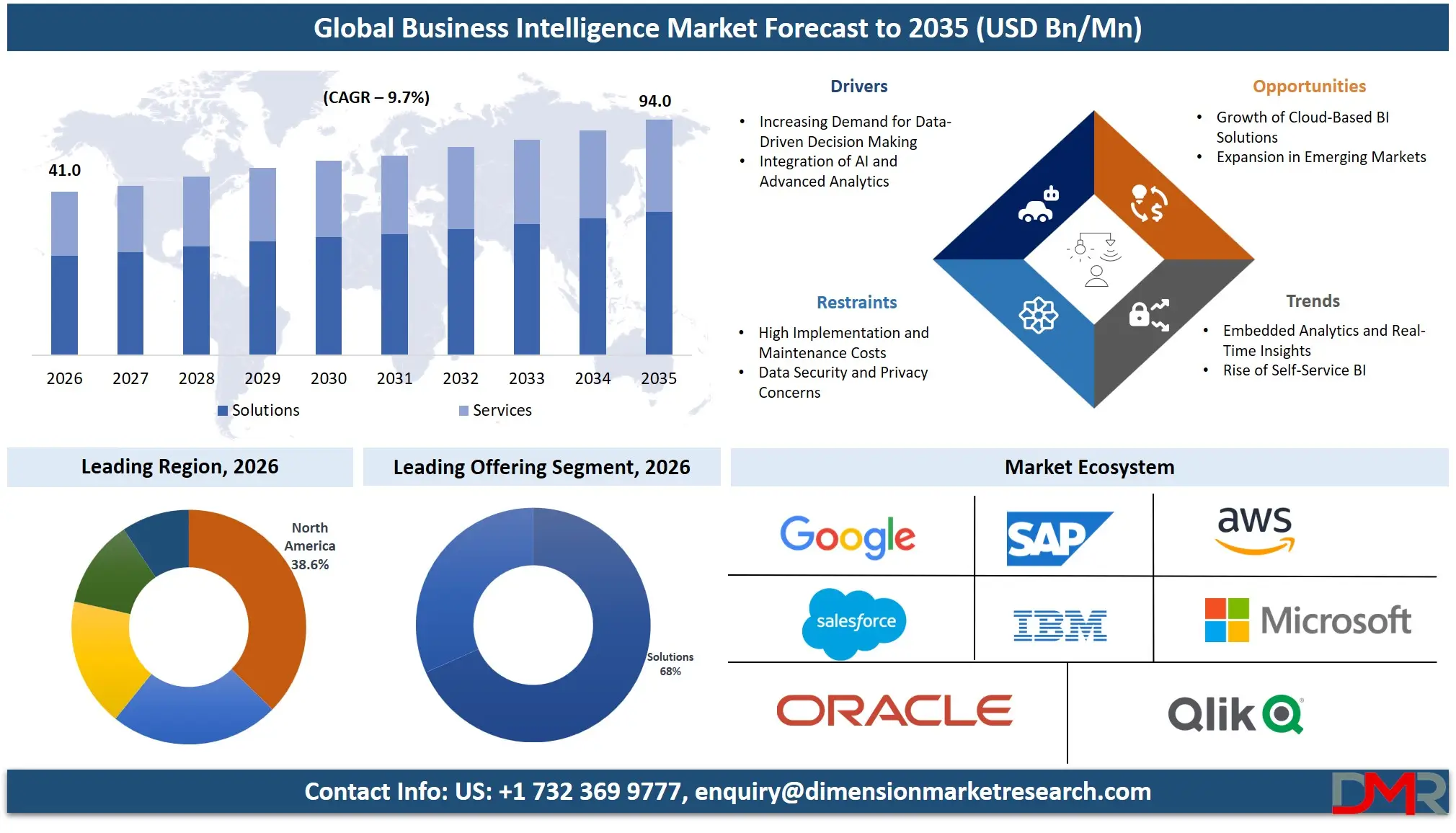
The Business Intelligence Market size is expected to be USD 41.0 billion in 2026 and increase at a compound annual growth rate of 9.7% to USD 94.0 billion in 2035 due to the growing need for data-driven approach to decision making.
ℹ
To learn more about this report –
Download Your Free Sample Report Here
Business intelligence comprises a range of software applications, platforms, and other services used for deriving actionable insights from raw data through processes of analysis, reporting, and visualization. Some of its components include data warehousing, dashboards, predictive analytics, and cloud business intelligence.
It thrives as a result of fast-growing digital transformation, data volume increase, and the demand for real-time insight. Self-service and artificial intelligence business intelligence are gaining momentum as enterprises try to become more flexible and competitive. Other key trends within business intelligence that affect its development are embedding, data democratization, and integration with cutting-edge technology.
ℹ
To learn more about this report –
Download Your Free Sample Report Here
The US Business Intelligence Market
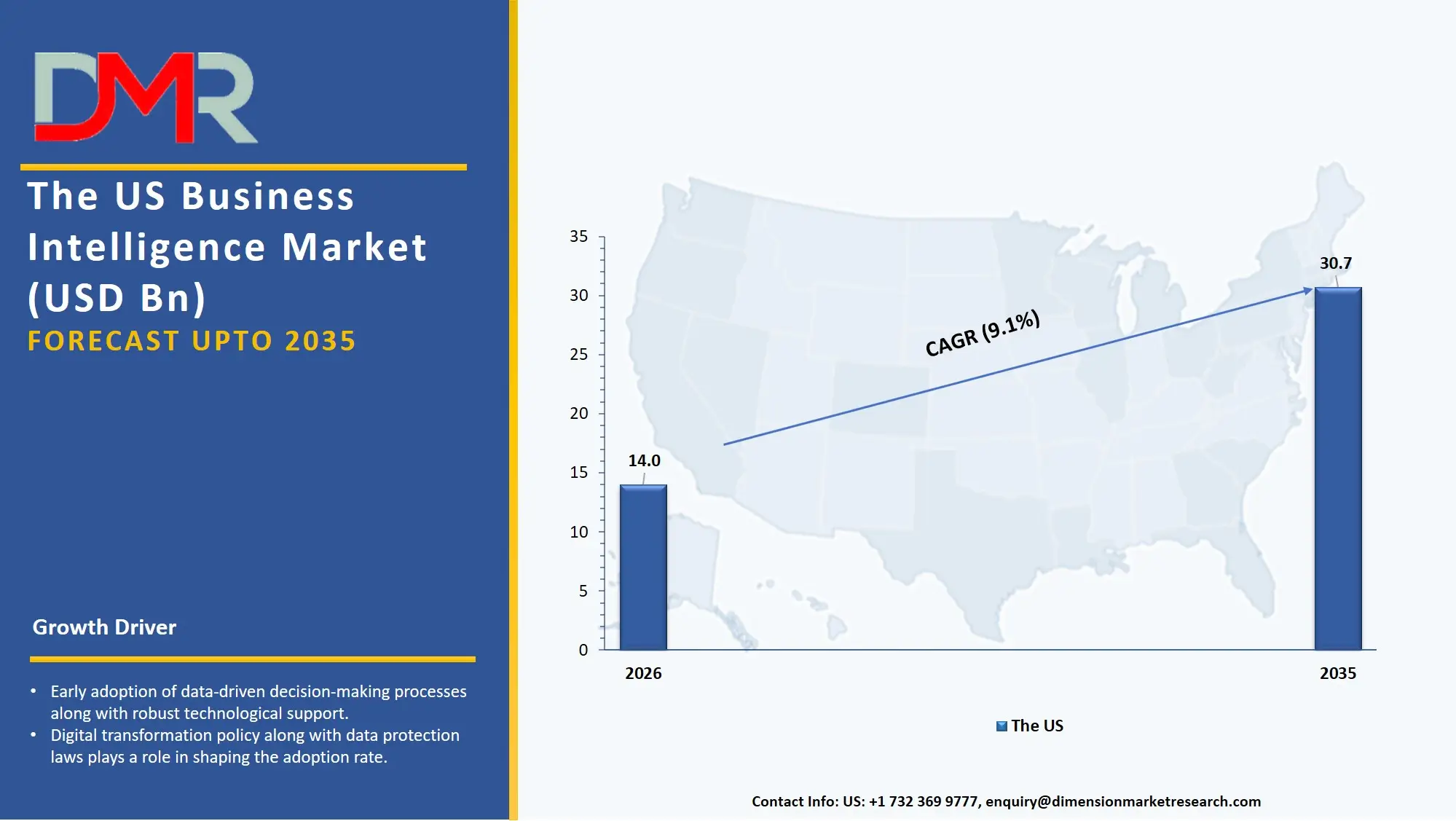
The US Business Intelligence Market size is estimated to be USD 14.0 billion in 2026 and is expected to increase at a CAGR of 9.1% over the forecast period.
ℹ
To learn more about this report –
Download Your Free Sample Report Here
In the United States, the business intelligence market has progressed rapidly because of the early adoption of data-driven decision-making processes along with robust technological support. Firms belonging to various industries like banking, hospitals, and retail make use of BI solutions to improve their performance. The digital transformation policy along with data protection laws plays a role in shaping the adoption rate. The availability of technology providers and ongoing advancements in analytics software with AI integrations fuel the progress of the market.
Europe Business Intelligence Market
The Europe Business Intelligence Market size is estimated to be USD 10.3 billion in 2026 and at a CAGR of 9.3% over the forecast period.
The Business Intelligence landscape in Europe is characterized by strict data security laws and sustainable measures such as the GDPR / EU Data Act. Firms are spending more on BI technologies to achieve operational transparency and efficiencies within their operations as well as adhering to existing regulation requirements. Some of the industries embracing BI are the manufacturing industry, banking and finance, and energy companies. Europe also experiences an increase in cloud-based BI solutions.
Japan Business Intelligence Market
The market size of Japan Business Intelligence will be USD 1.6 billion in 2026 and at a CAGR of 9.5% in the forecast period.
The Business Intelligence market in Japan is growing owing to factors such as digitization, automation, and smart cities. There are various industries where BI solutions are being used to improve efficiency. The government's efforts in encouraging digital transformation in companies are making them adopt new technologies more quickly. There are, however, still problems in some areas such as legacy software and inadequate skills of employees. Nevertheless, developments in AI and IoT present great possibilities.
Key Takeaways
- Market Size & Forecast: The Business Intelligence Market size is projected to reach USD 41.0 billion in 2026 and is anticipated to have a value of USD 94.0 billion in 2035.
- Growth Rate & Outlook: The Business Intelligence Market size is set to grow at a compound annual growth rate of 9.7% during the forecast period of 2026 to 2035.
- Primary Growth Drivers: Some of the major growth drivers in the market include Increased Need for Data-Driven Approach to Decision Making, and more.
- Key Market Trends: Some of the major trends in the market are Embedded Analytics and Real-Time Insights, and more.
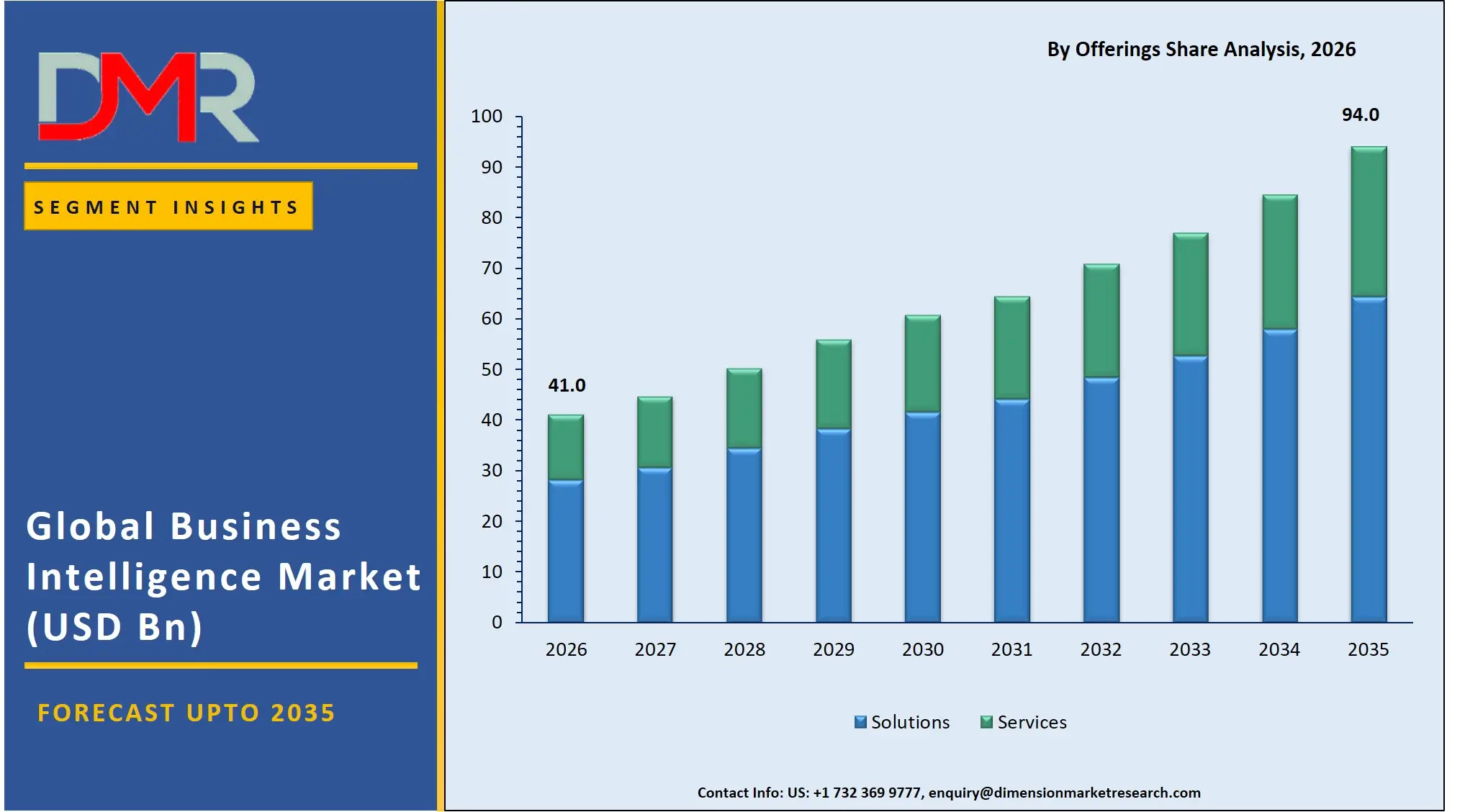
- By Offering: The solutions segment is anticipated to get the majority share of the Business Intelligence market in 2026.
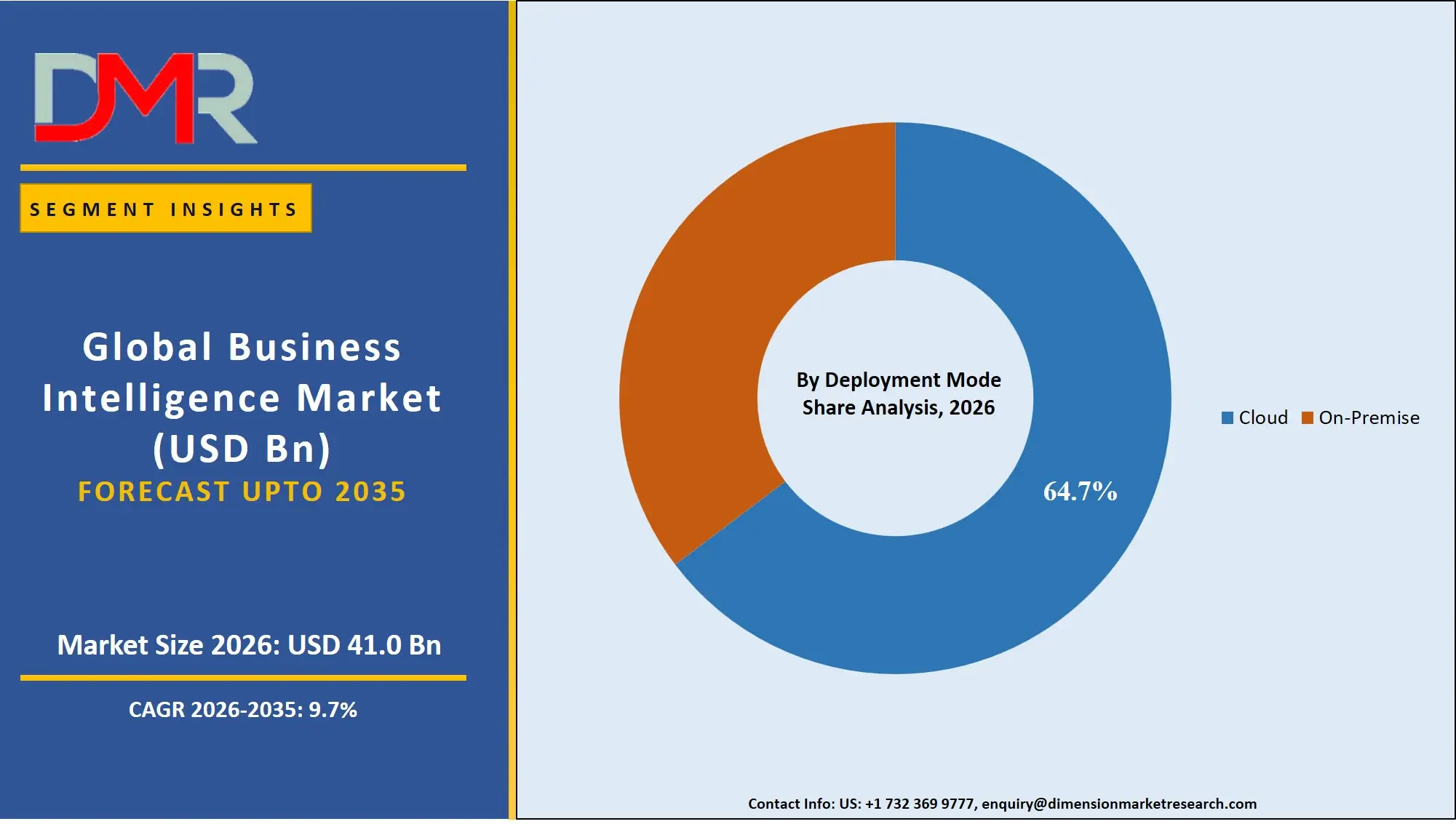
- By Deployment Mode: Cloud segment is expected to get the largest revenue share in 2026 in the Business Intelligence market.
- By Organization Size: Large Enterprises segment is expected to get the largest revenue share in 2026 in the Business Intelligence market.
- Regional Leadership: North America is set to lead the Business Intelligence market with an estimated 38.6% share in 2026.
What is the Business Intelligence?
Business Intelligence is defined as an intelligent system based on technology that entails gathering, analyzing, and presenting data in order to make better decisions. Business intelligence systems entail the use of technologies such as data mining, reporting, dashboarding, among others, which help to transform data into insightful information. Business intelligence systems allow companies to analyze their performance and develop strategies.
Use Cases
- BI Tools for Operational Efficiency: Organizations employ BI technologies to oversee the processes, spot inefficiencies, and make improvements to their processes. The dashboards allow for real-time tracking and faster problem-solving, enhancing efficiency and cost management in the process.
- BI Tools for Customer Behavior Analysis: BI allows for better customer analysis that can be used for the creation of targeted campaigns that will satisfy the needs of customers.
- BI Tools for Financial Performance Management: Organizations employ BI technology for budgeting and financial planning purposes to forecast future financial performance, allowing for more efficient financial management.
- BI Tools for Supply Chain Optimization: Organizations benefit from BI technology as it allows for enhanced visibility in the supply chain and better management of inventory and logistics processes.
How AI Is Transforming the Business Intelligence Market
AI is transforming the Business Intelligence market by offering analytical capabilities, predicting trends, and automating data processing tasks. The application of AI within the domain of business intelligence can help in pattern recognition, prediction, and providing insights without much human input.
Moreover, AI has been used for improving user experience by employing natural language processing and conversation analytics. This helps in interacting with data more efficiently. In addition, it helps in visualizing data and detecting anomalies.
Market Dynamic
Driving Factors in the Business Intelligence Market
Growing Need for Data-Driven Approach to Decision Making
Businesses nowadays depend more on data-based approaches for increasing efficiency and gaining competitive edge. The explosion of data being generated through various channels such as Internet of Things, social media platforms, digital marketing, and enterprise applications makes it necessary to deploy sophisticated BI solutions that can analyze the vast amount of data being produced.
Restraints in the Business Intelligence Market
High Deployment and Maintenance Expenses
The deployment cost of Business Intelligence systems, which covers infrastructural, licensing, and personnel costs, is quite high. Small and medium enterprises may find it difficult to implement BI technologies because of their budget constraints. Besides, the maintenance cost of the system adds up to the total deployment cost, making it difficult for enterprises to embrace BI.
Opportunities in the Business Intelligence Market
The Growth of Cloud-Based BI Tools
The emergence of cloud computing technologies is generating many opportunities for BI tools due to its scalability and efficiency at low costs. Cloud-based BI solutions help businesses save on infrastructure expenses and allow accessing BI results remotely. This becomes especially useful for SMEs, thus boosting their implementation.
Trends in the Business Intelligence Market
Embedded Analytics and Real-Time Insights
Embedded analytics is revolutionizing the way companies leverage BI through embedded analytics within their business applications. In conjunction with real-time data processing technology, decisions can be made immediately with the latest insights. This development is especially significant in industries such as retail, banking, and healthcare.
Research Scope and Analysis
The Business Intelligence market is experiencing sustained expansion as organizations increasingly adopt data-driven decision-making, cloud-based analytics, artificial intelligence, and self-service reporting capabilities. The market encompasses software solutions and associated services that enable organizations to collect, integrate, analyze, visualize, and interpret business data. Increasing enterprise data volumes, demand for real-time insights, and the integration of AI and machine learning into analytics platforms are reshaping the competitive landscape. Cloud deployment is gaining importance because of its scalability, accessibility, and lower infrastructure requirements, while enterprises continue to use on-premise environments for sensitive and highly regulated workloads.
ℹ
To learn more about this report –
Download Your Free Sample Report Here
By Offering Analysis
For the offerings section, solutions take center stage in the Business Intelligence market, holding an expected market share of 68.4% in 2026 due to their significance in helping analytics processes like dashboarding, reporting, and data integration. Businesses value these solutions to derive meaningful insights from the collected information and make decisions based on data-driven approaches. The growing trend towards real-time analytics and visualization tools has made this segment more dominant. Nevertheless, services still play an important part in implementing and optimizing the use of BI solutions and have a relatively smaller market share compared to the solutions segment. Data integration and ETL have been identified as the fastest-growing segments under solutions.
By Deployment Mode Analysis
Deployment through clouds is predicted to drive the market for Business Intelligence, which will account for 64.7% of all revenue by 2026 due to its scalability and flexibility. There are several reasons why businesses are attracted to cloud BI tools: real-time analysis, easy access from any location, and convenient connection with other corporate solutions. Such demand is especially high within SMEs due to budget constraints. On-premise deployment remains essential for industries such as BFSI and government because of the sensitive information that should be kept secure and compliant with regulations. Cloud deployment becomes the fastest-growing segment for a similar reason, merging the features of both alternatives.
By Organization Size Analysis
The market share held by large enterprises will be a staggering 62.3% in 2026 owing to their large amounts of data, complicated business models, and more financial resources to adopt the latest Business Intelligence technology. Large corporations use BI software for making plans, managing risks, and improving their performance. Their requirement for custom and integrated analytics systems also contributes to their significant market presence. Conversely, small and medium-sized companies (SMEs) will become the fastest-growing category in the industry. This is because of the rising number of affordable cloud-based BI products and an increased understanding of the advantages of evidence-based decision-making.
By Application Analysis
The financial performance and strategy management application will be the largest segment of 28.9% in 2026 due to the growing focus on transparency, accuracy, and proper risk management in financial performance. Business Intelligence tools are vital in conducting comprehensive analysis of financial data and identifying patterns that can be used in decision making. The growth in the financial performance and strategy management application is attributed to the rising demand for accountability and compliance with financial regulations. On the other hand, CRM analytics will be the fastest-growing segment since there is an increased focus on customer-oriented strategies.
By End User Analysis
The BFSI sector is projected to occupy the largest share of the Business Intelligence Market, at 26.5%, by 2026, considering the sector's heavy dependency on analytics for managing fraud, credit risk analysis, regulatory compliance, and CRM functions. The BFSI sector always makes sure to invest in BI systems to optimize their business operations. Moreover, the highly regulated nature of the BFSI industry also plays an instrumental role in increasing the deployment of BI solutions in the BFSI sector. On the other hand, the healthcare sector is forecasted to become the fastest-growing end-user segment, considering the increasing importance of BI tools for improving patient care and making efficient decisions.
The Business Intelligence Market Report is segmented on the basis of the following:
By Offerings
- Solutions
- Dashboards & Scorecards
- Data Integration & ETL
- Reporting & Visualization
- Query & Analysis
- Services
- Consulting
- Deployment & Integration
- Support & Maintenance
By Deployment
By Organization Size
By Application
- Supply Chain Analytic Applications
- CRM Analytics Operations
- Financial Performance & Strategy Management
- Production Planning Analytic Operations
- Others
By End User
- BFSI
- IT & Telecom
- Retail & Consumer Goods
- Manufacturing
- Healthcare
- Others
Regional Analysis
Leading Region in the Business Intelligence Market
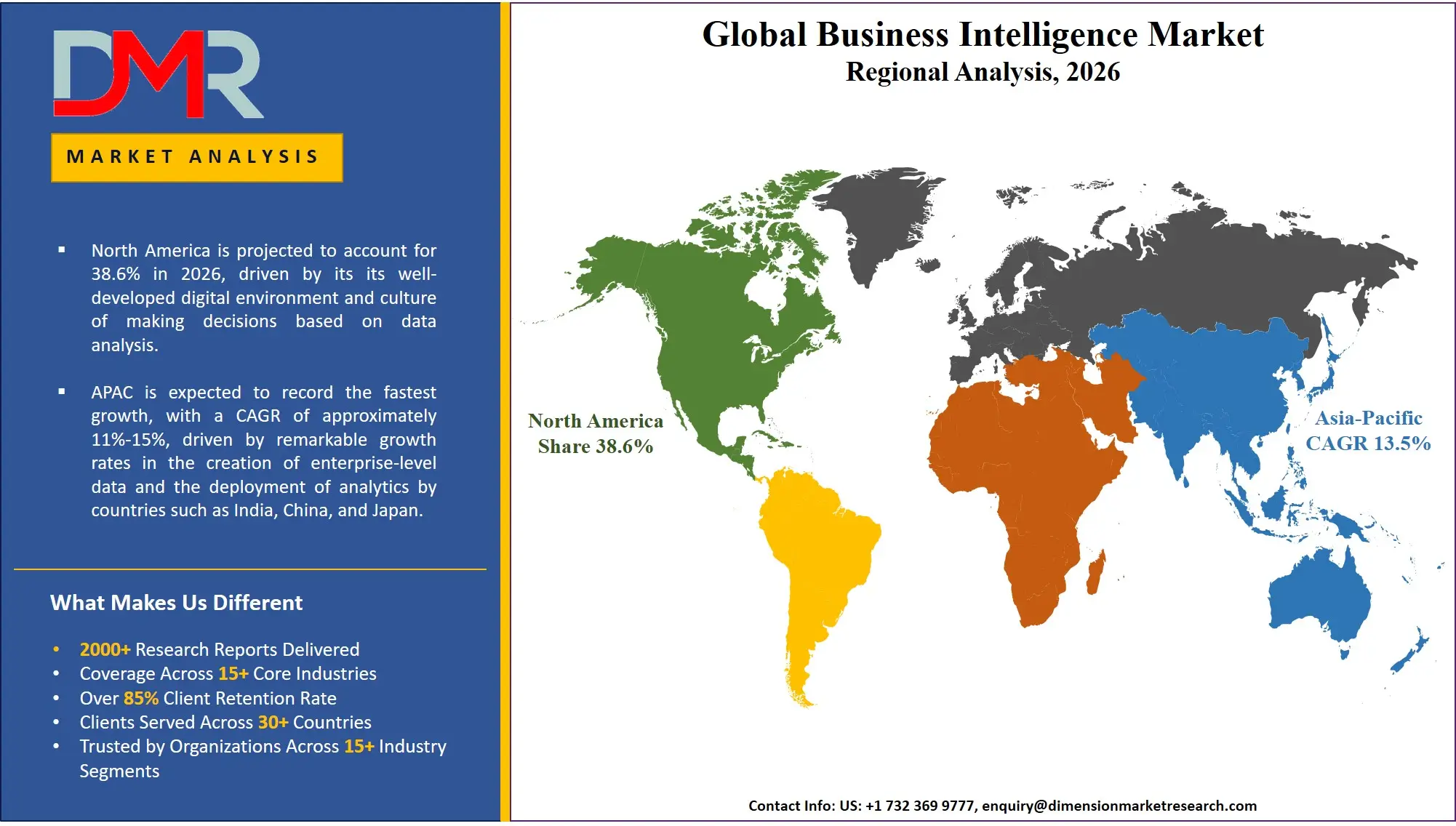
The North American region is expected to hold a dominant position within the global Business Intelligence market, occupying around 38.6% of the market share by 2026, owing to its well-developed digital environment and culture of making decisions based on data analysis. Cloud computing, artificial intelligence, and analytics software have been adopted early on by the region and contribute greatly to enhancing the functionality of Business Intelligence. Companies operating in industries including but not limited to banking, healthcare, retail, and technology have been consistently utilizing analytical tools for staying ahead in the competition.
ℹ
To learn more about this report –
Download Your Free Sample Report Here
Fastest Growing Region in the Business Intelligence Market
The Asia-Pacific region is fast becoming the leading market in the Business Intelligence industry owing to its fast-growing economy and technological advancements. There have been remarkable growth rates in the creation of enterprise-level data and the deployment of analytics by countries such as India, China, and Japan. The push towards smart cities, digitalized economies, and Industry 4.0 by governments has fueled the need for BI solutions. Also, there is growing recognition that the region's burgeoning SMEs require affordable and scalable analytics tools.
By Region
North America
Europe
- Germany
- The U.K.
- France
- Italy
- Russia
- Spain
- Benelux
- Nordic
- Rest of Europe
Asia-Pacific
- China
- Japan
- South Korea
- India
- ANZ
- ASEAN
- Rest of Asia-Pacific
Latin America
- Brazil
- Mexico
- Argentina
- Colombia
- Rest of Latin America
Middle East & Africa
- Saudi Arabia
- UAE
- South Africa
- Israel
- Egypt
- Rest of MEA
Competitive Landscape
High competition exists in the Business Intelligence industry as a result of consistent innovations in technology and changing consumer needs. Businesses emphasize improvement of product features through the use of AI technologies, cloud-based systems, and ease of use interfaces. Merger and acquisitions serve as major strategies employed in the expansion of business. Entry into the market is limited by high costs associated with high technological inputs.
Some of the prominent players in the global Business Intelligence Market are:
- Microsoft
- Salesforce
- SAP
- Oracle
- IBM
- SAS Institute
- Qlik
- Google
- Amazon Web Services
- Domo, Inc.
- Cloud Software Group
- Strategy Inc
- Sisense
- ThoughtSpot
- Alteryx
- Zoho Corporation
- Yellowfin BI
- Pyramid Analytics
- GoodData
- Incorta
- Other Key Players
Recent Developments
- In October 2024, Cloverleaf Analytics released Version 4.0 of its Cloverleaf Insurance Intelligence platform, where the version's shows improved capabilities, like its elimination of the operational data store (ODS) and establishment of a data warehouse, allowing carriers to more easily and rapidly upload and store policies, claims, and legacy raw data.
- In September 2024, Oracle unveiled new AI-powered capabilities for Oracle Fusion Data Intelligence that support organizations to extract maximum value from their data assets and have a competitive edge in a highly analytics-driven business landscape, which consists of new intelligent applications for Oracle Fusion Cloud Human Capital Management (HCM) and Oracle Fusion Cloud Supply Chain & Manufacturing (SCM) that go beyond traditional analytics & recommend actions to users in critical day-to-day workstreams.
- In June 2024, Databricks launched Databricks AI/BI, a new type of business intelligence (BI) product that focuses on democratizing analytics and insights for anyone in an organization, which features a pair of complementary experiences like an AI-powered, low-code interface for developing and distributing fast, interactive dashboards; and Genie, a conversational interface for showcasing ad-hoc and follow-up questions through natural language.
Report Details
| Report Characteristics |
| Market Size (2026) |
USD 41.0 Bn |
| Forecast Value (2035) |
USD 94.0 Bn |
| CAGR (2026–2035) |
9.7% |
| Historical Period |
2021 – 2025 |
| Forecast Period |
2027 – 2035 |
| Base Year |
2025 |
| Estimate Year |
2026 |
| Segments Covered |
By Offerings, By Deployment, By Organization Size, By Application, By End User |
| Regional Coverage |
North America – The US and Canada; Europe – Germany, The UK, France, Russia, Spain, Italy, Benelux, Nordic, & Rest of Europe; Asia-Pacific – China, Japan, South Korea, India, ANZ, ASEAN, Rest of APAC; Latin America – Brazil, Mexico, Argentina, Colombia, Rest of Latin America; Middle East & Africa – Saudi Arabia, UAE, South Africa, Turkey, Egypt, Israel, & Rest of MEA |
Frequently Asked Questions
How big is the Business Intelligence Market?
▾ The Business Intelligence Market size is expected to reach USD 41.0 billion by 2026 and is projected to reach USD 94.0 billion by the end of 2035.
Which region held the largest share of the Business Intelligence Market in 2026?
▾ North America is set to lead the Business Intelligence market with an estimated 38.6% share in 2026.
Which region is expected to grow the fastest in the Business Intelligence Market?
▾ Asia Pacific is the fastest-growing region in the Business Intelligence market during the forecast period
Who are the key players in the Business Intelligence Market?
▾ Some of the key players in the Business Intelligence Market include IBM, SAP, Oracle and more.
What is the CAGR of the Business Intelligence Market from 2026 to 2035?
▾ The market is growing at a CAGR of 9.7 percent over the forecasted period.
What factors are driving the growth of the Business Intelligence Market?
▾ Growing Need for Data-Driven Approach to Decision Making, and more are the factors driving the growth of the Business Intelligence Market.
What are the major trends in the Business Intelligence Market?
▾ Embedded Analytics and Real-Time Insights, and more are some of the major trends in the market.
How is the Business Intelligence Market segmented?
▾ The Business Intelligence Market is segmented by offerings, deployment, organization size, application, end user.