What is the Business Process Management Market Size?
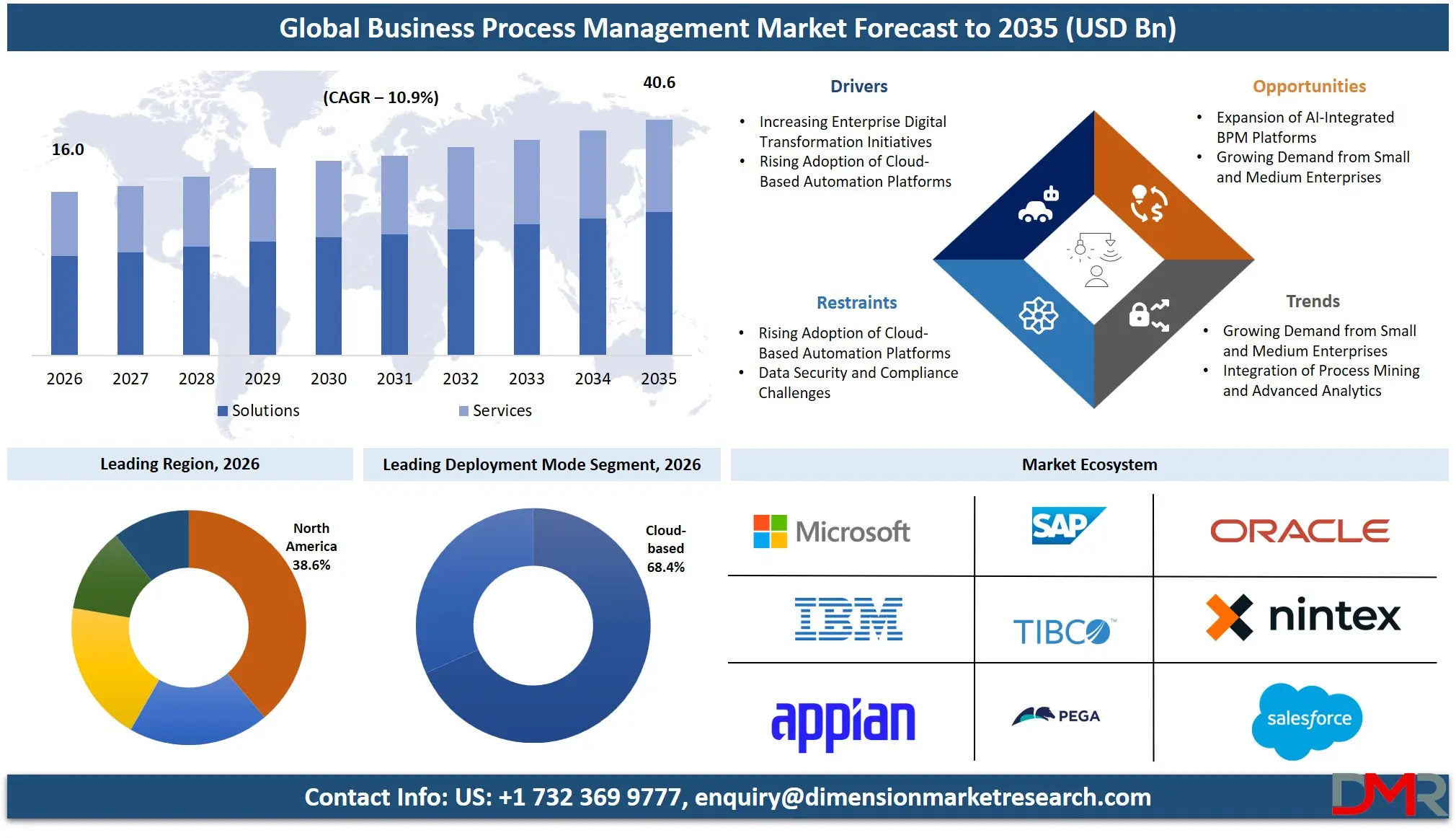
The Business Process Management Market size is expected to be USD 16.0 billion in 2026 and increase at a compound annual growth rate of 10.9% to USD 40.6 billion in 2035 due to the introduction of AI, ML, and cloud computing in BPM tools has made it easy to analyze the process and take a decision through predictions.
ℹ
To learn more about this report –
Download Your Free Sample Report Here
Business Process Management (BPM) market consists of all the technologies, products, services that allow enterprises to design, automate, manage and streamline their business processes. This market contains solutions such as process automation software, low code platform, Robotic Process Automation (RPA), and analytical tools. The BPM market is fueled by digital transformation, adoption of cloud services, and artificial intelligence.
ℹ
To learn more about this report –
Download Your Free Sample Report Here
The US Business Process Management Market
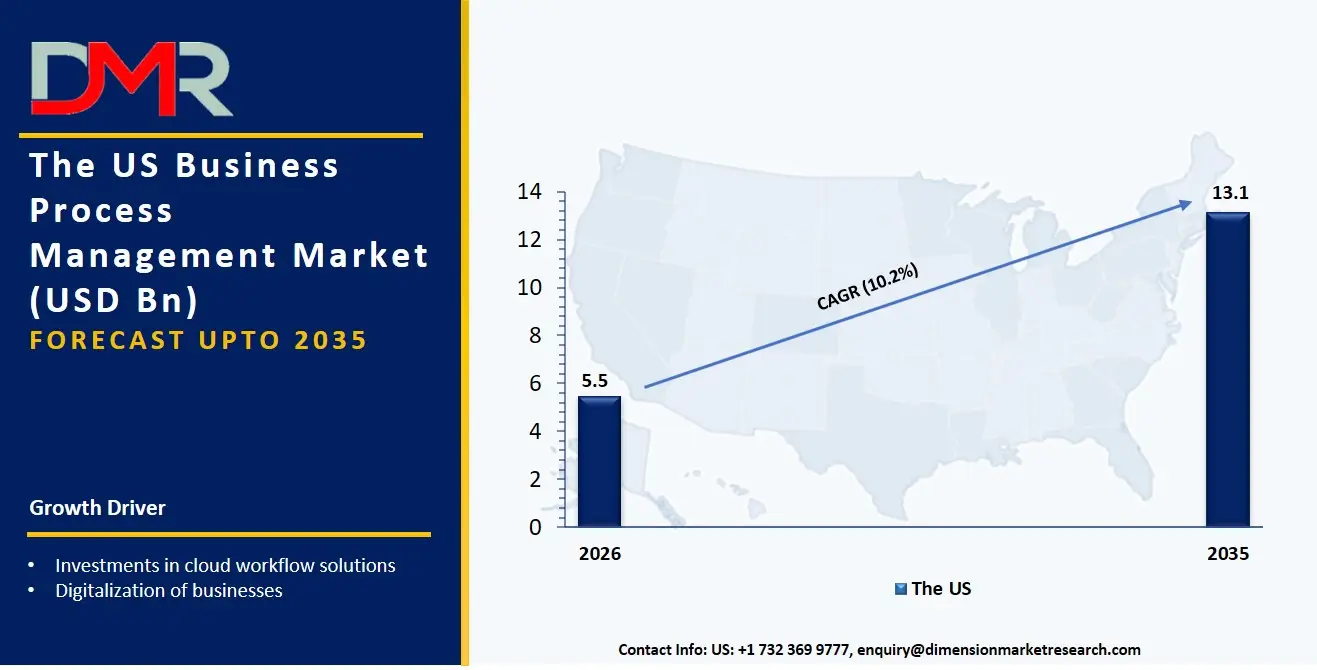
The US Business Process Management Market size is estimated to be USD 5.5 billion in 2026 and is expected to increase at a CAGR of 10.2% over the forecast period.
In the US Business Process Management Market, factors such as digitalization of businesses, use of AI-based automated solutions, and investments in cloud workflow solutions have emerged as significant drivers. Large enterprises from BFSI, Healthcare, Retail, and IT domains continue with their legacy modernization initiatives through BPM solutions. Technology vendors, availability of cloud solutions, and high requirements for efficiency have enabled the growth of the market. Furthermore, government regulations concerning security and compliance management are also motivating companies to deploy BPM solutions.
ℹ
To learn more about this report –
Download Your Free Sample Report Here
Europe Business Process Management Market
The Europe Business Process Management Market size is estimated to be USD 4.3 billion in 2026 and is expected to increase at a CAGR of 10.5% over the forecast period.
The BPM Market in Europe is witnessing consistent growth thanks to good regulatory policies, automation within enterprises, and digitization aimed at sustainability. Initiatives under the European Green Deal and digitization are pushing companies towards intelligent BPM solutions that will help them optimize their processes. Industries that are among the top users include manufacturing, banking, logistics, and public administration. The adoption of low-code BPM software and process analytics solutions is on the rise in Germany, France, and Nordic countries due to an emphasis on agility and compliance automation.
Japan Business Process Management Market
The market size of Japan Business Process Management will be USD 640 million in 2026 and at a CAGR of 11.2% in the forecast period.
The Business Process Management market in Japan is increasing owing to demands for automation, lack of workers, and investments in digital workplace solutions. More firms in the manufacturing, telecom, finance, and healthcare sectors are deploying BPM applications to enhance efficiency. Digital transformation programs and efforts to develop smart industries are also contributing to the growth in the deployment of BPM solutions. The precision of business operation and advanced robotic integration make it possible for AI-driven BPM solutions to flourish in Japan. Integration with old systems and expensive implementation represent the key challenges for SMEs in the market.
Key Takeaways
- Market Size & Forecast: The Business Process Management Market size is projected to reach USD 16.0 billion in 2026 and is anticipated to have a value of USD 40.6 billion in 2035.
- Growth Rate & Outlook: The Business Process Management Market size is set to grow at a compound annual growth rate of 10.9% during the forecast period of 2026 to 2035.
- Primary Growth Drivers: Some of the major growth drivers in the market include Increase in the Adoption of Digital Transformation Approaches by Firms, and more.
- Key Market Trends: Some of the major trends in the market are Advances in Low-Code and No-Code BPM Platform Emergence, and more.
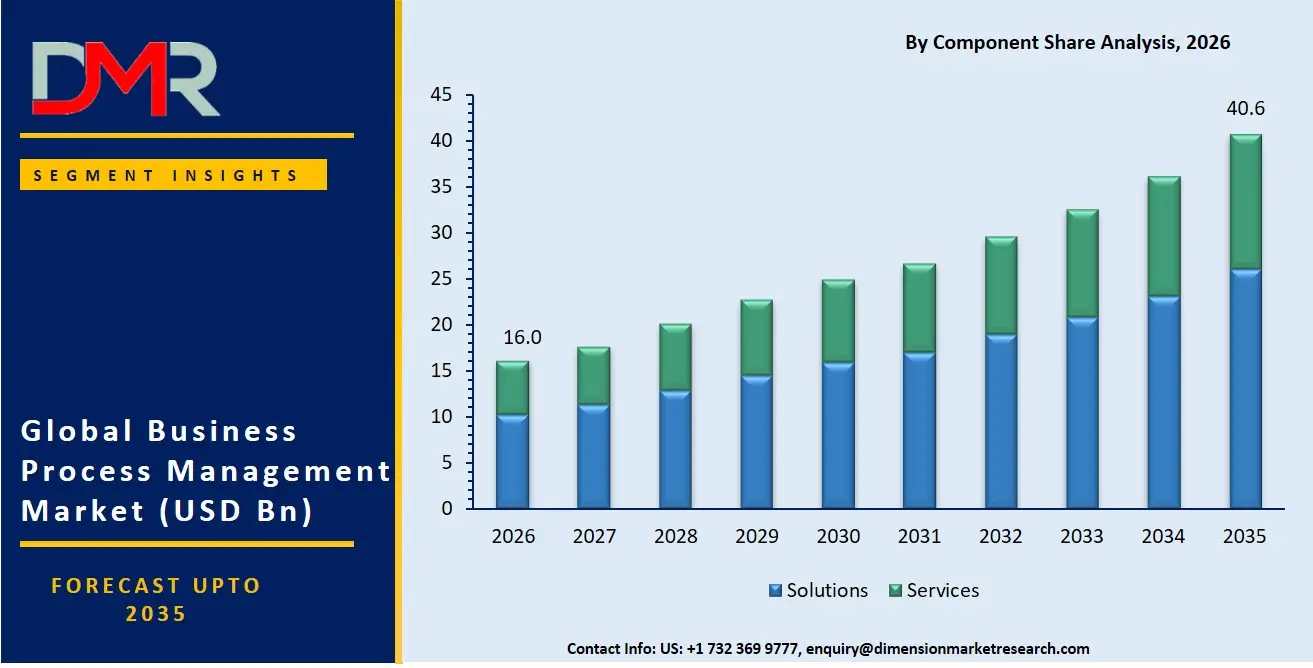
- By Component: Solutions segment is anticipated to get the majority share of the Business Process Management market in 2026.
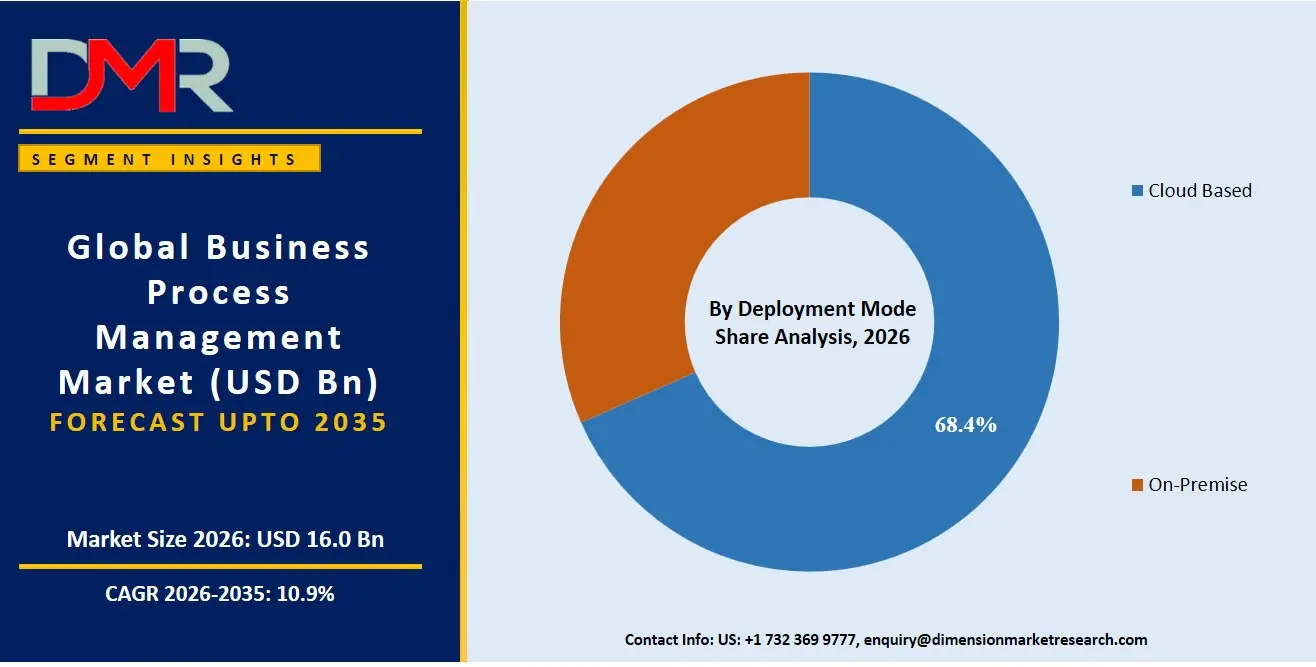
- By Deployment Mode: Cloud is expected to get the largest revenue share in 2026 in the Business Process Management market.
- By Organization Size: Large Enterprise segment is expected to get the largest revenue share in 2026 in the Business Process Management market.
- Regional Leadership: North America is set to lead the Business Process Management market with an estimated 38.6% share in 2026.
What is the Business Process Management?
Business Process Management (BPM) is defined as an organizational practice that aims at improving efficiency, effectiveness, and compliance of business workflows within the organization through planning, modeling, execution, monitoring, and optimization processes. Business Process Management involves the use of technology tools such as analytics, automation tools, integration, and other consulting and service offerings that support business operations. BPM has played a major role in transforming organizations through process improvement by making work processes easier and lowering the cost of operations and improving customer experience. Some of the current trends shaping BPM include AI-enabled workflow automation, low-code development platforms, RPA, cloud BPM suites, and process mining technology among others.
Use Cases
- Customer Service Automation: Through BPM software, tickets can be routed more efficiently, customer complaints managed automatically, and customer requests processed faster, leading to faster responses and higher customer satisfaction rates. BPMs that use AI technology can also give priority to customers and handle escalation procedures in an effective manner.
- Financial Process Optimization: Companies make use of BPM systems to approve invoices and automate procure-to-pay processes and financial report generation. BPMs not only help reduce errors but also track compliance measures and process transactions much faster and more efficiently, giving better visibility into organizational spending.
- HR Workflow Management: Recruitment and onboarding of employees, payroll processing, and general employee management are easier through BPM software as it helps organizations optimize workforce productivity, cut down on costs, and remain compliant with regulatory laws.
- Supply Chain and Procurement Management: Onboarding vendors and automating logistics and inventory workflows is done effectively using BPM systems. Procurement transparency, timely processing of procurements, and better visibility into business operations are possible due to process automation in companies.
How AI Is Transforming the Business Process Management Market
The integration of artificial intelligence in Business Process Management will change this industry in ways such as providing the ability to automate workflows and engage in predictive analysis and decision-making. AI-based BPM tools can conduct analysis on big data, detect flaws within processes, and automate tedious administrative duties without requiring much human intervention. In addition, natural language processing and machine learning techniques contribute to better handling of documents and management of customer interactions.
The use of artificial intelligence in BPM will also contribute to increased operational flexibility via adaptive workflows and intelligent task management as well as predictive maintenance techniques. Organizations are adopting this technology to optimize their BPM processes in terms of employee performance, operational efficiency, and improved experiences for customers due to faster responses and customized services.
Market Dynamic
Driving Factors in the Business Process Management Market
Increase in the Adoption of Digital Transformation Approaches by Firms
Firms in all industries have employed digital transformation approaches to improve efficiency and reduce the workload while encouraging client participation. BPM tools ensure that firms automate their processes, simplify their processes, and cooperate within different departments. The introduction of AI, ML, and cloud computing in BPM tools has made it easy to analyze the process and take a decision through predictions. Agile business practices are common in all firms, thus making BPM a critical component of the digital approach.
Restraints in the Business Process Management Market
High Cost Associated With BPM System Implementation And Integration
The implementation of advanced BPM solutions will always need huge costs in infrastructure upgrading, software acquisition, training employees, and integrating the solution into an organization's existing system infrastructure. Companies running on traditional information technology infrastructure would find themselves with a difficult and lengthy implementation process. Moreover, financial limitations can pose as a barrier for SMBs to adopt BPM.
Opportunities in the Business Process Management Market
Growth Prospects for AI-Based BPM Solutions
There are tremendous opportunities available within the scope of increasing use of artificial intelligence in BPM systems, which will benefit all parties participating in the market. AI-based BPM platforms are capable of automating decision-making processes, forecasting possible problems in the workflow, and suggesting more efficient workflows. There is an increasing demand from enterprises for automation tools featuring real-time analytics, natural language processing, and intelligent document processing capabilities.
Trends in the Business Process Management Market
Low-Code and No-Code BPM Platform Emergence
The emergence of low-code and no-code BPM platforms is revolutionizing the industry due to the capability that enables non-technical personnel to design, automate, and optimize processes without deep knowledge about programming. Increasingly, companies are turning to these platforms for faster application development and greater agility. Process automation democratization is contributing to the achievement of cost reduction in development and quicker adaptation to business needs.
Research Scope and Analysis
The segmentation will be carried out based on the components, mode of deployment, organization size, application, technology, and vertical industry. Growth factors, limitations, and regional factors will be studied to evaluate market performance and adoption rates. Moreover, competitive strategies, developments such as artificial intelligence (AI) and automation, as well as future demand situations, will be analyzed.
ℹ
To learn more about this report –
Download Your Free Sample Report Here
By Component Analysis
The solutions category is likely to account for a majority of the market share at around 63.8% by 2026 owing to increased demand from enterprises for automation platforms, intelligent BPM suites, and process analytics software tools. There will be greater emphasis on the use of software tools to optimize business processes in order to simplify operations and improve decision-making efficiencies. Low code/no code BPM platforms are experiencing fast uptake since they ensure speedy implementation and customization. Process mining and AI-based BPM solutions are likely to be the fastest-growing sub-segments as enterprises seek timely information regarding their operations and predictive capabilities for optimizing their processes. The services category, on the other hand, is expected to continue expanding steadily owing to the increased demand for integration, deployment, consultancy, and management services.
By Deployment Model Analysis
The adoption of cloud-based deployment is expected to contribute about 68.4% to the Business Process Management market in 2026 because of the high potential of scalability, less infrastructure needs, and accessibility of cloud-based BPM platforms. Companies are opting for the implementation of both public and hybrid cloud BPM platforms in order to ensure that their business can operate effectively regardless of location. The cloud-based BPM platform will offer an increased level of flexibility in the integration of AI, analysis, and automation technologies. The use of hybrid cloud BPM systems is experiencing fast growth due to the balance of data security and agility offered by such BPM platforms.
By Organization Size Analysis
The large enterprises are expected to account for around 71.2% share of the Business Process Management market by 2026 due to high operational complexity, bigger budget allocations towards Information Technology investments, and high inclination towards business automation strategies. Large enterprises make heavy use of BPM tools to streamline their processes, improve compliance management, and facilitate better interdepartmental collaboration. BFSI, healthcare, and manufacturing industry verticals are among the ones that are undergoing large-scale digital transformations, thereby boosting the use of BPM. However, it is the SME segment which holds the highest growth potential since cloud-based BPM applications have made BPM more affordable for this segment.
By Business Function Analysis
The Finance & Accounting vertical will lead the business process management market in 2026 with an anticipated 29.7% market share, owing to the increasing need for automation of invoices, procurement-to-payment processes, and financial workflows that ensure compliance. Organizations have been focusing on implementing BPM technologies in finance departments to help achieve greater accuracy in their processes, minimize delays, and enhance auditability. Systems for order-to-cash and invoice processing are being complemented by analytics powered by artificial intelligence technologies. The Human Resources and Customer Service departments are also experiencing widespread implementation of BPM platforms for automated processes like employee onboarding, payroll management, and customer communication.
By Technology Integration Analysis
AI-integrated BPM is expected to dominate the technology integration segment by garnering about 36.9% market share by 2026 due to growing preference towards intelligent automation and predictive process management. AI-powered BPM tools assist in optimizing processes, decision-making automation, and managing customer interactions through the use of machine learning algorithms and natural language processing techniques. Additionally, there is increasing adoption of BPM solutions associated with process analytics and mining as a result of increasing need for operational transparency and performance tracking. RPA-integrated BPM software solutions are still very important when it comes to the automation of repetitive processes across the financial, customer services, and supply chain management verticals.
By Industry Vertical Analysis
The BFSI industry is estimated to represent about 24.5 percent of the BPM market in 2026 due to rising requirements for compliance management, fraud detection processes, and customer onboarding. Financial organizations depend on BPM software solutions to enhance their efficiencies in operations, document handling, and compliance. The healthcare and life science industries will experience one of the highest growth rates since many hospitals and healthcare providers need workflow automation technologies for patient management, claim handling, and other administrative procedures. Retailing, manufacturing, and information technology industries are also experiencing rapid expansion of BPM usage for improving customer relationships and boosting enterprise efficiencies through efficient workflow automation solutions.
The Business Process Management Market Report is segmented on the basis of the following:
By Component
- Solutions
- Business Process Automation (BPA) Platforms
- Intelligent BPM (iBPM) Suites
- Low-Code/No-Code BPM Platforms
- Process Mining Solutions
- Business Rules Management Systems (BRMS)
- Case Management Solutions
- Services
- Consulting Services
- Integration & Deployment Services
- Managed Services
- Support & Maintenance Services
By Deployment Mode
- Cloud-Based
- Public Cloud
- Private Cloud
- Hybrid Cloud
- On-Premise
By Organization Size
- Large Enterprises
- Small & Medium Enterprises (SMEs)
By Business Function
- Finance & Accounting
- Procure-to-Pay
- Order-to-Cash
- Invoice Processing
- Human Resources
- Recruitment Workflow
- Employee Onboarding
- Payroll Management
- Customer Service
- Ticket Management
- Complaint Resolution
- Service Request Automation
- Procurement & Supply Chain
- Vendor Management
- Inventory Workflow
- Logistics Workflow
- Legal & Compliance
- Contract Lifecycle Management
- Regulatory Compliance Workflow
By Technology Integration
- AI-Integrated BPM
- RPA-Integrated BPM
- Process Analytics & Mining BPM
- IoT-Integrated BPM
By Industry Vertical
- Banking, Financial Services & Insurance (BFSI)
- Healthcare & Life Sciences
- Retail & E-Commerce
- Manufacturing
- IT & Telecommunications
- Government & Public Sector
- Transportation & Logistics
- Energy & Utilities
Regional Analysis
Leading Region in the Business Process Management Market
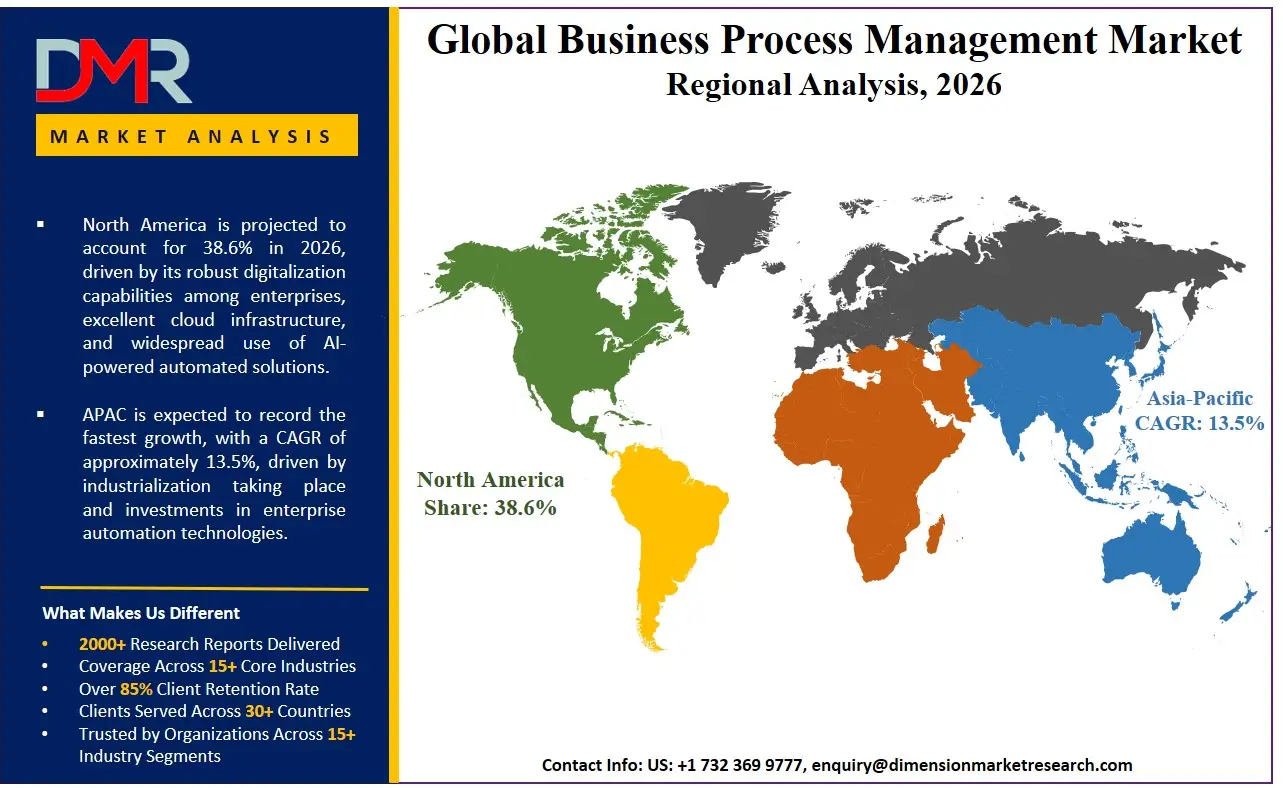
The market share of North America in the Business Process Management market is anticipated to have 38.6% in 2026 owing to its robust digitalization capabilities among enterprises, excellent cloud infrastructure, and widespread use of AI-powered automated solutions. BFSI, healthcare, retail, and IT firms continue to make substantial investments in BPM tools and solutions that focus on optimizing workflows and providing intelligent process automation. This region enjoys the advantage of having key players in the BPM market operating within the region, along with considerable spending in R&D, coupled with favorable policies on digital governance and cybersecurity.
ℹ
To learn more about this report –
Download Your Free Sample Report Here
Fastest Growing Region in the Business Process Management Market
The Asia-Pacific region will be identified as the leading region with high growth rate in terms of business process management because of the industrialization taking place and investments in enterprise automation technologies. China, India, Japan, and South Korea are the countries in which the adoption of BPM through cloud BPM solutions is on the rise in the manufacturing industry, telecommunication sector, retail industry, and banking and finance industry respectively. Moreover, with the increase in government efforts in supporting digital transformation and AI adoption, the market growth rate in these regions will also see an increase.
By Region
North America
Europe
- Germany
- The U.K.
- France
- Italy
- Russia
- Spain
- Benelux
- Nordic
- Rest of Europe
Asia-Pacific
- China
- Japan
- South Korea
- India
- ANZ
- ASEAN
- Rest of Asia-Pacific
Latin America
- Brazil
- Mexico
- Argentina
- Colombia
- Rest of Latin America
Middle East & Africa
- Saudi Arabia
- UAE
- South Africa
- Israel
- Egypt
- Rest of MEA
Competitive Landscape
The Business Process Management (BPM) market faces highly intense competition due to constant innovation and the adoption of cloud computing and AI solutions among others. Competitive advantage within this market will be gained through investments in technology aimed at improving workflow and process automation technologies, low code development platforms, and advanced process analytics. The market faces high barriers to entry due to complex technology, high enterprise integration, and difficult client retention. BPM vendors invest more in R&D, mergers & acquisitions, and specialized solutions to increase their market presence.
Some of the prominent players in the global Business Process Management are:
- IBM
- Pegasystems
- Appian
- ServiceNow
- Oracle
- SAP
- Microsoft
- Software AG
- Nintex
- Bizagi
- Kissflow
- Creatio
- Newgen Software
- OpenText
- Hyland Software
- Salesforce
- Camunda
- Bonitasoft
- ProcessMaker
- TIBCO Software
- Other Key Players
Recent Developments
- In May 2026, SAP SE launched the concept of the Autonomous Enterprise as a solution intended to improve business workflows by facilitating greater collaboration between human intelligence and artificial intelligence in meeting the changing needs of businesses on a global scale. This solution is composed of an AI platform that facilitates the building and governance of AI agents, an autonomous suite that facilitates execution of the business process, and a revamped user experience.
- In October 2025, SEKISUI CHEMICAL CO., LTD., Fujitsu Limited, and SAP Japan Co., Ltd. jointly announced the upgrade of the management platform of SEKISUI CHEMICAL to include the implementation of SAP S/4HANA Cloud solutions. This solution is geared towards improving the efficiency of making decisions based on data analytics while standardizing the administration process across global operations. This is part of the company's ongoing digital transformation, which seeks to create value from a unified data-based business perspective.
- In May 2025, Infosys BPM made an announcement regarding the introduction of AI agents to process invoices as part of the company's leading Accounts Payable on Cloud platform. With the help of Infosys Topaz technology, the new feature is set to revolutionize the way of handling invoices by moving from manual processing aided by AI to fully autonomous AI-first processing.
Report Details
| Report Characteristics |
| Market Size (2026) |
USD 16.0 Bn |
| Forecast Value (2035) |
USD 40.6 Bn |
| CAGR (2026–2035) |
10.9% |
| Historical Period |
2021 – 2025 |
| Forecast Period |
2027 – 2035 |
| Base Year |
2025 |
| Estimate Year |
2026 |
| Segments Covered |
By Component, By Deployment Mode, By Organization Size, By Business Function, By Technology Integration, By Industry Vertical |
| Regional Coverage |
North America – The US and Canada; Europe – Germany, The UK, France, Russia, Spain, Italy, Benelux, Nordic, & Rest of Europe; Asia-Pacific – China, Japan, South Korea, India, ANZ, ASEAN, Rest of APAC; Latin America – Brazil, Mexico, Argentina, Colombia, Rest of Latin America; Middle East & Africa – Saudi Arabia, UAE, South Africa, Turkey, Egypt, Israel, & Rest of MEA |
Frequently Asked Questions
How big is the Business Process Management Market?
▾ The Business Process Management Market size is expected to reach USD 16.0 billion by 2026 and is projected to reach USD 40.6 billion by the end of 2035.
What is the CAGR of the Business Process Management Market from 2026 to 2035?
▾ The market is growing at a CAGR of 10.9 percent over the forecasted period.
What factors are driving the growth of the Business Process Management Market?
▾ Increase in the Adoption of Digital Transformation Approaches by Firms, and more are the factors driving the growth of the Business Process Management Market.
What are the major trends in the Business Process Management Market?
▾ Low-Code and No-Code BPM Platform Emergence, and more are some of the major trends in the market.
Who are the key players in the Business Process Management Market?
▾ Some of the key players in the Business Process Management Market include IBM, SAP, Microsoft, and more.
How is the Business Process Management Market segmented?
▾ The Business Process Management Market is segmented by component, deployment mode, organization size, business function, technology integration, industry vertical.
Which region held the largest share of the Business Process Management Market in 2026?
▾ North America is set to lead the Business Process Management market with an estimated 38.6% share in 2026.
Which region is expected to grow the fastest in the Business Process Management Market?
▾ Asia Pacific is the fastest-growing region in the Business Process Management market during the forecast period.