Market Snapshot
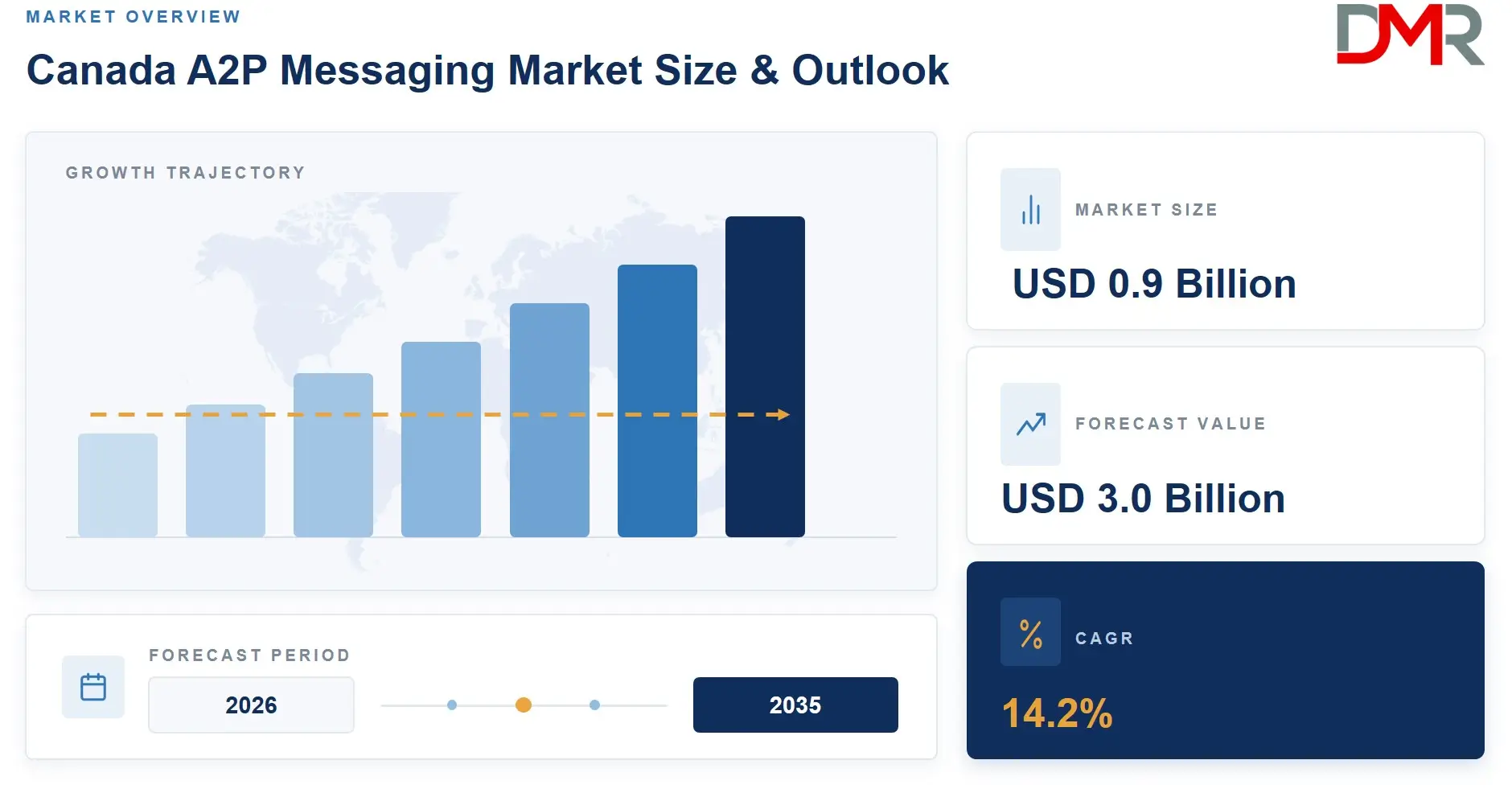
- Market Size (2026): USD 0.9 Bn
- Forecast Value (2035): USD 3.0 Bn
- CAGR (2026-2035): 14.2%
- Leading Messaging Channel (2026): SMS, around 46%
- Leading Application (2026): Transactional Alerts & Notifications, close to 41%
- Key Players: Twilio, TELUS, Sinch, and others
What is the Canada A2P Messaging Market and its Market Size?
The Canada A2P Messaging Market size is estimated to reach USD 0.9 Bn in 2026 and is further anticipated to reach USD 3.0 Bn by 2035, at a CAGR of 14.2%.
ℹ
To learn more about this report –
Download Your Free Sample Report Here
Application-to-person messaging covers automated communications that enterprise systems trigger and route to a consumer handset through a carrier gateway, without a human agent typing the message. In Canada the category spans one-time passwords, delivery and appointment alerts, promotional campaigns and conversational support exchanges carried over SMS, RCS Business Messaging and OTT channels such as WhatsApp. The figures in this report describe demand generated inside Canada, meaning traffic terminating on Canadian mobile numbers, not the worldwide billings of vendors that happen to be headquartered here.
Enterprises buy A2P capacity to close a reliability gap that push notifications and email cannot fill. A bank confirming a wire transfer, a courier flagging a delivery window or a clinic reminding a patient of an appointment needs a channel that reaches a phone without an app install and gets read within minutes. Aggregator platforms and direct carrier connections give buyers that reach at a predictable per-message cost, with delivery receipts and, increasingly, richer formatting than plain text allows.
What is changing structurally is the channel mix sitting behind that reach. TELUS, Bell and Rogers have each activated RCS Business Messaging on their networks, giving brands branded, verified threads inside the native inbox rather than a generic short code. At the same time, the Canadian Radio-television and Telecommunications Commission has sharpened its enforcement of Canada's Anti-Spam Legislation, pushing senders toward stricter consent capture and identification practices that are reshaping how campaigns get built before a single message goes out.
Use Cases
- Digital Banking Authentication: Canadian banks and credit unions route one-time passcodes and wire-transfer confirmations through A2P gateways to satisfy multi-factor authentication rules, cutting fraud losses while keeping login friction low enough that customers do not abandon mobile banking sessions midway through.
- Retail Delivery Coordination: National couriers and e-commerce retailers send shipment status and delivery-window alerts to shoppers, replacing inbound call-centre volume with proactive texts that account for close to 18% of application-level A2P traffic in the retail and logistics buyer segment.
- Healthcare Appointment Management: Provincial health networks and private clinics use automated reminders and pre-visit intake links to reduce missed appointments, a use case gaining urgency as wait-list pressure across Canadian primary care pushes administrators toward lower-cost patient outreach.
- Utility and Municipal Outage Notification: Regional utilities and municipal services push storm, outage and billing alerts to registered accounts, valuing SMS for its reach into rural and northern communities where broadband-dependent apps are not a reliable fallback channel.
Key Takeaways
- Market Size & Share: The market is estimated at USD 0.9 Bn in 2026, rising to USD 3.0 Bn by 2035.
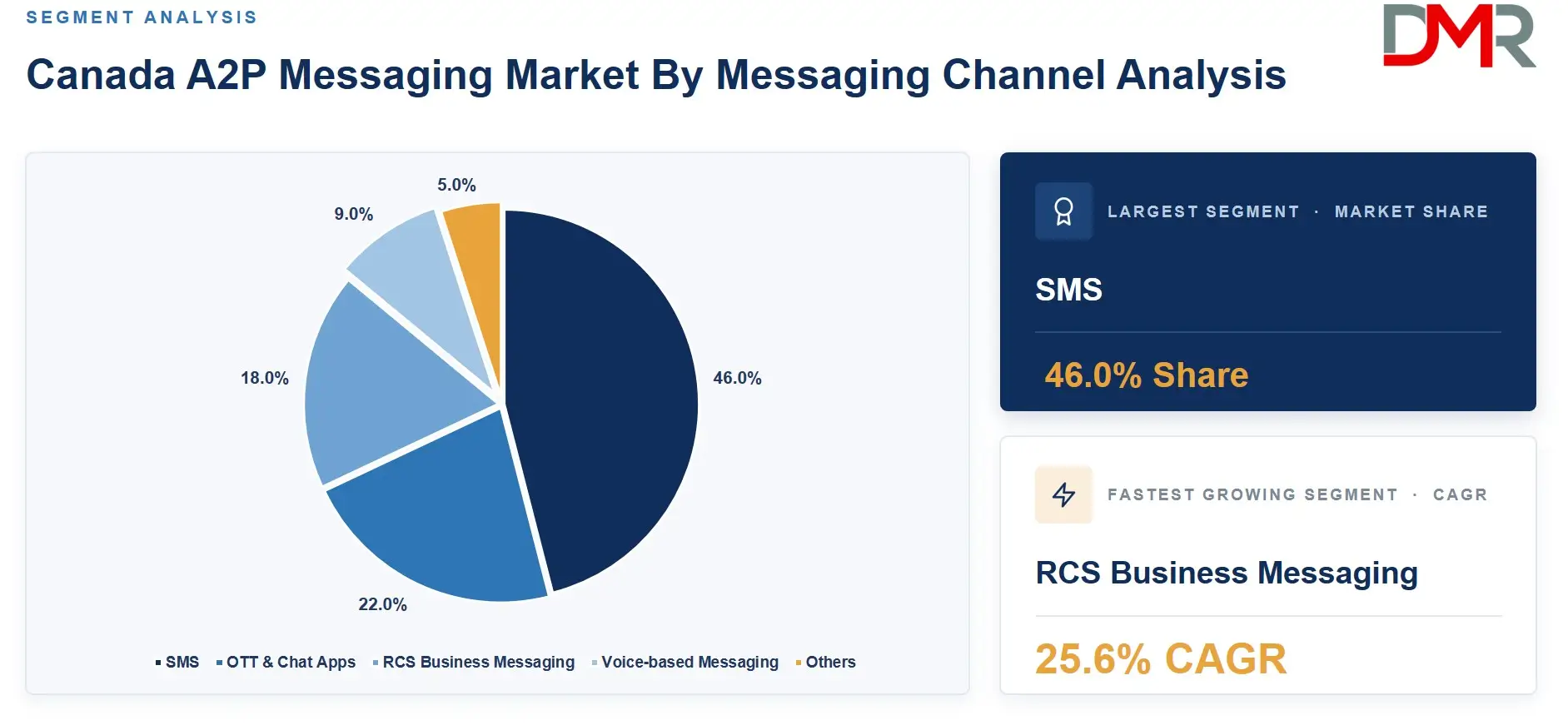
- Messaging Channel Analysis: SMS is expected to hold approximately 46% of 2026 traffic even as RCS Business Messaging expands fastest.
- Demand Concentration: Ontario and Quebec-based enterprise buyers are projected to originate close to 58% of national A2P volume in 2026, reflecting where head-office banking, retail and healthcare administration functions sit.
- Application Mix: Transactional alerts and notifications are set to account for around 41% of 2026 spend, ahead of authentication traffic.
- Regulatory Pressure: CASL enforcement carries administrative penalties of up to CAD 10 Mn per violation for organizations, a ceiling that is actively reshaping sender consent practices.
- Competitive Intensity: The three national carriers plus a layer of global CPaaS aggregators are projected to keep pricing pressure on route margins through 2035.
How AI/Gen AI is Transforming the Canada A2P Messaging Market?
Artificial intelligence is changing A2P messaging in Canada less through headline generative features and more through the operational layer that decides which message a customer receives and when. Aggregators and enterprise platforms increasingly route traffic using machine-learned models that predict the cheapest channel likely to reach a given handset, falling back from RCS to SMS automatically when a device or carrier combination cannot support rich formatting, which keeps delivery costs down without manual channel management.
On the content side, generative language models are being used to draft and localize message variants for English and French-speaking segments, a distinction that matters more in Canada than in most single-language markets given Quebec's provincial language requirements for commercial communications. Conversational AI is also moving into the RCS and WhatsApp channels themselves, letting a brand's messaging thread hand off simple queries to an automated agent before escalating to a live representative.
- Predictive Channel Routing: Machine learning models select SMS, RCS or OTT delivery per recipient based on historical read and failure rates.
- Bilingual Content Generation: Language models draft and adapt English and French message variants to meet Quebec commercial-communication requirements.
- Conversational Support Bots: Natural-language agents handle routine order-status and appointment queries directly inside RCS and WhatsApp threads.
- Fraud and Spam Pattern Detection: Anomaly-detection models flag suspicious sender behaviour before a campaign reaches the point of CASL exposure.
Key Drivers in the Canada A2P Messaging Market
Two forces are pulling enterprise messaging spend upward through the forecast period.
- Mandatory Multi-Factor Authentication in Financial Services: Canadian banking regulators and card networks have pushed multi-factor authentication into standard practice for online banking, card-not-present transactions and wire transfers, and SMS or RCS one-time passcodes remain the lowest-friction delivery method available to most account holders. Every new digital banking product, buy-now-pay-later checkout flow and insurance claims portal adds another authentication touchpoint that routes through an A2P gateway rather than a proprietary app, since not every customer has installed the issuing institution's app. This structural requirement gives the market a recurring transactional volume base that is largely insulated from marketing budget cycles, and it grows in lockstep with the number of digital accounts Canadians open each year.
- E-commerce and Delivery Volume Growth: Parcel volumes handled by national and regional couriers have climbed steadily as online retail penetration deepens outside the largest metros, and each shipment typically triggers two to four automated notifications covering confirmation, dispatch, delivery window and completion. Retailers have found that proactive delivery texts measurably reduce inbound call-centre load and improve satisfaction scores, which has turned notification messaging from a discretionary add-on into a default part of the checkout stack. As same-day and locker-based delivery formats expand into mid-sized Canadian cities, the number of status touchpoints per order is rising rather than staying flat, compounding the underlying volume growth.
Restraints in the Canada A2P Messaging Market
Two structural brakes limit how quickly the market can scale.
- CASL Compliance Overhead: Canada's Anti-Spam Legislation imposes some of the strictest consent, identification and unsubscribe requirements in any developed messaging market, and the administrative burden of maintaining verifiable consent records falls disproportionately on smaller senders that lack dedicated compliance staff. Enforcement actions carrying penalties in the millions of dollars have made larger enterprises cautious about expanding promotional messaging volume even where the channel would otherwise perform well, and some marketing teams have shifted budget toward email or app push notifications specifically to avoid CASL exposure, capping the addressable promotional segment of the market.
- Carrier Filtering and Sender ID Friction: Canadian carriers apply aggressive spam-filtering heuristics to protect subscribers, and unregistered or inconsistently branded sender identities are frequently throttled or blocked outright, particularly on long-code routes used by smaller aggregators. Enterprises that have not completed short-code or verified sender-ID registration see unpredictable deliverability, which discourages experimentation with new use cases and pushes volume toward a small number of established carrier-approved routes, concentrating the market rather than broadening it.
Growth Opportunities in the Canada A2P Messaging Market
Two areas of white space stand out for vendors and enterprise buyers alike.
- Mid-Market Retail and Regional Healthcare Networks: Adoption to date has concentrated among national banks, large retailers and provincial health authorities, leaving a broad tier of regional retail chains, independent clinics and credit unions still running notification workflows manually or through basic email. CPaaS platforms that package CASL-compliant consent management, sender-ID registration and template libraries into a self-serve product lower the barrier for this mid-market tier to adopt A2P messaging without hiring dedicated compliance or integration staff, and this segment represents the largest pool of enterprises that have not yet been converted.
- RCS-Native Commerce Journeys: As RCS Business Messaging reaches a critical mass of TELUS, Bell and Rogers subscribers, retailers and financial services firms have an opening to build entire purchase and servicing journeys, from product carousels to in-thread payment confirmation, inside a single verified messaging thread rather than routing customers out to a web link. Early movers that build this capability now stand to capture engagement rates well above legacy SMS campaigns before the channel becomes commoditized.
Trends in the Canada A2P Messaging Market
Two shifts are reshaping how the channel is bought and delivered.
- Consolidation Around Verified Sender Programs: Enterprises are moving away from ad hoc long-code sending toward registered short codes and verified RCS agent profiles, trading upfront registration effort for materially better deliverability and lower blocking risk, a shift accelerated by carriers tightening default filtering thresholds on unregistered traffic.
- Bundling Into Broader Customer Engagement Suites: Enterprise buyers increasingly purchase A2P capacity as one channel inside a unified customer-engagement or contact-centre platform rather than as a standalone SMS gateway, favouring vendors that also handle email, push and voice so campaign logic and consent records live in one system rather than several disconnected tools.
Research Scope and Analysis
Segment performance is assessed across five axes: messaging channel, application, end use industry, enterprise size and distribution channel. Each axis identifies the sub-segment carrying the largest share of 2026 demand and the one expanding fastest through 2035.
ℹ
To learn more about this report –
Download Your Free Sample Report Here
By Messaging Channel
SMS is projected to hold the largest share by messaging channel in 2026, accounting for around 46% of traffic, a position it retains because every mobile handset in Canada supports it without regard to device age, carrier plan or app installation, making it the default fallback for authentication and time-critical alerts regardless of which richer channel a brand prefers. Growth, however, is concentrated in RCS Business Messaging, expanding at a CAGR of 25.6% between 2026 and 2035 as TELUS, Bell and Rogers complete carrier-side rollout and brands migrate promotional and engagement traffic toward branded, interactive threads that outperform plain SMS on click-through and response rates.
By Application
Transactional alerts and notifications are expected to lead by application in 2026, holding close to 41% of spend, reflecting the sheer volume of delivery, billing and appointment touchpoints that Canadian enterprises now generate as a routine part of order and account management. The steeper trajectory sits with customer engagement and support messaging, projected at a CAGR of 22.1% as conversational RCS and WhatsApp threads let brands resolve routine service queries inside the messaging channel itself rather than redirecting customers to a call centre or web portal.
By End Use Industry
BFSI is set to remain the largest end use industry in 2026, accounting for approximately 33% of demand, anchored by the sector's regulatory obligation to authenticate digital transactions and its early, sustained investment in messaging infrastructure. The fastest expansion belongs to healthcare, forecast at a CAGR of 21.4% as provincial health networks and private clinics digitize appointment and prescription-reminder workflows that were previously handled by phone calls or paper notices, a shift compounded by ongoing primary-care capacity pressure across the country.
By Enterprise Size
Large enterprises are projected to account for the majority of 2026 spend at around 61%, since national banks, telecom carriers and major retailers were the earliest adopters and continue to run the highest transaction volumes per account. Growth, however, is tilted toward small enterprises, expanding at a CAGR of 19.8% as self-serve CPaaS platforms remove the integration and compliance overhead that previously kept smaller Canadian businesses out of the channel entirely.
By Distribution Channel
Aggregators and CPaaS platforms are expected to route close to 48% of 2026 message volume, since most enterprises prefer a single API and unified billing relationship over managing direct connections with three separate national carriers. The fastest growth sits with enterprise messaging platforms and contact-centre integrations, projected at a CAGR of 23.7% as buyers fold A2P sending into broader customer-engagement suites rather than treating it as a standalone procurement line.
The Canada A2P Messaging Market Report is Segmented Based on the Following
By Messaging Channel
- SMS
- RCS Business Messaging
- OTT & Chat Apps
- Voice-based Messaging
- Others
By Application
- Transactional Alerts & Notifications
- OTP & Authentication
- Promotional & Marketing
- Customer Engagement & Support
- Others
By End Use Industry
- BFSI
- Retail & E-commerce
- Healthcare
- Travel & Logistics
- IT & Telecom
- Others
By Enterprise Size
- Large Enterprises
- Medium Enterprises
- Small Enterprises
- Others
By Distribution Channel
- Aggregators & CPaaS Platforms
- Direct Carrier Connectivity
- Enterprise Messaging Platforms
- Others
Regulatory Landscape
Canada's messaging regime centres on Canada's Anti-Spam Legislation, enforced by the Canadian Radio-television and Telecommunications Commission alongside the Personal Information Protection and Electronic Documents Act, and it is currently among the strictest consent-based frameworks in any developed market. The Commission has moved from issuing warning letters toward levying administrative monetary penalties that can reach into the millions of dollars for organizations found sending commercial electronic messages without adequate consent or identification. What is shifting now is enforcement intensity rather than the statute itself, with the Commission publicly flagging cohorts of high-complaint senders for review. The commercial opening lies with compliance-as-a-feature messaging platforms that bundle consent capture, sender registration and audit trails directly into the sending workflow, reducing the legal exposure that currently discourages some enterprises from scaling promotional volume. The corresponding risk is that continued high-profile penalties could push cautious buyers toward lower-reach channels, tempering promotional segment growth even as transactional volume keeps climbing.
Technology Analysis
Carrier-side technology has moved decisively toward RCS Business Messaging, with TELUS, Bell and Rogers all having activated the Google Jibe-based RCS ecosystem for branded business messaging on compatible Android and Apple handsets. What is shifting now is device-level readiness, as iOS support for RCS closes the gap that previously limited branded messaging to Android users only, widening the addressable base for interactive, verified threads. The commercial opening sits with early-mover brands able to build full commerce and support journeys natively inside RCS before the channel becomes as commoditized as SMS, capturing engagement premiums while they last. The corresponding risk is fragmented carrier rollout timing and inconsistent device support, which forces platforms to maintain SMS fallback logic indefinitely, adding engineering overhead. Together, these dynamics are shifting competitive advantage toward vendors that can manage multi-channel routing intelligently rather than those that sell a single channel well.
Competitive Landscape
Competition in the Canada A2P messaging market runs on two levels: the three national carriers that own the terminating network and a broad layer of CPaaS aggregators and specialist platforms that provide the API, compliance tooling and multi-channel routing enterprises actually buy. Basis of competition centres on deliverability consistency, breadth of channel support including RCS and OTT, and depth of CASL-aligned consent management, more than on raw per-message price. Dominant strategies include carriers monetizing verified sender programs alongside their core connectivity, and global CPaaS platforms bundling Canadian routes into broader North American offerings while regional integrators focus on vertical-specific compliance packaging for banking and healthcare buyers.
Some of the Prominent Players in the Canada A2P Messaging Market Are
- Twilio Inc.
- Sinch AB
- Vonage (Ericsson)
- Infobip
- Microsoft Corporation
- Google LLC
- Amazon Web Services
- Salesforce, Inc.
- Genesys
- Bandwidth Inc.
- MessageBird
- CM.com
- Plivo Inc.
- Kaleyra, Inc.
- Syniverse Technologies
- Mavenir
- Clickatell
- OneSignal
- Attentive Mobile Inc.
- Klaviyo, Inc.
- Postscript
- SimpleTexting
- EZ Texting
- Textedly
- Zenvia
- Bell Canada (BCE Inc.)
- TELUS Corporation
- Rogers Communications Inc.
- Quebecor Inc. (Videotron / Freedom Mobile)
- SaskTel
- Eastlink
- Tbaytel
- Mitel Networks Corporation
- Sangoma Technologies Corporation
- Enghouse Systems Limited
- BlackBerry Limited
- OpenText Corporation
- CGI Inc.
- Iotum Inc.
- Shopify Inc.
- Other Key Players
Recent Developments
- In July 2026, Bell Canada completed a satellite ground station supporting its direct-to-device network with AST SpaceMobile, a step toward extending native SMS and text-to-911 reach to areas outside conventional cellular coverage.
- In April 2026, Rogers Communications expanded its satellite-to-mobile messaging service through a partnership with T-Mobile, letting Canadian subscribers send texts while roaming outside domestic network range.
- In March 2026, the CRTC's enforcement of Canada's Anti-Spam Legislation produced a penalty exceeding a million dollars against a domestic sender for unconsented commercial electronic messages, underscoring tightening consent-verification expectations for A2P campaigns.
- In December 2025, Rogers added WhatsApp voice, video and messaging support to its satellite service, broadening the OTT channels reachable through carrier-backed infrastructure beyond plain SMS.
- In May 2025, Bell Canada partnered with Zoom to launch an AI-enabled workplace collaboration suite for Canadian enterprises, extending Bell's business messaging and communications portfolio beyond core carrier connectivity.
- In November 2024, the CRTC issued warning letters to roughly two dozen companies flagged for high complaint volumes under Canada's Anti-Spam Legislation, signalling closer scrutiny of consent and identification practices ahead of stricter enforcement.
Report Details
| Report Characteristics |
| Market Size (2026) |
USD 0.9 Bn |
| Forecast Value (2035) |
USD 3.0 Bn |
| CAGR (2026-2035) |
14.2% |
| Historical Data |
2021 - 2025 |
| Forecast Data |
2026 - 2035 |
| Base Year |
2025 |
| Segments Covered |
By Messaging Channel, By Application, By End Use Industry, By Enterprise Size, By Distribution Channel |
| Regional Coverage |
Canada |
Frequently Asked Questions
How big is the Canada A2P Messaging Market?
▾ The Canada A2P Messaging Market is estimated at USD 0.9 Bn in 2026 and is projected to reach USD 3.0 Bn by 2035, reflecting sustained enterprise demand for authentication, notification and engagement messaging across Canadian mobile networks.
What is the growth rate of the Canada A2P Messaging Market?
▾ The market is expected to expand at a CAGR of 14.2% between 2026 and 2035, supported by mandatory authentication messaging in financial services and rising delivery-notification volume tied to e-commerce growth across the country.
What is driving demand in the Canada A2P Messaging Market?
▾ Demand is driven primarily by financial institutions' reliance on SMS and RCS one-time passcodes for multi-factor authentication, alongside a steady rise in delivery, billing and appointment notifications generated as retail and healthcare transactions increasingly move online.
Who are the key players in the Canada A2P Messaging Market?
▾ Prominent players include Twilio, TELUS, Bell Canada, Rogers Communications, Sinch, Infobip and Mitel Networks, alongside global CPaaS platforms and specialist messaging vendors serving Canadian enterprise buyers.
Which messaging channel holds the largest share in the Canada A2P Messaging Market?
▾ SMS is expected to remain the largest messaging channel in 2026, accounting for approximately 46% of traffic, owing to its universal handset compatibility and its role as the default fallback for time-critical authentication messages.
What role does RCS Business Messaging play in the Canada A2P Messaging Market's growth?
▾ RCS Business Messaging is the fastest-growing channel, forecast at a CAGR of 25.6% through 2035, as TELUS, Bell and Rogers complete network-side rollout and brands shift promotional and engagement traffic toward branded, interactive threads.
Which industry generates the most demand in the Canada A2P Messaging Market?
▾ BFSI generates the most demand, holding around 33% of 2026 spend, driven by regulatory authentication requirements, while healthcare is the fastest-growing end use industry as provincial networks digitize appointment and reminder workflows.