Canada Carbon Black Market snapshot
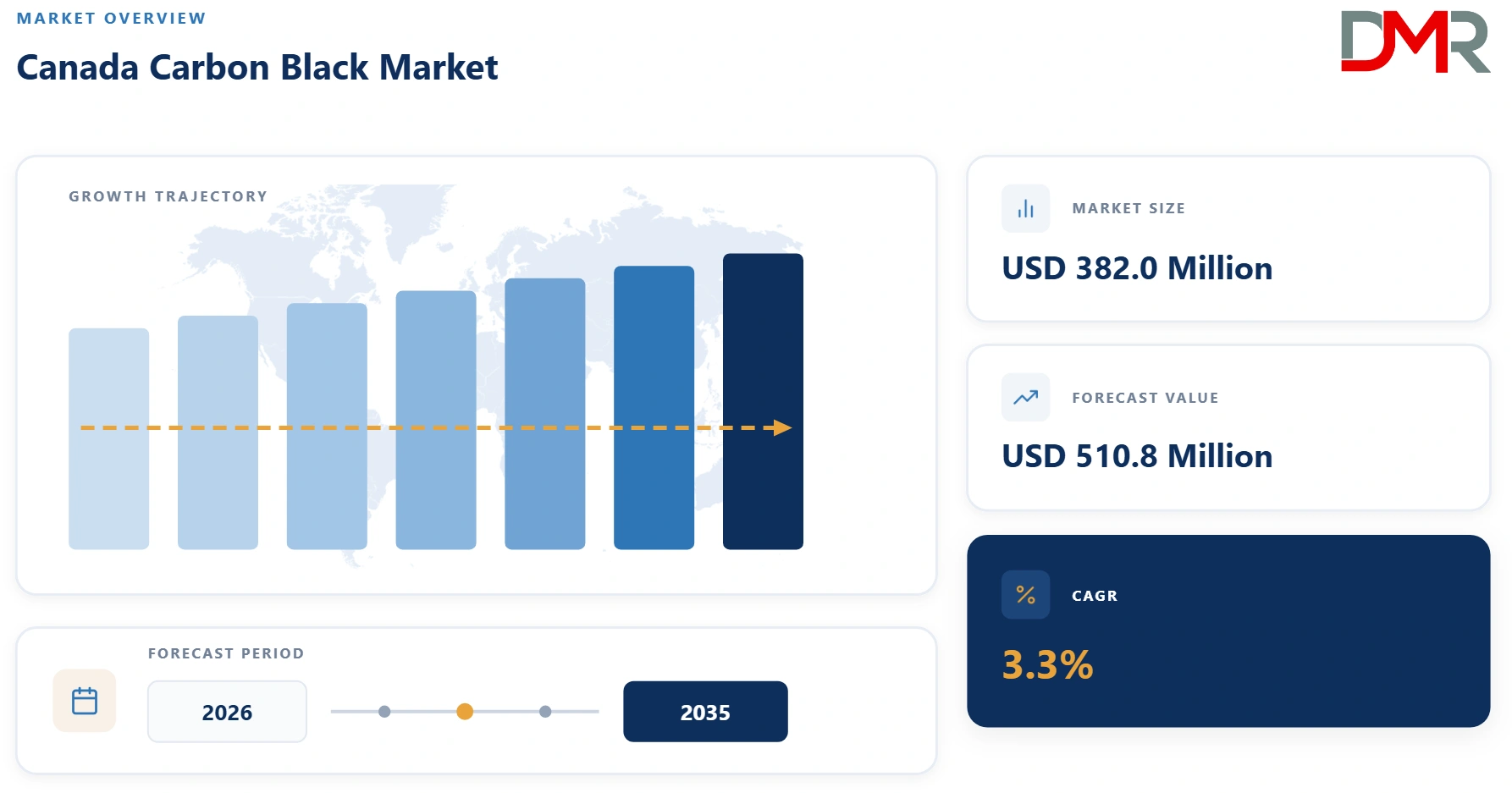
- Canada Carbon Black Market size in 2026 is: USD 382.0 Million
- Canada Carbon Black Market size in 2035 is: USD 510.8 Million
- Canada CAGR from 2027 to 2035 is: 3.3%
- Furnace is the leading type segment: 60.8%
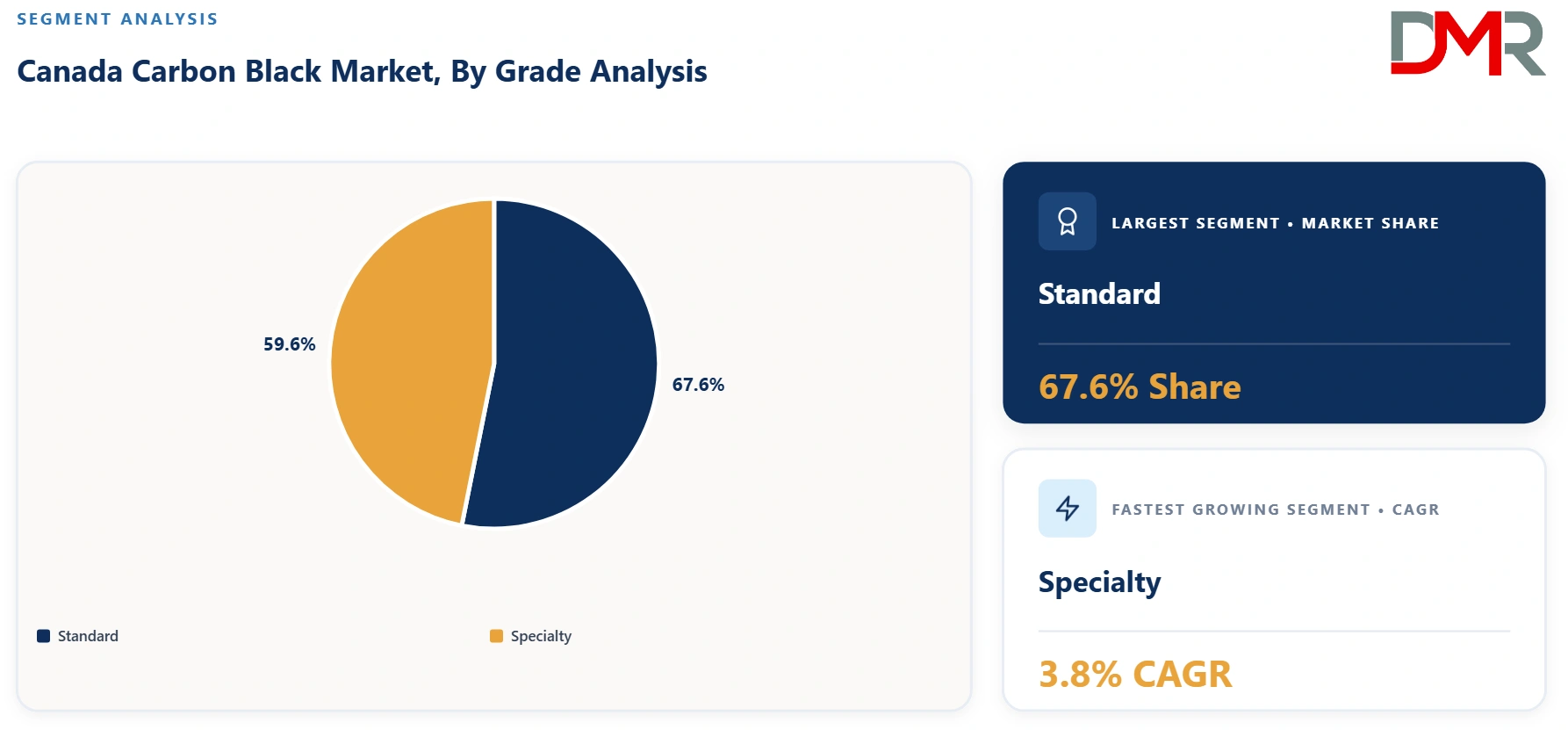
- Standard Grade is the leading grade segment: 67.6%
- Tires is the leading application segment: 61.4%
- Automotive is the leading end-use industry segment: 37.2%
- Thermal is the fastest-growing type segment: 4.2% CAGR
- Specialty is the fastest-growing grade segment: 3.8% CAGR
- Inks & Toners is the fastest-growing application segment: 3.9% CAGR
- Packaging is the fastest-growing end-use industry segment: 4.3% CAGR
What is the Canada Carbon Black Market? Canada Carbon Black Market Size.
The Canada Carbon Black Market size is valued at USD 382.0 Million in 2026, and it is further anticipated to reach a market value of USD 510.8 Million by 2035 at a CAGR of 3.3%.
ℹ
To learn more about this report –
Download Your Free Sample Report Here
The Canada Carbon Black Market operates on the basis of increasing demand from the industries such as the tire manufacturing, automotive, industrial rubber and plastics. The application of carbon black is crucial to enhancing the performance of tires and rubber. Its use in coatings, inks, toners and specialty plastics increases the market demand even more. The increasing production of automotive, replacement tires, infrastructural developments and need for high-performance materials fuel the growth of the industry. Moreover, increased demand for recycling of tires provides scope for recycled carbon black.
Use Cases
- Tire Manufacturing: Carbon black plays an important role in Canada's tire manufacturing industry, particularly in the production of passenger vehicle, commercial vehicle, and off-road tires. Canada's automotive manufacturing activities in Ontario, along with demand from transportation and logistics operators, support the consumption of carbon black in tire compounds. It improves tire strength, abrasion resistance, and durability, making it suitable for vehicles operating across Canada's varied road and weather conditions. Demand for replacement tires also contributes to carbon black consumption, particularly due to long-distance transportation, commercial trucking, and seasonal tire requirements across the country.
- Industrial Rubber Products: Canada's mining, oil and gas, forestry, and heavy manufacturing industries create demand for carbon black in industrial rubber products. Mining operations in provinces such as Ontario, Quebec, and British Columbia require durable conveyor belts, hoses, seals, gaskets, and vibration-control components to support material handling and equipment operations. Carbon black improves the mechanical strength, abrasion resistance, and service life of these rubber products. The expansion and maintenance of industrial infrastructure, along with equipment requirements in Canada's resource-based industries, support the use of carbon black in specialized rubber applications.
- Plastics and Polymer Manufacturing: Carbon black is used in Canada's plastics and polymer manufacturing industry for pigmentation, UV protection, and electrical conductivity in specialized applications. Its use is relevant to the production of plastic pipes, automotive components, agricultural films, cable insulation, and construction materials. Canada's construction and infrastructure activities create demand for durable polymer products, particularly piping and outdoor plastic applications that require resistance to sunlight exposure. Additionally, automotive manufacturing and electrical infrastructure projects support the use of carbon black in specialized plastic compounds. These applications contribute to demand for carbon black across Canada's polymer processing and manufacturing industries.
- Paints, Coatings, Inks & Toners: Carbon black is used in Canada's paints, coatings, printing inks, and toner manufacturing industries, where it provides black pigmentation, opacity, and UV protection in selected formulations. Demand is supported by construction, automotive refinishing, industrial equipment maintenance, and packaging-related printing activities. Canada's infrastructure maintenance requirements and exposure to harsh winter conditions increase the importance of protective coating systems for industrial structures, machinery, and transportation equipment. Specialty carbon black grades are also used in printing inks and toners to achieve consistent colour, dispersion, and printing performance, supporting their application across Canada's packaging and commercial printing industries.
Key Takeaways
- Market Growth: The Canada Carbon Black Market is anticipated to reach USD 510.8 Million by 2035, starting from USD 382.0 Million in 2026, at a CAGR of 3.3%. Market growth is supported by increasing demand from tire manufacturing, automotive production, industrial rubber applications, plastics, and coatings.
- Thermal Leads the Type Segment: Thermal dominates the type segment by acquiring a market share of 60.8% in 2026. Its widespread use in tire manufacturing, industrial rubber products, and automotive components supports its leading position. However, Channel Black is projected to witness the highest growth rate at a CAGR of 4.2%.
- Standard Grade Dominates the Grade Segment: Standard Grade accounts for 67.6% of the market share in 2026 owing to its extensive use in tire manufacturing and conventional rubber applications. Its ability to improve mechanical strength, durability, and abrasion resistance supports its widespread adoption across automotive and industrial rubber manufacturing. However, Specialty Grade is projected to witness the highest growth rate at a CAGR of 3.8%, driven by increasing demand for high-performance pigments, conductive materials, plastics, and coatings.
- Tires Leads the Application Segment: Tires account for 61.4% of the market share in 2026 owing to the extensive use of carbon black as a reinforcing material in tire treads, sidewalls, and other components. Its ability to improve tire strength, abrasion resistance, durability, and overall performance supports its leading position. Demand from automotive production and replacement tire markets further strengthens this application. However, Inks & Toners are projected to witness the highest growth rate at a CAGR of 3.9%.
- Automotive Leads the End-Use Industry Segment: Automotive accounts for 37.2% of the market share in 2026 owing to the widespread use of carbon black in tires, hoses, belts, seals, and other rubber components. Demand for durable automotive materials, vehicle production, and replacement tires supports the segment's leading position. The increasing requirement for high-performance rubber and plastic components further contributes to consumption. However, Packaging is projected to witness the highest growth rate at a CAGR of 4.3%, supported by increasing demand for durable plastic packaging materials and specialty polymer applications.
How AI/Gen AI Is Transforming Canada Carbon Black Market?
AI and Generative AI have started influencing the way carbon black producers handle their production process, quality, and logistics operations in Canada. Producers are using AI technology in the monitoring of furnace temperature, management of raw material, and maintaining a high quality of production process. Technology is also helpful in identifying any problem with the machinery and avoiding any unforeseen cost and time related to machinery problems. In terms of product development, AI technology assists in testing various combinations of carbon black and getting the desired strength, conductivity, and pigmenting. Generative AI also allows researchers to study production data and finding better ways of manufacturing. AI-based demand forecasting is also helpful in managing inventory and raw material.
Key Drivers in the Canada Carbon Black Market
Growing Demand from Canada's Automotive and Tire Manufacturing Industry
Canada's automotive manufacturing industry, particularly in Ontario, creates demand for carbon black through the production of tires and automotive rubber components. The presence of vehicle assembly plants and automotive parts manufacturers across Ontario supports the requirement for reinforced rubber materials used in passenger vehicles and commercial transportation. Carbon black improves the strength, abrasion resistance, and durability of tire compounds, making it important for both original equipment and replacement tire production. Additionally, Canada's long-distance transportation network, commercial trucking activities, and seasonal winter tire requirements contribute to replacement tire demand. These factors support the consumption of carbon black by tire manufacturers and automotive component suppliers operating in the Canadian market.
Rising Demand from Canada's Mining, Oil and Gas, and Industrial Sectors
Canada's extensive mining, oil and gas, and resource-processing activities create demand for carbon black-based industrial rubber products. Mining operations across Ontario, Quebec, and British Columbia require reinforced conveyor belts, industrial hoses, seals, and other rubber components to withstand abrasive materials and demanding operating conditions. Similarly, Alberta's oil sands industry requires durable rubber products for material handling and industrial equipment. Carbon black improves the mechanical strength, wear resistance, and service life of these components. The continued operation, maintenance, and modernization of Canada's resource extraction and processing infrastructure support demand for carbon black in industrial rubber applications.
Restraints in the Canada Carbon Black Market
Exposure to Volatility in Petroleum Feedstock and Energy Costs
Carbon black production depends heavily on petroleum-derived feedstocks, including carbon-rich oils obtained from refining processes. In Canada, fluctuations in global crude oil prices, refinery operating conditions, and the availability of suitable feedstocks can affect raw material procurement costs for carbon black manufacturers. Changes in energy prices also influence manufacturing expenses, particularly for energy-intensive furnace black production. Additionally, transportation costs associated with moving feedstocks and finished products across Canada's geographically dispersed industrial regions can increase supply chain expenses. These cost fluctuations create challenges for manufacturers in maintaining stable product prices and profit margins, particularly when higher input costs cannot be fully passed on to customers.
Compliance with Canada's Environmental and Industrial Emission Regulations
Carbon black manufacturing involves energy-intensive operations that generate greenhouse gas emissions, particulate matter, and other industrial pollutants. Manufacturers operating in Canada must comply with applicable federal and provincial environmental requirements, including regulations under the Canadian Environmental Protection Act and provincial air-quality permitting frameworks. Facilities may need to invest in emission-control equipment, continuous monitoring systems, energy-efficiency improvements, and industrial waste management processes to meet regulatory requirements. These compliance obligations can increase capital expenditure and operating costs. The requirements may be particularly challenging for smaller manufacturers and facilities seeking to modernize existing production infrastructure while maintaining cost competitiveness.
Growth Opportunities in the Canada Carbon Black Market
Expansion of Recovered Carbon Black Production Through Tire Recycling
Canada's established tire collection and recycling activities create opportunities for developing recovered carbon black through end-of-life tire processing. Pyrolysis technology can convert scrap tires into recovered carbonaceous materials that can be further processed and evaluated for use in selected rubber and plastic applications. Provincial tire stewardship and extended producer responsibility programs provide a potential source of feedstock for recycling businesses. This creates opportunities for Canadian recycling companies and material manufacturers to develop partnerships for recovering valuable materials from discarded tires. Further improvements in recovered carbon black quality, consistency, and compatibility with industrial applications could support its adoption by Canadian rubber and polymer manufacturers seeking to incorporate recycled materials into their production processes.
Increasing Opportunities for Specialty Carbon Black in Advanced Industrial Applications
Canada's growing focus on electric vehicles, battery manufacturing, electrical infrastructure, and advanced materials creates opportunities for specialty carbon black producers. Conductive carbon black can be used in battery electrodes, conductive plastics, cable compounds, and selected electronic applications, while high-colour and UV-resistant grades serve coatings and polymer manufacturers. Investments in Canada's battery supply chain, particularly in Ontario and Quebec, provide potential opportunities for suppliers of specialized conductive materials. Furthermore, demand for advanced polymer compounds in automotive and electrical applications can create opportunities for manufacturers offering application-specific carbon black grades. Suppliers capable of meeting technical requirements for conductivity, dispersion, purity, and consistency can expand their presence in these specialized applications.
Trends in Canada Carbon Black Market
Adoption of Advanced Manufacturing Technologies and Process Automation
Carbon black manufacturers and industrial material producers in Canada are increasingly focusing on modernizing manufacturing operations through automation, digital monitoring, and advanced process-control systems. Furnace black production requires precise control of temperature, feedstock flow, reaction conditions, and particle characteristics to maintain consistent product quality. Automated monitoring systems, digital production controls, and predictive maintenance technologies can help manufacturers identify operational irregularities and reduce unplanned equipment downtime. These technologies are particularly relevant to Canadian industrial facilities facing high energy costs, skilled labour requirements, and the need for efficient production operations. The adoption of advanced manufacturing systems is supporting improvements in process consistency, resource utilization, and operational reliability across the Canadian carbon black supply chain.
Growing Focus on Sustainable Production and Circular Material Use
Sustainability is becoming increasingly important in Canada's carbon black industry as manufacturers respond to environmental requirements and growing interest in resource efficiency. Tire recycling, recovered carbon black, improved energy utilization, and industrial waste reduction are receiving greater attention across the Canadian materials and rubber industries. The development of recycling infrastructure and provincial tire stewardship initiatives is creating opportunities to recover materials from end-of-life tires and reduce dependence on conventional raw material inputs. Manufacturers are also exploring more efficient production technologies and improved emission-control systems to reduce the environmental impact of industrial operations. These developments are encouraging a gradual shift toward circular material practices and more resource-efficient carbon black production in Canada.
Research Scope and Analysis
Canada Carbon Black Market is segmented based on Type into Furnace, Channel, Thermal, Acetylene, Lamp, and Others, By Grade into Standard and Specialty, By Application into Tires, Industrial Rubber Products, Plastics, Coatings, Inks & Toners, Textile Fibers, and Others, By End-Use Industry into Automotive, Building & Construction, Packaging, Electronics, Consumer Goods, and Others.
ℹ
To learn more about this report –
Download Your Free Sample Report Here
By Type Analysis
The Thermal segment holds the largest market share by value, accounting for 60.8% of the Canada Carbon Black Market in 2026. Its dominance is supported by its extensive use in tire manufacturing and industrial rubber products. The Channel segment is forecasted to experience the highest CAGR of 4.2% during 2027–2035.
By Grade Analysis
The Standard Grade segment holds the largest market share, accounting for 67.6% of the Canada Carbon Black Market in 2026. Its leading position is attributed to its widespread use in tire manufacturing, rubber products, and other industrial applications, where it offers reliable reinforcement and pigmentation properties. The Specialty Grade segment is forecasted to register the highest CAGR of 3.8% during 2027–2035.
By Application Analysis
The Tires segment holds the largest market share, accounting for 61.4% of the Canada Carbon Black Market in 2026. Its leading position is supported by the extensive use of carbon black as a reinforcing material to improve tire strength, durability, and resistance to wear. The Inks & Toners segment is forecasted to experience the highest CAGR of 3.9% during 2027–2035.
By End-Use Industry Analysis
The Automotive segment holds the largest market share, accounting for 37.2% of the Canada Carbon Black Market in 2026. Its dominance is driven by the substantial demand for carbon black in tire production, automotive rubber components, and plastic parts, where it supports durability, strength, and pigmentation. The Packaging segment is forecasted to register the highest CAGR of 4.3% during 2027–2035.
The Canada Carbon Black Market Report is segmented based on the following:
By Type
- Furnace
- Channel
- Thermal
- Acetylene
- Lamp
- Others
By Grade
By Application
- Tires
- Industrial Rubber Products
- Plastics
- Coatings
- Inks & Toners
- Textile Fibers
- Others
By End-Use Industry
- Automotive
- Building & Construction
- Packaging
- Electronics
- Consumer Goods
- Others
Regulatory Landscape
The Canada Carbon Black Market operates under federal and provincial regulations that address industrial emissions, air quality, and greenhouse gas (GHG) emissions. The Canadian Environmental Protection Act, 1999 (CEPA 1999) provides the federal framework for pollution control, while eligible facilities must report specified pollutant releases under the National Pollutant Release Inventory (NPRI). Depending on the province and facility, carbon pricing requirements may apply through the federal Output-Based Pricing System (OBPS) or provincial programs such as Alberta's Technology Innovation and Emissions Reduction (TIER) and Ontario's Emissions Performance Standards (EPS). Ontario's O. Reg. 419/05 and Alberta's Environmental Protection and Enhancement Act (EPEA) also set requirements for controlling air pollution. These regulations encourage manufacturers to improve emission monitoring and adopt cleaner production methods, while adding to compliance and operating costs.
Investment and White Space Analysis
Opportunities for investment include modernization of carbon black production, special carbon black, and recovered carbon black. With the demand from tire production, vehicle parts production, plastic industries, and industrial rubber goods production, there is an increase in the drive for product quality improvement and capacity building. Recovered carbon black also represents an area for investment since tire recycling and pyrolysis can provide another way to obtain carbon-based material and resource recovery. But investing depends on various aspects like cost of technology used, availability of raw materials, efficiency of the process, and maintaining quality of the product.
Competitive Landscape
The Canada Carbon Black Market can be seen with the existence of well-known international manufacturers and suppliers who compete on the basis of product quality, production ability, technology and distribution. The major companies working in this competitive environment are Cabot Corporation, Birla Carbon, Orion Engineered Carbons, Tokai Carbon Co., Ltd., and Continental Carbon Company. These companies concentrate on providing services to the various industries like tires, automotive industry, industrial rubber and specialty applications. The competition in this market environment is further affected by the increase in demand for high-quality carbon black products, which helps manufacturers enhance their product line and research and development. The increase in the use of sustainable material will help recovered carbon black to gain momentum in the market.
Some of the prominent players in Canada Carbon Black Market are:
- Cabot Corporation
- Birla Carbon
- Cancarb Limited
- Orion Engineered Carbons S.A.
- Tokai Carbon Co., Ltd.
- Continental Carbon Company
- PCBL Chemical Limited
- Himadri Speciality Chemical Ltd.
- Mitsubishi Chemical Group Corporation
- Denka Company Limited
- OCI Company Ltd.
- Jiangxi Black Cat Carbon Black Co., Ltd.
- Omsk Carbon Group
- Longxing Chemical Stock Co., Ltd.
- Koppers Inc.
- Others
Recent Developments
- In June 2026, Cancarb Limited completed and commissioned a solar power facility at its carbon black manufacturing site in Medicine Hat, Alberta. The project includes more than 7,000 solar panels and has a generation capacity of approximately 3.5 MW. This investment supports the company's efforts to reduce emissions and improve the sustainability of its manufacturing operations.
- In February 2026, Cabot Corporation completed the acquisition of Mexico Carbon Manufacturing S.A. de C.V. from Bridgestone Corporation. The acquisition expands Cabot's manufacturing footprint in North America, increases its production capacity and strengthens its ability to supply a broader range of reinforcing carbon products.
Report Details
| Report Characteristics |
| Market Size (2026) |
USD 382.0 Mn |
| Forecast Value (2035) |
USD 510.8 Mn |
| CAGR (2027–2035) |
3.3% |
| Historical Data |
2021 – 2025 |
| Forecast Data |
2027 – 2035 |
| Base Year |
2026 |
| Segments Covered |
By Type, By Grade, By Application, End-Use Industry |
Frequently Asked Questions
How big is the Canada Carbon Black Market?
▾ The Canada Carbon Black Market is valued at USD 382.0 Million in 2026 and is projected to reach approximately USD 510.8 Million by 2035.
What is the CAGR of the Canada Carbon Black Market from 2027 to 2035?
▾ The Canada Carbon Black Market is anticipated to grow at a compound annual growth rate (CAGR) of 3.3% during the forecast period from 2027 to 2035.
What factors are driving the growth of the Canada Carbon Black Market?
▾ The Canada Carbon Black Market is driven by rising tire production and replacement tire demand, along with increasing use of reinforced rubber products across the automotive, mining, construction, and manufacturing industries.
What are the major trends in the Canada Carbon Black Market?
▾ The major trends in the Canada Carbon Black Market include the adoption of automated manufacturing technologies, predictive maintenance, and advanced quality control systems, along with a growing focus on sustainable production, recovered carbon black, energy efficiency, and tire recycling.
Who are the key players in the Canada Carbon Black Market?
▾ The key players in the Canada Carbon Black Market are Cabot Corporation, Birla Carbon, Orion Engineered Carbons S.A., Tokai Carbon Co., Ltd., Continental Carbon Company, Sid Richardson Carbon & Energy Co., Asahi Carbon Co., Ltd., Denka Company Limited, Mitsubishi Chemical Group Corporation, and Jiangxi Black Cat Carbon Black Co., Ltd. Among others.
How is the Canada Carbon Black Market segmented?
▾ The Canada Carbon Black Market is segmented based on Type into Furnace, Channel, Thermal, Acetylene, Lamp, and Others, By Grade into Standard and Specialty, By Application into Tires, Industrial Rubber Products, Plastics, Coatings, Inks & Toners, Textile Fibers, and Others, By End-Use Industry into Automotive, Building & Construction, Packaging, Electronics, Consumer Goods, and Others.