Canada Cold Chain Logistics Market Snapshot
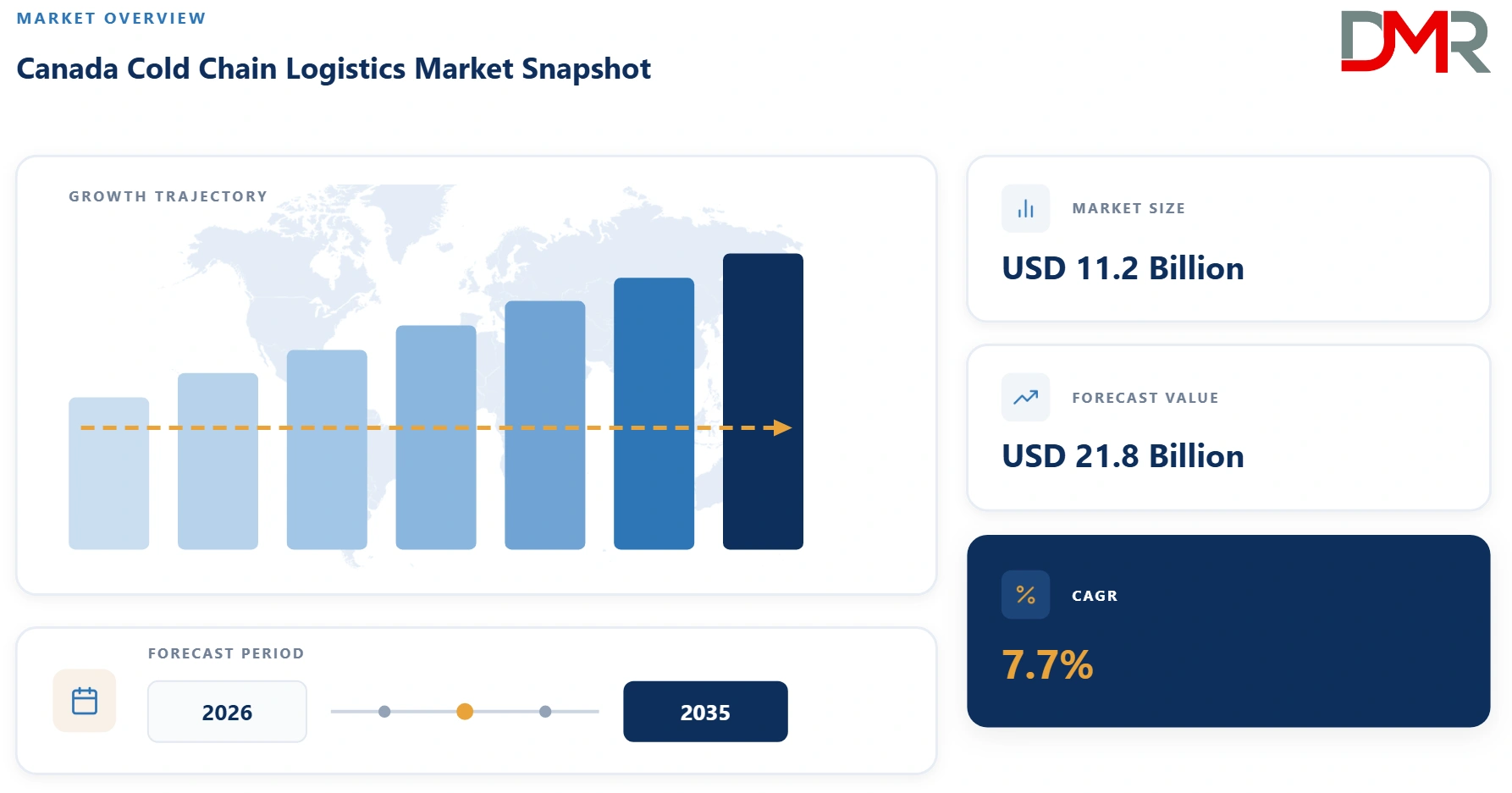
- Canada Cold Chain Logistics Market Size in 2026: USD 11.2 Billion
- Canada Cold Chain Logistics Market Size in 2035: USD 21.8 Billion
- Canada CAGR from 2026 to 2035: 7.7%
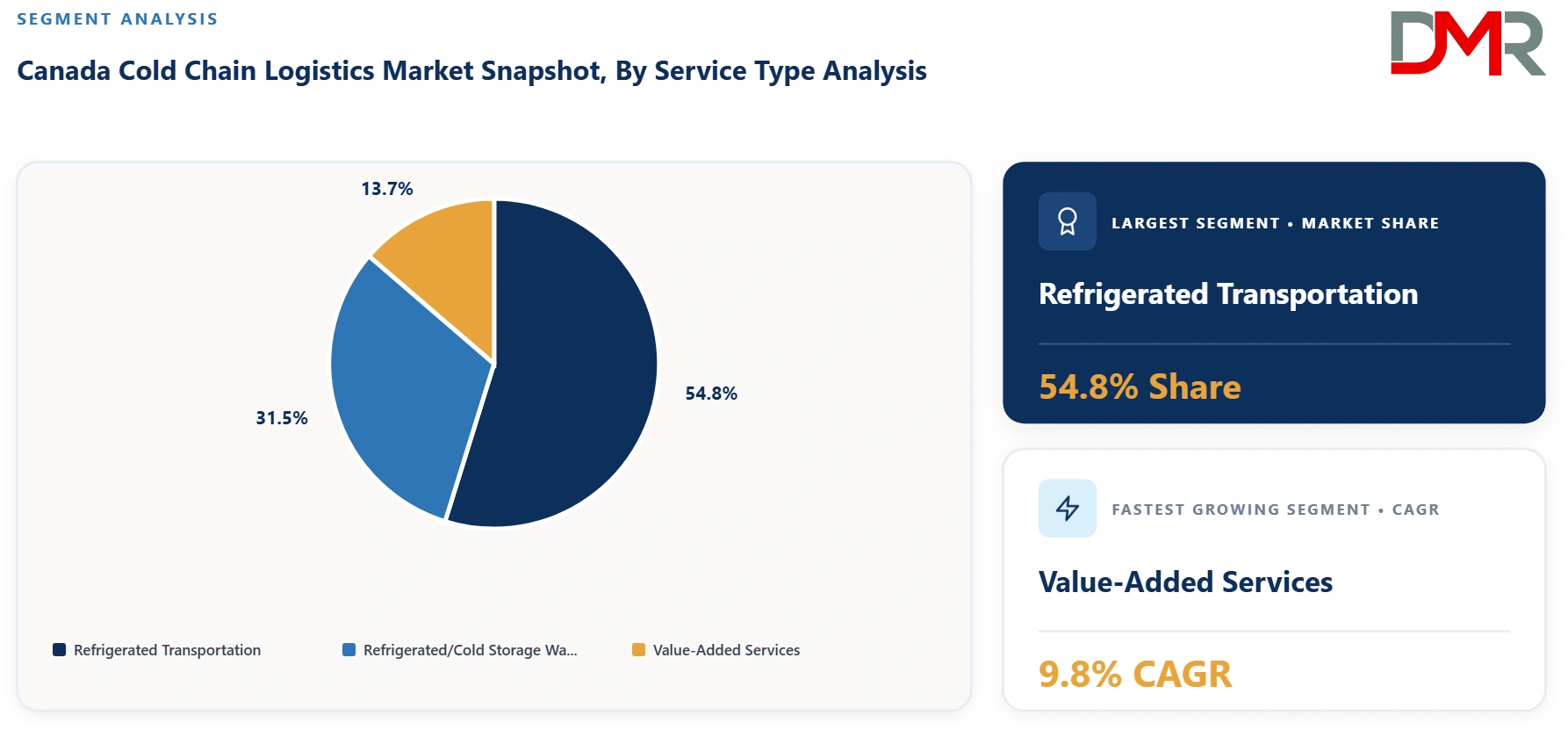
- Refrigerated Transportation is the leading service type segment in 2026: 54.8%
- Frozen is the leading temperature type segment in 2026: 46.3%
- Roadways is the leading mode of transport segment in 2026: 71.4%
- Fruits and Vegetables is the leading application segment in 2026: 26.9%
- Food and Beverage Industry is the leading end user segment in 2026: 74.2%
What is the Canada Cold Chain Logistics Market and its Market Size?
The Canada Cold Chain Logistics Market is projected to be valued at USD 11.2 Billion in 2026 and is projected to reach USD 21.8 Billion by 2035, expanding at a CAGR of 7.7% during the forecast period.
ℹ
To learn more about this report –
Download Your Free Sample Report Here
Growth is being propelled by rapid expansion of grocery e-commerce and direct-to-consumer meal kit and fresh food delivery services, sustained growth in pharmaceutical and biologics distribution requiring stringent temperature-controlled logistics, and Canada's structural reliance on long-distance, cross-provincial refrigerated transportation to move fresh and frozen food from concentrated production regions to widely dispersed population centers. The maturing of real-time temperature monitoring and IoT-enabled tracking technology, growing investment in automated and energy-efficient cold storage warehousing near major urban and port distribution hubs, and rising consumer and regulatory expectations for verifiable, unbroken cold chain integrity are reshaping the market from largely manual, regionally fragmented refrigerated trucking operations into a more consolidated, technology-enabled, nationally integrated logistics sector. Investment is accelerating as cold chain providers modernize aging refrigerated fleets and warehouse infrastructure while expanding capacity to serve growing pharmaceutical, frozen food, and e-commerce grocery demand.
Use Cases
- Cross-Provincial Refrigerated Transportation of Fresh Produce: Grocery retailers and food distributors rely on long-haul refrigerated trucking to move fresh fruits, vegetables, and dairy products from concentrated agricultural production regions to population centers across Canada's vast geography, requiring consistent temperature control across multi-day transit times.
- Temperature-Controlled Pharmaceutical and Vaccine Distribution: Pharmaceutical distributors and healthcare logistics providers use validated cold chain transportation and storage to move biologics, vaccines, and temperature-sensitive medications between manufacturing sites, distribution centers, and healthcare facilities in compliance with strict regulatory handling requirements.
- Last-Mile Cold Chain for Grocery E-Commerce and Meal Kit Delivery: Online grocery platforms and meal kit companies rely on temperature-controlled last-mile delivery fleets and packaging solutions to maintain product quality and food safety for chilled and frozen items shipped directly to consumers.
- Seafood and Meat Export Cold Chain Logistics: Canadian seafood and meat exporters depend on integrated cold chain networks connecting processing facilities, port cold storage, and refrigerated ocean freight to preserve product quality for international export markets, particularly to the United States and Asia-Pacific.
Key Takeaways
- Market Size: The Canada Cold Chain Logistics Market is anticipated to be valued at USD 11.2 Billion in 2026 and is forecast to reach USD 21.8 Billion by 2035, expanding at a CAGR of 7.7%.
- Growth Outlook: Market expansion is sustained by rapid growth in grocery e-commerce and meal kit delivery, sustained pharmaceutical and biologics distribution growth, and continued structural reliance on long-distance refrigerated transportation across Canada's dispersed population geography.
- Primary Growth Drivers: Expanding grocery e-commerce and direct-to-consumer fresh food delivery, growing pharmaceutical and biologics cold chain distribution requirements, rising consumer and regulatory expectations for verifiable cold chain integrity, and continued investment in automated, energy-efficient cold storage infrastructure are accelerating market growth.
- By Service Type Analysis: Refrigerated Transportation is projected to lead the service type segment with a 54.8% share in 2026, reflecting Canada's structural reliance on long-distance trucking to connect dispersed production and population centers. Value-Added Services is the fastest-growing service type segment at 9.8% CAGR, driven by rising demand for blast freezing, repackaging, and inventory management services alongside core transportation and storage.
- By Temperature Type Analysis: Frozen is expected to dominate with a 46.3% share in 2026, supported by extensive frozen food, seafood, and meat distribution volumes. Deep-Frozen is the fastest-growing temperature type segment at 9.1% CAGR, driven by expanding pharmaceutical biologics and specialty frozen food distribution requiring ultra-low temperature handling.
- By Mode of Transport Analysis: Roadways is poised to lead with a 71.4% share in 2026, reflecting the dominance of refrigerated trucking across Canada's road-dependent distribution network. Railways is the fastest-growing mode of transport segment at 8.6% CAGR, driven by growing investment in intermodal refrigerated rail capacity for long-haul, cross-country freight.
- By Application Analysis: Fruits and Vegetables is expected to command a 26.9% share in 2026, underpinned by high transportation volume and perishability requirements. Pharmaceuticals and Healthcare is the fastest-growing application segment at 10.3% CAGR, fuelled by expanding biologics and vaccine distribution requirements.
- By End User Analysis: Food and Beverage Industry is projected to dominate with a 74.2% share in 2026, reflecting the sector's overwhelming share of overall cold chain volume. Pharmaceutical and Healthcare Industry is the fastest-growing end user segment at 9.9% CAGR, driven by sustained growth in temperature-sensitive drug and biologics distribution.
Key Drivers in the Canada Cold Chain Logistics Market
Structural Reliance on Long-Distance Refrigerated Transportation Across Dispersed Geography
Canada's vast geography and concentration of population centers far from key agricultural production regions create a structural, ongoing requirement for long-distance refrigerated transportation to move fresh and frozen food across the country. Unlike more geographically compact markets, Canadian cold chain logistics providers must maintain consistent temperature control across multi-day transit routes spanning thousands of kilometers, often through extreme seasonal temperature variation. This geographic reality sustains persistent demand for reliable, well-maintained refrigerated fleet capacity and reinforces the strategic importance of cold chain infrastructure investment across the food distribution system.
Rapid Growth in Grocery E-Commerce and Direct-to-Consumer Fresh Food Delivery
Continued expansion of online grocery ordering, meal kit subscription services, and direct-to-consumer fresh food delivery platforms is driving substantial growth in last-mile cold chain logistics demand. Consumers increasingly expect reliable delivery of chilled and frozen groceries and prepared meals with consistent quality, requiring logistics providers to invest in temperature-controlled last-mile delivery fleets, insulated packaging solutions, and real-time delivery tracking capable of ensuring product integrity through the final delivery stage. This channel shift is expanding cold chain logistics demand beyond traditional business-to-business distribution into a growing consumer-facing last-mile segment.
Restraints in the Canada Cold Chain Logistics Market
Extreme Seasonal Climate Variation and Infrastructure Maintenance Costs
Canada's extreme seasonal temperature variation, ranging from severe winter cold to warm summer conditions, represents a significant restraint on the Cold Chain Logistics Market. Refrigerated vehicles and cold storage facilities must be engineered and maintained to perform reliably across this wide temperature range, increasing equipment costs, energy consumption, and maintenance requirements relative to markets with more moderate climates. Winter road conditions can also disrupt long-haul refrigerated transportation schedules, particularly across northern and rural distribution routes, creating operational reliability challenges that logistics providers must manage through redundant routing and contingency planning.
Growth Opportunities in the Canada Cold Chain Logistics Market
Automated and Energy-Efficient Cold Storage Facility Investment
Growing demand for cold storage capacity near major urban distribution hubs and ports presents a substantial opportunity for developers and logistics providers investing in automated, energy-efficient warehousing facilities. Automated storage and retrieval systems can improve space utilization and reduce labor dependency in an industry facing similar workforce availability challenges to broader logistics and transportation sectors, while energy-efficient refrigeration systems can meaningfully reduce operating costs given Canada's significant heating and cooling energy requirements across seasonal extremes.
Cold Chain Infrastructure Supporting Biologics and Cell and Gene Therapy Distribution
Rising growth in biologics, cell and gene therapy, and other advanced pharmaceutical distribution requiring ultra-low temperature and validated cold chain handling presents a significant opportunity for logistics providers developing specialized pharmaceutical cold chain capability. Providers capable of meeting stringent validation, monitoring, and chain-of-custody documentation requirements for high-value, temperature-sensitive pharmaceutical products can capture premium, long-term contracts with pharmaceutical manufacturers and healthcare distribution networks as this therapeutic category continues to expand.
Trends in the Canada Cold Chain Logistics Market
Growing Adoption of Real-Time IoT-Based Temperature Monitoring
Cold chain logistics providers across Canada are increasingly adopting IoT-enabled sensors and real-time temperature monitoring systems across refrigerated vehicles and storage facilities, allowing continuous visibility into product condition throughout transit and storage. This technology adoption is being driven by both customer demand for verifiable cold chain integrity documentation and providers' own interest in proactively identifying and addressing temperature excursions before they result in product loss. Real-time monitoring data is increasingly being integrated into broader supply chain visibility platforms shared with food and pharmaceutical manufacturer clients.
Consolidation Among Regional Cold Chain and Logistics Providers
The Canada Cold Chain Logistics Market is experiencing increasing consolidation as larger national and North American logistics companies acquire regional refrigerated transportation and cold storage operators to build broader, more integrated coast-to-coast networks. Consolidation allows combined entities to offer more comprehensive geographic coverage, shared investment in fleet modernization and automated warehousing, and stronger negotiating position with major food and pharmaceutical manufacturer clients. Smaller independent regional operators face growing competitive pressure to specialize in niche applications or align with larger platforms to remain viable.
Research Scope and Analysis
The Canada Cold Chain Logistics Market is segmented by service type, temperature type, mode of transport, application, and end user, covering refrigerated transportation, cold storage warehousing, value-added services, chilled, frozen, deep-frozen temperature ranges, and food, pharmaceutical, and chemical industry end users.
ℹ
To learn more about this report –
Download Your Free Sample Report Here
By Service Type Analysis
Refrigerated Transportation is projected to dominate the Canada Cold Chain Logistics Market with approximately 54.8% share in 2026, reflecting the country's structural reliance on long-distance trucking to connect dispersed agricultural production regions with population centers. Value-Added Services is expected to register the highest CAGR of 9.8% during 2026-2035, driven by growing manufacturer and retailer demand for blast freezing, repackaging, labeling, and inventory management services integrated alongside core transportation and storage offerings.
By Temperature Type Analysis
Frozen is anticipated to dominate the Canada Cold Chain Logistics Market by temperature type, accounting for approximately 46.3% share in 2026, supported by extensive frozen food, seafood, and meat product distribution volumes across the domestic and export supply chain. Deep-Frozen is projected to register the highest CAGR of 9.1% between 2026 and 2035, driven by expanding pharmaceutical biologics distribution and specialty frozen food categories requiring ultra-low temperature handling and storage.
By Mode of Transport Analysis
Roadways is projected to lead the Canada Cold Chain Logistics Market with an estimated 71.4% share in 2026, reflecting the dominant role of refrigerated trucking in a road-dependent national distribution network spanning vast, often sparsely connected geography. Railways is expected to register the fastest CAGR of 8.6% through 2035, driven by growing investment in intermodal refrigerated rail capacity as an efficient, lower-emission alternative for long-haul, cross-country cold chain freight.
By Application Analysis
Fruits and Vegetables is projected to lead the Canada Cold Chain Logistics Market with an estimated 26.9% share in 2026, underpinned by high transportation volume and the inherent perishability of fresh produce moved across long domestic supply chains. Pharmaceuticals and Healthcare is expected to register the fastest CAGR of 10.3% through 2035, driven by sustained growth in biologics, vaccine, and temperature-sensitive medication distribution requiring validated cold chain handling.
By End User Analysis
Food and Beverage Industry is projected to dominate the Canada Cold Chain Logistics Market with approximately 74.2% share in 2026, reflecting the sector's overwhelming share of total cold chain transportation and storage volume. Pharmaceutical and Healthcare Industry is expected to register the fastest CAGR of 9.9% through 2035, driven by sustained growth in temperature-sensitive drug, vaccine, and biologics distribution requiring specialized validated cold chain logistics capability.
The Canada Cold Chain Logistics Market Report is segmented based on the following:
By Service Type
- Refrigerated Transportation
- Refrigerated/Cold Storage Warehousing
- Value-Added Services
By Temperature Type
- Chilled
- Frozen
- Deep-Frozen
By Mode of Transport
- Roadways
- Railways
- Airways
- Waterways
By Application
- Dairy Products
- Fruits and Vegetables
- Meat, Fish and Seafood
- Bakery and Confectionery
- Pharmaceuticals and Healthcare
- Others
By End User
- Food and Beverage Industry
- Pharmaceutical and Healthcare Industry
- Chemical Industry
- Others
Technology Analysis
Technology investment is increasingly shaping competitiveness in the Canada Cold Chain Logistics Market as providers adopt IoT-based real-time temperature monitoring, telematics-enabled fleet management, and automated storage and retrieval systems to improve reliability, energy efficiency, and supply chain visibility. Growing use of predictive maintenance analytics for refrigerated fleet and warehouse equipment is helping providers reduce unplanned equipment failures that risk product loss during Canada's extreme seasonal temperature swings. Opportunities are expanding for providers investing in energy-efficient refrigeration systems suited to both extreme cold and summer heat conditions, electric and alternative-fuel refrigerated vehicle technology, and blockchain or digital ledger-based chain-of-custody documentation for pharmaceutical and premium food applications. However, high capital costs for fleet and facility modernization, combined with integration complexity across legacy warehouse management systems, remain adoption barriers for smaller regional operators.
Investment and White Space Analysis
Investment opportunities in the Canada Cold Chain Logistics Market are expanding alongside sustained grocery e-commerce growth, pharmaceutical and biologics distribution expansion, and continued national investment in modernized, energy-efficient cold storage and transportation infrastructure. Significant white space exists in automated cold storage warehousing near major urban distribution hubs, specialized pharmaceutical and biologics cold chain capability, intermodal refrigerated rail expansion, and last-mile cold chain solutions supporting grocery e-commerce and meal kit delivery growth. Providers with strong nationwide network coverage, proven temperature validation and monitoring capability, and established relationships with major food and pharmaceutical manufacturer clients are positioned to capture premium, longer-duration contracts. However, extreme seasonal climate-related operating costs, winter transportation reliability challenges, and consolidation-driven competitive pressure can constrain margins for smaller, regionally concentrated operators.
Competitive Landscape
The Canada Cold Chain Logistics Market is moderately consolidated and increasingly competitive, comprising large national and North American cold chain logistics companies, regional refrigerated transportation and storage operators, and specialized pharmaceutical cold chain logistics providers. Competition centers on nationwide network coverage, fleet and facility modernization, temperature validation and monitoring capability, and reliability across Canada's demanding seasonal climate conditions. Large national providers benefit from broad geographic coverage, integrated multimodal capability, and established relationships with major food and pharmaceutical manufacturer clients, while regional and specialized providers compete on category-specific expertise and closer client relationships in particular regions or applications. Companies increasingly differentiate through investment in real-time monitoring technology, energy-efficient infrastructure, and specialized pharmaceutical handling capability rather than transportation capacity alone.
Some of the prominent players in the Canada Cold Chain Logistics Market are:
- Americold Logistics
- Lineage Logistics
- Congebec Logistics
- Conestoga Cold Storage
- Trenton Cold Storage
- Confederation Freezers
- Groupe Robert
- MTE Logistix
- Canada Cartage
- Day & Ross
- Midland Transport
- DSV
- Yusen Logistics
- Kuehne+Nagel
- DHL Supply Chain
- C.H. Robinson
- Ryder System
- Penske Logistics
- FedEx
- UPS Supply Chain Solutions
- AIT Worldwide Logistics
- Radiant Logistics
- Mactrans Logistics
- 3PL Links
- National Cold Chain
- ColdStar Solutions
- Kelcold Refrigerated Warehouse and Logistics
- Plett Trucking
- TransDirect Freightlines
- Conrad Refrigerated Trucking
- Erb Group
- Manitoulin Transport
- Andlauer Healthcare Group
- Metro Supply Chain
- Brimich Logistics
- McKenna Logistics
- Martin Brower
- Canadian Cold Storage
- A.P. Moller - Maersk
- Oceanex
- Other Key Players
Recent Developments
- June 2026: Americold Logistics opened its new integrated cold-chain import-export hub at Port Saint John, New Brunswick. Developed with DP World and CPKC, the facility provides approximately 22,000 pallet positions and connects refrigerated storage with rail and maritime transportation.
- November 2025: UPS completed its approximately CAD 2.2 billion acquisition of Canada-based Andlauer Healthcare Group, significantly expanding its temperature-controlled pharmaceutical and healthcare logistics capabilities across Canada and North America.
- October 2025: Congebec and CN announced plans to develop a state-of-the-art refrigerated warehouse at CN’s Calgary Logistics Park in Alberta, integrating cold storage, cross-docking, transloading, and first- and last-mile logistics services.
Report Details
| Report Characteristics |
| Market Size (2026) |
USD 11.2 Bn |
| Forecast Value (2035) |
USD 21.8 Bn |
| CAGR (2026–2035) |
7.7% |
| Historical Data |
2021 – 2025 |
| Forecast Data |
2026 – 2035 |
| Base Year |
2025 |
| Segments Covered |
By Service Type, By Temperature Type, By Mode of Transport, By Application, and By End User |
| Country Coverage |
Canada |
Frequently Asked Questions
How big is the Canada Cold Chain Logistics Market?
▾ The Canada Cold Chain Logistics Market is valued at USD 11.2 Billion in 2026 and is projected to reach USD 21.8 Billion by 2035, reflecting sustained demand for refrigerated transportation and cold storage across the food, beverage, and pharmaceutical distribution industries.
What is the CAGR of the Canada Cold Chain Logistics Market from 2026 to 2035?
▾ The market is projected to expand at a compound annual growth rate (CAGR) of 7.7% between 2026 and 2035, supported by growing grocery e-commerce and meal kit delivery, expanding pharmaceutical distribution requirements, and continued cold chain infrastructure modernization.
What factors are driving the growth of the Canada Cold Chain Logistics Market?
▾ Growth is driven by expanding grocery e-commerce and direct-to-consumer fresh food delivery, growing pharmaceutical and biologics cold chain distribution requirements, rising consumer and regulatory expectations for verifiable cold chain integrity, and continued investment in automated, energy-efficient cold storage infrastructure.
What are the major trends in the Canada Cold Chain Logistics Market?
▾ Major trends include growing adoption of real-time IoT-based temperature monitoring, continued consolidation among regional cold chain and logistics providers, and rising investment in intermodal refrigerated rail as an alternative to long-haul trucking.
Who are the key players in the Canada Cold Chain Logistics Market?
▾ Key market participants include Versacold Logistics Services, Lineage Logistics, Americold Logistics, TFI International, and Congebec Logistics, among other national and regional cold chain logistics providers.
How is the Canada Cold Chain Logistics Market segmented?
▾ The market is segmented by service type, temperature type, mode of transport, application, and end user, with demand analysis concentrated across Ontario, Quebec, British Columbia, and the Prairie provinces.