Market Snapshot
- Market Size (2026): USD 1.0 Bn
- Forecast Value (2035): USD 4.9 Bn
- CAGR (2026-2035): 19.4%
- Leading Charger Type (2026): DC Fast Chargers, around 47%
- Leading Installation Type (2026): Public Charging, close to 52%
- Key Players: FLO, ChargePoint, Petro-Canada, and others
What is Canada Electric Vehicle Charging Station Market and its Market Size?
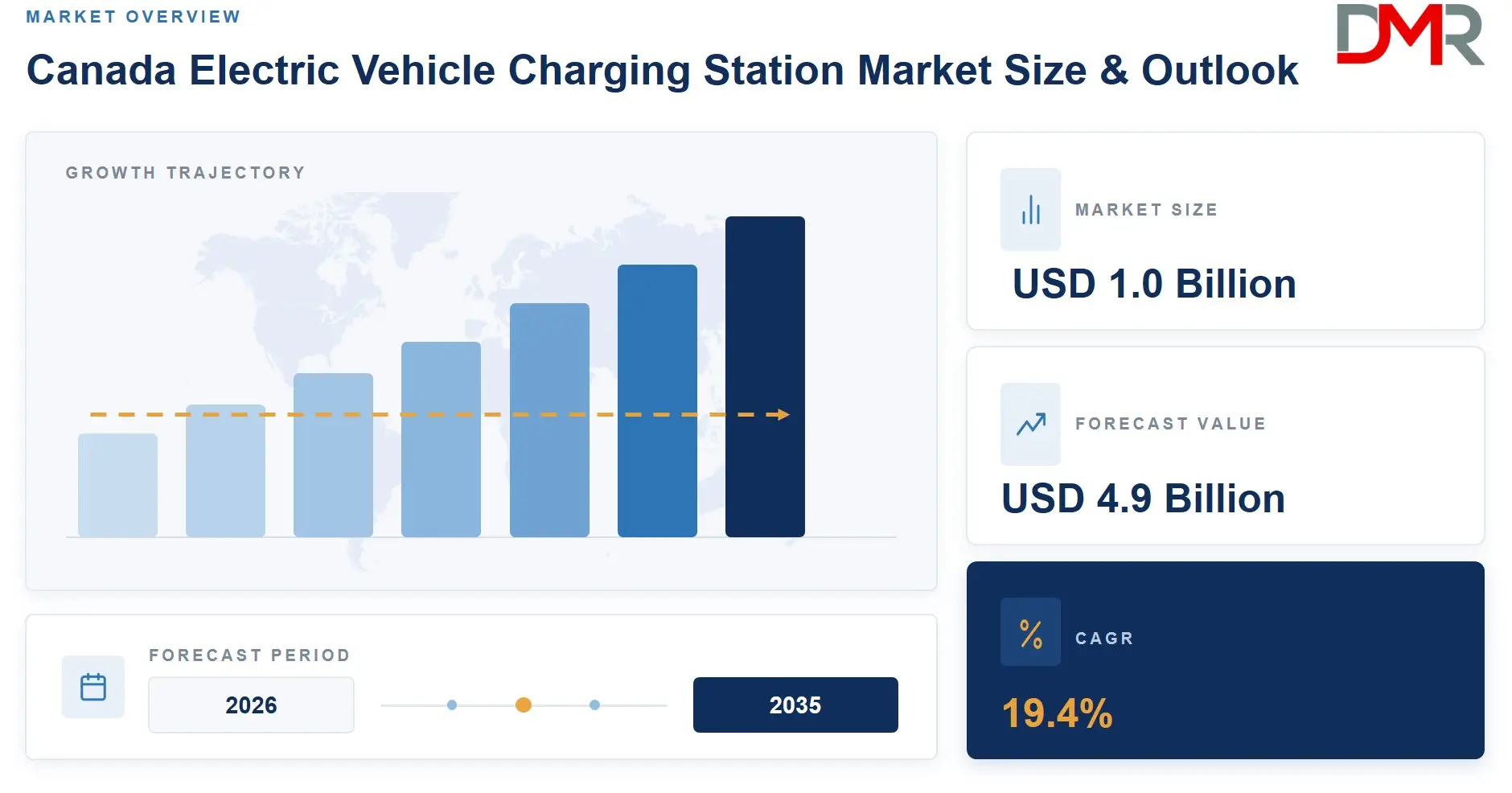
The Canada Electric Vehicle Charging Station Market size is estimated to reach USD 1.0 Bn in 2026 and is further anticipated to reach USD 4.9 Bn by 2035, at a CAGR of 19.4%.
ℹ
To learn more about this report –
Download Your Free Sample Report Here
Coverage spans the hardware, installation and network-operation revenue generated by public charging stations, workplace installations, home charging equipment and fleet or depot charging infrastructure located inside Canada. Included within this scope are Level 1 and Level 2 alternating current chargers, direct current fast chargers and ultra-fast high-power units rated above 150 kilowatts, along with the connector hardware, software platforms and installation labour tied to each deployment. These figures describe demand generated inside Canada; they exclude the worldwide revenue booked by charging equipment makers headquartered in the country, several of which sell most of their output abroad.
Buyers fall into four broad groups: municipal and provincial governments building out public corridors, retailers and property owners hosting destination or workplace chargers, utilities and independent network operators running the charging assets themselves, and homeowners or condominium boards installing residential units. Purchase decisions weigh upfront hardware and installation cost against expected utilization, grid connection capacity and, for public operators, the pace at which provincial rebate programs and federal contribution funding offset capital outlay.
Demand is shifting from a network-density phase, where the priority was closing highway coverage gaps, toward a utilization and reliability phase, where operators prioritize uptime, payment simplicity and faster charging speeds at existing sites. The rollout of the North American Charging Standard connector alongside the established Combined Charging System, growing fleet electrification among delivery and transit operators, and provincial zero-emission vehicle sales mandates are together reshaping where and how quickly new charging capacity gets built.
Use Cases
- Highway Corridor Fast Charging: Provincial transportation agencies and private network operators install DC fast and ultra-fast charging hubs along interprovincial highways, closing coverage gaps that previously discouraged long-distance electric vehicle trips and giving travelers predictable stopping points between major cities.
- Workplace Charging Programs: Employers add Level 2 charging bays to office and industrial parking lots, letting commuting staff charge during the workday and reducing reliance on home charging for employees living in multi-unit buildings without dedicated parking access.
- Municipal Fleet Depot Electrification: Transit agencies and municipal vehicle fleets install depot charging infrastructure sized to overnight bus and service-vehicle turnaround schedules, a segment where depot charging now accounts for close to 9% of installation demand nationally.
- Multi-Unit Residential Retrofits: Condominium boards and property managers retrofit shared parkades with metered Level 2 charging stalls, addressing a persistent gap for renters and condo owners who cannot install a dedicated home charger.
Key Takeaways
- Market Size & Share: The market is projected to grow from USD 1.0 Bn in 2026 to USD 4.9 Bn by 2035, expanding at a CAGR of 19.4%.
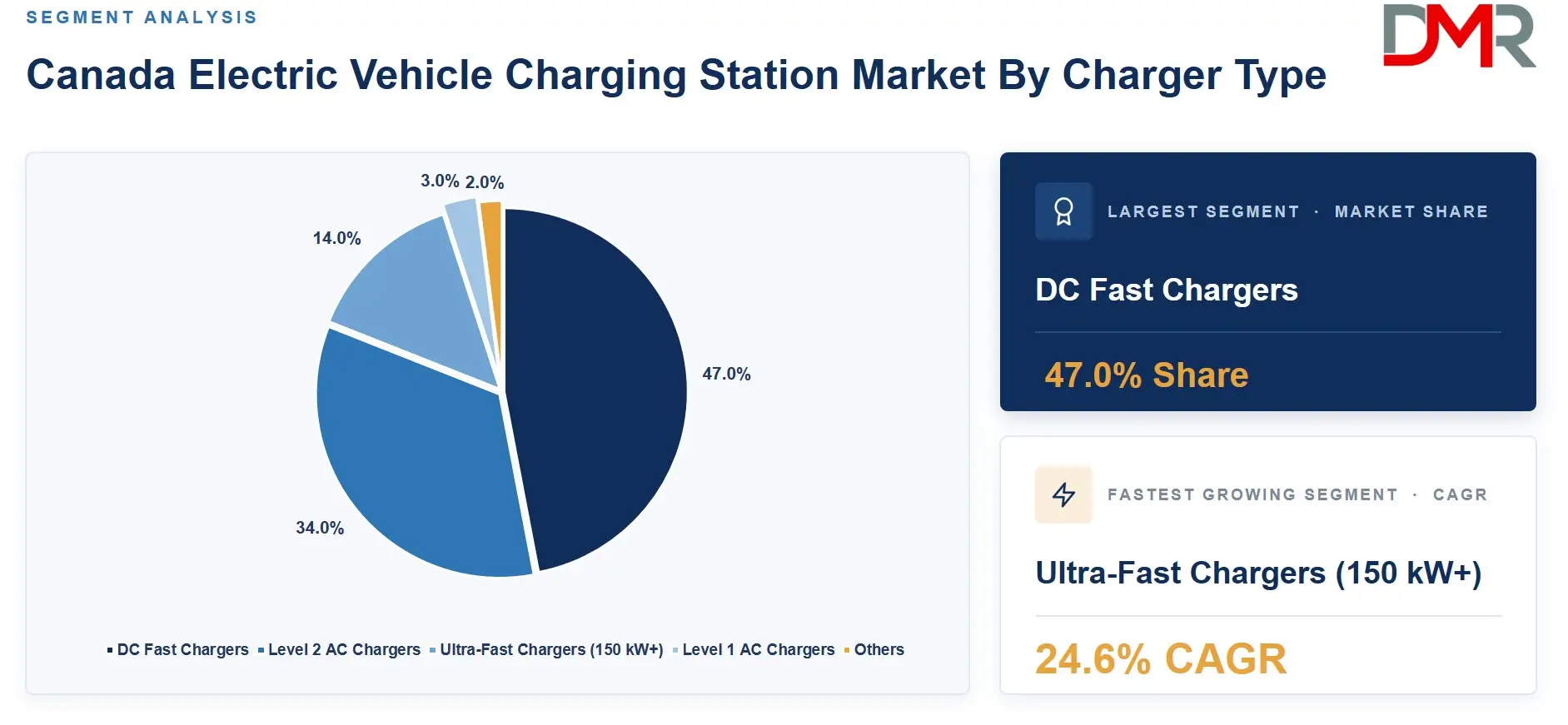
- Charger Type Analysis: DC fast chargers are expected to hold approximately 47% of 2026 revenue, while ultra-fast chargers rated above 150 kilowatts post the steepest growth at a CAGR of 24.6%.
- Demand Concentration: Ontario and Quebec together host the majority of installed public charging capacity, reflecting population density, provincial rebate programs and early utility-led network build-out.
- Installation Type Analysis: Public charging accounts for close to 52% of 2026 revenue, with fleet and depot installations growing fastest at a CAGR of 26.3%.
- Connector Standard Shift: The North American Charging Standard is on pace to grow at a CAGR of 29.8% through 2035 as automakers add native NACS ports and adapters proliferate.
- Policy Dependence: Federal contribution funding and provincial rebate programs remain a meaningful share of new public charger capital budgets, tying deployment pace to program renewal cycles.
How AI/Gen AI is Transforming the Canada Electric Vehicle Charging Station Market?
Artificial intelligence is entering the Canada Electric Vehicle Charging Station Market mainly through operational tools rather than headline generative applications. Network operators apply predictive analytics to forecast charger utilization by site and time of day, which shapes decisions on where to add stalls or upgrade power capacity ahead of demand rather than after congestion appears.
Computer vision and sensor fusion are also finding a role in site planning and asset monitoring, helping operators flag faulty connectors, vandalism or blocked stalls before a driver arrives to find a dead unit. Large language model tools are being adopted more slowly, mostly for customer support chat and for drafting the grid interconnection and permitting documentation that utilities require before a new site can be energized.
- Predictive Utilization Forecasting: Machine learning models analyze historical session data to anticipate peak charging windows, informing pricing and stall-expansion decisions at individual sites.
- Computer Vision Site Monitoring: Camera-based systems detect blocked bays, vandalism or connector faults, cutting the time a charger sits offline before a technician is dispatched.
- AI-Assisted Grid Interconnection Documentation: Large language model tools help network operators draft the load studies and permitting paperwork utilities require before energizing a new site.
- Dynamic Load Management: Algorithmic load balancing shares available power across multiple bays at a site, letting operators install more stalls without a full service upgrade.
Key Drivers in the Canada Electric Vehicle Charging Station Market
Demand for charging infrastructure across Canada is being pulled forward by two forces of a different kind: regulatory mandates that fix a compliance deadline, and a fleet economics shift that makes electrification cheaper to operate at scale.
- Provincial and Federal Zero-Emission Vehicle Mandates: Federal light-duty vehicle sales regulations require a rising share of new vehicles sold in Canada to be zero-emission by set model-year thresholds, and several provinces layer their own targets on top. Automakers responding to these mandates need a charging network dense enough to support the electric vehicles they are obligated to sell, which pushes utilities, fuel retailers and dedicated network operators to commit capital years ahead of the point where fleet turnover alone would justify it. The effect compounds provincially: Quebec and British Columbia pair mandate compliance with their own rebate programs, concentrating early build-out in the two provinces with the clearest regulatory backstop.
- Fleet Electrification Economics: Delivery fleets, transit agencies and last-mile logistics operators are converting depot vehicles to electric power because total cost of ownership, once fuel and maintenance savings are counted, now favours electric over diesel or gasoline for many duty cycles. Depot charging demand follows fleet purchase decisions directly, and because a single depot installation can require dozens of charging points sized to overnight turnaround, fleet conversions generate concentrated, predictable charger orders that installers can plan capacity around, unlike the more diffuse demand from individual public charging sessions.
Restraints in the Canada Electric Vehicle Charging Station Market
Two structural brakes slow the pace at which new charging capacity reaches the ground, and both sit upstream of any single project.
- Grid Interconnection and Utility Upgrade Delays: Many high-power public and depot charging sites require a local transformer or feeder upgrade before a utility will approve the connection, and interconnection queues in dense urban areas can push a project's energization date well past its planned opening. Rural and northern communities face a sharper version of the same constraint, where the nearest adequate grid capacity may sit a considerable distance from the intended charging site, adding cost that a smaller population base struggles to justify on utilization alone.
- Capital Cost and Utilization Risk in Early-Stage Corridors: A DC fast charging site carries meaningfully higher upfront hardware and installation cost than a comparable fuel retail investment, and outside the densest travel corridors, utilization can remain low for the first several years of operation. Operators sizing new sites must weigh that early revenue gap against contribution funding that rarely covers full project cost, which discourages investment in lower-traffic corridors even where longer-term demand is expected to justify the build.
Growth Opportunities in the Canada Electric Vehicle Charging Station Market
Two pockets of unmet demand stand out against an otherwise well-served national network.
- Multi-Unit Residential Retrofit Channel: A large share of Canadian condominium and apartment residents have no dedicated parking spot wired for home charging, and retrofitting shared parkades remains slower and costlier than new-build wiring. Companies that package metered charging hardware with the electrical and strata-approval process into a single retrofit offering are positioned to capture a channel that individual electricians and building managers have struggled to serve efficiently, particularly in older condominium stock in Toronto and Vancouver.
- Northern and Remote Community Charging Corridors: Communities along northern highway routes and in resource-sector regions currently sit outside the practical range of a single electric vehicle charge, which limits both tourism traffic and local fleet conversion. Federal remote and northern infrastructure funding streams are beginning to target these gaps specifically, and operators who secure early sites on routes such as the corridors linking northern British Columbia and the territories stand to hold a durable first-mover position once traffic volumes catch up to coverage.
Trends in the Canada Electric Vehicle Charging Station Market
Two shifts are visible in how charging capacity gets built and paid for, distinct from the drivers pulling overall demand.
- Connector Standardization Around NACS: Major automakers active in the Canadian market have committed to native North American Charging Standard ports on new vehicle models, and network operators are retrofitting or dual-equipping existing Combined Charging System sites rather than building single-standard stations, reshaping procurement specifications for new hardware orders.
- Utility-Led Network Ownership: Provincial utilities including Hydro-Quebec and Ontario-based operators are taking a direct ownership role in public fast-charging networks rather than leaving deployment entirely to private operators, a structural shift away from the retailer and fuel-station model that dominated the market's early years.
Research Scope and Analysis
Segment performance is examined across five axes: charger type, installation type, connector type, end use and power output. Each axis identifies the sub-segment holding the largest share of 2026 revenue and the one expanding fastest through 2035, along with the commercial reason behind each position.
ℹ
To learn more about this report –
Download Your Free Sample Report Here
By Charger Type
DC fast chargers are projected to hold the largest share by charger type in 2026, accounting for approximately 47% of revenue, since public and fleet operators favour direct current hardware capable of a meaningful charge within thirty to forty-five minutes rather than the multi-hour session a Level 2 unit requires. That speed advantage matters most on public corridors and at fleet depots, where a stall sitting idle for hours represents lost throughput. Growth, however, is concentrated in ultra-fast chargers rated above 150 kilowatts, expanding at a CAGR of 24.6% between 2026 and 2035 as newer electric vehicle models arrive with battery packs capable of accepting higher charge rates and operators upgrade flagship highway sites to capture travelers willing to pay a premium for the fastest available session.
By Installation Type
Public charging is expected to account for close to 52% of 2026 revenue, reflecting the scale of highway corridor and urban curbside build-out funded jointly by provincial rebate programs and federal contribution funding over the past several years. Workplace and residential installations trail behind because both depend on a slower, site-by-site private capital decision rather than a coordinated public procurement process. The steeper trajectory sits with fleet and depot charging, projected to grow at a CAGR of 26.3% as transit agencies and delivery fleets convert vehicles on a scale that requires dozens of charging points at a single depot rather than the incremental additions typical of public or workplace sites.
By Connector Type
CCS Combo 1 connectors are set to retain the largest 2026 share at approximately 51%, the legacy result of years spent as the default non-Tesla fast-charging standard across every major public network built in Canada to date. That installed base gives CCS durability even as newer hardware ships with alternative connectors. The fastest-growing segment is the North American Charging Standard, projected at a CAGR of 29.8% through 2035 as automakers add native NACS ports to new vehicle lineups and network operators retrofit existing stations with adapters or dual-connector cables to serve both standards from a single stall.
By End Use
Commercial and retail properties are projected to hold the largest 2026 share at around 33%, since shopping centres, hotels and quick-service retail locations offer the dwell time and existing parking infrastructure that make Level 2 and fast charging installations straightforward to site. Growth, however, is concentrated in fleet operators, expanding at a CAGR of 25.4% as logistics and transit fleets convert depots at a pace that outstrips the more gradual growth of individual commercial site additions.
By Power Output
Stations rated between 50 and 150 kilowatts are expected to hold the largest 2026 share at approximately 41%, a middle tier that balances charging speed against equipment and grid connection cost for the typical public or fleet site. The steeper trajectory sits with stations rated above 150 kilowatts, projected to grow at a CAGR of 27.6% as flagship highway corridor sites upgrade to serve the newest generation of high-capacity vehicle batteries.
The Canada Electric Vehicle Charging Station Market Report is Segmented Based on the Following
By Charger Type
- DC Fast Chargers
- Level 2 AC Chargers
- Ultra-Fast Chargers (150 kW+)
- Level 1 AC Chargers
- Others
By Installation Type
- Public Charging
- Workplace Charging
- Residential Charging
- Fleet and Depot Charging
- Others
By Connector Type
- CCS Combo 1
- North American Charging Standard (NACS)
- CHAdeMO
- J1772
- Others
By End Use
- Commercial and Retail
- Government and Municipal
- Fleet Operators
- Residential
- Others
By Power Output
- 50 to 150 kW
- Below 50 kW
- Above 150 kW
- Others
Regulatory Landscape
Canada's charging infrastructure sits under a layered regulatory regime: federal light-duty vehicle sales mandates set the demand-side timeline, while the Zero Emission Vehicle Infrastructure Program and provincial rebate schemes in Quebec, British Columbia and Ontario fund the supply side. Building codes are shifting too, with several provinces now requiring electrical rough-in for future charging capacity in new multi-unit residential construction. What is changing is a move from grant-by-grant funding toward standing eligibility criteria that let operators plan multi-year rollouts with more certainty. The commercial opening sits with operators able to navigate overlapping federal and provincial applications efficiently; the risk is that funding renewal delays stall projects already committed to a construction timeline.
Investment and White Space Analysis
Capital is flowing into Canada's charging network from three directions: provincial utilities deploying balance-sheet funding, private network operators raising equity and debt against future usage revenue, and federal contribution grants that co-fund a portion of eligible project cost. What is shifting is the entry of utility-scale investors willing to fund depot and highway corridor sites ahead of proven utilization, betting on fleet conversion volumes rather than current session counts. The clearest white space sits in secondary highway corridors and northern routes that remain underserved relative to the densely covered corridor linking Windsor and Quebec City. The risk is a widening gap between well-funded urban sites and thinly served rural regions, leaving parts of the charging map incomplete well into the next decade.
Competitive Landscape
The Canada Electric Vehicle Charging Station Market remains moderately fragmented, spanning global charging hardware manufacturers, Canadian pure-play network operators, provincial utilities and fuel retailers that have added charging bays to existing forecourts. Competition centres on network reliability, charging speed, payment simplicity and, increasingly, exclusive site access secured through long-term leases with highway rest stops, retail landlords and municipal parking authorities. Utilities hold a structural advantage in grid interconnection speed, since they can prioritize their own projects within their territory, while private operators compete on software, app experience and loyalty pricing to build session volume. Consolidation is beginning as smaller regional operators sell charging assets to better-capitalized national networks or utility-backed platforms seeking scale, a pattern likely to continue as utilization economics reward operators large enough to spread software and maintenance cost across a wide site portfolio.
Some of the Prominent Players in the Canada Electric Vehicle Charging Station Market Are
- ChargePoint
- Tesla Supercharger Network
- ABB E-mobility
- Siemens eMobility
- Schneider Electric
- Blink Charging
- Shell Recharge Solutions
- BP Pulse
- Kempower
- Delta Electronics
- Electrify Canada
- Enel X Way
- EV Connect
- FreeWire Technologies
- Autel Energy
- EVBox
- ADS-TEC Energy
- Tritium
- Alpitronic
- Wallbox
- Webasto Charging Systems
- Power Electronics S.L.
- Eaton EV Charging Solutions
- Heliox
- FLO (AddEnergie Technologies)
- SWTCH Energy
- ChargeLab
- eCAMION
- Sun Country Highway
- Ivy Charging Network
- Hydro-Quebec (Circuit electrique)
- BC Hydro
- ATCO Electric
- EPCOR
- Toronto Hydro
- Alectra Utilities
- Ontario Power Generation
- SaskPower
- Petro-Canada (Suncor Energy)
- Parkland Corporation
- Other Key Players
Recent Developments
- In May 2026, Ivy Charging Network added a cluster of high-power fast-charging hubs along the Highway 401 corridor in Ontario, extending its network beyond its original Greater Toronto Area rollout.
- In February 2026, FLO expanded a manufacturing line at its Quebec facility to meet rising demand for Level 2 home and workplace chargers across Canada.
- In September 2025, Petro-Canada added DC fast-charging bays to further highway locations as part of its coast-to-coast network build-out.
- In April 2025, Hydro-Quebec's Circuit electrique network passed a new milestone in public charging point count across the province.
- In November 2024, Natural Resources Canada allocated further Zero Emission Vehicle Infrastructure Program funding toward charger deployment in multi-unit residential buildings and rural communities.
- In June 2024, Tesla began opening a portion of its Canadian Supercharger network to non-Tesla vehicles fitted with NACS adapters.
Report Details
| Report Characteristics |
| Market Size (2026) |
USD 1.0 Bn |
| Forecast Value (2035) |
USD 4.9 Bn |
| CAGR (2026-2035) |
19.4% |
| Historical Data |
2021 - 2025 |
| Forecast Data |
2026 - 2035 |
| Base Year |
2025 |
| Segments Covered |
By Charger Type, By Installation Type, By Connector Type, By End Use and By Power Output |
| Regional Coverage |
Canada |
Frequently Asked Questions
How big is the Canada Electric Vehicle Charging Station Market?
▾ The Canada Electric Vehicle Charging Station Market is estimated at USD 1.0 Bn in 2026 and is projected to reach USD 4.9 Bn by 2035, growing at a CAGR of 19.4% across the forecast period as public, workplace, residential and fleet charging capacity expands nationwide.
What is the growth rate of the Canada Electric Vehicle Charging Station Market?
▾ The market is projected to expand at a CAGR of 19.4% between 2026 and 2035, driven by zero-emission vehicle sales mandates, fleet electrification and continued federal and provincial funding for public and depot charging infrastructure.
What is driving demand in the Canada Electric Vehicle Charging Station Market?
▾ Demand is driven primarily by federal and provincial zero-emission vehicle mandates, which obligate automakers to sell a rising share of electric models and, in turn, push utilities and network operators to build out charging capacity ahead of fleet turnover, alongside fleet electrification economics that make depot conversion increasingly cost-favourable.
Who are the key players in the Canada Electric Vehicle Charging Station Market?
▾ Key players include FLO, ChargePoint, Petro-Canada, Tesla Supercharger Network, Ivy Charging Network, Hydro-Quebec's Circuit electrique, Electrify Canada and BC Hydro, alongside global hardware manufacturers and provincial utilities operating public and depot charging networks.
Which charger type holds the largest share in the Canada Electric Vehicle Charging Station Market?
▾ DC fast chargers hold the largest share, accounting for approximately 47% of 2026 revenue, reflecting operator preference for hardware that delivers a meaningful charge within thirty to forty-five minutes on public corridors and at fleet depots.
Which installation type is growing fastest in the Canada Electric Vehicle Charging Station Market?
▾ Fleet and depot charging is the fastest-growing installation type, projected to expand at a CAGR of 26.3% through 2035 as transit agencies and delivery fleets convert depot vehicles on a scale that requires dozens of charging points per site.
What role does the North American Charging Standard play in the Canada Electric Vehicle Charging Station Market?
▾ The North American Charging Standard is the fastest-growing connector segment, projected at a CAGR of 29.8% through 2035, as automakers add native NACS ports and network operators retrofit existing CCS Combo 1 sites with adapters or dual-connector cables to serve both standards.