Canada Food Processing Equipment Market Snapshot
- Canada Food Processing Equipment Market Size in 2026: USD 4.36 Billion
- Canada Food Processing Equipment Market Size in 2035: USD 7.71 Billion
- Canada CAGR from 2026 to 2035: 6.5%
- Processing Equipment is the leading equipment type segment in 2026: 42.1%
- Automatic is the leading mode of operation segment in 2026: 54.7%
- Meat, Poultry and Seafood is the leading food category segment in 2026: 26.3%
- Large-Scale Food Processors is the leading end user segment in 2026: 58.4%
What is the Canada Food Processing Equipment Market and its Market Size?
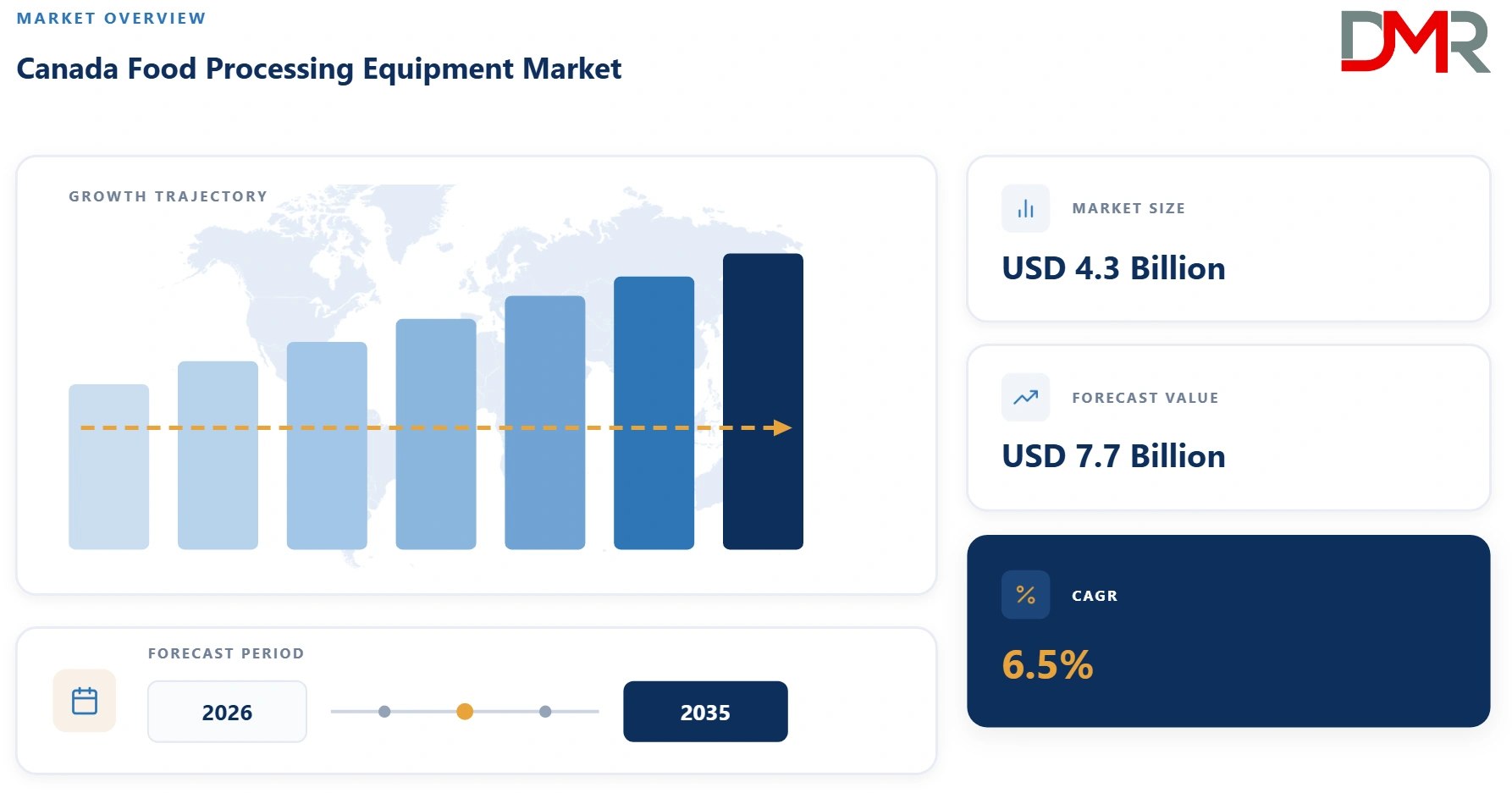
The Canada Food Processing Equipment Market is projected to be valued at USD 4.36 Billion in 2026 and is projected to reach USD 7.71 Billion by 2035, expanding at a CAGR of 6.5% during the forecast period.
ℹ
To learn more about this report –
Download Your Free Sample Report Here
Growth is being propelled by persistent labor shortages across the Canadian food manufacturing sector that are pushing processors toward automated and semi-automated equipment, sustained investment in modernizing aging processing infrastructure across the meat, dairy, and grain milling industries, and growing export-oriented capacity expansion among Canadian food processors seeking to serve U.S. and international markets. The maturing of hygienic, washdown-compatible automated equipment suited to Canada's stringent food safety regulatory environment, growing processor investment in energy-efficient equipment to manage rising utility costs, and expanding vendor capability to retrofit automation into legacy processing facilities are reshaping the market from largely manual, equipment-replacement-driven purchasing into a more strategic, efficiency- and compliance-oriented capital investment category. Investment is accelerating as processors balance equipment modernization needs against capital cost pressures and navigate Canada's evolving food safety and traceability regulatory requirements.
Use Cases
- Automated Meat and Poultry Processing Line Modernization: Meat and poultry processors invest in automated cutting, deboning, and portioning equipment to address persistent labor shortages in physically demanding processing roles while improving yield consistency and food safety outcomes.
- Dairy Processing Equipment Upgrades for Capacity Expansion: Dairy processors invest in modernized pasteurization, homogenization, and packaging equipment to expand production capacity and meet growing demand for value-added dairy products, including specialty cheeses and plant-based dairy alternatives.
- Grain Milling and Processing Equipment for Export-Oriented Capacity: Grain processors and millers invest in modernized milling, sorting, and packaging equipment to expand processing capacity serving both domestic demand and growing export markets for Canadian grain and pulse products.
- Hygienic Equipment Retrofits for Food Safety Compliance: Food processors across categories invest in washdown-compatible, easy-to-clean equipment designs to meet Canadian Food Inspection Agency sanitation requirements and reduce contamination risk associated with harder-to-clean legacy equipment.
Key Takeaways
- Market Size: The Canada Food Processing Equipment Market is anticipated to be valued at USD 4.36 Billion in 2026 and is forecast to reach USD 7.71 Billion by 2035, expanding at a CAGR of 6.5%.
- Growth Outlook: Market expansion is sustained by persistent food manufacturing labor shortages driving automation investment, continued modernization of aging processing infrastructure, and growing export-oriented capacity expansion among Canadian food processors.
- Primary Growth Drivers: Worsening food processing labor availability, rising wage and energy costs, growing export demand for Canadian meat, grain, and dairy products, and tightening food safety and sanitation regulatory requirements are accelerating equipment modernization and automation investment.
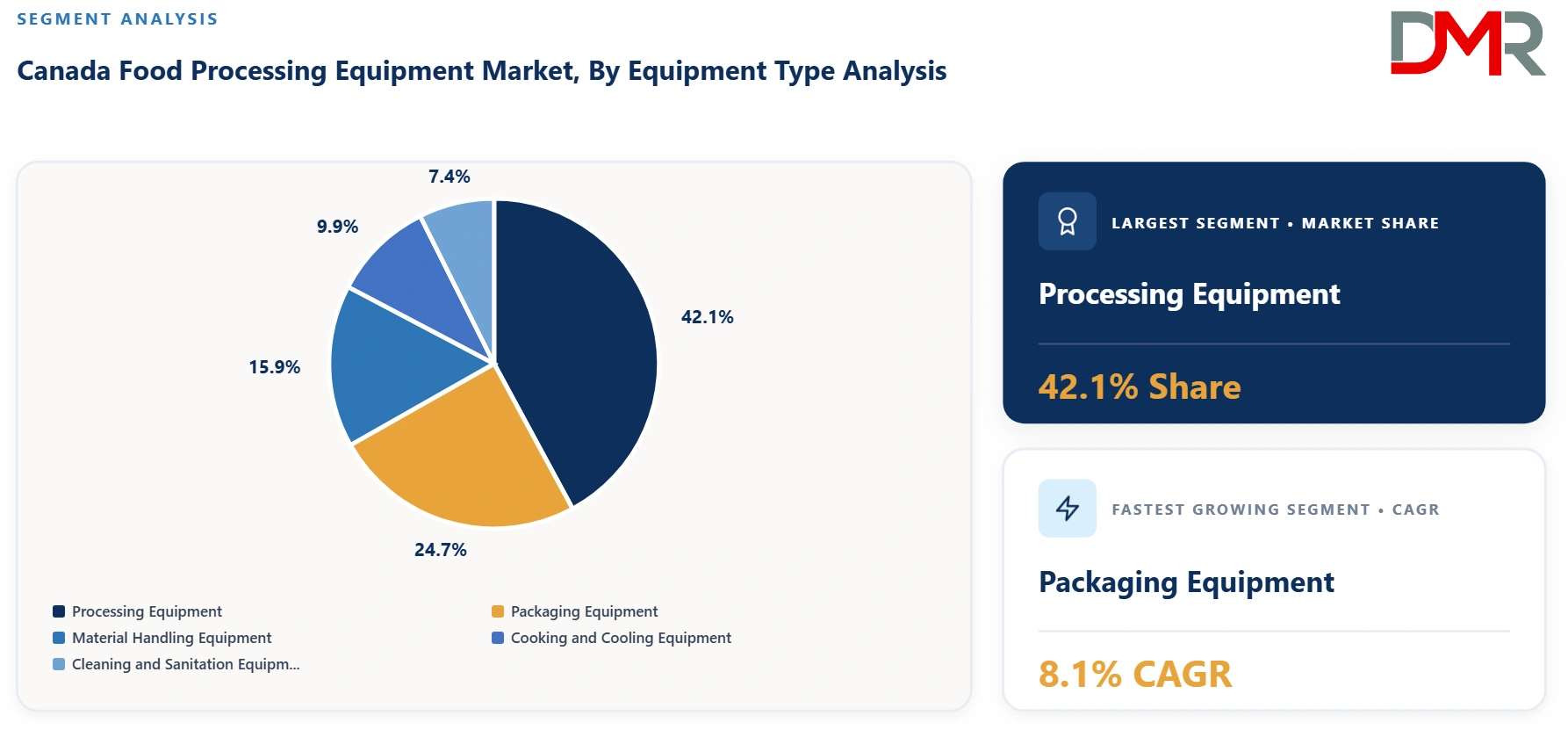
- By Equipment Type Analysis: Processing Equipment is projected to lead the equipment type segment with a 42.1% share in 2026, reflecting its central role across cutting, mixing, forming, and portioning operations. Packaging Equipment is the fastest-growing equipment type segment at 8.1% CAGR, driven by rising demand for automated, flexible packaging lines supporting both retail and export product formats.
- By Mode of Operation Analysis: Automatic equipment is expected to dominate with a 54.7% share in 2026, supported by processor investment in labor-reducing automation. Automatic is also the fastest-growing mode of operation segment at 8.6% CAGR, as declining automation costs and worsening labor availability continue to favor higher levels of automation across processing facilities.
- By Food Category Analysis: Meat, Poultry and Seafood is expected to command a 26.3% share in 2026, underpinned by significant processing complexity and strong automation return-on-investment potential. Grain Milling and Processing is the fastest-growing food category segment at 7.9% CAGR, driven by expanding export-oriented processing capacity investment.
- By End User Analysis: Large-Scale Food Processors are projected to dominate with a 58.4% share in 2026, reflecting greater capital availability for equipment modernization and automation investment. Small and Medium-Sized Processors is the fastest-growing end user segment at 8.3% CAGR, driven by falling automation equipment costs and growing availability of flexible financing options.
Key Drivers in the Canada Food Processing Equipment Market
Persistent Labor Shortages Across the Canadian Food Manufacturing Sector
Chronic difficulty recruiting and retaining plant-floor labor across Canada's food manufacturing sector is a primary driver of growth in the Food Processing Equipment Market. Physically demanding processing roles, particularly in meat and poultry processing, face persistent turnover and recruitment challenges, compounded by broader competition for manufacturing labor and immigration policy constraints affecting temporary foreign worker availability in some processing regions. Rising wage costs further increase the financial case for automating repetitive, injury-prone tasks. As labor availability constraints persist, food processors are increasingly treating automation equipment investment as an operational necessity rather than a discretionary efficiency upgrade.
Growing Export-Oriented Capacity Expansion Among Canadian Food Processors
Sustained international demand for Canadian meat, grain, pulse, and dairy products is driving processors to invest in modernized, higher-capacity processing equipment capable of meeting both volume and quality standards required for export markets, particularly the United States and growing Asia-Pacific demand. Export market access often requires processors to meet specific international food safety certification and equipment standards, further reinforcing the business case for equipment modernization investment among processors seeking to expand or maintain export market participation.
Restraints in the Canada Food Processing Equipment Market
High Capital Costs and Return-on-Investment Uncertainty for Smaller Processors
Significant upfront capital investment required for modern automated processing equipment represents a meaningful restraint on the Canada Food Processing Equipment Market, particularly for small and mid-sized processors operating with more constrained capital budgets and less certain production volume growth. Smaller processors must carefully weigh equipment investment against uncertain demand growth and financing costs, and may face longer payback periods relative to large-scale processors able to spread equipment costs across greater production volumes, slowing automation adoption pace among this segment relative to larger, better-capitalized competitors.
Growth Opportunities in the Canada Food Processing Equipment Market
Flexible Financing and Equipment-as-a-Service Models for Smaller Processors
Growing interest among small and mid-sized food processors in accessing modern processing equipment without large upfront capital outlays presents a significant opportunity for equipment vendors offering leasing, financing, and equipment-as-a-service commercial models. These flexible arrangements can lower adoption barriers for resource-constrained processors, expanding the addressable market for equipment vendors beyond large, well-capitalized processors and supporting longer-term, recurring vendor-client relationships.
Energy-Efficient Equipment for Rising Utility Cost Management
Rising industrial energy costs across several Canadian provinces present an opportunity for equipment vendors offering energy-efficient processing, refrigeration, and cleaning equipment capable of meaningfully reducing processor operating costs. Vendors demonstrating clear energy savings and faster payback periods through efficient equipment design are well positioned to capture equipment replacement and modernization contracts, particularly among processors facing sustained energy cost pressure in provinces with higher industrial electricity rates.
Trends in the Canada Food Processing Equipment Market
Growing Integration of Automation Equipment with Plant-Wide Data Systems
Canadian food processors are increasingly moving away from standalone equipment purchases toward integrated automation and data platform investments that connect processing, packaging, and quality control equipment into unified plant-wide monitoring and analytics systems. This convergence allows processors to move beyond individual equipment automation toward holistic production optimization, predictive maintenance, and improved food safety documentation, increasing the strategic value of equipment investment beyond throughput improvement alone.
Rising Adoption of Hygienic, Washdown-Compatible Equipment Design
Growing regulatory and buyer emphasis on food safety and sanitation is driving processor preference for equipment specifically engineered for easy cleaning and washdown compatibility, reducing contamination risk and simplifying compliance with Canadian Food Inspection Agency sanitation requirements. Equipment manufacturers are increasingly designing products with hygienic material choices, simplified disassembly for cleaning, and reduced bacterial harborage points, reflecting the food safety-driven nature of much of the market's equipment replacement and modernization activity.
Research Scope and Analysis
The Canada Food Processing Equipment Market is segmented by equipment type, mode of operation, food category, and end user, covering processing, packaging, material handling, cooking and cooling, and cleaning and sanitation equipment across dairy, meat, bakery, beverage, and grain processing categories.
ℹ
To learn more about this report –
Download Your Free Sample Report Here
By Equipment Type Analysis
Processing Equipment is projected to dominate the Canada Food Processing Equipment Market with approximately 42.1% share in 2026, reflecting its central role across cutting, mixing, forming, portioning, and other core production operations spanning nearly all food categories. Packaging Equipment is expected to register the highest CAGR of 8.1% during 2026-2035, driven by rising processor investment in automated, flexible packaging lines capable of supporting both domestic retail and growing export product format requirements.
By Mode of Operation Analysis
Automatic equipment is anticipated to dominate the Canada Food Processing Equipment Market by mode of operation, accounting for approximately 54.7% share in 2026, supported by sustained processor investment in labor-reducing, throughput-improving automated systems. Automatic equipment is also projected to register the highest CAGR of 8.6% between 2026 and 2035, as declining automation technology costs and worsening food manufacturing labor availability continue to favor higher levels of automation across both large and mid-sized processing facilities.
By Food Category Analysis
Meat, Poultry and Seafood is expected to lead the Canada Food Processing Equipment Market by food category, accounting for approximately 26.3% share in 2026, underpinned by significant processing complexity and strong automation return-on-investment potential given labor-intensive cutting and portioning requirements. Grain Milling and Processing is projected to achieve the fastest CAGR of 7.9% during 2026-2035, driven by expanding export-oriented processing capacity investment supporting Canada's significant grain and pulse export industry.
By End User Analysis
Large-Scale Food Processors are projected to dominate the Canada Food Processing Equipment Market with approximately 58.4% share in 2026, reflecting greater capital availability for comprehensive equipment modernization and automation investment programs. Small and Medium-Sized Processors are expected to register the fastest CAGR of 8.3% through 2035, driven by falling automation equipment costs and growing availability of flexible financing and equipment-as-a-service commercial models.
The Canada Food Processing Equipment Market Report is segmented based on the following:
By Equipment Type
- Processing Equipment
- Packaging Equipment
- Material Handling Equipment
- Cooking and Cooling Equipment
- Cleaning and Sanitation Equipment
By Mode of Operation
- Automatic
- Semi-Automatic
- Manual
By Food Category
- Dairy Products
- Meat, Poultry and Seafood
- Bakery and Confectionery
- Beverages
- Fruits and Vegetables
- Grain Milling and Processing
- Others
By End User
- Large-Scale Food Processors
- Small and Medium-Sized Processors
- Artisanal and Specialty Food Producers
Technology Analysis
Technology development is increasingly shaping competitiveness in the Canada Food Processing Equipment Market as vendors invest in AI-enhanced process control, predictive maintenance analytics, and hygienic equipment design suited to Canada's stringent food safety regulatory environment. Growing integration of sensors and connected equipment is enabling processors to monitor equipment performance and product quality in real time, reducing unplanned downtime and improving traceability documentation. Opportunities are expanding for vendors developing energy-efficient equipment suited to managing rising industrial utility costs, retrofit-friendly automation solutions for legacy processing facilities, and equipment capable of handling the variability inherent in processing fresh meat, produce, and other natural food products. However, achieving reliable performance while maintaining food-grade sanitation compatibility and managing the retrofit complexity of older Canadian processing facilities remain persistent technical challenges.
Investment and White Space Analysis
Investment opportunities in the Canada Food Processing Equipment Market are expanding alongside persistent labor shortages, growing export-oriented processing capacity expansion, and continued modernization of aging processing infrastructure across the meat, dairy, and grain processing industries. Significant white space exists in flexible financing and equipment-as-a-service models for small and mid-sized processors, energy-efficient equipment addressing rising utility costs, and hygienic, washdown-compatible equipment designs meeting evolving food safety requirements. Vendors with strong retrofit capability, energy efficiency credentials, and flexible commercial financing models are positioned to capture premium, longer-duration contracts across a broader base of processor sizes. However, high upfront capital costs, return-on-investment uncertainty for smaller processors, and retrofit complexity in legacy facilities can constrain adoption pace, particularly among smaller, capital-constrained processors.
Competitive Landscape
The Canada Food Processing Equipment Market is moderately consolidated and increasingly competitive, comprising large diversified global food processing equipment manufacturers, specialty Canadian equipment suppliers, and international automation and robotics companies serving the food processing sector. Competition centers on food-grade equipment design and sanitation compliance, energy efficiency, integration capability with existing plant infrastructure, and breadth of after-sales service and technical support offered alongside equipment sales. Large diversified equipment manufacturers benefit from broad product portfolios and established processor relationships, while specialty and domestic suppliers compete on category-specific expertise and closer, more responsive client service relationships. Companies increasingly differentiate through flexible financing models, energy-efficient equipment design, and integrated automation and data platform offerings rather than equipment sales alone.
Some of the prominent players in the Canada Food Processing Equipment Market are:
- JBT Marel
- GEA Group
- Bühler Group
- Tetra Pak
- Alfa Laval
- The Middleby Corporation
- Krones AG
- SPX FLOW
- BAADER Group
- Heat and Control
- Provisur Technologies
- Bucher Industries
- MULTIVAC Group
- Duravant
- Urschel Laboratories
- FAM STUMABO
- Handtmann Group
- Weber Food Technology
- Risco S.p.A.
- Bettcher Industries
- Reiser
- Grote Company
- Foodmate
- TNA Solutions
- Fenco Food Machinery
- Clextral
- Cabinplant
- Sormac
- Kronen GmbH
- TREIF Maschinenbau
- Vemag Maschinenbau
- Seydelmann
- Stephan Machinery
- Mepaco
- Lyco Manufacturing
- Hughes Equipment Company
- Vanmark Equipment
- Pemberton & Associates
- Deville Technologies
- Unisource Food Equipment Systems
- Other Key Players
Recent Developments
- May 2026: Bühler launched its Nutrex 7 Series extrusion systems, featuring enhanced hygiene, digital integration, reduced cleaning times, and higher operating efficiency for food and feed processing applications.
- September 2025: GEA introduced the GSI 260 separator skid for beverage processing, designed to improve product yield while lowering freshwater and energy consumption and simplifying integration into existing production facilities.
- January 2025: JBT completed its acquisition of Marel, combining complementary food-processing equipment portfolios across meat, poultry, seafood, prepared foods, beverages, and other applications, strengthening its offering to North American processors.
- January 2025: Tetra Pak expanded its homogenization equipment portfolio with the Homogenizer 15C and Homogenizer 20C, offering a compact two-stage homogenization process and energy savings of up to 25%.
Report Details
| Report Characteristics |
| Market Size (2026) |
USD 4.3 Bn |
| Forecast Value (2035) |
USD 7.7 Bn |
| CAGR (2026–2035) |
6.5% |
| Historical Data |
2021 – 2025 |
| Forecast Data |
2026 – 2035 |
| Base Year |
2025 |
| Segments Covered |
By Equipment Type, By Mode of Operation, By Food Category, and By End User |
| Country Coverage |
Canada |
Frequently Asked Questions
How big is the Canada Food Processing Equipment Market?
▾ The Canada Food Processing Equipment Market is valued at USD 4.36 Billion in 2026 and is projected to reach USD 7.71 Billion by 2035, reflecting sustained investment in automated and modernized processing equipment across the Canadian food manufacturing industry.
What is the CAGR of the Canada Food Processing Equipment Market from 2026 to 2035?
▾ The market is projected to expand at a compound annual growth rate (CAGR) of 6.5% between 2026 and 2035, supported by persistent labor shortages, growing export-oriented processing capacity expansion, and continued infrastructure modernization.
What factors are driving the growth of the Canada Food Processing Equipment Market?
▾ Growth is driven by worsening food processing labor availability, rising wage and energy costs, growing export demand for Canadian meat, grain, and dairy products, and tightening food safety and sanitation regulatory requirements.
What are the major trends in the Canada Food Processing Equipment Market?
▾ Major trends include growing integration of automation equipment with plant-wide data systems, rising adoption of hygienic, washdown-compatible equipment design, and expanding investment in energy-efficient equipment to manage rising industrial utility costs.
Who are the key players in the Canada Food Processing Equipment Market?
▾ Key market participants include GEA Group, Bühler Group, JBT Corporation, Marel, and Tetra Pak, among other diversified global and specialty Canadian food processing equipment manufacturers.
How is the Canada Food Processing Equipment Market segmented?
▾ The market is segmented by equipment type, mode of operation, food category, and end user, with demand analysis concentrated across Ontario, Quebec, Alberta, and the Prairie provinces.