Canada Food Safety Testing Market Snapshot
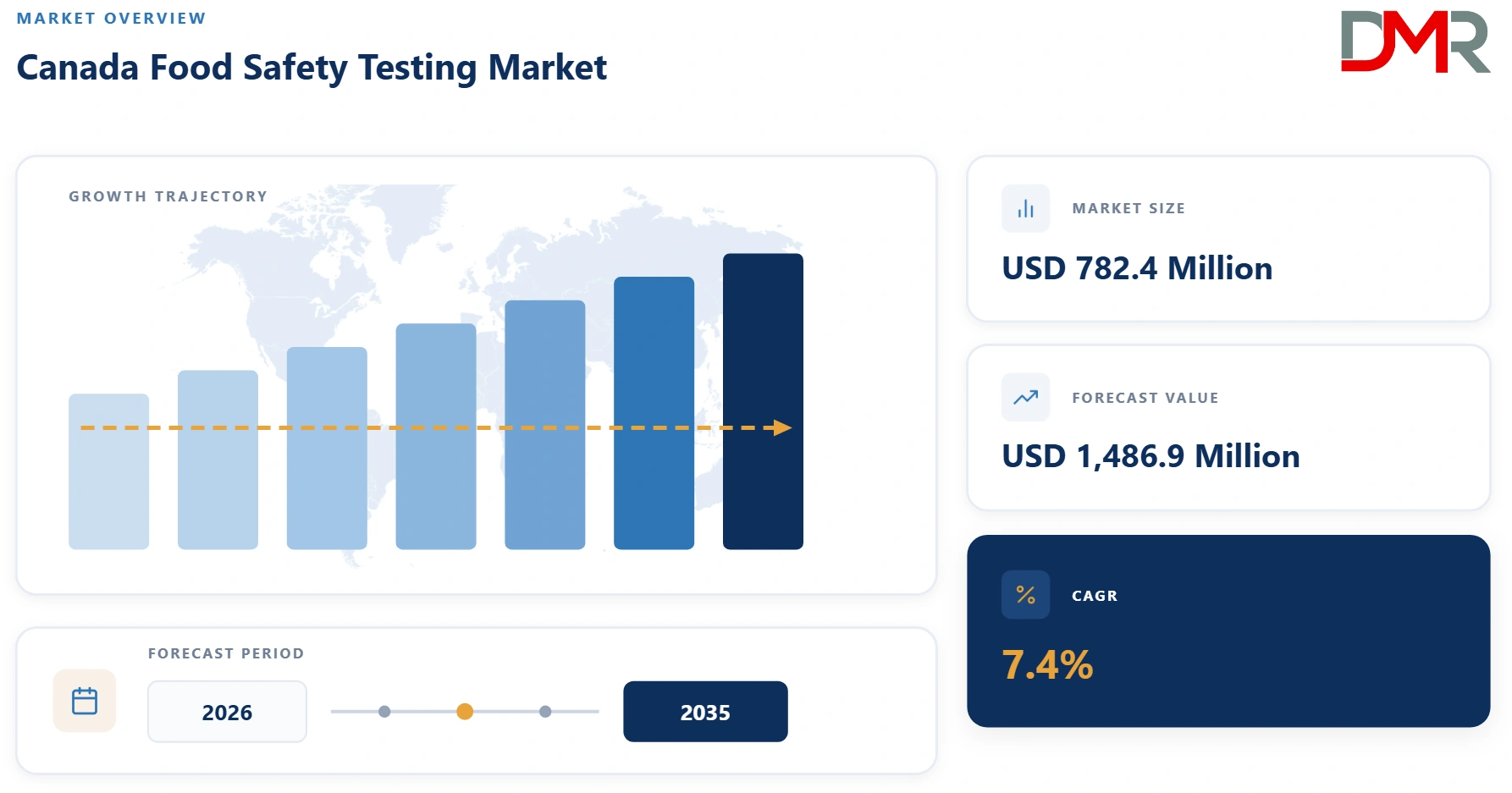
- Canada Food Safety Testing Market Size in 2026: USD 782.4 Million
- Canada Food Safety Testing Market Size in 2035: USD 1,486.9 Million
- Canada CAGR from 2026 to 2035: 7.4%
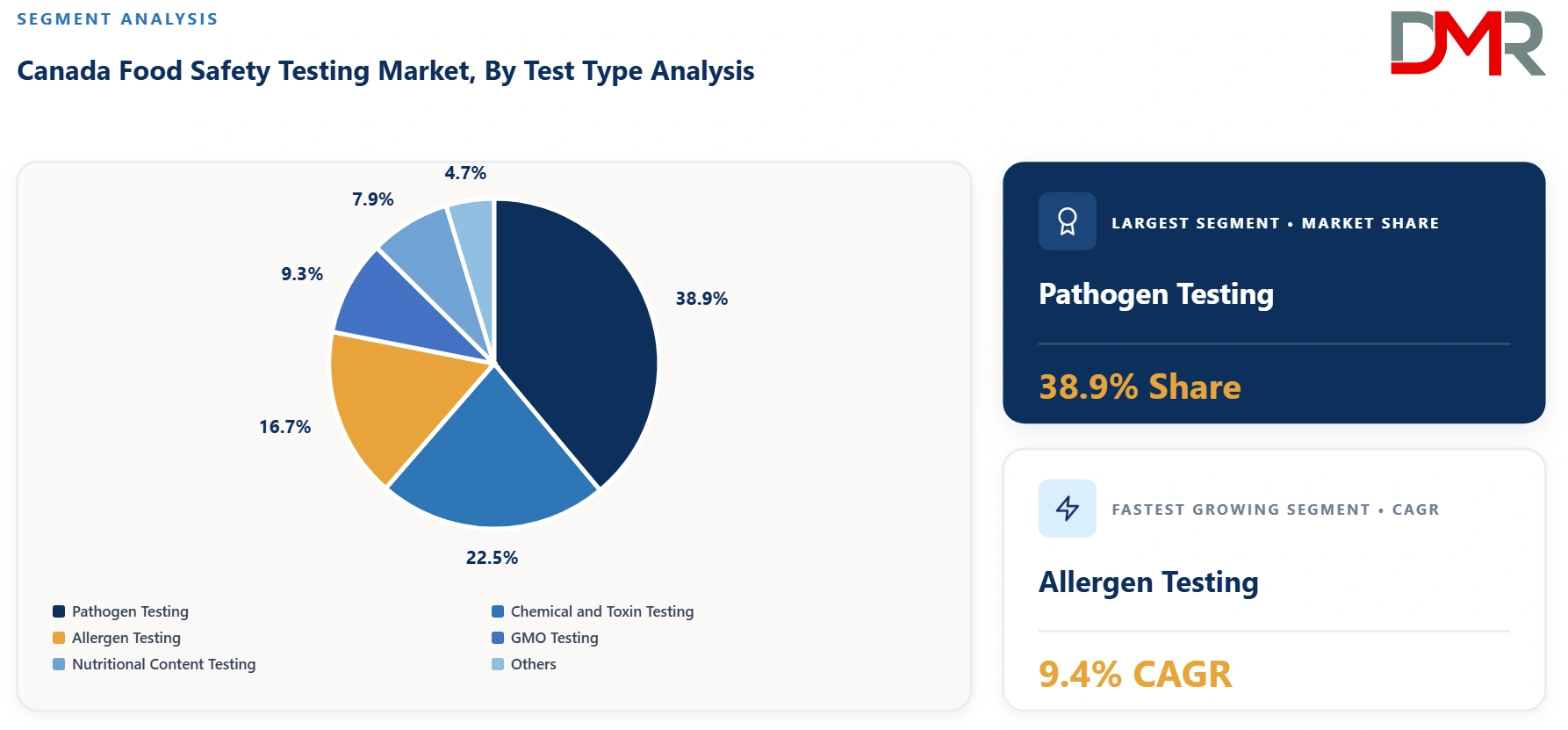
- Pathogen Testing is the leading test type segment in 2026: 38.9%
- Rapid Testing Technologies is the leading technology segment in 2026: 56.2%
- Meat, Poultry and Seafood is the leading food category segment in 2026: 29.6%
- Third-Party/Outsourced Testing Laboratories is the leading service provider segment in 2026: 61.8%
What is the Canada Food Safety Testing Market and its Market Size?
The Canada Food Safety Testing Market is projected to be valued at USD 782.4 Million in 2026 and is projected to reach USD 1,486.9 Million by 2035, expanding at a CAGR of 7.4% during the forecast period.
ℹ
To learn more about this report –
Download Your Free Sample Report Here
Growth is being propelled by the Canadian Food Inspection Agency's continued enforcement of the Safe Food for Canadians Regulations, which impose comprehensive preventive control and testing obligations across the food supply chain, sustained consumer and retailer demand for allergen and contaminant transparency, and rising food import volumes that require verification testing to meet Canadian safety and labeling standards. The maturing of rapid, molecular-based pathogen and allergen detection technologies capable of delivering results in hours rather than days, growing retailer-mandated supplier testing requirements that exceed baseline regulatory minimums, and expanding laboratory network capacity to serve a widely dispersed national food production base are reshaping food safety testing from a periodic, compliance-driven activity into a more continuous, technology-enabled quality assurance function. Investment is accelerating as testing laboratories expand rapid-method capacity and food manufacturers increasingly integrate testing data into broader traceability and quality management systems.
Use Cases
- Pathogen Testing for Meat and Poultry Processing Compliance: Meat and poultry processors conduct routine pathogen testing for Salmonella, E. coli, and Listeria as part of mandatory preventive control plans required under the Safe Food for Canadians Regulations, verifying processing controls are effectively managing contamination risk.
- Allergen Testing for Packaged Food Labeling Verification: Packaged food manufacturers use allergen testing to verify accurate labeling and detect potential cross-contamination from shared production lines, reducing recall risk associated with undeclared allergens, a leading cause of Canadian food recalls.
- Import Verification Testing for Food Safety and Labeling Compliance: Food importers and distributors commission testing to verify that imported food products meet Canadian contaminant, additive, and labeling standards before distribution, particularly for products sourced from regions with differing regulatory requirements.
- Nutritional Content and GMO Testing for Retailer Private Label Verification: Retailers commission nutritional content and GMO testing for private label products to verify label accuracy and support non-GMO or specific dietary claim marketing, ensuring compliance with Canadian food labeling requirements.
Key Takeaways
- Market Size: The Canada Food Safety Testing Market is anticipated to be valued at USD 782.4 Million in 2026 and is forecast to reach USD 1,486.9 Million by 2035, expanding at a CAGR of 7.4%.
- Growth Outlook: Market expansion is sustained by continued Safe Food for Canadians Regulations enforcement, growing retailer-mandated supplier testing requirements, and rising demand for rapid, molecular-based testing technologies that reduce time-to-result across the food supply chain.
- Primary Growth Drivers: Comprehensive federal preventive control and testing obligations under the Safe Food for Canadians Regulations, rising food import volumes requiring verification testing, growing consumer demand for allergen and contaminant transparency, and maturing rapid testing technology are accelerating market growth.
- By Test Type Analysis: Pathogen Testing is projected to lead the test type segment with a 38.9% share in 2026, reflecting its central role in meat, poultry, and ready-to-eat food safety compliance. Allergen Testing is the fastest-growing test type segment at 9.4% CAGR, driven by rising recall risk associated with undeclared allergens and growing retailer verification requirements.
- By Technology Analysis: Rapid Testing Technologies is expected to dominate with a 56.2% share in 2026, supported by growing preference for faster time-to-result over traditional culture-based methods. Rapid Testing Technologies is also the fastest-growing technology segment at 9.1% CAGR, as PCR, ELISA, and biosensor-based methods continue displacing slower traditional testing approaches.
- By Food Category Analysis: Meat, Poultry and Seafood is expected to command a 29.6% share in 2026, underpinned by stringent mandatory pathogen testing requirements. Processed Foods is the fastest-growing food category segment at 8.7% CAGR, driven by rising allergen and ingredient verification testing across an expanding range of packaged and prepared food products.
- By Service Provider Analysis: Third-Party/Outsourced Testing Laboratories are projected to dominate with a 61.8% share in 2026, reflecting food manufacturers' preference for accredited, specialized external testing capability. Third-Party/Outsourced Testing Laboratories is also the fastest-growing service provider segment at 8.5% CAGR, as smaller and mid-sized processors increasingly rely on outsourced testing rather than building in-house laboratory capability.
Key Drivers in the Canada Food Safety Testing Market
Comprehensive Enforcement of the Safe Food for Canadians Regulations
The Canadian Food Inspection Agency's continued enforcement of the Safe Food for Canadians Regulations, which require most food businesses to maintain written preventive control plans, traceability systems, and, for many products, licensing, is a central driver of growth in the Food Safety Testing Market. These regulations obligate food businesses to demonstrate, often through documented testing, that their processes effectively control identified food safety hazards. As enforcement activity and inspection frequency continue under this regulatory framework, sustained testing demand is expected across processors, importers, and distributors subject to preventive control obligations.
Rising Food Import Volumes Requiring Verification Testing
Canada's significant reliance on food imports to supplement domestic production, particularly for produce, processed foods, and specialty ingredients, is driving sustained demand for import verification testing to confirm compliance with Canadian contaminant, additive, and labeling standards. Food importers and distributors face testing obligations both to meet CFIA import requirements and to manage commercial risk associated with distributing non-compliant products. As import volumes continue growing to meet consumer demand for year-round product availability and diverse food offerings, import-related testing demand is expected to remain a structurally important market driver.
Restraints in the Canada Food Safety Testing Market
Testing Capacity Constraints in Remote and Rural Production Regions
Limited availability of accredited food safety testing laboratory capacity in more remote and rural Canadian food production regions represents a meaningful restraint on the Food Safety Testing Market. Producers and processors located far from major urban centers, where most testing laboratories are concentrated, may face longer sample transit times, higher logistics costs, and reduced access to the fastest rapid-testing turnaround times available to processors located near laboratory facilities. This geographic disparity can complicate compliance timelines and increase testing-related costs for food businesses operating in more dispersed production regions.
Growth Opportunities in the Canada Food Safety Testing Market
Expansion of Rapid, On-Site and Point-of-Need Testing Technologies
Growing demand for faster, more accessible testing options presents a substantial opportunity for technology providers developing portable, on-site testing devices capable of delivering preliminary pathogen or allergen results without requiring sample transport to centralized laboratories. Such technologies could be particularly valuable for processors in remote regions facing testing capacity constraints, as well as for retailers and foodservice operators seeking faster verification capability closer to the point of food handling and distribution.
Integrated Testing Data and Traceability Platform Services
Rising food manufacturer and retailer interest in integrating testing results directly into broader traceability and quality management systems presents an opportunity for testing laboratories and technology providers to offer combined testing-and-data-platform services. Providers capable of delivering not just test results but integrated digital documentation supporting both regulatory compliance and broader supply chain quality assurance objectives can differentiate from testing-only providers and build deeper, longer-term client relationships.
Trends in the Canada Food Safety Testing Market
Growing Retailer-Mandated Supplier Testing Standards Beyond Regulatory Minimums
Major Canadian grocery and foodservice retailers are increasingly establishing their own supplier testing requirements, often exceeding baseline Safe Food for Canadians Regulations obligations, as part of broader supply chain risk management and private label quality assurance programs. This retailer-driven layer of testing demand is reinforcing and in some cases accelerating testing adoption timelines and frequency beyond what regulatory requirements alone would necessitate, particularly for private label and fresh food suppliers.
Consolidation Among Third-Party Testing Laboratory Networks
The Canada Food Safety Testing Market is experiencing increasing consolidation as larger North American and global testing laboratory networks acquire regional Canadian testing providers to build broader, more geographically comprehensive laboratory networks. Consolidation allows combined entities to offer wider testing capability breadth, shared investment in rapid testing technology, and more consistent service levels across dispersed Canadian production regions, gradually reshaping the competitive landscape toward fewer, larger, more capital-intensive testing laboratory groups.
Research Scope and Analysis
The Canada Food Safety Testing Market is segmented by test type, technology, food category, and service provider, covering pathogen, chemical, allergen, GMO, and nutritional testing, traditional and rapid testing technologies, and in-house and third-party laboratory services across major food categories.
ℹ
To learn more about this report –
Download Your Free Sample Report Here
By Test Type Analysis
Pathogen Testing is projected to dominate the Canada Food Safety Testing Market with approximately 38.9% share in 2026, reflecting its central and mandatory role in meat, poultry, seafood, and ready-to-eat food safety compliance under federal preventive control requirements. Allergen Testing is expected to register the highest CAGR of 9.4% during 2026-2035, driven by rising recall risk associated with undeclared allergens and growing retailer and manufacturer investment in cross-contamination verification testing.
By Technology Analysis
Rapid Testing Technologies are anticipated to dominate the Canada Food Safety Testing Market by technology, accounting for approximately 56.2% share in 2026, supported by growing preference for PCR, ELISA, and biosensor-based methods offering significantly faster time-to-result compared to traditional culture-based testing. Rapid Testing Technologies are also projected to register the highest CAGR of 9.1% between 2026 and 2035, as continued technology improvement and cost reduction further displace slower traditional testing methods across the industry.
By Food Category Analysis
Meat, Poultry and Seafood is expected to lead the Canada Food Safety Testing Market by food category, accounting for approximately 29.6% share in 2026, underpinned by stringent mandatory pathogen and contaminant testing requirements applicable to this high-risk food category. Processed Foods is projected to achieve the fastest CAGR of 8.7% during 2026-2035, driven by rising allergen, ingredient, and nutritional verification testing demand across an expanding and increasingly diverse range of packaged and prepared food products.
By Service Provider Analysis
Third-Party/Outsourced Testing Laboratories are projected to dominate the Canada Food Safety Testing Market with approximately 61.8% share in 2026, reflecting food manufacturers' broad preference for accredited, specialized external testing capability over building costly in-house laboratory infrastructure. Third-Party/Outsourced Testing Laboratories are also expected to register the fastest CAGR of 8.5% through 2035, as smaller and mid-sized processors increasingly rely on outsourced testing services to meet regulatory and retailer requirements without significant capital investment in proprietary laboratory capability.
The Canada Food Safety Testing Market Report is segmented based on the following:
By Test Type
- Pathogen Testing
- Chemical and Toxin Testing
- Allergen Testing
- GMO Testing
- Nutritional Content Testing
- Others
By Technology
- Traditional/Culture-Based Methods
- Rapid Testing Technologies
- Others
By Food Category
- Meat, Poultry and Seafood
- Dairy Products
- Processed Foods
- Fruits and Vegetables
- Beverages
- Grain and Cereal Products
- Others
By Service Provider
- In-House/Captive Laboratories
- Third-Party/Outsourced Testing Laboratories
Technology Analysis
Technology development is central to the trajectory of the Canada Food Safety Testing Market as laboratories invest in next-generation sequencing, portable biosensor devices, and AI-enhanced data analysis to improve testing accuracy, speed, and predictive risk identification. Growing use of digital laboratory information management systems is streamlining sample tracking and results reporting, improving turnaround time and supporting integration with client traceability and quality management platforms. Opportunities are expanding for technology providers developing portable, point-of-need testing devices suited to remote and rural production regions, as well as multiplexed testing platforms capable of screening for multiple pathogens or allergens simultaneously from a single sample. However, achieving consistent accuracy and regulatory acceptance for newer rapid and portable testing technologies relative to established reference methods remains an ongoing validation challenge across the industry.
Investment and White Space Analysis
Investment opportunities in the Canada Food Safety Testing Market are expanding alongside sustained regulatory enforcement, growing retailer-mandated supplier testing standards, and continued technology improvement in rapid and portable testing methods. Significant white space exists in point-of-need and on-site testing technologies for remote production regions, integrated testing-and-traceability data platform services, and expanded allergen and ingredient verification testing capacity supporting the growing packaged and prepared food segment. Laboratories with strong accreditation credentials, broad geographic coverage, and established relationships with major Canadian food processors and retailers are positioned to capture premium, longer-duration testing contracts. However, testing capacity constraints in remote regions, ongoing consolidation-driven competitive pressure, and validation requirements for newer rapid testing technologies can constrain near-term scalability for smaller, regionally concentrated testing providers.
Competitive Landscape
The Canada Food Safety Testing Market is moderately consolidated and increasingly competitive, comprising large global and North American testing laboratory networks, regional Canadian testing providers, and specialized testing technology and equipment manufacturers. Competition centers on laboratory accreditation breadth, geographic coverage across Canada's dispersed production regions, rapid testing technology capability, and turnaround time reliability. Large global testing networks benefit from broad accreditation portfolios, integrated technology platforms, and established relationships with major national and multinational food processor clients, while regional Canadian providers compete on localized service responsiveness and closer client relationships in specific production regions. Companies increasingly differentiate through rapid testing technology investment, integrated data platform services, and expanded geographic laboratory network coverage rather than testing turnaround time alone.
Some of the prominent players in the Canada Food Safety Testing Market are:
- Mérieux NutriSciences
- SGS
- Eurofins Scientific
- Intertek Group
- ALS Limited
- NSF
- AGAT Laboratories
- Thermo Fisher Scientific
- bioMérieux
- Neogen Corporation
- Hygiena
- QIAGEN
- Bio-Rad Laboratories
- Agilent Technologies
- Bruker Corporation
- Waters Corporation
- Shimadzu Corporation
- SCIEX
- R-Biopharm
- Romer Labs
- Charm Sciences
- Gold Standard Diagnostics
- IDEXX Laboratories
- Abbott Laboratories
- Luminex Corporation
- Promega Corporation
- Merck KGaA
- Sartorius AG
- Charles River Laboratories
- Microbac Laboratories
- Certified Laboratories
- Nelson Laboratories
- CARO Analytical Services
- Activation Laboratories
- Bureau Veritas
- TÜV SÜD
- AsureQuality
- PerkinElmer
- Foss Analytics
- Megazyme
- Other Key Players
Recent Developments
- July 2026: Thermo Fisher Scientific launched the Thermo Scientific InstaFlux workflow for food microbiology laboratories, automating enrichment-media preparation and sample processing while improving traceability and reducing hands-on laboratory time.
- June 2026: bioMérieux introduced the GENE-UP TYPER SLM assay, a real-time PCR solution designed to rapidly characterize Salmonella strains and support root-cause analysis of contamination in food-processing environments.
- April 2026: Neogen received AOAC Performance Tested Methods certification for its Listeria Right Now rapid environmental monitoring assay, which detects Listeria without enrichment and delivers results in approximately two hours. The product is also marketed in Canada.
Report Details
| Report Characteristics |
| Market Size (2026) |
USD 782.4 Mn |
| Forecast Value (2035) |
USD 1,486.9 Mn |
| CAGR (2026–2035) |
7.4% |
| Historical Data |
2021 – 2025 |
| Forecast Data |
2026 – 2035 |
| Base Year |
2025 |
| Segments Covered |
By Test Type, By Technology, By Food Category, By Service Provider |
| Country Coverage |
Canada |
Frequently Asked Questions
How big is the Canada Food Safety Testing Market?
▾ The Canada Food Safety Testing Market is valued at USD 782.4 Million in 2026 and is projected to reach USD 1,486.9 Million by 2035, reflecting sustained demand for pathogen, allergen, and contaminant testing across the Canadian food supply chain.
What is the CAGR of the Canada Food Safety Testing Market from 2026 to 2035?
▾ The market is projected to expand at a compound annual growth rate (CAGR) of 7.4% between 2026 and 2035, supported by continued Safe Food for Canadians Regulations enforcement, growing retailer-mandated testing requirements, and rising adoption of rapid testing technologies.
What factors are driving the growth of the Canada Food Safety Testing Market?
▾ Growth is driven by comprehensive federal preventive control and testing obligations under the Safe Food for Canadians Regulations, rising food import volumes requiring verification testing, growing consumer demand for allergen and contaminant transparency, and maturing rapid testing technology.
What are the major trends in the Canada Food Safety Testing Market?
▾ Major trends include growing retailer-mandated supplier testing standards beyond regulatory minimums, continued consolidation among third-party testing laboratory networks, and rising adoption of point-of-need and portable rapid testing technologies.
Who are the key players in the Canada Food Safety Testing Market?
▾ Key market participants include SGS Canada, Bureau Veritas, Intertek Group, Eurofins Scientific, and Mérieux NutriSciences, among other global and regional food safety testing laboratory networks.
How is the Canada Food Safety Testing Market segmented?
▾ The market is segmented by test type, technology, food category, and service provider, with demand analysis concentrated across Ontario, Quebec, Alberta, and British Columbia.