What is the Carbon Capture and Storage Market Size?
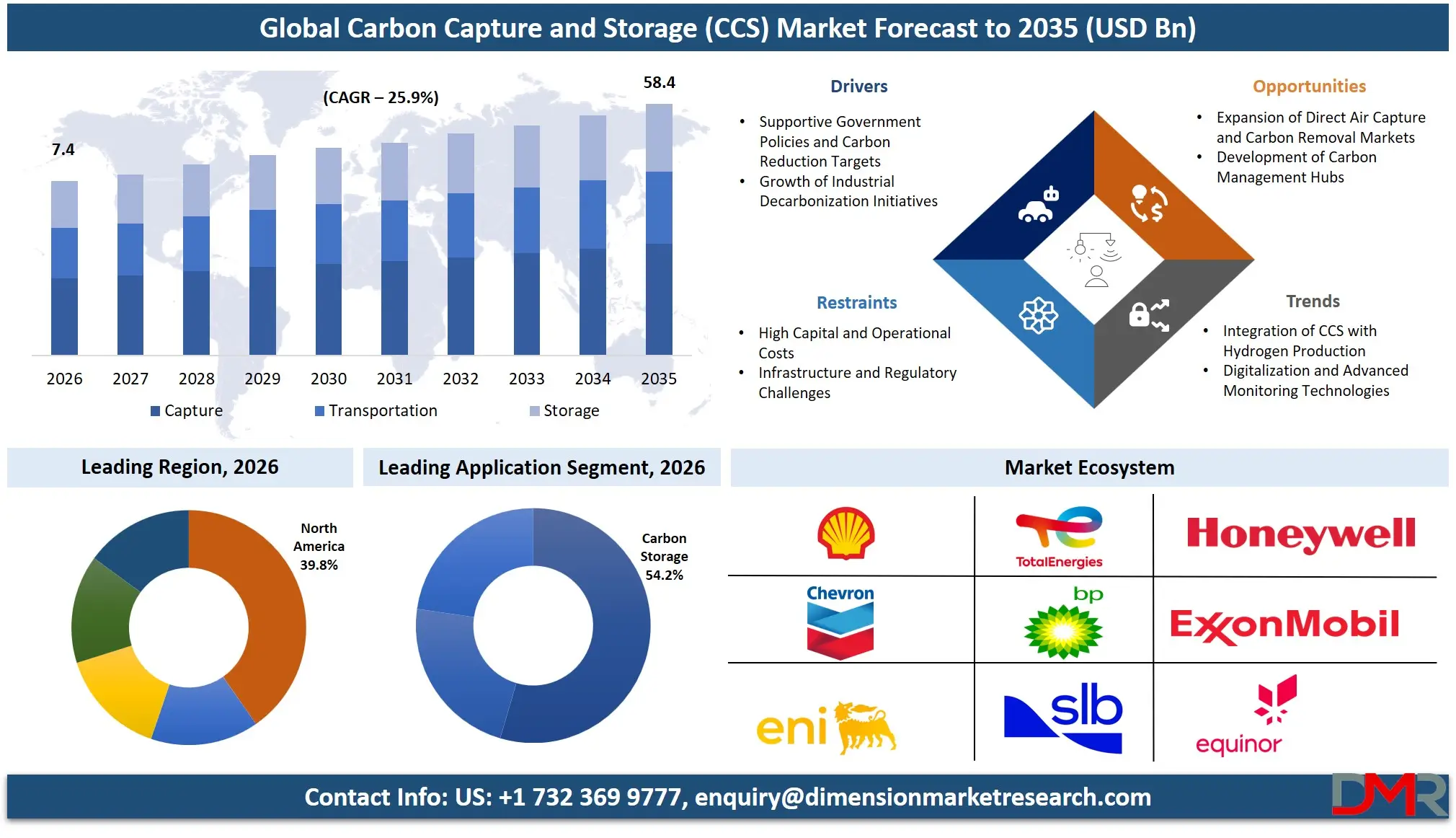
The Carbon Capture and Storage (CCS) Market size is expected to be USD 7.4 billion in 2026 and increase at a compound annual growth rate of 25.9% to USD 58.4 billion in 2035 due to government support for CCS deployment and climate goals.
ℹ
To learn more about this report –
Download Your Free Sample Report Here
The Carbon Capture and Storage (CCS) market consists of a number of technologies, which can be applied to capture CO2 emissions from factories, power stations, hydrogen plants, and other enterprises. At the same time, CCS covers the transportation of the captured CO2 through pipelines and ships and storage of CO2 in geological formations, such as saline aquifers and depleted oil and gas fields. In general, the CCS is important for the decarbonization plan globally because it assists in cutting down emissions from difficult to abate industries like cement, steel, chemical, and refining industry. The growth in the net zero pledges, carbon pricing plans, governmental support, direct air capture, and investments in carbon management technology increases the use of CCS both in developed and developing countries.
The US Carbon Capture and Storage Market
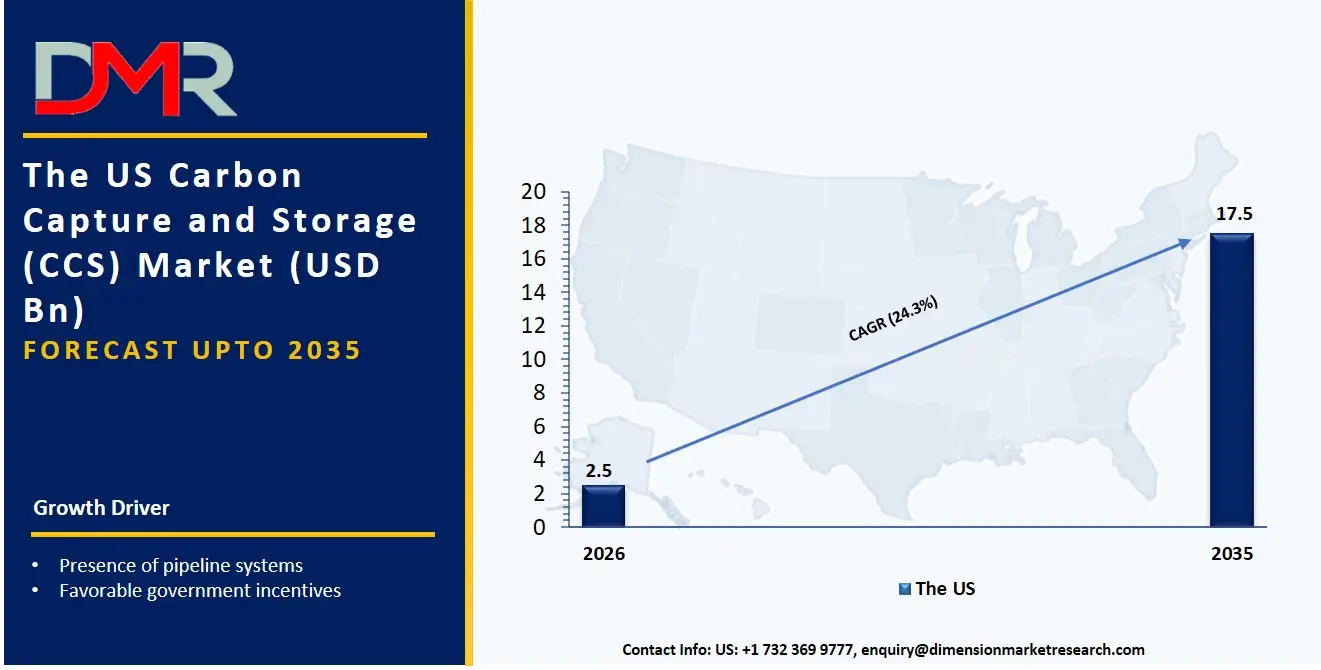
The US Carbon Capture and Storage (CCS) Market size is estimated to be USD 2.5 billion in 2026 and is expected to increase at a CAGR of 24.3% over the forecast period.
ℹ
To learn more about this report –
Download Your Free Sample Report Here
Among the most developed markets for CCS, the US can be cited owing to geological potential of storage, presence of pipeline systems, and favorable government incentives. In particular, the use of tax credit mechanisms, which include projects of carbon sequestration, facilitates the implementation of such technologies within the industry and energy sectors. At the same time, the US enjoys active involvement of energy corporations, manufacturers of industrial products, and technology vendors. Large-scale investment into infrastructure at the Gulf Coast, direct air capture projects, and industrial decarbonization centers contributes to the development of this market.
Europe Carbon Capture and Storage Market
The Europe Carbon Capture and Storage (CCS) Market size is estimated to be USD 1.9 billion in 2026 and is expected to increase at a CAGR of 24.7% over the forecast period.
The CCS market in Europe is motivated by climate regulations, carbon pricing regimes, and decarbonization requirements. Various regional programs initiated within the framework of the European Green Deal promote reduction of carbon in industry and development of transport infrastructure for CO₂. Norway, the Netherlands, Denmark, and the UK are leading countries with projects in CCS and CO₂ transport. Sectors such as cement production, chemical industries, and steel production are turning more to CCS.
Japan Carbon Capture and Storage Market
The market size of Japan Carbon Capture and Storage (CCS) will be USD 370 million in 2026 and at a CAGR of 24.8% in the forecast period.
The CCS market in Japan is growing as the country tries to strike a balance between being competitively industrious and maintaining carbon neutrality. The government's support in recycling of carbon, development of hydrogen, and decarbonization of industries is motivating the use of CCS technologies. Heavy industries such as energy production, oil refining, and chemical industries are looking at carbon management options as a way of reducing emissions. Lack of adequate storage capacity within the country has motivated international cooperation on CCS.
Key Takeaways
- Market Size & Forecast: The Carbon Capture and Storage (CCS) Market size is projected to reach USD 7.4 billion in 2026 and is anticipated to have a value of USD 58.4 billion in 2035.
- Growth Rate & Outlook: The Carbon Capture and Storage (CCS) Market size is set to grow at a compound annual growth rate of 25.9% during the forecast period of 2026 to 2035.
- Primary Growth Drivers: Some of the major growth drivers in the market are Government Support for CCS Deployment and Climate Goals, and more.
- Key Market Trends: Some of the major trends in the market are CCS and Hydrogen Production Integration and more.
- By Service Type: Capture segment is anticipated to get the majority share of the Carbon Capture and Storage (CCS) Market in 2026.
- By End User Type: Oil & Gas sector is expected to get the largest revenue share in 2026 in the Carbon Capture and Storage (CCS) Market.
- By Application Type: Carbon Storage segment is expected to get the largest revenue share in 2026 in the Carbon Capture and Storage (CCS) Market.
- Regional Leadership: North America is set to lead the Carbon Capture and Storage (CCS) Market with an estimated 39.8% share in 2026.
What is the Carbon Capture and Storage ?
The Carbon Capture and Storage (CCS) system is an emissions mitigation technology that involves capturing the CO₂ created during various industrial activities and other energy-producing processes to prevent its release into the atmosphere. The system consists of three main elements, namely, CO₂ capture, its transportation using either pipelines or marine transport, and permanent geological storage. CCS technology can be applied in power generation, oil and gas industry, cement production, steel making, chemicals production, hydrogen production, and direct air capture plants. As the world strives towards net-zero emissions, CCS is being acknowledged as an essential technology in reducing emissions in industrial sectors while ensuring energy security and competitiveness.
Use Cases
- Reduction of Industrial Emissions: The application of CCS technology is widespread in cement, steel, and chemical industries, where emissions of greenhouse gases can hardly be prevented via adopting renewable sources of energy. The implementation of CCS allows industries to comply with ever-growing environmental restrictions and retain their production effectiveness.
- Carbon Neutral Power Plants: Fossil fuel power stations can adopt CCS systems to reduce carbon emissions effectively. Such an approach provides stable electricity supply and helps to move gradually towards cleaner energy production processes.
- Blue Hydrogen Production: Blue hydrogen plants apply CCS technology for capturing CO₂ that is emitted during the processing of natural gas. Thus, the technology provides an opportunity to implement a low-carbon hydrogen economy.
- Enhanced Oil Recovery (EOR): CO₂ captured by CCS can be used for increasing the extraction of hydrocarbons from oil reservoirs. Besides, a considerable amount of carbon will be permanently stored underground, which creates environmental and financial advantages.
How AI Is Transforming the Carbon Capture and Storage Market
Artificial intelligence is making a difference in CCS activities through predictive maintenance, process optimization, emissions monitoring, and reservoir management. AI-enabled analytics help detect operational inefficiencies, conserve energy while capturing carbon, and ensure equipment reliability. AI algorithms also help characterize the geology and select storage sites, helping in project planning and risk assessment.
In addition, artificial intelligence makes a difference in the real-time monitoring of CO₂ transportation infrastructure and underground storage reservoirs. Powerful algorithms make sense of huge amounts of data generated by sensors, seismological analysis, and other sources, helping optimize performance. With the increase in size and complexity of CCS activities, AI is expected to assume an even greater role.
Market Dynamic
Driving Factors in the Carbon Capture and Storage (CCS) Market
Government Support for CCS Deployment and Climate Goals
Climate policies, carbon prices, emission standards, and tax credits represent some of the best motivators for CCS implementation. Nations seeking to achieve their net-zero targets have realized that CCS is a crucial technology that can help cut emissions in hard-to-decarbonize sectors. The financial assistance provided by governments, grants, tax credits, and joint ventures between the government and private sector companies decrease risk levels and increase economic feasibility.
Restraints in the Carbon Capture and Storage (CCS) Market
High Costs of Capture Equipment, Transportation Infrastructure, Compression Plants and Storage Facilities
The high cost of installing the necessary capture equipment, the development of the necessary transport infrastructure, compression plants and storage facilities is still one of the main problems facing the technology. The high operating costs connected with energy-intensive capture systems may affect the economic performance of the whole project.
Opportunities in the Carbon Capture and Storage (CCS) Market
Direct Air Capture and Carbon Removal Market Expansion
With more companies showing interest in carbon dioxide removal systems, CCS firms can expect several opportunities in their future plans. Direct air capture plants depend on the permanent sequestration of CO2 in order to generate negative emissions. Growing corporate demand for carbon removal offsets and increasing popularity of voluntary carbon markets should provide an incentive to invest in big-scale carbon removal systems.
Trends in the Carbon Capture and Storage (CCS) Market
CCS and Hydrogen Production Integration
The growing adoption of low-carbon hydrogen production is leading to integration of CCS with hydrogen production facilities. Blue hydrogen projects are implementing carbon capture technologies to minimize emissions resulting from natural gas reforming processes. This phenomenon is leading to the expansion of CCS applications from their industrial roots to other uses.
Research Scope and Analysis
Analysis of the market for Carbon Capture and Storage (CCS) covers issues related to the adoption of technology, services, end-user industries, applications, and regional advancements in the industry. The research highlights the factors that drive, restrain, and shape the opportunities for growth of the market. The analysis also covers competitive aspects of the industry.
ℹ
To learn more about this report –
Download Your Free Sample Report Here
By Technology Analysis
The Post-Combustion Capture technology segment is projected to maintain its dominant position, as it holds an estimated market share of 46.8% in 2026. The reason for this lies in the fact that it can be retrofitted into existing facilities without making any changes to the infrastructure due to its compatibility. It has gained widespread commercial acceptance owing to its efficient performance as well as regulations. On the other hand, the fastest-growing technology segment will be Direct Air Capture (DAC). This is because there has been an increased need for carbon removal and net-negative emissions technologies in recent years. There have been increased sustainability commitments made by corporations and development of carbon credit markets, which are promoting investment in DAC technologies.
By Service Analysis
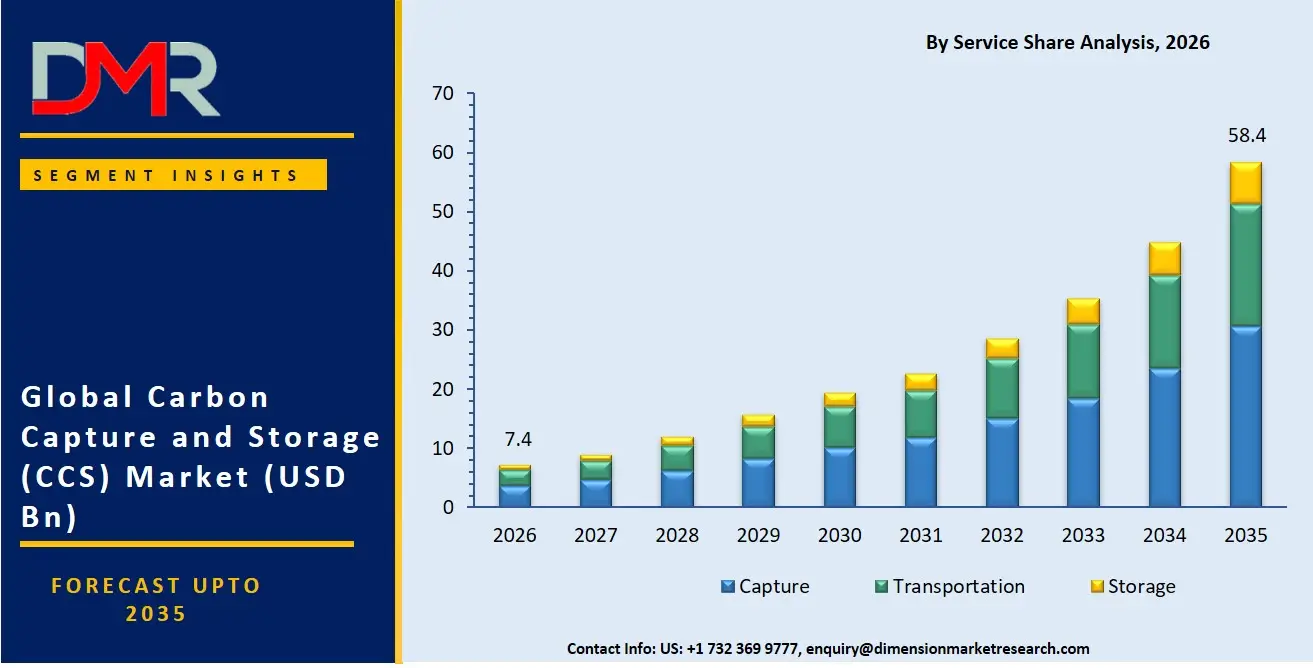
Capture services are forecasted to be the dominant type of service in the industry with an estimated share of around 52.4% of the overall revenue in 2026. Carbon capture is the most costly process because of the high intricacy of CO₂ capture and treatment from the industries.
ℹ
To learn more about this report –
Download Your Free Sample Report Here
Innovations in solvents, membranes, and adsorption methods continuously boost the effectiveness of the process. Transportation services are likely to experience the highest CAGR owing to the development of carbon management centers and intercountry CCS projects. The development of storage facilities and the increasing sizes of projects will drive the need for transportation systems.
By End Use Industry Analysis
The Oil & Gas sector is predicted to continue leading the segment of end-use application, holding a 31.7% share in the CCS market in 2026. This sector has significant experience in the utilization of CO2, sub-surface operations, and pipelines, which makes it an ideal candidate for CCS technology implementation. Moreover, existing Enhanced Oil Recovery processes and emerging decarbonization policies will keep the Oil & Gas sector in the lead position. But the segment of Cement is expected to be the fastest-growing one due to increased regulation to mitigate process emissions which cannot be addressed by traditional energy efficiency solutions.
By Application Analysis
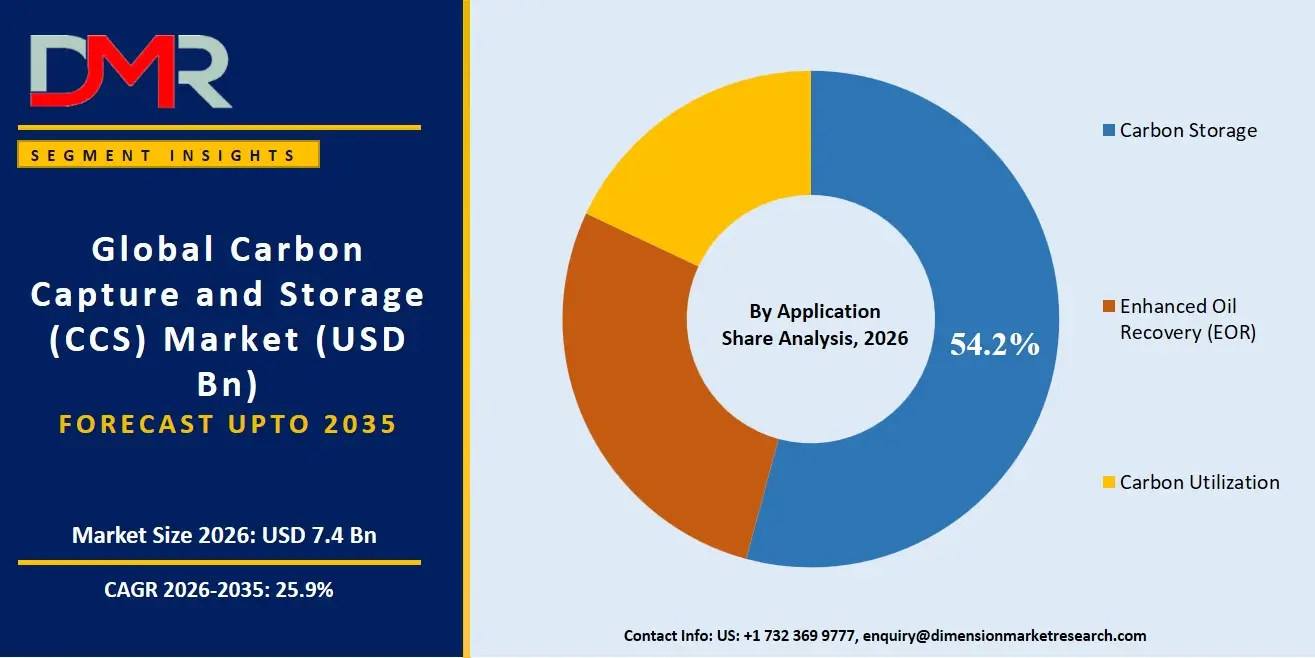
Carbon Storage is expected to capture the maximum market share with an estimated 54.2% share in 2026. The permanent storage of the captured carbon dioxide in geological formations is the ultimate goal of most of the CCS projects with a focus on meeting net-zero emission targets. Advancements in the technologies of storage, development in regulatory policies, and availability of appropriate geological formations will drive the market towards its leadership. It is expected that Carbon Utilization will grow at the fastest rate in terms of applications due to advancements made in the production of synthetic fuels, chemicals, building materials, and circular carbon economy.
The Carbon Capture and Storage (CCS) Market Report is segmented on the basis of the following:
By Technology
- Post-Combustion Capture
- Pre-Combustion Capture
- Oxy-Fuel Combustion Capture
- Direct Air Capture (DAC)
By Service
- Capture
- Transportation
- Pipeline Transport
- Ship Transport
- Storage
- Saline Aquifers
- Depleted Oil & Gas Reservoirs
- Enhanced Oil Recovery (EOR)
- Other Geological Formations
By End-Use Industry
- Oil & Gas
- Power Generation
- Cement
- Iron & Steel
- Chemicals & Petrochemicals
- Fertilizers
- Hydrogen Production
- Other Industrial Sectors
By Application
- Carbon Storage
- Enhanced Oil Recovery (EOR)
- Carbon Utilization
- Chemicals & Fuels
- Building Materials
- Other Industrial Uses
Regional Analysis
Leading Region in the Carbon Capture and Storage (CCS) Market
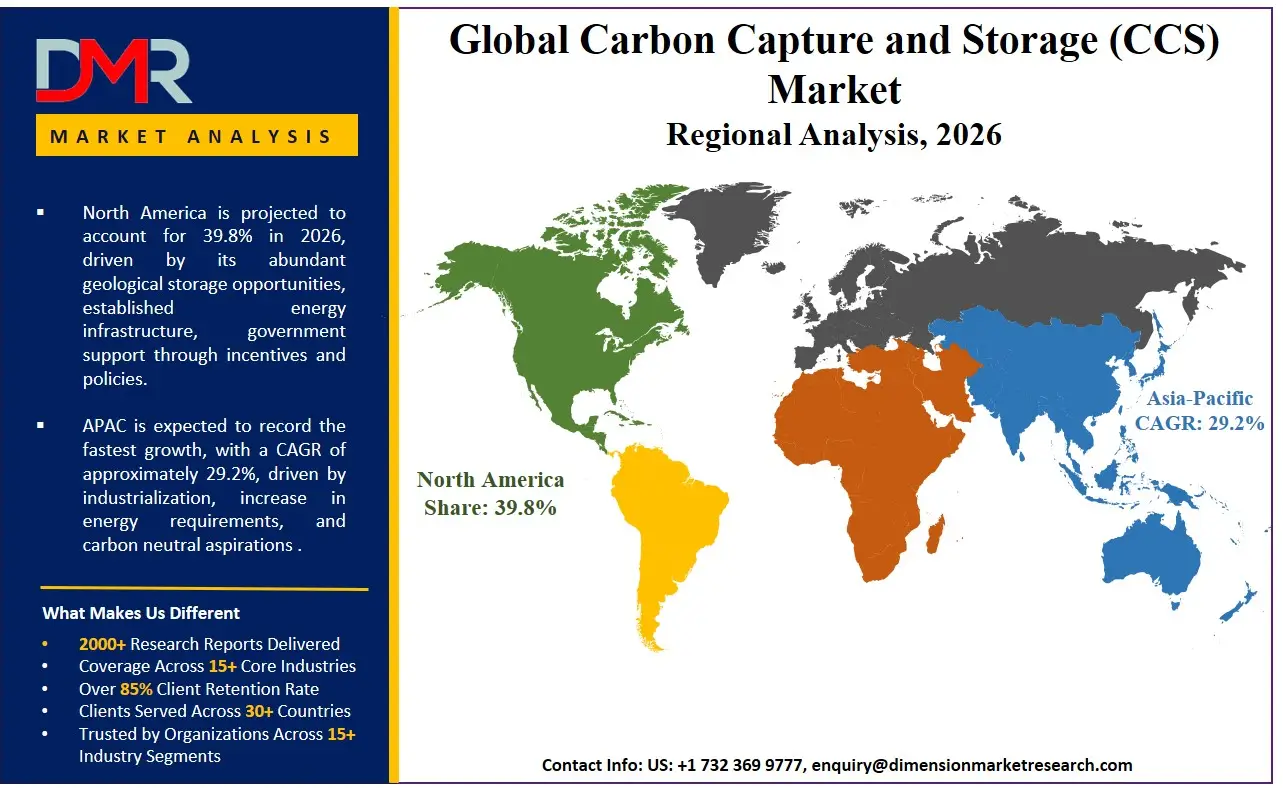
North America is forecast to hold dominance in the global CCS market with a projected market share of 39.8% in 2026. This can be attributed to the abundant geological storage opportunities, established energy infrastructure, government support through incentives and policies, and active involvement of the private sector in the market. In the U.S., the market will continue to be driven by tax incentives, initiatives for industrial decarbonization, and investments in carbon management hubs. Similarly, Canada will contribute greatly with its carbon storage projects and climate policies.
ℹ
To learn more about this report –
Download Your Free Sample Report Here
Fastest Growing Region in the Carbon Capture and Storage (CCS) Market
The Asia-Pacific region is anticipated to become the leading regional market for CCS in the coming forecast period. Industrialization, increase in energy requirements, and carbon neutral aspirations are some of the key factors behind the investments in the region. Countries such as China, Japan, South Korea, and Australia are making efforts in this regard through their respective government and industrial carbon reduction policies. Increased activity in hydrogen production plants, steel production, cement production, and power plants provides many avenues for CCS technology to flourish.
By Region
North America
Europe
- Germany
- The U.K.
- France
- Italy
- Russia
- Spain
- Benelux
- Nordic
- Rest of Europe
Asia-Pacific
- China
- Japan
- South Korea
- India
- ANZ
- ASEAN
- Rest of Asia-Pacific
Latin America
- Brazil
- Mexico
- Argentina
- Colombia
- Rest of Latin America
Middle East & Africa
- Saudi Arabia
- UAE
- South Africa
- Israel
- Egypt
- Rest of MEA
Competitive Landscape
The CCS industry can be described as being made up of a range of competitors that include technology developers, engineering companies, infrastructure companies, industry players, and energy companies, among others, all competing along the value chain of carbon. Competition in the CCS industry revolves around increasing the efficiency of carbon capture, reducing costs, ensuring adequate storage facilities, and the construction of efficient transportation systems. Strategic alliances, joint ventures, licensing, and collaboration are some of the competition strategies used by competitors in the industry. High capital demands, regulatory issues, and technical knowledge represent significant barriers to entry into the market.
Some of the prominent players in the global Carbon Capture and Storage (CCS) are:
- Shell plc
- Exxon Mobil Corporation
- Chevron Corporation
- TotalEnergies SE
- Equinor ASA
- BP plc
- Eni S.p.A.
- Occidental Petroleum Corporation
- Aker Carbon Capture ASA
- SLB
- Baker Hughes Company
- Honeywell International Inc.
- Mitsubishi Heavy Industries, Ltd.
- Hitachi, Ltd.
- Siemens Energy AG
- Fluor Corporation
- Worley Limited
- Technip Energies N.V.
- Linde plc
- Air Liquide S.A.
- Other Key Players
Recent Developments
- In February 2026, ABB unveiled its first integrated gas analyzer suite dedicated to Carbon Capture, Utilization and Storage (CCUS) technology, integrating all monitoring into one. This solution allows for continuous CO₂ purity and impurities measurements throughout the whole CCUS value chain, aiding the decarbonization process in sectors like cement, oil refineries, power plants, chemicals, LNG, and waste-to-energy plants. Presented in a form of a turnkey modular analyzer suite, the solution is designed to make implementation easier, minimize the engineering work, improve measurement accuracy, and help companies meet strict CO₂ quality requirements.
- In February 2026, DNV has launched Industrial Services and is now offering itself as a dedicated global player offering solutions in quality assurance and inspections for energy, infrastructure, and industries. This comes as an answer to increasing demands fueled by the need for energy transition projects, infrastructure developments, and higher standards of compliance. This new division is expected to serve various industries such as renewable energies, power grid, hydrogen, carbon capture, rail transport, and manufacturing.
- In June 2025, The collaboration between ADNOC, Microsoft, and Abu Dhabi Future Energy Company (Masdar) was announced at the Abu Dhabi International Petroleum Exhibition and Conference. It is indicative of the growing trend in the oil and gas industry that aims to assist in the increasing energy requirements of artificial intelligence technologies. This collaboration entails investigating the potentialities of supplying renewable energy sources to Microsoft's growing number of data centers.
Report Details
| Report Characteristics |
| Market Size (2026) |
USD 7.4 Bn |
| Forecast Value (2035) |
USD 58.4 Bn |
| CAGR (2026–2035) |
25.9% |
| Historical Period |
2021 – 2025 |
| Forecast Period |
2027 – 2035 |
| Base Year |
2025 |
| Estimate Year |
2026 |
| Segments Covered |
By Technology, By Service, By End-Use Industry, By Application |
| Regional Coverage |
North America – The US and Canada; Europe – Germany, The UK, France, Russia, Spain, Italy, Benelux, Nordic, & Rest of Europe; Asia-Pacific – China, Japan, South Korea, India, ANZ, ASEAN, Rest of APAC; Latin America – Brazil, Mexico, Argentina, Colombia, Rest of Latin America; Middle East & Africa – Saudi Arabia, UAE, South Africa, Turkey, Egypt, Israel, & Rest of MEA |
Frequently Asked Questions
How big is the Carbon Capture and Storage (CCS) Market?
▾ The Carbon Capture and Storage (CCS) Market size is expected to reach USD 7.4 billion by 2026 and is projected to reach USD 58.4 billion by the end of 2035.
What is the CAGR of the Carbon Capture and Storage (CCS) Market from 2026 to 2035?
▾ The market is growing at a CAGR of 25.9 percent over the forecasted period.
What factors are driving the growth of the Carbon Capture and Storage (CCS) Market?
▾ Government Support for CCS Deployment and Climate Goals, and more are the factors driving the growth of the Carbon Capture and Storage (CCS) Market.
What are the major trends in the Carbon Capture and Storage (CCS) Market?
▾ CCS and Hydrogen Production Integration, and more are some of the major trends in the market.
Who are the key players in the Carbon Capture and Storage (CCS) Market?
▾ Some of the key players in the Carbon Capture and Storage (CCS) Market include BP, Shell, Eni, and more
How is the Carbon Capture and Storage (CCS) Market segmented?
▾ The Carbon Capture and Storage (CCS) Market is segmented by technology, service, end-use industry, application.
Which region held the largest share of the Carbon Capture and Storage (CCS) Market in 2026?
▾ North America is set to lead the Carbon Capture and Storage (CCS) Market with an estimated 39.8% share in 2026.
Which region is expected to grow the fastest in the Carbon Capture and Storage (CCS) Market?
▾ Asia Pacific is the fastest-growing region in the Carbon Capture and Storage (CCS) Market during the forecast period.