What is the Carbon Nanotube Conductive Additive Market Size?
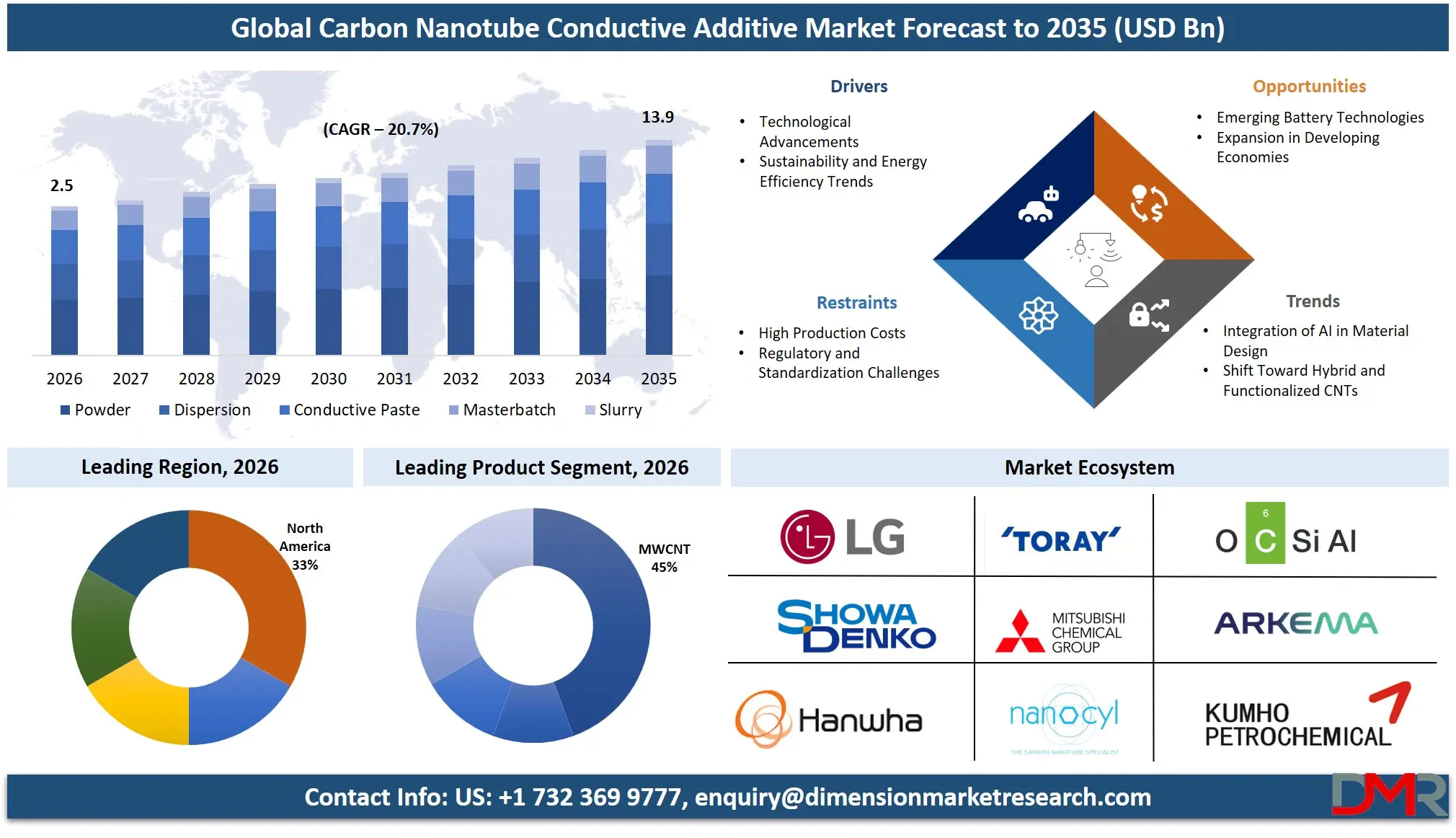
The Carbon Nanotube Conductive Additive Market size is expected to be USD 2.5 billion in 2026 and increase at a compound annual growth rate of 20.7% to USD 13.9 billion in 2035 due to continuous innovations in CNT synthesis, processing, and hybrid systems.
ℹ
To learn more about this report –
Download Your Free Sample Report Here
The Carbon Nanotube (CNT) Conductive Additives Market can be defined as the market which is composed of highly advanced carbonaceous products that have been produced for increasing electrical conductivity, tensile strength, and thermal resistance. Some of the major components in this case include multi-walled carbon nanotubes, single walled carbon nanotubes, and functionalized carbon nanotubes. These materials find their application in polymers, paints, ink, and batteries. It is evident that the use of carbon nanotubes has grown significantly in various industries including energy storage, electronics, and aerospace among others.
ℹ
To learn more about this report –
Download Your Free Sample Report Here
The US Carbon Nanotube Conductive Additive Market
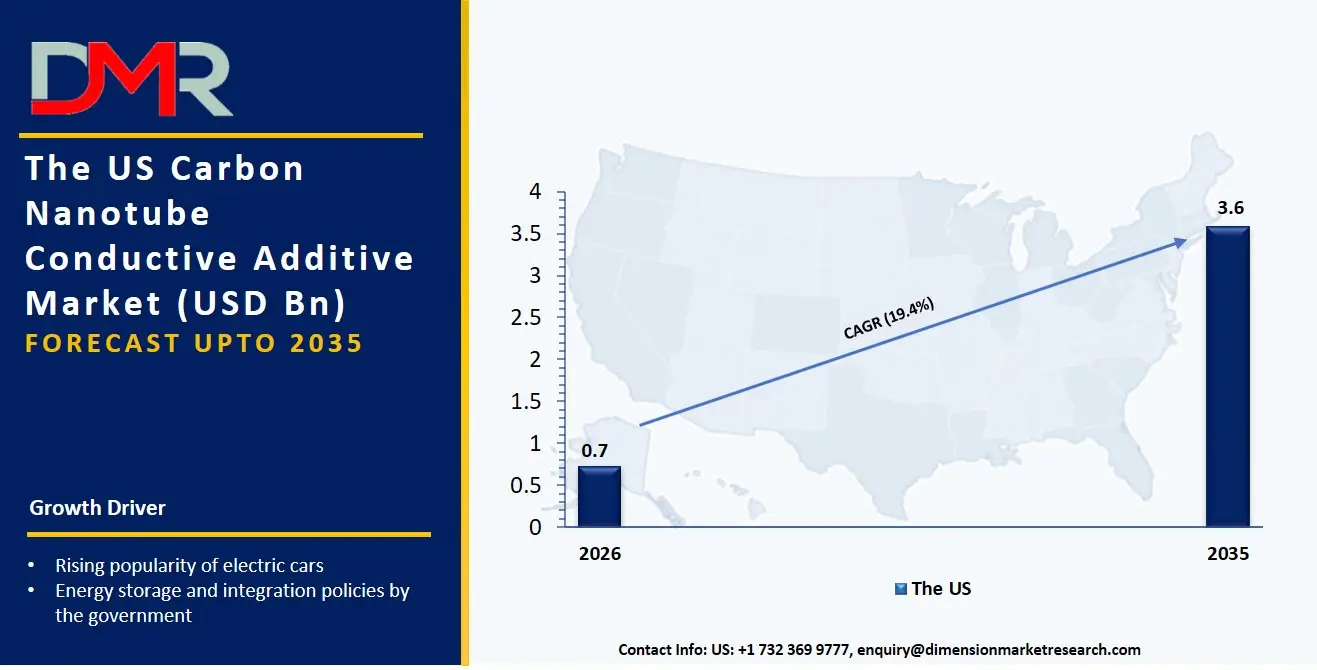
The US Carbon Nanotube Conductive Additive Market size is estimated to be USD 700 million in 2026 and is expected to increase at a CAGR of 19.4% over the forecast period.
The US market is experiencing rapid growth owing to the rising popularity of electric cars, lithium-ion batteries, and electronics. Energy storage and integration policies by the government encourage their use. The leading companies are engaged in research and development and collaboration to acquire a larger market share. Rising demands for lightweight conductors and automation have led to an increase in investments in carbon nanotube applications, making the US a frontrunner in this industry.
ℹ
To learn more about this report –
Download Your Free Sample Report Here
Europe Carbon Nanotube Conductive Additive Market
The Europe Carbon Nanotube Conductive Additive Market size is estimated to be USD 750 million in 2026 and is expected to increase at a CAGR of 19.5% over the forecast period.
European growth in the field is backed by strong environmental laws and measures like the European Green Deal. The regions where high rates are recorded include Germany, France, and the Nordic countries due to the presence of electric vehicle production, renewable energy projects, and electronics manufacturing. Financial support from the government for research and innovations speeds up the use of CNTs in batteries, conductive plastic, and coatings, increasing their penetration rate.
Japan Carbon Nanotube Conductive Additive Market
The market size of Japan Carbon Nanotube Conductive Additive will be USD 125 million in 2026 and at a CAGR of 20.1% in the forecast period.
The use of CNT-based conductive additives in the electronics industry, electric vehicles, and energy storage technologies is witnessing fast adoption in Japan. The growing trend of urbanization and modernization of industries drives the demand for lightweight and efficient materials. Green energy policies, semiconductor development, and advancements in batteries are some of the major driving factors for the Japanese carbon nanotube market. Some of the limitations associated with this market are high manufacturing costs and stringent quality requirements.
Key Takeaways
- Market Size & Forecast: The Carbon Nanotube Conductive Additive Market size is projected to reach USD 2.5 billion in 2026 and is anticipated to have a value of USD 13.9 billion in 2035.
- Growth Rate & Outlook: The Carbon Nanotube Conductive Additive Market size is set to grow at a compound annual growth rate of 20.7% during the forecast period of 2026 to 2035.
- Primary Growth Drivers: Some of the major growth drivers in the market include Technological Developments, and more.
- Key Market Trends: Some of the major trends in the market areMove Towards Hybrid and Functionalized CNTs, and more.
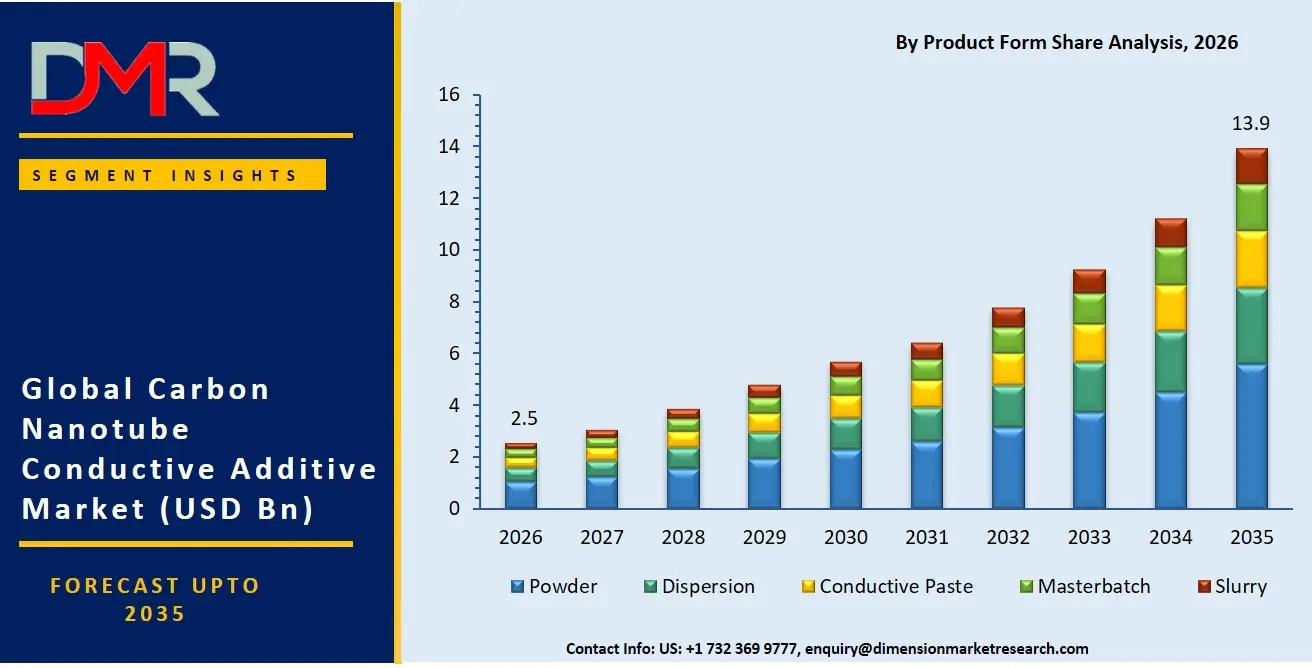
- By Product Form: The powder segment is anticipated to get the majority share of the Carbon Nanotube Conductive Additive market in 2026.
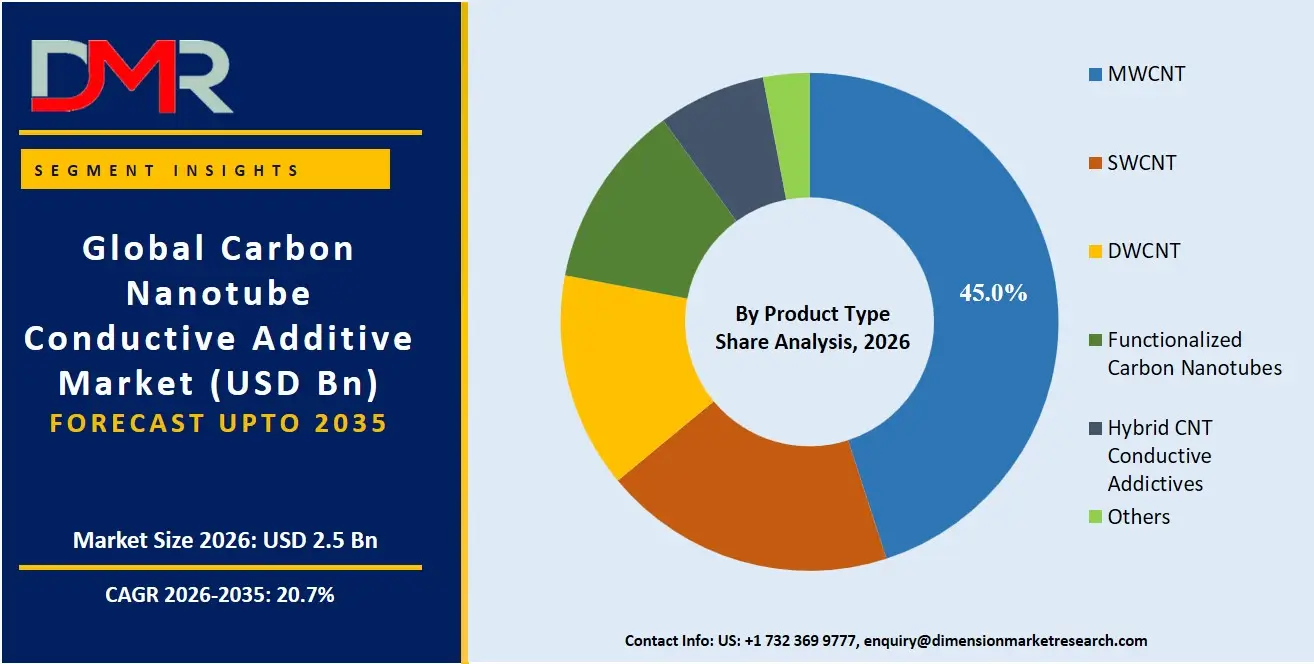
- By Product Type: MWCNT is expected to get the largest revenue share in 2026 in the Carbon Nanotube Conductive Additive market.
- By Application: The energy storage segment is expected to get the largest revenue share in 2026 in the Carbon Nanotube Conductive Additive market.
- Regional Leadership: North America is set to lead the Carbon Nanotube Conductive Additive market with an estimated 33.0% share in 2026.
What is the Carbon Nanotube Conductive Additive?
Conductive Carbon Nanotubes are advanced nanomaterials based on nanocylinders made of carbon material and possessing excellent electrically conductive properties, mechanical hardness, and thermal stability. The additives are employed to improve the characteristics of composite materials, coatings, paints, and batteries, creating a conducting network on a nanometric scale. This type of material possesses significant advantages compared to conventional additives like carbon black or metal powders.
Use Cases
- Lithium-ion batteries: The addition of CNTs increases the conductivity of electrodes and provides a longer life cycle of batteries.
- EMI shielding: Employed for EMI protection and in antistatic applications.
- Flexible electronics: Enhance the performance of sensors, displays, and wearables because of their high conductivity and flexibility.
- Conductive plastics & composites: Incorporated in automobile and industrial parts to lower their weight.
How AI Is Transforming the Carbon Nanotube Conductive Additive Market
AI technology is changing the CNT research landscape through improved synthesis conditions, predictive performances, and quality control. The use of machine learning algorithms can improve the uniformity of dispersion in the composite materials, decrease defects, and improve the conductivity. Moreover, AI technology plays an important role in maintaining manufacturing facilities to minimize downtime and increase efficiency.
Furthermore, AI technology enables efficient data analysis which will aid in designing application-specific products based on CNT. For instance, CNT can be designed for use in batteries, conductive inks, and coating materials. Thus, new products reach the market faster.
Market Dynamic
Driving Factors in the Carbon Nanotube Conductive Additive Market
Technological Developments
Continuous innovations in CNT synthesis, processing, and hybrid systems have helped create improved electrical and thermal properties in lower quantities of fillers. Dispersion methods and low-cost production processes have driven prices down, resulting in an abundance of CNTs in the automotive, electronic, and battery sectors.
Restraints in the Carbon Nanotube Conductive Additive Market
Regulatory and Standardization Issues
The lack of standardized global standards for CNTs presents obstacles in the implementation of CNTs in different areas. Regulatory and safety issues, including disposal and storage, add to the complications associated with manufacturing and application processes.
Opportunities in the Carbon Nanotube Conductive Additive Market
Developing Economies Market Growth
Innovative economies from the APAC and Latin American regions are focusing on building up EV production capacity, electronics industries, and renewable power generation systems. The use of conductive additives from CNT will open up new avenues of growth by supplying high-quality products.
Trends in the Carbon Nanotube Conductive Additive Market
Move Towards Hybrid and Functionalized CNTs
The hybrid variety of carbon nanotubes as well as those that have been modified by grafting and functionalization is gaining greater traction because of their potential to perform better in various applications.
Research Scope and Analysis
Market scope for the study of CNT Conductive Additive includes an elaborate segmentation basis of product type, formulation, battery technology, application, and end-use industry segments. Demand dynamics, technological developments, and regional penetration trends are examined to gain insights into the evolving demands of the market. Market evolution in terms of energy storage devices, electronic components, and composite materials is another important area covered in the study.
ℹ
To learn more about this report –
Download Your Free Sample Report Here
By Product Type Analysis
MWCNTs constitute the primary form of product, commanding around 45% market share in 2026 on account of being economically viable, having excellent electrical conductivity, and possessing remarkable mechanical strength. Their prevalence can be attributed to widespread use in batteries, conductive polymers, coatings, and composites owing to their easy incorporation and diverse utility. Functionalized MWCNTs comprise the fastest-growing category, taking advantage of developments in hybrid formulations, surface treatments, and dispersion methods. Their dominance is expected to rise further in high-tech electronics, energy storage devices, and automotive systems requiring highly functional conductive agents.
By Product Form Analysis
The powder form is expected to dominate the market in 2026 with a forecasted market share of 40% because of its convenient use, handling, and ability to scale up in composite production, ink production, and coatings production. The dispersion form, especially the aqueous dispersion, is the fastest-growing category due to increasing usage in eco-friendly coatings, electrodes in lithium ion batteries, and printable electronics. The reason behind the growing usage is the ability to provide good control over conductivity and performance of these materials.
By Battery Chemistry Analysis
The segment is dominated by Lithium Iron Phosphate (LFP), which holds an approximated market share of 38% in 2026 due to wide EV adoption, increase in energy storage capacity on grids, and the natural safety and cost benefits of LFP batteries. CNT conductive additives have been seen to provide great conductivity for electrodes, lowering internal resistances. In addition, solid-state batteries represent the fastest growing segments due to increased energy densities and safety as well as reliability.
By Application Analysis
Applications of carbon nanotube additives in energy storage, especially lithium-ion batteries, are emerging as the front runner, with a forecasted market share of 42% in 2026. CNTs are used to improve electrode conductivity, reduce energy losses, and increase battery life; therefore, CNTs are indispensable for developing energy storage devices. Among all applications of CNTs, conductive plastics & composites hold the largest growth potential because of increasing demand from the automotive, aerospace, and flexible electronics segments.
By End Use Industry Analysis
Market share for the automotive industry is expected to reach 35% in 2026, as the production of electric and hybrid vehicles will continue, and the need for conductive and lightweight materials for batteries and components is increasing. Among various end-user applications, electronics and semiconductor sectors show the highest growth potential due to rising adoption of conductive additive CNTs to improve high frequency circuits, electromagnetic interference shielding, flexible displays, and wearable devices.
The Carbon Nanotube Conductive Additive Market Report is segmented on the basis of the following:
By Product Type
- Multi-Walled Carbon Nanotubes (MWCNT)
- Single-Walled Carbon Nanotubes (SWCNT)
- Double-Walled Carbon Nanotubes (DWCNT)
- Functionalized Carbon Nanotubes
- Carboxylated CNT
- Aminated CNT
- Polymer-Grafted CNT
- Hybrid CNT Conductive Additives
- Others
By Product Form
- Powder
- Dispersion
- Water-Based
- Solvent-Based
- Conductive Paste
- Masterbatch
- Slurry
By Battery Chemistry
- Lithium Iron Phosphate (LFP)
- Nickel Manganese Cobalt (NMC)
- Nickel Cobalt Aluminum (NCA)
- Lithium Manganese Oxide (LMO)
- Silicon-Based Anodes
- Solid-State Batteries
- Others
By Application
- Energy Storage
- Lithium-Ion Batteries
- Supercapacitors
- Energy Storage Systems (ESS)
- Conductive Plastics & Composites
- Conductive Coatings
- Conductive Inks
- EMI Shielding Materials
- Sensors & Flexible Electronics
- Others
By End-use Industry
- Automotive
- Electric Vehicles
- Hybrid Vehicles
- Electronics & Semiconductors
- Energy & Power
- Aerospace & Defense
- Industrial Manufacturing
- Others
Regional Analysis
Leading Region in the Carbon Nanotube Conductive Additive Market
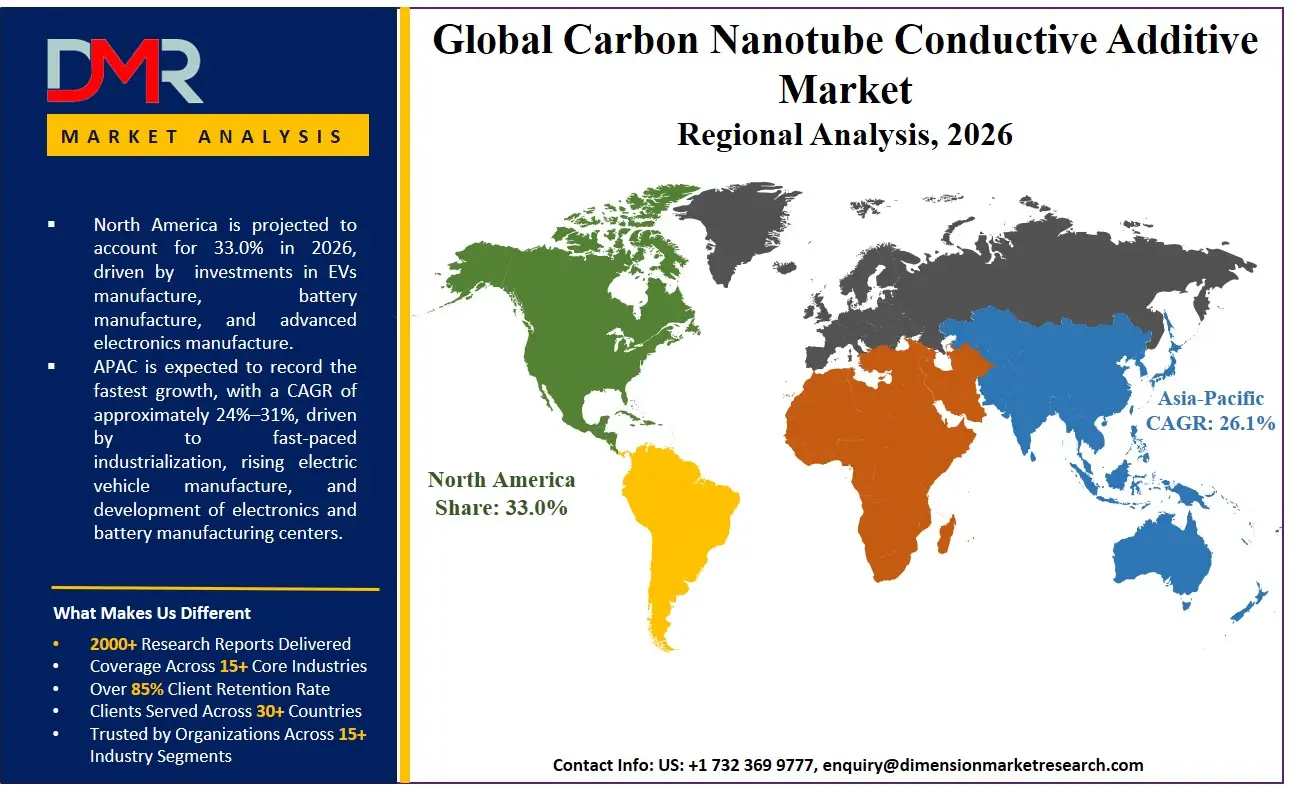
The North American region is estimated to capture an important market share of 33% by 2026 in the CNT Conductive Additive Market due to investments in EVs manufacture, battery manufacture, and advanced electronics manufacture. In addition, research and development, favorable government policies on clean energy products, and increased demand for lightweight conductive additives in aerospace and defense sectors will drive the CNT Conductive Additive Market growth in North America. The United States is among the largest sources of revenue in this region as a result of advanced material manufacturers and battery technology manufacturers operating there.
ℹ
To learn more about this report –
Download Your Free Sample Report Here
Fastest Growing Region in the Carbon Nanotube Conductive Additive Market
The Asia-Pacific region is likely to register the highest growth rate owing to fast-paced industrialization, rising electric vehicle manufacture, and development of electronics and battery manufacturing centers. Countries including China, South Korea, and India are making substantial investments in the research and development of CNT conductive additives as well as their mass production. Favorable policies from governments, reduced production costs, and emergence of industrial clusters are driving market adoption in the region. In addition, the increasing need for energy storage systems, flexible electronics, and conductive plastics has been driving the rapid growth of this region.
By Region
North America
Europe
- Germany
- The U.K.
- France
- Italy
- Russia
- Spain
- Benelux
- Nordic
- Rest of Europe
Asia-Pacific
- China
- Japan
- South Korea
- India
- ANZ
- ASEAN
- Rest of Asia-Pacific
Latin America
- Brazil
- Mexico
- Argentina
- Colombia
- Rest of Latin America
Middle East & Africa
- Saudi Arabia
- UAE
- South Africa
- Israel
- Egypt
- Rest of MEA
Competitive Landscape
Carbon Nanotube Conductive Additive industry can be described by the high competitiveness within it as a result of the innovations in technologies, products, and scales of production. The firms operating in this industry tend to implement initiatives aimed at expanding their production capacities, improving dispersion techniques, and creating new CNTs that comply with the requirements of batteries and electronics. Establishing cooperation with EV producers, battery producers, and electronic devices producers is seen as an emerging trend within the CNT additive industry. In view of the relatively high barriers to entry associated with manufacturing issues, patents, and quality concerns, existing players with well-developed R&D facilities will dominate over the newcomers.
Some of the prominent players in the global Carbon Nanotube Conductive Additive are:
- Cabot Corporation
- OCSiAl
- Jiangsu Cnano Technology
- LG Chem
- Showa Denko (Resonac)
- Nanocyl SA
- Arkema SA
- Toray Industries
- Mitsubishi Chemical Group
- Kumho Petrochemical
- Dongjin Semichem
- Hanwha Solutions
- Thomas Swan & Co. Ltd.
- Hyperion Catalysis International
- Advanced Nano Products (ANP)
- Raymor Industries
- Chengdu Organic Chemicals (Timesnano)
- Qingdao Haoxin New Energy Technology
- Shenzhen Jinbaina Nanotechnology
- Shenzhen Nanotech Port
- Other Key Players
Recent Developments
- In January 2026, With an increasing need for conductive gloves in sectors like electronics, chemical, logistics, healthcare, and consumer goods, there is an increase in the search for ways of improving conductivity and touchscreen functionalities at lower costs. SIOResin has unveiled two new products; the H-4417 Carbon Nanotube Conductive Paste and the H-3726 Single-Walled Carbon Nanotube dispersion. The products are meant to make the manufacture of conductive gloves easier and more efficient.
- In October 2025, Birla Carbon, a major producer and supplier of top-notch carbon products around the world, is expected to attend K 2025, the largest trade show in the world for plastics and rubber, set to happen in Düsseldorf, Germany, from October 8 to 15, 2025. Birla Carbon's representatives will be showcasing their range of advanced and environmentally friendly carbon products available under ConductexTM carbon blacks, RavenTM carbon blacks, Continua™ SCM, and NanocylTM CNTs at Hall 8A, Booth J29.
- In July 2025, Imerys Graphite & Carbon Switzerland Ltd., an independent subsidiary of Imerys SA that is a global player in conductive carbon black, has partnered with Jiangsu Cnano Technology Co., Ltd., a major manufacturer of carbon nanotubes. The cooperation leverages the technical know-how of both entities to create innovative conductive additives combining carbon black and carbon nanotubes for enhanced electric vehicle battery performance.
Report Details
| Report Characteristics |
| Market Size (2026) |
USD 2.5 Bn |
| Forecast Value (2035) |
USD 13.9 Bn |
| CAGR (2026–2035) |
20.7% |
| Historical Period |
2021 – 2025 |
| Forecast Period |
2027 – 2035 |
| Base Year |
2025 |
| Estimate Year |
2026 |
| Segments Covered |
By Product Type, By Product Form, By Battery Chemistry, By Application, By End-use Industry |
| Regional Coverage |
North America – The US and Canada; Europe – Germany, The UK, France, Russia, Spain, Italy, Benelux, Nordic, & Rest of Europe; Asia-Pacific – China, Japan, South Korea, India, ANZ, ASEAN, Rest of APAC; Latin America – Brazil, Mexico, Argentina, Colombia, Rest of Latin America; Middle East & Africa – Saudi Arabia, UAE, South Africa, Turkey, Egypt, Israel, & Rest of MEA |
Frequently Asked Questions
How big is the Carbon Nanotube Conductive Additive Market?
▾ The Carbon Nanotube Conductive Additive Market size is expected to reach USD 2.5 billion by 2026 and is projected to reach USD 13.9 billion by the end of 2035.
What is the CAGR of the Carbon Nanotube Conductive Additive Market from 2026 to 2035?
▾ The market is growing at a CAGR of 20.7 percent over the forecasted period.
What factors are driving the growth of the Carbon Nanotube Conductive Additive Market?
▾ Technological Developments, and more are the factors driving the growth of the Carbon Nanotube Conductive Additive Market.
What are the major trends in the Carbon Nanotube Conductive Additive Market?
▾ Move Towards Hybrid and Functionalized CNTs, and more are some of the major trends in the market.
Who are the key players in the Carbon Nanotube Conductive Additive Market?
▾ Some of the key players in the Carbon Nanotube Conductive Additive Market include LG, Showa, Toray, and more.
How is the Carbon Nanotube Conductive Additive Market segmented?
▾ The Carbon Nanotube Conductive Additive Market is segmented by product type, product form, battery chemistry, application, end-use industry.
Which region held the largest share of the Carbon Nanotube Conductive Additive Market in 2026?
▾ North America is set to lead the Carbon Nanotube Conductive Additive market with an estimated 33.0% share in 2026.
Which region is expected to grow the fastest in the Carbon Nanotube Conductive Additive Market?
▾ Asia Pacific is the fastest-growing region in the Carbon Nanotube Conductive Additive market during the forecast period.