Global Carrier Routing Equipment Market snapshot
- Global Carrier Routing Equipment Market size in 2026 is: USD 29.4 Bn
- Global Carrier Routing Equipment Market size in 2035 is: USD 39.2 Bn
- Global CAGR from 2027 to 2035 is: 3.3%
- Internet Connectivity is the leading application segment in 2026: 31.5%
- Fixed Network is the leading network type segment in 2026: 62.1%
- Core Routers are the leading equipment type segment in 2026: 39.7%
- Telecom Operators are the leading end user segment in 2026: 64.5%
- Data Centre Interconnection is the fastest-growing application segment: 4.1% CAGR
- Mobile Network is the fastest-growing network type segment: 4.3% CAGR
- Edge Routers are the fastest-growing equipment type segment: 4.4% CAGR
- Cloud Service Providers and Data Centre Operators are the fastest-growing end user segment: 4.6% CAGR
- Asia Pacific is the leading region in 2026: 41.6%
- Asia Pacific is the expected fastest-growing region: 4.2% CAGR
What is Global Carrier Routing Equipment Market? Global Carrier Routing Equipment Market Size.
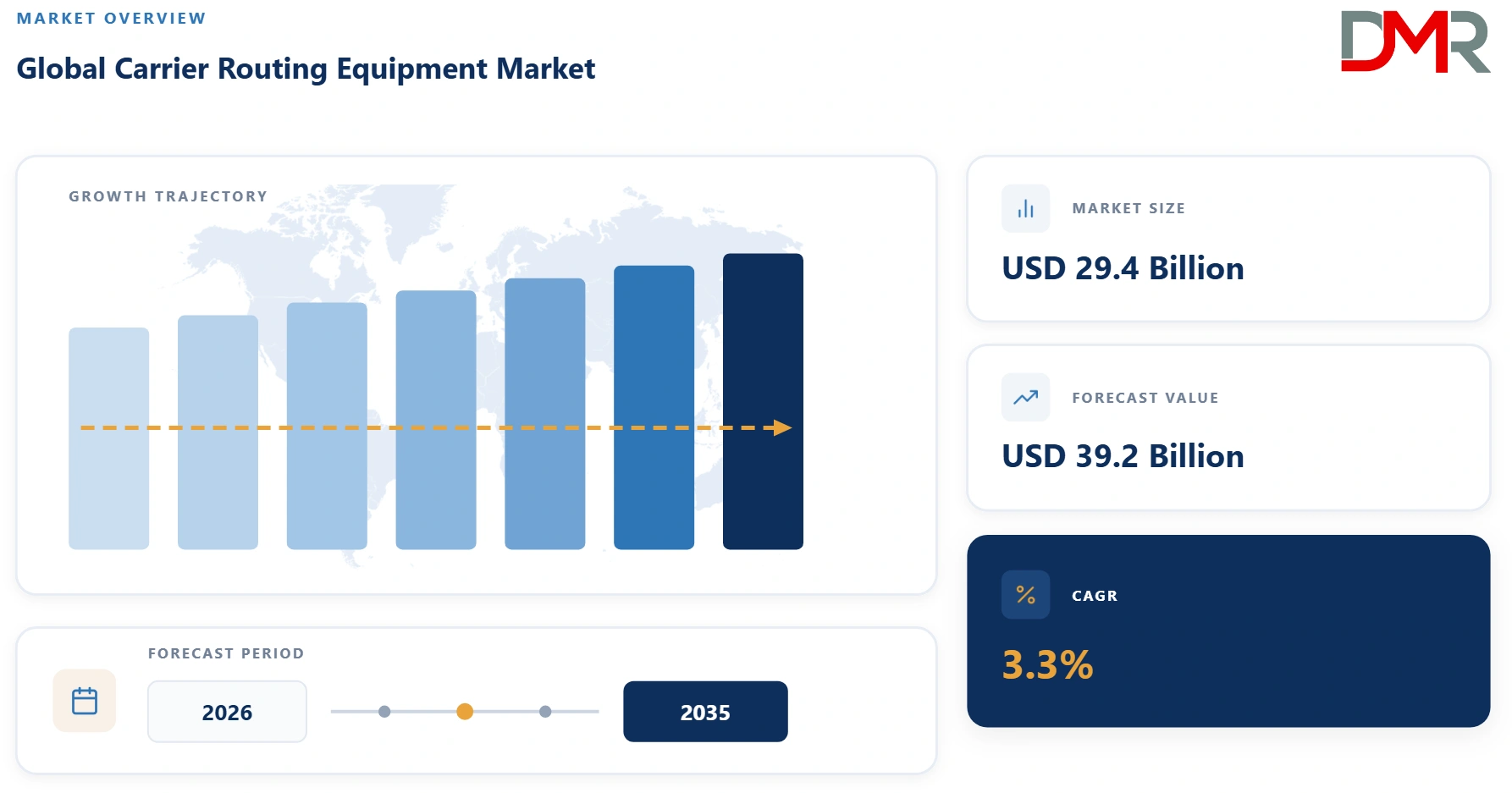
The Global Carrier Routing Equipment Market size is valued at USD 29.4 billion in 2026, and it is further anticipated to reach a market value of USD 39.2 billion by 2035 at a CAGR of 3.3%.
ℹ
To learn more about this report –
Download Your Free Sample Report Here
The Global Carrier Routing Equipment Market is driven by higher internet traffic, increased demand for high-speed connectivity, and constant investments in telecommunications infrastructure. Carrier Routing Equipment enables telecom operators, and cloud service providers to efficiently route large volumes of data across their networks. The adoption of 5G networks, growth in cloud computing, and growing need for data Centre interconnects are among the factors fueling the market’s growth.
Use Cases
- 5G Network Infrastructures: Telecom service providers use Carrier Routing Equipment to control data flows in the network from mobile network sites to core network infrastructures. Such equipment helps ensure consistent network connectivity and can cope with high bandwidth requirements of 5G networks. With a growth in data consumption by mobile clients, telecom companies upgrade their router equipment in order to manage increased network traffic volumes. Also, the equipment may be used for connected devices, smart cities' infrastructures, and automated manufacturing systems.
- Data Centre Interconnections: Carrier Routing Equipment also allows telecom service providers to connect data centres located in different geographic locations. Thus, they can facilitate the transfer of vast amounts of data between data centres used for providing cloud services, data storage and backup, and disaster recovery solutions. In the context of the increasing importance of cloud-based platforms for businesses, this aspect becomes crucial.
- Carrier Routers For ISP Networks: ISP networks employ carrier routing devices that help in directing internet traffic within the network and providing connection to their residential and business clients. They help in addressing increasing demands for bandwidth and ensuring network performance at times of high traffic levels. They also enable ISPs to distribute data through multiple routes within their networks. Increasing internet access, services, and communications have been enhancing the demand for such routing devices.
- Video and Multimedia Delivery Services: Carrier routers are utilized to manage large amounts of data created by video streaming, online games, and broadcasting services. They help telecom operators and CDNs deliver multimedia data within their network efficiently. They also assist in handling traffic prioritization and reduce network congestion at times of increased demand. This ensures that service providers deliver smooth video streams and provide consistent content quality for their customers.
Key Takeaways
- Market Growth: The Global Carrier Routing Equipment Market will grow from USD 29.4 billion in 2026 to USD 39.2 billion in 2035 at a CAGR of 3.3% from 2027 to 2035. Increasing internet traffic, rising demand for high-speed connectivity, expansion of 5G networks, and investments in telecommunications infrastructure are supporting the market growth.
- Internet Connectivity Dominates the Application Segment: Internet Connectivity holds 31.5% of the market in 2026, supported by increasing internet usage, growing bandwidth requirements, and rising demand for reliable network connectivity. Data Centre Interconnection is the fastest-growing application segment, with a CAGR of 4.1%.
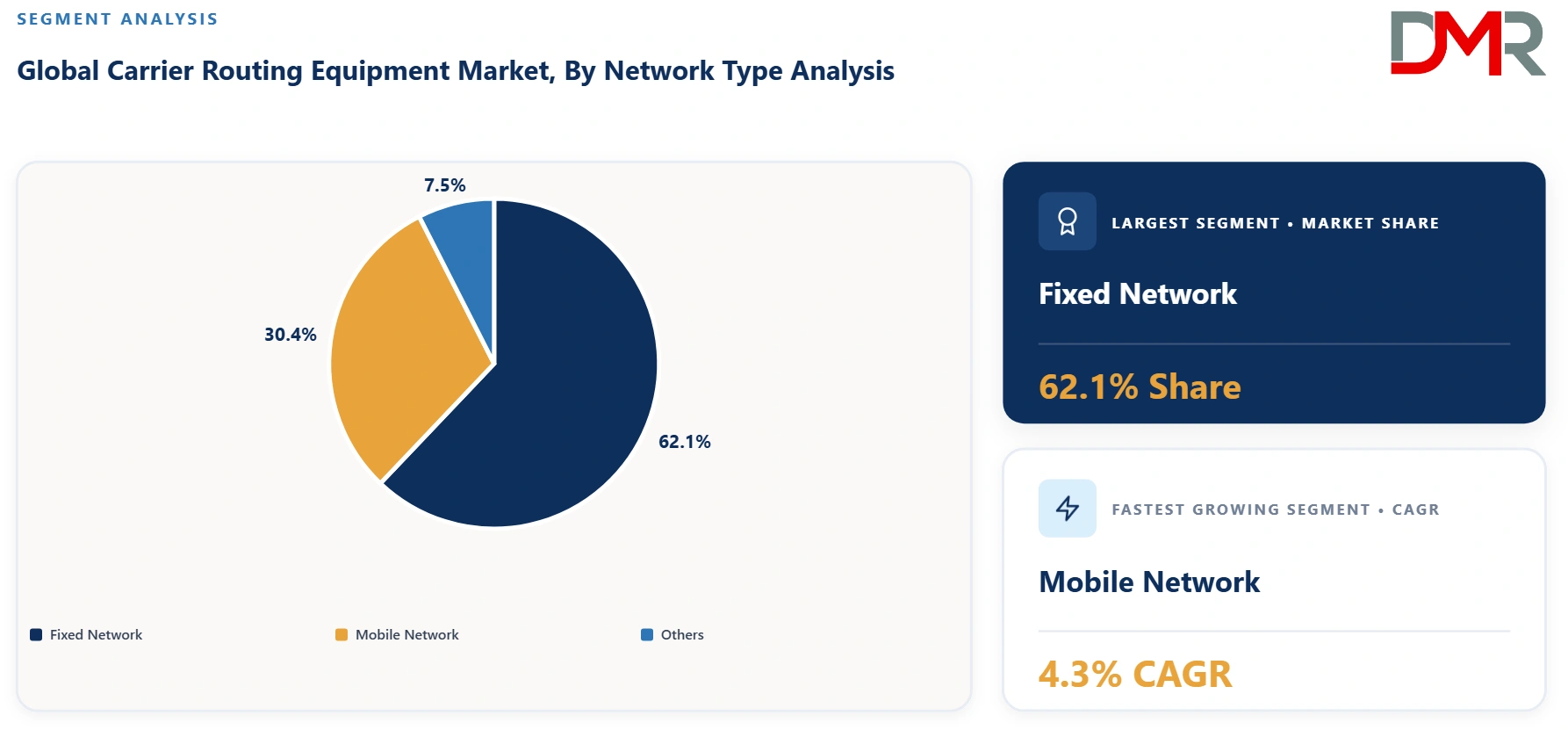
- Fixed Network Dominates the Network Type Segment: Fixed Network holds 62.1% of the market in 2026, backed by its widespread use in broadband connectivity, enterprise networking, and telecommunications infrastructure. However, Mobile Network is the fastest-growing network type segment, with a CAGR of 4.3%, supported by 5G deployment and increasing mobile data consumption.
- Core Routers Dominate the Equipment Type Segment: Core Routers hold 39.7% of the market in 2026 owing to their ability to manage large volumes of data traffic and facilitate communication across extensive network infrastructures. Edge Routers are also the fastest-growing equipment type, with a CAGR of 4.4%, driven by increasing demand for efficient network traffic management, low-latency connectivity, and high-speed data transmission at network access points.
- Telecom Operators Dominate the End User Segment: Telecom Operators hold 64.5% of the market in 2026, supported by their extensive use of Carrier Routing Equipment to manage network traffic and provide reliable communication services. Cloud Service Providers and Data Centre Operators are the fastest-growing End User segment, with a CAGR of 4.6%.
- Asia Pacific Dominates the Regional Market: Asia Pacific holds 41.6% of the market in 2026, supported by established telecommunications infrastructure, high internet penetration, strong presence of networking equipment providers, and continued investments in network modernization.
- Growth Opportunity for Asia Pacific: Asia Pacific is expected to witness the highest CAGR of 4.2%. Expansion of 5G networks, increasing internet penetration, rising mobile data consumption, and investments in telecommunications infrastructure across countries such as China and India are creating growth opportunities for market players.
How AI/Gen AI Is Transforming the Global Carrier Routing Equipment Market?
Artificial intelligence (AI) and generative AI (Gen AI) are revolutionizing the Global Carrier Routing Equipment Market through the enhancement of network management, traffic optimization, and improved operational efficiency. AI technology is used in routing systems to help in the analysis of real-time network data for traffic congestion, prediction of network failures, and selection of data routes. This will ensure that the network performance of telecom companies is maintained without any disruptions. The generative AI technology also supports the operation of networks by helping engineers analyze network problems, configure network settings, and perform repetitive tasks in troubleshooting networks. Predictive maintenance using AI technology allows telecom companies to detect equipment failure before it impacts the performance of their networks.
Key Drivers in the Global Carrier Routing Equipment Market
Increasing Internet Traffic and Bandwidth Requirements
The increased adoption of digital platforms, video streaming, gaming, and cloud computing services is creating significant internet traffic on networks. Telecom operators will need routers that have the ability to handle these increased levels of traffic. Carrier routers help in transmitting large amounts of data across networks and managing traffic. Increased device connections and increased consumption of bandwidth-hungry services have led to an increased demand for carrier router equipment that has the ability to transmit increased amounts of data traffic.
Expansion of 5G Network Infrastructure
The growth of 5G networks requires the adoption of superior carrier routing systems that can help with faster data transfer. There is a need to upgrade existing infrastructure to suit the higher speeds and low latency associated with 5G services. Carrier routers have the function of connecting mobile network cells to the core network and controlling the movement of data from one point to another in the networks. There is increased development of 5G network infrastructure in both developed and developing countries, leading to investments in superior routing systems.
Restraints in the Global Carrier Routing Equipment Market
High Initial Deployment and Infrastructure Costs
Setup and use of the routing equipment by the carrier would entail significant costs incurred on network equipment, setting up the equipment, and related infrastructural costs. Existing network equipment may also need upgrading to ensure compatibility with new routing equipment. Such costs can pose a financial burden, especially to smaller and regional operators who do not have much money to invest. Maintenance of the equipment and further software updates will raise costs of running the network as well. This can pose delays and limit the use of advanced routing equipment among cost-conscious operators.
Network Security and Cybersecurity Risks
Routing devices at the carrier level manage vast amounts of confidential information and form an integral part of the telecommunications infrastructure; hence, network security is one of the primary considerations in this regard. Threats such as cyber-attacks, unauthorized data access, route hijacking, and distributed denial-of-service attacks can adversely impact the working of the network. Telecom companies have to make sure that they have all the necessary measures in place, such as monitoring of security, traffic filtering, access control, and updating of software. This could involve higher costs of operation and technology.
Growth Opportunities in the Global Carrier Routing Equipment Market
Data Centre Infrastructure Expansion
The increasing deployment of hyperscale data Centres and cloud infrastructure presents opportunities for carriers’ routing equipment suppliers. Cloud service providers need large network capacity links to transport data across data Centres located in different geographic locations for various cloud services, including cloud storage, computing, and disaster recovery purposes. This leads to an increasing demand for sophisticated routing technology to process large amounts of traffic. Further, the expanding data Centre capacity in emerging countries is also generating a need for flexible networking infrastructure. Companies that provide routers with high capacity for data Centre interconnection would have the chance to exploit such investments.
Growing Demand for Network Infrastructure in Emerging Economies
Telecommunications network infrastructure is being developed in emerging markets in order to enhance the availability of internet facilities as well as provide greater connectivity via digital means in both urban and rural regions. Countries such as India, Indonesia, Brazil, and Vietnam are experiencing a rising need for broadband connectivity, mobile connectivity, and enterprise networking. It provides room for manufacturers of carrier routers in order to deliver the routers needed for the development of networks in these countries.
Key trends in the Global Carrier Routing Equipment Market
Increasing Adoption of AI-Enabled Network Management
The use of AI technology in telecom operators has been increasing as it helps increase operational efficiencies while making routing easier. AI software helps in analyzing network performance, identifying any abnormal traffic behavior, possible failures, and making appropriate suggestions about routing. The use of AI network management also helps in making it easier to predict the maintenance needs of a network. As networks continue to become more complicated, one trend that will continue to be relevant in the industry is the use of AI technology in carrier routing solutions.
Shift Toward Software-Defined Networking
Software-Defined Networking (SDN) has become increasingly relevant in the market for Carrier Routing Equipment because of the increasing demand for flexibility when managing network infrastructures among telecom companies. SDN decouples the network control plane from the data plane of the network forwarding devices. Therefore, operators will be able to manage their routing policies and resources through software programs. Such an approach facilitates network configuration and bandwidth allocation. In addition, it allows for network automation and management in complex telecommunications settings. The demand for flexible network infrastructures is prompting the development of SDN-compatible routers.
Research Scope and Analysis
The Global Carrier Routing Equipment Market is segmented based on Application into Voice Over IP, Virtual Private Networks, Data Centre Interconnection, Internet Connectivity, Video and Multimedia Delivery, Mobile Backhaul and Others, Network Type into Fixed Network, Mobile Network and Others, Equipment Type into Core Routers, Edge Routers, Access Routers, Transport Routers and Others, End User into Telecom Operators, Cloud Service Providers and Data Centre Operators, Enterprises and Others. Geographically, the market includes Asia Pacific, Europe, North America, Latin America, and the Middle East and Africa.
ℹ
To learn more about this report –
Download Your Free Sample Report Here
By Application Analysis
The Internet Connectivity application segment holds the largest market share by value, accounting for 31.5% of the global market in 2026. Its dominance is attributed to rising internet usage, increasing bandwidth requirements, and growing demand for reliable connectivity. The Data Centre Interconnection application segment is forecasted to experience the highest CAGR of 4.1% during 2027–2035, driven by cloud adoption and data Centre expansion.
By Network Type Analysis
The Fixed Network segment holds the largest market share by value, accounting for 62.1% of the global market in 2026. Widespread fibre-optic infrastructure, fixed broadband connections, and wired telecommunications networks support its dominance. The Mobile Network segment is forecasted to experience the highest CAGR of 4.3% during 2027–2035, driven by 5G deployment and increasing mobile data consumption.
By Equipment Type Analysis
The Core Routers segment holds the largest market share by value, accounting for 39.7% of the global market in 2026. Its dominance is attributed to its ability to manage high volumes of data traffic and support connectivity across large telecommunications networks. The Edge Routers segment is also forecasted to experience the highest CAGR of 4.4% during 2027–2035, driven by increasing demand for efficient network traffic management, low-latency connectivity, and high-speed data transmission at network access points.
By End User Analysis
The Telecom Operators segment holds the largest market share by value, accounting for 64.5% of the global market in 2026. Its dominance is attributed to the extensive use of Carrier Routing Equipment to manage network traffic and deliver voice and data services. The Cloud Service Providers and Data Centre Operators segment is forecasted to experience the highest CAGR of 4.6% during 2027–2035.
The Global Carrier Routing Equipment Market Report is segmented based on the following:
By Application
- Voice Over IP
- Virtual Private Networks
- Data Centre Interconnection
- Internet Connectivity
- Video and Multimedia Delivery
- Mobile Backhaul
- Others
By Network Type
- Fixed Network
- Mobile Network
- Others
By Equipment Type
- Core Routers
- Edge Routers
- Access Routers
- Transport Routers
- Others
By End User
- Telecom Operators
- Cloud Service Providers and Data Centre Operators
- Enterprises
- Others
Regional Analysis
Asia Pacific is the Leading Region in Global Carrier Routing Equipment Market
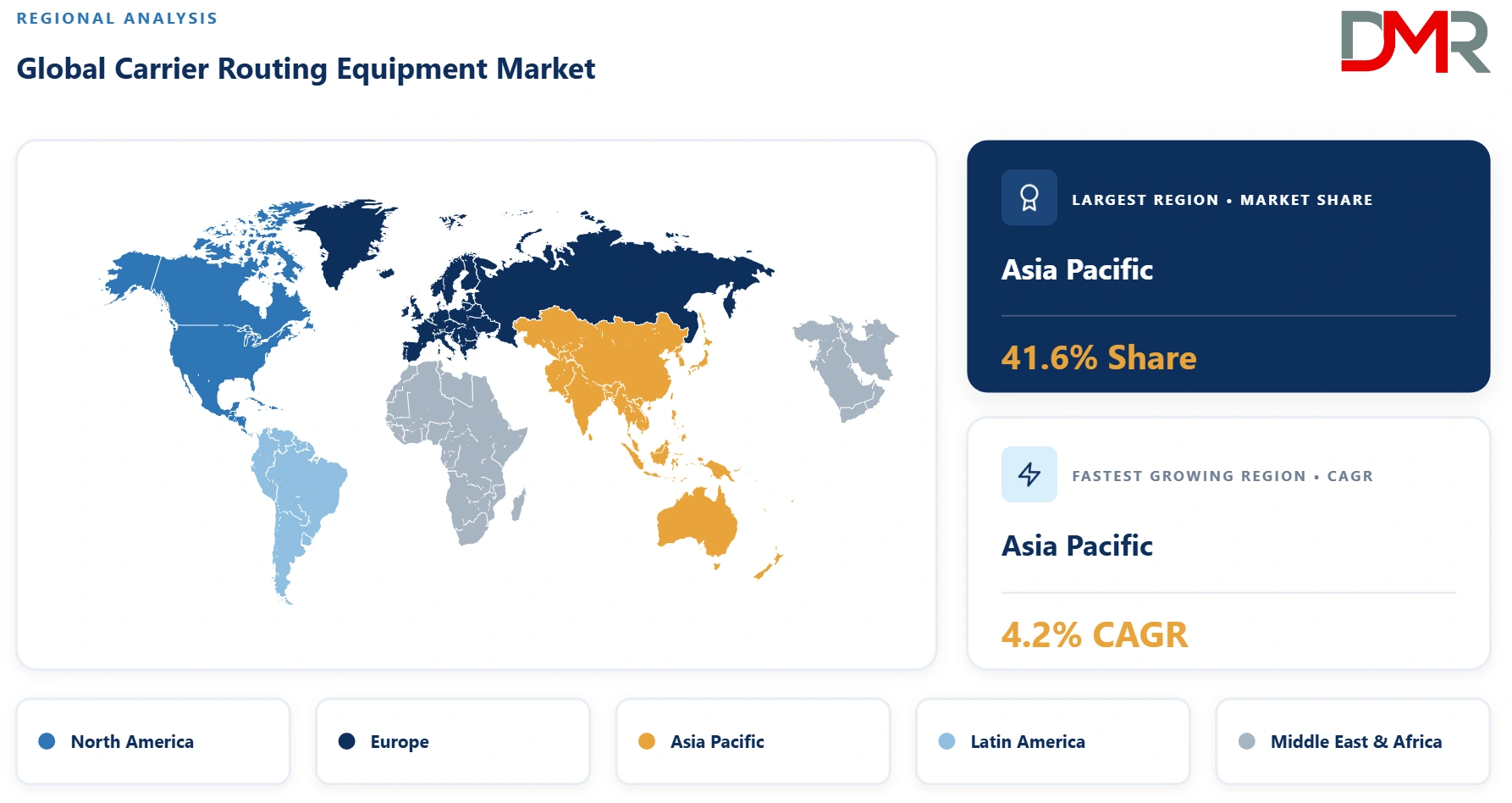
The Asia Pacific region holds a market dominance in the Global Carrier Routing Equipment Market in 2026, holding a market share of 41.6%, valued at USD 12.2 billion. The reason behind this leadership can be attributed to well-developed telecommunication infrastructure, high internet usage, and increased investment in network upgrades. Several countries, including China, India, Japan, and South Korea, are making investments in telecommunication infrastructure and fiber optic network expansion.
ℹ
To learn more about this report –
Download Your Free Sample Report Here
Asia Pacific is the Fastest-Growing Region in Global Carrier Routing Equipment Market
The Asia Pacific region is forecasted to witness the fastest growth in the Global Carrier Routing Equipment Market, registering a CAGR of 4.2% during 2027–2035. The main factors contributing to the growth include fast deployment of 5G networks, increasing penetration of the internet, and increased mobile data usage. Several countries, including China, India, Japan, and South Korea, are making investments in telecommunication infrastructure and fiber optic network expansion.
The Europe Global Carrier Routing Equipment Market
Europe emerges as a major market for Carrier Routing Equipment, owing to a well-developed telecom infrastructure, broadband penetration, and network upgrades in the region. Growing expenditure on the construction of fiber-optic networks, 5G, and high-speed internet is boosting the demand for efficient routing solutions. Moreover, the increasing use of cloud computing, data Centres, and the need for corporate connectivity is compelling telecom operators to invest in network infrastructure upgrades.
The Latin America Global Carrier Routing Equipment Market
The Carrier Routing Equipment Market in Latin America is receiving a boost as a result of the effort being undertaken to close the connectivity gap and enhance coverage in underprivileged regions. Telecom companies are concentrating on enhancing their aging infrastructure to accommodate high data rates. Increased spending in the telecommunications sector in developing nations like Brazil, Mexico, and Chile, along with increased demand for enterprise networking solutions, has created an opportunity for the Carrier Routing Equipment providers.
The Middle East and Africa Global Carrier Routing Equipment Market
There has been some incremental growth seen in the Global Carrier Routing Equipment Market in the Middle East and Africa region, owing to efforts made towards improving digital connectivity and building better telecommunications infrastructure. Countries like Saudi Arabia, the UAE, and South Africa have been making efforts towards developing their broadband networks, 5G networks, and data Centres. Further, the rising need for better internet access, government policies for improving connectivity, and data Centres have led service providers to upgrade their routing infrastructure.
Major Country Analysis
United States Global Carrier Routing Equipment Market
The U.S. Carrier Routing Equipment Market is valued at USD 10.2 billion in 2026 and is expected to reach approximately USD 13.8 billion by 2035, registering a CAGR of 3.4%. Some of the factors that lead to the growth of the market include an increasing number of people using the internet, increased need for high-speed connections, and investment in telecommunications infrastructure. Carrier routing devices help telecom companies and ISPs in managing the traffic and providing connectivity. Apart from that, the growth in the market can be attributed to the growth in 5G networks, fiber optics, cloud computing, and data Centres in the U.S.
Japan Global Carrier Routing Equipment Market
Market growth in the Japan Carrier Routing Equipment Market is driven by the developed telecommunications sector, high internet penetration, and technological advancements in Japan. There are ongoing improvements in the network infrastructure to increase transmission capability and enhance service reliability. The emergence of 5G services, increased use of cloud computing, and data Centre needs are accelerating the demand for better routing systems. In addition, digital transformation in Japan, along with the implementation of next-generation communication networks, is promoting investments in Carrier Routing Equipment.
Saudi Arabia Global Carrier Routing Equipment Market
The Saudi Arabia Carrier Routing Equipment Market is driven by rising investments in the telecom infrastructure in the country and its digitalization programs. The growing use of 5G technology, development of smart cities, and the use of cloud services are leading to the growing demand for superior infrastructure. In addition to this, telecom companies are investing in their existing infrastructure to enhance capacity, data transmission, and connectivity within the organizations. Additionally, the government's digitalization efforts, data centres, and the growing demand for fast internet services are driving the adoption of superior Carrier Routing Equipment.
Technology Analysis
Advancements in technology have impacted the Global Carrier Routing Equipment Market through higher adoption of high-bandwidth routers, software-defined networking, network automation, and AI-enabled traffic management systems. Expansion in the number of 5G networks, development of fiber optics infrastructure, and the demand for data Centre interconnections are driving manufacturers to make faster and energy-efficient routing solutions. Such technological changes offer opportunities for advanced core and edge routers that can handle large volumes of data traffic. Nevertheless, complex technologies, security risks, compatibility with legacy systems, and upgrade costs are some of the challenges that exist.
Investment and White Space Analysis
Investment and White Space Analysis outlines the opportunities presented by increased telecommunication infrastructure investments, network upgrades, and improved connectivity. The growing investments in 5G technology, fiber-optic cables, cloud computing, and hyperscale data Centres have been driving up the need for advanced routing hardware used by carriers. There are also opportunities available in emerging markets due to the expansion of broadband and improvements made to connectivity in underdeveloped areas. Moreover, the need for faster data transmission and robust network infrastructure has been driving telecom companies and service providers to update their existing infrastructure. However, high capital costs, uncertain returns on investments, and regional disparities in infrastructure growth can limit the expansion of the market.
By Region
North America
Europe
- Germany
- France
- The U.K.
- Italy
- Spain
- Rest of Europe
Asia Pacific
- China
- Japan
- India
- Australia
- South Korea
- Rest of APAC
Latin America
- Mexico
- Brazil
- Rest of LATAM
Middle East and Africa
- Saudi Arabia
- The UAE
- South Africa
- Rest of MEA
Competitive Landscape
The Global Carrier Routing Equipment Market is marked by the presence of already existing firms manufacturing telecommunication equipment that compete with each other using innovation, development of products, strategic alliances, and network solutions. The leading companies concentrate on the creation of highly-capable, energy-efficient, and scalable routing equipment capable of solving problems related to increasing data traffic and bandwidth. There are constant investments into the construction of 5G infrastructure, fiber-optic network, cloud connections, and data Centre interconnections, which motivates companies to enhance the portfolio of their products. Moreover, there is an adoption of artificial intelligence, automation, and software-defined networking capabilities for improving performance of networks.
Some of the prominent players in the Global Carrier Routing Equipment Market are:
- Cisco Systems, Inc.
- Huawei Technologies Co., Ltd.
- Nokia Corporation
- Telefonaktiebolaget LM Ericsson
- ZTE Corporation
- Arista Networks, Inc.
- Ciena Corporation
- NEC Corporation
- Fujitsu Limited
- Hewlett Packard Enterprise Company
- Dell Technologies Inc.
- Extreme Networks, Inc.
- ADTRAN Holdings, Inc.
- Ribbon Communications Inc.
- FiberHome Telecommunication Technologies Co., Ltd.
- H3C Technologies Co., Limited
- Ruijie Networks Co., Ltd.
- Edgecore Networks Corporation
- Accton Technology Corporation
- Allied Telesis, Inc.
- Tejas Networks Limited
- HFCL Limited
- Ceragon Networks Ltd.
- Aviat Networks, Inc.
- Ekinops S.A.
- DriveNets Ltd.
- Arrcus, Inc.
- RtBrick Inc.
- 6WIND S.A.
- Radisys Corporation
- Telco Systems
- Actelis Networks, Inc.
- PacketLight Networks Ltd.
- MikroTikls SIA
- Ubiquiti Inc.
- D-Link Corporation
- TP-Link Technologies Co., Ltd.
- MRO-TEK Realty Limited
- Inventum Technologies Private Limited
- Nivetti Systems
- Others
Recent Developments
- In October 2025, Cisco announced the launch of its 8223 routing system, powered by the Silicon One P200 chip. The router delivers a capacity of 51.2 terabits per second and is designed to connect multiple data centres supporting distributed artificial intelligence workloads. The system incorporates deep-buffer routing capabilities and programmability to support high-bandwidth data transmission across data Centre networks. Cisco also confirmed that the 8223 was shipping to initial hyperscale customers. This development highlights advancements in high-capacity routing equipment for data-intensive infrastructure.
- In September 2026, Ciena announced that it would showcase its new 8300 edge router at India Mobile Congress 2026. The router is designed to support AI-driven services through high-performance edge networking, with demonstrations covering coherent routing, segment routing, and Ethernet Virtual Private Network capabilities. This development highlights the growing demand for advanced edge routing solutions to support AI workloads, high-bandwidth services, and increasing network traffic.
Report Details
| Report Characteristics |
| Market Size (2026) |
USD 29.4 Bn |
| Forecast Value (2035) |
USD 39.2 Bn |
| CAGR (2027–2035) |
3.3% |
| The US Market Size (2026) |
USD 10.2 Bn |
| Historical Data |
2021 – 2025 |
| Forecast Data |
2027 – 2035 |
| Base Year |
2026 |
| Segments Covered |
By Application, By Network Type, By Equipment Type, By End User. |
| Regional Coverage |
North America – The US and Canada; Europe – Germany, France, The UK, Italy, Spain, Rest of Europe; Asia-Pacific – China, Japan, India, Australia, South Korea, Rest of APAC; Latin America – Mexico, Brazil, Colombia, Argentina, Rest of LATAM; Middle East & Africa – Saudi Arabia, The UAE, South Africa, Rest of MEA |
Frequently Asked Questions
How big is the Global Carrier Routing Equipment Market?
▾ The Global Carrier Routing Equipment Market is estimated to be valued at USD 29.4 billion in 2026 and is projected to reach approximately USD 39.2 billion by 2035.
What is the CAGR of the Global Carrier Routing Equipment Market from 2027 to 2035?
▾ The Global Carrier Routing Equipment Market is anticipated to grow at a compound annual growth rate (CAGR) of 3.3% during the forecast period from 2027 to 2035.
What factors are driving the growth of the Global Carrier Routing Equipment Market?
▾ The growth of the Global Carrier Routing Equipment Market is driven by increasing internet traffic, rising demand for high-speed connectivity, and the expansion of 5G network infrastructure. Additionally, growing investments in cloud computing, data centres, fibre-optic networks, and telecommunications infrastructure are increasing the demand for high-capacity routing solutions.
What are the major trends in the Global Carrier Routing Equipment Market?
▾ The major trends in the Global Carrier Routing Equipment Market include the increasing adoption of AI-enabled network management and the shift toward Software-Defined Networking (SDN). AI technologies help telecom operators monitor network performance, detect abnormal traffic, predict failures, and optimize routing operations.
Which region held the largest share of the Global Carrier Routing Equipment Market in 2026?
▾ Asia Pacific holds the largest share of the Global Carrier Routing Equipment Market in 2026, accounting for approximately 41.6% of the total market.
Which region is expected to grow the fastest in the Global Carrier Routing Equipment Market?
▾ Asia Pacific is expected to be the fastest-growing regional market during the forecast period, registering a CAGR of 4.2%. The growth is supported by expanding 5G networks, increasing internet penetration, rising mobile data consumption, and investments in telecommunications infrastructure and data centre development across countries such as China, India, Japan, and South Korea.
Who are the key players in the Global Carrier Routing Equipment Market?
▾ Key players in the Global Carrier Routing Equipment Market include Cisco Systems, Inc., Huawei Technologies Co., Ltd., Nokia Corporation, Telefonaktiebolaget LM Ericsson, ZTE Corporation, Arista Networks, Inc., Ciena Corporation, NEC Corporation, Fujitsu Limited, Hewlett Packard Enterprise Company, Dell Technologies Inc., Extreme Networks, Inc., ADTRAN Holdings, Inc., and Ribbon Communications Inc., and Others.
How is the Global Carrier Routing Equipment Market segmented?
▾ The Global Carrier Routing Equipment Market is segmented based on Application into Voice Over IP, Virtual Private Networks, Data Centre Interconnection, Internet Connectivity, Video and Multimedia Delivery, Mobile Backhaul, and Others; Network Type into Fixed Network, Mobile Network, and Others; Equipment Type into Core Routers, Edge Routers, Access Routers, Transport Routers, and Others; and End User into Telecom Operators, Cloud Service Providers and Data Centre Operators, Enterprises, and Others. Geographically, the market is segmented into North America, Europe, Asia Pacific, Latin America, and the Middle East and Africa.