Market Snapshot
- The Global Casino Gaming Equipment Market was valued at USD 15.7 Billion in 2025 and is projected to reach USD 31.20 Billion by 2035, at a CAGR of 7.1%.
- By Product Type, Slot Machines led with a 42.8% revenue share in 2025.
- By Installation, equipment Installed Inside Casino captured a 67.2% share in 2025.
- By Mode of Operation, Floor Mounted units held a 62.7% revenue share in 2025.
- By End User, Casinos accounted for an 82.7% revenue share in 2025.
- North America was the dominant region with a 39.5% revenue share in 2025.
Market Overview
The casino gaming equipment market covers the design, manufacture, and supply of physical hardware deployed on casino floors and in regulated gaming venues. Core product categories include electronic gaming machines, slot cabinets, video lottery terminals, video poker units, electronic table systems, gaming chips, and ancillary validation and payment hardware. The market excludes online gambling software, lottery draw systems operated without physical terminals, and unregulated gaming devices.
Casino gaming equipment sits at the intersection of hospitality, regulated gaming, and consumer electronics. Equipment manufacturers depend on approvals from national and regional gaming commissions before any unit reaches a casino floor, creating a compliance-led commercial cycle unlike most hardware sectors. Operators in commercial casino venues, integrated resorts, and hotel casinos account for the bulk of procurement volume, while cruise casino operators and leisure center concessions represent smaller but consistent demand channels.
Networked gaming terminals now transmit real-time floor performance data to casino management systems, shifting equipment from passive revenue generators to active data assets. Manufacturers that embed analytics-ready hardware into their cabinets can offer operators measurable floor optimization tools. This shift is redefining procurement criteria: buyers increasingly evaluate connected capability and software integration potential alongside unit economics and game content.
Market Size and Forecast
The Global Casino Gaming Equipment Market size is estimated at USD 16.81 Billion in 2026 from USD 15.7 Billion in 2025, and is projected to reach USD 31.20 Billion by 2035, exhibiting a CAGR of 7.1% during the forecast period.
Commercial casino venues in the United States provide a clear benchmark for the scale of physical gaming equipment demand. As reported by the American Gaming Association's State of the States 2025, 492 commercial casino locations across 27 U.S. states generated USD 49.89 billion in total revenue from electronic gaming devices and table games in 2024. That volume of operational throughput directly sustains equipment replacement cycles, floor expansion decisions, and upgrade capex across one of the world's most mature casino markets. A floor generating that revenue level requires continuous hardware investment to maintain uptime, compliance status, and competitive game content.
.webp)
ℹ
To learn more about this report –
Download Your Free Sample Report Here
The forecast trajectory assumes steady legalization activity across emerging jurisdictions continues to unlock greenfield equipment demand. Replacement cycles in established markets are compressing as cashless payment integration and data-linked monitoring standards require hardware upgrades ahead of natural end-of-life timelines. Downside risk centers on regulatory tightening that delays new product approvals, extending the time gap between R&D investment and commercial revenue for equipment vendors.
Product Type Analysis
Slot Machines led the Product Type segment with a 42.8% share in 2026.
Slot machines command the largest share of casino floor space and the highest equipment procurement budgets across all venue types. Operators favor slot cabinets because they generate revenue per square foot with minimal staffing overhead, making floor-level economics compelling for large-format casinos and integrated resort operators alike. Cabinet manufacturers compete on display quality, game content libraries, and networked analytics capability rather than price alone.
Video Lottery Terminals and Video Poker Machines serve distinct operator segments, particularly state-regulated lottery concessions and smaller gaming venues where table staffing costs are prohibitive. Gaming Chips and Casino Tables represent the physical backbone of live table operations. Demand for premium chip sets and RFID-enabled table layouts is rising in high-volume VIP rooms, where tracking accuracy directly affects both security and player loyalty management.
Installation Analysis
With a 67.2% share in 2026, equipment Installed Inside Casino outpaced all other Installation categories.
Casino-interior installations dominate procurement because purpose-built gaming facilities offer the regulatory certainty, infrastructure, and floor management systems that high-specification electronic gaming equipment requires. Operators inside licensed casino premises invest in networked terminal ecosystems that integrate with casino management platforms, loyalty systems, and cashless payment infrastructure. Outside-casino installations face tighter operating hour restrictions and lower per-machine revenue thresholds, which constrain the business case for premium hardware.
.webp)
ℹ
To learn more about this report –
Download Your Free Sample Report Here
Outside-casino channels, including malls and leisure centers, are growing as jurisdictions experiment with distributed gaming formats. These venues typically deploy entry-level or mid-tier terminals rather than the full-feature cabinets seen on traditional casino floors. The revenue per unit is lower, but the aggregate footprint expansion can be meaningful for manufacturers targeting volume over unit value.
Mode of Operation Analysis
Floor Mounted units accounted for 62.7% of Mode of Operation demand in 2026, the highest of any category.
Floor-mounted cabinets define the visual and functional identity of a casino floor. Permanent installations allow operators to build the power, networking, and monitoring infrastructure that modern gaming machines require. Casinos investing in cashless TITO systems and real-time player analytics do so through their floor-mounted terminal estate, not through portable units. The capital intensity of floor-mounted procurement creates multi-year vendor relationships and long replacement cycles.
Portable gaming units serve cruise ships, charity gaming events, and temporary casino operations where fixed infrastructure is impractical. Manufacturers serving this segment prioritize battery longevity, ruggedized cabinets, and offline operating capability. Growth in cruise and riverboat casino deployments is pulling portable unit demand upward, even as floor-mounted units retain their dominant share.
End User Analysis
A 82.7% share made Casinos the clear leader across End User categories in 2026.
Commercial casinos, hotel casinos, and standalone gaming facilities account for the overwhelming majority of global equipment procurement. Large integrated resort operators place multi-year, multi-site orders that set pricing benchmarks for the entire supply chain. Hotel casinos represent a growing sub-channel as international hotel groups in Southeast Asia and the Middle East open gaming floors as part of resort complexes, creating demand for equipment that meets multiple national compliance standards simultaneously.
Malls, leisure centers, and cruise and riverboat casinos each occupy a small but strategically distinct share of the end-user base. Cruise casino operators require compact, maritime-rated hardware built to withstand humidity and movement. Leisure centers and malls deploy lower-denomination machines to serve casual, non-dedicated gaming audiences. Both channels are underpenetrated relative to the scale of their foot traffic, suggesting a volume opportunity for manufacturers willing to develop venue-specific product lines.
Key Market Segments
By Product Type
- Slot Machines
- Video Lottery Terminal
- Video Poker Machines
- Gaming Chips
- Casino Tables
By Installation
- Installed Inside Casino
- Installed Outside Casino
By Mode of Operation
By End User
- Casinos
- Standalone Casino
- Hotel Casino
- Cruise and Riverboat Casino
- Malls
- Leisure Centers
Regional Analysis
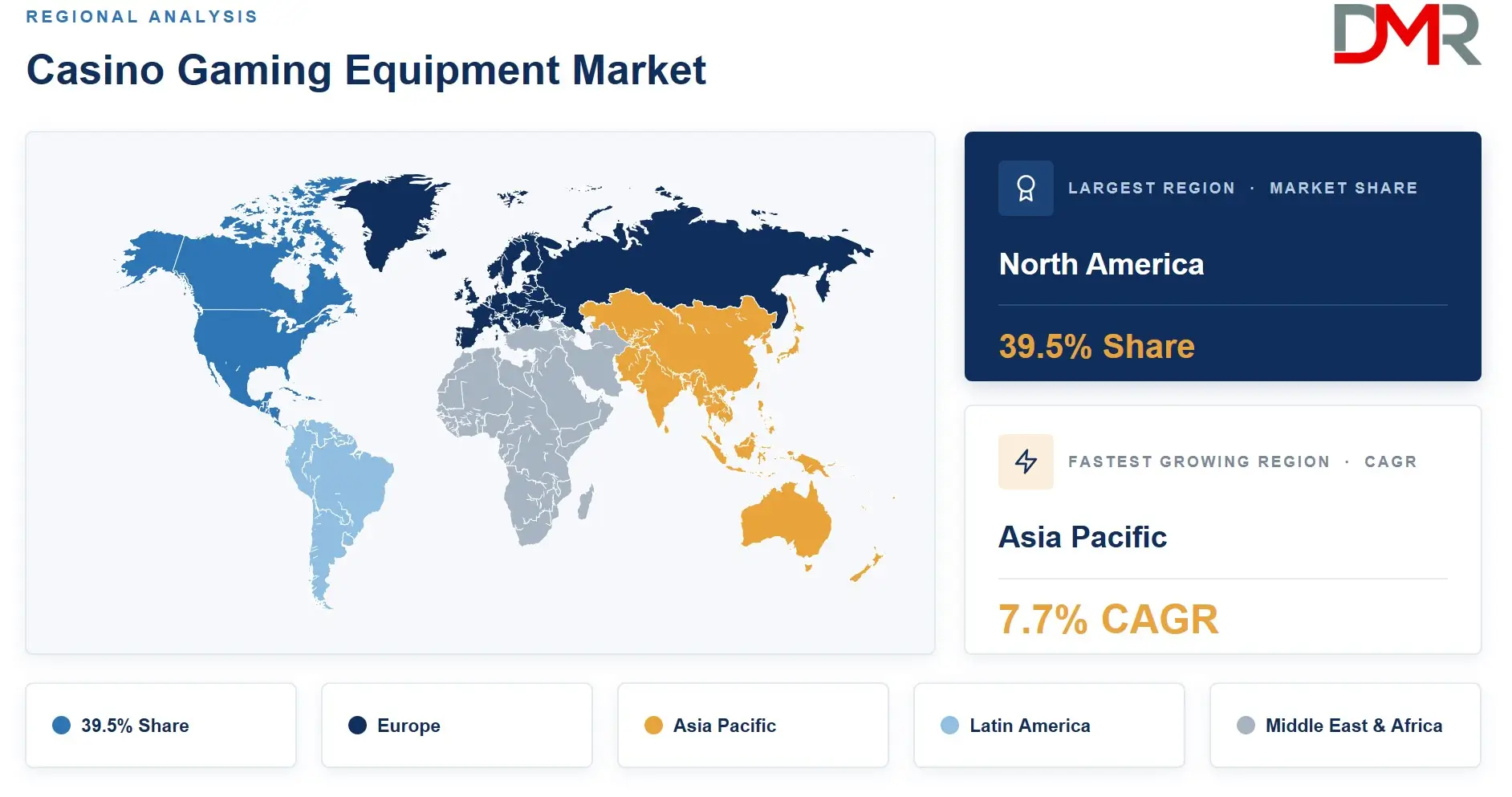
North America led the Regional segment with a 39.5% revenue share in 2026, supported by the world's largest base of licensed commercial casino venues.
The United States anchors North American dominance through its dense network of commercial casinos, tribal gaming facilities, and state-regulated gaming venues. Mature regulatory frameworks across Nevada, New Jersey, and expanding markets in New York and Illinois create continuous equipment replacement and upgrade demand. Canadian provinces add a secondary layer of procurement activity through government-operated casino networks that run multi-year fleet modernization programs.
ℹ
To learn more about this report –
Download Your Free Sample Report Here
Asia Pacific is the fastest-growing regional market, driven by Macau's recovery and new integrated resort developments across the Philippines, Singapore, and Japan. Nearly 1,000 casino floor supervisors in Macau reported operational challenges during RFID smart table rollouts, as reported by SiGMA, underscoring that large-scale equipment modernization in the region requires significant workforce adaptation investment alongside hardware procurement. Europe maintains steady demand through a combination of land-based casino networks and VLT concessions, while Latin America and the Middle East represent early-stage markets where casino legislation is opening new procurement windows for global equipment vendors.
Key Regions and Countries
North America
Europe
- Germany
- France
- The UK
- Spain
- Italy
- Rest of Europe
Asia Pacific
- China
- Japan
- South Korea
- India
- Australia
- Rest of APAC
Latin America
- Brazil
- Mexico
- Rest of Latin America
Middle East & Africa
- GCC
- South Africa
- Rest of MEA
Market Dynamics
Integrated Resorts and Cashless Systems Drive Equipment Replacement
Integrated resort casino developments across emerging tourism hubs are placing large multi-category equipment orders that would otherwise take years to accumulate through incremental floor expansion. A single new resort opening can require hundreds of slot cabinets, complete table game suites, and the full network infrastructure to connect every terminal to a central casino management system. Vendors that can fulfill complex, multi-product orders across multiple compliance jurisdictions hold a structural advantage over specialists.
The shift from cash-based to cashless and TITO payment systems is pulling forward hardware replacement demand that natural end-of-life cycles would not have triggered for several more years. Casino operators upgrading to cashless infrastructure must replace or retrofit every terminal on their floor to accept the new payment protocols. For equipment manufacturers, this represents an accelerated revenue opportunity in markets that would otherwise be in a slow-replacement phase.
Compliance Costs and Capital Intensity Constrain Mid-Tier Operators
Upgrading legacy table-game equipment to RFID-enabled smart configurations requires capital that mid-tier casino operators struggle to justify. An interview published by SiGMA confirms that RFID retrofits on individual casino tables exceeded USD 20,000 per unit, a cost level that makes a full floor conversion a multi-million-dollar commitment. Smaller operators facing that threshold often delay upgrades, creating a two-speed market where large operators modernize faster than the rest.
Staff retraining compounds the capital burden. European casino operators required a two-week structured training program for every dealer and pit boss transitioning to RFID table systems, as documented by the same SiGMA case study. Two weeks of reduced operational efficiency per staff member across a full table-game floor materially raises the total cost of an equipment upgrade beyond the hardware invoice alone. Mid-tier casinos absorbing both the hardware cost and the productivity impact face a genuine barrier to adoption.
Regional Casinos and Cloud Monitoring Create Untapped Revenue Pools
Small and regional casinos operating legacy mechanical devices represent a structurally underpenetrated segment for networked, analytics-ready electronic gaming equipment. Operators in these venues lack the floor performance data that modern casino management platforms provide, putting them at a competitive disadvantage relative to large commercial casinos that actively optimize machine placement, denomination mix, and content rotation. Vendors offering entry-level networked terminals with simplified management interfaces can address this gap without competing on price with premium cabinet suppliers.
Cloud-connected remote monitoring and predictive maintenance platforms are creating a recurring revenue layer that pure hardware manufacturers cannot offer. A vendor that sells a floor-mounted slot cabinet and then provides uptime monitoring, remote diagnostics, and content update services over a subscription contract builds a revenue relationship that outlasts the hardware sale by years. Operators benefit from reduced downtime and lower total ownership cost. Manufacturers that build this service layer gain more durable customer relationships and more predictable revenue than equipment sales alone provide.
Market Trends
Omni-Channel Integration and Modular Cabinet Design Reshape Equipment Value
Casino gaming equipment is converging with online gambling platforms, enabling players to carry session progress between physical machines and digital accounts. Modular cabinet architectures are accelerating this shift by allowing operators to refresh game content without replacing physical hardware, reducing the cycle time between game launches and floor deployment. Vendors building open, upgradable cabinet platforms will capture disproportionate share as operators prioritize total lifecycle value over lowest acquisition cost.
Market Competition Overview
The casino gaming equipment market is moderately consolidated at the top and fragmented in the mid-tier. A small group of global manufacturers with multi-jurisdiction compliance portfolios, established operator relationships, and diversified product lines across electronic gaming machines, table systems, and payment hardware hold the largest revenue shares. These incumbents compete primarily on product breadth, game content libraries, and the speed with which they earn regulatory approval across new markets.
Mid-tier competition is intensifying as regional manufacturers invest in networked gaming technology to close the capability gap with global leaders. Vendor consolidation is reshaping procurement dynamics. In July 2025, Everi Holdings was delisted from the New York Stock Exchange following its acquisition alongside IGT's Gaming & Digital Business by Apollo Funds, with Everi shareholders receiving USD 14.25 per share and IGT receiving USD 4.05 billion in gross cash proceeds. Transactions at this scale reduce the number of independent full-portfolio competitors, concentrating purchasing leverage and product roadmap control among fewer players.
Company Profiles
International Game Technology plc (IGT) is the market's most vertically integrated competitor, with a product range spanning slot cabinets, systems software, lottery terminals, and digital gaming platforms. IGT's scale allows it to pursue regulatory approvals across dozens of jurisdictions simultaneously, a capability that smaller manufacturers cannot replicate cost-effectively. In September 2025, IGT introduced a 55-inch curved-screen AI-powered gaming cabinet designed to analyze player preferences in real time and deliver tailored game content integrated with casino management platforms. The RISE55™ cabinet, which features an UHD display that substantially exceeds the screen real estate of industry-standard dual-screen cabinets as confirmed by CDC Gaming, signals IGT's intent to compete on experience differentiation rather than unit price.
Aristocrat Leisure Ltd. competes through deep game content libraries and a disciplined approach to regulated market entry, prioritizing jurisdictions where its compliance investment yields the highest return. Aristocrat's recurring revenue model, anchored by game content licensing and systems services, insulates it from the cyclical capex swings that affect pure hardware manufacturers. The company's focus on player engagement metrics rather than cabinet specifications reflects a strategic bet that software-led differentiation will outlast hardware-led competition as cabinets commoditize.
Key Players
- Abbiati Casino Equipment S.r.l.
- PlayAGS Inc.
- Rye Park LLC
- Scientific Games Inc.
- TCSJohnHuxley
- Universal Entertainment Corp.
- AGS LLC
- Ainsworth Game Technology Limited
- ALFASTREET
- AMATIC Industries GmbH
- Angel Group Co. Ltd.
- APEX pro gaming s.r.o.
- Aristocrat Leisure Ltd.
- Aruze Gaming America Inc.
- Cammegh
- Eclipse Gaming Systems
- Euro Games Technology Ltd.
- Everi Holdings Inc.
- Konami Group Corporation
- Light & Wonder Inc.
- Matsui Gaming Machine Co. Ltd.
- MERKUR.COM AG
- NOVOMATIC AG
- Gamebridge Casino Equipment
- Gaming Partners International Inc.
- Incredible Technologies Inc.
- Interblock d.d.
- International Game Technology plc
- Jackpot Digital Inc.
Supply Chain and Value Chain Analysis
Casino gaming equipment supply chains begin with electronic component manufacturers supplying display panels, semiconductors, random number generator chips, and bill validators to cabinet assemblers. Cabinet manufacturers source metalwork, cabinetry, and finishing materials from industrial suppliers before integrating electronics, software, and game content into finished units. The highest value in the chain sits with software and game content developers, whose intellectual property determines the commercial attractiveness of each cabinet far more than the hardware specifications alone.
The primary bottleneck is regulatory approval, which sits between manufacturing completion and commercial deployment. A finished cabinet that has not received certification from the relevant gaming laboratory and commission cannot be sold or installed, regardless of its technical quality. Vendors that build compliance testing into their development cycle earlier rather than treating it as a final-stage gate compress time-to-market and reduce the revenue cost of delays.
Regulatory Landscape
Gaming equipment regulation operates at the national and sub-national level, with no unified global standard. Australia's Victorian Gambling and Casino Control Commission amended the Gaming Machine National Standard to Revision 12.1 in December 2025, with the new standard taking effect in August 2026. The Victorian Appendix reduced the maximum cash load-up limit per electronic gaming machine to AUD 100, down from AUD 1,000, directly constraining equipment operating parameters across every linked machine in the jurisdiction. New South Wales adopted the same GMNS 12.1 standard effective March 2026, with a defined 12-month transition period before the Prohibited Features Register retires in September 2026.
Enforcement actions complement technical standards as a compliance pressure point. The UK Gambling Commission reported taking action against 24 operators during 2024–25, resulting in £4.2 million in regulatory fines and settlements, as published in its annual report. Operators facing enforcement exposure tighten their equipment configuration controls and accelerate compliance-driven hardware upgrades, a dynamic that generates both risk and replacement demand for compliant gaming equipment suppliers.
Investment and White Space Analysis
Investment is concentrating in two areas: large-format integrated resort builds across Asia Pacific and the Middle East, and technology upgrades within North America's mature commercial casino network. Greenfield resort projects generate the highest single-order values, but the approval and construction timelines run long. North American upgrade cycles offer nearer-term revenue with lower risk for suppliers already holding floor approvals across U.S. jurisdictions.
The clearest white space sits in small and regional casinos across Latin America and Southeast Asia that still operate first-generation electronic gaming devices without network connectivity. Vendors capable of offering low-cost, compliance-ready networked terminals with remote monitoring and simplified management interfaces can enter this segment without competing against the premium cabinet strategies of global leaders. Cruise casino operators represent a secondary white space, with equipment requirements distinct enough that few manufacturers have built dedicated maritime-rated product lines.'
Recent Developments
- July 2025 — Apollo Funds completed the acquisition of International Game Technology's Gaming & Digital Business and Everi Holdings in an all-cash transaction valued at approximately USD 6.3 Billion, creating a combined enterprise operating under the IGT name with Gaming, Digital, and FinTech business units.
- May 2025 — IGT deployed the RISE55™ gaming cabinet across U.S. casino floors, featuring an ultra-high-definition 55-inch curved display that provides substantially larger screen real estate than industry-standard dual-screen configurations.
Report Details
| Report Characteristics |
| Market Value (2025) |
USD 15.7 Billion |
| Market Value (2026) |
USD 16.81 Billion |
| Forecast Revenue (2035) |
USD 31.20 Billion |
| CAGR (2026–2035) |
7.1% |
| Historical Data |
2020 – 2024 |
| Forecast Data |
2026 – 2035 |
| Base Year |
2025 |
| Report Coverage |
Revenue Forecast, Market Dynamics, Competitive Landscape, Recent Developments |
| Segments Covered |
By Product Type (Slot Machines, Video Lottery Terminal, Video Poker Machines, Gaming Chips, Casino Tables), By Installation (Installed Inside Casino, Installed Outside Casino), By Mode of Operation (Floor Mounted, Portable), By End User (Casinos, Malls, Leisure Centers) |
| Regional Coverage |
North America – US, Canada; Europe – Germany, France, UK, Spain, Italy, Rest of Europe; Asia-Pacific – China, Japan, South Korea, India, Australia, Rest of APAC; Latin America – Brazil, Mexico, Rest of Latin America; Middle East & Africa – GCC, South Africa, Rest of MEA |
| Prominent Players |
Abbiati Casino Equipment S.r.l., PlayAGS Inc., Rye Park LLC, Scientific Games Inc., TCSJohnHuxley, Universal Entertainment Corp., AGS LLC, Ainsworth Game Technology Limited, ALFASTREET, AMATIC Industries GmbH, Angel Group Co. Ltd., APEX pro gaming s.r.o., Aristocrat Leisure Ltd., Aruze Gaming America Inc., Cammegh, Eclipse Gaming Systems, Euro Games Technology Ltd., Everi Holdings Inc., Konami Group Corporation, Light & Wonder Inc., Matsui Gaming Machine Co. Ltd., MERKUR.COM AG, NOVOMATIC AG, Gamebridge Casino Equipment, Gaming Partners International Inc., Incredible Technologies Inc., Interblock d.d., International Game Technology plc, Jackpot Digital Inc., and Other Key Players |
| Customization Scope |
Customization for segments and region or country level will be provided. Additional customization can be done based on requirements. |
| Purchase Options |
We have three licenses to opt for: Single User License, Multi-User License (Up to 5 Users), and Corporate Use License (Unlimited Users and Printable PDF). |
Frequently Asked Questions
What is the biggest investment opportunity in Casino Gaming Equipment Market ?
▾ The clearest near-term opportunity lies in supplying networked, analytics-ready electronic gaming equipment to small and regional casinos still operating legacy mechanical devices, particularly across Latin America and Southeast Asia. Cloud-connected monitoring and predictive maintenance platforms layered over existing equipment estates offer manufacturers a recurring revenue model that outlasts the initial hardware sale.
Who are the top companies in Casino Gaming Equipment Market ?
▾ International Game Technology plc, Aristocrat Leisure Ltd., NOVOMATIC AG, Light & Wonder Inc., and Konami Group Corporation rank among the leading global suppliers by product breadth and regulatory footprint. The July 2025 merger of IGT's Gaming & Digital Business with Everi Holdings under Apollo Funds created one of the largest combined gaming equipment and FinTech enterprises in the market.
Which segment is growing fastest opportunity in Casino Gaming Equipment Market and why?
▾ Outside-casino installation channels and portable gaming units are growing fastest as jurisdictions expand distributed gaming formats beyond traditional licensed floors. Cruise and riverboat casino operators are pulling portable unit demand upward while mall and leisure center concessions absorb entry-level terminal volumes that the traditional casino channel does not service.
Which region is growing fastest opportunity in Casino Gaming Equipment Market and why?
▾ Asia Pacific is the fastest-growing region, with Macau's post-pandemic recovery and new integrated resort projects across the Philippines, Japan, and Singapore generating substantial greenfield equipment demand. Regulatory liberalization in select Southeast Asian markets is opening additional procurement cycles for global equipment vendors that already hold multi-jurisdiction compliance approvals.
What is the biggest challenge holding Casino Gaming Equipment Market back?
▾ Stringent certification and compliance requirements from gaming commissions and testing laboratories remain the single largest structural barrier to growth. RFID smart table retrofits exceeding USD 20,000 per unit, combined with the multi-week staff retraining they require, deter mid-tier casino operators from upgrading at the pace that technology and player preference shifts would otherwise support.