Market Overview
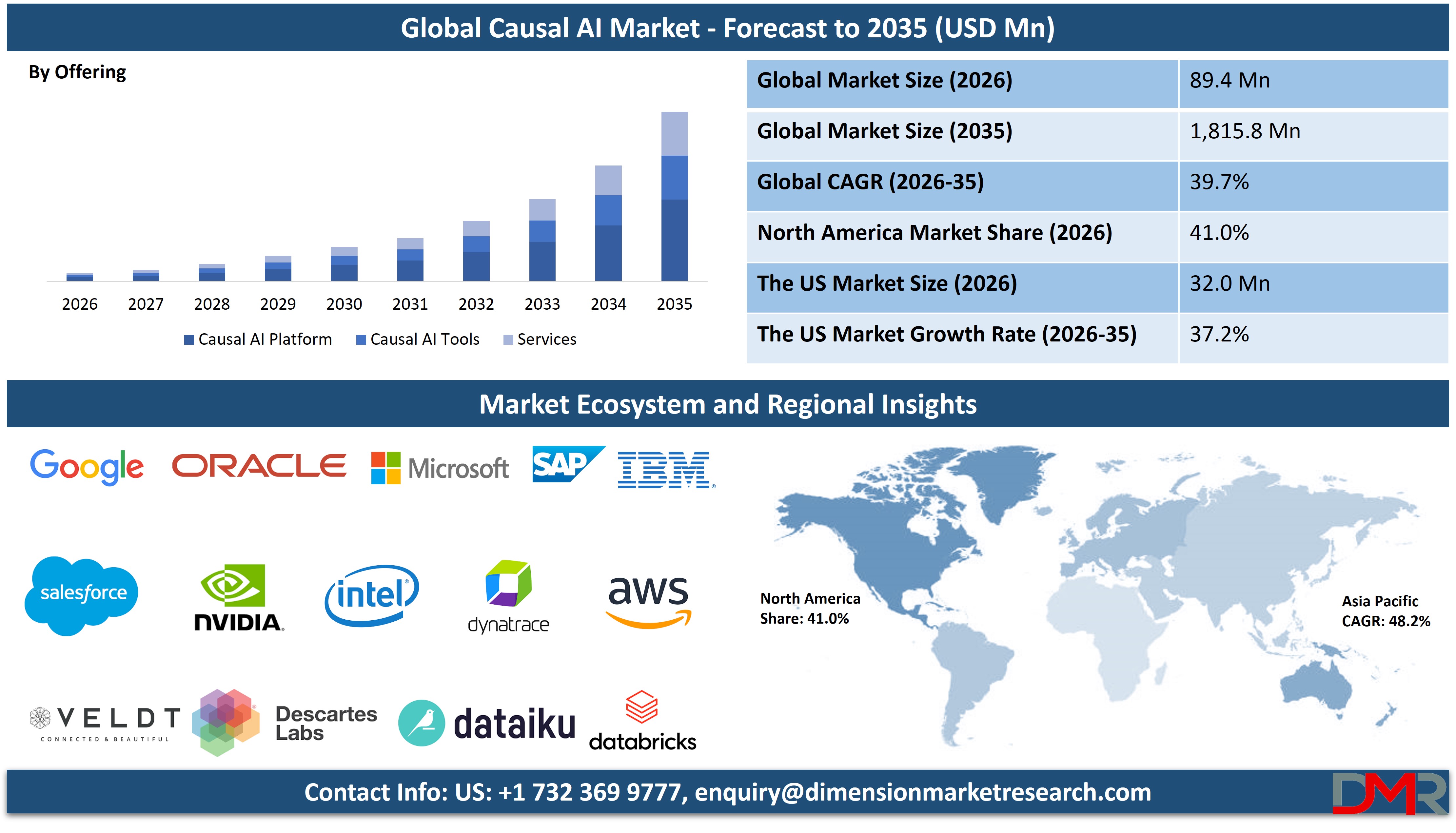
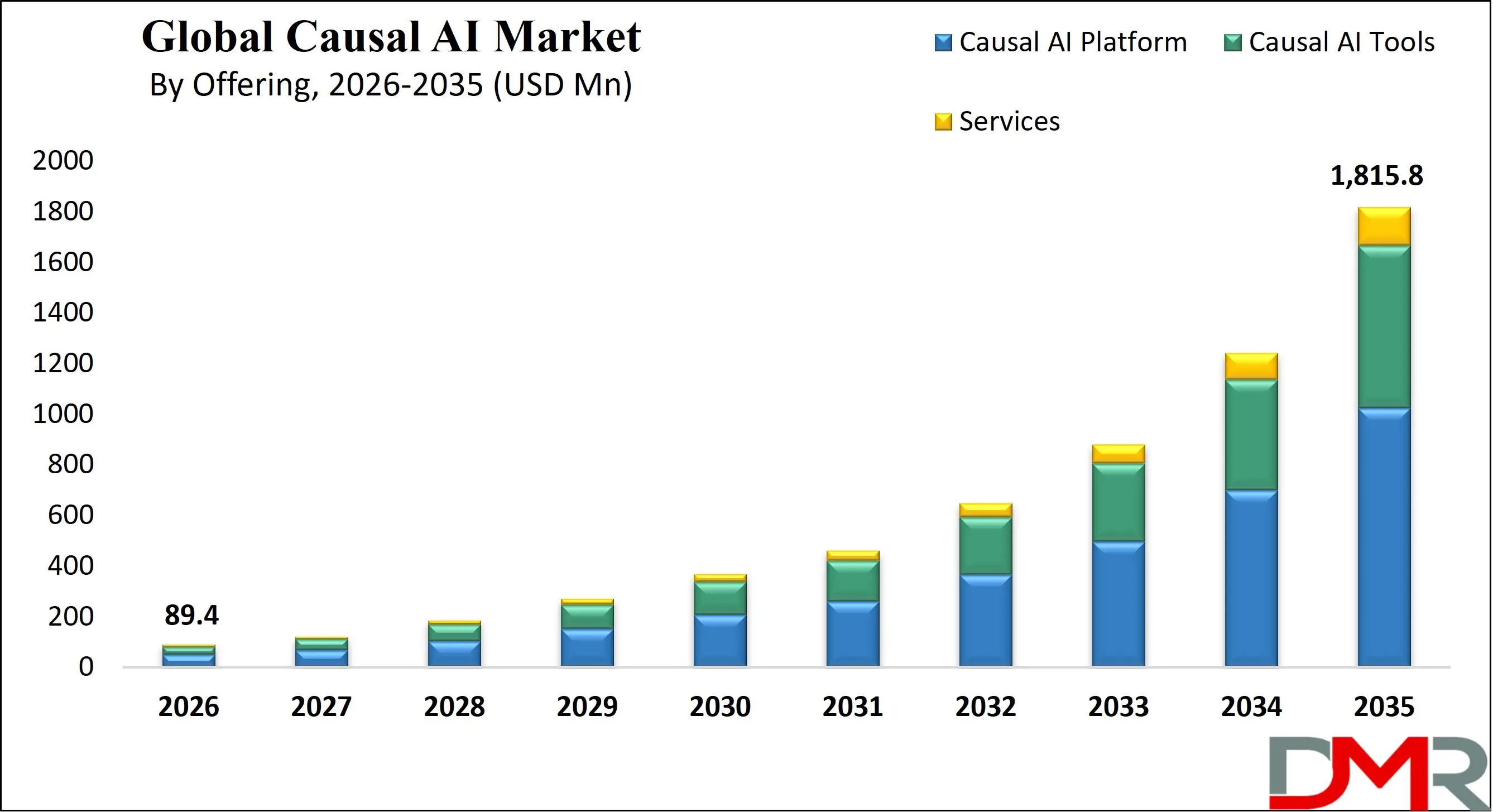
The Global Causal AI Market size is projected to reach USD 89.4 million in 2026 and grow at a compound annual growth rate of 39.7% to reach a value of USD 1,815.4 million in 2035.
ℹ
To learn more about this report –
Download Your Free Sample Report Here
Causal AI, or causal artificial intelligence, refers to intelligent systems designed to uncover, model, and reason about cause-and-effect relationships rather than relying solely on correlations or predictive patterns. Leveraging advanced methodologies such as causal inference, causal discovery, counterfactual reasoning, structural causal models (SCMs), and graph-based causal analysis, these solutions enable explainable AI (XAI) and transparent decision-making in complex environments. Organizations increasingly prioritize causal AI to understand why specific outcomes occur, complementing traditional predictive analytics with actionable insights.
Within the broader AI ecosystem, causal AI enhances algorithmic transparency, decision intelligence, risk-aware AI, and model interpretability, making it particularly critical for regulated industries, high-risk domains, and strategic planning initiatives. Unlike conventional machine learning models, which are prone to bias, data drift, and limited explainability, causal AI provides robust, accountable, and reliable insights, supporting policy evaluation, simulation-based forecasting, and optimization strategies.
The market’s growth is fueled by the integration of causal reasoning with enterprise analytics platforms, cloud-based AI deployments, and hybrid AI architectures, enabling scalable causal modeling and real-time counterfactual analysis. Increased regulatory pressure for explainable AI, along with the demand for trustworthy and auditable AI systems, has positioned causal AI as a core enterprise capability rather than an experimental tool.
ℹ
To learn more about this report –
Download Your Free Sample Report Here
Recent trends highlight a transition from academic research to commercial adoption, with enterprises embedding causal engines into decision intelligence platforms, simulation tools, and optimization frameworks. Innovations such as automated causal discovery, cloud-native causal AI solutions, and integration with machine learning workflows are driving market maturity, accelerating enterprise-scale adoption, and creating long-term growth opportunities in sectors such as finance, healthcare, manufacturing, and energy.
The US Causal AI Market
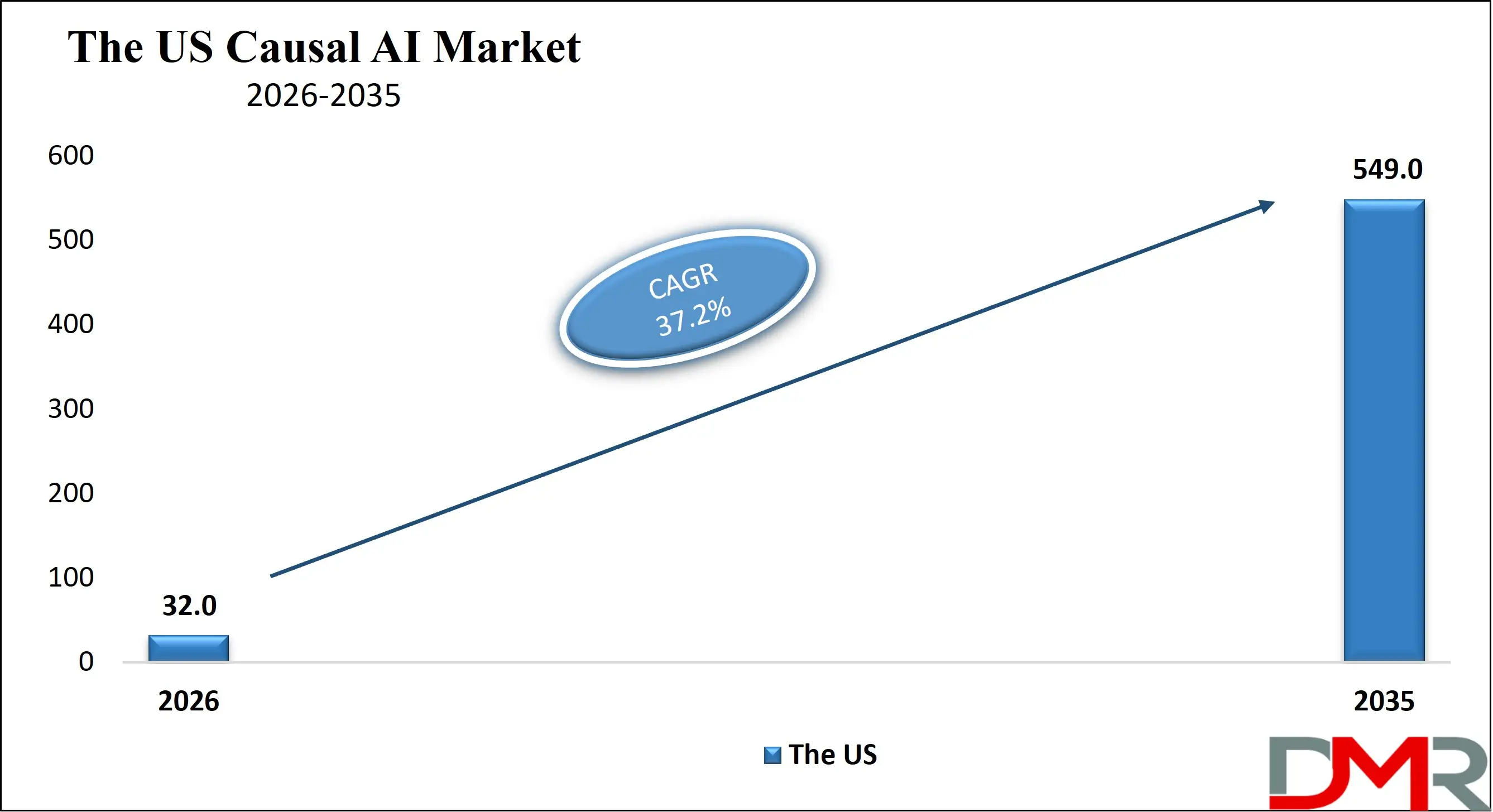
The US Causal AI Market size is projected to reach USD 32.0 million in 2026 at a compound annual growth rate of 37.2% over its forecast period.
The United States represents a leading global market for causal AI, driven by its advanced artificial intelligence ecosystem, concentration of technology innovators, and early enterprise adoption. Key industries, including healthcare, finance, insurance, and defense, are increasingly integrating causal reasoning, counterfactual analysis, and structural causal models to strengthen regulatory compliance, mitigate operational risks, and enhance explainable AI (XAI) capabilities.
ℹ
To learn more about this report –
Download Your Free Sample Report Here
Government initiatives supporting responsible AI, funding for advanced analytics, and AI research grants further accelerate market adoption. Additionally, the availability of mature cloud infrastructure, high-performance computing, and a large data science talent pool enables seamless integration of causal AI into enterprise decision workflows, simulation platforms, and optimization systems. These factors position the US as a dominant contributor to global causal AI revenues, fueling enterprise-scale deployment, innovation in decision intelligence, and scalable AI solutions.
Europe Causal AI Market
Europe Causal AI Market size is projected to reach USD 26.8 million in 2026 at a compound annual growth rate of 36.9% over its forecast period. The market is driven by strict regulatory frameworks emphasizing algorithmic transparency, fairness, and accountability in AI systems. Policies such as the EU AI Act encourage enterprises to adopt causal reasoning, explainable AI (XAI) models, and structural causal frameworks that clarify decision outcomes.
Key adoption sectors include banking, healthcare, energy, and public sector analytics, where regulatory compliance, risk management, and decision traceability are critical. Initiatives such as the European Green Deal, digital transformation programs, and smart government strategies further accelerate the deployment of decision-oriented AI solutions. Strong academic-industry collaboration, research-driven innovation programs, and government-backed AI funding continue to support steady growth, reinforcing Europe’s position as a hub for trustworthy and accountable AI systems.
Japan Causal AI Market
Japan Causal AI Market size is projected to reach USD 4.5 million in 2026 at a compound annual growth rate of 39.9% over its forecast period. Growth is fueled by rapid industrial digitalization, smart manufacturing initiatives, and government-led AI strategies promoting automation, predictive analytics, and data-driven decision-making.
Japanese enterprises are increasingly leveraging causal analytics, counterfactual reasoning, and structural causal models to enhance quality control, predictive maintenance, supply chain resilience, and operational efficiency. Leading adoption occurs in the healthcare and automotive sectors, where safety-critical systems, precision manufacturing, and regulatory compliance demand transparent and explainable decision-making. While challenges such as legacy infrastructure and AI skill gaps persist, strong government backing, industrial AI roadmaps, and focus on automation and smart manufacturing create robust, long-term market opportunities.
Global Causal AI Market: Key Takeaways
- Market Growth from Regulatory Insights: The market is set to expand nearly fivefold from USD 89.4 million in 2026 to USD 1,815.4 million by 2035 (CAGR 39.7%), primarily driven by the global codification of AI governance standards (EU AI Act, U.S. NIST AI RMF) that mandate explainability and robustness, directly favoring causal methodologies.
- Asia-Pacific as the Volume & Growth Frontier: The APAC region will exhibit the highest CAGR, fueled by massive digital transformation programs, government-led AI strategies (China’s Next Generation AI Development Plan, India’s National AI Strategy), and rapid adoption in manufacturing and financial services.
- Offering Segment Insights: Causal AI platforms is projected to dominate with 56.3% revenue share in 2026, offering end-to-end solutions from data ingestion to deployment. Tools, SDKs, and managed services complement platforms, enabling enterprises to scale causal analytics efficiently across multiple teams and applications.
- Deployment Type Segment Insights: Cloud-based deployment, holding 58.0% share by 2026, drives adoption through scalability, seamless integration, and collaboration. Hybrid and on-premises deployments serve regulatory or latency-sensitive use cases, but cloud reduces IT overhead and accelerates enterprise AI workflows.
- Application Segment Insights: Financial Management is the largest application with 37.2% revenue share in 2026, using causal AI for portfolios, fraud, and compliance. Marketing, supply chain, and customer analytics apply causal reasoning to optimize ROI, pricing, and operational efficiency.
- Technology Diversification Beyond Basic Inference: While core causal inference engines maintain dominance, graph-based modeling and counterfactual simulation tools are capturing high-value strategic planning and policy-testing segments due to their scenario exploration capabilities.
Global Causal AI Market: Use Cases
- Counterfactual Credit Scoring in Banking: Causal AI models assess loan applications by simulating an applicant’s creditworthiness under different hypothetical scenarios (e.g., different income levels), enabling fairer lending beyond historical correlation and reducing demographic bias.
- Causal Attribution in Marketing Mix Modeling: Moving beyond last-click attribution, Causal AI disentangles the true incremental impact of each marketing channel (TV, social, search) on sales, optimizing spend allocation by quantifying cause-and-effect relationships amidst noise.
- Root Cause Analysis in Semiconductor Manufacturing: In fabs with thousands of process parameters, Causal AI identifies the precise combination of equipment settings and environmental factors causing yield deviations, accelerating problem resolution and saving millions in waste.
- Causal Patient Stratification in Healthcare: AI models identify not just correlations but causal pathways linking patient genotypes, biomarkers, and treatments to outcomes, enabling personalized medicine and improving clinical trial design by identifying the right patient subgroups.
- Policy Simulation for Public Sector: Governments use counterfactual simulation tools to model the causal impact of proposed policy interventions (e.g., a new tax, educational program) on key socioeconomic metrics before implementation, de-risking public spending.
Global Causal AI Market: Stats & Facts
- The U.S. Department of Commerce stated that explainable and decision-oriented AI investments increased by over 28% in 2025 compared to 2024.
- The European Commission reported that more than 40% of regulated enterprises adopted interpretable AI frameworks by 2025.
- Japan Ministry of Economy, Trade and Industry confirmed AI-driven industrial analytics funding exceeded JPY 1.2 trillion (USD 7.6 million) in 2025.
- OECD indicated that global adoption of causal and explainable AI tools grew at a CAGR above 35% between 2024 and 2025.
- The World Economic Forum noted that over 60% of enterprises deploying AI in high-risk decisions prioritized causal reasoning capabilities in 2025.
Global Causal AI Market: Market Dynamic
Driving Factors in the Global Causal AI Market
Demand for Explainable and Trustworthy AI
The increasing need for transparency and accountability in AI-driven decisions is a major growth driver for the Causal AI market. Traditional black-box models often fail to meet regulatory and ethical standards, especially in sectors such as healthcare, finance, and public policy. Causal AI provides interpretable insights by explaining why outcomes occur, not just predicting them. This capability helps organizations build trust with regulators, customers, and stakeholders. As AI regulations tighten globally, enterprises are prioritizing causal models to ensure compliance, reduce bias, and improve decision reliability.
Shift Toward Decision Intelligence
Organizations are moving beyond predictive analytics toward decision intelligence platforms that guide actions and interventions. Causal AI enables scenario testing, policy evaluation, and counterfactual analysis, allowing businesses to understand the impact of decisions before implementation. This shift is particularly relevant in supply chain management, pricing strategies, and risk planning. The ability to simulate outcomes under different conditions enhances strategic agility and operational efficiency, making causal AI a critical component of next-generation analytics solutions.
Restraints in the Global Causal AI Market
High Complexity and Skill Requirements
Implementing Causal AI requires advanced expertise in statistics, data science, and domain knowledge, which limits adoption among smaller organizations. Building accurate causal models involves complex assumptions, data preparation, and validation processes. The shortage of skilled professionals and the steep learning curve increase deployment costs and slow adoption. These challenges can discourage enterprises with limited resources from fully embracing causal AI solutions.
Data Limitations and Integration Challenges
Causal AI relies heavily on high-quality, well-structured data to establish reliable cause-and-effect relationships. Inconsistent, biased, or incomplete datasets can undermine model accuracy. Additionally, integrating causal engines with existing legacy systems and data pipelines can be technically challenging. These limitations affect scalability and may delay deployment, particularly in organizations with fragmented data ecosystems.
Opportunities in the Global Causal AI Market
Expansion in Regulated Industries
Highly regulated sectors such as healthcare, insurance, banking, and energy present significant growth opportunities for Causal AI. These industries require transparent decision frameworks to meet compliance and audit requirements. As regulations evolve, demand for causal reasoning tools that support explainability and accountability is expected to rise, creating untapped potential for vendors offering industry-specific solutions.
Integration with Advanced AI Technologies
Combining causal inference with machine learning, reinforcement learning, and generative AI opens new growth avenues. Hybrid systems can deliver both predictive accuracy and causal understanding, enhancing automation and optimization capabilities. This integration enables more adaptive and resilient AI systems, driving adoption across complex, dynamic environments.
Trends in the Global Causal AI Market
Automation of Causal Discovery
Automated causal discovery tools are gaining traction as they reduce manual modeling efforts and accelerate deployment. These tools identify causal structures directly from data, making causal AI more accessible to enterprises. Automation improves scalability and supports real-time decision-making, shaping the market’s evolution.
Cloud-Based Causal AI Platforms
Cloud deployment is emerging as a dominant trend due to scalability, cost efficiency, and ease of integration. Cloud-based causal AI platforms enable organizations to process large datasets, collaborate across teams, and deploy models faster. This trend supports broader market adoption, particularly among mid-sized enterprises.
Research Scope and Analysis
By Offering Analysis
Causal AI Platforms are projected to dominate the global market, holding an estimated 56.3% revenue share through the forecast period. This dominance is anchored in the enterprise demand for integrated, production-grade solutions rather than piecemeal tools. End-to-End Causal AI Platforms provide a unified environment for data ingestion, causal discovery, model building, validation, counterfactual simulation, and deployment, streamlining the entire workflow. Their value proposition lies in reducing time-to-insight and ensuring methodological rigor through guided workflows. Causal Discovery & Inference Engines form the core computational layer of these platforms, handling the heavy lifting of identifying causal structures from complex, high-dimensional data. The primary demand drivers are large enterprises in BFSI and Tech that require scalable, governed, and collaborative environments to deploy causal analytics across multiple teams and use cases.
Causal AI Tools represent the modular approach, allowing organizations to address specific needs. Decision Intelligence Tools that overlay causal insights on business KPIs are gaining traction for executive dashboards. Software Development Kits (SDKs) and Causal AI APIs are critical for embedding causal capabilities into existing applications and data science pipelines. While platforms dominate in greenfield deployments, tools hold strong appeal for augmenting existing analytics stacks and for use by specialized data science teams.
Services are essential for market activation, given the complexity. Professional Services for implementation, customization, and training account for the majority of service revenue. Managed Services, where vendors remotely operate and optimize a causal AI environment, are growing rapidly among organizations that lack in-house expertise.
By Deployment Mode Analysis
Cloud-based Deployment is the dominant and fastest-growing mode, expected to hold over 58.0% share by 2030. The scalability, access to managed AI services, and ease of integrating with cloud data warehouses (Snowflake, BigQuery, Databricks) make cloud deployment the logical choice. It facilitates collaboration, easier updates to causal models, and reduces the IT overhead for enterprises.
Hybrid Deployment is significant for industries with strict data sovereignty or latency requirements (e.g., healthcare with PHI, manufacturing with real-time OT data). It allows sensitive data to remain on-premises while leveraging cloud-based causal inference engines or model training.
On-Premises Deployment maintains a niche, primarily in government, defense, and highly regulated BFSI firms, where data cannot leave the private data center. Its share is gradually declining as cloud security assurances improve.
By Technology Analysis
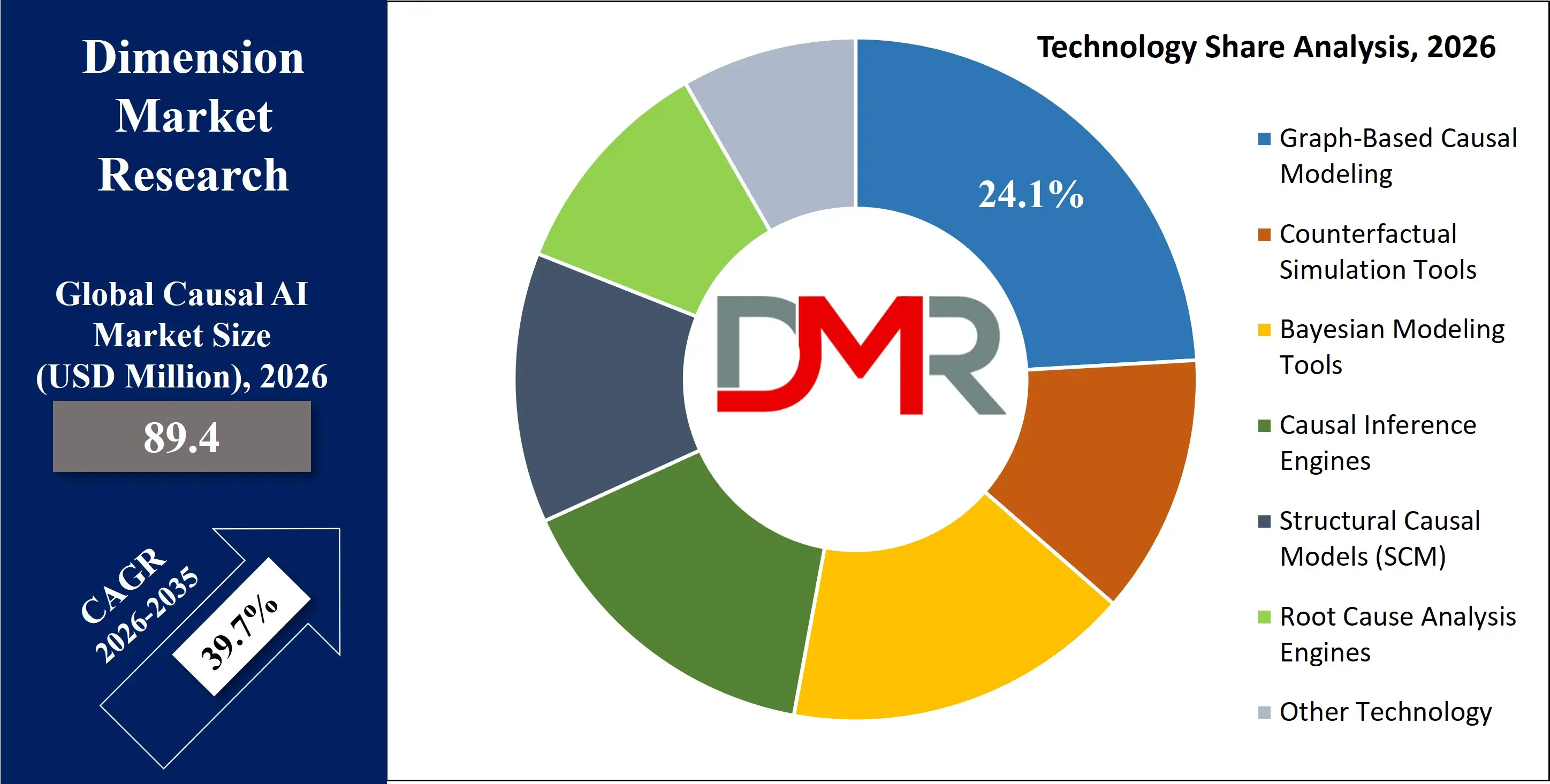
Graph-Based Causal Modeling and Structural Causal Models (SCMs) are the foundational technologies driving the Causal AI market. These frameworks excel at representing complex systems with interdependent variables, enabling organizations to model intricate relationships between multiple factors. SCMs provide a formal structure for defining causal relationships, while graph-based approaches visualize dependencies, identify confounders, and support counterfactual reasoning. Their versatility makes them indispensable across enterprise risk management, financial modeling, and operational simulations, where understanding interdependencies is critical.
ℹ
To learn more about this report –
Download Your Free Sample Report Here
Counterfactual Simulation Tools are emerging as the highest-growth technology segment, primarily due to the increasing demand for strategic planning, policy testing, and scenario analysis. These tools allow enterprises to ask “What would have happened if?” or “What will happen if we implement X?”, providing a foundation for predictive and prescriptive decision-making. They are widely applied in marketing optimization, resource allocation, and operational planning, enabling decision-makers to evaluate multiple strategies before implementation.
Causal Inference Engines form the workhorse layer of the market, deriving accurate causal estimates from observational and experimental data. Techniques like Double Machine Learning, Meta-Learners, and instrumental variable approaches are continuously improving performance, enabling faster and more reliable causal effect estimation.
Bayesian Modeling Tools and Root Cause Analysis Engines serve specialized roles. Bayesian models quantify uncertainty, supporting risk assessment, forecasting, and probabilistic decision-making, while root cause analysis is critical for troubleshooting complex systems, such as industrial IoT networks or IT infrastructure. Collectively, these technologies form a comprehensive ecosystem supporting decision intelligence, optimization, and risk-aware AI, making them central to enterprise adoption of Causal AI.
By Application Analysis
Financial Management is poised to be the largest and most dominant application segment, expected to capture over 37.2% of the market revenue by the end of 2026. Finance inherently relies on cause-and-effect relationships, such as the factors driving asset price movements, loan defaults, or fraudulent activities. Causal AI transforms traditional descriptive analytics into prescriptive frameworks, allowing organizations to model the impact of macroeconomic shocks, regulatory changes, and strategic interventions. Key sub-applications include portfolio performance modeling, fraud monitoring, and compliance analytics, where causal models identify root drivers of risk and automate regulatory reporting.
Marketing and Pricing Management is a high-value application area, leveraging causal attribution to optimize marketing mix strategies, dynamic pricing, and customer lifetime value (CLV) calculations. Unlike conventional analytics that often conflate correlation with causation, Causal AI allows enterprises to identify the true drivers of customer behavior, improving return on marketing spend and enabling data-driven growth strategies.
Operations and Supply Chain Management is critical for resilient and efficient operations, using Causal AI for root cause analysis, causal demand forecasting, and simulating supplier disruptions. Retailers and e-commerce firms utilize causal models for inventory optimization, dynamic pricing, and customer journey analytics, enhancing operational agility and reducing stock-outs.
Sales and Customer Management benefits from causal models by identifying the real drivers of churn, optimizing sales interventions, and personalizing interactions based on causal relationships rather than simple correlations. Across these applications, Causal AI enables evidence-based decision-making, improved ROI, and risk-aware operational planning, reinforcing its growing adoption across strategic enterprise functions.
By Organization Size Analysis
Large enterprises are the dominant adopters of Causal AI, expected to account for 65.0% of total revenue in 2026. Their complex decision-making processes, vast and varied datasets, and exposure to regulatory requirements make causal transparency and explainability critical. Sectors such as banking, insurance, pharmaceuticals, and technology rely on Causal AI to improve risk management, compliance reporting, and operational efficiency. Large organizations have the financial resources and specialized talent required to deploy enterprise-scale platforms, integrate advanced analytics into workflows, and satisfy board-level and regulatory scrutiny.
Small and Medium Enterprises (SMEs), however, represent the fastest-growing segment in terms of adoption rate (CAGR). Adoption is initially led by tech-native SMEs and consulting firms, leveraging cloud-based Causal AI platforms and APIs to reduce costs and skill barriers. SMEs are using Causal AI for focused applications such as digital marketing optimization, e-commerce conversion rate improvement, and targeted customer analytics, often starting with modular tools before scaling to full platforms. The increasing availability of software-as-a-service (SaaS) causal solutions democratizes access, enabling SMEs to compete with larger organizations by leveraging evidence-based decision-making and predictive planning in critical areas of business operations.
By Industry Vertical Analysis
Banking, Financial Services & Insurance (BFSI) is the largest vertical, projected to hold over 27.2% market share by the end of 2027. Applications include anti-money laundering, credit risk assessment, algorithmic trading, insurance claims analysis, and customer profitability modeling. Regulatory requirements around model explainability, fairness, and risk management make causal approaches a necessity in this sector.
Healthcare & Pharmaceuticals is a fast-growing vertical, driven by drug discovery, clinical trial optimization, and personalized treatment planning. Causal AI enables the identification of biological pathways, treatment impacts, and outcome prediction, aligning naturally with the scientific method in biomedical research.
Technology & IT Services companies are both providers and adopters, using Causal AI for system reliability engineering (SRE), customer success analytics, and product impact assessment. Manufacturing leverages Causal AI for quality control, predictive maintenance, and smart factory optimization, improving operational efficiency. Retail & E-commerce applies causal models for customer journey analysis, pricing, and inventory management, enhancing responsiveness to market changes.
Energy, Utilities & Renewable Resources use causal AI for grid optimization, demand forecasting, and predictive asset maintenance, enabling better resource allocation, cost reduction, and sustainable operations. Across verticals, Causal AI adoption is guided by the need for explainability, performance optimization, and risk mitigation, making it an essential tool for strategic decision-making and operational resilience.
The Global Causal AI Market Report is segmented on the basis of the following
By Offering
- Causal AI Platform
- End-to-End Causal AI Platforms
- Causal Discovery & Inference Engines
- Causal AI Tools
- Decision Intelligence Tools
- Causal Discovery Tools
- Software Development Kits (SDKs)
- Root Cause Analysis Tools
- Causal AI APIs
- Causal Modeling Tools
- Services
- Professional Services
- Managed Services
By Deployment Mode
By Technology
- Graph-Based Causal Modeling
- Counterfactual Simulation Tools
- Bayesian Modeling Tools
- Causal Inference Engines
- Structural Causal Models (SCM)
- Root Cause Analysis Engines
- Other Technology
By Application
- Financial Management
- Portfolio Analysis & Simulation
- Factor-Based Investing
- Investment Performance Evaluation
- Fraud Monitoring & Detection
- Regulatory & Compliance Analytics
- Other Financial Management Applications
- Marketing & Pricing Management
- Portfolio Analysis & Simulation
- Factor-Based Investing
- Investment Performance Evaluation
- Fraud Monitoring & Detection
- Regulatory & Compliance Analytics
- Other Marketing & Pricing Applications
- Operations & Supply Chain Management
- Portfolio Analysis & Simulation
- Factor-Based Investing
- Investment Performance Evaluation
- Fraud Monitoring & Detection
- Regulatory & Compliance Analytics
- Other Operations & Supply Chain Applications
- Sales & Customer Management
- Portfolio Analysis & Simulation
- Factor-Based Investing
- Investment Performance Evaluation
- Fraud Monitoring & Detection
- Regulatory & Compliance Analytics
- Other Sales & Customer Management Applications
- Other Applications
By Organization Size
- Large Enterprises
- Small and Medium Enterprises(SMEs)
By Industry Vertical
- Banking, Financial Services & Insurance (BFSI)
- Media, Entertainment & Broadcasting
- Healthcare & Pharmaceutical
- Retail & E-commerce
- Manufacturing
- Transportation, Logistics & Fleet Management
- Telecommunications
- Energy, Utilities & Renewable Resources
- Government & Public Sector
- Technology & IT Services
- Other Verticals
Global Causal AI Market: Regional Analysis
Leading Region in the Causal AI Market
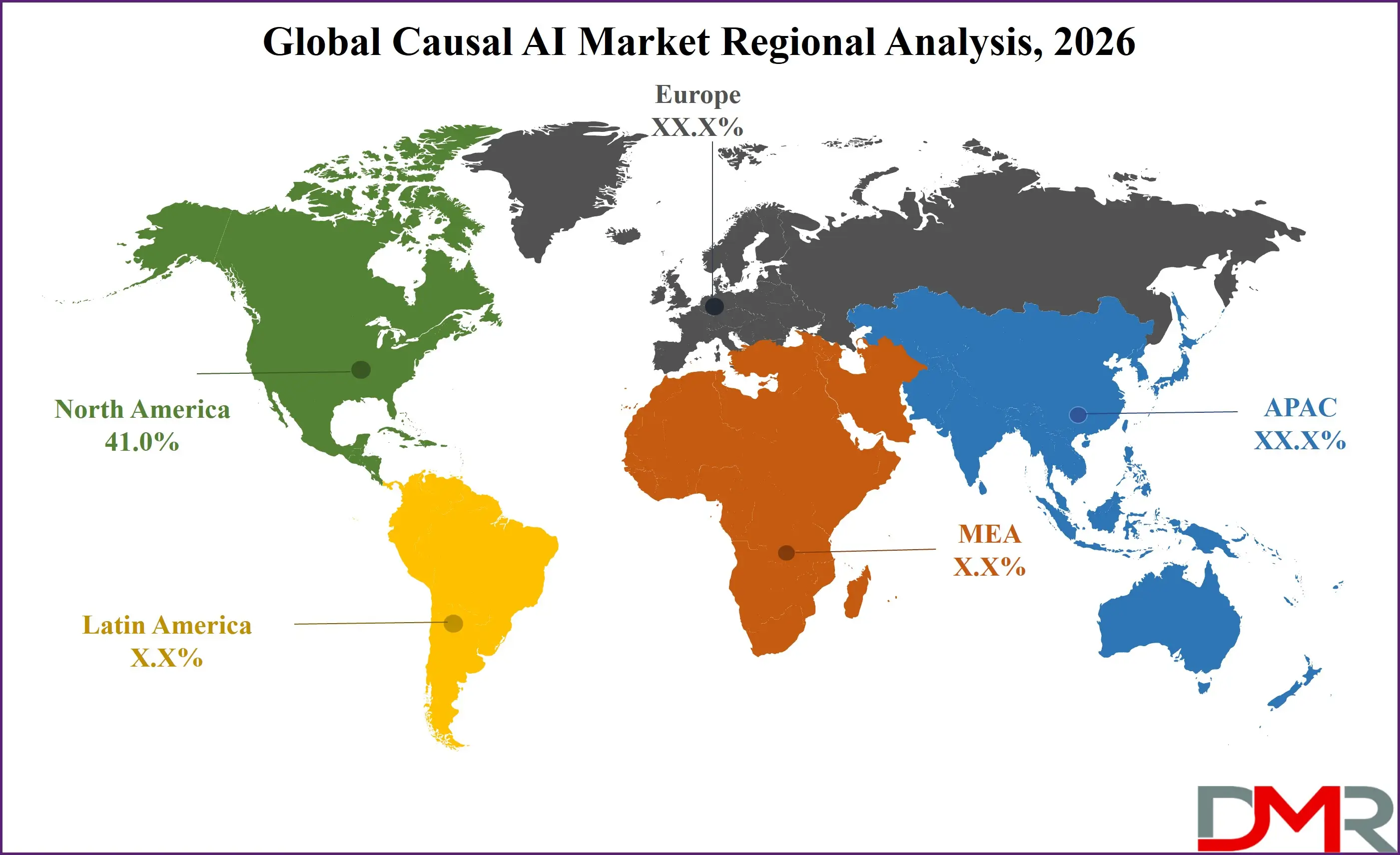
North America will be leading the Causal AI market with a 41.0% share in 2026, because its market fundamentals are primed for enterprise adoption today. The region, led by the United States, possesses a critical combination of the world's largest concentration of AI talent and research, deep-pocketed enterprises in leading verticals (tech, finance, pharma), and a regulatory environment that is increasingly focusing on algorithmic accountability. This creates a strong, willing, and able customer base for premium Causal AI platforms and services.
ℹ
To learn more about this report –
Download Your Free Sample Report Here
Crucially, this demand is reinforced by a mature cloud and data infrastructure ecosystem, which provides the necessary foundation for deploying complex causal models. This environment has nurtured a first-mover ecosystem of specialized Causal AI vendors (e.g., CausaLens), cloud AI platforms with causal features, and system integrators. The revenue lead is thus built on a foundation of high-value enterprise contracts in the BFSI and technology sectors, where the need for robust, explainable decision-making is a strategic imperative.
Fastest Growing Region in the Causal AI Market
Asia-Pacific achieves the highest CAGR because it represents the planet's most powerful convergence of massive digitalization and industrial automation on an unprecedented scale. The region is home to the world's largest manufacturing base and fastest-growing financial markets, where the application of AI for efficiency and risk management is critical. This is compounded by strong top-down government mandates (China's AI strategy, Singapore's National AI Strategy) that promote the development and adoption of advanced AI, including trustworthy AI. The growth catalyst is the scale of implementation in smart manufacturing, fintech, and e-commerce.
While North America's growth is driven by regulatory and strategic demand from mature enterprises, Asia-Pacific's is fueled by industrial-scale problem-solving and integration into next-generation digital infrastructure. However, this market is in an earlier maturity stage. Challenges like a nascent talent pool for causal methodologies and a focus on rapid, applied solutions over foundational research shape the adoption pattern, with growth initially skewed towards tools and cloud APIs rather than full-scale platforms.
By Region
North America
Europe
- Germany
- The U.K.
- France
- Italy
- Russia
- Spain
- Benelux
- Nordic
- Rest of Europe
Asia-Pacific
- China
- Japan
- South Korea
- India
- ANZ
- ASEAN
- Rest of Asia-Pacific
Latin America
- Brazil
- Mexico
- Argentina
- Colombia
- Rest of Latin America
Middle East & Africa
- Saudi Arabia
- UAE
- South Africa
- Israel
- Egypt
- Rest of MEA
Competitive Landscape
The Causal AI market is defined by innovation-driven competition, with vendors focusing on developing advanced capabilities that differentiate their offerings. Leading players prioritize research and development, emphasizing automated causal discovery, counterfactual analysis, and integration with machine learning workflows to deliver actionable insights at scale. Platform integration has emerged as a critical strategy, enabling seamless incorporation of causal engines into enterprise decision intelligence systems, simulation tools, and optimization platforms, which enhances operational efficiency and supports strategic planning across industries.
Scalable deployment models, particularly cloud-based and hybrid architectures, are increasingly adopted to address the growing demand from enterprises of all sizes. Companies are also pursuing strategic partnerships with software providers, cloud infrastructure firms, and analytics consultancies to expand market reach, co-develop solutions, and embed causal capabilities into broader enterprise ecosystems.
High entry barriers characterize the market due to the technical complexity of causal modeling, the need for specialized talent, and the requirement for deep domain expertise to interpret causal relationships accurately. These factors favor established vendors with proven analytical capabilities, mature platforms, and industry-specific knowledge. Emerging players often target niche applications, such as marketing optimization, predictive maintenance, or finance-specific causal engines, to gain early traction.
Some of the prominent players in the global Causal AI are
- IBM
- Microsoft
- Google
- Amazon Web Services (AWS)
- Oracle
- SAP SE
- NVIDIA
- Meta
- Geminos
- Glencoe Software
- Howso
- H20.ai
- Impact Genome
- Intel
- Salesforce
- Alibaba
- VELDT Inc
- Databricks
- CausaLens
- Causaly
- Causely
- Aitia
- Cognizant
- Dataiku
- Descartes Lab
- Element AI
- EY
- Actable AI
- Unlearn.AI
- Dynatrace
- Logility
- Invrmntl
- Modzy
- Nebula
- OpenAI
- Pinterest
- PwC
- RapidMiner
- Restackio
- Seldon
- Shopify
- Slack
- Snowflake
- Symphony Ayasdi AI
- Taskade
- ThoughtSpot
- TikTok
- Trifacta
- Twitter
- Uber
- WeChat
- Wipro
- Amelia.ai
- Biotx.ai
- Beyond Limits
- Blue Prism
- Aible
- Parabole.AI
- Data Poem
- Lifesight
- Causa
- CausaAI
- CognitiveScale
- Causality Link
- Scalnyx
- DataRobot
- Other Key Players
Recent Developments
- In January 2026, Allos AI announced USD 5.0 million in seed financing led by Oxford Science Enterprises (OSE) to commercialize the industry's first "glass-box" Causal AI platform, accelerating the end-to-end reformulation of complex generic drugs. The funding will support expansion across formulation development and data science as the company focuses on hard-to-genericize small-molecule medicines.
- In September 2025, Causaly introduced Causaly Agentic Research, an agentic AI breakthrough that delivers the transparency and scientific rigor that life sciences research and development demands. First-of-their-kind, specialized AI agents access, analyze, and synthesize comprehensive internal and external biomedical knowledge and competitive intelligence.
- In February 2025, the fully managed service allows data scientists to run automated causal effect estimation directly on BigQuery datasets, supporting major methods like Doubly Robust Learning and Meta-Learners.
- In January 2025, the National Institute of Standards and Technology published a specific profile of its AI Risk Management Framework focusing on using causal methods to achieve explainability and robustness, providing a de facto standard for federal contractors and regulated industries.
- In December 2024, A group comprising Pfizer, Roche, and AstraZeneca announced a shared framework for using Causal AI models to identify patient subgroups and simulate trial outcomes, aiming to reduce trial costs and duration.
- In November 2024, the funding round, led by a major sovereign wealth fund, will be used to expand sales in APAC and further develop its no-code causal platform for business analysts.
- In October 2024, the board established under the EU AI Act published guidelines endorsing structural causal models as a preferred technical approach for fulfilling the explainability requirements for high-risk AI systems.
- In September 2024, the new “Causal Insights” capability allows SAP’s enterprise customers to automatically uncover cause-and-effect relationships within their integrated business data across supply chain, finance, and sales modules.
Frequently Asked Questions
How big is the Global Causal AI Market?
▾ The Global Causal AI Market size is expected to reach USD 89.4 million by 2026 and is projected to reach USD 1,815.8 million by the end of 2035.
Which region accounted for the largest Global Causal AI Market?
▾ North America is expected to have the largest market share in the Global Causal AI Market, with a share of about 41.0% in 2026.
How big is the Causal AI Market in the US?
▾ The US Causal AI market is expected to reach USD 32.0 million by 2026.
Who are the key players in the Causal AI Market?
▾ Some of the major key players in the Global Causal AI Market include IBM, Google, NVIDIA, and others.
What is the growth rate in the Global Causal AI Market?
▾ The market is growing at a CAGR of 39.7 percent over the forecasted period.