Market Snapshot
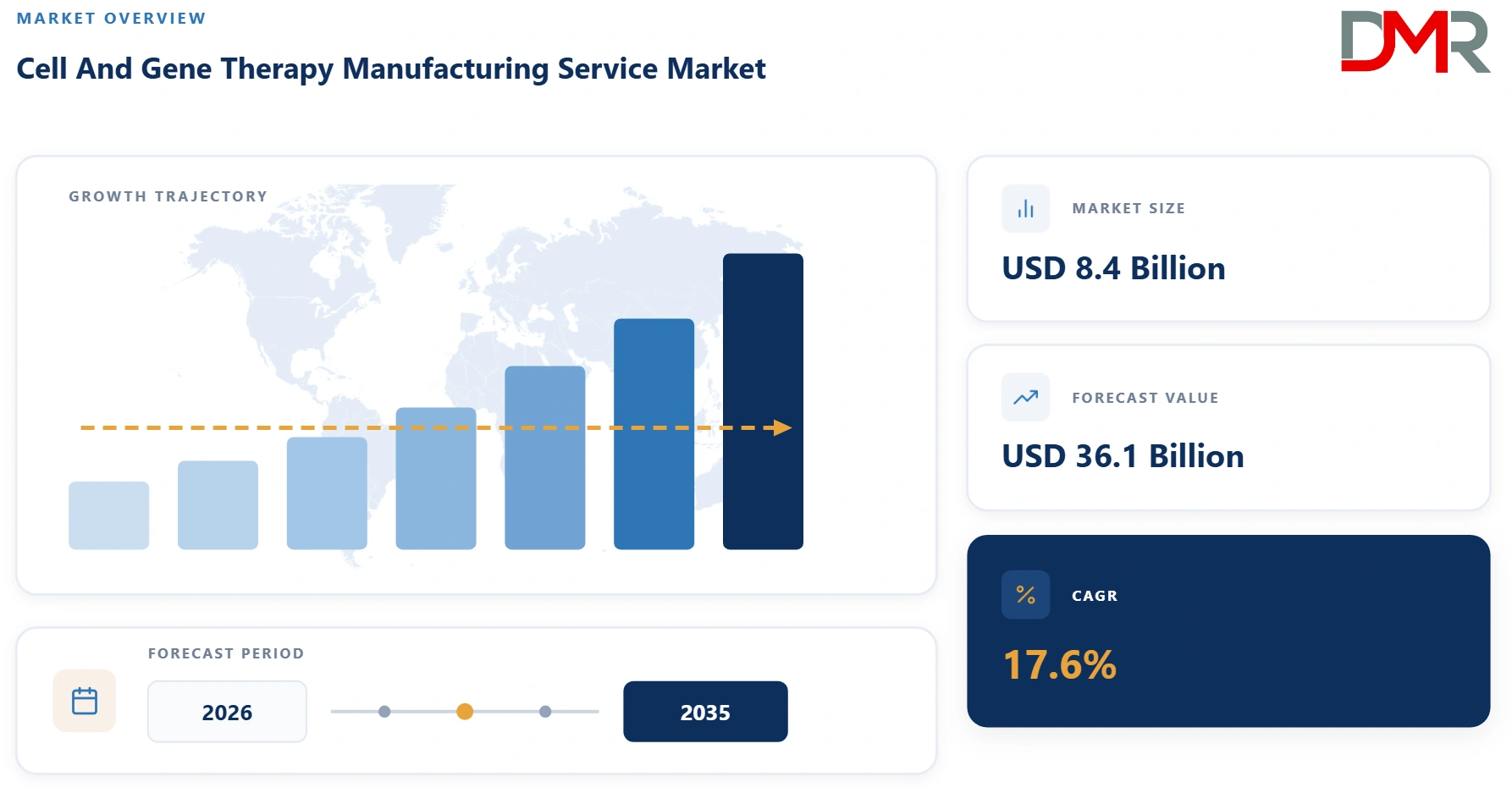
- Market Size (2026): USD 8.4 Bn
- Forecast Value (2035): USD 36.1 Bn
- CAGR (2026-2035): 17.6%
- Largest Region (2026): North America, approximately 46%
- Fastest-Growing Region: Asia-Pacific
- Leading Service Type (2026): Manufacturing, around 39%
- Leading Therapy Type (2026): Cell Therapy, close to 44%
- Key Players: Lonza, Thermo Fisher Scientific, AGC Biologics and others
What is Cell And Gene Therapy Manufacturing Service Market and its Market Size?
Global Cell And Gene Therapy Manufacturing Service Market size is estimated to reach USD 8.4 Bn in 2026 and is further anticipated to reach USD 36.1 Bn by 2035, at a CAGR of 17.6%.
ℹ
To learn more about this report –
Download Your Free Sample Report Here
Cell and gene therapy manufacturing services cover outsourced development, scale-up, GMP production, analytical testing, release support and related activities required to convert advanced therapy concepts into clinical or commercial products. The boundary includes autologous and allogeneic cell processing, viral and non-viral vector production, plasmid DNA support, gene-modified cell workflows and specialized fill and finish. It excludes the therapeutic product's own sales value and focuses on fees earned for development and manufacturing work performed for sponsors.
Demand comes primarily from biotechnology companies, pharmaceutical developers, academic spinouts and commercial therapy owners that need infrastructure difficult to justify internally. Buyers select partners for vector expertise, cleanroom availability, process reproducibility, potency assay capability, chain-of-identity controls and regulatory inspection readiness. Outsourcing is particularly valuable when a sponsor must move from small clinical batches to validated commercial processes without rebuilding its manufacturing organization at each stage.
The industry's structure is changing as programs mature from experimental manufacturing into repeatable platform production. Closed processing, single-use systems, automated cell handling, suspension vector production, digital batch records and decentralized or regional capacity are reducing dependence on highly manual workflows. At the same time, sponsors are becoming more selective about capacity commitments, which favors service providers that can combine technical depth with flexible suites, credible quality systems and a path from process development through commercial supply.
Use Cases
- Autologous Oncology Programs: CAR-T and other patient-specific therapy developers use specialist manufacturers to receive leukapheresis material, perform activation, gene transfer, expansion and formulation, and return a traceable dose. Outsourcing gives smaller sponsors access to controlled cleanroom operations and chain-of-identity systems without building a dedicated network before clinical proof is established.
- In Vivo Gene Therapy Programs: Rare-disease developers contract vector specialists for plasmid preparation, upstream production, purification, analytical characterization and aseptic filling of AAV or other vectors. The service model allows sponsors to reserve appropriate scale as clinical demand changes while transferring a defined process toward validation and commercial readiness.
- Allogeneic Cell Therapy Scale-Up: Developers of donor-derived T-cell, NK-cell, stem-cell and iPSC-derived products use CDMOs to convert research protocols into closed, scalable processes. Manufacturing partners help establish cell banks, raw-material controls, cryopreservation steps and release methods so one production campaign can support a broader patient population.
- Academic Translation and Spinouts: Hospitals, universities and newly formed biotechnology companies use manufacturing service providers to bridge laboratory methods into phase-appropriate GMP production. The partner supplies quality systems, documentation, facility controls and technology-transfer discipline that are rarely available inside a discovery laboratory, improving readiness for regulatory submissions and multicenter trials.
Key Takeaways
- Market Size & Share: Gene therapy is expected to represent roughly 32% of 2026 revenue as vector-based programs continue to require specialized external capacity.
- Service Type Analysis: Manufacturing is projected to hold about 39% of service revenue in 2026, reflecting the labor, cleanroom, quality and batch-execution intensity of advanced therapies.
- Regional Analysis: Europe is set to account for nearly 27% of global revenue in 2026, supported by an established advanced-therapy development base and specialized manufacturing clusters.
- Commercial Scale: Commercial manufacturing is forecast to expand at a CAGR of 22.4% through 2035 as more programs move beyond clinical supply.
- Vector Shift: Non-viral delivery manufacturing services are projected to grow at a CAGR of 23.1%, faster than the overall industry as electroporation and engineered delivery approaches broaden.
- Buyer Mix: Biotechnology companies are expected to generate around 56% of 2026 service demand because many emerging developers operate asset-light manufacturing models.
How AI/Gen AI is Transforming the Cell And Gene Therapy Manufacturing Service Market?
AI is being applied where advanced therapy production generates complex process, quality and scheduling data. Multivariate models can relate critical process parameters to yield or quality attributes, while computer vision can support cell morphology monitoring and anomaly detection. Digital twins can test operating windows before a physical run, and machine-learning forecasting can improve suite utilization where autologous batches create irregular demand. These uses are operational rather than speculative because manufacturing economics depend on reducing failed runs, manual review and idle capacity.
Generative AI has a narrower but useful role in documentation-intensive workflows. Controlled LLM systems can assist with first-pass summaries of deviations, change-control records, validation evidence and regulatory documentation, provided quality personnel retain review authority and source traceability. The highest-value implementations are likely to sit inside validated data environments rather than open-ended general-purpose tools.
- Process Modeling: Machine-learning models connect upstream and downstream parameters with yield, impurity and potency outcomes to guide process characterization.
- Digital Batch Review: AI-supported exception detection can prioritize records requiring human investigation and shorten quality review queues.
- Capacity Scheduling: Reinforcement learning and optimization tools can sequence patient-specific batches around equipment, staffing and release constraints.
- Documentation Support: Controlled LLM workflows can organize CMC evidence and draft structured summaries while preserving human quality oversight.
Key Drivers in the Global Cell And Gene Therapy Manufacturing Service Market
Outsourcing grows when the cost and complexity of internal manufacturing rise faster than a sponsor's need for permanent capacity. Two forces are especially important.
- Expanding Clinical Pipeline and Modality Complexity: Cell therapy is expected to account for approximately 44% of 2026 service revenue, illustrating how much demand is tied to products with specialized handling and release requirements. A sponsor developing CAR-T, NK-cell or stem-cell therapy needs more than cleanroom space: it needs validated chain-of-custody procedures, trained operators, potency testing and cryogenic logistics. Gene therapy adds vector engineering, transfection, purification and characterization demands. Because these capabilities are expensive to duplicate across many small biotechnology companies, a growing pipeline translates into outsourced process development and GMP work even before products reach commercial scale.
- Movement from Clinical Supply to Commercial Manufacturing: Commercial-scale services are forecast to grow at 22.4% from 2026 to 2035, above the headline market rate. Clinical processes often rely on manual steps, small lots and flexible release strategies, but approval requires validated processes, comparability evidence, supply continuity and predictable turnaround. That transition creates multi-year work for CDMOs across technology transfer, process performance qualification, analytical validation and routine production. Providers able to support both clinical and commercial stages can retain programs through this transition, while sponsors reduce the execution risk of moving a late-stage asset to a new facility.
Restraints in the Global Cell And Gene Therapy Manufacturing Service Market
Growth remains constrained by manufacturing economics and by the technical difficulty of transferring living or vector-based products between facilities. These brakes affect both buyers and service providers.
- High Cost of Specialized Capacity and Uneven Utilization: Manufacturing services represent around 39% of 2026 revenue, but the same infrastructure that supports this share also creates a fixed-cost burden. Segregated suites, environmental monitoring, qualified single-use systems, viral containment and specialized staff must be maintained even when sponsor schedules slip. Autologous workflows add further complexity because capacity cannot always be pooled efficiently across patients. When biotechnology funding tightens or trials pause, utilization can fall quickly, pressuring service pricing and discouraging speculative capacity additions. Sponsors therefore face reservation fees, minimum commitments or limited flexibility at precisely the stage when clinical timelines remain uncertain.
- Technology Transfer and Regulatory Comparability Risk: Viral vectors are projected to represent roughly 61% of vector-related service demand in 2026, leaving a large portion of the market exposed to complex biological processes with sensitive yield and impurity profiles. Moving a process from a sponsor or another CDMO can change equipment, raw materials, scale and analytical methods, creating comparability questions. Cell therapies face similar issues because operator technique and starting-material variability influence output. A failed transfer can delay clinical supply and consume scarce development batches, making sponsors reluctant to switch providers and slowing the pace at which new capacity can win established programs.
Growth Opportunities in the Global Cell And Gene Therapy Manufacturing Service Market
White space is strongest where current production models are too manual or geographically concentrated. Providers that reduce transfer friction can capture programs earlier and keep them longer.
- Closed and Automated Allogeneic Manufacturing Platforms: Allogeneic cell therapy is projected to grow at a CAGR of 24.2% through 2035, creating an opening for standardized platforms that handle larger batch sizes and repeatable donor-derived production. CDMOs can differentiate by integrating closed cell selection, activation, editing, expansion, harvest and fill workflows with in-process analytics. Unlike patient-specific production, an allogeneic batch may serve many doses, making scale economics and process consistency more central to the buying decision. Providers that establish platform processes and transferable analytical packages can reduce development time for sponsors while building reusable know-how across multiple programs.
- Asia-Pacific Capacity for Regional and Global Programs: Asia-Pacific is forecast to expand at a CAGR of 21.8% through 2035, faster than the global average. The opportunity is not simply lower operating cost; sponsors increasingly need manufacturing near clinical sites, regional regulatory expertise and supply chains that reduce cross-border handling of time-sensitive material. Japan, South Korea, China, India and Australia offer different strengths across cell processing, vector production, clinical development and biologics manufacturing. Service providers with harmonized quality systems across regions can use Asian facilities for local programs while also giving multinational sponsors a second manufacturing node and greater supply resilience.
Trends in the Global Cell And Gene Therapy Manufacturing Service Market
Competition is shifting from selling cleanroom capacity toward selling reproducible platforms and integrated execution. Buyers increasingly test how well a provider can standardize a process without constraining product-specific science.
- Platformization of Vector and Cell Processing: Process development is expected to represent approximately 18% of 2026 service revenue, but its strategic value extends into later manufacturing because platform choices determine transfer speed and scale-up risk. CDMOs are building standard upstream, downstream and analytical frameworks for AAV, lentiviral vectors and common immune-cell workflows, then adapting only the product-specific elements. This reduces the amount of bespoke engineering required for each new program. The trend also changes commercial negotiations, with sponsors comparing platform performance, development timelines and data packages rather than purchasing suite time alone.
- Greater Use of Non-Viral and Closed-System Workflows: Non-viral delivery services are forecast to grow at 23.1% through 2035 as developers evaluate electroporation, transposon systems and other approaches that can reduce dependence on viral-vector supply. In cell processing, closed and automated equipment is also reducing open manipulations and operator variability. These shifts favor CDMOs that remain technology-agnostic and can qualify multiple manufacturing routes within one quality system. They also broaden the competitive field because a provider no longer needs to win every program through proprietary viral-vector capacity; it can compete through process integration, analytics and manufacturing control.
Research Scope and Analysis
Segment performance is assessed across six axes: service type, therapy type, vector type, scale of operation, application and end user. Each view identifies where 2026 revenue is concentrated and which sub-segment is expected to expand fastest through 2035, together with the operating reason behind that trajectory.
ℹ
To learn more about this report –
Download Your Free Sample Report Here
By Service Type
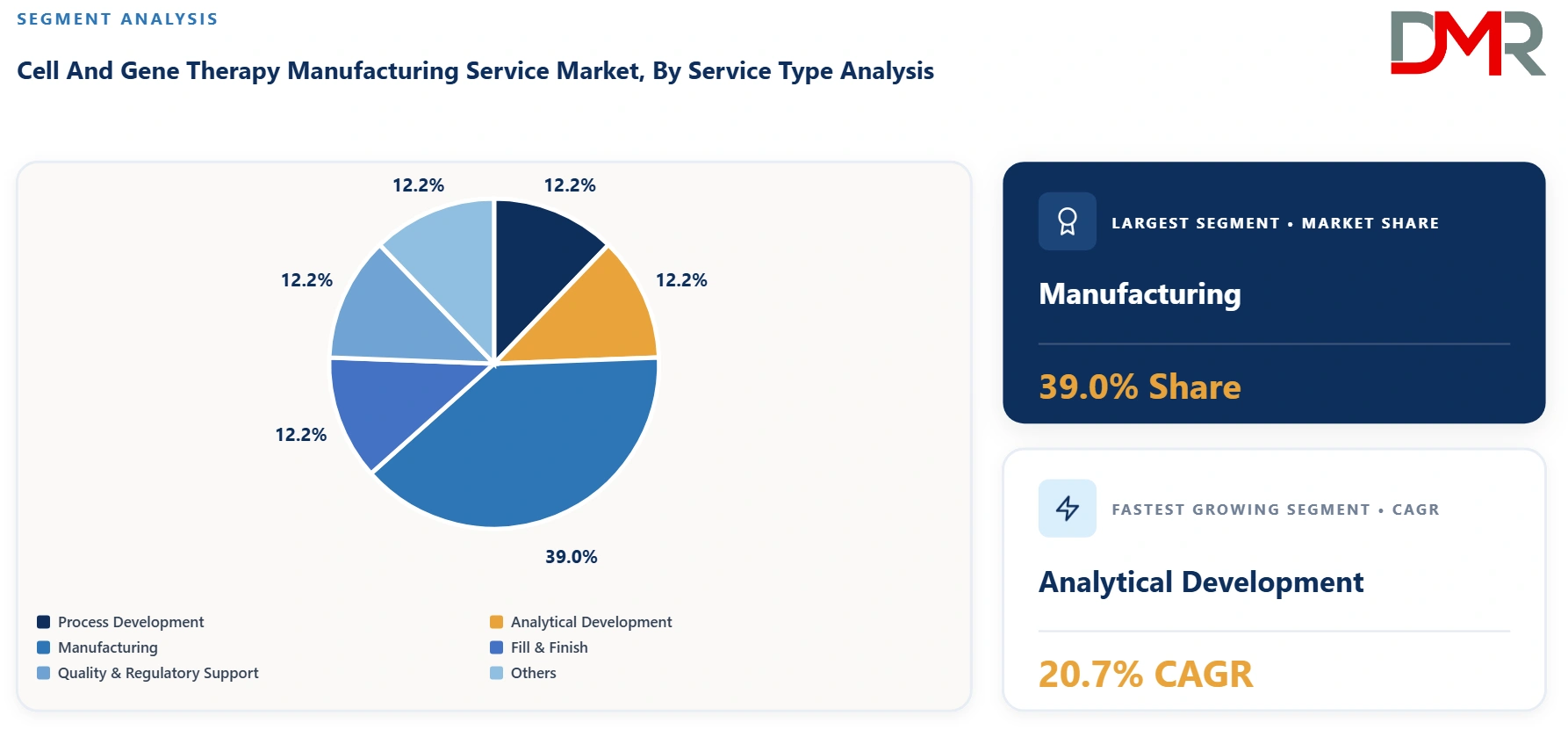
Manufacturing is projected to hold the largest service-type share in 2026 at approximately 39%, because GMP batch execution absorbs cleanroom time, trained labor, quality oversight, raw-material control and equipment qualification that cannot be compressed into a development-only fee. Sponsors also tend to outsource routine production after a successful technology transfer, extending revenue across multiple campaigns. Growth, however, is concentrated in analytical development, which is forecast to expand at a CAGR of 20.7% from 2026 to 2035. Advanced therapies require product-specific potency, identity, purity and safety methods, and those assays must become more reliable as programs approach approval. The rising need for orthogonal characterization and faster release therefore increases the analytical content of each outsourced program.
By Therapy Type
Cell therapy is expected to carry the highest 2026 revenue share by therapy type at around 44%, supported by labor-intensive autologous production, expanding allogeneic programs and the need for controlled chain-of-identity operations. Its service intensity remains high because starting material varies and many processes still involve complex cell handling. The steeper trajectory sits with gene-modified cell therapy, projected to grow at a CAGR of 21.9% through 2035. These programs combine cell-processing requirements with gene-transfer or gene-editing steps, increasing the number of manufacturing interfaces that sponsors may outsource. As CAR-T, engineered NK-cell and edited stem-cell approaches broaden, integrated providers can capture both vector or editing support and final cell-product manufacturing within one program.
By Vector Type
Viral vectors are set to represent the largest vector-type share in 2026, accounting for roughly 61% of revenue because AAV and lentiviral systems remain central to many in vivo gene therapies and gene-modified cell products. Production requires specialized upstream systems, purification, biosafety controls and assays for potency and impurities, supporting external manufacturing demand. Growth, however, is concentrated in non-viral vectors and delivery systems at a CAGR of 23.1% between 2026 and 2035. Electroporation, transposon-based systems and emerging delivery technologies can simplify selected workflows or reduce dependence on vector availability. CDMOs that qualify non-viral processes alongside viral capabilities can serve sponsors as delivery strategies evolve during development.
By Scale of Operation
Clinical manufacturing is projected to hold approximately 58% of scale-related revenue in 2026, reflecting the large number of programs still moving through early and mid-stage development and the frequent need for small, flexible GMP campaigns. Clinical work also carries repeated technology-transfer and process-change activity as sponsors learn from each cohort. Commercial manufacturing is the faster-growing sub-segment, advancing at a CAGR of 22.4% through 2035. Approved products require validated, repeatable output, supply continuity and stronger inventory planning, which expands the value of each retained manufacturing relationship. As more therapies reach routine supply, CDMOs with inspection-ready facilities and commercial quality systems can convert development programs into longer-duration contracts and higher facility utilization.
By Application
Oncology is expected to account for close to 49% of application revenue in 2026, driven by the concentration of engineered immune-cell programs and the continuing use of gene-modified cellular platforms in hematologic malignancies and solid-tumor research. Oncology developers also iterate rapidly across constructs, creating recurring development and manufacturing needs. The fastest growth is projected in rare and genetic diseases at a CAGR of 20.5% through 2035. Many of these indications have a strong biological rationale for gene replacement, editing or durable cell-based intervention, while small patient populations make internal manufacturing infrastructure harder to justify. Outsourced platforms can therefore spread specialized vector, analytical and quality capabilities across multiple low-volume programs.
By End User
Biotechnology companies are projected to generate the largest end-user share in 2026 at approximately 56%, since emerging therapy developers often prioritize research and clinical assets over ownership of large manufacturing networks. Outsourcing also lets them add capacity in stages as financing and clinical evidence develop. Growth, however, is concentrated among pharmaceutical and biopharmaceutical companies, with service demand forecast to rise at a CAGR of 19.6% through 2035. Larger drug makers are expanding advanced-therapy portfolios through licensing, partnerships and acquisitions, but they still use external specialists for modality-specific capacity, overflow production and regional redundancy. This creates a hybrid model in which internal manufacturing and CDMO networks coexist rather than one replacing the other.
The Global Cell And Gene Therapy Manufacturing Service Market Report is Segmented Based on the following:
By Service Type
- Process Development
- Analytical Development
- Manufacturing
- Fill & Finish
- Quality & Regulatory Support
- Others
By Therapy Type
- Cell Therapy
- Gene Therapy
- Gene-Modified Cell Therapy
- Others
By Vector Type
- Viral Vectors
- Non-Viral Vectors & Delivery Systems
- Others
By Scale of Operation
- Preclinical & Process Development
- Clinical Manufacturing
- Commercial Manufacturing
- Others
By Application
- Oncology
- Rare & Genetic Diseases
- Cardiovascular Diseases
- Neurological Disorders
- Ophthalmology
- Others
By End User
- Biotechnology Companies
- Pharmaceutical & Biopharmaceutical Companies
- Academic & Research Institutes
- Hospitals & Medical Centers
- Others
Regional Analysis
Region with the Largest Revenue Share
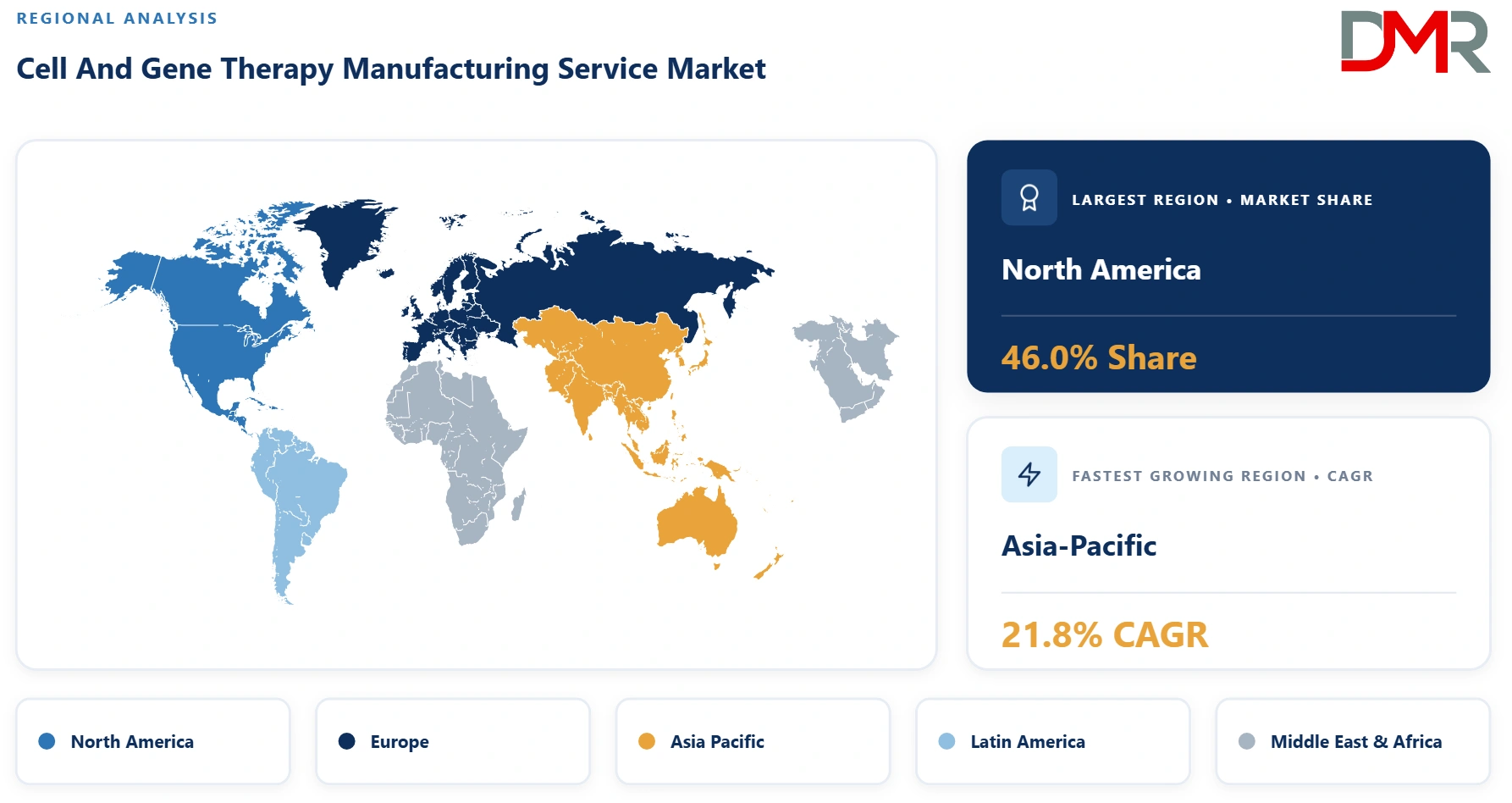
North America is expected to remain the largest regional market in 2026, accounting for approximately 46% of global revenue. The region combines a deep biotechnology funding base, a large number of cell and gene therapy developers, major academic medical centers and experienced GMP manufacturing networks. The US also concentrates commercial launches and regulatory interactions that require sponsors to maintain inspection-ready supply. These conditions support demand across process development, vector manufacturing, cell processing, analytical testing and fill and finish. Capacity is not uniformly utilized, however, so providers compete increasingly on technical fit, commercial readiness and flexible contracting rather than on available cleanroom square footage alone.
ℹ
To learn more about this report –
Download Your Free Sample Report Here
Region with the Highest CAGR
Asia-Pacific is forecast to record the highest regional CAGR at 21.8% from 2026 to 2035. Growth is being pulled by expanding clinical activity, national biomanufacturing strategies, stronger domestic biotechnology ecosystems and the localization of advanced-therapy production in China, Japan, South Korea, India and Australia. Regional providers are adding cell-processing, vector and analytical capabilities, while international CDMOs are building or extending Asian footprints to serve sponsors closer to trial sites. The region still faces uneven regulatory pathways and varying levels of manufacturing maturity, but the combination of technical talent, biologics infrastructure and rising sponsor demand is creating a broader addressable base for outsourced services.
By Region
North America
Europe
- Germany
- France
- The UK
- Italy
- Spain
- Rest of Europe
Asia-Pacific
- China
- Japan
- India
- Australia
- South Korea
- Rest of APAC
Latin America
- Mexico
- Brazil
- Colombia
- Argentina
- Rest of LATAM
Middle East & Africa
- Saudi Arabia
- The UAE
- South Africa
- Rest of MEA
Regulatory Landscape
Advanced-therapy manufacturing is governed by demanding CMC expectations covering identity, potency, purity, sterility, comparability, traceability and process control. FDA requirements for biologics and human cells, EMA advanced therapy medicinal product frameworks, and national GMP regimes shape facility and documentation design. Regulators are increasingly focused on whether processes can remain controlled as sponsors scale, automate or transfer production. Commercial openings therefore favor CDMOs with inspection experience, validated analytical methods and quality systems able to support lifecycle changes. The principal brake is product specificity: a platform can standardize equipment and documentation, but critical assays and control strategies often remain therapy-specific, keeping regulatory execution labor-intensive and differentiating experienced providers.
Investment and White Space Analysis
Investment is moving away from capacity expansion for its own sake toward flexible assets that can serve several modalities and stages. White space sits in closed cell-processing platforms, high-yield vector production, rapid analytical release, non-viral delivery support and regional manufacturing nodes that reduce transport risk. Asia-Pacific's forecast CAGR of 21.8% highlights the commercial case for selectively adding capability near growing clinical ecosystems rather than concentrating every program in established Western hubs. The risk is utilization: trial delays, financing cycles and program attrition can leave dedicated suites underused. Providers with modular facilities, multi-product quality systems and transferable platforms are better positioned to balance capacity risk while protecting pricing and customer retention.
Competitive Landscape
Competition spans large diversified CDMOs, specialist vector and cell-therapy manufacturers, regional advanced-therapy providers and technology companies that increasingly support closed production. Scale alone does not determine position because sponsors buy modality expertise, transfer speed, quality history, analytical depth and confidence that a partner can support later-stage supply. Large providers compete through integrated networks and broad service portfolios, while specialists focus on difficult vectors, cell types, rapid development platforms or flexible clinical capacity. Partnerships, platform standardization, automation and regional expansion are common strategies. As capacity becomes more available, differentiation is shifting toward execution reliability, commercial inspection readiness and the ability to preserve product quality while shortening development and release timelines.
Some of the Prominent Players in the Global Cell And Gene Therapy Manufacturing Service Market Are
- Lonza
- Thermo Fisher Scientific
- Catalent
- AGC Biologics
- Charles River Laboratories
- FUJIFILM Diosynth Biotechnologies
- Oxford Biomedica
- SK pharmteco
- National Resilience
- RoslinCT
- Kincell Bio
- Andelyn Biosciences
- OmniaBio
- Cellipont Bioservices
- Minaris Regenerative Medicine
- Rentschler Biopharma
- Genezen
- BioCentriq
- Exothera
- Viralgen
- 3P BIOVIAN
- IDT Biologika
- Wacker Biotech
- Batavia Biosciences
- Northway Biotech
- Takara Bio
- Porton Advanced Solutions
- GenScript ProBio
- Pharmaron
- Cell Therapies
- BioCina
- GeneCraft
- VIVEbiotech
- ABL
- Creative Biolabs
- Miltenyi Biotec
- Cytiva
- Sartorius
- Terumo Blood and Cell Technologies
- Cellares
- Other Key Players
Recent Developments
- In September 2026, Andelyn Biosciences agreed to support scale-up and manufacturing for Genprex's diabetes gene therapy program, applying its cell and gene therapy platform to process optimization, analytical development and drug-product manufacturing ahead of clinical translation.
- In March 2026, Lonza extended its commercial manufacturing agreement with Genetix Biotherapeutics for ZYNTEGLO and planned additional manufacturing capacity in Houston, showing how long-running development relationships can convert into expanded commercial gene-therapy supply.
- In June 2025, AGC Biologics announced cell-therapy process development and clinical manufacturing services at its Yokohama Technical Center, extending its advanced-therapy footprint into Asia and creating a regional bridge ahead of a larger Yokohama manufacturing facility.
- In April 2025, AGC Biologics established a dedicated Cell and Gene Technologies Division to coordinate its cell-therapy and viral-vector capabilities across the United States, Europe and Japan, emphasizing platform design and scalable manufacturing.
- In 2025, Lonza reported that all of its Cell & Gene sites were contracted to manufacture at least one approved commercial therapy, indicating a broader shift in outsourced advanced-therapy capacity from clinical development toward sustained commercial execution.
Report Details
| Report Characteristics |
| Market Size (2026) |
USD 8.4 Bn |
| Forecast Value (2035) |
USD 36.1 Bn |
| CAGR (2026–2035) |
17.6% |
| The US Market Size (2026) |
USD 3.0 Bn |
| Historical Data |
2021 – 2025 |
| Forecast Data |
2026 – 2035 |
| Base Year |
2025 |
| Segments Covered |
By Service Type, By Therapy Type, By Vector Type, By Scale of Operation, By Application and By End User |
| Regional Coverage |
North America - The US and Canada; Europe - Germany, France, The UK, Italy, Spain, Rest of Europe; Asia-Pacific - China, Japan, India, Australia, South Korea, Rest of APAC; Latin America - Mexico, Brazil, Colombia, Argentina, Rest of LATAM; Middle East & Africa - Saudi Arabia, The UAE, South Africa, Rest of MEA |
Frequently Asked Questions
How big is the Global Cell and Gene Therapy Manufacturing Service Market?
▾ The Global Cell And Gene Therapy Manufacturing Service Market is estimated at USD 8.4 Bn in 2026. Demand includes outsourced process development, analytical development, GMP cell and vector manufacturing, fill and finish, quality support and related services used by biotechnology and pharmaceutical sponsors developing advanced therapies.
What is the growth rate of the Global Cell And Gene Therapy Manufacturing Service Market?
▾ The industry is projected to expand at a CAGR of 17.6% from 2026 to 2035. Growth is supported by a larger clinical pipeline, increasing outsourcing, more therapies moving toward commercial supply, and continued need for specialized facilities, quality systems and technical teams that are costly for individual sponsors to build internally.
Which region holds the largest share in the Global Cell And Gene Therapy Manufacturing Service Market?
▾ North America is expected to hold the largest share in 2026 at approximately 46%. Its position reflects the concentration of biotechnology developers, advanced-therapy clinical programs, specialist manufacturing infrastructure, academic medical centers and commercial product activity, particularly in the United States.
Who are the key players in the Global Cell And Gene Therapy Manufacturing Service Market?
▾ Key participants include Lonza, Thermo Fisher Scientific, Catalent, AGC Biologics, Charles River Laboratories, FUJIFILM Diosynth Biotechnologies and Oxford Biomedica. Competition centers on modality expertise, quality performance, process transfer, vector and cell-processing platforms, analytical capability, geographic reach and the ability to support programs from development into commercial manufacturing.
Which service type holds the largest share of the Cell And Gene Therapy Manufacturing Service market?
▾ Manufacturing is projected to lead service-type revenue in 2026 with around 39% share. GMP production carries high service value because it combines controlled facilities, trained operators, raw-material management, batch documentation, environmental monitoring, quality oversight and release activities across clinical and commercial programs.