Chile Cold Chain Logistics Market Snapshot
- Market Size in 2026: USD 562.1 million
- Market Size in 2035: USD 830.9 million
- CAGR, 2026-2035: 4.5%
- Leading Service Type in 2026: Refrigerated Warehouse, 52.0%
- Leading Application in 2026: Seafood, 31.0%
- Leading Temperature Type in 2026: Frozen, 39.2%
- Fastest-Growing Technology Segment: Liquid Nitrogen, 7.8% CAGR
What is the Chile Cold Chain Logistics and its Market Size?
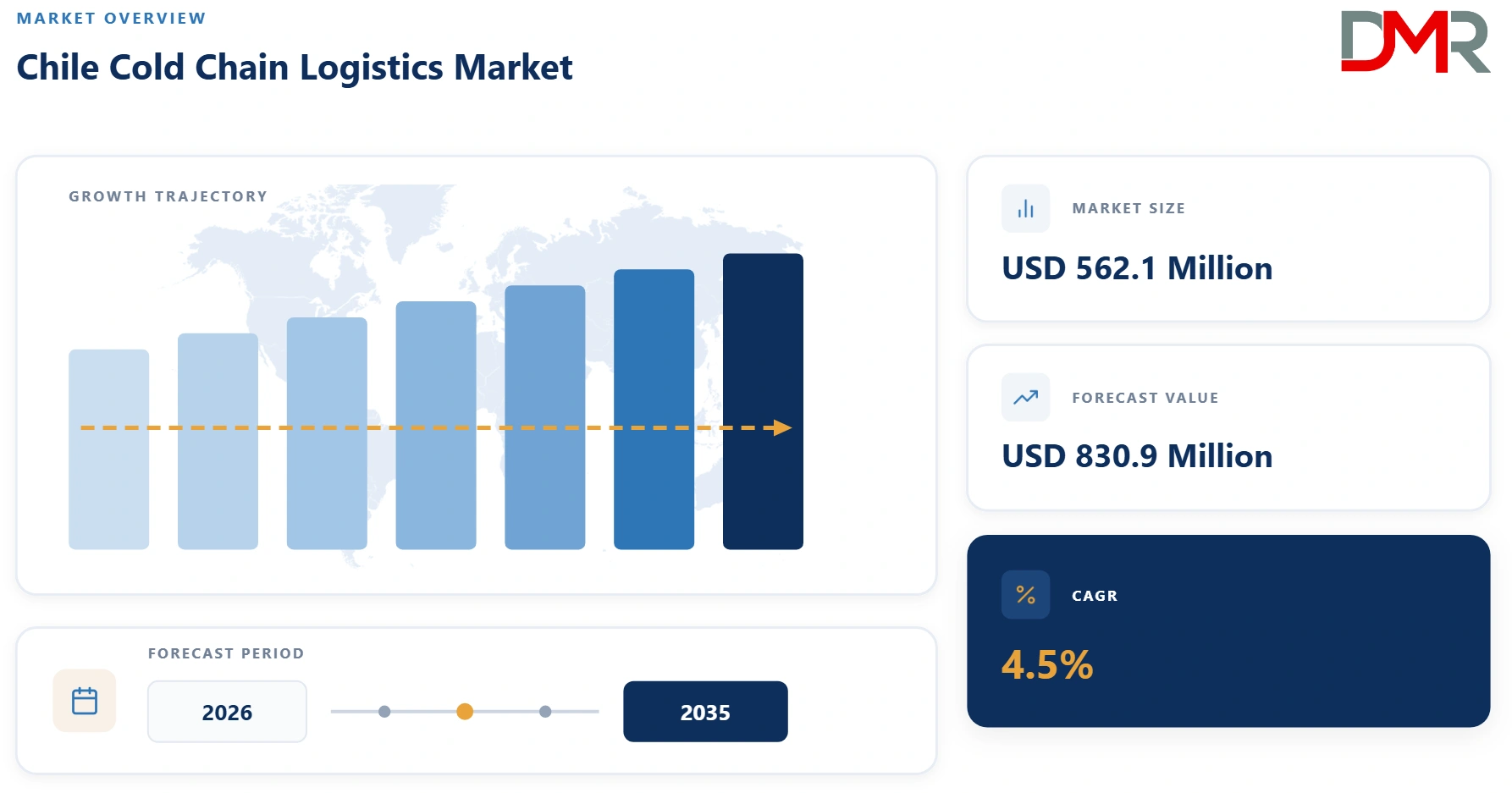
Chile's cold chain logistics market is estimated at USD 562.1 million in 2026, rising to approximately USD 830.9 million by 2035, representing an estimated 4.5% CAGR.
ℹ
To learn more about this report –
Download Your Free Sample Report Here
Chile cold chain logistics comprises temperature-controlled warehousing, refrigerated transportation, consolidation, handling, freezing, distribution, monitoring and related value-added services used to preserve perishable or temperature-sensitive products from origin through final delivery. The market serves exporters, food manufacturers, retailers, food-service companies, fisheries, aquaculture producers and other temperature-sensitive supply chains. Its core value proposition is maintaining product quality, safety, shelf life and regulatory compliance while minimizing spoilage and temperature excursions. Chile's extensive geographic footprint and export-oriented food economy make cold-chain infrastructure particularly important for salmon, seafood, fresh fruit, frozen products, meat, dairy and other perishables.
Use Cases
- Seafood export logistics: Maintains salmon, trout, shellfish and frozen fish at controlled temperatures through processing, storage and port delivery.
- Fresh-fruit distribution: Protects cherries, berries, grapes and other perishables through pre-cooling, refrigerated transportation and export-oriented cold storage.
- Meat and poultry logistics: Provides controlled storage, consolidation and transportation for frozen and chilled animal proteins.
- Dairy distribution: Preserves milk, cheese, butter, ice cream and other temperature-sensitive dairy products across national distribution networks.
- Frozen-food fulfillment: Supports supermarkets, food service and manufacturers requiring reliable frozen storage and last-mile distribution.
- Export-port consolidation: Integrates freezing, inspection, storage and container loading close to ports to reduce intermediate handling.
Key Takeaways
- Market Size and Growth: The market is estimated at USD 562.1 million in 2026 and projected to reach USD 830.9 million by 2035, at approximately 4.46% CAGR.
- Growth Drivers: Food-export expansion, especially seafood and fruit, domestic frozen-food consumption, automation, digital traceability and port-adjacent infrastructure are the principal growth catalysts.
- Segment Dominance: Refrigerated warehousing is expected to remain the largest service category, while seafood leads applications and frozen logistics leads temperature categories.
- Fastest Growth: Liquid-nitrogen-based temperature-control solutions are estimated to record the fastest technology growth, supported by specialized rapid-freezing applications and premium export products.
- Competitive Direction: The market remains relatively low in concentration, but consolidation is increasing as large operators acquire regional facilities and integrate transportation with storage.
How AI/Gen AI is Transforming the Chile Cold Chain Logistics Market?
AI-enabled analytics, IoT sensors, GPS tracking and warehouse automation are increasingly being integrated into Chile's cold-chain infrastructure. Operators use real-time temperature sensors, fleet-management systems, automated storage and retrieval, predictive maintenance and digital inventory platforms to monitor products continuously. Transport providers such as Transportes Nazar already promote multitemperature operations, online temperature monitoring and preventive alerts.
The principal benefits are reduced spoilage, faster exception management, better asset utilization, lower labor requirements and improved energy efficiency. Automated facilities can also increase storage density while minimizing manual handling. Emergent Cold LatAm's 2026 automated Chilean facility, with 33,000 pallet positions, illustrates the shift toward high-throughput automated cold storage.
Key Drivers in the Chile Cold Chain Logistics Market
Expansion of Perishable Food Exports
Chile's strong position in global exports of seafood, salmon, fresh fruit, vegetables and other perishable products continues to create sustained demand for temperature-controlled logistics. Exporters require reliable pre-cooling, refrigerated storage, freezing, transportation and port-side handling to preserve product quality throughout long international supply chains. Seasonal exports, particularly seafood and fruit, also create periods of concentrated demand for cold-storage capacity and refrigerated vehicles.
Rising Demand for Modern and Integrated Cold-Chain Services
Cold-chain customers are increasingly seeking integrated logistics solutions rather than standalone warehousing or transportation. Food producers and exporters are prioritizing providers that can combine storage, freezing, consolidation, transportation, inventory management and temperature monitoring. This is encouraging logistics companies to expand their networks and invest in automated facilities, digital monitoring systems and energy-efficient refrigeration. The growth of domestic frozen-food consumption is also strengthening demand from supermarkets, food-service operators and food manufacturers.
Restraints in the Chile Cold Chain Logistics Market
High Infrastructure and Operating Costs
Cold-chain logistics requires substantially greater investment than conventional logistics because facilities must incorporate specialized insulation, refrigeration systems, temperature-monitoring equipment, backup systems and controlled loading areas. Refrigeration also creates continuous energy consumption, making operating costs sensitive to electricity prices and equipment efficiency. Smaller logistics providers can face difficulties financing modern facilities or replacing older refrigeration systems, particularly when utilization fluctuates according to seasonal agricultural and seafood cycles.
Geographic and Seasonal Logistics Complexity
Chile's long geographic structure creates significant challenges for temperature-controlled transportation. Production regions, processing facilities, distribution centers and export ports can be separated by considerable distances, requiring refrigerated vehicles to maintain consistent conditions across extended routes. Seasonal peaks in fruit and seafood exports can simultaneously increase demand for warehouse space, refrigerated trucks, containers and port infrastructure, creating temporary capacity constraints. Limited availability of specialized reefer vehicles during peak periods can increase logistics costs and make service reliability more difficult to maintain. Road congestion and delays around major logistics corridors can further increase the risk of temperature excursions.
Growth Opportunities in the Chile Cold Chain Logistics Market
Port-Adjacent and Integrated Cold-Chain Infrastructure
Expansion of cold-storage and freezing infrastructure near major export gateways represents a significant opportunity for logistics providers and infrastructure investors. Port-adjacent facilities can reduce unnecessary transportation, handling and waiting time between processing and vessel loading while improving temperature integrity. Integrated facilities can combine blast freezing, refrigerated storage, consolidation, inspection, packaging and transportation, allowing exporters to manage multiple stages through a single logistics provider. This model is particularly attractive for seafood and frozen food supply chains where maintaining temperature consistency is critical.
Digital Monitoring and Energy-Efficient Cold Chains
The adoption of IoT sensors, cloud platforms, automated alerts, predictive analytics and digital traceability provides an opportunity to improve both service quality and operating efficiency. Continuous monitoring enables logistics providers to identify temperature deviations quickly, reduce product losses and provide customers with digital records of cold-chain conditions. Predictive maintenance can also reduce refrigeration equipment downtime and improve fleet utilization. At the same time, photovoltaic systems, energy-efficient refrigeration and improved insulation can help operators manage the high energy requirements associated with temperature-controlled facilities.
Trends in the Chile Cold Chain Logistics Market
Shift Toward Integrated Logistics Solutions
The Chilean market is increasingly moving toward integrated cold-chain providers capable of delivering warehousing, transportation, freezing, consolidation and value-added services under one operating model. Customers benefit from fewer handoffs, improved visibility and simpler supply-chain management, while providers gain stronger customer relationships and higher utilization of their infrastructure. This trend is also encouraging acquisitions and network expansion as companies seek nationwide coverage and greater scale.
Automation, Digitalization and Sustainable Refrigeration
Cold-chain operators are increasingly adopting automated storage, IoT temperature monitoring, advanced refrigeration controls and renewable-energy solutions. Automation improves storage density and handling efficiency, while digital monitoring provides greater visibility over temperature and inventory conditions. Sustainable refrigeration is also gaining importance as operators seek to reduce energy consumption and environmental impact. Together, these technologies are shifting competition toward operational efficiency, reliability, traceability and sustainability rather than physical storage capacity alone.
Research Scope and Analysis
The market is analyzed by Service Type, Application, Temperature Type and Technology. Service type captures core logistics activities; application reflects major product categories; temperature type distinguishes chilled and frozen requirements; and technology covers the principal thermal-control methods used in specialized cold-chain handling and packaging.
ℹ
To learn more about this report –
Download Your Free Sample Report Here
By Service Type Analysis
Refrigerated Warehouse is estimated to dominate Chile's cold-chain logistics market in 2026 with approximately 52.0% share, supported by the country's export-oriented food economy and increasing demand for strategically located storage near production and consumption centers. Modern facilities also increasingly combine storage with blast freezing, consolidation, inspection and value-added services. Refrigerated Transportation represents approximately 48.0% and remains essential because Chile's geographically elongated territory requires temperature-controlled movement between farms, processing facilities, distribution centers and ports. Refrigerated transportation is expected to be the faster-growing service segment at approximately 5.0% CAGR through 2035, driven by integrated logistics contracts, food-service distribution, e-commerce-related fulfillment and growing requirements for real-time temperature visibility. Warehouse demand nevertheless remains structurally strong because export seasonality creates a need for buffer capacity. The second-largest service sub-segment is refrigerated transportation, with its growth supported by fleet modernization and multitemperature vehicles. Transportes Nazar, for example, highlights multitemperature capability, online monitoring and nationwide coverage.
By Application Analysis
Seafood is estimated to lead the application segment in 2026 with approximately 31.0% share, reflecting Chile's exceptionally large salmon, trout, shellfish and frozen-fish export base. Salmon and trout alone generated approximately USD 6.58 billion in exports in 2025, while Chile ranked first globally for several frozen seafood categories. Fruit & Vegetable follows with approximately 25.0% share, supported by Chile's major cherry, grape, berry and other fruit exports. Meat accounts for approximately 19.0%, while Dairy Products represents about 12.0%. Alternative Protein is smaller at an estimated 4.0% but is projected to grow fastest, at approximately 8.1% CAGR, as Chile's food industry develops plant-based and other protein alternatives requiring controlled storage and distribution. Others account for the remaining 9.0%. Seafood should retain leadership, although fruit logistics will remain highly seasonal and increasingly sophisticated because premium export markets require precise temperature control and traceability.
By Temperature Analysis
Frozen products are estimated to represent approximately 39.2% of the market in 2026, making frozen logistics the leading temperature category. The segment benefits from Chile's major frozen seafood exports, frozen fruit, meat and prepared foods. Mordor Intelligence reported frozen logistics at 38.55% of the Chilean cold-chain market in 2025, providing a strong baseline for the 2026 estimate. Chilled logistics represents approximately 35.0%, supported by fresh seafood, meat, dairy and fresh produce. Ambient and specialized temperature-controlled services make up the balance in broader industry classifications, although this report focuses on the user's requested frozen/chilled structure. Chilled logistics is expected to grow at approximately 4.8% CAGR, slightly faster than frozen as premium fresh-food consumption and high-value fresh exports increase. Nevertheless, frozen remains structurally advantaged because freezing provides longer shelf life and supports long-distance international distribution.
By Technology Analysis
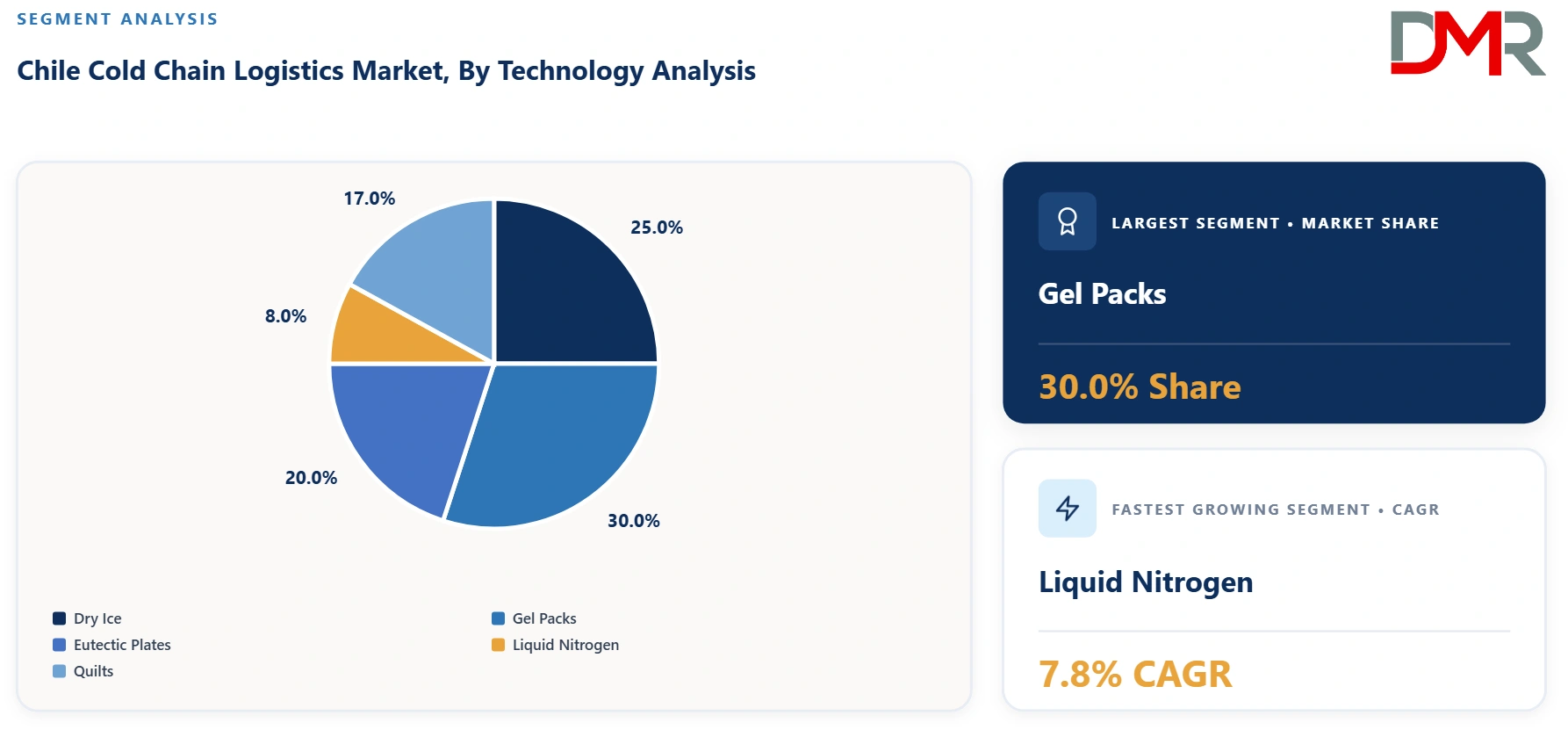
Gel Packs are estimated to lead the technology segment at approximately 30.0% share, particularly in smaller shipments, chilled food distribution and applications requiring reusable or disposable thermal protection. Dry Ice represents about 25.0%, benefiting from its very low-temperature performance for frozen products and specialized distribution. Eutectic Plates account for approximately 20.0% and are increasingly attractive where reusable thermal-control systems can lower long-term packaging costs. Quilts represent around 17.0%, primarily providing passive insulation and protection against short-duration temperature fluctuations. Liquid Nitrogen has the smallest estimated share, at approximately 8.0%, but is projected to be the fastest-growing technology at 7.8% CAGR because of its suitability for rapid freezing, specialized food processing and premium applications. Growth will remain niche because nitrogen-based systems require specialized infrastructure and operational expertise. The technology mix is expected to evolve toward reusable, sensor-enabled and energy-efficient thermal solutions.
The Chile Cold Chain Logistics Market Report is segmented on the basis of the following:
By Service Type
- Refrigerated Warehouse
- Refrigerated Transportation
By Application
- Seafood
- Meat
- Fruit & Vegetable
- Dairy Products
- Alternative Protein
- Others
By Temperature Type
By Technology
- Dry Ice
- Gel Packs
- Eutectic Plates
- Liquid Nitrogen
- Quilts
Regulatory Landscape
Chile's cold-chain market operates under a comparatively structured food-safety framework. The country's Reglamento Sanitario de los Alimentos establishes sanitary requirements for production, storage, distribution, transportation and sale of food. Perishable foods requiring refrigeration must be transported in closed vehicles capable of maintaining the required temperature, equipped with externally readable thermometers and subject to sanitary authorization. Frozen-food rules additionally establish temperature and continuous-recording requirements. These regulations create recurring demand for qualified equipment, temperature monitoring and documented compliance. Regulatory requirements raise operating costs for smaller providers but also favor professional third-party logistics operators with certified fleets and digital traceability. Future regulatory emphasis on food safety, environmental performance and digital records should create opportunities for IoT monitoring, automated compliance reporting and lower-emission refrigeration technologies.
Investment and White Space Analysis
The clearest investment white space is port-adjacent integrated cold infrastructure, particularly facilities combining rapid freezing, storage, consolidation and transportation. San Antonio is emerging as a key opportunity, illustrated by Emergent Cold LatAm's 2026 blast-freezing investment exceeding 10,500 tons of annual processing capacity. Biobío also offers significant potential because of its seafood, fruit and reefer-export base; IceStar's Coronel facility provides 40,000 planned pallet positions across two phases.Additional opportunities exist in southern Chile, where salmon production creates demand for specialized storage and transportation. Investors should prioritize facilities near ports and production clusters, automated high-density warehouses, renewable-powered refrigeration and integrated transport networks rather than commodity warehouse capacity alone.
Competitive Landscape
Chile's cold-chain logistics market is relatively fragmented but undergoing consolidation, with national operators competing alongside international and regional logistics companies. Major participants include Emergent Cold LatAm, IceStar, Megafrio/IceStar, Friofort, Empresas Taylor, Transportes Nazar, Frigoríficos Puerto Montt, TudeFrigo, CEVA Logistics, DHL Supply Chain, DSV and Kuehne + Nagel, among others. Industry research characterizes market concentration as low, while recent acquisitions indicate increasing consolidation. Competition centers on storage capacity, geographic coverage, port proximity, transportation reliability, food-safety compliance, automation, energy efficiency and digital temperature visibility. M&A, facility expansion and integrated storage-plus-transport offerings are becoming increasingly important competitive strategies.
Some of the prominent players in the Chile Cold Chain Logistics Market are:
- Emergent Cold LatAm
- IceStar Chile
- Megafrio Chile
- Empresas Taylor
- Megalogistica
- Frigoríficos Puerto Montt
- Tudefrigo
- Transportes Nazar
- Loginsa
- Friofort
- Frio Romeral
- Frigorífico Simunovic
- Friosan
- Transportes Flores
- Andes Logistics
- Agunsa
- Frío Express
- Logística Chile
- Cencocal
- Transportes Frío Sur
- Ultramar
- CEVA Logistics
- DHL Supply Chain
- Kuehne+Nagel
- DSV
- Yusen Logistics
- TIBA
- Omni Logistics
- Röhlig Logistics
- JAS Worldwide
- C.H. Robinson
- Logistics Partners Chile
- Cool Carriers
- Maersk
- DB Schenker
- Kintetsu World Express
- Nippon Express
- Hellmann Worldwide Logistics
- Bolloré Logistics
- Rhenus Logistics
- Other Key Players
Recent Developments
- June 2026: Emergent Cold LatAm announced two new blast-freezing tunnels in San Antonio capable of processing more than 10,500 tons annually, using CO₂ refrigeration and integrating freezing, consolidation and inspection.
- March 2026: Emergent Cold LatAm inaugurated what it described as the largest automated food cold-storage facility in Latin America in Chile, adding 33,000 pallet positions and reinforcing the country's move toward automated cold storage.
- April 2025: IceStar completed its acquisition of Mega Frío, expanding to approximately 130,000 pallet positions and strengthening its national storage, food-service distribution and transportation capabilities.
- March 2025: IceStar inaugurated a temperature-controlled facility in Coronel following an investment of approximately USD 30 million, targeting fruit and seafood export logistics in Biobío.
- April 2024: IceStar inaugurated its Quilicura expansion following a USD 20 million investment, adding more than 12,500 pallet positions and increasing the facility's total capacity to more than 35,000 pallet positions.
Report Details
| Report Characteristics |
| Market Size (2026) |
USD 562.1 Mn |
| Forecast Value (2035) |
USD 830.9 Mn |
| CAGR (2026–2035) |
4.5% |
| Historical Data |
2021 – 2025 |
| Forecast Data |
2026 – 2035 |
| Base Year |
2025 |
| Segments Covered |
By Service Type, By Application, By Temperature Type, By Technology |
| Country Coverage |
Chile |
Frequently Asked Questions
What is the size of the Chile Cold Chain Logistics Market in 2026?
▾ The Chile Cold Chain Logistics Market is estimated at approximately USD 562.1 million in 2026, supported by strong demand from food exports, retail and food-service distribution.
What will the Chile Cold Chain Logistics Market size be by 2035?
▾ The Chile Cold Chain Logistics Market is projected to reach approximately USD 830.9 million by 2035, driven by infrastructure expansion, technology adoption and increasing demand for temperature-controlled logistics.
What is the expected CAGR of the Chile Cold Chain Logistics Market from 2026 to 2035?
▾ The Chile Cold Chain Logistics Market is expected to expand at approximately 4.5% CAGR from 2026 to 2035, supported by growing perishable-food distribution and export activity.
What are the major growth drivers for the Chile Cold Chain Logistics Market?
▾ Key drivers include seafood and fruit exports, increasing frozen-food consumption, expansion of refrigerated infrastructure, warehouse automation, digital temperature monitoring and integrated logistics services.
What are the major trends in the Chile Cold Chain Logistics Market?
▾ Major trends include automated cold storage, IoT-enabled temperature monitoring, sustainable refrigeration, port-adjacent facilities, integrated logistics solutions and increasing consolidation among cold-chain operators.
Which segment dominates the Chile Cold Chain Logistics Market?
▾ Refrigerated Warehouse is expected to dominate the Service Type segmentation of the Chile Cold Chain Logistics Market, supported by increasing demand for storage, consolidation and export-oriented cold-chain infrastructure.
Which application leads the Chile Cold Chain Logistics Market?
▾ Seafood is expected to lead the Application segment of the Chile Cold Chain Logistics Market, supported by Chile's substantial salmon, trout, shellfish and frozen seafood industries.
Which segment is expected to grow fastest in the Chile Cold Chain Logistics Market?
▾ Liquid Nitrogen is projected to be the fastest-growing Technology segment in the Chile Cold Chain Logistics Market, supported by specialized rapid-freezing and premium food-processing applications.
Who are the key players in the Chile Cold Chain Logistics Market?
▾ Major participants in the Chile Cold Chain Logistics Market include Emergent Cold LatAm, IceStar, Friofort, Empresas Taylor, Transportes Nazar, Frigoríficos Puerto Montt and TudeFrigo.
What are the key restraints affecting the Chile Cold Chain Logistics Market?
▾ High infrastructure costs, energy consumption, geographic distances, seasonal demand fluctuations, specialized equipment requirements and operational complexity are major restraints affecting the Chile Cold Chain Logistics Market.
How is technology transforming the Chile Cold Chain Logistics Market?
▾ IoT sensors, automation, AI-enabled analytics, GPS tracking and digital inventory systems are improving temperature visibility, reducing spoilage, increasing warehouse efficiency and strengthening supply-chain traceability.
How is the Chile Cold Chain Logistics Market segmented?
▾ The Chile Cold Chain Logistics Market is segmented by Service Type, Application, Temperature Type and Technology, covering major cold-chain services, product categories and temperature-control solutions.