Chile Food Packaging Market Snapshot
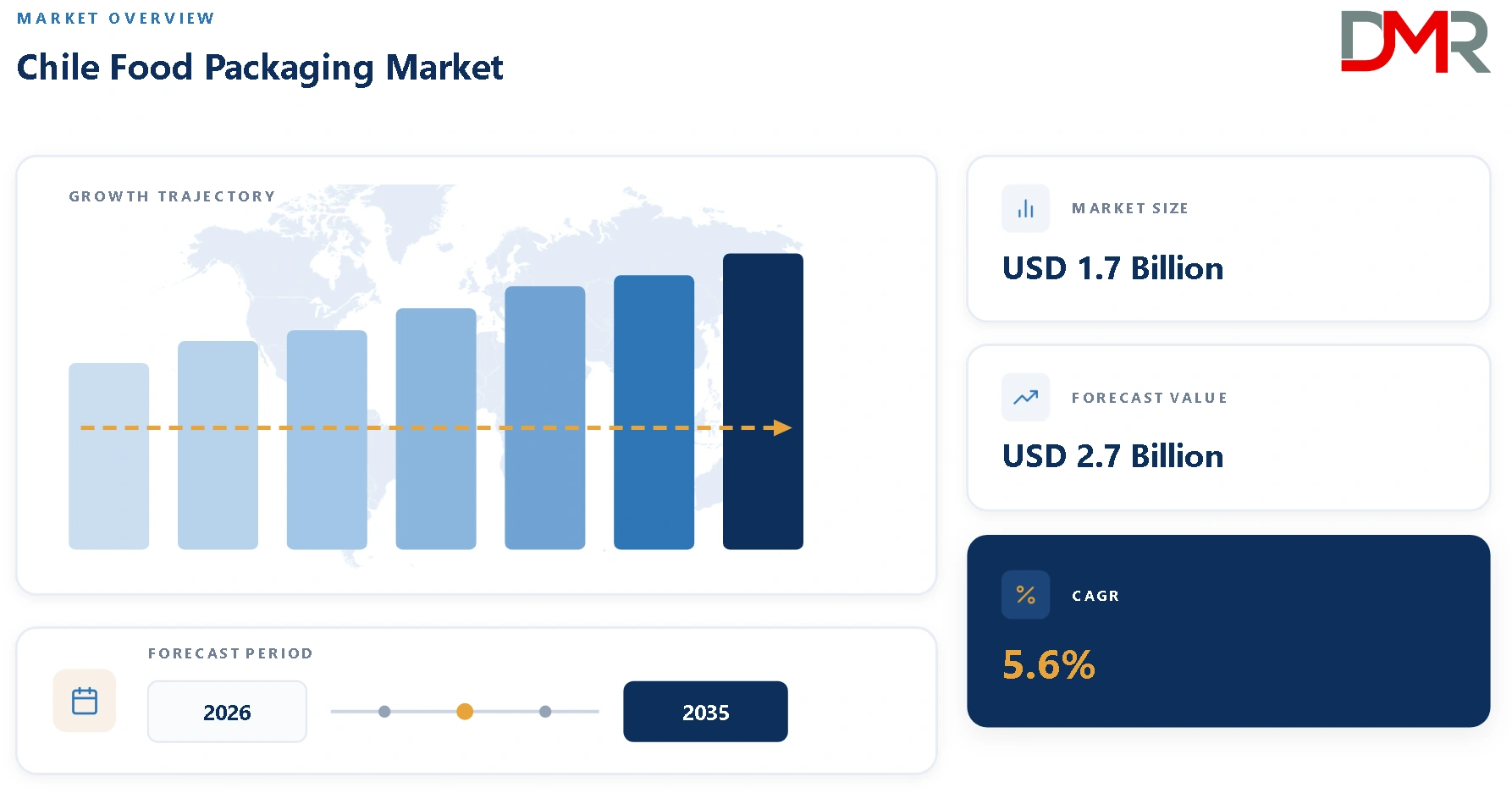
- Market Size 2026: USD 1.7 billion
- Market Size 2035: USD 2.7 billion
- CAGR, 2026-2035: 5.6%
- Leading Packaging Type: Flexible packaging, 37%
- Leading Application: Dairy Products, 18%
What is the Chile Food Packaging and its Market Size?
The Chile food packaging market is estimated at USD 1.7 billion in 2026, rising to approximately USD 2.7 billion by 2035, representing a 5.6% CAGR.
ℹ
To learn more about this report –
Download Your Free Sample Report Here
The Chile food packaging market comprises the manufacture, conversion, supply and use of packaging formats designed to protect, preserve, transport, display and dispense food products sold in Chile. It includes flexible films and pouches, paper and paperboard cartons, corrugated packaging, rigid plastic containers, glass jars and bottles, metal cans and emerging bio-based formats. The market serves food processors, beverage and dairy manufacturers, exporters, retailers, foodservice operators and consumers. Its core value proposition is extending shelf life while maintaining food safety, product quality, convenience, logistics efficiency and brand visibility. Increasingly, packaging must also satisfy recyclability, material-reduction and circular-economy requirements.
Use Cases
- Dairy packaging: Protects milk, yogurt, cheese and other products through refrigerated and shelf-stable distribution.
- Fresh-produce packaging: Provides protection, ventilation, portioning and transport efficiency for Chile's fruit and vegetable exports.
- Seafood packaging: Supports freezing, chilled distribution, moisture protection and international shipment of salmon and seafood.
- Convenience-food packaging: Enables portion control, microwaveability, resealability and extended shelf life for ready-to-eat products.
- Sauce and condiment packaging: Uses bottles, flexible pouches and aseptic formats to improve dispensing and preservation.
- Bakery and snack packaging: Provides moisture, oxygen and light barriers while supporting attractive retail presentation.
Key Takeaways
- Market size: Chile's food packaging market is estimated at USD 1.67 billion in 2026, reaching USD 2.72 billion by 2035.
- Growth: The market is forecast to expand at approximately 5.6% CAGR from 2026-2035.
- Primary drivers: Packaged-food consumption, convenience, food exports, e-commerce, private labels and sustainability requirements.
- Segment dominance: Flexible packaging is estimated to lead by packaging type with approximately 37% share in 2026.
- Application leadership: Dairy products represent an estimated 18% share, supported by widespread packaged milk and yogurt consumption.
- Fastest growth: Bio-based and compostable materials are estimated to grow at approximately 8.2% CAGR, albeit from a relatively small base.
- Strategic theme: Recyclability, lightweighting, mono-material structures, fiber-based alternatives and circularity are becoming competitive necessities rather than optional features.
How AI/Gen AI is Transforming the Chile Food Packaging Market?
Advanced packaging technologies including AI-enabled quality inspection, IoT-connected production equipment, digital printing, smart packaging and automated packaging lines are improving Chilean food manufacturers' ability to produce consistent, traceable and resource-efficient packaging. IoT sensors can monitor filling, sealing, temperature and machine performance, while machine vision detects defects at high production speeds. Digital printing enables shorter runs and faster customization, supporting private labels and product launches.
The principal benefits are lower material waste, reduced downtime, improved quality control and more accurate production planning. Automation is particularly valuable for exporters that must maintain stringent quality standards across large volumes. Smart and connected packaging can additionally support traceability and consumer engagement.
Key Drivers in the Chile Food Packaging Market
Expansion of Packaged and Convenience Foods
Growing consumer preference for convenient, ready-to-eat, portion-controlled and easy-to-store food products is increasing demand for food packaging in Chile. Urban lifestyles, modern retail formats, private-label products and the expansion of online grocery purchasing are encouraging food manufacturers to use packaging that provides convenience, portability, resealability and extended shelf life. Snacks, dairy products, bakery items, processed foods and ready meals are particularly benefiting from this shift. Manufacturers are also investing in attractive packaging formats to differentiate products on increasingly competitive retail shelves.
Strong Food-Export Industry
Chile's established food-export industry is a major structural driver for packaging demand. The country is a significant exporter of fresh fruits, seafood, salmon, processed foods and other agricultural products, creating substantial requirements for protective primary and secondary packaging. Export-oriented food manufacturers require packaging capable of withstanding long transportation distances, temperature variations, moisture exposure and repeated handling. Corrugated cases, high-barrier films, vacuum packaging, modified-atmosphere packaging and specialized produce and seafood packaging are consequently gaining importance. Exporters are also increasingly required to meet international sustainability and packaging standards, encouraging investment in lightweight, recyclable and resource-efficient solutions.
Restraints in the Chile Food Packaging Market
Raw-Material Price Volatility and Cost Pressure
Fluctuations in the prices of polymers, paper, pulp, aluminum, glass, energy and transportation create significant cost pressures for packaging manufacturers. Packaging producers may face difficulty passing higher input costs to food manufacturers, particularly in price-sensitive food categories. At the same time, food companies increasingly expect packaging suppliers to provide lightweight and sustainable solutions without significantly increasing unit costs. Recycled, bio-based and compostable materials can involve higher procurement, processing or certification costs compared with conventional materials.
Recycling Infrastructure and Regulatory Challenges
The transition toward a circular packaging economy presents implementation challenges for the Chilean food packaging industry. Increasing producer responsibilities for packaging waste are encouraging manufacturers to redesign products and improve recyclability, but effective recycling also depends on collection systems, sorting facilities, recycling capacity and consumer participation. Flexible plastics, multilayer structures and certain specialized packaging formats can be particularly difficult to recover economically.
Growth Opportunities in the Chile Food Packaging Market
Sustainable and Recyclable Packaging
Sustainable packaging represents one of the strongest growth opportunities in Chile. Food manufacturers are increasingly seeking packaging that reduces material consumption, incorporates recycled or renewable inputs and improves recyclability. Mono-material flexible packaging, fiber-based trays, recyclable cartons, lightweight rigid containers and compostable materials are gaining attention as alternatives to conventional packaging structures. Packaging suppliers that can maintain food safety, barrier performance and shelf life while reducing environmental impact will have a significant competitive advantage. The opportunity is particularly strong in snacks, dairy, processed foods, fresh produce and seafood, where packaging is used at high volumes.
High-Performance Packaging for Food Exports
Chile's strong agricultural and seafood industries create significant opportunities for specialized packaging solutions designed for international supply chains. Fresh fruit, salmon, seafood, frozen foods and processed agricultural products require packaging capable of maintaining product quality throughout transportation and distribution. High-barrier films, vacuum packaging, modified-atmosphere packaging, temperature-resistant materials and stronger corrugated solutions can help reduce product losses and extend shelf life. Sustainable export packaging is an additional opportunity because international buyers increasingly seek lower material consumption and improved recyclability.
Trends in the Chile Food Packaging Market
Shift Toward Circular and Sustainable Packaging
Sustainability is becoming an increasingly important factor in packaging design, procurement and product development. Food companies are moving toward recyclable materials, lightweight structures, renewable inputs and packaging designs that support improved end-of-life recovery. Mono-material flexible packaging and paper-based solutions are attracting particular interest because they can potentially simplify recycling or reduce reliance on conventional plastics. Manufacturers are also reducing unnecessary packaging layers and optimizing package dimensions to lower material consumption and transportation requirements.
Increasing Adoption of Flexible and Convenience Formats
Flexible packaging is gaining popularity because it combines low material consumption with lightweight transportation, strong branding opportunities and convenient consumer functionality. Stand-up pouches, resealable bags, portion packs and flexible films are increasingly suitable for snacks, sauces, dairy products, frozen foods and convenience meals. Consumers value packaging that is easy to open, carry, store and dispose of, while food manufacturers benefit from efficient material utilization and transportation economics.
Research Scope and Analysis
The Chile food packaging market is segmented in this report by Packaging Type, Application, Packaging Format and Packaging Technology. Estimates reflect the relative consumption of packaging materials and formats across Chile's food-processing, retail, foodservice and export industries.
ℹ
To learn more about this report –
Download Your Free Sample Report Here
By Packaging Type Analysis
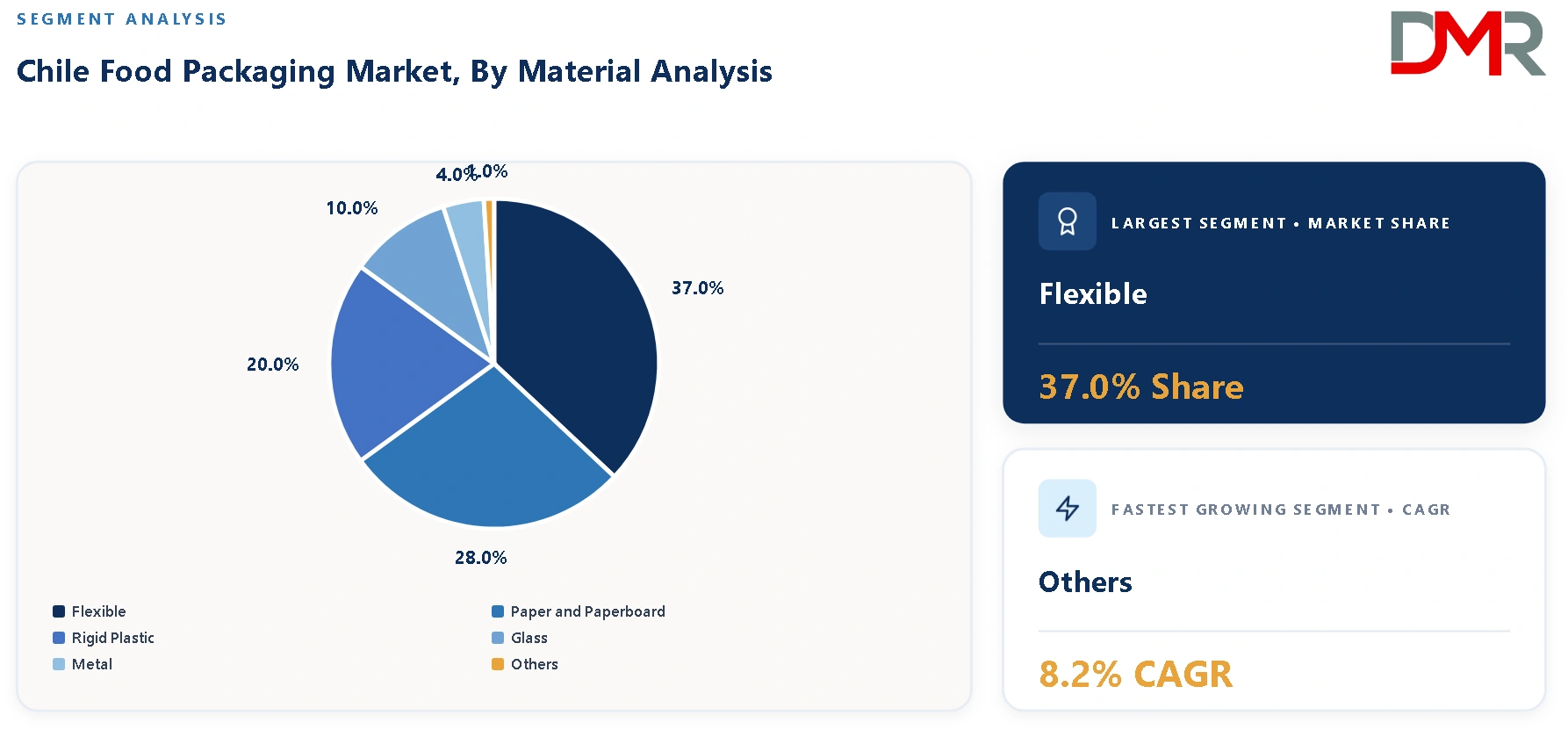
Flexible packaging is estimated to dominate the Chile food packaging market in 2026 with approximately 37% share, supported by its low material consumption, lightweight logistics profile, strong barrier capabilities and broad use in snacks, dairy products, sauces, frozen foods and processed foods. Paper and paperboard, estimated at approximately 28%, represent the second-largest category due to corrugated cases, cartons, trays and growing demand for fiber-based alternatives. Rigid plastic accounts for an estimated 20%, benefiting from bottles, tubs, trays and containers requiring durability and convenient handling. Glass and metal represent approximately 10% and 4%, respectively, with glass retaining relevance for sauces, premium foods and preserved products, while metal remains important for canned foods. Other materials account for roughly 1%. The fastest-growing sub-segment is estimated to be bio-based and compostable packaging within the broader sustainable-material category, at approximately 8.2% CAGR, driven by environmental regulation, consumer expectations and brand sustainability targets. The opportunity remains constrained by cost, barrier performance and recycling infrastructure.
By Application Analysis
Dairy products are estimated to be the largest food-packaging application in 2026 at approximately 18% share, reflecting the scale of packaged milk, yogurt, cheese and other dairy products. Aseptic cartons, plastic tubs, flexible films and rigid containers support multiple temperature and shelf-life requirements. Bakery, confectionery, pasta and noodles represent the second-largest application at an estimated 16%, supported by high-volume flexible films, paperboard cartons and protective secondary packaging. Meat, fish and poultry account for approximately 15%, with strong demand from Chile's seafood industry. Snacks and side dishes represent about 13%, followed by sauces, dressings and condiments at 12%, convenience foods at 11%, fruits and vegetables at 9%, and other applications at 6%. Convenience foods are expected to be the fastest-growing application at approximately 7.0% CAGR, benefiting from demand for ready-to-eat products, portion-controlled meals and packaging compatible with modern retail and food delivery.
The Chile Food Packaging Market Report is segmented on the basis of the following:
By Packaging Type
- Flexible
- Paper and Paperboard
- Rigid Plastic
- Glass
- Metal
- Others
By Application
- Bakery, Confectionery, Pasta, and Noodles
- Dairy Products
- Sauces, Dressings, and Condiments
- Snacks and Side Dishes
- Convenience Foods
- Meat, Fish, and Poultry
- Fruits and Vegetables
- Others
Regulatory Landscape
Chile's Extended Producer Responsibility (REP) regime is one of the most important forces shaping food packaging. Containers and packaging are classified as priority products, placing collection, recovery and reporting responsibilities on relevant producers and importers. The regulatory direction favors recyclable, lightweight and recoverable packaging while increasing the cost of poorly designed formats. Implementation remains a risk because infrastructure, municipal participation and collection economics must develop alongside regulatory targets. In 2026, government and industry representatives proposed changes intended to improve practical implementation of packaging REP obligations. For suppliers, compliance capability, recyclability documentation and lifecycle data are becoming competitive differentiators. Companies that anticipate regulatory requirements rather than merely react to them should have stronger access to large food manufacturers and multinational brand owners.
Investment and White Space Analysis
The most attractive investment white spaces are mono-material flexible packaging, fiber-based food trays, recyclable high-barrier films, sustainable seafood packaging, reusable transport packaging and advanced recycling infrastructure. Chile's export-oriented food economy provides a natural testing environment for packaging capable of reducing weight while maintaining cold-chain and transportation performance. CMPC's work on sustainable salmon packaging demonstrates demand for solutions combining logistics optimization, sustainability and export presentation. Additional opportunities exist in small-format aseptic packaging, spouted pouches and packaging designed for convenience foods. Investors should nevertheless assess raw-material availability, food-contact certification, recovery infrastructure and the economics of collecting low-value packaging. The strongest opportunities are likely to be solutions that reduce total system cost while simultaneously improving recyclability and regulatory compliance.
Competitive Landscape
The Chile food packaging market is moderately fragmented, combining multinational packaging groups, regional converters, domestic paper and carton producers, specialty manufacturers and integrated food companies. CENEM represents more than 120 organizations across Chile's packaging value chain, illustrating the breadth of the local ecosystem. Competition centers on price, product quality, food safety, barrier performance, manufacturing scale, sustainability credentials, customization and supply reliability. Companies are increasingly using partnerships, R&D collaborations, new materials, lightweighting and circular-economy initiatives to differentiate. Local producers benefit from customer proximity and market knowledge, while multinationals generally have advantages in technology, global procurement and R&D.
Some of the prominent players in the Chile Food Packaging Market are:
- CMPC Biopackaging
- Cartocor Chile
- BO Packaging
- Coexpan – Coembal Chile
- EPT
- Packaging Bio Bio (PBB)
- Vanni Packaging
- Antilhas
- Amcor
- Ball Chile
- Envases Impresos
- Plasenval
- Montesa
- Pac Life
- Industrias Vanni
- Chilempack
- Bolsapel
- Codepack
- Metalpren
- Herti
- Serviform
- Yapack
- Solucorp
- Compostech
- Empaque Verde
- I Am Not Plastic
- Packaging Bío Bío
- Food Pack
- Agropack
- Akipack
- Bepack
- Cristalim
- DPS Chile
- Groupack
- Fodor
- Matray Pack
- Nalón Plásticos
- Plaspak
- Green Heart Solutions
- Yugen Chile
- Other Key Players
Recent Developments
- March 2026: CMPC Biopackaging launched its third packaging innovation competition in Chile with Agrosuper, Soprole and AB InBev, focusing on corrugated-cardboard solutions designed to replace non-biodegradable materials.
- December 2025: Tetra Pak introduced a paper-based barrier solution for juice packaging with García Carrión, supporting greater use of renewable materials while maintaining the protection required for packaged beverages.
- December 2025: CMPC, together with MIT, Cambridge Innovation Center and Multi X, announced the winners of a packaging innovation challenge focused on developing more sustainable and efficient packaging solutions for Chilean salmon exports.
- March 2025: Amcor expanded its AmFiniti recycled-content packaging portfolio across the Andes region, including Chile, providing solutions aimed at reducing plastic waste and reliance on virgin plastic resources.
Report Details
| Report Characteristics |
| Market Size (2026) |
USD 1.7 Bn |
| Forecast Value (2035) |
USD 2.7 Bn |
| CAGR (2026–2035) |
5.6% |
| Historical Data |
2021 – 2025 |
| Forecast Data |
2026 – 2035 |
| Base Year |
2025 |
| Segments Covered |
By Packaging Type, By Application |
| Country Coverage |
Chile |
Frequently Asked Questions
What is the size of the Chile Food Packaging Market in 2026?
▾ The Chile Food Packaging Market is estimated at USD 1.7 billion in 2026, supported by packaged-food consumption, food exports and increasing demand for convenient packaging.
What is the projected size of the Chile Food Packaging Market by 2035?
▾ The Chile Food Packaging Market is projected to reach approximately USD 2.7 billion by 2035, driven by sustained demand for packaged foods and sustainable packaging.
What is the CAGR of the Chile Food Packaging Market from 2026 to 2035?
▾ The Chile Food Packaging Market is expected to expand at approximately 5.6% CAGR from 2026 to 2035, supported by structural growth across major food categories.
What are the key drivers of the Chile Food Packaging Market?
▾ The Chile Food Packaging Market is driven by convenience foods, packaged-food consumption, food exports, e-commerce, private-label products and growing sustainability requirements.
What are the major trends in the Chile Food Packaging Market?
▾ Major Chile Food Packaging Market trends include lightweighting, recyclable materials, mono-material structures, flexible packaging, resealable formats and increased adoption of sustainable packaging.
Which packaging type dominates the Chile Food Packaging Market?
▾ Flexible packaging dominates the Chile Food Packaging Market, accounting for an estimated 37% share in 2026, due to its versatility, lightweight nature and cost efficiency.
Which application represents the largest share of the Chile Food Packaging Market?
▾ Dairy products represent the largest application segment of the Chile Food Packaging Market, accounting for an estimated 18% share in 2026.
Which is the fastest-growing segment in the Chile Food Packaging Market?
▾ Bio-based and compostable packaging is estimated to be the fastest-growing segment of the Chile Food Packaging Market, with approximately 8.2% CAGR through the forecast period.