Chile Seafood Processing Market Snapshot
- Market Size in 2026: USD 10.1 billion
- Market Size in 2035: USD 15.2 billion
- CAGR, 2026-2035: 4.6%
- Leading Processing Type: Frozen Seafood Processing, 42%
- Leading Species Type: Others, 63%
- Leading Distribution Channel: Export Markets, 62%
- Fastest-Growing Segment: Direct-to-Consumer, 8.0% CAGR
What is the Chile Seafood Processing and its Market Size?
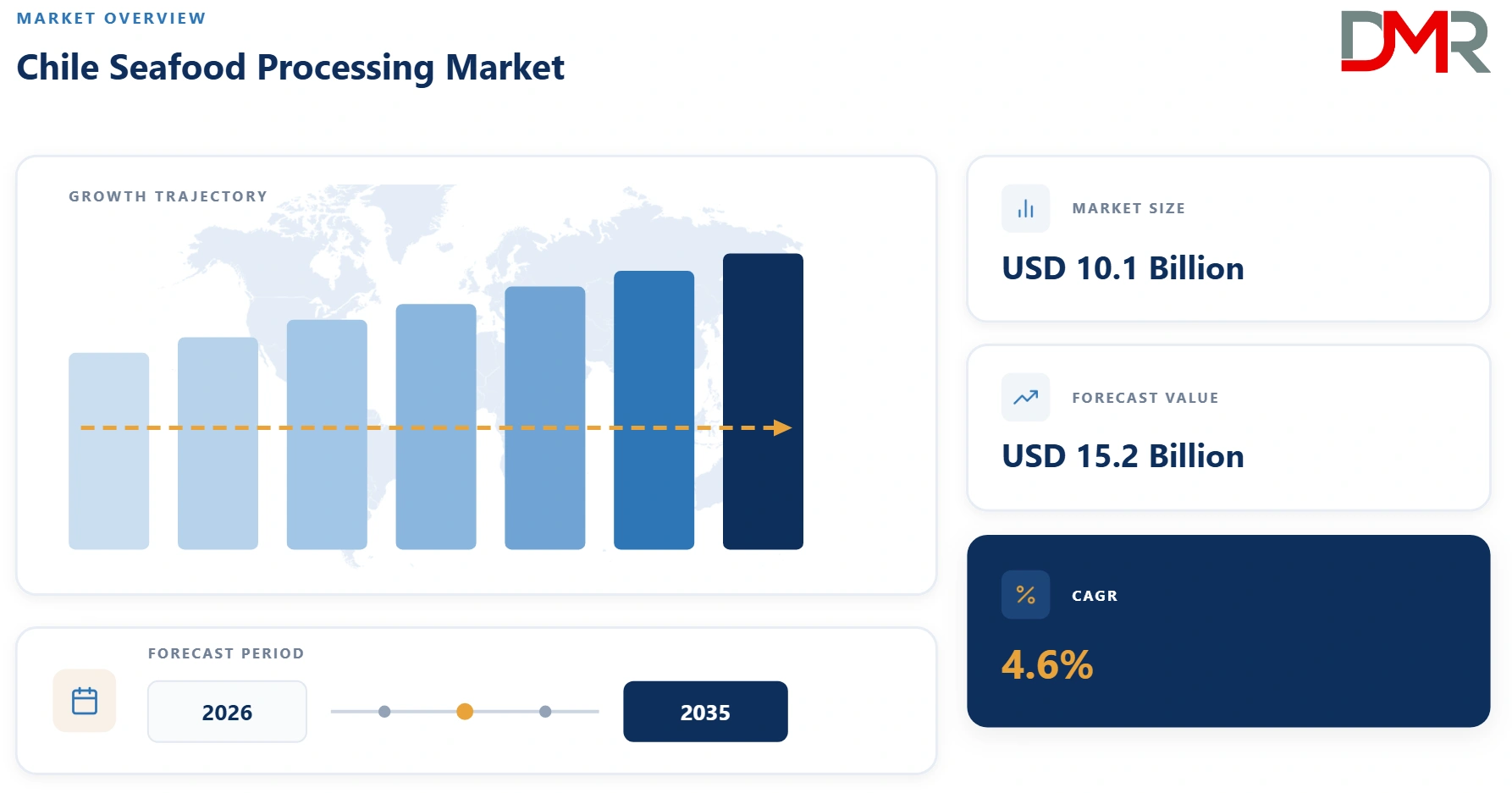
The Chile Seafood Processing Market is estimated at USD 10.1 billion in 2026 and is projected to reach approximately USD 15.2 billion by 2035, representing a 4.6% CAGR.
ℹ
To learn more about this report –
Download Your Free Sample Report Here
The Chile Seafood Processing Market encompasses the transformation, preservation, packaging and value addition of wild-caught and farmed seafood into products suitable for domestic and international consumption. It includes primary processing such as heading, gutting, filleting, chilling and freezing, as well as secondary processing such as portioning, smoking, canning, surimi production, marination, vacuum packing and ready-to-cook preparation. The sector links Chile's fisheries and aquaculture industries with retailers, foodservice operators, wholesalers and international distributors. Its principal value proposition is extending shelf life, improving food safety, increasing product convenience and generating higher-value export products from Chile's abundant marine resources.
Use Cases
- Frozen Seafood: Preserves fish and shellfish quality while enabling long-distance international distribution.
- Fresh/Chilled Products: Supplies premium seafood to supermarkets, restaurants and nearby export markets requiring short lead times.
- Canned Seafood: Provides shelf-stable protein with extended storage and broad retail accessibility.
- Value-Added Seafood: Converts raw seafood into fillets, portions, marinated products and ready-to-cook formats.
- Surimi Processing: Converts selected fish species into standardized protein ingredients for seafood products and foodservice.
- Smoked and Dried Seafood: Creates premium and shelf-stable products targeting specialty retail and foodservice applications.
Key Takeaways
- Market Size: The market is estimated at USD 10.1 billion in 2026, increasing to USD 15.2 billion by 2035.
- Growth Rate: The market is projected to expand at approximately 4.6% CAGR during 2026-2035.
- Growth Drivers: Export demand, aquaculture expansion, convenience foods, cold-chain development and premiumization are the principal growth catalysts.
- Segment Dominance: Frozen processing leads by processing type, while the broad Others species category dominates because it contains Chile's large salmon, trout and pelagic species base.
- Fastest Growth: Direct-to-consumer seafood is expected to grow fastest at approximately 8.0% CAGR, albeit from a relatively small base.
- Export Exposure: The industry remains heavily export oriented, with the United States representing 31.7% of Chile's seafood exports in 2025.
How AI/Gen AI is Transforming the Chile Seafood Processing Market?
AI, IoT and industrial automation are increasingly being deployed across Chilean seafood processing for automated grading, machine vision, temperature monitoring, predictive maintenance, inventory management and cold-chain traceability. Modern plants increasingly connect production equipment with digital quality-control systems, while processors use sensor data to monitor seafood temperature, throughput, yield and equipment performance. Camanchaca, for example, operates highly automated processing and recirculating aquaculture infrastructure, while its Tomé value-added facility processes up to 7,000 tonnes of raw material monthly.
Key Drivers in the Chile Seafood Processing Market
Strong Export Demand and International Market Position
The Chile Seafood Processing Market benefits from Chile's strong position as an international supplier of seafood products. Export demand creates consistent requirements for freezing, chilling, filleting, portioning, packaging and other processing activities. In early 2026, Chilean fisheries and aquaculture exports increased strongly compared with the previous year, while aquaculture accounted for the majority of export value and salmonids remained the leading export group.
Expanding Aquaculture Production and Availability of Processable Raw Material
Aquaculture is a major structural driver of the Chile Seafood Processing Market because it provides processors with a relatively predictable supply of commercially valuable seafood. Chile recorded approximately 1.53 million tonnes of aquaculture production in 2025, with salmonids representing the dominant fish category and mussels representing an important shellfish category.
Restraints in the Chile Seafood Processing Market
Raw-Material Volatility and Biological Risks
The Chile Seafood Processing Market remains exposed to fluctuations in the availability and quality of seafood raw materials. Wild fisheries are influenced by oceanographic conditions, biomass levels, seasonal patterns, fishing quotas and biological cycles. Chile's 2025 fisheries data showed strong growth in several pelagic resources, but such changes demonstrate the variability that processors must manage.
High Export Dependence and Exposure to International Trade Conditions
The Chile Seafood Processing Market is strongly dependent on international trade, making processors vulnerable to changes in tariffs, exchange rates, logistics costs, geopolitical conditions and demand in major destination markets. Seafood exports represented a significant portion of Chile's overall industry value, with aquaculture and salmonids accounting for particularly large shares of export earnings.
Growth Opportunities in the Chile Seafood Processing Market
Expansion of Value-Added and Ready-to-Cook Seafood
The Chile Seafood Processing Market has substantial potential to increase revenue by shifting from commodity-oriented products toward higher-value processed seafood. Demand for convenience, portion control and easy meal preparation is creating opportunities for fillets, skinless portions, marinated seafood, vacuum-packed products, ready-to-cook meals, smoked products and premium frozen formats.
Automation, Traceability and Sustainable Processing
Technology represents another major opportunity for the Chile Seafood Processing Market. Automated grading, machine vision, digital traceability, connected cold-chain monitoring and predictive maintenance can improve production efficiency and reduce losses. Processing plants can use real-time data to monitor temperature, product quality, equipment performance and production yields.
Trends in the Chile Seafood Processing Market
Premiumization and Convenient Seafood Products
The Chile Seafood Processing Market is increasingly shifting toward premium and convenience-oriented products. Consumers and foodservice operators are showing greater interest in standardized portions, fillets, ready-to-cook products, frozen seafood and packaged formats that reduce preparation time. This trend is encouraging processors to invest in secondary processing rather than relying solely on whole-fish or minimally processed products. Premiumization also enables companies to differentiate products based on species, origin, sustainability credentials, packaging and quality. As international retailers increasingly demand consistent specifications, processors with flexible and automated production lines are expected to gain a competitive advantage.
Sustainability, Traceability and Resource Efficiency
Sustainability and traceability are becoming increasingly important trends across the Chile Seafood Processing Market. International buyers are demanding greater visibility into seafood origin, production conditions, processing practices and environmental performance. Processors are consequently adopting stronger traceability systems, waste-reduction programs, energy-efficient equipment and improved water-management practices. The large scale of Chile's aquaculture and fisheries sector makes resource efficiency commercially significant because even small improvements in processing yield or energy consumption can produce meaningful cost savings.
Research Scope and Analysis
The market is segmented By Processing Type, By Species Type, By Distribution Channel and By End User. The analysis considers revenue generated from processed seafood sold domestically and internationally, excluding fishmeal and fish oil from the core market estimate.
ℹ
To learn more about this report –
Download Your Free Sample Report Here
By Processing Type Analysis
Frozen Seafood Processing is estimated to dominate with approximately 42% share in 2026, supported by Chile's long-distance export model, strong salmon and pelagic processing capabilities, and the ability of frozen products to preserve quality during international transportation. Fresh/Chilled Seafood Processing, with approximately 31% share, represents the second-largest category and remains important for premium salmon, domestic retail and geographically close export markets. Surimi and Value-Added Seafood Processing is estimated to be the fastest-growing category at approximately 6.7% CAGR, driven by consumer convenience, improved utilization of raw material and increasing demand for portions, ready-to-cook products and standardized seafood ingredients. Canned and preserved seafood accounts for approximately 12%, supported by jurel and other pelagic products, long shelf life and affordability. Dried and smoked seafood represents approximately 5% and remains a smaller but premium-oriented category. The processing mix is therefore expected to gradually shift toward higher-value products while frozen processing retains leadership because of Chile's export geography.
By Species Type Analysis
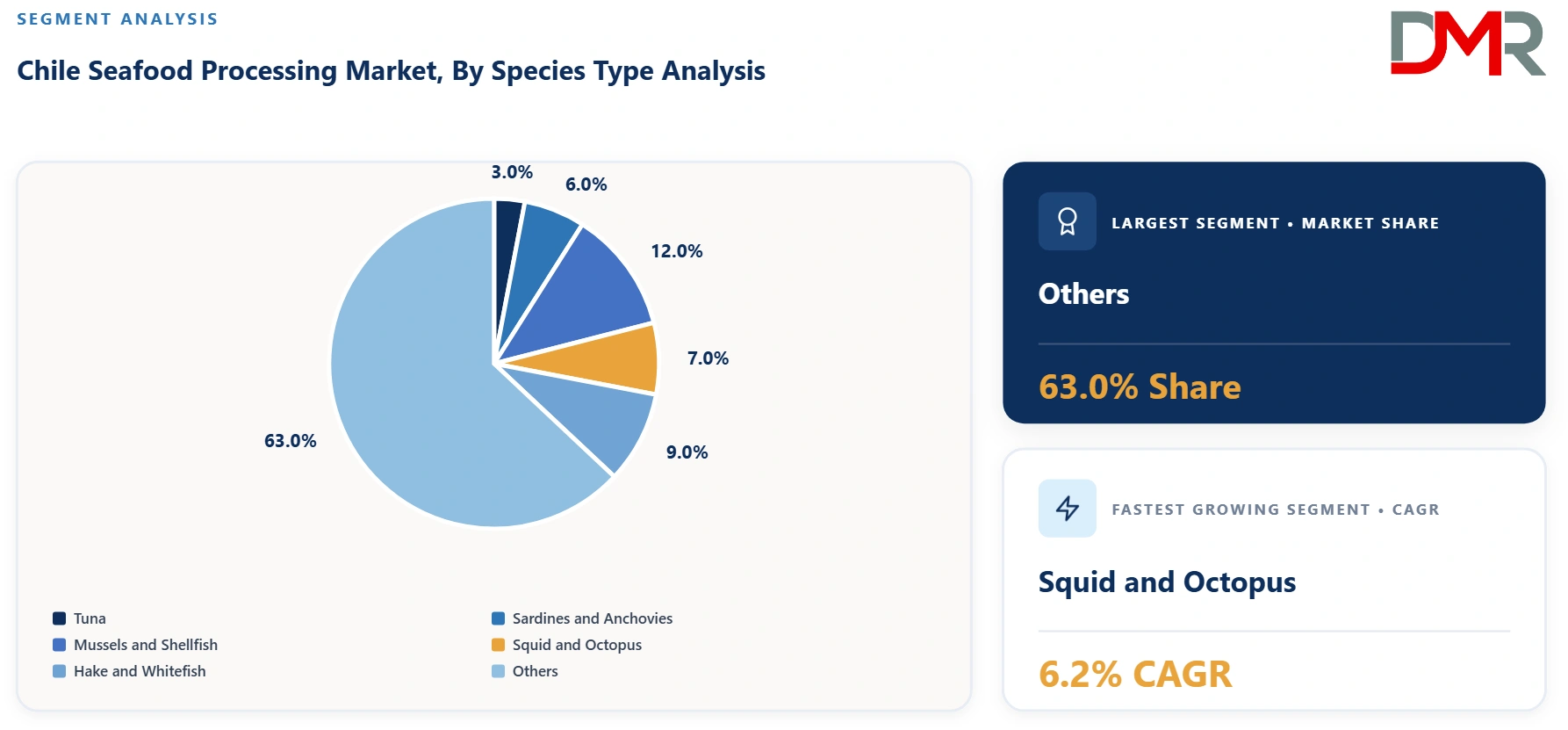
Others is estimated to be the dominant species category with approximately 63% share in 2026, reflecting the unusually large contribution of species not separately identified in the supplied segmentation particularly Atlantic salmon, coho salmon, trout, jack mackerel and other commercially important Chilean species. Sernapesca recorded 810,892 tonnes of Atlantic salmon and 309,521 tonnes of coho production in 2025, demonstrating why this residual category is structurally dominant. Mussels and Shellfish are estimated to be the second-largest named category at approximately 12%, supported by Chile's extensive mussel aquaculture industry. Squid and Octopus is projected to be the fastest-growing named species category at roughly 6.2% CAGR, benefiting from international demand and product diversification. Hake and whitefish account for approximately 9%, sardines and anchovies 6%, and tuna approximately 3%. The species structure demonstrates that salmonids remain the commercial center of gravity while Chile continues to diversify its seafood portfolio.
By Distribution Channel Analysis
Export Markets dominate distribution with approximately 62% share in 2026, reflecting Chile's position as a globally integrated seafood supplier. The country exported USD 9.19 billion in seafood products during 2025, with the United States alone accounting for USD 2.92 billion. Retail and Grocery Chains represent approximately 19%, supported by consumer demand for frozen fillets, chilled seafood, canned products and convenient packaged formats. Foodservice and HoReCa accounts for approximately 15%, driven by restaurants, hotels, catering and institutional kitchens requiring standardized portions. Direct-to-Consumer is the smallest category at approximately 4% but the fastest-growing, with an estimated 8.0% CAGR. Digital commerce, subscription seafood boxes, producer-owned websites and local delivery networks provide processors with an opportunity to capture retail margins and develop direct relationships with consumers. DTC remains constrained by logistics and cold-chain costs but should grow faster than traditional channels.
By End User Analysis
Export/International Trade represents approximately 64% of market revenue in 2026, making it the dominant end-user category. The concentration reflects Chile's export infrastructure, international certification capabilities and large-scale salmon and fisheries businesses. Chile's 2025 seafood exports reached approximately USD 9.19 billion, highlighting the scale of international demand. Domestic Consumption accounts for approximately 36% and is expected to grow at approximately 5.6% CAGR, faster than the overall market as Chilean consumers gain access to more convenient, packaged and value-added seafood. Domestic growth is supported by supermarkets, restaurants, prepared meals and increased awareness of seafood as a high-quality protein source. Export markets will remain dominant because of Chile's production scale, but domestic consumption represents an important diversification opportunity, particularly for processors able to develop affordable ready-to-cook products. Over the forecast period, the end-user structure should therefore remain export-led while domestic value-added consumption gradually gains share.
The Chile Seafood Processing Market Report is segmented on the basis of the following:
By Processing Type
- Frozen Seafood Processing
- Canned and Preserved Seafood Processing
- Fresh/Chilled Seafood Processing
- Surimi and Value-Added Seafood Processing
- Dried and Smoked Seafood Processing
By Species Type
- Tuna
- Sardines and Anchovies
- Mussels and Shellfish
- Squid and Octopus
- Hake and Whitefish
- Others
By Distribution Channel
- Retail and Grocery Chains
- Foodservice and HoReCa
- Export Markets
- Direct-to-Consumer
By End User
- Domestic Consumption
- Export/International Trade
Regulatory Landscape
Chile's seafood processing industry operates under a comprehensive framework covering fisheries management, aquaculture, environmental assessment, food safety, sanitary certification, traceability and export authorization. Sernapesca maintains official controls over seafood processing establishments and international export eligibility. In 2025, the agency reported 663 processing plants operating in the sector. Export competitiveness therefore depends not only on processing efficiency but also on maintaining certifications and meeting destination-country sanitary requirements. The regulatory environment presents both a barrier and competitive moat: compliant facilities gain access to demanding markets, while smaller processors can face significant capital costs for wastewater treatment, HACCP systems, traceability and environmental compliance. In 2026, regulatory modernization and efforts to accelerate aquaculture investment could improve capacity utilization and investment confidence. At the same time, changing U.S. trade policy demonstrates that regulatory risk extends beyond Chilean domestic rules into destination-market policy.
Investment and White Space Analysis
Investment opportunities are strongest in value-added processing, automation, cold-chain infrastructure, sustainable refrigeration, wastewater treatment and premium seafood formats. Large producers are increasingly investing in integrated production and technology: Cermaq's Chacao Canal project includes a USD 32.5 million second-stage RAS smolt facility, forming part of a broader USD 100 million project and illustrating continued investment in controlled production systems. Meanwhile, Blumar's Magallanes processing operation demonstrates the strategic value of regional processing capacity; its replacement plant has capacity of up to 3,960 tonnes per month. White space remains in digitally enabled mid-sized processing plants, premium mussel and shellfish products, ready-to-cook seafood, DTC cold-chain distribution and by-product valorization. The principal investment risks are biological volatility, regulatory delays, energy costs and export-market concentration.
Competitive Landscape
The Chile Seafood Processing Market is moderately consolidated at the high-value salmon-processing level but fragmented across fisheries, shellfish and smaller specialty processors. Leading companies compete through vertical integration, processing scale, product quality, international distribution, certification, automation and supply-chain control. Major players include AquaChile, Mowi Chile, Cermaq Chile, Australis Seafoods, Blumar, Camanchaca and other integrated producers and processors. Camanchaca, for example, operates multiple processing facilities spanning salmon, mussels, jurel, langostinos, abalones and other seafood categories and exports to more than 50 countries.
Some of the prominent players in the Chile Seafood Processing Market are:
- AquaChile
- Australis Seafoods
- Cermaq Chile
- Mowi Chile
- Multi X
- Salmones Camanchaca
- Blumar
- Salmones Austral
- Salmones Antártica
- Salmones de Chile
- Nova Austral
- Ventisqueros
- Yadran Quellón
- Pesquera Friosur
- Orizon
- Corpesca
- Landes
- Caleta Bay
- PacificBlu
- FoodCorp Chile
- Cooke Aquaculture Chile
- Pesquera Trans Antartic
- Pesquera Torres del Paine
- Pesquera Bahía Coronel
- Pesquera Bahía Caldera
- Lota Protein
- Pesquera Hanamar
- Pesca Chile
- Chile Seafoods
- Pesquera Isla Lennox
- Pesquera South Wind
- St. Andrews Smoky Delicacies
- Procesadora Calbuco
- Surproceso
- Fishplus
- Pesquera La Portada
- Alimex
- Industrias Isla Quihua
- Pesquera Santa Marta
- Comercial e Industrial del Sur
- Other Key Players
Recent Developments
- In August 2026, AKVA group reported progress on the second phase of Cermaq Chile’s RAS smolt facility, a USD 32.5 million project forming part of Cermaq’s broader USD 100 million Chacao Canal investment, strengthening the shift toward automated and technology-intensive aquaculture infrastructure.
- In June 2026, Blumar reported first-quarter revenue of USD 192.5 million, while its fisheries business increased 52% year over year, supported by stronger international prices, although salmon revenues declined amid lower volumes and challenging market conditions.
- In June 2026, Chile’s salmon sector completed a circular-economy production agreement involving 19 companies and 80 facilities, with approximately CLP 4.223 billion invested between 2021 and 2025 in cleaner production and resource-efficiency initiatives.
- In May 2026, Rabobank representatives visited Blumar’s Magallanes cultivation, processing and retail operations, highlighting financial-sector interest in southern Chile’s salmon production, processing infrastructure, traceability and sustainability potential.
Report Details
| Report Characteristics |
| Market Size (2026) |
USD 10.1 Bn |
| Forecast Value (2035) |
USD 15.1 Bn |
| CAGR (2026–2035) |
4.6% |
| Historical Data |
2021 – 2025 |
| Forecast Data |
2026 – 2035 |
| Base Year |
2025 |
| Segments Covered |
By Processing Type, By Species Type, By Distribution Channel, By End User |
| Country Coverage |
Chile |
Frequently Asked Questions
What is the market size of the Chile Seafood Processing Market in 2026?
▾ The Chile Seafood Processing Market is estimated to reach USD 10.1 billion in 2026, supported by strong seafood exports, aquaculture production and expanding value-added processing.
What will be the market size of the Chile Seafood Processing Market by 2035?
▾ The Chile Seafood Processing Market is projected to reach approximately USD 15.2 billion by 2035, reflecting sustained demand for processed seafood across domestic and international markets.
What is the CAGR of the Chile Seafood Processing Market from 2026 to 2035?
▾ The Chile Seafood Processing Market is expected to grow at a 4.6% CAGR from 2026 to 2035, driven by premiumization, processing innovation, aquaculture and export-market expansion.
What are the key growth drivers of the Chile Seafood Processing Market?
▾ The Chile Seafood Processing Market is driven by increasing international seafood demand, expanding aquaculture output, convenience-food consumption, cold-chain development and greater production of value-added seafood.
What are the major trends in the Chile Seafood Processing Market?
▾ Major trends shaping the Chile Seafood Processing Market include automation, AI-enabled processing, digital traceability, sustainable production, premium seafood formats, ready-to-cook products and direct-to-consumer distribution.
Which segment dominates the Chile Seafood Processing Market?
▾ Frozen Seafood Processing dominates the Chile Seafood Processing Market, accounting for an estimated 42% share in 2026, due to Chile's export-oriented supply chain and extensive cold-storage infrastructure.
Which segment is growing fastest in the Chile Seafood Processing Market?
▾ Direct-to-Consumer is expected to be the fastest-growing segment of the Chile Seafood Processing Market, expanding at an estimated 8.0% CAGR through 2035 as online seafood sales develop.
Who are the key players in the Chile Seafood Processing Market?
▾ Key players in the Chile Seafood Processing Market include AquaChile, Mowi Chile, Cermaq Chile, Australis Seafoods, Blumar and Camanchaca, along with numerous specialized seafood processors.
What are the major challenges facing the Chile Seafood Processing Market?
▾ The Chile Seafood Processing Market faces challenges including raw-material variability, biological risks, environmental regulations, rising operating costs, logistics constraints and changing international trade policies.
How is technology transforming the Chile Seafood Processing Market?
▾ AI, IoT, automation and digital traceability are transforming the Chile Seafood Processing Market by improving processing yields, quality control, cold-chain monitoring, predictive maintenance and operational efficiency.
What is the export outlook for the Chile Seafood Processing Market?
▾ The export outlook for the Chile Seafood Processing Market remains positive, supported by established international distribution networks, strong salmon exports and growing demand across North America, Asia, Europe and Latin America.
What are the key opportunities in the Chile Seafood Processing Market?
▾ Major opportunities in the Chile Seafood Processing Market include value-added seafood, ready-to-cook products, premium formats, sustainable processing, automation, digital traceability, domestic retail and direct-to-consumer sales.