Market Snapshot
- Market Size (2026): USD 3.8 Bn
- Forecast Value (2035): USD 11.9 Bn
- CAGR (2026-2035): 13.5%
- Leading Messaging Channel (2026): SMS, around 52%
- Leading Application (2026): OTP & Authentication, close to 38%
- Key Players: China Mobile, Tencent Cloud, Chuanglan 253, and others
What is China A2P Messaging Market and its Market Size?
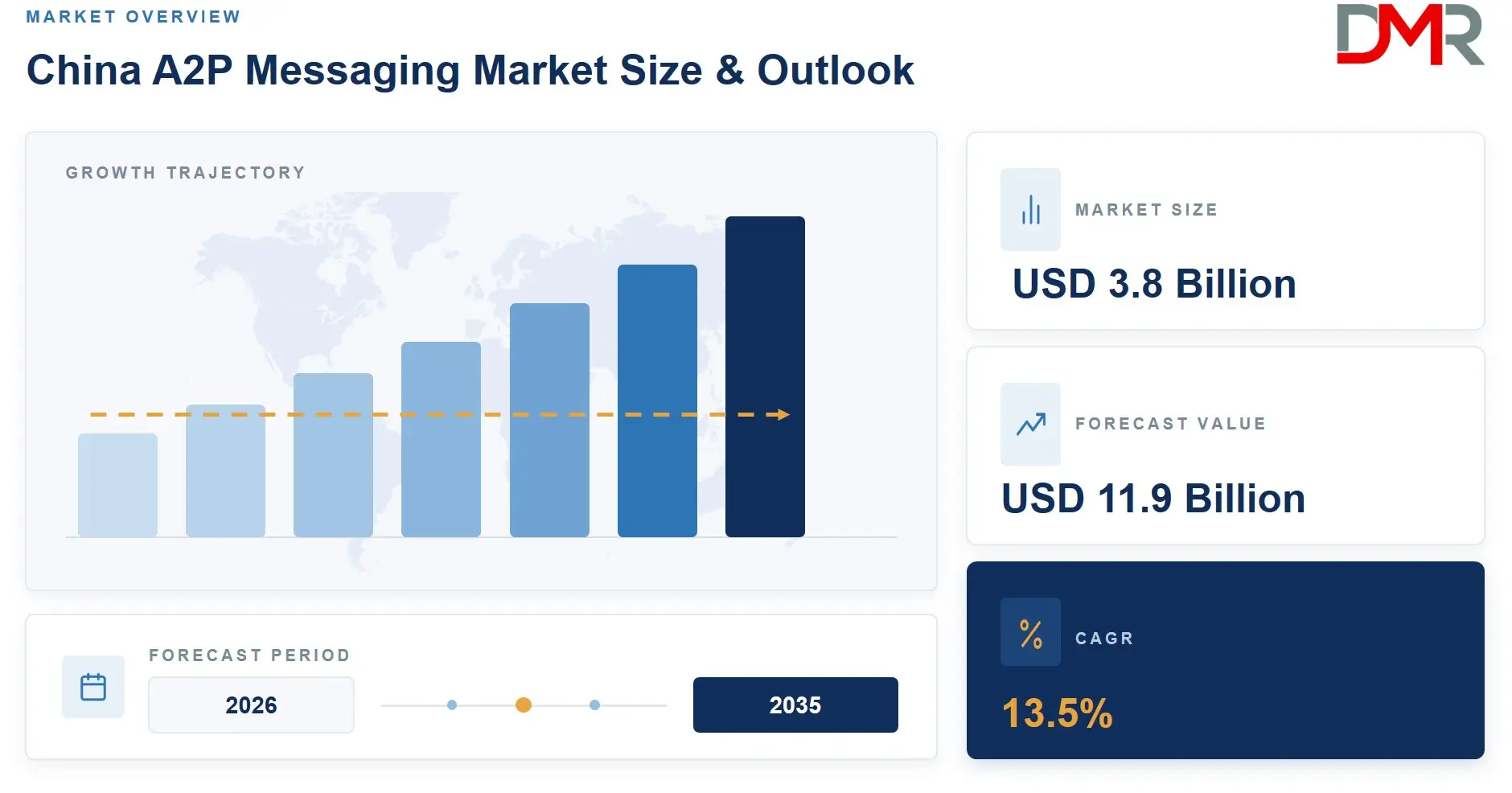
The China A2P Messaging Market size is estimated to reach USD 3.8 Bn in 2026 and is further anticipated to reach USD 11.9 Bn by 2035, at a CAGR of 13.5%.
ℹ
To learn more about this report –
Download Your Free Sample Report Here
Application-to-person messaging covers business-initiated text, rich media and voice notifications that terminate on mobile numbers issued inside mainland China, sent through licensed carrier gateways rather than open internet channels. The figures in this report cover messaging demand consumed inside China, not the worldwide revenue of aggregators or carriers headquartered there. Buyers span banks confirming logins, e-commerce platforms tracking parcels, ride-hailing operators dispatching drivers and hospitals reminding patients of appointments, all of whom need a delivery channel that does not depend on the recipient having a specific app installed or connected to data.
The market sits in an unusual worldwide position because WeChat already carries most peer-to-peer and much brand-to-consumer conversation, so carrier messaging in China survives less as a marketing tool and more as the verification and compliance layer beneath digital finance, government services and regulated commerce. SMS remains the default for one-time passcodes precisely because it does not require a chat app account, while China Mobile, China Unicom and China Telecom's jointly built RCS platform, branded domestically as 5G Messaging, is positioned as a richer alternative that keeps the carrier relevant as a business channel rather than a bare data pipe.
What is structurally changing is the registration regime around who may send at scale. MIIT has moved from loosely enforced sender codes toward mandatory content review, signature verification against registered trademarks and real-time blocking of unregistered traffic, which is consolidating volume onto compliant aggregators and squeezing informal resellers out of the supply chain entirely.
Use Cases
- Bank OTP Verification at Scale: National banks and digital-only lenders route one-time passcodes for login, payment confirmation and card issuance through licensed SMS gateways, since regulators require a verifiable, auditable channel that survives outages in third-party chat apps and keeps fraud liability traceable to a registered sender.
- Cross-Border E-Commerce Order Updates: Platforms selling into China from Southeast Asia and Europe use locally registered aggregator connections to push shipment and customs-clearance alerts to buyers, avoiding delivery notices that would otherwise sit unread inside apps the recipient rarely opens.
- Ride-Hailing Driver Dispatch Confirmation: Urban mobility platforms send trip assignment, fare-change and safety-check messages to drivers working in underground parking structures or rural pickup zones, where a carrier-grade channel outperforms push notifications tied to a live data connection.
- Hospital Appointment and Prescription Reminders: Provincial health systems use registered short codes to confirm outpatient bookings and refill windows for patients not enrolled in a hospital's own portal app, a channel of choice in lower-tier cities where smartphone data penetration still trails the coastal metros.
Key Takeaways
- Market Size & Share: The China A2P Messaging Market is estimated at USD 3.8 Bn in 2026 and is projected to reach USD 11.9 Bn by 2035, expanding at 13.5% CAGR.
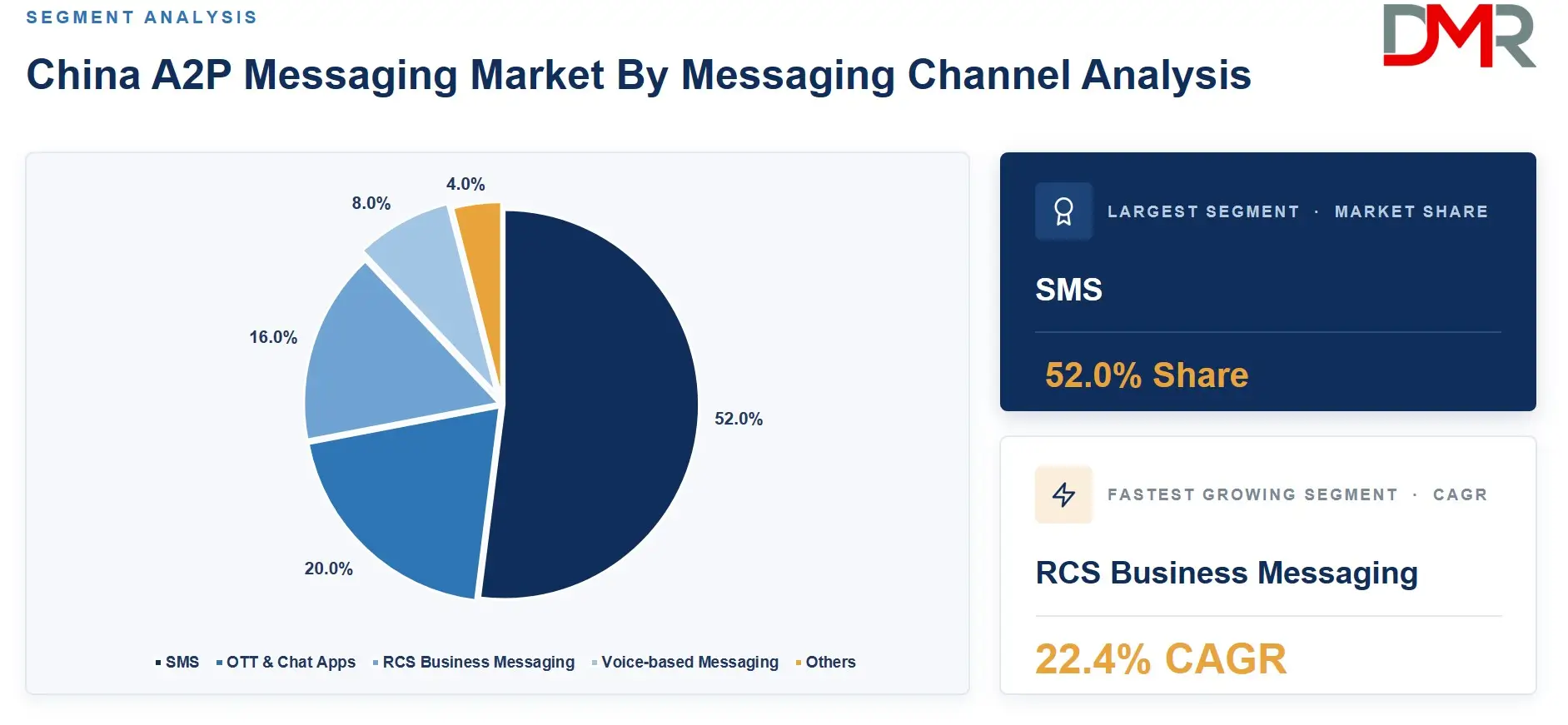
- Messaging Channel Analysis: SMS is expected to account for approximately 52% of 2026 revenue, while RCS Business Messaging is forecast to expand at 22.4% CAGR through 2035.
- Demand Concentration: BFSI is projected to generate around 34% of 2026 demand, anchored by OTP and transaction-alert volumes from national banks and payment platforms.
- Regulatory Momentum: MIIT's tightened Port SMS registration regime, enforced through 2025, is consolidating traffic onto fully registered senders and pushing unregistered gray-route volume out of the network.
- Enterprise Adoption Depth: Large enterprises are estimated to hold near 58% of 2026 spend, though SMEs are forecast to expand fastest at 19.8% CAGR as CPaaS platforms lower onboarding costs.
- Channel Intermediation: CPaaS and aggregator platforms are expected to route close to 46% of 2026 messaging volume, ahead of direct carrier and operator billing relationships.
How AI/Gen AI is Transforming the China A2P Messaging Market?
The clearest AI impact in this market is operational rather than a consumer-facing novelty. Aggregators and carriers alike face a compliance regime that reviews message content before it reaches a handset, and manually screening millions of daily templates against shifting MIIT rules is no longer viable at scale, so machine-learning content classifiers now sit ahead of the gateway to flag spam-pattern language, mismatched signatures and prohibited categories before a campaign is submitted for registration.
On the carrier side, China Mobile, China Unicom and China Telecom are layering large language model based intent recognition onto their joint 5G Messaging platform so that RCS conversations can route a customer query to the correct backend, whether that is a bank balance check, a logistics tracking request or a government service appointment, without a human agent in the loop for routine cases.
- Content Compliance Screening: Classifiers pre-check message templates against registered signatures and MIIT content categories before submission.
- Conversational RCS Assistants: LLM-based intent routing inside 5G Messaging threads resolves routine banking, logistics and government queries.
- Fraud Pattern Detection: Anomaly models flag sender accounts exhibiting the volume and timing signatures associated with telecom fraud rings.
- Delivery Route Optimization: Machine-learning routing selects among carrier and aggregator paths in real time to protect delivery rates during regional network congestion.
Key Drivers in the China A2P Messaging Market
Two forces are pulling enterprise messaging spend upward in China through 2035.
- Mandatory Two-Factor Verification Across Digital Finance: China's banking and payments regulators require a verifiable, independently auditable channel for login and transaction confirmation, and SMS remains the default because it does not depend on a chat app account or an active data session. As digital lending, wealth management and insurance products keep moving onto mobile-first platforms, every new account and every high-value transaction adds another OTP event, and the volume compounds faster than headline user growth because a single customer now triggers verification events across banking, payments and government-service logins that used to sit on separate paper or in-branch processes.
- National 5G Messaging Rollout by the Big Three Carriers: China Mobile, China Unicom and China Telecom have jointly committed to a Rich Communication Services platform, branded 5G Messaging, built into every compatible handset sold in the country, backed by more than a dozen device makers including Huawei, Xiaomi, Vivo and Oppo. Because the carriers control both the network and the default messaging app, they can push adoption without relying on consumers to download anything, which gives RCS a distribution advantage most markets outside China do not have, and enterprises are following that installed base with richer, higher-value message formats than SMS could ever carry.
Restraints in the China A2P Messaging Market
Two structural brakes temper how fast carrier messaging spend can grow.
- Fragmented Sender ID Registration Across Provinces: A brand operating nationally must register its signature, template content and sender identity separately with each provincial telecom bureau, and the approval criteria are not always applied consistently between regions. A campaign cleared in Guangdong can still be blocked in Sichuan pending a separate review, which forces national brands to run parallel registration workstreams and build in lead time that smaller domestic competitors without cross-province ambitions do not carry, slowing the pace at which new senders can reach full national coverage.
- WeChat's Dominance Over the Notification Layer: WeChat's Official Accounts and Mini Programs already deliver order confirmations, customer service and loyalty messaging to more than a billion users inside a single super-app, and brands that have already built a WeChat presence see less incremental value in paying for carrier messaging beyond the regulatory-mandated verification use cases. This caps the addressable spend for promotional and engagement messaging specifically, even as the compliance-driven OTP and transactional-alert categories keep growing largely untouched by WeChat's reach.
Growth Opportunities in the China A2P Messaging Market
Two areas of white space stand out for vendors positioned correctly.
- RCS-Enabled Rich Commerce Messaging for Lower-Tier Cities: Tier-3 and tier-4 city consumers are still building smartphone data habits, and carrier-native RCS messages that carry product images, order buttons and delivery tracking without requiring an app download fit that adoption curve better than either SMS or an app-first strategy. E-commerce platforms expanding into these markets have an opening to use 5G Messaging as a lighter-weight rich-media channel than building and promoting a dedicated app for users who may still be selective about what they install.
- Verified Business Messaging for Cross-Border Sellers: Overseas merchants selling into China through cross-border e-commerce platforms need a compliant local channel for order and customs updates, and few have the in-country entity structure to register directly with MIIT. Aggregators that package pre-registered sender identities, template libraries and compliance handling as a turnkey service for foreign sellers can capture a growing slice of cross-border trade volume that would otherwise default to unreliable app notifications.
Trends in the China A2P Messaging Market
Two shifts are reshaping how messaging is bought and delivered.
- Consolidation of Aggregators Around Compliance-as-a-Service: As MIIT enforcement tightens, buyers increasingly select an aggregator based on how fast it can register a new signature and keep a template compliant, not on price per message alone. This is pushing volume toward a smaller set of aggregators with dedicated compliance teams and provincial registration relationships, while informal resellers that once undercut on price are being squeezed out as their unregistered traffic gets blocked at the carrier level.
- Shift From Marketing Blast to Conversational Commerce: Brands are moving away from one-way promotional blasts toward RCS threads that let a customer reply, browse a product carousel or confirm a booking inside the message itself. This mirrors the conversational-commerce pattern already normalized inside WeChat, and carriers are actively encouraging it because two-way RCS traffic commands higher per-message pricing than static SMS broadcasts.
Research Scope and Analysis
Segment performance is assessed across five axes: messaging channel, application, end use industry, enterprise size and distribution channel. Each axis identifies the sub-segment carrying the largest share of 2026 revenue and the one expanding fastest through 2035, with the commercial reason behind each position.
ℹ
To learn more about this report –
Download Your Free Sample Report Here
By Messaging Channel
SMS is projected to hold the largest share of the China A2P Messaging Market by channel in 2026, accounting for approximately 52% of revenue, since it remains the default channel regulators recognize for OTP and transaction verification and requires no app install or data connection to reach a recipient. Growth, however, is concentrated in RCS Business Messaging, expanding at a CAGR of 22.4% between 2026 and 2035, as China Mobile, China Unicom and China Telecom's joint 5G Messaging platform reaches critical handset coverage and enterprises begin shifting rich-media order confirmations and customer-service threads away from plain-text SMS toward the richer format carriers are actively promoting.
By Application
OTP and authentication is expected to remain the largest application by 2026 revenue, holding close to 38% of the market, driven by mandatory two-factor verification across banking, payments and increasingly government digital-identity services. The steeper trajectory sits with customer engagement and support messaging, growing at a CAGR of 20.1% through 2035, as RCS's two-way capability lets brands resolve post-purchase queries and service requests inside the same thread that carried the original transaction alert, reducing the need for a separate customer-service app or call.
By End Use Industry
BFSI is set to lead end use industry demand in 2026 at around 34% of revenue, reflecting the sheer volume of login, payment and lending verification events generated by China's digital banking and fintech user base. Logistics and transportation is the fastest-growing industry vertical, forecast at a 21.8% CAGR to 2035, as parcel volumes from domestic and cross-border e-commerce keep expanding and delivery platforms adopt richer RCS tracking messages in place of bare SMS status updates.
By Enterprise Size
Large enterprises are projected to account for approximately 58% of 2026 spend, a position built on national banks, e-commerce platforms and telecom-adjacent businesses that already run compliant, high-volume registered sender programs across every province. SMEs are forecast to grow fastest, at a 19.8% CAGR through 2035, as CPaaS platforms package registration, template compliance and billing into self-service tools that let smaller merchants and regional service providers reach carrier-grade delivery without building their own compliance function.
By Distribution Channel
CPaaS and aggregator platforms are expected to intermediate close to 46% of 2026 messaging volume, since most enterprises would rather buy pre-registered sender access and API delivery from a specialist than negotiate directly with three separate state carriers. System integrators and IT vendors are the fastest-growing channel, at a 19.2% CAGR to 2035, as banks and large retailers increasingly bundle messaging into broader digital-transformation contracts rather than procuring it as a standalone line item.
The China A2P Messaging Market Report is Segmented Based on the Following
By Messaging Channel
- SMS
- OTT & Chat Apps
- RCS Business Messaging
- Voice-based Messaging
- Others
By Application
- OTP & Authentication
- Promotional & Marketing
- Transactional Alerts
- Customer Engagement & Support
- Others
By End Use Industry
- BFSI
- E-commerce & Retail
- IT & Telecom
- Logistics & Transportation
- Healthcare
- Others
By Enterprise Size
- Large Enterprises
- SMEs
- Government & Public Sector
- Others
By Distribution Channel
- CPaaS & Aggregator Platforms
- Direct Carrier & Operator Channels
- System Integrators & IT Vendors
- Others
Regulatory Landscape
China's messaging market operates under MIIT's Port SMS regime, which requires every commercial sender to register a signature that matches a trademark, company name or ICP filing before traffic is accepted onto carrier networks. Enforcement has tightened through 2025 and into 2026, with generic or shared signature options withdrawn and unregistered brand traffic blocked outright rather than merely deprioritized. What is shifting now is the shift from after-the-fact penalties toward pre-emptive blocking, which forces aggregators to build compliance into onboarding rather than campaign review. The commercial opening sits with aggregators that can turn multi-province registration into a packaged, fast-turnaround service, since that speed is now a genuine competitive differentiator rather than a back-office cost. The risk is that a fast-moving brand entering a new province without registration in place can lose days of delivery entirely, which keeps buyers from switching to unregistered, lower-cost senders regardless of price and sustains pricing power for compliant aggregators.
Technology Analysis
The defining technology shift in this market is the carriers' joint push to make RCS, branded 5G Messaging, a default rather than an optional feature, backed by a device-maker coalition that already covers the large majority of smartphones sold in China. What is shifting now is handset-level penetration crossing the threshold where enterprises can target RCS as a primary channel rather than a niche add-on, following years where SMS remained the only reliable universal option. The commercial opening is in rich-media use cases, conversational commerce and in-thread payment confirmation that plain SMS cannot support, letting carriers charge a premium over legacy text pricing. The risk is fragmented rollout pacing between China Mobile, China Unicom and China Telecom, since a brand's RCS reach depends on which carrier a given recipient uses, which keeps SMS as a mandatory fallback and adds integration complexity that smaller enterprises may be unwilling to absorb without aggregator support.
Competitive Landscape
The China A2P Messaging Market is concentrated at the network layer around the three state carriers that jointly control 5G Messaging delivery, while the aggregator and CPaaS layer beneath them remains fragmented and competitive on registration speed, API reliability and compliance handling rather than price alone. Cloud platform arms of the country's largest internet companies compete for enterprise messaging budgets bundled with broader cloud and customer-engagement contracts, while specialist aggregators compete on turnaround time for multi-province sender registration. Consolidation pressure is building at the smaller end of the aggregator market as MIIT's stricter enforcement raises the fixed cost of staying compliant.
Some of the Prominent Players in the China A2P Messaging Market are:
- Huawei Technologies
- ZTE Corporation
- Ericsson
- Nokia
- Infobip
- Sinch
- Kaleyra
- Twilio
- CM.com
- Mitto AG
- Tencent Cloud
- Alibaba Cloud
- Baidu Smart Cloud
- JD Cloud & AI
- NetEase Yunxin
- Chuanglan 253
- SUBMAIL
- Yunpian
- Ronglian Cloud
- MobTech
- UCloud
- Kingsoft Cloud
- Bird (MessageBird)
- Comviva
- Syniverse
- Route Mobile
- Global Message Services
- China Mobile Communications Group
- China Unicom
- China Telecom
- Digital China Group
- Neusoft Corporation
- Inspur Group
- iSoftStone
- Kingdee International
- Yonyou Network Technology
- H3C Technologies
- DingTalk
- iFLYTEK
- Unisound AI Technology
- Other Key Players
Recent Developments
- In June 2026, the GSMA's Mobile Economy China 2026 report highlighted China Telecom Shanghai's commercial launch of a 5G-Advanced network with AI-driven massive uplink capability, underscoring how carriers are pairing network upgrades with the enterprise messaging and data services they sell alongside connectivity.
- In April 2026, China Unicom reported that its Unicom Cloud unit was serving around 438,000 major government and enterprise customers, with a growing base of paying users for its Cloud-AI products, reflecting the same enterprise digitalization budgets that increasingly bundle in carrier messaging services.
- In December 2025, MIIT-mandated Port SMS rules tightened further as generic signature options were discontinued and traffic from brands not fully registered began being blocked outright, forcing aggregators and enterprise senders to accelerate compliance registration across every province they operate in.
- In November 2025, China launched its national online identity authentication system, letting citizens obtain a verified digital identity code, a development that dovetails with the same real-name verification infrastructure banks and platforms rely on when triggering OTP and authentication messaging.
Report Details
| Report Characteristics |
| Market Size (2026) |
USD 3.8 Bn |
| Forecast Value (2035) |
USD 11.9 Bn |
| CAGR (2026-2035) |
13.5% |
| Historical Data |
2021 - 2025 |
| Forecast Data |
2026 - 2035 |
| Base Year |
2025 |
| Segments Covered |
By Messaging Channel, By Application, By End Use Industry, By Enterprise Size, and By Distribution Channel |
| Regional Coverage |
China |
Frequently Asked Questions
How big is the China A2P Messaging Market?
▾ The China A2P Messaging Market is estimated at USD 3.8 Bn in 2026 and is projected to reach USD 11.9 Bn by 2035, reflecting steady growth in verification, transactional and enterprise engagement messaging carried over licensed carrier networks across the country.
What is the growth rate of the China A2P Messaging Market?
▾ The market is forecast to grow at a CAGR of 13.5% between 2026 and 2035, supported by rising two-factor authentication volumes in digital finance and the national carrier rollout of RCS-based 5G Messaging as a richer alternative to plain SMS.
What is driving demand in the China A2P Messaging Market?
▾ Demand is driven primarily by mandatory two-factor verification across banking, payments and government digital services, which generates recurring OTP volume, alongside the big three carriers' joint 5G Messaging rollout, which is pulling enterprise spend toward richer, higher-priced RCS message formats.
Who are the key players in the China A2P Messaging Market?
▾ Key players include China Mobile, China Unicom, China Telecom, Huawei Technologies, ZTE Corporation, Tencent Cloud, Alibaba Cloud and Chuanglan 253, alongside multinational aggregators such as Infobip, Sinch and Twilio serving cross-border senders.
Which messaging channel leads the China A2P Messaging Market?
▾ SMS leads by channel, accounting for approximately 52% of 2026 revenue, since it remains the regulator-recognized default for OTP and verification traffic, though RCS Business Messaging is growing fastest as carrier 5G Messaging adoption scales.
How is 5G Messaging (RCS) changing the China A2P Messaging Market?
▾ China Mobile, China Unicom and China Telecom's joint 5G Messaging platform is shifting enterprise spend toward rich-media, two-way conversational formats, forecast to grow at 22.4% CAGR through 2035 as handset-level RCS coverage keeps expanding nationwide.
Which industry generates the most A2P messaging demand in China?
▾ BFSI generates the most demand, holding around 34% of 2026 revenue on the strength of login, payment and lending verification traffic, ahead of e-commerce and retail as the second-largest source of messaging volume in the China A2P Messaging Market.