China Autonomous Warehouse Robotics Market Snapshot
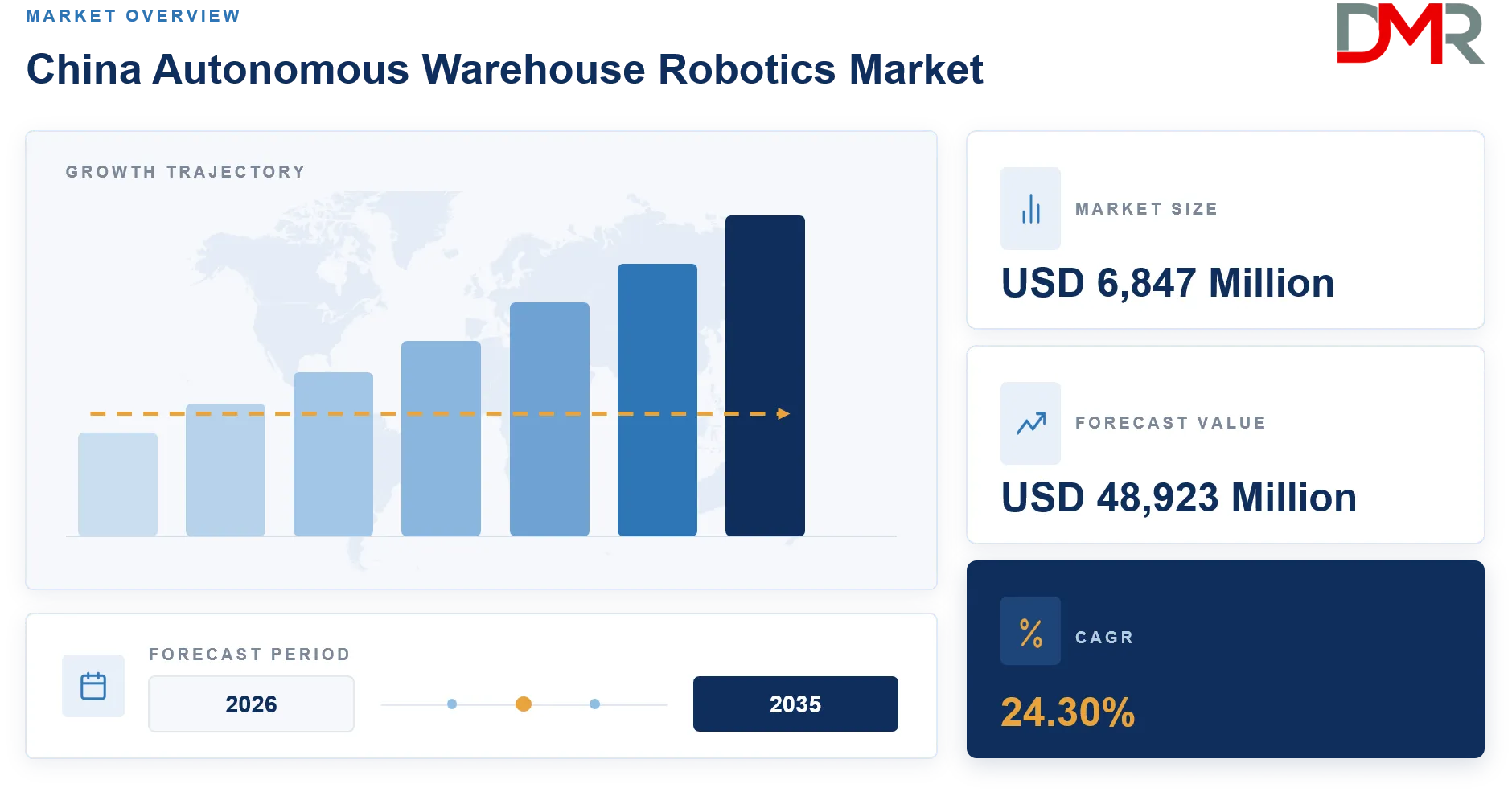
- Market Value: China autonomous warehouse robotics market is valued at USD 6,847 million in 2026 and is projected to reach USD 48,923 million by 2035.
- CAGR: China autonomous warehouse robotics market is expected to grow at a CAGR of 24.3% from 2026 to 2035.
- By Robot Type Segment Analysis: Autonomous Mobile Robots (AMRs) led the robot type segment with a 40.7% share in 2026.
- By Warehouse Function Segment Analysis: Material Transport led warehouse functions with a 31.6% share in 2026.
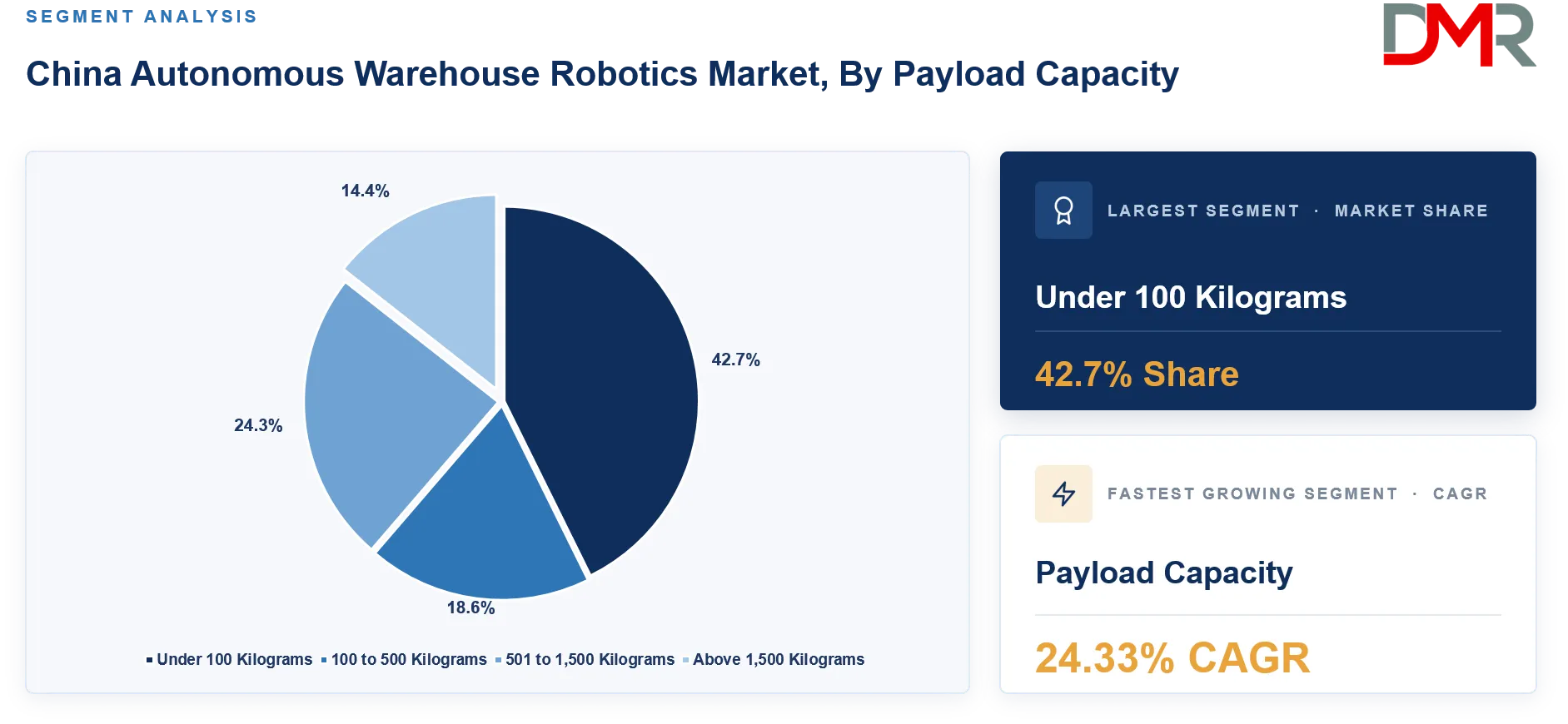
- By Payload Capacity Segment Analysis: Under 100 Kilograms led the payload capacity segment with a 42.7% share in 2026.
- By End-Use Industry Segment Analysis: E-Commerce and Retail led the end-use industry segment with a 34.2% share in 2026.
- Major Players: Geek+, Hai Robotics, Hikrobot, Quicktron, and VisionNav Robotics.
What is the China Autonomous Warehouse Robotics Market and its Market Size?
The China Autonomous Warehouse Robotics Market size is projected to be valued at USD 6,847 million in 2026 and is expected to reach USD 48,923 million by 2035, expanding at a CAGR of 24.3% during the forecast period. This represents more than a sevenfold expansion in market revenue as warehouses shift from fixed automation toward flexible robotic systems that can transport, pick, sort, store, retrieve, palletize, and manage goods with reduced manual intervention.
ℹ
To learn more about this report –
Download Your Free Sample Report Here
Autonomous warehouse robotics refers to mobile robots, robotic picking systems, autonomous case-handling systems, sorting robots, palletizing systems, and supporting hardware and software used to automate warehouse workflows. The China autonomous warehouse robotics market is closely connected with e-commerce fulfillment, third-party logistics, manufacturing distribution, smart factories, and high-throughput storage facilities. Demand is increasingly shaped by the need for flexible capacity, shorter fulfillment cycles, higher inventory accuracy, safer material movement, and warehouse systems that can scale without major changes to fixed infrastructure.
Use Cases
- Autonomous Material Movement: AMRs and AGVs transport cartons, totes, pallets, racks, and components between receiving, storage, production, picking, packing, and shipping areas. This reduces repetitive travel by warehouse staff and supports continuous goods movement across high-volume distribution facilities.
- Goods-to-Person Fulfillment: Shelf-moving and tote-handling robots bring inventory directly to picking stations. The model is particularly relevant to Chinese e-commerce and retail warehouses where operators manage large SKU catalogs, variable order volumes, promotional peaks, and demanding order cut-off times.
- Robotic Picking and Sorting: Piece-picking, case-picking, bin-picking, parcel-sorting, and singulation robots automate labor-intensive fulfillment stages. These systems support faster processing of mixed products while improving repeatability and reducing dependence on manual sorting during demand surges.
- Automated Storage and Retrieval: Autonomous case-handling robots and related storage systems move containers between dense storage locations and workstations. The use case enables operators to improve space utilization while maintaining rapid access to inventory in facilities where land and warehouse capacity carry high strategic value.
- Pallet Handling and Loading: Autonomous forklifts, pallet AGVs, robotic palletizers, and depalletizers automate movement of heavier loads across inbound and outbound operations. Adoption is relevant to manufacturing, food and beverage, logistics, chemicals, and other industries with repetitive pallet-based material flows.
How AI and Generative AI are Transforming the China Autonomous Warehouse Robotics Market?
Artificial intelligence is expanding the capabilities of autonomous warehouse robots beyond programmed movement. Navigation algorithms can process information from cameras, LiDAR, depth sensors, and other inputs to help robots identify obstacles, select routes, manage congestion, and operate around workers and equipment. Computer vision also supports item recognition, barcode handling, bin picking, parcel identification, inventory inspection, and pallet detection. In large Chinese fulfillment centers, these capabilities allow fleets to respond more effectively to changes in order density, storage positions, aisle traffic, and workstation demand.
Generative AI is creating additional opportunities in warehouse planning, software interaction, maintenance, and operational decision support. Natural-language interfaces can simplify access to fleet data, fault information, task status, and warehouse performance metrics for supervisors. Advanced models can also support scenario planning by evaluating order patterns, robot utilization, charging schedules, workstation capacity, and potential bottlenecks. As robotic fleets become larger, the commercial value is shifting from individual robot intelligence toward coordinated orchestration of robots, people, warehouse software, storage systems, and fulfillment priorities.
Key Drivers in the China Autonomous Warehouse Robotics Market
Expansion of High-Volume E-Commerce Fulfillment
E-commerce and retail accounted for 34.2% of market demand in 2026, making the industry the largest end-use segment. Online fulfillment creates complex operating conditions because warehouses must process large SKU ranges, frequent small orders, returns, promotional spikes, and short dispatch windows. Autonomous robots provide scalable transport, picking, sorting, and storage capacity, allowing fulfillment operators to add robotic units as volume changes instead of depending entirely on fixed conveyor infrastructure.
Demand for Flexible Warehouse Productivity
Warehouse operators are increasingly evaluating automation based on throughput, labor productivity, facility utilization, and deployment flexibility. Autonomous systems can be introduced into existing facilities with fewer structural changes than many forms of fixed automation. AMRs can also be reassigned between workflows as warehouse demand changes. This flexibility supports adoption among e-commerce operators, manufacturers, third-party logistics providers, and distribution centers seeking greater output without proportionally increasing labor requirements.
Restraints in the China Autonomous Warehouse Robotics Market
Integration Complexity Across Existing Warehouses
Autonomous robots do not operate independently of the wider warehouse technology environment. Effective deployment may require integration with warehouse management systems, warehouse execution software, conveyors, elevators, scanners, storage systems, charging infrastructure, and enterprise platforms. Older facilities may contain inconsistent layouts or processes that were designed for manual handling. Integration complexity can extend deployment cycles and increase engineering requirements, particularly in brownfield warehouses with multiple legacy systems.
Investment and Operational Performance Requirements
Robotic projects require spending on hardware, software, installation, mapping, integration, employee training, maintenance, and system support. Buyers must also determine whether expected throughput improvements justify total lifecycle costs. The financial case can vary by order profile, SKU complexity, facility size, labor availability, utilization rate, and operating hours. Smaller warehouses with low or irregular throughput may therefore adopt automation more selectively than large fulfillment and manufacturing facilities with predictable high-volume workflows.
Growth Opportunities in the China Autonomous Warehouse Robotics Market
Expansion of Robots into Mixed Warehouse Workflows
A major opportunity lies in moving beyond isolated transport tasks toward connected robotic workflows. Facilities can combine AMRs, picking robots, sorting systems, autonomous forklifts, case-handling robots, and palletizing equipment within a coordinated operating environment. This creates opportunities for vendors that can manage heterogeneous fleets and connect robotic systems with warehouse software. Integrated automation can address receiving, replenishment, picking, consolidation, packing, pallet movement, shipping, and returns within the same facility.
Growing Automation Demand Beyond E-Commerce
Manufacturing, third-party logistics, pharmaceuticals, food and beverage, chemicals, textiles, and transportation offer a broader customer base for autonomous warehouse robotics. Each industry presents different requirements involving payload, hygiene, traceability, inventory control, speed, safety, and operating environment. Vendors able to configure robotic platforms for industry-specific workflows can expand beyond general fulfillment applications. This creates opportunities for specialized hardware, software, system integration, maintenance, and fleet optimization services.
Trends in the China Autonomous Warehouse Robotics Market
Shift Toward AMR-Based Flexible Automation
Autonomous Mobile Robots held 40.7% of the robot type market in 2026, reflecting strong demand for flexible movement and fulfillment systems. Unlike route-dependent material handling technologies, advanced AMRs can dynamically navigate warehouse environments and adapt to operational changes. Goods-to-person robots, shelf-moving platforms, cart-moving robots, and autonomous case-handling systems are broadening the AMR category from simple transport into storage and fulfillment. Modular deployment also enables operators to expand fleets in stages.
Increasing Importance of Fleet Management Software
As robotic installations expand from small deployments to hundreds of connected units, fleet management becomes a critical layer of warehouse automation. Software must assign tasks, prioritize orders, coordinate traffic, monitor battery levels, schedule charging, manage exceptions, and connect robots with warehouse systems. Buyers are therefore evaluating autonomous robotics as a combined hardware and software architecture. This trend creates recurring opportunities around fleet optimization, analytics, updates, integration, monitoring, and lifecycle support.
Research Scope and Analysis
The China Autonomous Warehouse Robotics Market is segmented based on Robot Type, Warehouse Function, Component, Payload Capacity, End-Use Industry, and regional deployment. The study provides an in-depth analysis of key segments and sub-segments, covering their applications, industry adoption, demand patterns, and contribution to overall market growth.
ℹ
To learn more about this report –
Download Your Free Sample Report Here
By Robot Type
Autonomous Mobile Robots dominated the robot type segment with a 40.7% share in 2026. Their leadership is supported by the ability to automate horizontal movement while retaining greater flexibility than many fixed material-handling systems. Goods-to-person robots reduce walking time by moving inventory to operators, while shelf-moving and cart-moving robots support dynamic fulfillment layouts. Autonomous case-handling robots extend AMR functionality into denser storage environments. Demand is also supported by phased deployment, since companies can begin with a limited fleet and expand capacity as order volumes, storage requirements, or facility footprints grow.
By Warehouse Function
Material Transport accounted for 31.6% of market revenue in 2026, making it the leading warehouse function. Transportation is one of the most repetitive activities within distribution and manufacturing facilities, connecting receiving docks, storage locations, picking areas, packing stations, production lines, consolidation zones, and outbound docks. Automating these movements can reduce non-value-added employee travel while creating a predictable internal flow of goods. The segment benefits from the wide use of AMRs, pallet AGVs, tugger systems, autonomous forklifts, and cart-moving robots across multiple industries.
By Payload Capacity
Robots with payload capacity under 100 kilograms held 42.7% of the market in 2026. This category is closely aligned with tote movement, parcel handling, smaller cart transport, e-commerce picking, inventory movement, and other high-frequency warehouse activities. Lower-payload robots can operate in larger fleets and serve numerous workstations, making them suitable for facilities that prioritize order velocity and flexible routing. Higher-payload systems remain essential for pallets, industrial components, bulk goods, production logistics, and heavy material handling.
By End-Use Industry
E-Commerce and Retail represented 34.2% of the China autonomous warehouse robotics market in 2026. The segment combines high order volumes with broad SKU assortments, rapid inventory movement, returns processing, promotional peaks, and tight delivery expectations. These operating characteristics support demand for goods-to-person robots, sorting systems, picking technology, autonomous case handling, material transport, and inventory automation. Manufacturing and third-party logistics also provide substantial growth opportunities as companies seek to connect warehouse robotics with production supply, distribution, and contract fulfillment operations.
The China Autonomous Warehouse Robotics Market Report is segmented on the basis of the following:
By Robot Type
- Autonomous Mobile Robots
- Goods-to-Person Robots
- Shelf-Moving Robots
- Cart-Moving Robots
- Autonomous Case-Handling Robots
- Automated Guided Vehicles
- Unit-Load AGVs
- Pallet AGVs
- Tugger AGVs
- Forklift AGVs
- Robotic Picking Systems
- Piece-Picking Robots
- Case-Picking Robots
- Bin-Picking Robots
- Robotic Sorting Systems
- Parcel-Sorting Robots
- Cross-Belt Sorting Robots
- Singulation Robots
- Palletizing and Depalletizing Robots
- Robotic Palletizers
- Robotic Depalletizers
By Warehouse Function
- Material Transport
- Goods-to-Person Picking
- Order Picking
- Sorting
- Storage and Retrieval
- Inventory Management
- Packaging and Labeling
- Loading and Unloading
- Palletizing and Depalletizing
- Returns Processing
By Component
- Hardware
- Software
- Fleet Management Systems
- Services
By Payload Capacity
- Under 100 Kilograms
- 100 to 500 Kilograms
- 501 to 1,500 Kilograms
- Above 1,500 Kilograms
By End-Use Industry
- E-Commerce and Retail
- Manufacturing
- Third-Party Logistics
- Food and Beverage
- Pharmaceuticals and Healthcare
- Logistics and Transportation
- Chemicals
- Textiles and Apparel
Competitive Landscape
The China autonomous warehouse robotics market features competition across AMRs, autonomous case-handling systems, vision technology, autonomous forklifts, picking systems, sorting robots, fleet software, and integrated warehouse automation. Geek+, Hai Robotics, Hikrobot, Quicktron, VisionNav Robotics, ForwardX Robotics, Megvii, Mushiny, SIASUN, Jaten Robot, Multiway Robotics, CSG Smart Science, Dorabot, Flexiv, Gaussian Robotics, Mech-Mind Robotics, and other suppliers address different parts of the automation stack. Competitive differentiation increasingly depends on more than robot specifications.
Buyers evaluate deployment speed, navigation reliability, fleet scalability, warehouse software integration, throughput, uptime, safety, maintenance, application engineering, and total cost of ownership. Vendors that can support mixed robotic fleets and connect transport, storage, picking, sorting, and pallet workflows are positioned to capture larger automation projects. The market also creates opportunities for specialized providers focused on machine vision, autonomous navigation, robotic manipulation, fleet orchestration, and industry-specific warehouse applications.
Some of the prominent players in the China Autonomous Warehouse Robotics Industry are:
- Geek+
- Hai Robotics
- Hikrobot
- Quicktron
- VisionNav Robotics
- ForwardX Robotics
- Megvii
- Mushiny
- SIASUN
- Jaten Robot
- Multiway Robotics
- CSG Smart Science
- AwayFromKeyboard Robotics
- Dorabot
- Flexiv
- Gaussian Robotics
- Idriverplus
- JJ Robotics
- Kuavo
- Mech-Mind Robotics
- Others
Technology Analysis
Technology development in the China autonomous warehouse robotics market is shifting from standalone mobile machines toward connected robotic ecosystems that combine autonomous navigation, machine vision, intelligent picking, fleet orchestration, and warehouse software integration. AMRs increasingly use LiDAR, cameras, depth sensors, simultaneous localization and mapping, and sensor fusion to navigate dynamic facilities without relying entirely on fixed routes. Vision systems and robotic arms extend automation into bin picking, case handling, sorting, palletizing, and depalletizing. Fleet management platforms coordinate traffic, task allocation, charging, and robot utilization while connecting equipment with warehouse management and execution systems. Companies such as Geek+, Hai Robotics, Hikrobot, Quicktron, VisionNav Robotics, ForwardX Robotics, and Mech-Mind Robotics are active across these technology layers. The next phase of market growth is expected to favor interoperable systems capable of managing mixed fleets, variable SKUs, changing warehouse layouts, and higher fulfillment throughput.
Patent Analysis
Patent activity in China's autonomous warehouse robotics industry is concentrated around navigation, localization, robotic manipulation, storage and retrieval, fleet scheduling, obstacle avoidance, machine vision, autonomous forklifts, charging, and multi-robot coordination. Intellectual property has strategic value because competitive performance increasingly depends on how efficiently robots perceive warehouse environments, calculate routes, handle irregular goods, and coordinate large fleets. Companies such as Geek+, Hai Robotics, Hikrobot, Quicktron, VisionNav Robotics, SIASUN, ForwardX Robotics, and Mech-Mind Robotics operate in technology areas where proprietary algorithms, mechanical designs, control systems, and application methods can strengthen product differentiation. Patent portfolios can also provide insight into future competition by showing where vendors are investing engineering resources. As China warehouse robotics demand expands, patents covering case-handling systems, vision-guided manipulation, flexible navigation, fleet optimization, and autonomous material movement are likely to become increasingly important competitive assets.
Recent Developments
- August 2026: Geek+ Expanded global manufacturing and logistics operations from its Hefei headquarters, with robots undergoing final testing for shipment to Europe, reinforcing production and overseas deployment capacity.
- March 2026: Hai Robotics Partnered with TGW Logistics to integrate HaiPick Climb ACR technology into TGW’s LivePick goods-to-person platform, broadening scalable warehouse automation deployments for apparel, grocery and consumer goods.
- August 2025: Geek+ Reported 31% year-on-year H1 revenue growth to RMB1.025 billion, RMB1.760 billion in orders and a new order above RMB100 million, while expanding customers, channels and its warehouse-robotics commercialization footprint.
Report Details
| Report Characteristics |
| Market Size (2026) |
USD 6,847 Million |
| Forecast Value (2035) |
USD 48,923 Million |
| CAGR (2026–2035) |
24.3% |
| Historical Data |
2021 – 2025 |
| Forecast Data |
2027 – 2035 |
| Base Year |
2025 |
| Estimate Year |
2026 |
| Segments Covered |
By Robot Type (Autonomous Mobile Robots {Goods-to-Person Robots, Shelf-Moving Robots, Cart-Moving Robots, and Autonomous Case-Handling Robots}, Automated Guided Vehicles {Unit-Load AGVs, Pallet AGVs, Tugger AGVs, and Forklift AGVs}, Robotic Picking Systems {Piece-Picking Robots, Case-Picking Robots, and Bin-Picking Robots}, Robotic Sorting Systems {Parcel-Sorting Robots, Cross-Belt Sorting Robots, and Singulation Robots}, and Palletizing and Depalletizing Robots {Robotic Palletizers and Robotic Depalletizers}), By Warehouse Function (Material Transport, Goods-to-Person Picking, Order Picking, Sorting, Storage and Retrieval, Inventory Management, Packaging and Labeling, Loading and Unloading, Palletizing and Depalletizing, and Returns Processing), By Component (Hardware, Software, Fleet Management Systems, and Services), By Payload Capacity (Under 100 Kilograms, 100 to 500 Kilograms, 501 to 1,500 Kilograms, and Above 1,500 Kilograms), By End-Use Industry (E-Commerce and Retail, Manufacturing, Third-Party Logistics, Food and Beverage, Pharmaceuticals and Healthcare, Logistics and Transportation, Chemicals, and Textiles and Apparel) |
| Regional Coverage |
China |
Frequently Asked Questions
What is the current size of the China Autonomous Warehouse Robotics Market?
▾ China Autonomous Warehouse Robotics Market size is valued at USD 6,847 million in 2026, reaching USD 48,923 million by 2035.
What is the growth rate of the China Autonomous Warehouse Robotics Market during?
▾ China Autonomous Warehouse Robotics Market is forecast to grow at a CAGR of 24.3% during the 2026-2035 period.
What factors are driving the growth of the China Autonomous Warehouse Robotics Market?
▾ China Autonomous Warehouse Robotics Market growth is driven by e-commerce, automation, and warehouse productivity gains.
What are the major challenges restraining the China Autonomous Warehouse Robotics Market?
▾ China Autonomous Warehouse Robotics Market faces restraints from integration complexity, investment cost, and legacy IT.
Which segment holds the largest share of the China Autonomous Warehouse Robotics Market?
▾ Autonomous Mobile Robots lead the China Autonomous Warehouse Robotics Market with a 40.7% share in 2026.
Who are the leading companies in the China Autonomous Warehouse Robotics Market?
▾ Geek+, Hai Robotics, Hikrobot, Quicktron, VisionNav Robotics, ForwardX Robotics, Megvii, Mushiny, SIASUN, Jaten Robot, Multiway Robotics, CSG Smart Science, AwayFromKeyboard Robotics, Dorabot, Flexiv, Gaussian Robotics, Idriverplus, JJ Robotics, Kuavo, and Mech-Mind Robotics are leading companies in the China Autonomous Warehouse Robotics Market.
How is AI influencing the China Autonomous Warehouse Robotics Market?
▾ AI advances the China Autonomous Warehouse Robotics Market through navigation, vision, fleet control, and smart picking.
What are the future opportunities and trends in the China Autonomous Warehouse Robotics Market?
▾ China Autonomous Warehouse Robotics Market opportunities include mixed fleets, smart warehousing, and industrial uptake.