China Cold Chain Logistics Market Snapshot
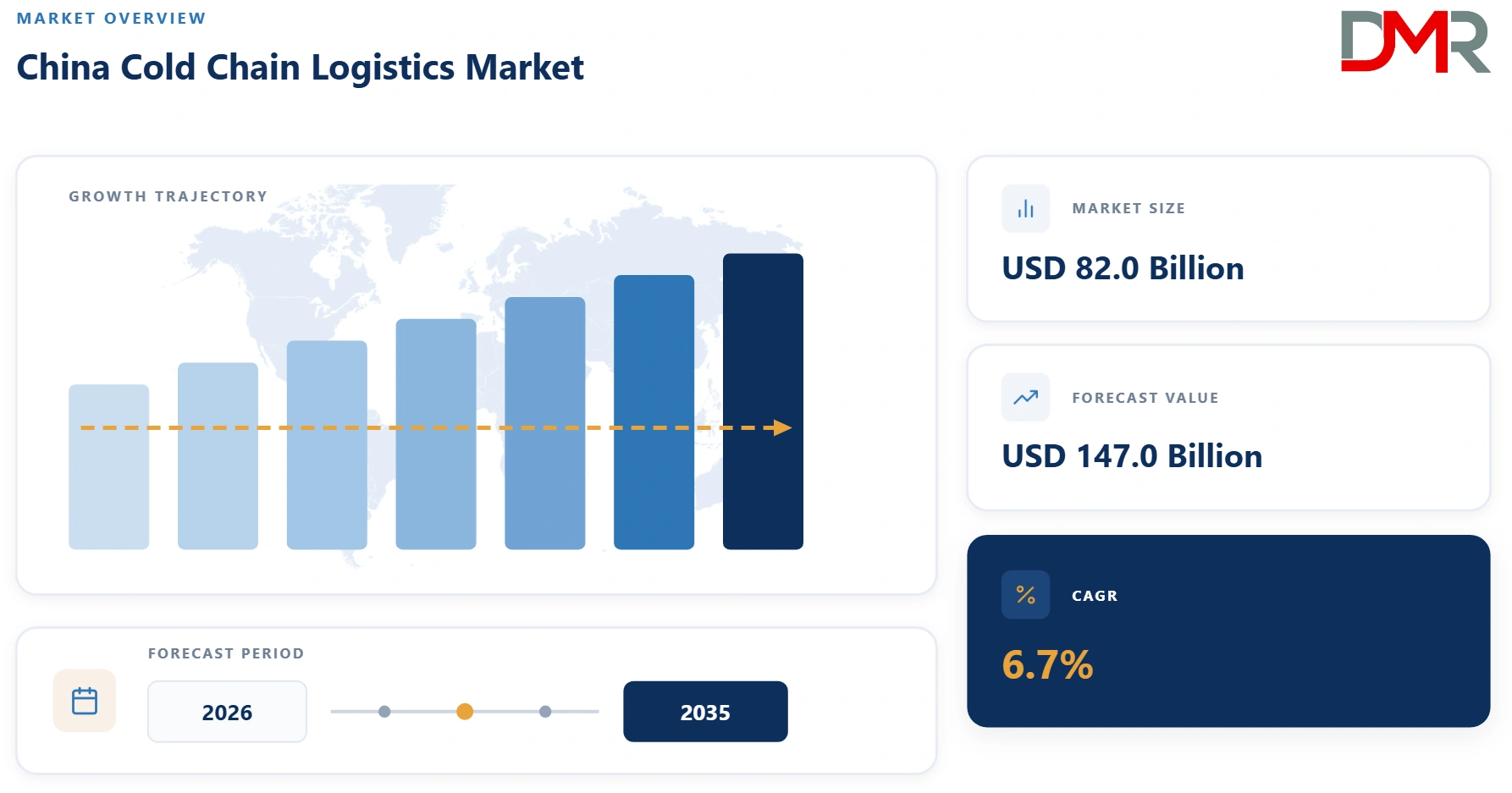
- Market Size, 2026: USD 82.0 billion
- Market Size, 2035: USD 147.0 billion
- Global/China CAGR, 2026-2035: 6.7%
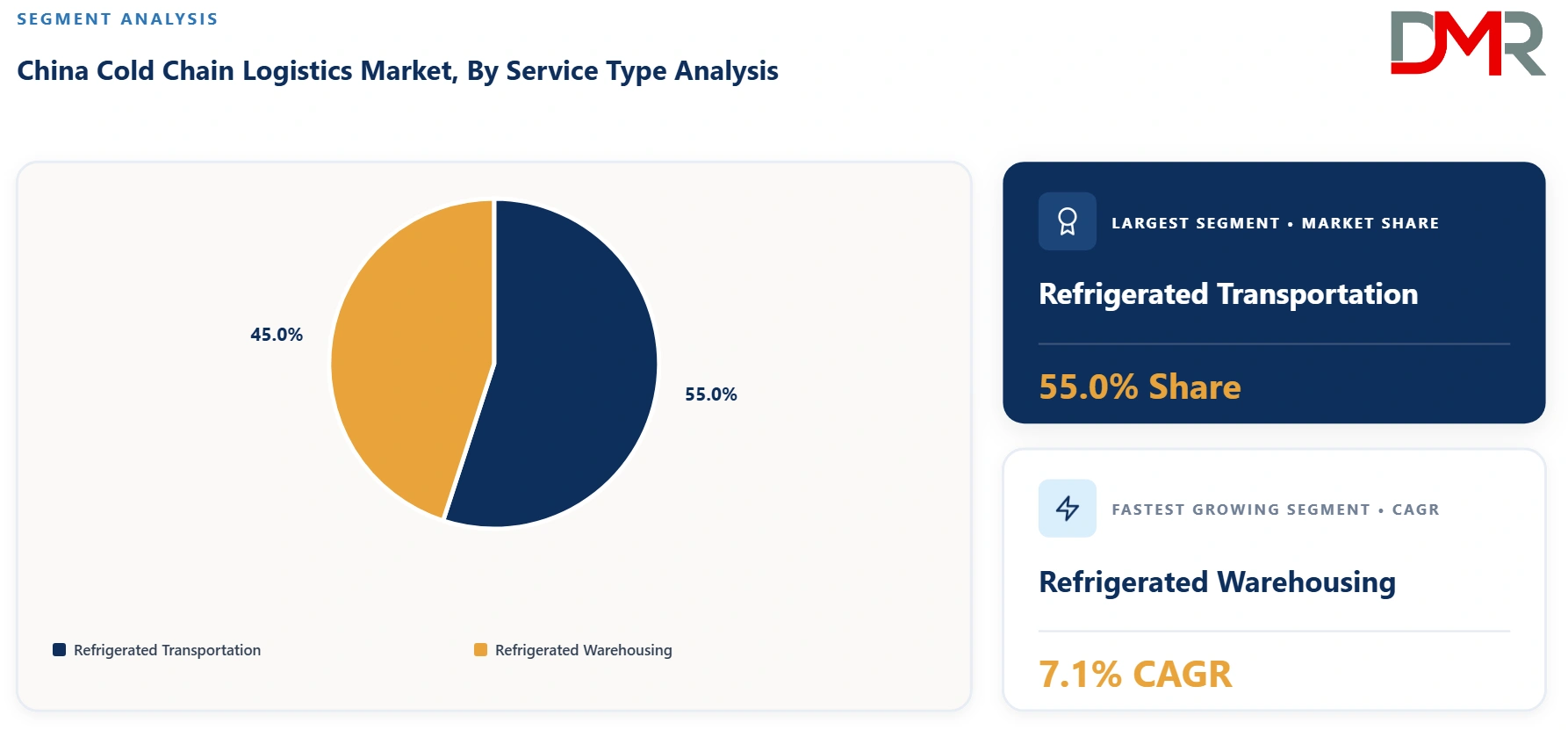
- Leading Service Type, 2026: Refrigerated Transportation, 55%
- Leading Application, 2026: Fruit & Vegetable, 28%
- Leading Temperature Type, 2026: Frozen, 58%
- Leading Technology, 2026: Dry Ice, 34%
- Fastest-Growing Segment: Alternative Protein, 10.2% CAGR
What is the China Cold Chain Logistics and its Market Size?
China cold chain logistics comprises the specialized storage, transportation, handling, distribution, fulfillment, monitoring, and related value-added services required to maintain temperature-sensitive products within prescribed temperature ranges from production through final consumption. The market primarily serves food and agricultural products, including meat, seafood, dairy, fruits and vegetables, frozen foods and alternative proteins, while also supporting pharmaceutical and other temperature-sensitive goods. Its core value proposition is preservation of product quality and shelf life while reducing spoilage, food-safety risks, inventory losses, and delivery-time uncertainty. The ecosystem includes refrigerated warehouses, reefer trucks, multimodal transport, temperature-controlled packaging, digital monitoring, automated warehouses, cold-chain parks and last-mile distribution.
ℹ
To learn more about this report –
Download Your Free Sample Report Here
The China cold chain logistics market is estimated at USD 82.0 billion in 2026, equivalent to approximately RMB 589 billion using an illustrative exchange-rate assumption, compared with official 2025 cold-chain logistics revenue of RMB 556.71 billion. The market is projected to reach approximately USD 147.0 billion by 2035, representing an estimated 6.7% CAGR during 2026-2035. The growth outlook is supported by rising demand for fresh and frozen food, rapid expansion of instant retail and fresh-food e-commerce, modernization of cold-storage infrastructure, growth in restaurant chains and foodservice, higher food-safety standards, and increasing cross-border trade in agricultural products.
Use Cases
- Fresh-food e-commerce fulfillment: Enables rapid delivery of fruits, vegetables, meat, seafood and dairy products while maintaining freshness.
- Frozen-food distribution: Preserves frozen products through regional warehouses, long-haul transportation and last-mile delivery networks.
- Restaurant supply chains: Supports centralized procurement and multi-temperature distribution for restaurant and foodservice chains.
- Agricultural supply-chain optimization: Connects farms, fisheries and processing facilities with urban consumption centers.
- Cross-border food logistics: Maintains temperature integrity for imported and exported seafood, meat, fruit and processed foods.
- Food-safety compliance: Provides traceability, temperature monitoring and controlled handling across storage and transportation stages.
Key Takeaways
- Market size: China cold chain logistics is estimated at USD 82.0 billion in 2026, reaching approximately USD 147.0 billion by 2035.
- Growth rate: The market is forecast to expand at approximately 6.7% CAGR from 2026 to 2035.
- Primary growth drivers: Fresh-food consumption, instant retail, restaurant-chain expansion, infrastructure modernization, food-safety regulation and cross-border agricultural trade.
- Segment dominance: Refrigerated transportation is estimated to represent 55% of 2026 service revenue, while frozen products account for approximately 58% of temperature-controlled logistics demand.
- Application leadership: Fruit and vegetable logistics represents approximately 28% of application revenue because of China's large agricultural production and highly perishable product base.
- Fastest-growing segment: Alternative-protein cold-chain logistics is projected to grow at approximately 10.2% CAGR, driven by plant-based, cultivated and other next-generation protein supply chains.
How AI/Gen AI is Transforming the China Cold Chain Logistics Market?
AI, IoT and cloud platforms are shifting China's cold-chain industry from asset-heavy logistics toward digitally monitored, predictive supply-chain operations. IoT sensors continuously capture temperature, humidity, vehicle location, door openings and equipment conditions, while cloud platforms consolidate these data across warehouses, vehicles and distribution nodes. AI is increasingly applied to demand forecasting, route optimization, inventory allocation, predictive maintenance and exception management. SF, for example, operates multi-temperature cold-storage facilities with 24-hour temperature monitoring and traceable processes.
The principal benefits are lower spoilage, better vehicle utilization, improved warehouse throughput and greater visibility across fragmented supply chains. Predictive analytics can identify refrigeration failures before product quality is compromised, while automated scheduling reduces empty miles and improves delivery reliability. China's 2025 cold-chain infrastructure expansion increasingly shifted from simple capacity growth toward intelligent and automated facilities.
Key Drivers in the China Cold Chain Logistics Market
Expansion of Fresh-Food E-Commerce and Instant Retail
China's increasingly time-sensitive food-consumption model is a major structural driver of cold-chain logistics. Consumers increasingly expect fresh products to arrive within hours or the same day, requiring distribution networks capable of maintaining temperature integrity across fulfillment centers, stores and last-mile delivery. Online grocery, community retail, restaurant delivery and instant-commerce platforms are consequently increasing demand for urban cold-storage nodes and small-batch refrigerated distribution. China's logistics authorities reported that rapid growth in online consumption and instant retail was generating new requirements for hour-level, next-day and even minute-level fulfillment.
Modernization of Cold-Chain Infrastructure
Cold-chain infrastructure investment is shifting from basic capacity expansion toward automated, energy-efficient and strategically located logistics networks. China's cold-storage capacity reached approximately 267 million m³ in 2025, up 5.53% year over year, while refrigerated-vehicle sales increased 30.2%. The development of national backbone cold-chain bases is also improving connections between agricultural production areas, ports, processing centers and urban consumption markets.
Restraints in the China Cold Chain Logistics Market
High Energy, Labor and Asset Costs
Cold-chain logistics remains considerably more capital- and energy-intensive than conventional logistics. Refrigeration equipment must operate continuously, while warehouses require insulation, backup power and specialized handling infrastructure. Refrigerated vehicles also have higher acquisition, maintenance and fuel or electricity costs. Energy prices, labor shortages and relatively low asset utilization can compress margins, particularly for smaller operators serving fragmented customers. The challenge is intensified when facilities operate below optimal utilization outside peak agricultural or holiday seasons.
Growth Opportunities in the China Cold Chain Logistics Market
Smart Cold-Chain Platforms and Automation
Digitalization provides one of the largest opportunities for productivity improvement. Cloud-based transportation management systems, warehouse-management platforms, IoT sensors, AI demand forecasting and automated material handling can reduce labor requirements while increasing inventory accuracy and temperature visibility. Smart cold-chain parks can combine storage, processing, distribution, trading and digital services, creating multiple revenue streams beyond traditional warehousing.
Cross-Border and Production-Origin Cold Chains
China's agricultural and food companies are increasingly expanding internationally, while domestic consumers are purchasing imported seafood, fruit, meat and specialty foods. This creates opportunities for cold-chain providers that can combine customs clearance, port handling, international transportation, bonded storage and domestic distribution. Production-origin services are also becoming more valuable as logistics providers connect farms and fisheries directly with national markets.
Trends in the China Cold Chain Logistics Market
Electrification and Low-Carbon Refrigerated Transportation
New-energy refrigerated vehicles are moving from pilot applications toward broader commercial deployment, particularly for urban and short-haul distribution. In 2025, new-energy refrigerated vehicle sales reached approximately 36,769 units, representing 44.86% of total refrigerated-vehicle sales, with sales growth of more than 72%.
From Capacity Expansion to Value-Added Services
The market is moving beyond simply adding warehouse cubic meters. Operators increasingly combine cold storage with processing, packaging, inventory management, e-commerce fulfillment, trading, transportation and data services. This shift allows providers to increase revenue per customer and differentiate from commodity storage providers.
Research Scope and Analysis
The China cold chain logistics market is segmented By Service Type, By Application, By Temperature Type and By Technology. The analysis evaluates 2026 revenue shares, competitive positioning, adoption drivers, operational requirements and projected growth rates across the principal sub-segments.
ℹ
To learn more about this report –
Download Your Free Sample Report Here
By Service Type Analysis
Refrigerated Transportation is estimated to dominate the service-type segment with approximately 55% share in 2026, supported by China's large geographic footprint, dispersed agricultural production base and growing requirement for high-frequency movement between farms, processing plants, regional warehouses and urban consumption centers. Transportation also benefits from fresh-food e-commerce and restaurant-chain expansion, which require frequent rather than purely bulk movements. Refrigerated Warehousing represents the remaining approximately 45% and is the second-largest sub-segment, benefiting from modernization of storage infrastructure and increasing demand for multi-temperature facilities. However, refrigerated warehousing is estimated to be the faster-growing service category at approximately 7.1% CAGR, compared with roughly 6.4% for transportation, because modern supply chains increasingly require strategic inventory positioning and automated fulfillment. Warehouse operators are also adding processing, packaging and value-added services, improving revenue per cubic meter. The increasing development of national backbone cold-chain bases should further improve utilization of strategically located facilities. China's 2025 cold-storage capacity reached 267 million m³, indicating substantial continuing investment in the physical infrastructure supporting this segment.
By Application Analysis
Fruit & Vegetable logistics is estimated to lead the application segment with approximately 28% share in 2026, reflecting China's enormous fresh-produce production base, high perishability and growing requirement for rapid farm-to-consumer distribution. Meat represents the second-largest application at approximately 23%, supported by frozen and chilled pork, poultry and beef supply chains, while Seafood accounts for approximately 18%. Dairy Products contribute about 15%, Others approximately 11%, and Alternative Protein around 5%. Although Alternative Protein is currently smaller, it is expected to be the fastest-growing application at approximately 10.2% CAGR through 2035, driven by development of plant-based products, new protein formats, specialized temperature requirements and investment in modern food-processing ecosystems. Seafood also remains attractive because of China's extensive fisheries sector and international seafood trade. The development of dedicated seafood cold-chain parks, such as the approximately RMB 1.5 billion Zhoushan International Aquatic Products City Cold Chain Logistics Park, illustrates continuing investment in production-linked infrastructure.
By Temperature Analysis
Frozen logistics is estimated to hold approximately 58% share in 2026, making it the dominant temperature category. Frozen logistics benefits from long-distance transportation requirements, national distribution of meat and seafood, frozen prepared foods and the expansion of modern retail and foodservice. Its operational model also permits longer inventory cycles than chilled distribution, making centralized warehouses economically attractive. Chilled logistics represents approximately 42% and is the second-largest category, with strong demand from fresh meat, dairy, produce and premium food products. Chilled logistics is projected to grow faster at approximately 7.5% CAGR, compared with roughly 6.1% for frozen, because consumers increasingly demand fresh rather than simply preserved products. Chilled distribution also benefits from same-day and next-day retail models, which require tightly controlled temperatures and rapid inventory turnover. The growing use of multi-temperature warehouses allows operators to handle frozen and chilled products within the same facility, increasing asset utilization and enabling integrated services for supermarket, restaurant and e-commerce customers.
By Technology Analysis
Dry Ice is estimated to represent approximately 34% share in 2026 within the specified temperature-control technology segment, particularly for short-duration transportation, high-value perishables and applications where compact thermal control is required. Gel Packs account for approximately 24%, benefiting from relatively low cost and broad application in last-mile and parcel-based cold-chain delivery. Eutectic Plates represent around 20%, providing reusable thermal-storage capabilities for scheduled transportation and distribution. Quilts account for approximately 15%, primarily as supplementary thermal insulation, while Liquid Nitrogen represents approximately 7%. Although Liquid Nitrogen remains niche because of handling requirements and infrastructure complexity, it is projected to be the fastest-growing technology at roughly 10.0% CAGR in selected high-value and specialized applications. More broadly, the industry is moving toward integrated thermal-control systems combining sensors, insulation, refrigerants and digital monitoring rather than relying on a single technology. This trend should favor suppliers capable of providing reusable, energy-efficient and digitally traceable temperature-control solutions.
The China Cold Chain Logistics Market Report is segmented on the basis of the following:
By Service Type
- Refrigerated Warehouse
- Refrigerated Transportation
By Application
- Seafood
- Meat
- Fruit & Vegetable
- Dairy Products
- Alternative Protein
- Others
By Temperature Type
By Technology
- Dry Ice
- Gel Packs
- Eutectic Plates
- Liquid Nitrogen
- Quilts
Regulatory Landscape
China's regulatory environment is becoming a stronger structural influence on cold-chain logistics. The March 2025 national food-safety policy emphasized whole-chain supervision covering agricultural products, storage, transportation, delivery and emerging food-sales models. It calls for stronger storage controls, traceability, transportation coordination and clearer responsibilities among shippers, carriers and receivers. For cold-chain operators, this creates additional compliance costs but also favors professionally managed providers with digital monitoring, documented temperature histories and standardized operating procedures. Regulatory tightening should accelerate consolidation as smaller operators struggle to finance compliance technology. Over the medium term, regulation is likely to increase demand for IoT sensors, electronic documentation, automated monitoring and auditable supply-chain platforms while raising the value of high-quality integrated logistics services.
Investment and White Space Analysis
Investment opportunities increasingly exist outside China's most developed eastern logistics clusters. Western and central provinces offer white space for production-origin cold storage, multimodal refrigerated transportation and regional distribution centers serving agricultural and livestock production. The 2025 selection of Baotou as a national backbone cold-chain logistics base, involving approximately RMB 2.19 billion of investment and 778,000 m³ of cold-storage capacity, illustrates the expansion of strategically located infrastructure. Other attractive white spaces include cross-border cold chains, seafood logistics, pharmaceutical-grade temperature control, low-carbon refrigerated fleets, automated warehouses and rural-to-urban aggregation. Investors should prioritize facilities with multiple temperature zones, high throughput, strong road/rail/port connectivity and integrated value-added services rather than conventional standalone storage assets.
Competitive Landscape
hina's cold-chain logistics industry remains highly fragmented but progressively consolidating. National operators such as SF Express, JD Logistics and Sinotrans compete with regional cold-chain specialists, warehouse developers, food-distribution companies and international logistics providers. The leading competitive strategies include geographic network expansion, integrated warehousing and transportation, automation, digital temperature monitoring, cross-border capabilities, strategic partnerships and vertical specialization. Differentiation increasingly depends on network density, delivery reliability, temperature integrity, technology, warehouse quality and ability to serve customers across multiple temperature zones.
Some of the prominent players in the China Cold Chain Logistics Market are:
- Sinotrans Limited
- SF Express
- JD Logistics
- Beijing Ershang Group
- China Merchants Americold Logistics
- Shanghai Jin Jiang International Industrial Investment
- Nichirei Logistics Group
- CJ Rokin Logistics & Supply Chain
- HNA Cold Chain
- Shandong Gaishi International Logistics Group
- Xianyi Holdings Group
- Shanghai Speed Fresh Logistics
- Chengdu Silverplow Low-temperature Logistics
- Zhenjiang Hengwei Supply Chain Management
- China International Marine Containers (CIMC)
- Kerry Logistics Network
- Lineage Logistics
- Americold Logistics
- YH Global Supply Chain
- Zhengming Logistics
- Beijing Shounong Food Group
- Hunan Hongxing Frozen Food
- Shanghai Tengyi Boshi International Freight Forwarding
- Swire Pacific Cold Storage
- Kuehne+Nagel
- DHL Supply Chain
- FedEx
- Maersk
- DSV
- UPS Supply Chain Solutions
- Air China Cargo
- China Cargo Airlines
- China Post
- YTO Express
- STO Express
- Yunda Holding
- Best Logistics Technology
- Deppon Logistics
- Rongqing Logistics
- Elephant Logistics
- Other Key Players
Recent Developments
- June 2025: The Guangzhou Cold Chain Smart Industrial Park launched with approximately RMB 1.5 billion in planned fixed-asset investment, combining cold storage, food processing, smart logistics and trading services.
- May 2025: McDonald's China began construction of a smart supply-chain industrial park in Huzhou, integrating cold-chain processing, food packaging and warehousing logistics and targeting operations from 2027.
- April 2025: The Zhoushan International Aquatic Products City Cold Chain Logistics Park continued construction on a project valued at approximately RMB 1.5 billion, strengthening seafood storage, processing and distribution infrastructure.
- March 2025: Construction began on the approximately RMB 5 billion Yuhu Cold Chain (Tianjin) Trading Center, planned at about 500,000 m² and designed to combine agricultural-product trading, cold storage, logistics and smart-park functions.
Report Details
| Report Characteristics |
| Market Size (2026) |
USD 82.0 Bn |
| Forecast Value (2035) |
USD 147.0 Bn |
| CAGR (2026–2035) |
6.7% |
| Historical Data |
2021 – 2025 |
| Forecast Data |
2026 – 2035 |
| Base Year |
2025 |
| Segments Covered |
By Service Type, By Application, By Temperature Type, By Technology |
| Country Coverage |
China |
Frequently Asked Questions
What is the China Cold Chain Logistics market size in 2026?
▾ The China Cold Chain Logistics market is estimated at approximately USD 82.0 billion in 2026, supported by expanding cold-storage infrastructure and temperature-controlled transportation demand.
What will the China Cold Chain Logistics market be worth in 2035?
▾ The China Cold Chain Logistics market is projected to reach approximately USD 147.0 billion by 2035, reflecting sustained growth across refrigerated warehousing and transportation.
What is the CAGR of the China Cold Chain Logistics market?
▾ The China Cold Chain Logistics market is estimated to grow at approximately 6.7% CAGR from 2026 to 2035, driven by fresh-food consumption and logistics modernization.
What are the major growth drivers of the China Cold Chain Logistics market?
▾ The China Cold Chain Logistics market is driven by fresh-food e-commerce, instant retail, restaurant-chain expansion, food-safety requirements, infrastructure modernization and cross-border food trade.
What are the major trends in the China Cold Chain Logistics market?
▾ Major trends in the China Cold Chain Logistics market include AI and IoT adoption, automated warehouses, electric refrigerated vehicles, smart cold-chain parks and integrated fulfillment.
Who are the key players in the China Cold Chain Logistics market?
▾ Key players in the China Cold Chain Logistics market include SF Express, JD Logistics, Sinotrans, Beijing Ershang, Jin Jiang, China Merchants Americold Logistics and regional specialists.
Which segment dominates the China Cold Chain Logistics market?
▾ Refrigerated Transportation leads the China Cold Chain Logistics market by service type, while Fruit & Vegetable leads applications and Frozen leads temperature types.
Which is the fastest-growing segment in the China Cold Chain Logistics market?
▾ Alternative Protein is projected to be the fastest-growing major application in the China Cold Chain Logistics market, with an estimated 10.2% CAGR from 2026 to 2035.