China Digital Twin Operations Market Snapshot
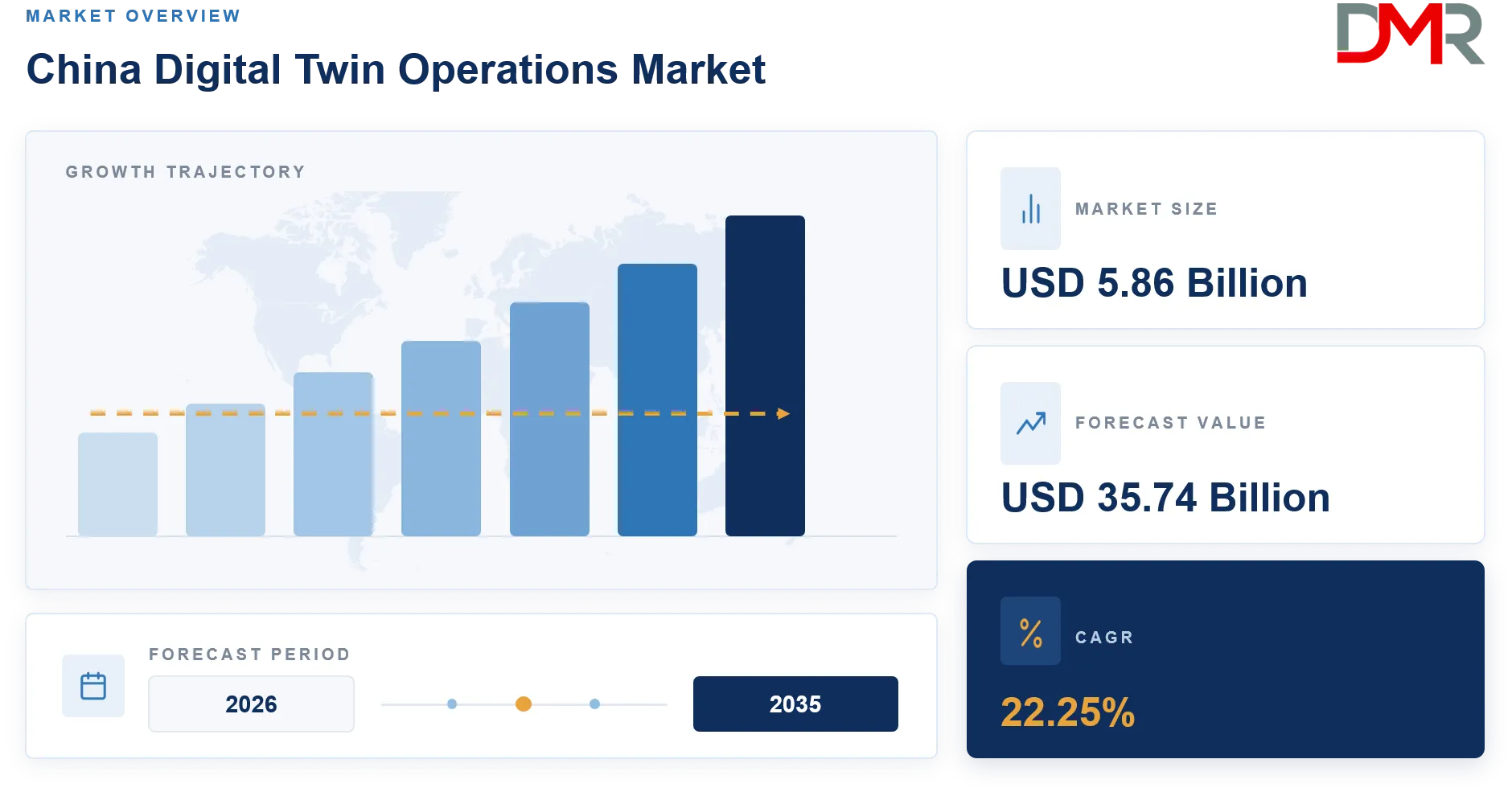
- Market Value: The China Digital Twin Operations Market is valued at USD 5.86 billion in 2026 and is projected to reach USD 35.74 billion by 2035.
- CAGR: The China Digital Twin Operations Market is expected to expand at a CAGR of 22.25% from 2026 to 2035.
- By Technology Type Analysis: Process digital twin led the technology type segment with a 32.8% share in 2026.
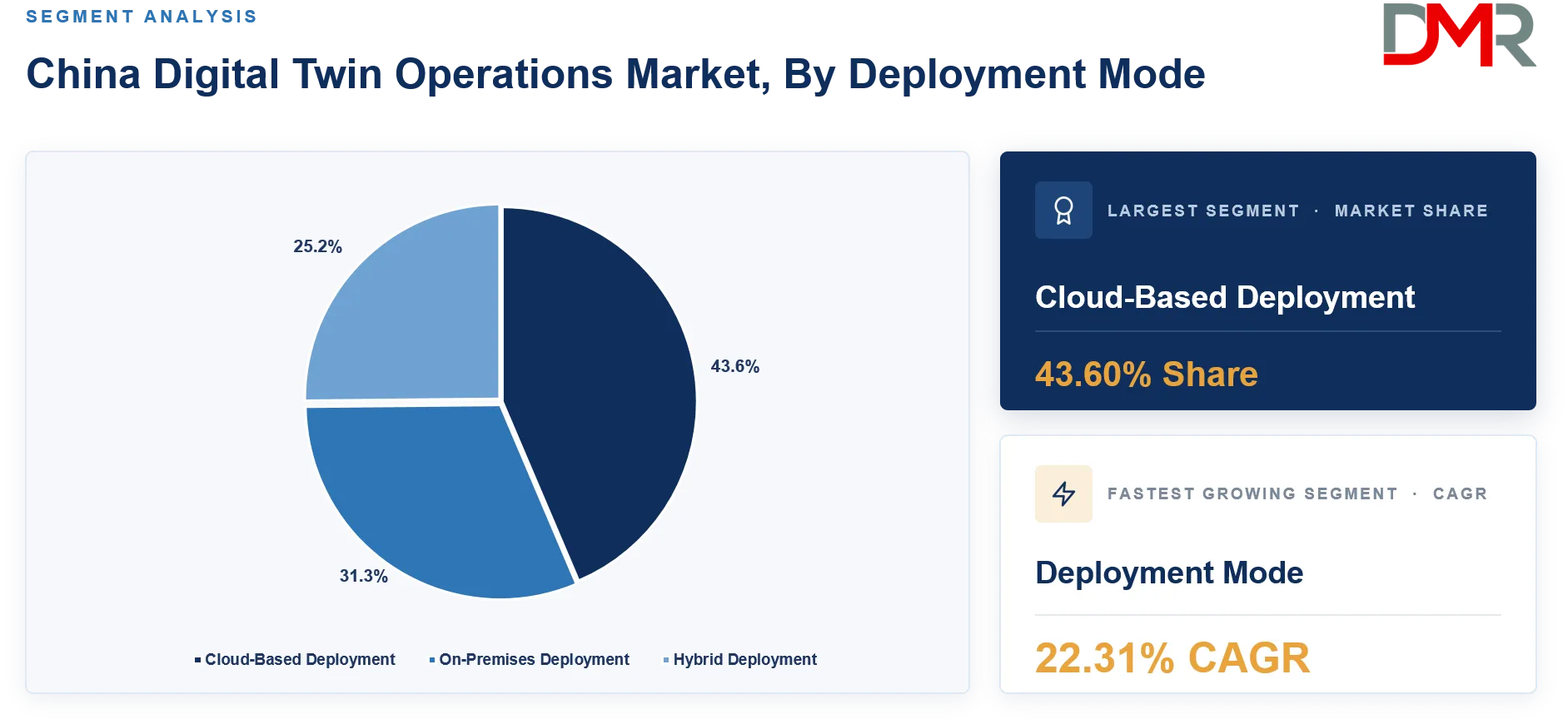
- By Deployment Analysis: Cloud-based deployment led the deployment segment with a 43.6% share in 2026.
- By Application Analysis: Predictive maintenance and operations accounted for a 22.4% share in 2026.
- Major Players: 51WORLD, Freedo Technology, UINO Technology, SmartYunzhou, Taireal and Others.
What is the China Digital Twin Operations Market and its Market Size?
The China Digital Twin Operations Market size is projected to reach USD 35.74 billion by 2035 from USD 5.86 billion in 2026, expanding at a CAGR of 22.25% during the forecast period. The market covers digital representations of physical products, processes, systems, and components that use operational data to support monitoring, simulation, optimization, maintenance, and decision-making. In China, adoption is closely connected with smart manufacturing, industrial Internet platforms, infrastructure digitization, connected equipment, and data-driven operations. Research on Chinese industrial applications also links digital twins with the integration of design, manufacturing, and maintenance across the product lifecycle.
ℹ
To learn more about this report –
Download Your Free Sample Report Here
The commercial value of digital twin operations is moving beyond visualization toward measurable operating outcomes. Enterprises are using virtual models to evaluate process changes, monitor asset performance, identify abnormal conditions, and improve maintenance planning. China-based market evidence shows strong growth across digital twin solution categories, while 51WORLD has identified design and operation optimization as a major addressable application area. This shift supports demand for platforms that combine IoT data, simulation, cloud computing, analytics, artificial intelligence, and operational workflows.
Use Cases
- Predictive Maintenance: Digital twins combine equipment data, historical performance, and simulation models to identify potential failures earlier and support maintenance scheduling.
- Process Optimization: Manufacturers can simulate production conditions, test process changes, and identify operating parameters before applying changes to physical assets.
- Infrastructure Operations: Digital representations of buildings, transportation networks, utilities, and industrial facilities support monitoring, planning, and operational coordination.
- Product Lifecycle Management: Product twins connect design, testing, manufacturing, service, and lifecycle data to improve engineering decisions and reduce development risks.
- Supply Chain Simulation: Enterprises can model production capacity, logistics flows, inventory conditions, and disruption scenarios to improve planning and operational resilience.
How AI/Gen AI is Transforming the China Digital Twin Operations Market?
AI is increasing the operational value of digital twins by turning large streams of sensor and enterprise data into forecasts, anomaly alerts, and recommended actions. Machine learning models can identify patterns in equipment behavior, while digital twin simulations provide a controlled environment for testing operating scenarios. This combination is particularly relevant to predictive maintenance, where research has identified digital twin technology as an important approach for improving equipment condition monitoring and maintenance decisions. In China, the growing use of industrial IoT, edge computing, and intelligent manufacturing systems creates a wider data foundation for these applications.
Generative AI adds a new interaction layer by allowing users to query complex digital environments using natural language. It can help summarize operational conditions, explain abnormal events, compare scenarios, and support faster access to insights. Market evidence also points to generative AI applications in digital twin environments, including natural-language interaction and more efficient handling of large volumes of real-time data. For business leaders, the impact is significant because digital twins can evolve from specialist engineering tools into operational decision platforms used by production, maintenance, supply chain, infrastructure, and management teams.
Key Drivers in the China Digital Twin Operations Market
Expansion of Smart Manufacturing
China's large manufacturing base is creating a substantial application environment for digital twin operations. Manufacturers increasingly need real-time visibility into machines, production lines, quality conditions, and asset performance. Digital twins allow physical equipment and processes to be represented in software and analyzed alongside operational data. Research on Chinese manufacturing applications highlights the use of digital twins across design, production, condition monitoring, and maintenance. This supports demand for process simulation, predictive maintenance, performance monitoring, and production optimization solutions.
Growing Industrial Data Infrastructure
The development of industrial IoT, cloud platforms, edge computing, sensors, and enterprise data systems is improving the technical foundation required for digital twin deployment. Cloud-based platforms can centralize data and simulation workloads, while edge processing can reduce latency for operational applications. Research involving Chinese process manufacturing has demonstrated edge, fog, and cloud architectures for digital twin-based health management and production planning. As enterprises connect more assets and operational systems, the value of maintaining continuously updated digital representations increases.
Restraints in the China Digital Twin Operations Market
Integration and Data Quality Challenges
Digital twin operations depend on consistent data from sensors, enterprise applications, machines, and physical assets. In large industrial environments, these sources may use different standards, architectures, and data formats. Poor data quality can reduce model accuracy and weaken the value of operational predictions. Integration also becomes more difficult when enterprises operate legacy equipment alongside modern IoT infrastructure. As a result, organizations may need substantial spending on data engineering, connectivity, model development, and system integration before achieving measurable returns from a digital twin program.
High Implementation Complexity
Large-scale digital twin deployments require more than visualization software. Enterprises may need domain models, real-time data pipelines, simulation capabilities, cybersecurity controls, cloud or edge infrastructure, and specialized technical teams. The complexity increases when a twin covers multiple facilities or connects product, process, and supply chain data. Smaller companies can face particular budget and skills constraints. These factors may extend deployment cycles and make buyers more cautious when evaluating the total cost of ownership, integration requirements, and expected operational benefits.
Growth Opportunities in the China Digital Twin Operations Market
AI-Enabled Operational Twins
The integration of AI with digital twin platforms creates an opportunity to move from descriptive monitoring toward predictive and prescriptive operations. AI models can forecast equipment degradation, identify process anomalies, test operating scenarios, and recommend maintenance actions. Chinese research and industrial applications already demonstrate digital twin approaches for predictive maintenance and production-line monitoring. Vendors that combine simulation, real-time data, machine learning, and workflow automation can therefore target higher-value operational use cases rather than basic visualization projects.
Expansion Across Infrastructure and Industrial Ecosystems
Digital twin adoption can expand from individual machines to factories, industrial parks, buildings, transportation systems, utilities, and connected urban infrastructure. This creates larger opportunities for platforms capable of managing multiple assets and data sources through a unified operational environment. The Chinese market already includes providers targeting digital twin solutions across different application domains, with market participants ranging from one-stop platforms to specialized point-solution providers. This ecosystem expansion can increase demand for interoperable software, professional services, and infrastructure.
Trends in the China Digital Twin Operations Market
Shift Toward Real-Time Operational Intelligence
The China Digital Twin Operations Market is shifting from static 3D visualization toward continuously updated operational models. Enterprises increasingly want digital twins to connect physical conditions with analytics, alerts, simulation, and business workflows. This trend raises the importance of real-time data ingestion, edge computing, AI analytics, and integrated control environments. Recent research on industrial predictive maintenance demonstrates how digital twins can combine sensor information, modeling, and intelligent analysis to support more responsive maintenance decisions.
Cloud and Hybrid Digital Twin Architectures
Cloud-based deployment is gaining importance because it can support centralized data management, scalable computing, collaboration, and access across distributed operations. Hybrid architectures remain relevant where enterprises need to keep sensitive operational workloads closer to physical assets while using cloud infrastructure for analytics and broader management. This architecture aligns with industrial environments where latency, data governance, cybersecurity, and scalability must be balanced. The 43.6% share held by cloud-based deployment in 2026 reflects the growing preference for scalable digital twin environments.
Research Scope and Analysis
This study evaluates the China Digital Twin Operations Market across technology type, deployment mode, enterprise size, component, application, end-user industry, and geographic markets. The analysis considers market size, growth patterns, adoption factors, operational use cases, competitive positioning, technological development, and emerging commercial opportunities.
ℹ
To learn more about this report –
Download Your Free Sample Report Here
By Technology Type;
Process digital twin accounted for the leading technology type position with a 32.8% share in 2026. Its strength reflects the direct connection between digital twin technology and operational improvement, particularly where enterprises need to simulate workflows, optimize production parameters, and anticipate equipment or process issues. Process twins can connect operational data with process models to evaluate different scenarios without disrupting physical operations. This makes them relevant to manufacturing plants, energy facilities, logistics environments, and other process-intensive operations. As enterprises seek measurable efficiency improvements, process digital twins can become a practical bridge between data collection and operational decision-making. Research on process manufacturing has demonstrated digital twin architectures that combine equipment-level monitoring, process optimization, and production planning.
By Deployment Mode;
Cloud-based deployment led the deployment segment with a 43.6% share in 2026. Cloud infrastructure supports centralized storage, scalable computing, remote access, model management, and integration with enterprise applications. These capabilities are useful for organizations operating multiple factories, facilities, or geographically distributed assets. Cloud deployment can also reduce the need for every site to maintain dedicated computing resources for advanced analytics and simulation. At the same time, hybrid architectures remain important for workloads that require low latency or tighter operational control. The development of edge-fog-cloud approaches in Chinese industrial research illustrates how digital twin applications can distribute processing across multiple computing layers.
By Application;
Predictive maintenance and operations held a 22.4% share in 2026, making it the leading application segment. The application is commercially attractive because unplanned equipment downtime can affect production schedules, asset utilization, maintenance costs, and product quality. Digital twins allow organizations to combine physical models with sensor and historical data to monitor asset health and estimate potential failure conditions. Research has identified predictive maintenance as a major digital twin application in manufacturing, while Chinese research has explored digital twin architectures for production-line condition monitoring and maintenance. Future demand is expected to favor solutions that connect predictions directly with maintenance workflows and operational decisions.
The China Digital Twin Operations Market Report is segmented on the basis of the following:
By Technology Type
- Product Digital Twin
- Virtual Prototyping
- Performance Monitoring
- Lifecycle Management
- Process Digital Twin
- Workflow Simulation
- Process Optimization
- Predictive Maintenance
- System Digital Twin
- Infrastructure Modeling
- Network Performance Analysis
- Integrated System Simulation
- Component Digital Twin
By Deployment Mode
- Cloud-Based Deployment
- On-Premises Deployment
- Hybrid Deployment
By Enterprise Size
- Large Enterprises
- Small and Medium Enterprises
By Component
- Software Solutions
- Professional Services
- Hardware Infrastructure
By Application
- Product Design and Development
- Predictive Maintenance and Operations
- Process Optimization and Management
- Quality Control Systems
- Performance Monitoring Solutions
- Business Process Optimization
- Supply Chain Simulation
By End-User Industry
- Automotive and Transportation Sector
- Aerospace and Defense Industry
- Electronics and Semiconductors Manufacturing
- Energy and Utilities Sector
- Oil and Gas Industry
- Healthcare and Life Sciences
- Consumer Goods Manufacturing
- Construction and Infrastructure Sector
- Retail and E-commerce Industry
- Telecommunications Sector
- Agriculture Sector
Competitive Landscape
The China Digital Twin Operations Market has a fragmented and diverse competitive structure, with participants ranging from specialized digital twin developers to large cloud, mapping, industrial software, and technology companies. 51WORLD is a notable participant in the Chinese digital twin ecosystem, while market evidence indicates that leading providers include both one-stop solution companies and point-solution specialists. Competition is increasingly centered on the ability to combine visualization, real-time data, simulation, AI analytics, cloud infrastructure, industry expertise, and implementation services.
Providers with broad platform capabilities can address multiple applications, while specialized vendors can compete through domain-specific models and operational expertise. The market is also moving toward AI-enabled digital twins, which can increase differentiation through predictive analytics, automated insights, scenario testing, and natural-language interaction. Companies are therefore competing not only on software functionality but also on integration capabilities, deployment flexibility, industry knowledge, data management, and the ability to demonstrate measurable operational returns.
Some of the prominent players in the China Digital Twin Operations Industry are:
- 51WORLD
- Freedo Technology
- UINO Technology
- SmartYunzhou
- Taireal
- Inspur Smart City
- SuperMap
- Huawei Cloud
- Alibaba Cloud
- Tencent Cloud
- Baidu Intelligent Cloud
- COSMOPlat
- Meicloud
- Hualong Xunda
- NeuCloud
- ForceControl Technology
- Tongyuan Soft Control
- Youye Technology
- EasyV
- Fantuo Digital Creation
- Others
The technology landscape of the China Digital Twin Operations Market is evolving from basic 3D visualization toward integrated operational intelligence that connects physical assets with real-time data, simulation, analytics, and enterprise workflows. Process digital twins currently hold the leading position with a 32.8% share in 2026 because they address direct operating priorities such as workflow simulation, production optimization, asset utilization, and predictive maintenance. Product digital twins are gaining importance across engineering and manufacturing as companies seek to connect virtual prototyping, performance monitoring, and lifecycle management. System digital twins extend this capability to infrastructure, networks, facilities, and interconnected assets, enabling organizations to evaluate interactions across complex environments.
The technology stack increasingly combines IoT sensors, industrial communication systems, cloud computing, edge computing, artificial intelligence, machine learning, simulation engines, geographic information systems, and visualization platforms. AI is becoming especially important for anomaly detection, failure prediction, scenario analysis, and automated recommendations. Cloud architectures support centralized model management and scalable analytics, while hybrid configurations are relevant for operations requiring low latency or tighter data control. Chinese technology providers are also developing solutions tailored to manufacturing, smart cities, energy, transportation, and infrastructure applications. Future technology competition is likely to focus on interoperability, model accuracy, real-time synchronization, cybersecurity, AI integration, and the ability to demonstrate measurable improvements in productivity, maintenance efficiency, quality, and operating costs.
Patent activity surrounding digital twin technology in China reflects the broadening technical scope of the market from virtual modeling toward intelligent monitoring, simulation, prediction, and operational control. Patent development covers areas including digital modeling, equipment monitoring, production-line simulation, predictive maintenance, industrial IoT connectivity, data processing, virtual environments, intelligent control, and system-level optimization. Chinese research and patent records show applications focused on using digital twin models with sensor information to monitor equipment conditions, identify operational abnormalities, and support maintenance decisions. This activity is relevant to the China Digital Twin Operations Market because intellectual property is increasingly linked to practical industrial workflows rather than visualization alone. Patent development also spans digital representations of factories, machines, infrastructure, and complex production systems, supporting broader deployment across manufacturing and infrastructure environments.
The growing intersection of digital twins with AI, edge computing, cloud platforms, and industrial data systems is expanding the scope of potential patentable technologies. Companies with proprietary modeling methods, synchronization techniques, simulation algorithms, data architectures, or AI-driven prediction capabilities can strengthen differentiation and create barriers for competing providers. Patent activity is also useful for identifying technology direction, emerging application areas, and organizations investing in specific digital twin capabilities. As Chinese enterprises increase spending on intelligent manufacturing and operational digitization, patent development is expected to remain important for protecting algorithms, system architectures, industry-specific models, and integrated digital twin solutions. This makes intellectual property analysis a useful indicator of technological maturity and competitive positioning within the market.