China Food Additives Market Snapshot
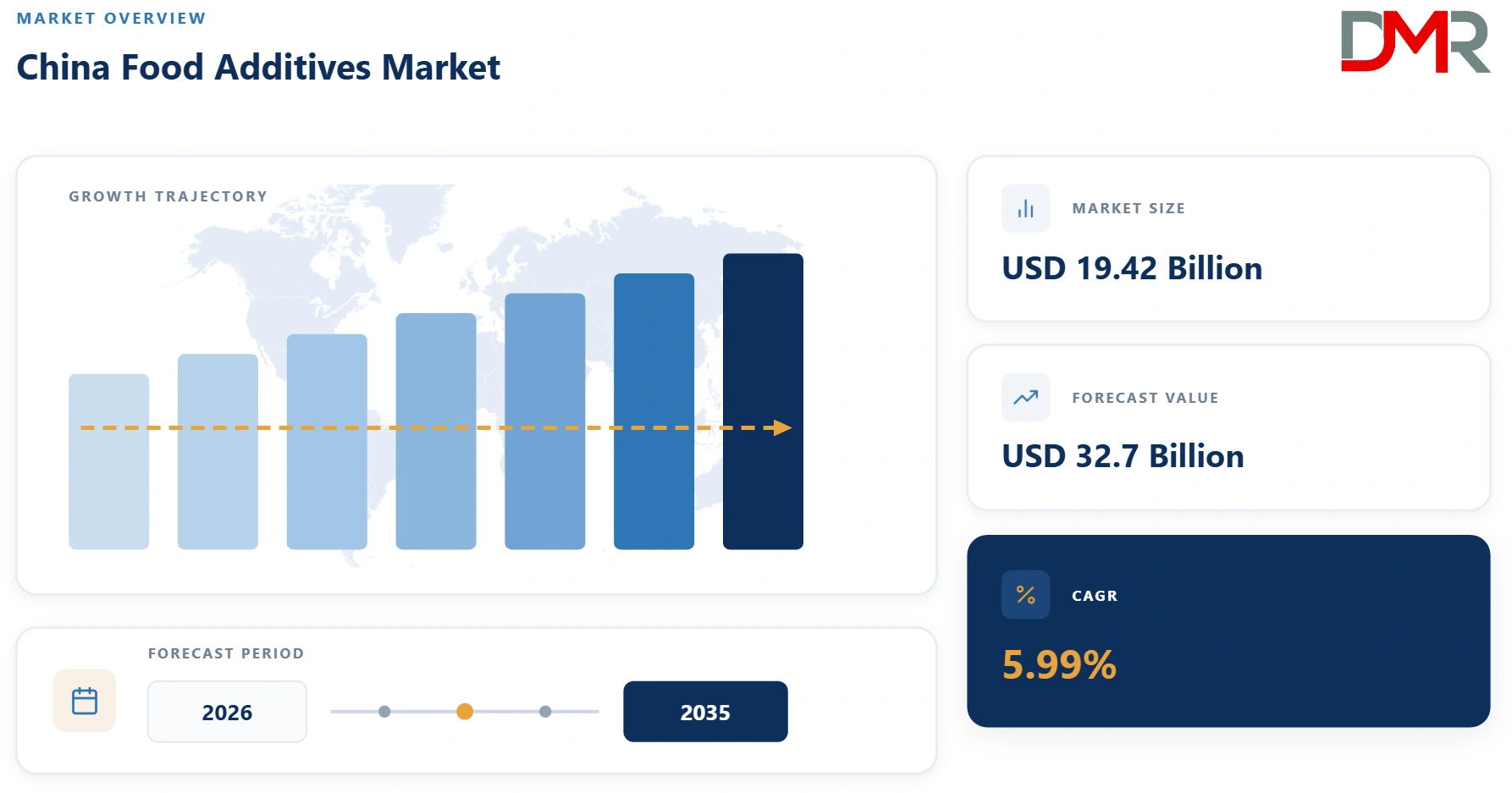
- Market Size in 2026: USD 19.42 billion
- Market Size in 2035: USD 32.7 billion
- CAGR, 2026–2035: 5.99%
- Leading Product Segment: Sweeteners / bulk sweeteners, 55% share
- Leading Source Segment: Synthetic, 68.4% share
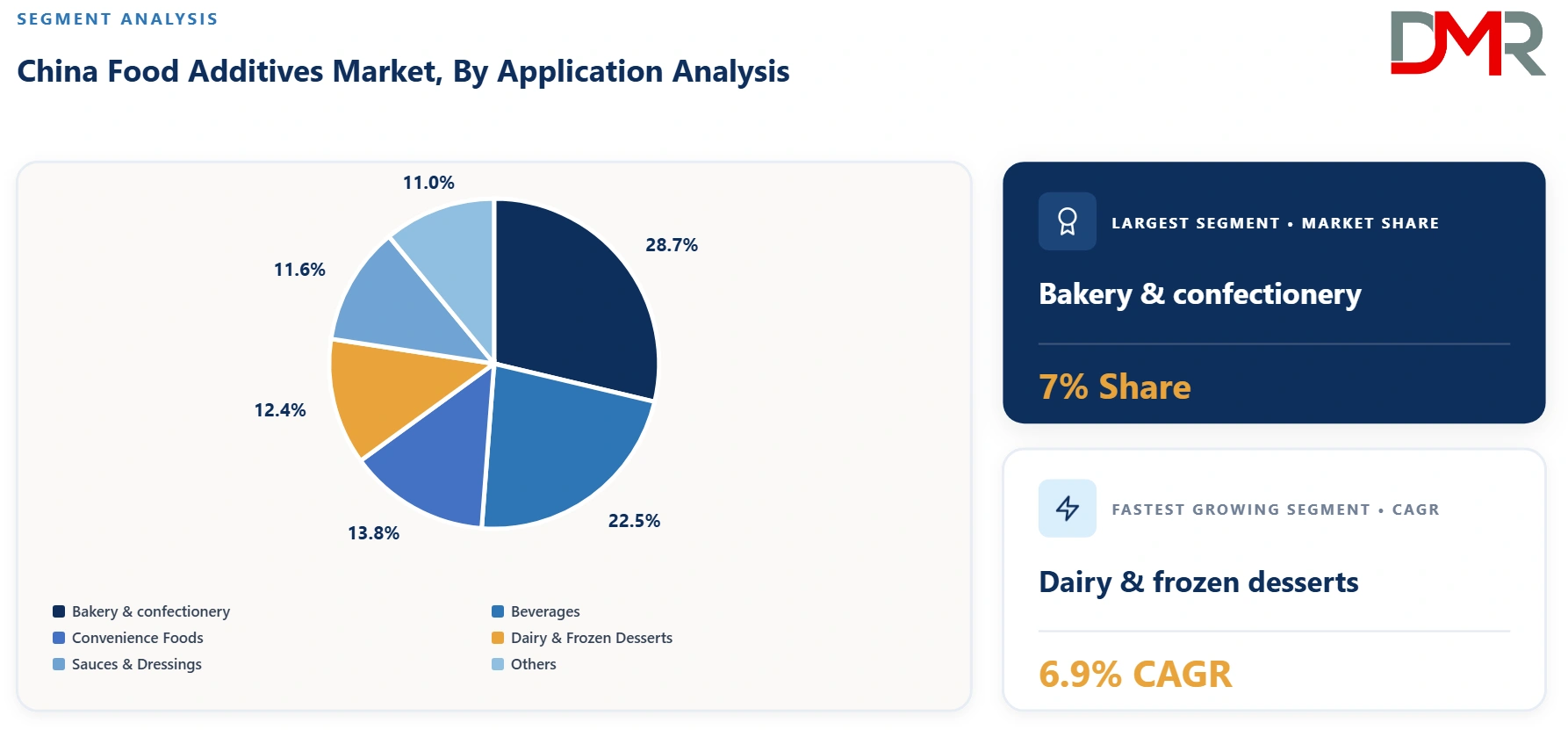
- Leading Application Segment: Bakery & confectionery, 28.7% share
- Fastest-Growing Product Segment: Food colorants, 7.1% CAGR
- Fastest-Growing Source Segment: Natural, 7.2% CAGR
- Fastest-Growing Application Segment: Dairy & frozen desserts, 6.9% CAGR
What is the China Food Additives and its Market Size?
The China Food Additives Market comprises ingredients intentionally added to food and beverages to improve sweetness, flavor, color, texture, stability, shelf life, processing efficiency, nutritional value, or sensory performance. The market encompasses sweeteners, flavors and enhancers, enzymes, emulsifiers, prebiotics, probiotics, dietary fibers, preservatives, colorants, hydrocolloids, acidulants, stabilizers and related functional systems. Its primary value proposition is enabling food manufacturers to produce safe, consistent, attractive and commercially scalable products while controlling formulation cost, extending shelf life and responding to consumer preferences such as reduced sugar, clean labels, functional nutrition and premium sensory experiences.
ℹ
To learn more about this report –
Download Your Free Sample Report Here
The China Food Additives Market is estimated at USD 19.42 billion in 2026 and is projected to reach USD 32.7 billion by 2035, representing an estimated 5.99% CAGR during 2026–2035. The outlook is supported by China's large processed-food manufacturing base, continued demand for convenience foods, premium beverages, bakery products and dairy, and increasing adoption of functional ingredients. Recent market research identifies bulk sweeteners as the largest product category, while natural ingredients, food colorants, dairy applications and functional nutrition are expanding faster than the overall market.
Use Cases
- Sugar reduction: High-intensity sweeteners and polyols help reformulate beverages, confectionery and dairy products with lower sugar content.
- Flavor enhancement: Flavors, MSG, nucleotides and taste modulators improve sensory performance and enable regionally tailored formulations.
- Shelf-life extension: Preservatives, antioxidants and stabilizers protect products from microbial, oxidative and physical deterioration.
- Texture optimization: Emulsifiers, hydrocolloids and enzymes improve mouthfeel, stability, elasticity and processing performance.
- Functional nutrition: Probiotics, prebiotics, dietary fibers and specialty ingredients support functional-food and wellness positioning.
- Natural reformulation: Botanical colors, natural flavors and fermentation-derived ingredients help manufacturers respond to clean-label preferences.
Key Takeaways
- Market size: China Food Additives is estimated at USD 19.42 billion in 2026, reaching approximately USD 32.7 billion by 2035.
- Growth: The market is expected to expand at approximately 5.99% CAGR through 2035.
- Primary drivers: Processed-food consumption, convenience formats, health-oriented reformulation, premiumization and China's large ingredient-manufacturing ecosystem.
- Segment dominance: Sweeteners/bulk sweeteners remain the largest product category, while synthetic ingredients retain the largest source share.
- Application leadership: Bakery and confectionery represents the largest application category in recent estimates.
- Fastest growth: Natural ingredients, food colorants, dairy/dessert applications, probiotics and prebiotics are expected to outperform commodity additives.
- Industry direction: The competitive center of gravity is moving from commodity volume toward biotechnology, application-specific systems, natural ingredients and regulatory-compliant functional formulations.
How AI/Gen AI is Transforming the China Food Additives Market?
AI and digital formulation tools are increasingly being used to accelerate flavor development, ingredient matching, sensory optimization, recipe prototyping and customer-specific formulation. In China, international suppliers are combining local application centers with digital platforms to respond faster to regional taste preferences. Givaudan, for example, operates a Digital Space in China and uses AI-enabled tools for formulation and product-development workflows, while IFF's Shanghai Creative Center applies culinary, sensory and technical expertise to localized food development.
Further, technology reduces formulation cycles, minimizes laboratory iterations, improves raw-material utilization and allows manufacturers to optimize taste, texture, cost and nutritional performance simultaneously. Biotechnology additionally enables fermentation-based production of enzymes, probiotics, amino acids, HMOs and other specialty ingredients.
Key Drivers in the China Food Additives Market
Expansion of Processed, Convenience and Packaged Foods
China's enormous food-processing industry provides a structural demand base for additives used in bakery, beverages, instant foods, sauces, dairy, confectionery and ready-to-eat products. Urban lifestyles, smaller households, food delivery, convenience retail and demand for consistent product quality encourage manufacturers to use ingredients that stabilize formulations and extend shelf life. The increasing sophistication of Chinese consumers is also creating demand for differentiated flavors, textures and nutritional profiles rather than simple commodity products. Food manufacturers consequently require additives that deliver predictable performance at industrial scale while maintaining competitive costs. This benefits China's established sweetener, flavor, fermentation and hydrocolloid producers.
Health, Wellness and Sugar-Reduction Reformulation
Health-oriented consumption is creating opportunities beyond traditional preservatives and bulk sweeteners. Manufacturers are reformulating beverages, dairy products, snacks and bakery products around reduced sugar, higher fiber, digestive health, protein enrichment and functional nutrition. This is increasing demand for high-intensity sweeteners, polyols, dietary fibers, prebiotics, probiotics, natural colors, specialty enzymes and fermentation-derived ingredients. The rapid expansion of biotechnology capabilities in China further supports local production of specialty ingredients that historically depended more heavily on imports.
Restraints in the China Food Additives Market
Commodity Price Volatility and Margin Pressure
Large portions of China's additives industry remain exposed to feedstock, energy, agricultural and fermentation-input costs. Commodity products such as bulk sweeteners, MSG-related products, acidulants and some hydrocolloids face intense domestic competition and relatively limited differentiation. Oversupply can quickly pressure selling prices, particularly when manufacturers expand capacity faster than downstream demand. Fufeng's 2025 interim results, for example, show the scale of China's food-additive production ecosystem, with MSG and starch sweeteners generating substantial revenue while facing year-on-year revenue pressure in the period.
Growth Opportunities in the China Food Additives Market
Natural, Clean-Label and Botanical Additives
Natural colors, botanical flavors, fermentation-derived ingredients and recognizable-label texturizers represent one of the strongest structural opportunities. Recent research indicates natural food-additive sources are growing faster than synthetic alternatives, while natural colorants are benefiting from premium bakery, confectionery and beverage innovation. Natural ingredients can command significant price premiums when they provide stable color, flavor and processing performance.
Biotechnology and Functional Nutrition
Fermentation and synthetic biology are opening higher-value applications in probiotics, enzymes, amino acids, HMOs, specialty fibers and other functional ingredients. Meihua's acquisition of food and pharmaceutical amino-acid and HMO assets from Kyowa Hakko in 2025 illustrates the movement toward higher-value downstream biotechnology. In February 2026, China's NHC also approved 3'-sialyllactose as a new nutritional fortifier, supporting further development of HMO applications.
Trends in the China Food Additives Market
Shift From Commodity Ingredients to Application Solutions
Ingredient suppliers are increasingly competing through complete formulation systems rather than individual additives. Application laboratories, co-development, digital formulation, sensory testing and technical service are becoming differentiators, particularly for multinational food manufacturers and fast-growing Chinese brands.
Naturalization and “Better-for-You” Reformulation
Demand is moving toward natural colors, recognizable ingredients, sugar reduction, gut-health ingredients and multifunctional additives. The transition is not eliminating synthetic additives, which remain dominant by source, but it is creating a rapidly growing premium tier.
Research Scope and Analysis
The China Food Additives Market is analyzed by Product, Source and Application. Product segmentation captures the functional ingredient mix; source distinguishes natural and synthetic inputs; application reflects demand from downstream food-processing categories. Estimates are synthesized from recent market databases and industry evidence.
ℹ
To learn more about this report –
Download Your Free Sample Report Here
By Product Analysis
Sweeteners are estimated to remain the dominant product category in 2026, accounting for approximately 55% of market value, supported by China's enormous beverage, confectionery, bakery and processed-food manufacturing base and the continued need for cost-effective sweetness systems. Recent market estimates similarly place bulk sweeteners at more than half of the market, although exact shares vary according to whether MSG and related taste-enhancement products are included. Flavors & enhancers represent the second major category, supported by demand for regionalized taste profiles, savory foods, instant noodles, sauces and premium beverages. Enzymes and emulsifiers are important enabling technologies for bakery, dairy and processed-food production. The fastest-growing specialist category is estimated to be prebiotics, at approximately 8.9% CAGR, as digestive-health positioning and functional-food development expand. Probiotics and dietary fibers are also expected to outperform traditional commodity additives as consumers increasingly seek gut-health and nutritional benefits..
By Source Analysis
Synthetic additives are estimated to hold approximately 68.4% of the 2026 market, reflecting China's scale advantage in industrial manufacturing, established chemical and fermentation infrastructure, cost competitiveness and consistent product specifications. Synthetic products remain especially important in commodity sweeteners, colors, preservatives and other high-volume applications where price and formulation reliability are critical. Natural additives account for roughly 31.6% but are expanding faster, with an estimated 7.2% CAGR, compared with approximately 5.6% for the overall market. Natural colors, botanical extracts, natural flavors and fermentation-derived ingredients are gaining traction among premium brands. Natural sources are particularly attractive where manufacturers seek simplified labels or differentiated health and sustainability claims. The long-term shift is therefore expected to be incremental rather than a wholesale replacement of synthetic additives: commodity applications will remain price-driven, while natural inputs will gain share in premium, functional and consumer-facing categories.
By Application Analysis
Bakery & confectionery is estimated to represent approximately 28.7% of China's food-additive demand, making it the leading application segment. Additives are widely required for sweetness, emulsification, texture, color, leavening support, shelf-life management and flavor development. Beverages form another major demand center, particularly for sweeteners, acidulants, flavors, stabilizers and natural colors. Dairy & frozen desserts are expected to be the fastest-growing application, with an estimated 6.9% CAGR, driven by premium yogurt, probiotic products, flavored milk, plant-based alternatives and functional frozen desserts. Convenience foods are also structurally attractive because instant noodles, prepared meals, sauces and snacks require flavor enhancers, hydrocolloids, emulsifiers and shelf-life systems. Sauces and dressings represent a further opportunity as Chinese consumers seek more diverse regional and international flavor profiles.
The China Food Additives Market Report is segmented on the basis of the following:
By Product
- Sweeteners
- Flavors & Enhancers
- Enzymes
- Emulsifiers
- Prebiotics
- Probiotics
- Dietary Fibers
- Others
By Source
By Application
- Bakery & confectionery
- Beverages
- Convenience Foods
- Dairy & Frozen Desserts
- Sauces & Dressings
- Others
Regulatory Landscape
China's food-additive market operates under the Food Safety Law, national food-safety standards and production-licensing requirements administered through national and local authorities. GB 2760-2024 is the central standard governing permitted food additives, application scopes and use requirements, and was updated following safety and technological-necessity assessments. In 2025, China's authorities launched a multi-agency comprehensive program targeting excessive and illegal additive use, strengthening oversight from raw materials and imports through production, distribution and food service. The 2025 Food Additive Production Licensing Review Rules further specify production-site, traceability, quality-control, labeling and process requirements and divide licensing into six categories, including single additives, food flavors, compound additives, nutritional fortifiers and enzymes. New additives and expanded uses remain subject to regulatory assessment, creating both a market-entry barrier and an advantage for companies with strong regulatory capabilities.
Investment and White Space Analysis
The strongest investment opportunities are concentrated in natural colors, specialty sweeteners, probiotics, prebiotics, dietary fibers, enzymes, HMOs and application-specific compound systems. Biotechnology is particularly attractive because China has deep fermentation expertise and extensive industrial-scale manufacturing infrastructure. The approval of 3'-SL in 2026 demonstrates the increasing commercial opportunity in advanced nutritional ingredients. Other white spaces include locally tailored natural flavors, low-sodium taste systems, sugar-reduction technologies, clean-label bakery solutions and functional beverage ingredients. Investment opportunities also exist in western and inland production hubs where lower-cost feedstocks, government-supported industrial infrastructure and proximity to agricultural inputs can support competitive manufacturing.
Competitive Landscape
China Food Additives is a hybrid competitive market, combining highly concentrated commodity categories with fragmented specialty and application-driven segments. Large domestic producers compete on scale, cost, fermentation technology and supply reliability, while multinational companies compete through proprietary formulations, application science, natural ingredients, regulatory expertise and global customer relationships. Major participants include Meihua Group, Fufeng Group, Angel Yeast, Givaudan, IFF, Kerry, dsm-firmenich, Ingredion, Cargill, ADM and other regional specialists. Competitive strategies increasingly include capacity expansion, biotechnology investment, acquisitions, local innovation centers, co-development partnerships and portfolio movement toward higher-value functional ingredients.
Some of the prominent players in the China Food Additives Market are:
- Fufeng Group
- Meihua Holdings Group
- Angel Yeast
- Cargill
- Archer Daniels Midland (ADM)
- BASF
- DSM-Firmenich
- Kerry Group
- Ingredion
- International Flavors & Fragrances (IFF)
- Ajinomoto
- Corbion
- Tate & Lyle
- Novonesis
- Lonza
- Givaudan
- Sensient Technologies
- CP Kelco
- Zhucheng Dongxiao Biotechnology
- Fooding Group
- Henan Jinmi MSG
- Tateho Chemical
- Evonik Industries
- Kalsec
- Fufeng Bio-Tech
- Shandong Qilu Biotechnology
- Shandong Longlive Bio-Technology
- Henan Lotus Gourmet Powder
- Henan Lianhua Monosodium Glutamate
- Shandong Linghua Group
- Anhui BBCA Group
- COFCO Corporation
- Wilmar International
- China Starch Holdings
- Shandong Zhongke Biotechnology
- AIPU Food Industry
- Eppen Biotech
- Shandong Runan Biotechnology
- Shandong Tianmei Bioengineering
- Shandong Ensign Industry
- Other Key Players
Recent Developments
- March 2026: dsm-firmenich announced Chinese authorization for its 3'-SL sodium salt for early-life nutrition, strengthening its HMO portfolio in Asia and increasing competition in premium infant and medical-nutrition ingredients.
- February 2026: Meihua secured China's approval for 3'-sialyllactose (3'-SL) as a new nutritional fortifier, expanding its position in human milk oligosaccharides and demonstrating the growing commercialization potential of synthetic-biology-derived nutrition ingredients.
- January 2026: Gelita's Liaoyuan facility reached approximately 11,000 tonnes of annual gelatin capacity, making it one of the company's largest production bases and reinforcing China's role as a manufacturing and export hub for gelatin and collagen ingredients.
- April 2025: IFF highlighted its Shanghai Creative Center, including an Instant Noodle Center of Excellence, to accelerate localized flavor, texture, sensory and ingredient innovation for Chinese and Asian food manufacturers.
- August 2024: Angel Yeast began commercial production at its Xizang plateau probiotics project, expanding domestic probiotic manufacturing and targeting applications across food, dairy and other biotechnology markets.
Report Details
| Report Characteristics |
| Market Size (2026) |
USD 19.42 Bn |
| Forecast Value (2035) |
USD 32.7 Bn |
| CAGR (2026–2035) |
5.99% |
| Historical Data |
2021 – 2025 |
| Forecast Data |
2026 – 2035 |
| Base Year |
2025 |
| Segments Covered |
By Product, By Source, By Application |
| Country Coverage |
China |
Frequently Asked Questions
What is the China Food Additives Market size in 2026?
▾ The China Food Additives Market is estimated at approximately USD 19.42 billion in 2026, supported by strong demand from processed food, beverages, bakery and dairy manufacturers.
What will the China Food Additives Market be worth in 2035?
▾ The China Food Additives Market is projected to reach approximately USD 32.7 billion by 2035, reflecting sustained demand for functional, natural and specialty food ingredients.
What is driving the China Food Additives Market?
▾ The China Food Additives Market is driven by processed-food consumption, convenience foods, beverage innovation, health-focused reformulation, sugar reduction, premiumization and expanding food manufacturing.
Which product category dominates the China Food Additives Market?
▾ Sweeteners dominate the China Food Additives Market, accounting for approximately 55% of market value in 2026 due to extensive use across beverages, confectionery, bakery and processed foods.
Which segment is growing fastest in the China Food Additives Market?
▾ Food colorants are among the fastest-growing segments in the China Food Additives Market, with an estimated 7.1% CAGR, supported by natural-color adoption and premium product innovation.
What are the major trends in the China Food Additives Market?
▾ Major trends in the China Food Additives Market include naturalization, clean-label formulations, sugar reduction, biotechnology, functional nutrition, localized flavors and AI-assisted product development.
Who are the major players in the China Food Additives Market?
▾ Major participants in the China Food Additives Market include Meihua, Fufeng, Angel Yeast, Givaudan, IFF, Kerry, dsm-firmenich, ADM, Cargill and Ingredion.
How is regulation affecting the China Food Additives Market?
▾ Regulations are significantly influencing the China Food Additives Market through updated GB 2760 standards, stricter production licensing, traceability requirements and controls on excessive or unauthorized additive use.