China Food Packaging Machinery Market Snapshot
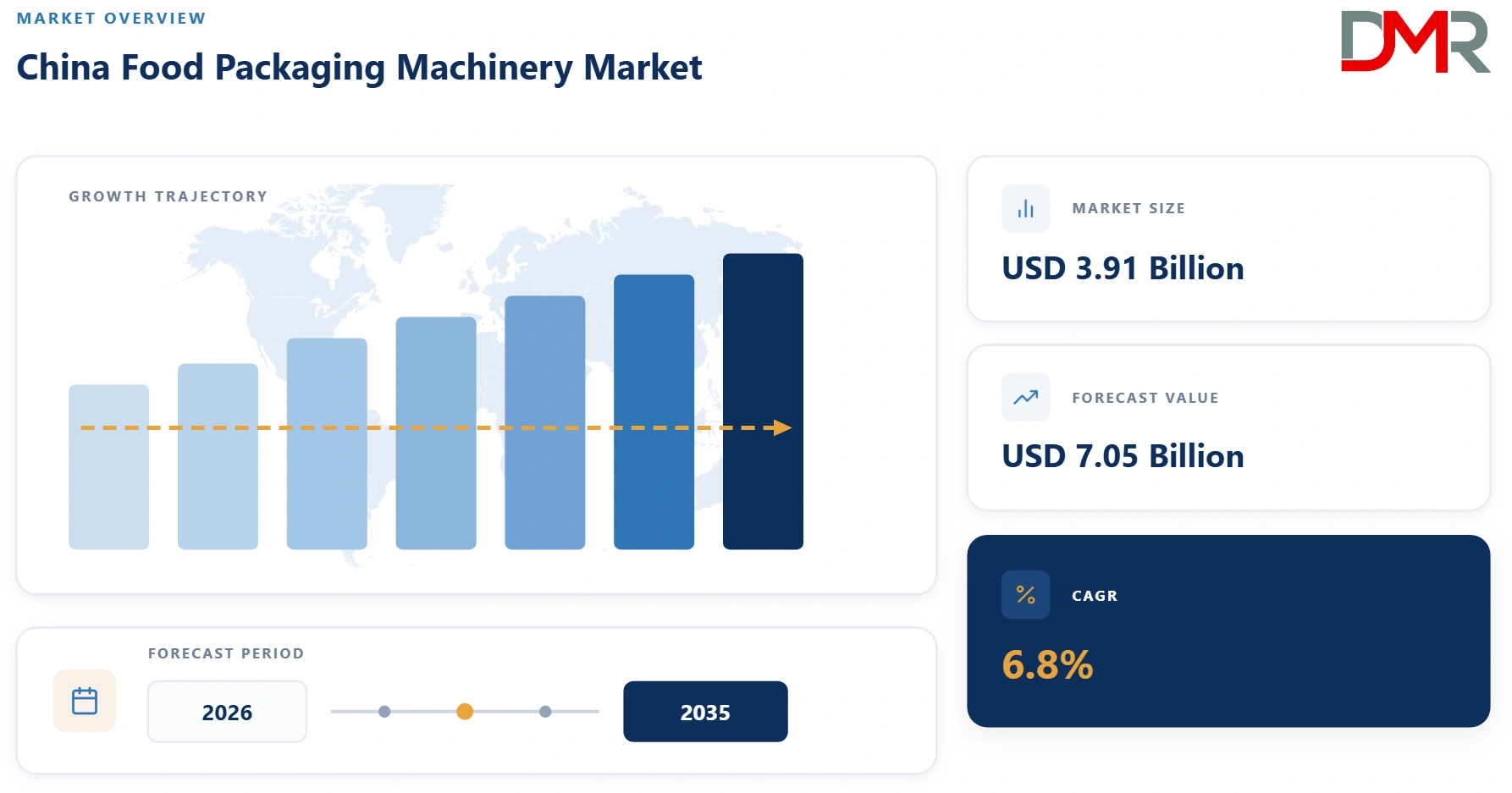
- Market Size in 2026: USD 3.91 Billion
- Market Size in 2035: USD 7.05 Billion
- CAGR, 2026–2035: 6.8%
- Leading Machinery Type in 2026: Form-Fill-Seal Machines, 31%
- Leading Packaging Format in 2026: Flexible Packaging, 58%
- Leading Automation Level in 2026: Automatic, 68%
- Fastest-Growing Machinery Segment: Case Packing & Palletizing Machines, 8.6% CAGR
What is the China Food Packaging Machinery and its Market Size?
China food packaging machinery comprises industrial equipment used to fill, dose, form, seal, wrap, label, code, carton, case-pack, palletize and otherwise prepare food products for storage, distribution and retail. The market covers standalone machines as well as integrated automated packaging lines serving products such as bakery goods, dairy, frozen foods, meat, seafood, snacks, beverages, fruits and vegetables.
ℹ
To learn more about this report –
Download Your Free Sample Report Here
Its core value proposition is to improve production throughput, packaging consistency, food safety, labor productivity, product protection and overall manufacturing economics. China's large food-processing base and mature machinery-manufacturing ecosystem also enable domestic equipment suppliers to offer increasingly customized and cost-competitive alternatives to imported machinery.
China's food packaging machinery market is estimated at USD 3.91 billion in 2026 with a 6.8% CAGR and is expected to reach USD 7.05 billion by 2035.
Growth is supported by packaged-food consumption, expansion of convenience and ready-to-eat products, replacement of labor-intensive processes with automation, greater demand for hygienic equipment and increasing adoption of high-speed, digitally monitored production lines. China's domestic machinery suppliers are also moving toward complete-line automation and intelligent-factory solutions, increasing the addressable value per customer installation.
Use Cases
- Snack packaging: High-speed weighing, filling, sealing and coding of chips, nuts, confectionery and other packaged snacks.
- Bakery packaging: Automated flow wrapping, bagging, cartoning and case packing for bread, biscuits and confectionery.
- Dairy packaging: Hygienic filling, sealing, labeling and secondary packaging of milk, yogurt and frozen dairy products.
- Frozen-food packaging: Automated pouching, tray sealing and case packing for dumplings, seafood and frozen prepared meals.
- Beverage packaging: Integrated bottle blowing, filling, capping, labeling, conveying and secondary packaging lines.
- Fresh-food packaging: Modified-atmosphere, vacuum and protective packaging systems extending product shelf life.
Key Takeaways
- The China food packaging machinery market is estimated at USD 3.91 billion in 2026, reaching approximately USD 7.05 billion by 2035 at 6.8% CAGR.
- Automation, packaged-food production and labor-productivity requirements are the principal structural growth drivers.
- Form-fill-seal machinery is the leading machinery category, accounting for an estimated 31% share in 2026.
- Flexible packaging remains the dominant packaging format because of material efficiency, convenience and compatibility with high-speed machinery.
- Automatic machinery represents approximately 68% of the market and is expected to gain share as manufacturers modernize production lines.
- Case packing and palletizing is modeled as the fastest-growing machinery category, supported by robotic handling and end-of-line automation.
- Competitive differentiation is increasingly shifting from machine price toward integration capability, uptime, software, service and intelligent-factory functionality.
How AI/Gen AI is Transforming the China Food Packaging Machinery Market?
AI, industrial IoT, machine vision, robotics and cloud-connected controls are increasingly being incorporated into Chinese packaging machinery. Equipment manufacturers are moving from standalone machines toward connected production cells capable of collecting operating data, detecting defects, optimizing machine settings and coordinating upstream and downstream equipment. Tech-Long, for example, describes the integration of AI, big data, industrial Internet and remote intelligent operation and maintenance into its packaging-equipment strategy.
The primary benefits are higher throughput, reduced unplanned downtime, lower labor requirements, improved quality consistency and predictive maintenance. Machine vision can identify seal, fill and labeling defects, while servo systems improve positioning and changeover performance. Robotic case packing and palletizing further reduce repetitive manual handling.
Key Drivers in the China Food Packaging Machinery Market
Expansion of Packaged and Convenience Foods
China's large and increasingly diversified food-processing industry is generating sustained demand for packaging equipment. Urban lifestyles, e-commerce distribution, convenience consumption and the expansion of ready-to-eat, frozen, snack and portion-controlled products increase the number of packaging operations performed per manufacturing site. Food producers are simultaneously seeking greater throughput and consistent packaging quality, encouraging investment in automated filling, forming, sealing, cartoning and end-of-line equipment. Flexible packaging is particularly well suited to high-volume snack and convenience-food applications because it can combine lightweight materials with high-speed production. Published market research also identifies packaged-food demand and food-industry automation as major drivers of China's machinery growth.
Industrial Automation and Labor Productivity
Rising requirements for productivity, consistency and labor efficiency are accelerating China's transition from semi-automatic to fully automatic packaging lines. Food manufacturers increasingly require machines capable of running multiple SKUs, performing rapid format changes and connecting directly with conveyors, inspection systems, robotic cells and warehouse operations. Domestic suppliers have developed broad portfolios spanning individual machines through complete production lines, lowering barriers for medium-sized food processors to adopt automation. Soontrue, for example, reports manufacturing bases in four Chinese locations and offers packaging machines alongside robotic case packing and palletizing solutions.
Restraints in the China Food Packaging Machinery Market
High Capital Requirements and ROI Pressure
High-speed packaging lines require substantial capital expenditure, especially where customers purchase integrated filling, inspection, labeling, secondary packaging and robotic end-of-line systems. Smaller food manufacturers can therefore postpone investment when demand visibility is uncertain or operating margins are under pressure. Equipment buyers increasingly expect short payback periods, making suppliers demonstrate measurable improvements in throughput, labor utilization, material consumption and uptime. The challenge is particularly relevant to smaller processors that cannot fully utilize high-speed equipment throughout the production cycle.
Growth Opportunities in the China Food Packaging Machinery Market
Robotic End-of-Line Automation
Robotic case packing and palletizing represents a particularly attractive growth area because these operations remain labor-intensive and are increasingly suitable for standardized automation. Food producers can use robotic arms for carton loading, case packing, sorting, palletizing and depalletizing while integrating machine vision for product identification. The shift from individual machines to complete automated cells allows suppliers to capture additional revenue from controls, conveyors, robotics, software and service contracts.
Smart, Flexible and Sustainable Packaging Lines
Demand is increasing for machinery capable of handling multiple package sizes, materials and SKUs with limited changeover time. Equipment that supports lightweight films, recyclable structures, lower material consumption and improved sealing control can benefit as food producers seek to reduce packaging costs and environmental impact. Digital monitoring creates another opportunity through remote diagnostics, predictive maintenance and performance analytics. Chinese machinery companies already increasingly position themselves as complete automation-solution providers rather than standalone equipment vendors.
Trends in the China Food Packaging Machinery Market
Shift Toward Intelligent Packaging Lines
Chinese food manufacturers are moving from individual machines toward connected packaging cells and complete automated production lines. Machine vision, robotics, remote monitoring and centralized controls are becoming increasingly common. Soontrue's recent product and exhibition activity emphasizes intelligent packaging equipment and integrated solutions, reflecting this broader industry direction.
Increasing Flexibility and High-Speed Production
Food producers are demanding machinery capable of handling shorter production runs, frequent SKU changes and multiple package formats while maintaining high throughput. This favors servo-driven equipment, automatic film tracking, quick-change tooling and recipe-based controls. Tech-Long's development of a 72,000-bottle-per-hour blowing-labeling-filling-capping combi-block illustrates the industry's emphasis on high-speed integrated systems.
Research Scope and Analysis
The China food packaging machinery market is analyzed by machinery type, packaging format, automation level, food product and end user. The segmentation captures differences in equipment configuration, packaging materials, automation intensity, product characteristics and buyer economics.
ℹ
To learn more about this report –
Download Your Free Sample Report Here
By Machinery Type Analysis
Form-Fill-Seal Machines are estimated to be the dominant machinery category in 2026, accounting for approximately 31% of market revenue, supported by extensive use across snacks, bakery products, confectionery, frozen foods, grains and other high-volume packaged products. Filling & Dosing Machines represent the second-largest category at approximately 19%, reflecting widespread demand in liquid, powder, granular and portion-controlled food applications. Case Packing & Palletizing Machines are expected to be the fastest-growing machinery category at an estimated 8.6% CAGR, driven by robotic automation and labor replacement. Cartoning, wrapping and overwrapping, sealing and closing, labeling and coding, and other packaging equipment collectively represent the remaining market. Growth is increasingly concentrated in integrated equipment capable of connecting primary packaging with downstream handling, inspection and logistics processes.
By Packaging Format Analysis
Flexible Packaging dominates the market with an estimated 58% share in 2026, reflecting its extensive use for snacks, bakery, confectionery, frozen foods, grains, powders and ready-to-eat products. Flexible packaging benefits from relatively low material consumption, lightweight transportation characteristics, attractive graphics and compatibility with high-speed VFFS and flow-wrapping machinery. Rigid Packaging accounts for approximately 42% and remains particularly important in dairy, beverages, sauces, canned products, jars, trays and products requiring higher structural protection. Rigid packaging is expected to grow at approximately 7.2% CAGR, supported by demand for convenience formats, portion packaging and premium presentation. Flexible packaging remains dominant, but machinery suppliers are increasingly developing systems capable of handling multiple materials and package geometries. Sustainability requirements are also encouraging equipment designs that improve sealing accuracy and reduce film consumption.
By Automation Level Analysis
Automatic machinery accounts for an estimated 68% share in 2026, making it the dominant automation category. Large food-processing companies prefer automatic systems because they offer higher throughput, consistent output, reduced labor dependency and easier integration with conveyors, inspection equipment and warehouse operations. Automatic machinery is expected to expand at approximately 7.3% CAGR, making it the fastest-growing automation category. Semi-automatic machinery represents approximately 32% and continues to serve smaller processors, lower-volume facilities and applications where product variety makes full automation difficult. Semi-automatic equipment remains attractive because of its lower acquisition cost and simpler maintenance requirements. However, as domestic suppliers offer modular automation and increasingly affordable robotic systems, the economic gap between semi-automatic and automatic solutions is narrowing, particularly for medium-sized processors with high labor requirements.
By Food Product Analysis
Snacks & Ready-to-Eat Foods represent the leading food-product segment with an estimated 22% share in 2026, supported by high packaging volumes, extensive use of flexible formats and the requirement for high-speed weighing, filling and sealing. Bakery & Confectionery is the second-largest category at approximately 18%, driven by widespread flow wrapping, bagging, cartoning and case packing. Beverages account for around 17%, with demand centered on filling, capping, labeling and secondary packaging systems. Dairy & Frozen Foods represent approximately 16%, while meat, poultry and seafood, fruits and vegetables, and other food products make up the balance. Snacks & Ready-to-Eat Foods are also expected to record approximately 8.0% CAGR, supported by convenience consumption, SKU proliferation and e-commerce-oriented food distribution.
By End User Analysis
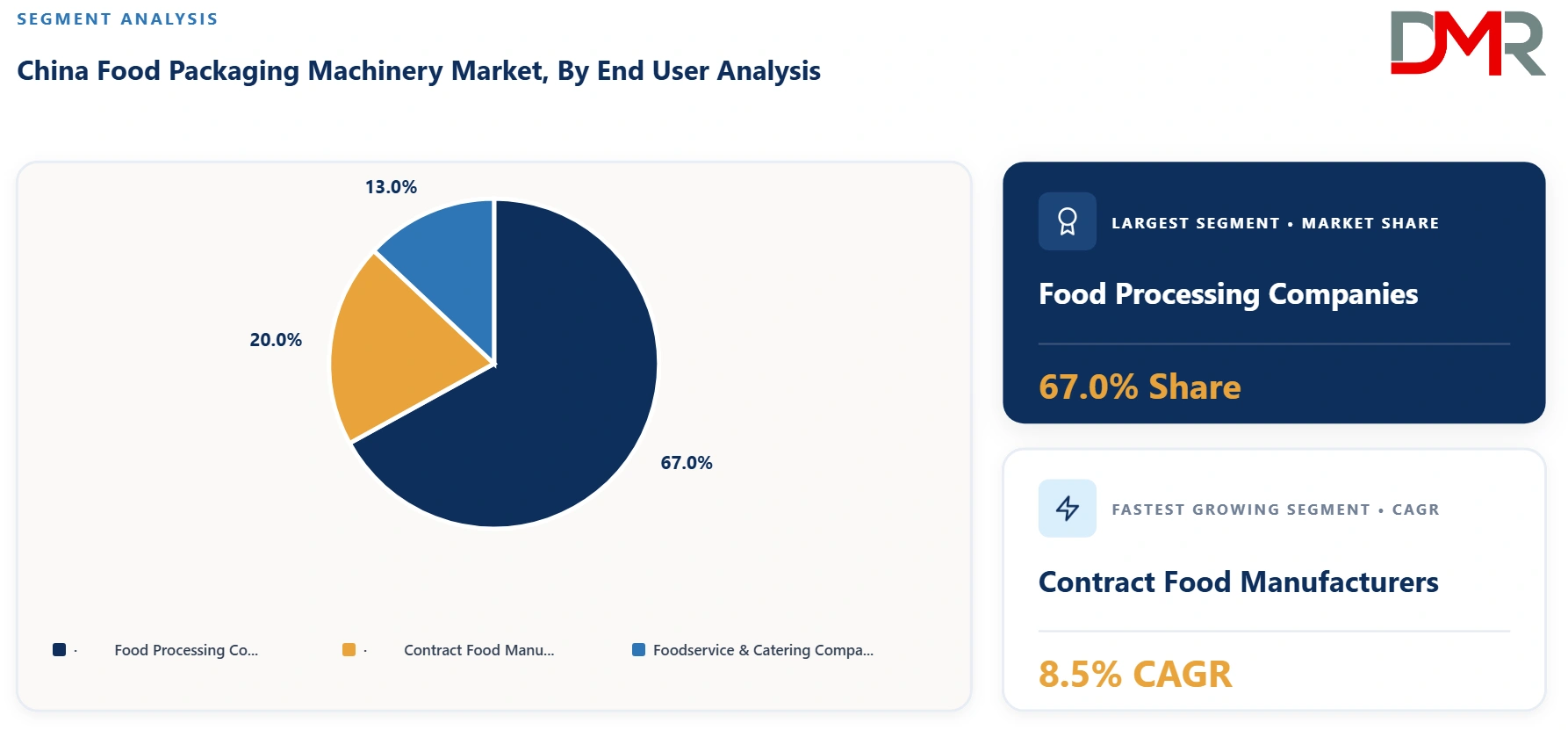
Food Processing Companies dominate demand, accounting for approximately 67% of 2026 market revenue because large processors operate high-volume production facilities and have greater requirements for automated packaging lines. They are followed by Contract Food Manufacturers, with approximately 20%, a segment expected to grow at around 8.5% CAGR because contract producers must support multiple brands, recipes, package sizes and production schedules. Foodservice & Catering Companies account for the remaining approximately 13%, with demand focused on portioning, tray sealing, prepared-food packaging and smaller-scale automated equipment. Contract manufacturing is particularly attractive for machinery suppliers because its high SKU diversity creates demand for flexible equipment, rapid changeovers and modular automation. The segment should therefore expand faster than the overall market as food brands increasingly use external manufacturing capacity.
The China Food Packaging Machinery Market Report is segmented on the basis of the following:
By Machinery Type
- Filling & Dosing Machines
- Form-Fill-Seal Machines
- Sealing & Closing Machines
- Wrapping & Overwrapping Machines
- Cartoning Machines
- Labeling & Coding Machines
- Case Packing & Palletizing Machines
- Other Packaging Machinery
By Packaging Format
- Flexible Packaging
- Rigid Packaging
By Automation Level
By Food Product
- Bakery & Confectionery
- Dairy & Frozen Foods
- Meat, Poultry & Seafood
- Fruits & Vegetables
- Snacks & Ready-to-Eat Foods
- Beverages
- Other Food Products
By End User
- Food Processing Companies
- Contract Food Manufacturers
- Foodservice & Catering Companies
Regulatory Landscape
China's food packaging machinery industry operates within a framework covering food safety, machinery safety, equipment performance, materials and product-contact hygiene. GB 16798-2023, Food Machinery Safety Requirements, became effective on April 1, 2024 and replaced the earlier GB 16798-1997 framework, establishing current mandatory safety requirements for food machinery. Liquid-food packaging equipment is additionally covered by GB/T 19063-2009, an active national recommended standard covering acceptance specifications for liquid-food packaging equipment. Other standards address food-processing equipment, packaging performance and specific equipment categories. Compliance increasingly influences equipment design, sanitation, material selection, machine safety, inspection and documentation.
Investment and White Space Analysis
The strongest investment opportunities are in robotic end-of-line automation, smart packaging lines, flexible-format machinery, machine vision, predictive maintenance and retrofit automation. Medium-sized food processors represent a significant white space because many require productivity improvements but cannot justify large turnkey installations. Contract manufacturers are another attractive customer segment because they need flexible equipment capable of rapid SKU and format changes. Geographically, manufacturing clusters in the Yangtze River Delta, Pearl River Delta and other major food-processing regions provide dense customer ecosystems and service opportunities. Export-oriented Chinese machinery suppliers also have room to expand in Southeast Asia, the Middle East, Latin America and other price-sensitive markets seeking automation at lower capital cost.
Competitive Landscape
The China food packaging machinery market is fragmented to moderately consolidated, with a large base of domestic machinery manufacturers competing alongside multinational suppliers. Competition historically centered on machine price, mechanical reliability and customization, but differentiation is shifting toward automation integration, speed, energy efficiency, digital connectivity, service and complete-line capability. Leading suppliers increasingly pursue vertical integration, product diversification, robotics, software and international expansion. Soontrue, for example, operates four manufacturing bases in China and offers equipment ranging from flow and vertical packaging machines to robotic case packing and palletizing systems.
Some of the prominent players in the China Food Packaging Machinery Market are:
- TECH-LONG
- Newamstar Packaging Machinery
- Youngsun Intelligent Equipment
- Hualian Machinery
- Shanghai Zengran Machinery
- Foshan Ruipuhua Machinery Equipment
- Shanghai Soontrue Machinery
- Guangzhou Guanhao Industrial
- Beijing JLS Machinery
- Shanghai Acepack Machinery
- Jiangsu Yizhong Food Packaging Machinery
- Zhejiang Dingye Machinery
- Wenzhou Changs Machinery
- Shanghai Kuko Packing Machinery
- Wenzhou Huaqiao Packing Machine Factory
- Shanghai Joygoal Food Machinery
- Shantou Huashilong Machinery
- Ruian Huadong Packing Machinery
- Zhejiang Haizhong Machinery
- Wenzhou Echo Machinery
- Shantou Jinping Xinhua Packing Machinery
- Foshan Dession Packaging Machinery
- Foshan Coretamp Packaging Machinery
- Foshan Soontrue Machinery Equipment
- Guangdong Luwia Packaging Machinery
- Shanghai Boevan Packaging Machinery
- Shanghai Yilugao Packaging Machinery
- Wenzhou Zhonghuan Packaging Machinery
- Zhejiang Chovyting Machinery
- Guangzhou Landpack Packaging Machinery
- Shanghai Royal Packaging Machinery
- Shanghai Tops Group
- Foshan Samfull Packaging Machinery
- Guangzhou Vanta Intelligent Equipment
- Shanghai Tengtian Packaging Machinery
- Foshan Landpack Packaging Machinery
- Zhejiang Haizhong Machinery
- Shandong Kangbeite Food Packaging Machinery
- Zhucheng Furuide Machinery
- Shandong Jinjiawang Packaging Machinery
- Other Key Players
Recent Developments
- In July 2026, Tech-Long reported delivery of four high-speed aseptic PET production lines to Dongpeng, including three 54,000-bottle-per-hour dry aseptic filling lines and one 36,000-bottle-per-hour line, highlighting continued investment in high-throughput beverage packaging.
- In July 2026, Tech-Long was included in the 2025–2026 intelligent-factory non-standard customized automation integrator ranking, reflecting the company's expansion from packaging machinery toward intelligent factory and customized automation solutions.
- In December 2025, Tech-Long announced that its 72,000-bottle-per-hour blowing-labeling-filling-capping combi-block had passed a scientific and technological achievement appraisal, with the project assessed at an internationally advanced technical level.
- In August 2025, Soontrue highlighted its more than 30-year experience in food packaging and processing machinery, with solutions spanning flow packing, vertical packaging, cartoning and automated production equipment for bakery, seafood, snacks and food processing.
- In June 2025, Soontrue exhibited intelligent packaging equipment and integrated whole-line solutions at ProPak China 2025 in Shanghai, highlighting automation, digital intelligence and industrial innovation across food processing and packaging.
Report Details
| Report Characteristics |
| Market Size (2026) |
USD 3.91 Bn |
| Forecast Value (2035) |
USD 7.05 Bn |
| CAGR (2026–2035) |
6.8% |
| Historical Data |
2021 – 2025 |
| Forecast Data |
2026 – 2035 |
| Base Year |
2025 |
| Segments Covered |
By Machinery Type, By Packaging Format, By Automation Level, By Food Product, By End User |
| Country Coverage |
China |
Frequently Asked Questions
What is the current size of the China Food Packaging Machinery Market in 2026?
▾ The China Food Packaging Machinery Market is estimated at approximately USD 3.91 billion in 2026, based on industry benchmarks and growth assumptions.
What will be the size of the China Food Packaging Machinery Market by 2035?
▾ The China Food Packaging Machinery Market is projected to reach approximately USD 7.05 billion by 2035, expanding at an estimated 6.8% CAGR from 2026 to 2035.
What is the CAGR of the China Food Packaging Machinery Market from 2026 to 2035?
▾ The China Food Packaging Machinery Market is estimated to grow at a 6.8% CAGR between 2026 and 2035, supported by automation and packaged-food demand.
What are the key growth drivers of the China Food Packaging Machinery Market?
▾ The China Food Packaging Machinery Market is driven by packaged-food expansion, industrial automation, labor productivity, convenience foods, e-commerce and food-safety requirements.
Which segment dominates the China Food Packaging Machinery Market?
▾ Form-Fill-Seal Machines dominate the China Food Packaging Machinery Market, accounting for an estimated 31% share in 2026 due to extensive food-sector applications.
Which is the fastest-growing segment in the China Food Packaging Machinery Market?
▾ Case Packing & Palletizing Machines are expected to be the fastest-growing segment in the China Food Packaging Machinery Market, with an estimated 8.6% CAGR.
What are the major trends shaping the China Food Packaging Machinery Market?
▾ Major China Food Packaging Machinery Market trends include robotics, AI, machine vision, industrial IoT, predictive maintenance, smart packaging lines and flexible automation.
Who are the key players in the China Food Packaging Machinery Market?
▾ Key players in the China Food Packaging Machinery Market include Soontrue, Tech-Long, Zhongya Machinery, Newamstar, Hualian, Krones, Tetra Pak, Syntegon, IMA and Coesia.