China Food Processing Equipment Market Snapshot
- Market Size, 2026: USD 6.45 billion
- Market Size, 2035: USD 10.35 billion
- CAGR, 2026–2035: 5.4%
- Leading Equipment Segment, 2026: Mechanical Processing Equipment, 25%
- Leading Mode of Operation, 2026: Automatic, 57%
- Leading End-Product Form, 2026: Solid, 47%
- Leading Application, 2026: Meat & Poultry, 21%
- Fastest-Growing Segment: Automatic equipment, 7.0% CAGR
What is the China Food Processing Equipment and its Market Size?
The China food processing equipment market comprises machinery, systems, controls, and integrated production lines used to transform agricultural and food ingredients into processed, preserved, packaged, or ready-to-consume products. It includes preparation, cutting, grinding, mixing, separation, thermal processing, drying, freezing, preservation, filling, conveying, and packaging equipment. The market serves food manufacturers, processors, beverage companies, dairy producers, meat and seafood processors, bakeries, grain processors, edible-oil companies, and ready-to-eat food manufacturers. Its principal value proposition is enabling higher throughput, consistent quality, food safety, labor productivity, traceability, and increasingly automated production.
ℹ
To learn more about this report –
Download Your Free Sample Report Here
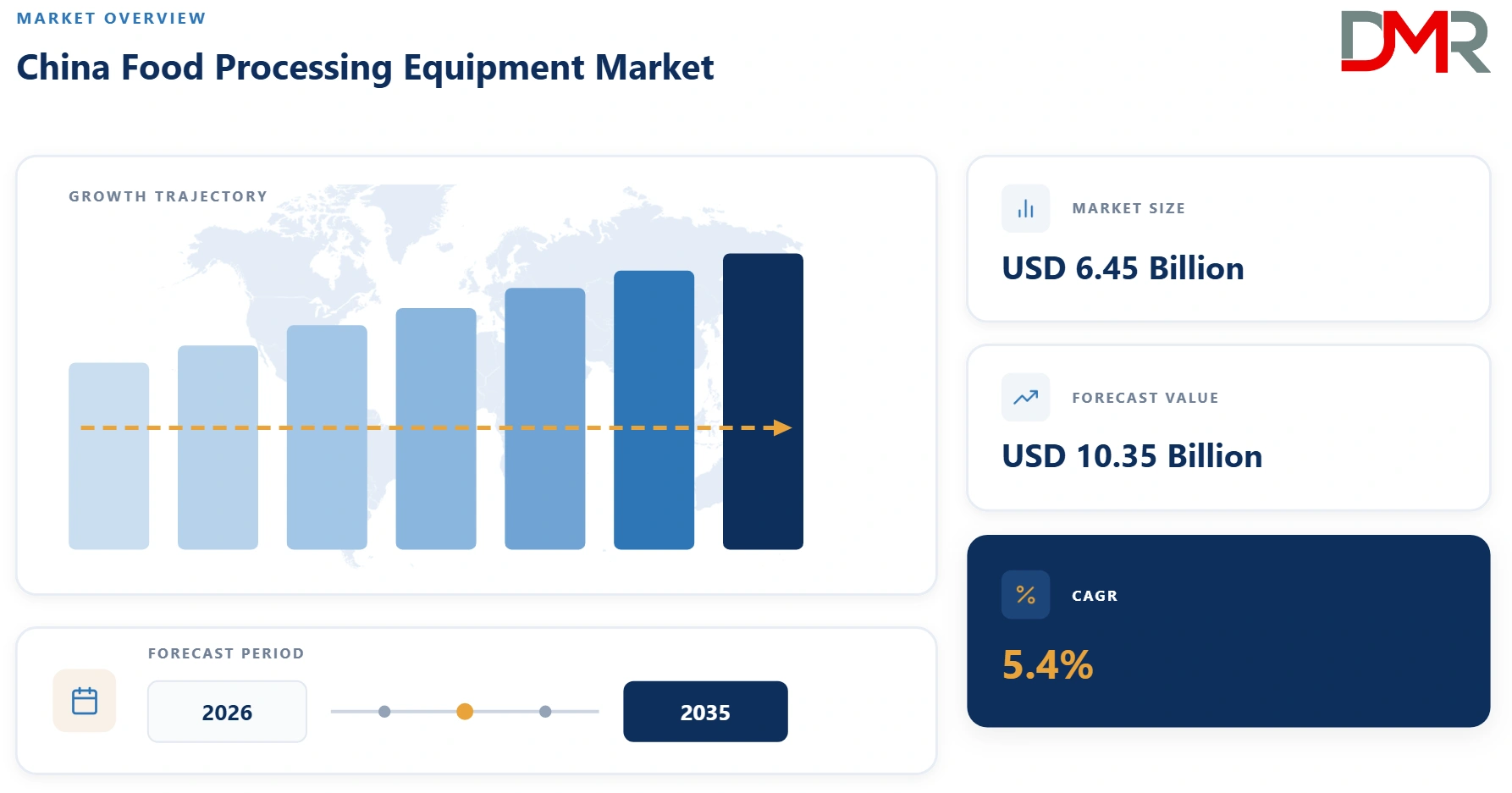
China's food-processing-equipment market is estimated at USD 6.45 billion in 2026 and is projected to reach approximately USD 10.35 billion by 2035, representing a modeled CAGR of about 5.4%. The estimate reflects continued investment in automation, food-safety compliance, processing-line modernization, labor substitution, cold-chain development, and higher-value processed foods.
Use Cases
- Meat and poultry processing: Automated cutting, deboning, grinding, forming, cooking, chilling, and packaging of protein products.
- Dairy production: Pasteurization, homogenization, filling, fermentation, drying, and aseptic processing of milk and dairy products.
- Bakery production: Mixing, forming, proofing, baking, cooling, slicing, and automated packaging of bakery products.
- Fruit and vegetable processing: Washing, sorting, peeling, cutting, drying, freezing, pulping, and preservation.
- Grain and starch processing: Milling, separation, concentration, drying, starch extraction, and downstream ingredient production.
- Ready-to-eat foods: Integrated cooking, portioning, filling, sterilization, cooling, and packaging lines for convenience foods.
Key Takeaways
- Market growth: China food-processing equipment is estimated to grow from USD 6.45 billion in 2026 to USD 10.35 billion in 2035.
- Automation: Automatic equipment is expected to remain the dominant operating mode as manufacturers address labor costs and consistency requirements.
- Industry demand: Meat, poultry, seafood, dairy, prepared foods, beverages, and agricultural-product processing represent major equipment-investment pools.
- Technology: AI, machine vision, robotics, sensors, industrial software, and predictive maintenance are shifting competition toward intelligent integrated lines.
- Exports: China is increasingly an equipment-exporting hub; 2025 food-processing-machinery exports reached about USD 2.84 billion according to Chinese trade-data analysis.
- Competitive structure: The market remains fragmented, with domestic suppliers particularly strong in cost-sensitive and customized equipment categories. Euromonitor estimates imports represented only 4.9% of the broader machinery category's 2025 market.
How AI/Gen AI is Transforming the China Food Processing Equipment Market?
AI, IoT, machine vision, robotics, PLC/SCADA systems, digital twins, and industrial analytics are moving Chinese food-processing equipment from standalone machinery toward connected production systems. Vision systems can inspect products for size, color, defects, and foreign material, while sensors continuously monitor temperature, pressure, vibration, moisture, flow, and energy consumption. AI-enabled control can subsequently adjust processing parameters in real time.
The primary benefits are higher throughput, reduced labor dependence, lower waste, improved product consistency, predictive maintenance, and better traceability. Automation is particularly attractive for meat, seafood, bakery, beverage, prepared-food, and packaging operations where repetitive processes can be standardized.
Key Drivers in the China Food Processing Equipment Market
Food-Industry Modernization and Automation
Chinese food manufacturers are progressively upgrading production facilities to increase productivity, improve hygiene, reduce manual intervention, and standardize output. The underlying food-processing industry remains substantial, while 2025 value added in agricultural and sideline food processing rose 5.6%. Automation is particularly compelling where processors face repetitive manual operations, variable labor availability, and strict quality requirements.
Rising Demand for Processed and Convenience Foods
Urban lifestyles, e-commerce distribution, foodservice growth, frozen foods, ready-to-eat products, beverages, snacks, and premium packaged foods are expanding the need for sophisticated processing capacity. Food manufacturers increasingly require equipment capable of shorter changeovers and flexible production of multiple SKUs.
Restraints in the China Food Processing Equipment Market
Capital-Intensive Equipment and Uneven SME Investment
Advanced processing lines can require substantial upfront capital, engineering, installation, validation, and maintenance expenditure. Smaller food processors may prioritize lower-cost semi-automatic machinery or refurbished equipment rather than investing in fully integrated smart factories.
Growth Opportunities in the China Food Processing Equipment Market
Smart, AI-Enabled Production Lines
The transition from isolated machines to integrated intelligent factories represents one of the strongest opportunities. Customers increasingly want equipment suppliers to provide complete solutions covering raw-material handling, processing, inspection, packaging, controls, and data management.
Export-Oriented Chinese Equipment Manufacturing
China's machinery industry has considerable cost, manufacturing-scale, supply-chain, and customization advantages. Food-processing machinery exports increased in value in 2025 despite lower unit volumes, with reported export value reaching approximately USD2.84 billion.
Trends in the China Food Processing Equipment Market
From Individual Machines to Complete Lines
Food manufacturers increasingly evaluate processing equipment according to overall factory performance rather than individual machine specifications. Industry observations from ProPak China 2026 indicate stronger customer interest in integrated raw-material handling, sterilization, filling, packaging, installation, and commissioning.
Intelligent and Flexible Manufacturing
AI-powered inspection, robotic handling, flexible sorting, digital controls, and automated packaging are moving into mainstream food-processing applications. At a 2026 Chinese food-processing exhibition, soft-robotics solutions demonstrated AI-enabled flexible sorting and packing capabilities for continuous operations.
Research Scope and Analysis
The China food-processing-equipment market is segmented by Equipment Type, Mode of Operation, Form of End Product, and Application. The following shares are modeled estimates for 2026 based on market structure, published segment information, industry demand patterns, and equipment investment intensity.
ℹ
To learn more about this report –
Download Your Free Sample Report Here
By Equipment Type Analysis
Mechanical Processing Equipment is estimated to be the largest equipment category in 2026, representing approximately 25% of market revenue, supported by broad use of cutting, slicing, grinding, milling, mixing, conveying, separation, and forming machinery across meat, bakery, grain, dairy, and prepared-food applications. Preparation Equipment follows at about 19%, reflecting widespread demand for washing, cleaning, sorting, peeling, and ingredient preparation. Heat Processing Equipment accounts for approximately 18% and is expected to be one of the faster-growing categories, supported by demand for cooking, pasteurization, sterilization, baking, evaporation, and thermal treatment. Packaging Equipment represents around 16%, while Preservation Equipment contributes approximately 14%, with refrigeration, freezing, drying, and related technologies benefiting from China's expanding cold-chain and convenience-food ecosystem. Others account for roughly 8%. Within the equipment structure, thermal and preservation technologies are likely to gain share as manufacturers prioritize shelf life, food safety, energy efficiency, and minimally processed products. Cooling and freezing equipment was identified as a leading equipment category in another published China market assessment, reinforcing the importance of preservation technologies.
By Mode of Operation Analysis
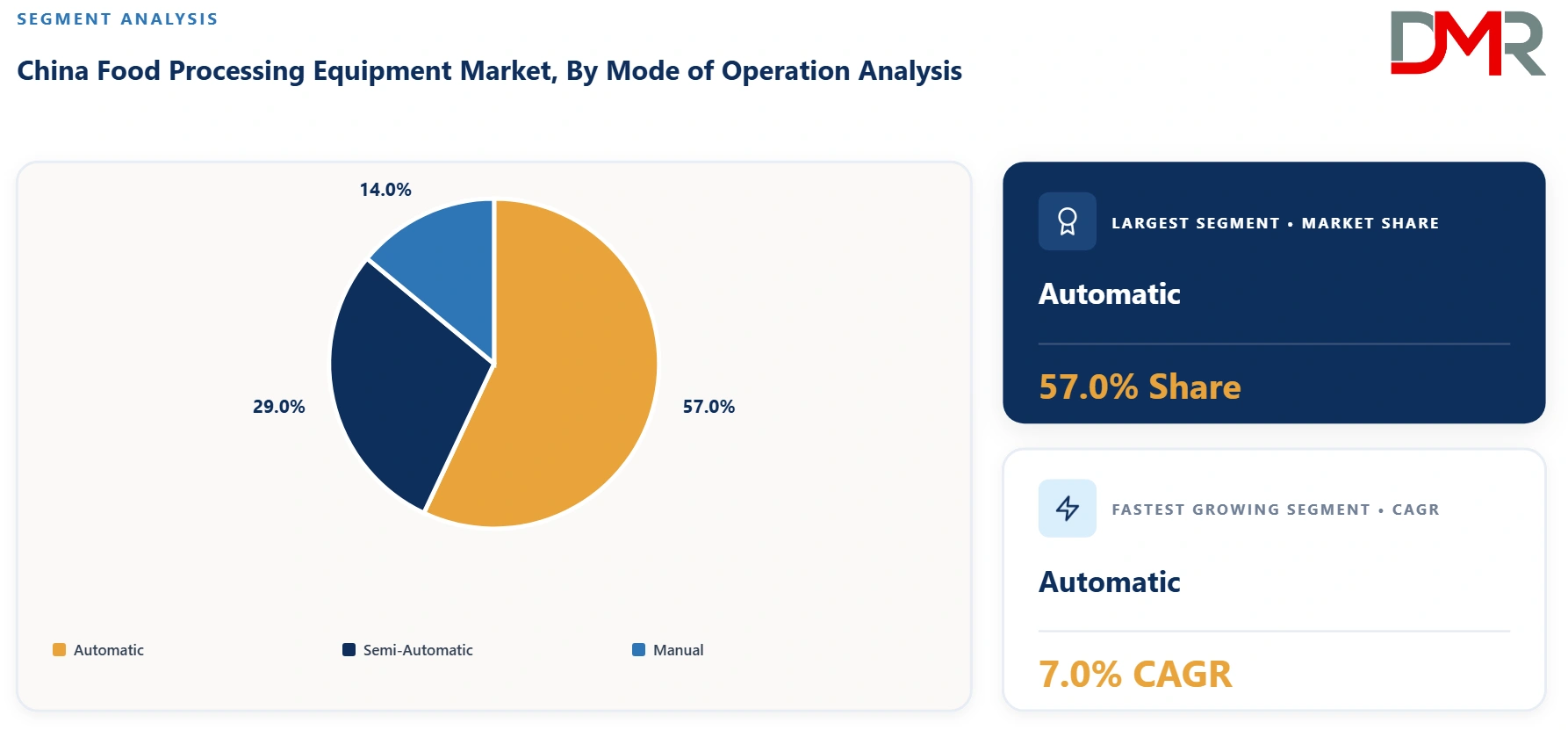
Automatic equipment is estimated to dominate the 2026 market with approximately 57% share, reflecting the industry's emphasis on labor productivity, hygiene, throughput, process consistency, and digital integration. Published market research also identifies automatic machinery as the largest operating-mode segment in China. Automatic systems are projected to be the fastest-growing sub-segment at about 7.0% CAGR through 2035, as robotic handling, machine vision, centralized controls, and predictive maintenance become more accessible. Semi-Automatic equipment is estimated at approximately 29%, remaining attractive to small and medium-sized processors seeking productivity improvements without the capital expenditure of fully automated lines. Manual equipment accounts for about 14% and remains relevant in smaller facilities, specialty production, low-volume processing, and applications where product variability makes automation difficult. Over time, the share of manual systems is expected to decline, while hybrid automatic/semi-automatic configurations remain important in China's highly fragmented processor base.
By Form of End Product Analysis
Solid products are estimated to represent approximately 47% of 2026 equipment demand, making them the largest end-product category. This reflects the breadth of meat, poultry, seafood, bakery, confectionery, grains, pulses, snacks, frozen foods, and processed fruit and vegetable applications. Liquid products represent approximately 34%, driven by beverages, dairy, sauces, edible oils, liquid ingredients, and aseptic products. Semi-solid products account for roughly 19%, covering sauces, pastes, spreads, fillings, processed dairy, purees, and prepared foods. Liquid and semi-solid processing is expected to grow rapidly because producers increasingly require hygienic closed processing, precise dosing, thermal treatment, homogenization, and automated filling. Equipment suppliers specializing in aseptic processing, UHT/HTST systems, evaporation, filling, and CIP/SIP technologies are therefore positioned to benefit. China's 2026 exhibition ecosystem shows strong representation from beverage processing, liquid-food systems, sterilization, filling, and related sanitary technologies.
By Application Analysis
Meat & Poultry is estimated to lead application demand in 2026 with approximately 21% share, reflecting high equipment intensity across cutting, deboning, grinding, forming, cooking, chilling, inspection, and packaging. A published China market assessment likewise identifies Meat, Poultry & Seafood as a major segment and estimates it as the fastest-growing industry segment at 6.46% CAGR over its forecast period. Dairy Products represent approximately 15%, followed by Beverages at 14%, Bakery & Confectionery at 12%, Ready-to-Eat & Ready-to-Cook Foods at 10%, Fruits & Vegetables at 8%, Grains & Pulses at 7%, Fish & Seafood at 6%, Edible Oils at 4%, and Others at 3%. Ready-to-eat and ready-to-cook food processing is expected to be among the fastest-growing applications as consumers demand convenience and manufacturers expand automated cooking, portioning, sterilization, and packaging capabilities. Meat, poultry, seafood, prepared foods, and beverage producers should remain particularly important buyers of integrated automated lines.
The China Food Processing Equipment Market Report is segmented on the basis of the following:
By Equipment Type
- Preparation Equipment
- Mechanical Processing Equipment
- Heat Processing Equipment
- Preservation Equipment
- Packaging Equipment
- Others
By Mode of Operation
- Automatic
- Semi-Automatic
- Manual
By Form of End Product
By Application
- Dairy Products
- Bakery & Confectionery
- Meat & Poultry
- Fish & Seafood
- Fruits & Vegetables
- Grains & Pulses
- Beverages
- Ready-to-Eat & Ready-to-Cook Foods
- Edible Oils
- Others
Regulatory Landscape
China's food-processing equipment market operates within an increasingly demanding food-safety, hygiene, product-quality, workplace-safety, and environmental framework. Equipment suppliers must design systems compatible with food-contact requirements, sanitary production practices, traceability, cleaning, and applicable national standards. Regulation therefore supports demand for stainless-steel sanitary construction, automated cleaning, contamination control, temperature monitoring, and digital traceability. The regulatory environment creates opportunities for established suppliers able to document compliance and provide validation and technical support, while smaller manufacturers may face higher engineering costs. Imported equipment can encounter additional certification and standards requirements, increasing localization incentives. Regulatory tightening is therefore both a growth driver for higher-quality machinery and a barrier to low-cost suppliers competing solely on price.
Import-Export Analysis
China is simultaneously a major exporter of food-processing machinery and an importer of specialized high-value equipment. Chinese trade data analysis indicates that 2025 exports of food-processing machinery reached approximately USD2.84 billion, up 6.7% year over year, although export volume declined 18%, implying a significant rise in average export value per machine. In 2024, reported exports were approximately USD2.66 billion versus imports of USD620 million for the narrower food-processing-machinery category. This indicates strong domestic manufacturing competitiveness, while advanced processing technologies remain areas where foreign suppliers can participate. The principal white space is therefore in high-precision, high-sanitation, energy-efficient, and specialized technologies combined with local service and engineering.
Competitive Landscape
The China food-processing-equipment market is highly fragmented, with domestic manufacturers competing alongside multinational suppliers and specialized regional engineering companies. Competition is increasingly based on automation, customization, price-performance, delivery speed, engineering capability, reliability, food-safety compliance, and after-sales service. Euromonitor estimates that the broader Chinese machinery-for-food, beverage, and tobacco-processing industry had 11,887 companies in 2025, with the top five representing only 2.2% of production value. Major international suppliers include Bühler, GEA, Krones, Marel-related businesses, Alfa Laval, JBT, SPX Technologies, and others, while Chinese competition includes numerous specialist machinery and turnkey-line providers. Strategic priorities increasingly include automation, robotics, international expansion, line integration, product specialization, and lifecycle services.
Some of the prominent players in the China Food Processing Equipment Market are:
- Tech-Long
- Newamstar
- Shanghai Joylong Industry
- Wenzhou Longqiang Machinery Technology
- Jiangsu Huahong Technology
- Shandong Longda Meat Processing Machinery
- Zhengzhou Dingsheng Machine Manufacturing
- Hefei Zhongcheng Food Machinery
- Guangzhou Xuzhong Food Machinery
- Jiangsu Kinty Food Machinery
- Shandong Sishui Huaxing Machinery
- Hangzhou Huihe Machine
- Foshan Nanhai Lvyuan Food Machinery
- Zhejiang Xuxiang Food Machinery
- Anhui Huibao Food Machinery
- Jinan Shengrun Machinery
- GEA Group
- Bühler Group
- Tetra Pak
- Marel
- JBT Corporation
- Heat and Control
- Ishida
- Yamato Holdings
- Nichimo
- SIPA
- SACMI
- OMAS Industries
- Alfa Laval
- Krones
- Syntegon Technology
- Multivac
- FLSmidth
- Hosokawa Micron
- SPX FLOW
- ANDRITZ
- Baker Perkins
- Pavan Group
- Clextral
- Bühler Aeroglide
- Other Key Players
Recent Developments
- June 2026: Shanghai EasyReal Machinery showcased liquid-food processing, UHT/HTST sterilization, evaporation, aseptic filling, CIP/SIP, and turnkey production solutions at ProPak China 2026, reflecting increasing demand for integrated sanitary processing systems.
- June 2026: Wenzhou Leadwing Machinery presented packaging automation solutions at the Shanghai food-processing and packaging machinery exhibition, highlighting continued investment in automated production lines and intelligent packaging.
- May 2026: Sino-Food Machinery Group reported successful commissioning of a large dual-starch production project in Henan, comprising three integrated potato–sweet-potato starch production lines and demonstrating China's growing capability in large-scale specialized processing engineering.
- July 2025: GELGOOG completed a vegetable-washing and air-drying line for Synear Food, providing customized equipment design, manufacturing, installation, and commissioning as part of Synear's production-line modernization strategy.
- May 2025: China Starch Holdings announced additional machinery acquisitions from Shanghai Senon for starch-production expansion, bringing aggregate machinery acquisitions in the disclosed projects to approximately RMB72.1 million.
Report Details
| Report Characteristics |
| Market Size (2026) |
USD 6.45 Bn |
| Forecast Value (2035) |
USD 10.35 Bn |
| CAGR (2026–2035) |
5.4% |
| Historical Data |
2021 – 2025 |
| Forecast Data |
2026 – 2035 |
| Base Year |
2025 |
| Segments Covered |
By Equipment Type, By Mode of Operation, By Form of End Product, By Application |
| Country Coverage |
China |
Frequently Asked Questions
What is the China Food Processing Equipment Market size in 2026?
▾ The China Food Processing Equipment Market is estimated at approximately USD 6.45 billion in 2026.
What will the China Food Processing Equipment Market be worth in 2035?
▾ The China Food Processing Equipment Market is projected to reach approximately USD 10.35 billion by 2035.
What is driving growth in the China Food Processing Equipment Market?
▾ Automation, food-safety requirements, processed-food demand, labor productivity, factory modernization, and cold-chain expansion are key growth drivers.
Which operating mode dominates the China Food Processing Equipment Market?
▾ Automatic equipment dominates the China Food Processing Equipment Market, accounting for an estimated 57% share in 2026.
Which equipment category leads the China Food Processing Equipment Market?
▾ Mechanical Processing Equipment leads the China Food Processing Equipment Market, with an estimated 25% market share in 2026.
Which application has the largest share of the China Food Processing Equipment Market?
▾ Meat & Poultry is estimated to be the largest application segment in the China Food Processing Equipment Market, with approximately 21% share.
What are the major technology trends in the China Food Processing Equipment Market?
▾ AI, robotics, machine vision, IoT sensors, predictive maintenance, and intelligent production systems are major technology trends transforming the market.
What is the export outlook for the China Food Processing Equipment Market?
▾ The China Food Processing Equipment Market has strong export potential, supported by China's manufacturing scale, competitive pricing, customization capabilities, and established supply chains.