China Seed Processing Machinery Market Snapshot
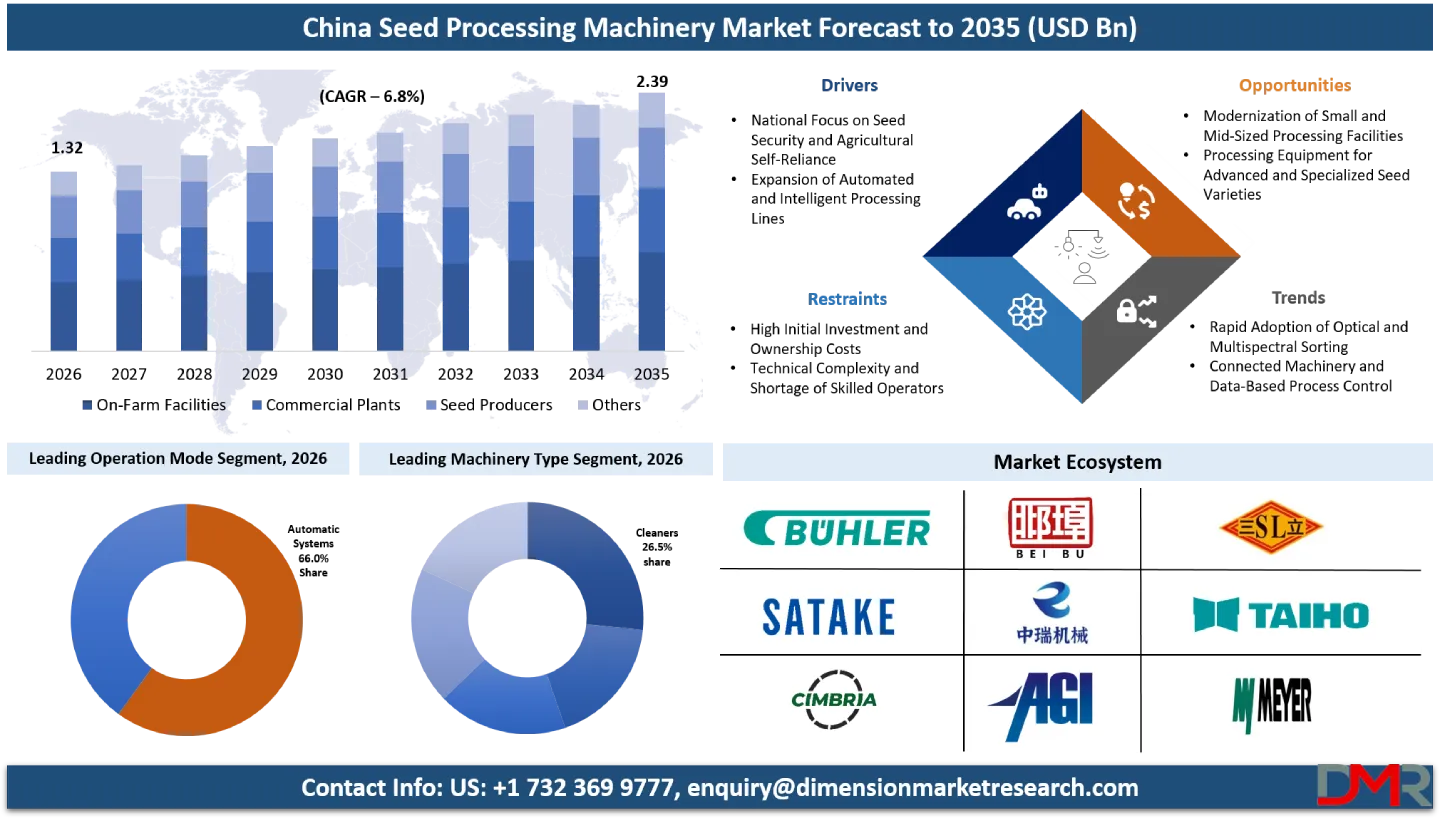
- Market Growth: The China Seed Processing Machinery Market is projected to grow from $1.32 bn in 2026 to $2.39 billion by 2035, at a CAGR of 6.8%.
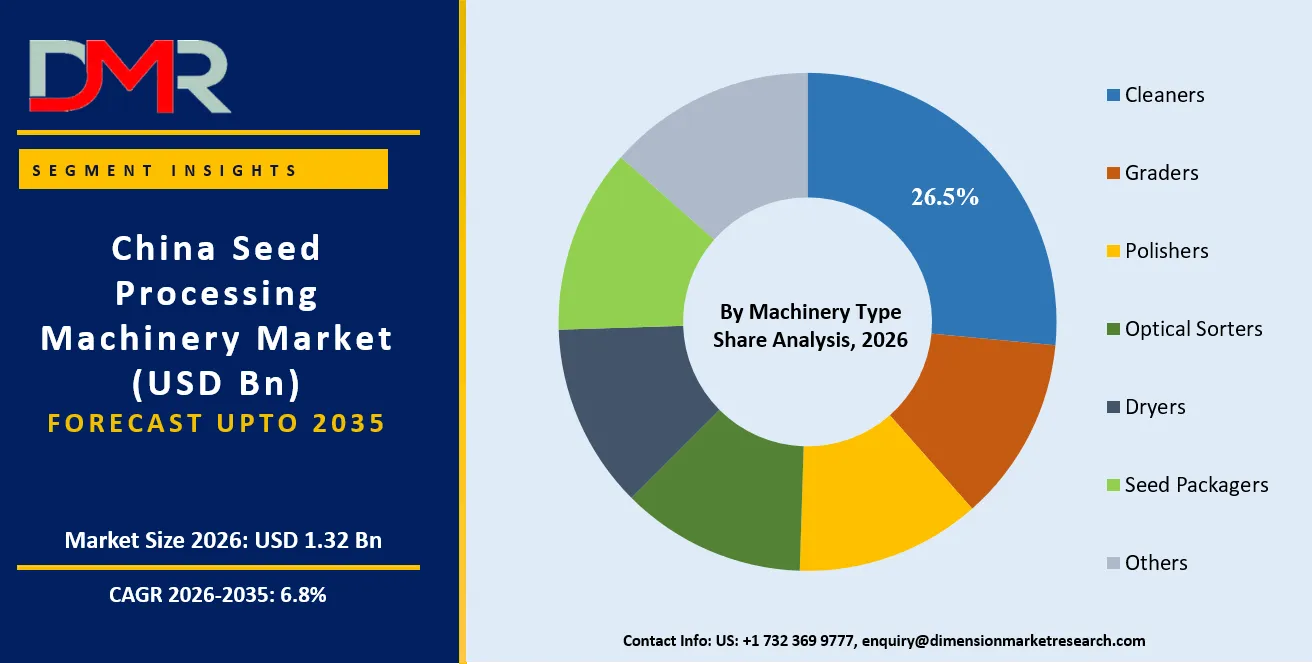
- By Machinery Type: The Cleaners segment is expected to lead the market, accounting for a 26.5% share in 2026.
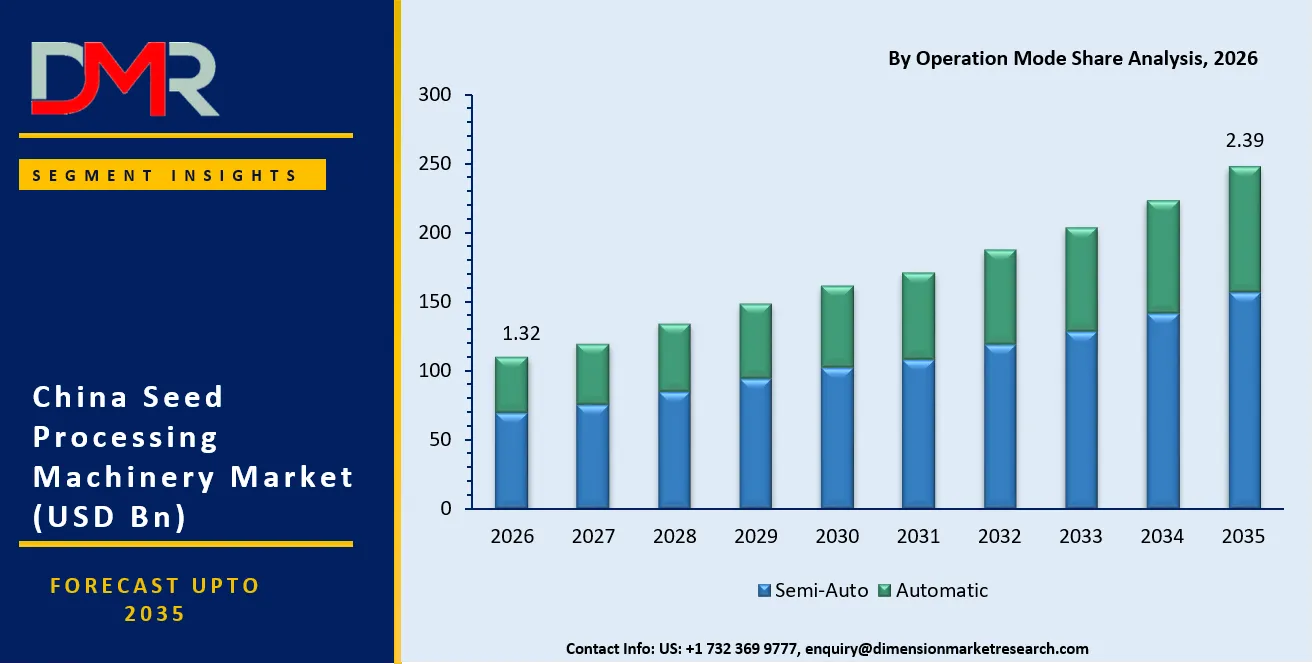
- By Operation Mode: The Automatic Systems segment is projected to dominate the market with a 66.0% share in 2026.
- By End User: The Commercial Seed Processing Plants segment is anticipated to hold the largest market share of 51.5% in 2026.
- Major Key Players: Bühler AG, Shijiazhuang Xinlu Technology Co., Ltd., Hefei Meyer Optoelectronic Technology Inc., and Others
What is the China Seed Processing Machinery Market and its Market Size?
The China seed processing machinery market size is projected to be valued at USD 1.32 billion in 2026 and is expected to reach USD 2.39 billion by 2035, expanding at a CAGR of 6.8% during the forecast period. The market includes equipment used to clean, grade, separate, treat, dry, coat, sort, package, and handle agricultural seeds before commercial distribution or planting. These systems help processors improve seed purity, germination consistency, physical uniformity, storage performance, and compliance with quality requirements.
ℹ
To learn more about this report –
Download Your Free Sample Report Here
Market demand is rising as China strengthens seed security, modernizes agricultural production, and supports the development of improved crop varieties. The country’s revised Seed Law reinforced intellectual property protection and formed part of a wider national seed industry revitalization program. This policy direction encourages seed producers to invest in reliable processing infrastructure that protects varietal purity and raises the commercial value of certified seed lots.
The China seed processing machinery market covers stand-alone machines as well as integrated processing lines. Major equipment categories include air-screen cleaners, gravity separators, destoners, graders, seed treaters, dryers, color sorters, conveyors, elevators, weighing systems, and packaging units. Cleaners accounted for 26.5% of the market in 2026 because cleaning is a basic step across almost every seed processing workflow. Automatic systems held a 66.0% share, reflecting demand for greater throughput, lower labor dependence, consistent quality, and better production control.
Use Cases
- Removal of Foreign Material: Seed cleaners separate dust, straw, stones, husks, broken kernels, weed seeds, and other unwanted matter from harvested seed lots. This improves physical purity, protects downstream machines, reduces storage risks, and prepares seeds for accurate grading, treatment, and packaging.
- Seed Grading and Size Classification: Graders classify seeds by width, length, thickness, shape, weight, or density. Uniform seed lots support accurate planting rates, smoother mechanical sowing, more even crop establishment, consistent coating coverage, and higher commercial acceptance among farms and distributors.
- Optical Sorting and Defect Detection: Camera-based and sensor-based sorters detect discolored, damaged, diseased, immature, or mixed-variety seeds. Modern systems can use color cameras, ultraviolet sensors, near-infrared imaging, and X-ray detection to improve quality control across wheat, corn, rice, soybean, millet, and vegetable seeds.
- Seed Treatment and Coating: Treatment machinery applies fungicides, insecticides, micronutrients, biological products, polymers, and colorants at controlled rates. Precise application helps protect seeds during storage and early crop development while reducing chemical waste, uneven coverage, and direct operator exposure.
- Commercial Processing and Packaging: Integrated plants combine cleaning, grading, sorting, treatment, weighing, bagging, and material handling. These lines allow seed companies and cooperatives to process large volumes with traceable batches, stable output quality, lower unit costs, and faster delivery during seasonal demand periods.
How AI and Generative AI are Transforming the China Seed Processing Machinery Market?
Artificial intelligence is improving the accuracy and speed of seed inspection by combining high-resolution cameras with machine vision and automated classification. These systems analyze surface color, shape, texture, size, and visible damage in real time. Some platforms also combine ultraviolet, near-infrared, or X-ray sensors to detect contaminants and defects that are difficult to identify through manual inspection. The machine can then activate targeted air jets or mechanical gates to remove unwanted material while preserving acceptable seeds. This supports higher purity, reduces human error, and allows processors to handle varied seed lots without relying on extensive manual sorting. Commercial optical sorting solutions already support a broad range of grains and seeds and can be configured with several sensing technologies for more complete quality control.
AI is also being used for predictive maintenance, process optimization, and automated production control. Sensors can monitor vibration, motor load, airflow, temperature, moisture, throughput, and rejection rates. Software can identify unusual operating patterns before a breakdown occurs and recommend adjustments to reduce downtime or product loss. Generative AI can support operators by converting machine data into maintenance instructions, troubleshooting guidance, shift summaries, and suggested processing recipes for different crops. It may also help manufacturers develop digital training tools and remote service systems for customers in less accessible production areas. China’s broader 2024 to 2028 smart agriculture plan calls for increased use of digital technologies, agricultural data systems, and intelligent equipment, creating a supportive environment for connected seed processing lines.
Key Drivers in the China Seed Processing Machinery Market
National Focus on Seed Security and Agricultural Self-Reliance
China’s focus on seed security is a major driver of the seed processing machinery market growth. National programs seek to improve domestic breeding capacity, protect plant variety rights, commercialize high-performing varieties, and reduce dependence on imported agricultural technologies. The revised Seed Law strengthened intellectual property protection and supported the wider revitalization of the seed industry. As more improved and specialized varieties enter commercial production, processors require modern cleaning, grading, sorting, and treatment systems to preserve genetic purity and deliver consistent seed quality. This increases machinery demand among seed enterprises, research-linked production facilities, cooperatives, and commercial processing plants.
Expansion of Automated and Intelligent Processing Lines
Rising labor costs, seasonal workforce shortages, and the need for consistent output are encouraging seed companies to replace manual operations with automated processing lines. Automatic systems represented 66.0% of the China seed processing machinery market in 2026. Integrated controls allow processors to coordinate cleaning, conveying, grading, optical sorting, treatment, weighing, and packaging with fewer manual steps. Automation also improves batch repeatability and enables plants to collect operating data for traceability and performance analysis. These benefits are important for commercial processors that manage multiple crops, short delivery windows, and strict purity requirements. Continued investment in smart agricultural equipment is expected to strengthen adoption through 2035.
Restraints in the China Seed Processing Machinery Market
High Initial Investment and Ownership Costs
Advanced seed processing lines require substantial spending on cleaners, graders, optical sorters, treatment units, conveyors, control systems, installation, and operator training. The cost rises further when plants add multispectral cameras, digital monitoring, dust control, and automated packaging. Large commercial processors can spread these expenses across high production volumes, but smaller seed companies and cooperatives may face longer payback periods. Seasonal use also lowers equipment utilization in some facilities. Limited financing and uncertain order volumes can therefore delay replacement cycles and restrict the adoption of fully automatic processing systems.
Technical Complexity and Shortage of Skilled Operators
Modern equipment requires operators who understand airflow settings, screen selection, gravity separation, optical calibration, treatment dosage, and digital controls. Incorrect settings can remove good seeds, retain defective material, damage seed coats, or reduce production efficiency. Technical skills are often less available in smaller cities and agricultural production areas, where users may also have limited access to rapid maintenance support. Imported components can add service complexity when spare parts are not locally stocked. These issues increase downtime risks and may encourage smaller processors to continue using basic machines rather than adopting connected, sensor-based production lines.
Growth Opportunities in the China Seed Processing Machinery Market
Modernization of Small and Mid-Sized Processing Facilities
A large growth opportunity exists in upgrading small and mid-sized facilities that still depend on labor-intensive cleaning, basic screening, and separate processing steps. Machinery suppliers can serve this customer group with modular lines that begin with cleaning and grading and later add gravity separation, optical sorting, treatment, or automatic packaging. Compact systems with lower power demand and simple controls can improve access in county-level markets. Leasing, equipment financing, remote diagnostics, and shared processing centers could reduce adoption barriers. This approach expands the addressable market while allowing processors to raise purity, throughput, and traceability in stages.
Processing Equipment for Advanced and Specialized Seed Varieties
China’s continued investment in high-yield, stress-resistant, gene-edited, and other advanced crop varieties creates demand for processing systems that protect seed identity and commercial value. Specialized varieties often require careful separation, gentle handling, accurate treatment, and documented batch control. Suppliers can develop crop-specific configurations for hybrid corn, rice, wheat, soybean, oilseed, vegetable, forage, and specialty seeds. The national agricultural strategy through 2035 places importance on breakthroughs in seeds, machinery, biotechnology, and agricultural modernization, supporting long-term opportunities for precision equipment and integrated quality-control systems.
Trends in the China Seed Processing Machinery Market
Rapid Adoption of Optical and Multispectral Sorting
Seed processors are moving beyond conventional screens and gravity tables by adding optical sorters that recognize differences in color, shape, size, and surface condition. Newer platforms combine visible-light cameras with ultraviolet or near-infrared sensing to detect subtle defects and foreign material. These technologies improve recovery rates because processors can remove specific contaminants without rejecting excessive quantities of acceptable seed. Satake identifies color and shape recognition as central to improving product quality, while multispectral systems from industry suppliers extend inspection beyond visible characteristics. This trend supports higher purity standards and greater automation.
Connected Machinery and Data-Based Process Control
Processing plants are increasingly linking machines through centralized control platforms that track throughput, rejection rates, motor performance, treatment dosage, and operating conditions. Plant managers can use this information to identify bottlenecks, compare batches, schedule maintenance, and reduce unplanned stoppages. Remote access also allows suppliers to diagnose faults and update processing settings without making an immediate site visit. China’s National Smart Agriculture Action Plan for 2024 to 2028 promotes digital platforms, smart equipment, data integration, and wider use of intelligent agricultural applications. This policy environment supports the development of connected seed processing plants and service-based machinery models.
Research Scope and Analysis
The China seed processing machinery market is segmented based on machinery type, operation mode, end user, and other relevant categories. The study provides an in-depth analysis of key segments and sub-segments, covering their applications, industry adoption, demand patterns, and contribution to overall market growth. Machinery types include cleaners, graders, separators, dryers, seed treaters, optical sorters, and supporting handling systems. Operation modes include automatic, semi-automatic, and manual equipment, while end users include commercial processing plants, seed companies, cooperatives, research organizations, and farms.
ℹ
To learn more about this report –
Download Your Free Sample Report Here
By Machinery Type
The cleaners segment dominated the China seed processing machinery market with a 26.5% share in 2026. Cleaning is the first major quality-improvement stage for most seed lots because harvested material commonly contains dust, chaff, stems, stones, broken seeds, undersized kernels, and weed seeds. Air-screen cleaners remain widely used due to their ability to combine aspiration with size-based separation across rice, wheat, corn, soybean, millet, vegetable, and forage seeds. Their strong market position is also supported by use in both basic facilities and fully integrated plants. Demand is shifting toward machines with adjustable airflow, quick screen replacement, dust collection, variable-speed controls, and automated feeding. Cleaners will remain essential as processors pursue higher physical purity, better downstream sorting performance, lower machinery wear, and more consistent commercial seed quality.
By End User
Commercial seed processing plants held a 51.5% share of the China seed processing machinery market in 2026. These facilities lead equipment demand because they handle high volumes for seed producers, breeders, distributors, cooperatives, and contract customers. A commercial plant may process several crops and varieties, making flexible configurations, rapid product changeovers, accurate separation, and strict batch control essential. Operators also require durable machines that can run for long shifts during peak periods without causing excessive seed damage or unplanned downtime. The segment is expected to retain its leading position as processing becomes more centralized and quality requirements rise. Opportunities include plant expansion, replacement of older equipment, digital retrofits, automated packaging, laboratory integration, dust management, remote service, and complete turnkey processing lines.
By Operation Mode
Automatic systems led the market with a 66.0% share in 2026. Their dominance reflects the need to process larger volumes while controlling labor costs, seed losses, and quality variation. Automated lines synchronize elevators, conveyors, cleaners, graders, gravity separators, optical sorters, treatment machines, weighing equipment, and bagging units through a central interface. Operators can store crop-specific settings, monitor line performance, and adjust operating parameters without stopping the full process. Automation is especially valuable during narrow seasonal windows when plants must handle high volumes and meet fixed delivery schedules. China’s smart agriculture policies also encourage the wider use of intelligent equipment and digital production systems. Future demand will favor automatic machinery with remote monitoring, fault alerts, traceability functions, predictive maintenance, and energy-management features.
ℹ
To learn more about this report –
Download Your Free Sample Report Here
The China Seed Processing Machinery Market Report is segmented on the basis of the following
By Machinery Type
- Optical Sorters
- Dryers
- Seed Packagers
- Cleaners
- Graders
- Pre-Cleaners
- Polishers
- Others
By Operation Mode
By End User
- On-Farm Facilities
- Commercial Seed Processing Plants
- Seed Producers
- Others
Competitive Landscape
The China seed processing machinery market is moderately fragmented, with competition driven by a mix of established global manufacturers and a broad base of domestic equipment suppliers. Market participants compete on product quality, automation capabilities, optical sorting technology, processing efficiency, energy consumption, customization, pricing, and after-sales support. International companies primarily focus on high-capacity and technologically advanced processing systems, while Chinese manufacturers leverage localized production, competitive pricing, faster delivery, and equipment tailored to the requirements of domestic seed processors.
Continuous investments in intelligent automation, digital monitoring, modular processing lines, and precision seed sorting technologies are strengthening product differentiation across the market. Strategic partnerships, distribution network expansion, and research and development activities remain key competitive strategies as manufacturers seek to address the growing demand for efficient and high-throughput seed processing solutions.
Some of the prominent players in the China seed processing machinery Industry are
- Hefei Meyer Optoelectronic Technology Inc.
- Shijiazhuang Sanli Grain Sorting Machinery Co., Ltd.
- Bühler AG
- Henan Zhongyuan Grain Machinery Co., Ltd.
- AGI
- Hebei Beibu Machinery Technology Co., Ltd.
- Hefei Taihe Optoelectronic Technology Co., Ltd.
- Shandong Sishui Sanyi Machinery Co., Ltd.
- Cimbria A/S
- Zhengzhou Aix Machinery Equipment Co., Ltd.
- Shijiazhuang Hongdefa Machinery Co., Ltd.
- Anhui Zhongke Optic-electronic Color Sorter Machinery Co., Ltd.
- Kaifeng Lecheng Machinery Co., Ltd.
- Satake Corporation
- Shijiazhuang Xinlu Technology Co., Ltd.
- Hebei Ruixue Grain Selecting Machinery Co., Ltd.
- Shijiazhuang Synmec International Trading, Ltd.
- Shijiazhuang Dingliang Machinery Equipment Co., Ltd.
- Others
Recent Developments
- August 2026: Bühler AG debuts AI-enhanced SORTEX J/H Spectravision sorters at World Seed Congress, boosting contaminant detection accuracy for Chinese seed processors.
- May 2026: Hefei Taihe partners with Kingfa Technology to integrate advanced machine learning into optical sorters, strengthening domestic competitiveness in seed grading automation.
- April 2026: Satake Corporation launches SSW80A mid-capacity rice mill in Hiroshima, targeting China’s expanding small-to-medium seed processing facilities with improved throughput.
Report Details
| Report Characteristics |
| Market Size (2026) |
USD 1.32 Billion |
| Forecast Value (2035) |
USD 2.39 Billion |
| CAGR (2026–2035) |
6.8% |
| The China Market Size (2026) |
USD 1.32 Billion |
| Historical Data |
2021 – 2025 |
| Forecast Data |
2027 – 2035 |
| Base Year |
2025 |
| Estimate Year |
2026 |
| Segments Covered |
By Machinery Type, By Operation Mode, By End User |
| Key Players |
Bühler AG, Shijiazhuang Xinlu Technology Co., Ltd., Hefei Meyer Optoelectronic Technology Inc., Hebei Ruixue Grain Selecting Machinery Co., Ltd., Satake Corporation, Zhengzhou Aix Machinery Equipment Co., Ltd., Shandong Sishui Sanyi Machinery Co., Ltd., AGI, Shijiazhuang Hongdefa Machinery Co., Ltd., Cimbria A/S, Kaifeng Lecheng Machinery Co., Ltd., Hefei Taihe Optoelectronic Technology Co., Ltd., Shijiazhuang Dingliang Machinery Equipment Co., Ltd., Anhui Zhongke Optic-electronic Color Sorter Machinery Co., Ltd., Henan Zhongyuan Grain Machinery Co., Ltd., Shijiazhuang Synmec International Trading, Ltd., Hebei Beibu Machinery Technology Co., Ltd., and Shijiazhuang Sanli Grain Sorting Machinery Co., Ltd. and Others |
Frequently Asked Questions
What is the current size of the China Seed Processing Machinery Market?
▾ The China Seed Processing Machinery Market is valued at USD 1.32 billion in 2026 and is projected to reach USD 2.39 billion by 2035, growing steadily at a CAGR of 6.8%.
What is the growth rate of the China Seed Processing Machinery Market during the forecast period?
▾ The China Seed Processing Machinery Market is expected to expand at a CAGR of 6.8% during the forecast period from 2026 to 2035.
What factors are driving the growth of the China Seed Processing Machinery Market?
▾ China Seed Processing Machinery Market is driven by seed security policies, automated processing adoption, and growing demand for high-quality seeds.
What are the major challenges restraining the China Seed Processing Machinery Market?
▾ High equipment costs, technical complexity, and shortages of skilled operators are limiting the growth of the China Seed Processing Machinery Market.
Which segment holds the largest share of the China Seed Processing Machinery Market?
▾ Commercial Seed Processing Plants segment held the largest share of the China Seed Processing Machinery Market, accounting for 51.5% in 2026.
Who are the leading companies in the global China Seed Processing Machinery Market?
▾ Leading companies in the China Seed Processing Machinery Market include Hefei Meyer Optoelectronic Technology Inc., Shijiazhuang Sanli Grain Sorting Machinery Co., Ltd., Bühler AG, Henan Zhongyuan Grain Machinery Co., Ltd., AGI, Hebei Beibu Machinery Technology Co., Ltd., Hefei Taihe Optoelectronic Technology Co., Ltd., Shandong Sishui Sanyi Machinery Co., Ltd., Cimbria A/S, Zhengzhou Aix Machinery Equipment Co., Ltd., Shijiazhuang Hongdefa Machinery Co., Ltd., Anhui Zhongke Optic-electronic Color Sorter Machinery Co., Ltd., Kaifeng Lecheng Machinery Co., Ltd., Satake Corporation, Shijiazhuang Xinlu Technology Co., Ltd., Hebei Ruixue Grain Selecting Machinery Co., Ltd., Shijiazhuang Synmec International Trading, Ltd., and Shijiazhuang Dingliang Machinery Equipment Co., Ltd.
How is AI influencing the China Seed Processing Machinery Market?
▾ AI is enhancing the China Seed Processing Machinery Market through machine vision, predictive maintenance, automated inspection, and intelligent process optimization.
What are the future opportunities and trends in the China Seed Processing Machinery Market?
▾ Future opportunities in the China Seed Processing Machinery Market include modular automation, optical sorting, connected machinery, and advanced seed processing technologies.